A closer look
Judgment tooth: at a glance
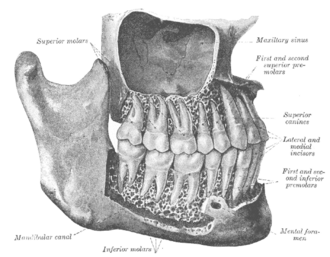
A Judgment tooth, or third mooring, is one of the three teeth Molare present in each of the four quadrants of human teeth. By occupying the last and therefore more internal position in the dental arc, the teeth of judgment are also called Eighth.[1]
There are therefore four in total: third lower molar, third upper molar, respectively on the right and left.
The word dente of judgment, present in countless languages (from Latin dens sapientiae), is due to the fact that they generally appear between the 16th and 25th years of age.[2] They can be even more than four or less, respectively in case of hyperdontia or hypodontia.
The scientific community, unlike what was affirmed in the past, agrees that the eruptive vis of the eighth would not cause a dense crowd.
Disorders and diseases
It often happens that a dente of judgment fails to appear, thus remaining included (when the dental germ is completely covered by the gum ) or semincluso...Explore this chapter
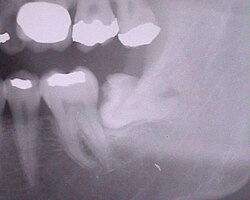
It often happens that a dente of judgement fails, thus remaining included (when the dental germ is completely covered by the gum) or seminclus (when it is partly visible). Failure to erupte (commonly called "growth") may be due to two factors:
- Given the conformation of jaw and jaw, it is possible that the tooth lacks place to erode (until).[3]
- The tooth growth axis is not properly oriented. In the most complicated cases, it may be that the tooth grows horizontally, possibly by pressing on the second molar.
A dente of the judgement that has grown imperfectly is likely to cause pathologies such as cyst, pericoronite, caries and abscess.[4]
The tooth of judgment in human evolution
The octaves, if they are properly eroded, can contribute to chewing and do not cause any disturbance as long as proper oral hygiene is applied. However, the fact that...Explore this chapter
The octaves, if they are properly eroded, can contribute to chewing and do not cause any disturbance as long as proper oral hygiene is applied. However, the fact that their growth is subject to variations and imperfections is also due to the evolutionary course of the human species: in the past man needed more molars to chew raw and ostic foods, which were abandoned during evolution while the dimensions of the jaw and jaw have clearly reduced, leaving little place available for normal development of the eighth tooth. The teeth of judgment are therefore a legacy of the past.[5] It is only with the age that the jaw and jaw should reach sufficient size to allow its development. However, according to some anthropologists, the appearance of octaves in late age would have the task to counterbalance the excessive wear of other teeth. Prehistoric nutrition and dental care in fact caused early teeth loss. In this way, the third molar, having sufficient space to develop, carried out a reserve function, preserving proper chewing.
Extraction
Extraction can be more or less complicated depending on the overall situation. For example, it is easier to extract from young people as the roots do not...Explore this chapter
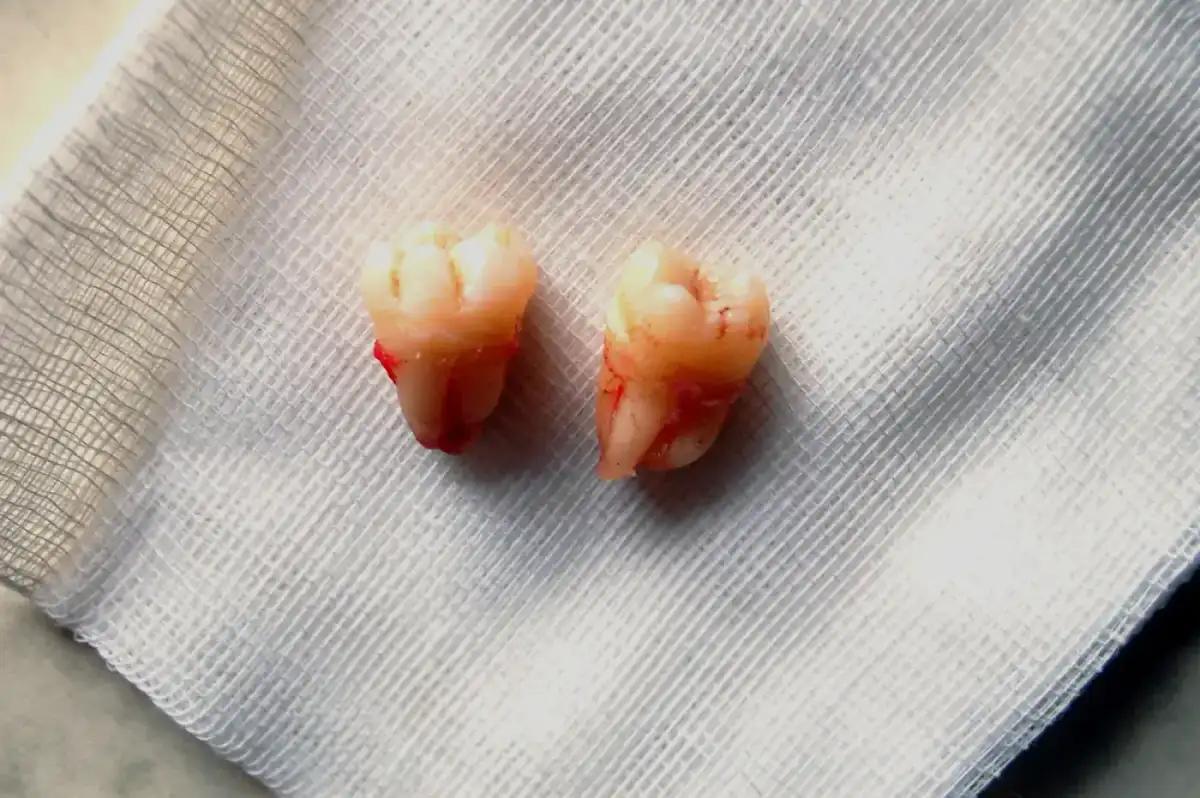
Extraction can be more or less complicated depending on the overall situation. For example, it is easier to extract from young people as the roots are not yet fully formed and the surrounding bone is softer; moreover, the tooth of higher judgment can be - at equal conditions - extracted more easily than the lower one. Depending on the case, it will be done with or without stitches, or with different types of anesthesia, in surgery or in clinic. The extraction of a completely outdated judgment tooth is the simplest case and usually does not require special attention apart from local anesthesia and the use of an appropriate analgesic. Even the extraction of a tooth of judgment included is often performed in local anesthesia.[6]
In general, therefore, we can talk about three main conditions for an extraction intervention concerning the tooth of judgment. Each condition requires techniques and approaches that can be different:
- Simple extraction: the tooth is extruded, i.e. it is visible in arcata without having to resort to x-rays or computerized tomography with beam. It can be extracted with pliers or using levers via EWF (Extraction Without Forceps) technique. Ortopantomography is always required to determine, especially at the lower arch, the possible proximity of dental roots to the mandibular nerve.
- In semi-inclusion: the tooth of judgement is partially covered by gum and/or bone, but it is seen in arch. Oral surgery serves to free the dentarian element and then can easily extract it from the alveolar site. Working with sonic handles in cases such as this allows a technique that uses vibrations to cut hard tissues, such as bone and teeth, respecting soft fabrics.
- Total bone inclusion (complete): the tooth is completely hidden inside the jaw or jaw. In this case, the disodontisis of the tooth of judgment is inevitably faced with a surgical approach. It is necessary to access the tooth hidden in the bone by removing part of it and then exposing and then extracting the dentarian element, often after splitting it into smaller parts. Sonic surgery allows to protect soft tissues especially in cases of this kind.
The course after a routine intervention is generally quick. Inflators and blood loss are possible for several hours after surgery. If the loss is moderate, it is to be considered normal during the first day after extraction.[7] In these cases the patient can bite on a gauze or on a fabric handkerchief. Paper tissues or ovats are to be considered as emergency solutions because they risk leaving traces that stick to the wound and which can cause its reopening when removed. It is also advantageous to slightly moisten the gauze or the handkerchief. In case of difficulty, to facilitate the healing of the wound we often recommend ice packs, while hot foods, cigarettes, coffee and alcohol are not recommended, as well as energetic rinses or too numerous or anti-aggregating drugs such as aspirin.[8]
The extraction of a judgment tooth made for purely precautionary purposes (anywhere in the absence of symptoms) is a custom that varies from country to country, and whose need is not fully supported by scientific studies.[9][10][11]
Although rare (0,005% of the total) the extraction of the third molar can involve, at a distance of two or three weeks, the fracture composed of the mandibular angle, due to the excessive and early load of the area operated during chewing.[12]
Notes
Explore this chapter
- ^ Marco Rossi, DENTS OF JUDICIAL extraction included, surgery of the third INCLUDED molar, up odontoclinic.it. Retrieved 4 February 2008 (archived fromoriginal url on 5 May 2012).
- ^ Wisdom Teeth, up aaoms.org. Retrieved 6 September 2013 (archived fromoriginal url on 7 September 2013).
- ^ Schulte, up dr-schulte.ch. Retrieved 4 February 2008 (archived fromoriginal url on 17 January 2008).
- ^ Humanitarianism, up humantoba.ca (archived fromoriginal url on 11 May 2000).
- ^ the teeth of judgment and their origin, up toothaposto.it. Retrieved 4 September 2014 (archived fromoriginal url on 5 September 2014).
- ^ Maxilfac, Judgment tooth included - surgical procedure, 19 August 2007. Retrieved 31 May 2025.
- ^ Candle, up candreva.it. Retrieved 4 February 2008 (archived fromoriginal url on 19 February 2008).
- ^ Post-operative instructions, up oralmax.it (archived fromoriginal url on 25 October 2008).
- ^ Jay W. Friedman, The Prophylactic Extraction of Third Molars: A Public Health Hazard, in American Journal of Public Health, vol. 97, no. 9, 2007-9, pp. 1554-1559, DOI:10.2105/AJPH.2006.100271. Retrieved 13 October 2019.
- ^ 1 Guidance | Guidance on the Extraction of Wisdom Teeth | Guidance | NICE, up www.nice.org. Retrieved 13 October 2019.
- ^ (EN) Surgical removal versus retention for the management of asymptomatic disease-free impacted wisdom teeth, up www.cochrane.org. Retrieved 31 May 2025.
- ^ Thomas Cutilli, Theodora Bourelaki and Second Scarsella, Pathological (late) fractures of the mandibular angle after lower third molar removal: a case series, in Journal of Medical Case Reports, vol. 7, 30 April 2013, pp. 121, DOI:10.1186/1752-1947-7-121. Retrieved 31 May 2025.
Continue your journey