A closer look
Oscar Wilde: at a glance
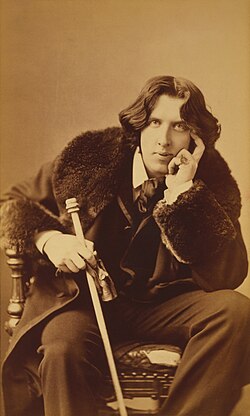
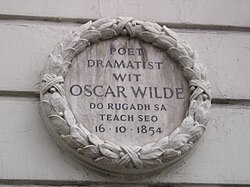
Oscar Fingal O'Flahertie Wills Wilde[1][N 1] (Dublin, 16 October 1854 – Paris, 30 November 1900) was an Irish writer as well as playwright, journalist, essayist, and literary critic of the Victorian age, an exponent of decadentism and British aestheticism.
Author from the seemingly simple and spontaneous writing, but substantially very refined and prone in search of ♪ (of the witty "joke"), with a sometimes scathing and impertinent style he wanted to awaken the attention of his readers and invite them to reflect.[N 2] It is known above all for the frequent use of aphorisms and paradoxes, for which it is still often mentioned.[N 3]
Born from the Irish family, then moved to England, the most remarkable episode of his life, of which there is ample trace in the chronicles of time,[N 4] was the trial and sentence to two years of forced labor for «big public indecency», as was defined homosexuality by the criminal law that codified the rules, even moral ones, concerning sexuality.[2] Wilde, already married, also lost the chance to see the two children. He had to leave Britain for continental Europe; he died in France for meningoencephalitis, after having converted to the point of death to the Catholic religion, to which he felt closer.
His works, including – in particular – his theatrical texts, are considered by critics of the masterpieces of the nineteenth century theatre.[3][N 5]
Biography
Origins and relationship with parents · Childhood · StudiesExplore this chapter
Origins and relationship with parents
Oscar was the son of two remarkable characters, both part of the so-called Protestant Ascendancy Anglo-Irish: his father, Sir William, was a famous Irish ophthalmologist, founder of a hospital in Dublin (St Mark)[4] and author of several medical treaties considered valid for a long time.[N 6] Among his patients, since 1863, he was able to count King Oscar I of Sweden and Queen Victoria of England, of which he became a personal ophthalmologist. Sir William also wrote books of archaeology and folklore.[N 7]
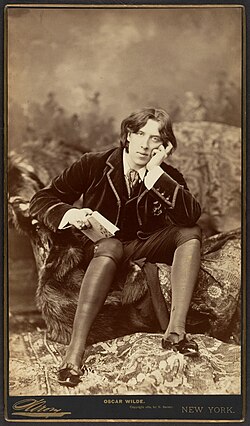
The passion for women dissolved his reputation as a doctor and scientist: he was accused of rape at the expense of a 19-year-old girl, Mary Travers.[N 8] The process that followed, almost a pre-announcement of what later suffered his son Oscar, who at the time of the events was eight years old, settled with a conviction to compensation for damages for a sum of £2,000 (of the time).[5]
The mother, Jane Francesca Elgee, was an Irish poet of English origins and byronian inspiration, known under the pseudonym of "Speranza" (in Italian), which derived from her motto "Phidancy, hope, constancy". The poetess claimed to descend from a noble Tuscan family, which was unlikely[6][N 9]. Just like her son, his mother tended to hide her true age, but it was obtained from her application for funding from the Royal Literary Fund in 1888.
The woman, with a rebel character, supported the cause of Irish irredentism, while her passion for confrontation and literary criticism led to the establishment of a cultural living room in Dublin and later also one in London.[7] She was a skilled conversator and her receptions were important events for the dublinese society.
Oscar Wilde had little in common with his father, much instead of his mother, who resembled appearance, voice, eccentricity and passion for literature. From her mother she had inherited also small wells, as the habit of hiding her true age.[N 10] On the occasion of his birthdays he was usually joking and dressing in scales, claiming to feel mourned for the death of another of his years.[8] Oscar had in common with his father the oratory skill[N 11] and the poor consideration for public opinion.
When the father wrote a book, Lough Corrib, which narrated the thorny events of the trial he underwent,[9] Oscar boasted that he inherited a famous name from his father.[10] The mother, who had hoped for the birth of a female,[11][12] later expressed several times the desire to see the unexpected male son pursue a career as a parliamentary.[13]
The couple had three children: the eldest, William Robert Kingsbury Wills Wilde (born September 26, 1852), the second-born Oscar, whose full name was Oscar Fingal O'Flahertie Wills Wilde, and the minor, Isola Francesca Emily Wilde (born April 2, 1857). In the choice of the name for Oscar and his brothers his mother wanted to refer to various elements:[N 12]
- Oscar, according to Irish mythology, was the name of Oisin's son (the Ossian of the Poems) born in the land of eternal youth, from which I wish to remain always young;
- Kingsbury, in homage to the mother's family;
- O'Flahertie, from the ancient kinship of the paternal grandmother.
It is also probable that the name is a tribute to his father's illustrious patient, King Oscar I. Wilde also had a half-brother and two half-sisters, illegitimate children of whom two recognized, born from his father's extramarital relations: Henry Wilson, Emily Wilde and Mary Wilde.
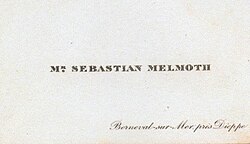
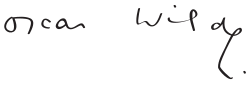
Oscar often changed his signature and the way he called himself; at university, for example, he chose the name of Wills Wilde.[14]
Exit of prison will adopt the name Sebastian Melmoth, protagonist of the novel Melmoth the Wanderer, written by his maternal great-uncle Charles Robert Maturin, while the name derives from the well-known legend of Saint Sebastian as a homosexual icon.[15][16][17][18]
To those who claimed that the Irish surname preceded by "Mac" was more important than that with "O'", Oscar said that among families of noble origins there were also "O' Wilde".[19]
During his life he also used other signatures:
- O.FO.F.W.W., on the occasion of collaborations with the magazine Kottabos (during the college years);
- C.3.3., signature invented during captivity;[N 13]
- St. Oscar of Oxford, elaborated just before death.[20]
He didn't like anyone to point out that his name was actually just Oscar Wilde.[21] Or, worse still, just Oscar.[N 14] Later it was also called "Grey Crow" (grey crow).[22] His wife Constance loved to call him Oscàr, French.
Childhood
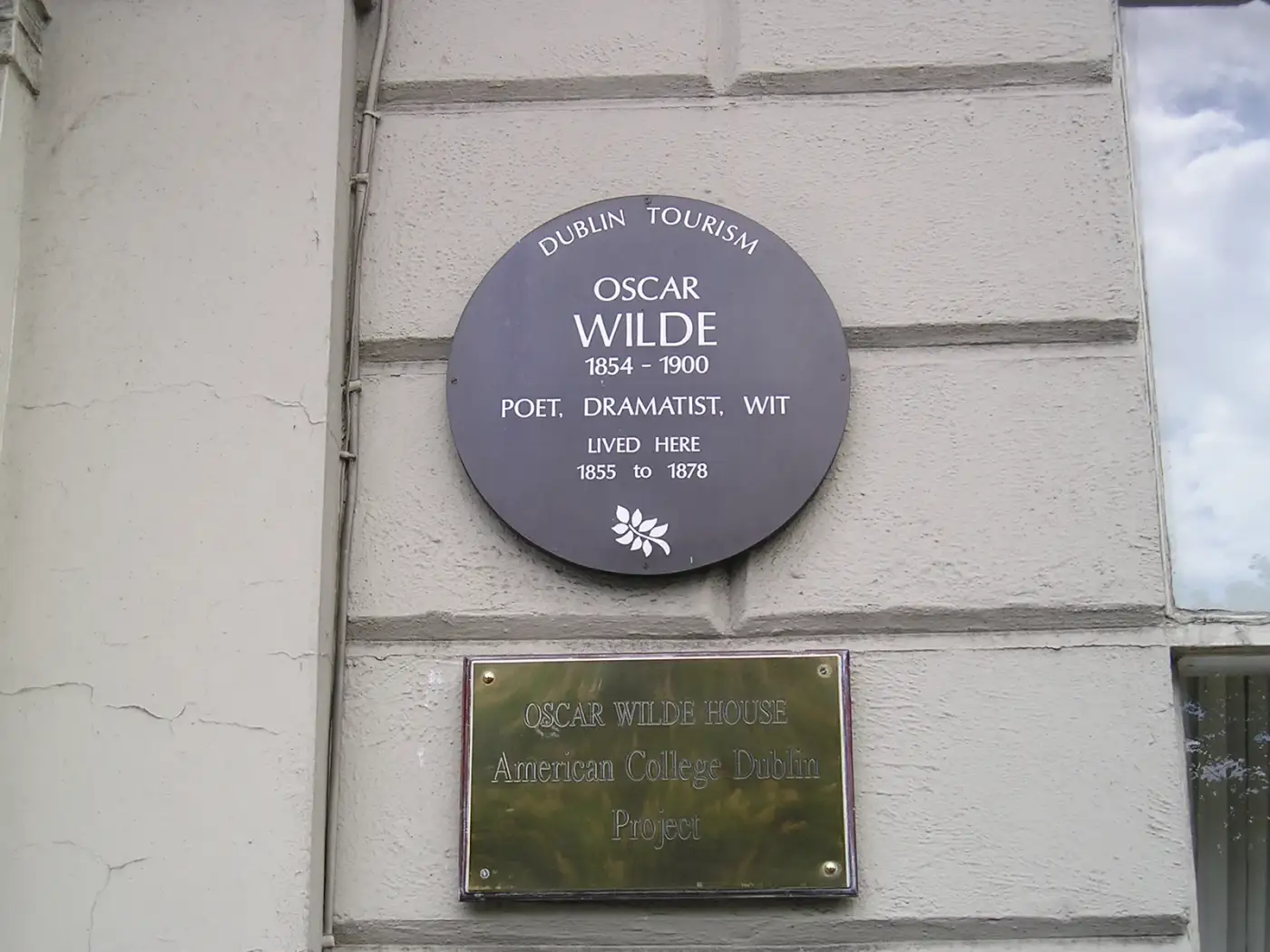
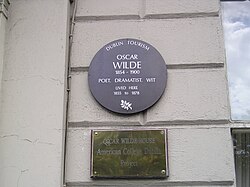
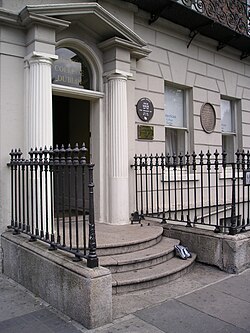
Oscar was born on 16 October 1854 in Dublin, Ireland (at the time United Kingdom constitutive nation), in a house of modest conditions at number 21 Westland Row[23], in a period of temporary poverty for the family, who shortly afterwards had the opportunity to move to a richer house, in the Dublin neighborhood of Merrion Square, where he declared that he was born there; he was baptized on 1 April 1855: for the occasion his mother asked Sir William Rowan Hamilton, who refused, to be his godfather. Of his baptism, perhaps a source of inspiration for the work The Importance of Being Earnest, and of his first years of encounter with the Catholic faith, Oscar himself later admitted that he had no memory.[24] Few are the certain news of his early years of life: once playing with his brother he broke an arm[25] and another time he fled home; it is also known that he liked to fish.[26]
Among the youthful friendships is that with Edward Carson, whom Oscar met in summer on Dungarvan's beaches, and which later became famous for being the one to whom he attributes the division of the kingdom of Ireland.[N 15]
An example of the character of Wilde Child is found in the following anecdote: together with his brother had been entrusted to a nanny. During the momentary absence of the latter, the clothes and clothing of children, who were in front of the fireplace to dry up, caught fire. In front of this episode he applauded amused, while his brother screamed scared. After the woman had turned off the flames, Oscar cried because the interesting show was over.[27]
Studies
Oscar Wilde was educated in the home walls until the age of nine; later, from 1864 to 1871, he studied at Portora Royal School in Enniskillen (Contea di Fermanagh), following the footsteps of his older brother.[28] From 1871 to 1874[29] He attended Trinity College in Dublin where, for his praiseworthy studies on Greek lyrics[30] (he boasted at length about the examination on "Meineke's Fragments of the Greek Comic Poets"[31]) won the Berkeley Gold Medal, the school's most prestigious award. In 1873, for the profit obtained, he obtained a scholarship, managing to win another in 1874 for attending lessons in classics which he was able to follow at Magdalen College in Oxford. The years spent at Oxford University, where he passionately studied the Greek classics, were later compared by Wilde to a flower compared to the rest of his life.[32] During his studies in Oxford he was started at Masonry in Apollo University Lodge, in which he became a Master Mason and from which he was later excluded for failure to pay the annual membership fees.[33][34]
Travels
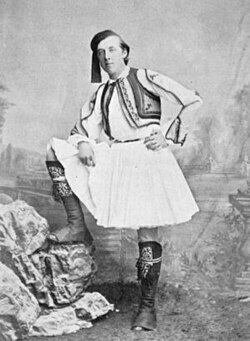
During the period of university studies, in the summer of 1875, he considered it important that he did not miss his cultural formation knowledge of the places of art and classical Italian culture. He traveled to Italy with William Goulding and Reverend John Pentland Mahaffy, his guardian in past years, famous for his conservative thought[30] that will not always share the ideas of Wilde[35]. Due to his excessive expenses, he was unable to visit all the cities he had promised and had to return to the university where, during his theology exam, he infuriated the Reverend William Archibald Spooner, who was already annoyed by his tardiness, with his contemptuous words.[N 16]
In 1876 the father died[28]. In those same years (1876-1879) Oscar managed to publish seven lyrics and thirteen poems. The following year, in the spring holidays, he again set off for Italy in the company of his old friends, who were joined by George Macmillan.
After another adventurous journey to Greece, he finally arrived in Rome, where he was received by Pope Pius IX to whom Wilde dedicated a sonnet. He also paid tribute to the tomb of John Keats, his favorite poet, at the Acattolic cemetery; I saw the grassy mantle on which his grave rested he kneeled with immense devotion. From this encounter of related souls - also Wilde, like Keats, was animated by a deep cult of beauty - the sonnet was born The Grave of Keats (1881).[36]
Because of the long holiday he was once again late in college, so he was suspended from his studies; he forbade his residence in campus for the remaining quarter period, and he was even deprived of all benefits.
Wilde at that time was considered in poverty conditions which attributed to the impossibility of a marriage with Florence Balcombe, who would solve his economic problems. In fact, his difficulties depended on the excessively expensive living standards. He then sought comfort and resources with his mother who refused to help him, claiming that for the inheritance he received could live in peace for several years.[37] He had to show up at the court twice to pay for debt.[N 17] On 13 June 1877 Henry Wilson died, his half-brother from whom Oscar expected a large inheritance, but was disappointed: he had the sum of £100 (about 9000 today) and the part of Illaunroe's home (the two were captive), but only provided that for at least 5 years he did not convert to Catholicism.[38]
The relationship with Walter Pater
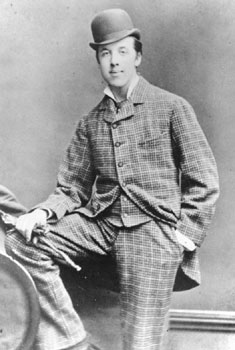
In that period Oscar wrote for Dublin University not without having some small screzies with the director, Keningale Cook.[39] He sent a copy of the article published to Walter Pater who wanted to know it. Afterwards, when Wilde continued the exchange of letters by inserting sonnets, Pater asked him to try in the prose, which he thought was much more difficult task.[40]
During the first encounters between the two, Oscar's behavior caused his friend Bodley to worry that Hardinge, his acquaintance, received letters from Pater who thus suspected a possible love relationship between the two.[41] Pater's behaviors were already known, who loved to surround themselves with young girls of female appearance.[N 18] Oscar will think that he was afraid of bad fame and said that[42] He used to speak so low that more than listening to him, he had to be eavesdropped.[43] Oscar, however, always showed him reverence by calling him in the letters "great master".[44]
The end of the university
In June 1878 Oscar presented himself for the Final Schools, where he turned in the assignment half an hour before the allotted time expired.[45] The commission, composed by the official speaker, the professor of poetry and three other members of the congregation, on June 11 declared winner Oscar Wilde who had still the examination of theology to be passed, then supported with good result in November. In Oxford, he won for poetry Ravenna even theOxford Newdigate Prize, a prestigious award already awarded to eminent men of letters such as Ruskin and Matthew Arnold. Following this success, his initials were written in gold letters on the school noticeboard, which were canceled after the trial and conviction. Only much later were they inserted again.[46]
After studies
Looking for a scholarship
Copy the diploma Bachelor of Arts, Wilde returned from Oxford to London where he began looking for further economic support. He applied to Trinity for a fellowship (scholarship) but during the written test Oscar noticed that the questions were asked incorrectly. Perhaps it was also because of these protests that he was rejected.[N 19]
Wilde didn't want to look for a heiress to marry, as his mother suggested, which instead her brother tried to do in vain. Willie was too frantic: she wanted to get engaged with a wealthy heiress only a few hours after she met her and also asked her to keep the tightest reservoir. The unconvinced woman of her love naturally refused.[47] Wilde was studying archaeology and looking for a scholarship.[48]
Helped by Frank Benson managed to stage the theatrical performance ofAgamemnon by Eschilo on 3 June 1880. He said he had been of great help for representation, widening advice and instructions. This version does not match Benson's comments.[N 20] On September 4, 1879 Wilde, anonymity, wrote for theAthena. a series of articles reviews of voices ofBritish Encyclopedia, with the collaboration of Richard Claverhouse Jebb with whom Wilde did not agree on many points.[N 21]
Oscar continued to amaze people with his extravaganzas: once actress Louise Jopling met him with a snake twisted at his neck.[49] He was able to respond to every offense he turned to, as the time when a viewer acted in an offensive way: these Wildes answered serenely: "It is incredible how it is easy to get acquainted with in London."[50] Of course, Oscar was pleased to be known by affirming, with false modesty, how easy it was to become.[51]
The house
Wilde decided to sell Bray's houses by making 2,800 pounds and hoping for the same fortune as Shakespeare who lived in London had acquired that fame he had not previously,[53] He was able to find a house at number 13 of Salisbury Street in early 1879, to be inhabited with his friend Frank Miles.
The house, which was transgressed, old and dark, in the eyes of Oscar had a romantic atmosphere and called it the "Casa del Tamigi", for the river that could be seen overlooking its windows.[52] The building consisted of three floors, Oscar was assigned the second and set up his books to the first. He decorated the part inhabited by him of lilies, Chinese porcelains and white panels. They also exhibited statuettes of Tanagra, Greek carpets, a painting by Edward Poynter that portrayed Lillie Langtry and expensive furniture.[N 22] Wilde changed his life and lived in Tite Street and Chelsea.
First Works and Travels
After spending some time with his mother, Wilde found a new residence on the third floor of Charles Street, which was near Grosvenor Square. Since the mid-1980s, he became a regular contributor to the Pall Mall Gazette managing as an anonymous author a column title The Poet's Corner, for reviews of new poetry books just published.[54]
On May 7, 1879, his brother Willie and his mother reached him in London, living at 146 Oakley Street (Chelsea). Lady Wilde opened a cultural living room that became so well known to attract the attention of the Prince of Wales who said "I don't know Mr. Wilde, and not knowing Mr. Wilde means not being known".[55]
In 1881, on the occasion of publication of the volume entitled Poem (Poems), Wilde, who had sent a copy to the Oxford Union library, was embittered by the review by Oliver Elton and Henry Newbolt who accused him of immorality, inconsistency and plagiarism, so much so that his book was rejected by the library[56] The accusations of immorality became more frequent: the father of his friend Frank Miles, who cohabited with Oscar, unleashed his son to break their relationship.[N 23]
Meanwhile, Oscar's fame came to the USA where a theater manager, Richard D'Oyly Carte, proposed Wilde a round of conferences in the US, with the intention of showing up close to the audience those extremists who roamed around Europe.[N 24] The stay was marked by bugs and inconveniences until Oscar risked to end up in prison, so that when he decided to return to Europe the newspapers defined his American adventure a failure.[57]
Marriage
Oscar Wilde's thought about women betrayed in love expressed him on the occasion of his walk along Sherard's way to Paris. He had noticed how in France they had what he considered a bad habit, that is, to love too much women: this inevitably led to betrayal with other women who, those, loved strongly the same way. In England this did not happen, because the English did not love women too much.[58]
His comment was on an anecdote concerning his friend Ernest La Jeunesse: in order to eliminate any doubt about his hypothetical impotence he had seduced the wife of him who had offended him. "The greatest answer to history," Wilde said.[59].
Wilde decided to stay in France, Paris, where he settled with the help of Robert Harborough Sherard.[N 25] He and Wilde met almost every day greeting each other with kisses on the lips, which he helped gossip about them.[60] In Paris he devoted himself to work, even if he loved to joke about it with Sherard: in fact once he said that for a whole morning he had only managed to lift a comma from his poetry and that in the afternoon he had put it back.[61]
Oscar decided to change his way of presenting himself and adopted a new hairstyle that imitated that of Roman emperors: very short hair with small curls. For his new haircut, as a model he brought from the barber a bust maybe of Nerone, or perhaps of Antinous.[62] But there was no lack of evil in this regard. Some suggested that her hair had become curly like her teeth.[63]
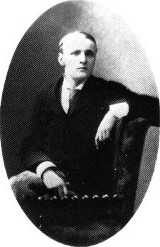
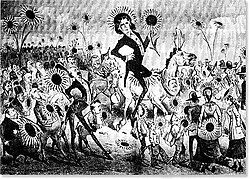
Returning to London, Wilde was very pleased that no one ever recognized him and that everyone agreed that he now showed fewer years than he really had.[N 26] He had so changed to the point that he was victim of a new satire Punch who pretended to sell sunflowers, lilies, old feathers and wigs, in short all the old features of Wilde.[64] Wilde began to plan to get married both to escape the moralists, and to save himself from wear.
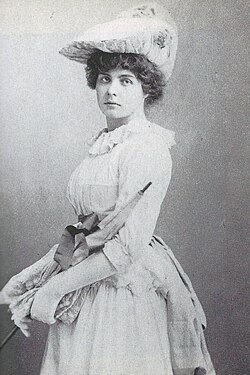
In May 1881 he accompanied his mother to their friends' house and here he met Constance Lloyd, a five-year-old girl younger than him, who owned an income of about £1,000 per year.[65] The young man was able to read Dante in Italian at the point of impressing Oscar so much, that as soon as he went out of the house he told his mother that she thought she would marry her.[N 27] Of their first meeting on 6 June 1881, he spoke with both the grandfather[66] both with his brother, stating that he liked his naturalness and the fact that, in dialogue, he gave the impression of being a cultural level higher than the average.[67]
To resurrect economically, waiting for the first American of Vera, he accepted a small lecture tour which began in London where he recounted, among other things, his American trip. He told how in the beginning, in Texas, they called him captain and in the end, in Mexico, general,[68] and that he felt offended only when he was called professor. Aspro was a three-column article Labouchere, which announced Wilde's decline;[69] He replied, saying that if there was no difference between fame and oblivion to announce failure.[70]
On August 2, 1883, to witness the representation of his tragedy, Wilde traveled to the United States for a short time on a journey where he was laughed at and with him.[71] Back in Europe resumed his lecture tour. During his two meetings in Dublin he met Constance again, with whom he trusted on 25 November.[72] After some dissides with her relatives and greeting letters from her conjuncts,[N 28] He had a lot of trouble to settle debts by not succeeding us in time neither for marriage nor to surrender the house.[N 29]
Conjugal life
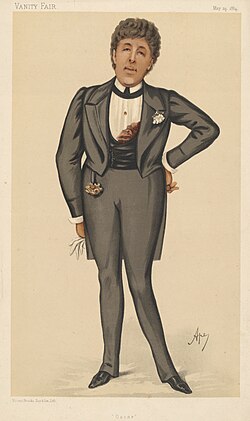
For Oscar Wilde the number one enemy of clothing was fashion, "a thing so bad that you had to change every 6 months".[73] Of his clothing that some felt absolutely crazy,[74] Wilde appreciated practicality. He tried to do himself for the sake of comfort in things to wear but found no one who followed him.[75] He then held a successful conference tour, criticized by the press.
The wedding, scheduled for April, was then moved to 29 May 1884 and celebrated in the church of Saint James Paddington[76]. After the honeymoon he already seemed to regret having gotten married.[77] At that time, he lost his savings in a scribbled manner, so that the 50 pounds given by his aunt for marriage were spent buying two tablespoons.[78]
As for the affinity of couple, the beginning was promising: Oscar complained jokingly that even if his wife was so beautiful he could not be jealous of it. Recognized on the street were called Hamlet and Ofelia.[79] The two newlyweds had difficulty in housing, as the house was not ready for time.
Wilde fought with the first construction company (Green), to which he did not want to pay any compensation;[80] thanks then to Godwin's help - the wife's rents were not enough to pay all the great expenses -[81] and the builder Sharpe, he finally managed to have a fixed accommodation at number 16 of Tite Street on January 1, 1885.[82]
The Wilde spouses, however, had to pay for the old builders before they were able to enter. The house consisted of 4 floors, not to mention the basement where the kitchen was. In the lobby two engravings could be admired: Diana and her nymphs in the bathroom And Apollo and the Muses; in the dining room a Morris carpet of green-blue color covered part of the floor, in the library there were an armchair and an oriental table, but lacked chairs. On the first floor there were two bedrooms, that of Oscar became then the children's room.[N 30] Wilde said he chose to live in the East End because, to hear him, people didn't wear masks there, it was sincere.[83]
His wife took every board of Oscars even in the way of dressing, sometimes with a positive outcome.[84] Wilde was looking for work, as the last lectures had not resulted in the hoped-for effect, but it was denied the place of school inspector. Meanwhile, Constance, who had been pregnant, disgusted Oscar because of the frequent nausees and inflated body.[85]
The first son, Cyril, was born on 5 June 1885 and, after a year and a half, the second-born Vyvyan, on 5 November 1886[86] (who by mistake was declared born on November 3).[87] After the birth of their children, Constance and Oscar began to be no longer a happy couple. She took him back for every mistake and exposed his lies,[88] Wilde, for his part, showed fatherly love for the children, but did not cease to attend men including Henry Marillier.
The meeting with Robert Ross
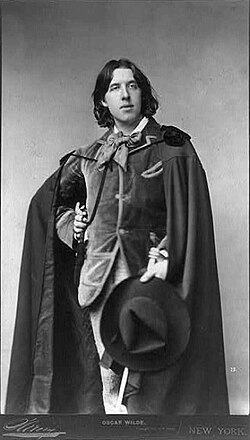
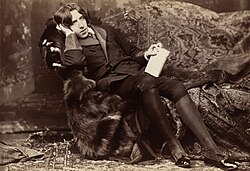
In 1886, Wilde met Robert Ross, who had just turned 17 and that for revealing to his family his homosexuality had to leave his home.[89] Oscar called the young San Roberto of Phillmore,[90] for his ability to fascinate people by inducing them into temptation,[91] as it had happened to him.[92]
Robert, after reciting Wilde's poems, on the incitement of Arthur Tilley himself, on March 8, 1889, was beaten and thrown into a fountain by some classmates, who later repented for having so caused him a pneumonia.[93] and a brain congestion.[N 31]
Ross was not the only lover of Wilde: man also frequented André Raffalovich at the same time as the scandal that had involved Lord Arthur Somerset in several sexually background episodes, which cost him exile from England.[N 32] The intimate relationship between the two soon ended up being replaced by that with other boys that Wilde invited to his home as the 17-year-old Richard Le Gallienne and Bernard Berenson, who however refused any relationship with the writer.
The Woman's World magazine
Meanwhile, feeling neglected, Constance tried to acquire notoriety by speaking at feminist meetings.[94] Thomas Wemyss Reid, Director of the Leeds Mercury in February 1887, he believed that Wilde, thanks to his talent in reviewing new books, would be of great help for a new journalistic magazine.
In Reid's magazine, The Lady's World: A Magazine of Fashion and Society, feminism was discussed and, when asked for an opinion, Wilde expressed it, positively impacting the editor who hired him.[95] On 18 May 1887, Oscar began his collaboration with a salary of £6 per week.[N 33] Wilde did not hesitate to ask Queen Victoria for a collaboration in the magazine with the publication of one of her poems, but she refused to say that she had never written. Exhorted by Mrs. Dinah Craik[96] Wilde, having been able to count on Arthur Fish's help, proposed and obtained after some discussion that the magazine's name changed in "The Woman's World" in November 1887.[97] At first it was punctual in carrying out his work, which began at 11 am, but he had taken the habit of leaving always before the time fixed to the point of going to work twice a week for only one hour,[N 34] probably because, since there was a ban on smoking in the offices, he could not abstain for a long time. In 1889, now bored with his work, he left the post.
The meetings
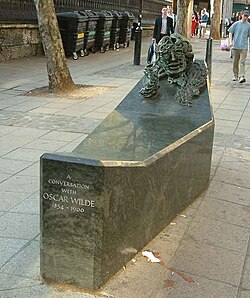
Wilde had numerous encounters with men who were interested in her:
- at Edward Burne-Jones's home he met then seventeen Aubrey Beardsley (on July 2, 1891).[98] Wilde later claimed that he had invented him;
- John Gray, a young man, as Bernard Shaw called it, among the most "dresses" among those of whom Wilde surrounded himself.[99]
Of humble origins, the father was a carpenter, Gray left school at age 13.
It is not sure the date when he met Wilde as they both then lie on their meeting, which occurred at least in 1889. The evidence they have of their first relationships is a dinner that was witnessed by Frank Liebich.[100]
- Lionel Johnson, who met on the occasion of his return to Oxford in February 1890, for the staging of Browing's Strafford. Oscar later described to his friend that meeting, telling him that Johnson had smoked all his cigarettes and confessing to him that he was in love with him.[101]
- John Barlas, who in the past threatened to blow up Parliament and who, arrested, had been released through Wilde. Barlas thought he was a character in the Bible. Wilde had compassion, because he said that the Bible was a cause of evil for humanity.[102]
- Max Beerbohm, who apostrophes Wilde as "divine", and Oscar who for his part called him as the person who possessed "the eternal oldness". Beerbohm wrote in those years the work Happy Hypocrites who treated a man and his mask.[103] Wilde was very happy with this "delicious gift", as he called it in a letter to the same Beerbohm where he wrote: "The explicit and accepted tribute to Dorian Gray in your story makes me happy."[104] Beerbohm also wrote another work, Zuleika Dobson, which recalled those of Wilde.
- Ernest Dowson, poet and esthetist, heterosexual but who admired Wilde and signed himself Dorian in the letters he sent to him, in homage to The portrait of Dorian Gray.
The meeting with André Gide
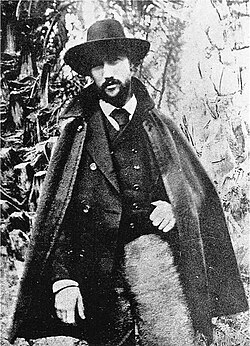
The 22-year-old André Gide met Wilde on November 26, 1891 and from that day the two began to attend daily. On the occasion of a dinner at Princess Olga Ouroussoff Gide said that Wilde "emanva una luce".[105] Among the two there was no love affair, although some suspected.
Gide compared Wilde to the character of Ménalque, with whom he described a relationship that went beyond friendship but was not love. Oscar, for his part, said that he loved Gide not for his beauty but because, as in the myth of the god Rijeka and Narciso, every time he could see himself reflected in his eyes.[106]
The meeting with James McNeill Whistler
Worthy of note was the swinging relationship between Wilde and James McNeill Whistler, where two strong personalities were opposed.[107]
Other works
In 1888 Wilde published The happy prince and other stories, a collection of fairy tales written for his two sons Cyril and Vyvyan.
In 1890 it was published The portrait of Dorian Gray. His mother liked the work very much,[108] but little to the audience of readers, so much so that Constance claimed that for that book no one wanted to attend them anymore.[109] Lionel Johnson wrote a poem in Latin to celebrate The portrait of Dorian Gray that his friend, his cousin, had read at least 9 times (perhaps 14) and insisted on meeting Wilde. Lionel agreed to accompany him: it was the first meeting between Oscar and Alfred Lord Douglas.
Return to France
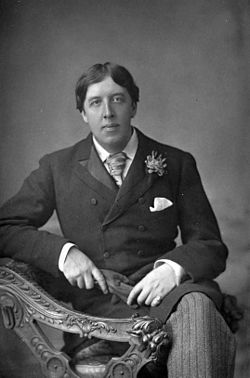
Oscar Wilde returned to Paris, forming "the great event of the literary salons of Paris" as he wroteEcho de Paris. He met Émile Zola on 11 March 1891 in Paris, and appreciated his almost obsessive search for the documentation necessary to write a good work,[110] while he asserted that it was a struggle that he would never do.[111] During these stays he consolidated relations with many local intellectuals, who were usually entertaining with anecdotes, stories and paradoxes expressing himself directly in French. He was able to speak only for Apollos, as he himself had repeatedly confessed to André Gide himself, and probably his most beautiful production remained only in the memory of those who had the fortune to listen to him. Several studio philosophies agree in believing Wilde much brighter as a conversator than as a writer.[112][N 35]
She also wanted to know Marcel Proust, but she only managed to see him escaping and eventually her only comment on the great author concerned the ugliness of his house.[N 36] In a dinner meeting with Jean Moréas and his disciples, Wilde asked the poet several times to recite some verses, but that, praised continuously by his admirers, refused every time. This behavior inspired Oscar who left angry.
When Wilde had the opportunity to invite Moréas and his companions, he was speaking all the time, so much so that Moréas called him a puzzler, while Wilde, in turn, asked himself ironically whether the poet had ever existed or if it were just a myth.[113] Oscar also met on February 24, 1891 Stéphane Mallarmé, who never appeared to the public. Mallarmé was a friend of Whistler's, who wrote him wrongly about Wilde.[114]
According to Wilde, when Mallarmé was able to be incomprehensible he was perfect, for this reason he had to write only in French and not in English, a language that understood well.[115] Oscar was not always welcomed friendly, as for example it happened with the translator of the works of Wilde Marcel Schwob, who described him as an avid consumer of opposite Egyptian cigarettes.[116] and of wormwood.[N 37] Oscar metaphorically compared him to a murderer and harassment of innocent women.[117]
Return to London
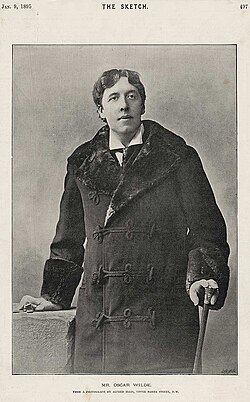
On December 22, 1891, Wilde returned to London to meet his brother who had contracted marriage in New York with a wealthy fifty-five years (he was almost 20 years younger) only for money.[118] Willie, after a quarrel, reconciled with his wife and returned to America where he began to speak ill of his brother: the two never spoke again.
To the first of ♪ Oscar had the idea that he and some of his friends had to adorn their dress with a green clove, almost to evoke membership in a secret sect, even though that flower did not mean anything, but the important thing was to make him believe.[119] It was then the time of the drama Salome,[N 38] but it was difficult to make representations in the theatres. Trying sorrow caused Wilde a worsening of health conditions. The doctors forced him to give up smoking, recommending him a ferreous diet.[120]
Wilde, at Blanche Roosevelt's house, had his hands read by a well-known esotericist of the time (tal Cheiro), who, without knowing who they were, said that Wilde's hands were like those of a king and that his right hand revealed that forty years he would collapse the world on him and that he would be exiled. As soon as you listen to these words, he left the house without saying a word.[121]
The relationship with Alfred Douglas
"I can resist everything except temptation."
(Oscar Wilde ne Lady Windermere's fan, translation by Alberto Rossatti[122])
The story of Wilde's relationship with Alfred Douglas differs depending on who tells it: he claimed that he was assillated by Wilde while the latter said that the initiative had been all about Alfred. Douglas came to Oscar's house in 1892 to ask for help because he was the subject of a blackmail. Oscar, thanks to his lawyer George Lewis, he solved everything.[N 39] The two began to attend and love each other, Oscar met Alfred's mother, Lady Bracknell, and made a character of it. The Importance of Being Earnest. In November 1892 Wilde noticed that Alfred, the young Domitian as he called him,[123] He spent without remorse much money that kept claiming from him almost to humiliate him.[124] Douglas made Wilde know the world of youth prostitution. In the fall of 1892, there was almost a competition between these boys. He had so much relationships with Alfred Taylor (son of an industrial), Sidney Mavor (future priest), Maurice Schwabe and Freddy Atkins, with whom he was like "to fight with the panthers"[125], Edward Shelley for a short time,[126] and Alfred Wood, seventeen years old, who blacked him out of 30 pounds.
Decadence and friends in pain
Since 1893, Wilde preferred to stay in the hotel to meet the young people of whom more than favours, who sometimes did not receive, sought the climate of ambiguity and unregulatedness. For his part, Douglas didn't care to hide. He came in from the main entrance, wanted everyone to know that he was Oscar's favorite guy.[127]
In May 1893 Wilde went to Oxford to meet Alfred and in the summer of that year the two stayed in a house at Goring-on-Thames, where Oscar met Theodore Wratislaw and blond Cyril.[128]
Many had been disappointed in the situation where Wilde was, which openly violated Criminal Law Amendment of 1885 (section 1, 1), an amendment that punished up to a maximum of two years of imprisonment men who practiced sexual acts among themselves.[N 40] Max Beerbohm wrote to Ross about how Oscar's soul was lost.[129] Even John Gray, favorite of Oscar before Douglas, now felt abandoned.[N 41] His friend Pierre Louÿs went to visit Wilde at the hotel together with Constance, who in tears prayed his husband to return home.[130] Wilde answered Pierre's questions saying that he had actually married three times in life, one with a woman and the other two with men.[131]
The fights, the removal and help towards the next
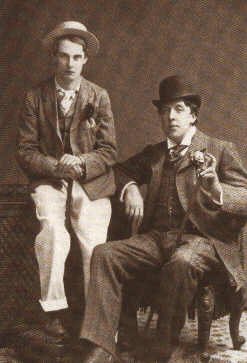
In this period there was the case of Philip Danney, the 16-year-old son of a colonel who was at the house of Robert Ross, who wrote to Douglas about the availability of the boy, who on Saturday slept with Douglas, on Sunday with Wilde and on Monday with a girl at Douglas' expense. When the young man returned to school without justification, it became known.[132] The father immediately turned to the police, but under counsel of the lawyer and given the boy's reticence to make Wilde's name he was convinced that it was better to let go, because even the son risked prison.[133] Ross then chose to go to Davos to escape the scandal that his family did not forgive him.[134] After a furious quarrel with Oscar, Douglas, as suggested by his mother, left at the time of Cairo,[135] While Wilde hid in Paris (he also gave a false address for security), regaining some serenity and applauding Paul Verlaine just out of prison.[136]
In 1894, Wilde visited his old mother who wanted Oscar to reappear with her brother.[137] In this period Wilde wrote Florentine Tragedy, The Saint courtisane (unfinished works) e The Cardinal of Avignon; he managed to finish An ideal husband.
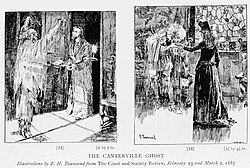
Another important work created at that time is The Canterville Ghost (The ghost of Canterville), published in February 1887, which features an American family who moves to England, where they deal with the spirit of an evil man who haunts their new home; the ghost would like to scare them at all costs, but he can't. Douglas's return then put an end to his desire to write.
In these days he helped the mother of Nelly Sickert, a widow of a man who had refused several times to meet him, to whom he had regained his smile.[138] There was evidence of a letter where an anonymous thanked Wilde for saving his house;[139] Edgar Saltus tells that he was approached by a half naked man to whom Wilde gave his coat.[140]
Gertrude Pearce, the instructor of Wilde's son, tells about the many ways Wilde helped her.[141]
Processes
The clamorous events that marked his life and saw him as a scandalous protagonist, for the public opinion of the well-thought-out compatriots, concerned the processes that Wilde had to endure, because of his homosexuality. He was tried and sentenced to the maximum penalty: two years in prison and forced labor. When the sentence was issued, Wilde was on the verge of fading.
Prison
Condemned very severely to the maximum of the penalty, Wilde, in a prison uniform, was transferred to Holloway Prison and from there to Pentonville where he had to take at least 3 months of the sentence before any contact with the outside was granted.[142] He worked six hours a day at a wheel mill. He slept without mattress, he knew hunger, insomnia and disease (dissenteria). The same seconds, while claiming that the prisoner was in perfect health, were worth seeing the conditions of the prisoner, who was 10 kilos thickened.[143]
She has remained famous in English literature De Profundis, a long letter that Oscar Wilde wrote in prison in 1897[144] (and which was published in 1905), after being put on trial, to her lover Alfred Douglas.[145]
Visits
Richard Burdon Haldane was a member of the prison investigation committee who visited Wilde on June 12, 1895.[146] On that occasion, Oscar asked and obtained 15 books from Haldane.[147]
On July 4, Oscar was transferred to Wandsworth, where he visited Constance's brother Otho Holland, warning him that Constance was thinking of proceeding to divorce him.[N 42] and that if he didn't want to lose the family, he had to do something. Wilde convinced himself to grant divorce as long as his wife went to live in America.[148]
On August 26, Oscar was visited by Robert Sherard, who although he had permission to bring a person with him found no one who wanted to accompany him. They were about to be made public by Douglas, other compromising letters. Sherard was instructed by Oscar to stop him, but Douglas threatened to kill him.[149]
On September 21, 1895, Wilde met Constance who, although he changed his surname to Holland, promised him that he would wait for him after the prison.[150] Both in London (from More Adey) and Paris, petitions were signed with little success that demanded a decrease in the penalty for Wilde. Émile Zola, Victorien Sardou and Jules Renard refused to join.[151]
The transfer to Reading Gaol
Free again
On 19 May 1897, he managed to avoid journalists, accompanied by Adey and Stewart Headlam, went home to them on a carriage. He decided to ask for asylum for months at the Jesuits of Farm Street who refused to welcome him.[154]
Wilde, although in contact with Douglas, wrote to his wife, still legally married to him, to reconcile, but Constance did not give up.[155] Others, like Fritz von Thaulow, were happy to spend time with him. Marquis Queensberry did not feel quiet and pawned Wilde who, once discovered to be observed, left the city for Berneval where many visited him: Lugné-Poe, Ernest Dowson, Charles Conder, Dalthousie Young, André Gide, Charles Wyndham, Fernand Xau and Leonard Smithers.
He boarded and crossed the Channel to never return, landing at Dieppe where Reggie Turner and Ross waited for him; in France he initially assumed the pseudonym of Sebastian Melmoth, already used previously. In Dieppe he also met Dowson who convinced him to attend a prostitute to restore his reputation, leaving him quite disappointed in the first relationship with a woman after 10 years.[156]
In Naples
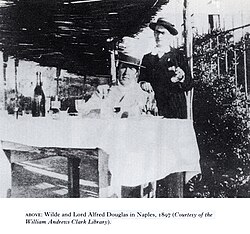
Meet again "Bosie" (Alfred Douglas) went with him to Naples staying at Villa del Giudice (via Posillipo 37)[157]. He saw Eleonora Duse and sent her a copy of the Salome, which the actress received with pleasure[158]. Wilde's arrival in Naples caused quite a stir, to the point that Matilde Serao wrote about it The Morning[159].
Constance learned about Wilde's renewed relationship with Douglas and wrote to convince him to leave his lover permanently, but Oscar replied that it was because of him if he had resumed the tenor of life.[160] Constance and Lady Douglas then used the blackmail of money because both Douglas and Wilde had no income but what they received from the two women. The two were so forced to live in two separate houses, then to leave permanently.[161] Oscar was able to receive £200 from his wife who, despite everything, continued to love him.[162]
To Capri
He arrived from Naples with Lord Alfred Douglas on October 15, 1897; the two lovers stayed in a room of the Grand Hotel Quisisana, but the presence of a remarkable English community forced them to leave the island; they did not find a hotel available to house them and were hosted by writer Axel Munthe in his villa (San Michele) for a few days. They returned to Naples and at the end of October 1897 Oscar Wilde went to Sicily, in Taormina.
To Taormina
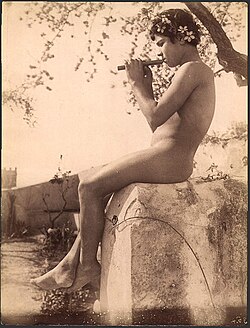
Oscar Wilde with the money received by Constance then went to Taormina to meet Baron Wilhelm von Gloeden, whose photographs he had seen at the Grafton Gallery in London and in the first issue of the magazine The Studio, in 1893, published by Charles Holmes; he had published his Salome with illustrations by Aubrey Beardsley and some "open air" photos of Sicilian boys photographed by the German Baron. In Taormina, a well-known gathering of Nordic homosexuals persecuted at home, Oscar Wilde met Robert Hawthorn Kitson, a wealthy British artist who had already known in London and whose famous residence of Taormina, Casa Cuseni, was an international intellectual dinner and today is the City Museum. Wilde and Kitson prepared some models and scenes for the photographic installation of von Gloeden, embellishing Sicilian boys such as fauns, satirs or deities and contributing to the birth of the archadic myth of Taormina, who had attracted in the previous decade already Friedrich Nietzsche. From Taormina Oscar Wilde wrote to Bosie: “I discovered here the paradise where we will live together.” On 13 February 1898 Oscar Wilde left Taormina to travel to Paris.[163]
Poverty
Unable to continue writing and always short of money, Wilde approached anyone who spoke English to procacciarsi da cibo.[N 43] He asked his translator Henry Davray for money and offered him a copy with dedication The Duchess of Malfi by Webster.[164] Frédéric Boutet saw him in July 1899 in the rain, in a bar that was about to close but Oscar didn't leave because he had no money to settle the bill.[165] Even when he returned to attend Douglas, the money was missing: once he took a public vehicle asking if anyone could pay his ticket. The present refused to help him and was obliged to come down and take a carriage, sure Alfred would pay the race.[166] He almost got robbed of a lyrical singer, Nellie Melba. Approaching her, she said, "I'm Oscar Wilde and I'm about to do something terrible. I'm about to ask her for money," the woman panicking gave him everything he had.[167] Another time, Ellen Terry saw him starving in front of a pastry shop, looking like for the hunger she felt biting her hands.[168] Reduced without front teeth and toothless, it was recognized by a few of his old friends, including Bodley and Emma Calvé,[169] to whom he said he had reduced in that way for the refusal of a monastery to which he had requested asylum.
The last years and death
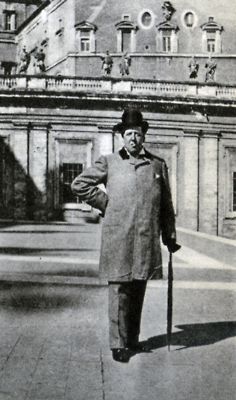
He left Douglas permanently and moved to Paris definitively since 1898, completed The Dance of Reading Gaol. The newly published work (the last real work of Wilde's career) proved to be a success, and Oscar sent numerous copies with dedications to his acquaintances: his wife also received one (but without dedication); the woman found the writing wonderful.[170] Constance died in Genoa, at the age of 39, on April 7, 1898, after a double surgical operation, first to the back and then for a uterine fibroid. The surgeon, Luigi Maria Bossi, attributed the death to operating complications that caused intestinal occlusion. According to recent studies, also conducted by the great-grandson of Wilde and Constance, Merlin Holland, the woman suffered from multiple sclerosis, a real cause of the complication that led her to premature death. According to Holland, neither Wilde nor Costance had syphilis, which was said at the time.[171] On the funeral monument to the monumental cemetery of Staglieno was affixed as an epitaph "moglie di Oscar Wilde", in English. It is said that Wilde had dreamed of her the day before her death saying, "Go away, leave me alone."[172] In May 1898, due to unknown causes, Wilde was operated on the throat.
In the capital, he became friends with some anti-dreyfusards, partisans in the Dreyfus affair of the guilt of the Jewish officer unjustly accused of treason in favour of Germany.[173][174][175][176] Between Wilde and Zola, in fact, there was mutual distrust: the French writer recalled the choking of Thérèse Raquin made by Wilde, who had appreciated Germinale, and Wilde had not forgotten that Zola had not signed the petition in his favor to have him released from prison in 1896.
In two years Beardsley died, on 16 March 1898 (she was twenty-five years old), Dowson, on 23 February 1900 at 32 years old (assisted by Sherard; both Douglas and Sherard will later become well known as anti-Semitic publicists) and his brother Willie, on 13 March 1899.
Wilde started traveling but only for vacation. After Beardsley's death, he reached his friend Frank who in December 1898 resided at the Hotel des Bains in La Napoule near Cannes. On that occasion, speaking to his friend, he said that while he was sunbathing about having met Balfour, Balfour himself boasted of having known Wilde.[177]
Travelling stopped in Genoa, in the cemetery of Staglieno, where they were buried at the foot of a hill the remains of Constance;[178] only later a writing was added that reminded of who the wife had been. For a short time he went to live from Mellor Gland in Switzerland, but tired of seeing himself rejected every loan request decided to leave almost immediately: he first went to Santa Margherita, where Ross saved him from the debts he had contracted, then to Paris at the hotel Marsollier, where he was obliged not to consume alcohol for six months.
Among the many trips that he still met in Fontainebleau the scientist Peter Chalmers Mitchell, who invited him to dinner, but Wilde refused to make him a bad figure, because he knew he was not well accepted.[179] He traveled back to Italy where he had the blessing of Pope Leo XIII six times in a short time and said that thanks to this he was healed his exantema.[180] Then in April 1900 he visited Palermo, where he stopped for 8 days to admire the beauties of the city, as reported also in his letters.[181]
In the last years of his life, Wilde, Catholic baptized as a child but educated as an Anglican Protestant, showed a significant rethink on his sexual choices and already in the famous De profundis, in a long letter to her ex-lover Alfred Douglas, she wrote: «Only in the mud did we meet» and, in a self-critical confession: «but above all I reproach myself for the complete ethical depravity to which I allowed you to drag me»[182]. Three weeks before his death, he told a correspondent of the Daily Chronicle: "Good part of my moral perversion is due to the fact that my father did not allow me to become Catholic. The artistic aspect of the Church and the fragrance of her teachings would heal me from my degeneration. I intend to welcome you as soon as possible»[183]. During his career they were often noticed, in fact, from the less salon chapters of the Dorian Gray until culminating in Reading Prison Ball full of pathos religious, a certain sympathy for the aesthetic side of the Latin Roman rite of the Catholic Church, dominant in Ireland.
In those days he met John Gray. Harris wrote in his place the work Mr. and Mrs. Daventry, the proceeds of which paid off Oscar's debts.
On 31 January 1900 Queensberry died leaving £20,000 to Alfred, who did not even give a penny to Wilde.[184] In those days, Wilde attended several literary cafés, where he met Anna de Brémont and said:
"I wrote when I didn't know my life. Now that I know the meaning of life, I have nothing to write. Life cannot be written: life can only be lived"
(Oscar Wilde in response to Anna de Brémont's question[185]. transl.: Alberto Rossatti[186])
Nevrastenia side or mussel poisoning, as Wilde himself claimed, suffered from a strong itching and had to continually scratch the various patches on the body. The doctor, who according to Ross calibrated in the correct diagnosis, visited him 68 times.[187]
He remained confined to bed since September 1900 and was operated for a paracentesis of the tympan (or perhaps for removals of polyps).[188] His health worsened quickly. At noon on 29 October he rose from the bed, after lunch he walked with Ross and at the bar drinking of wormwood.[189] The next day he attacked for an average otis due to neurosiphilis, a disease that had manifested many years before.[190] Morphine, opium and chlorinal were given to him to relieve pain, but he drank champagne every day, claiming that he was "love above his chances".[191] The old suppuration of the right ear returned; in November inflammation came to the brain causing a meningoencephalitis. According to some studies, the real cause of Wilde's mortal disease was not neurosiphilis, but a simple otis contracted in prison, degenerated into a more serious infection due to inappropriate care.[192] In the last days of November he lost the use of the word, according to a legend after having said a last ironic phrase: "O se va il this wallpaper or I'm leaving!"[193]
On 29 November Wilde, who could no longer speak, raising his hand twice in response made Ross understand that he wanted to see a Catholic priest to convert himself[194]. Robert Ross brought the Irish priest Cuthbert Dunne to him. Since Oscar was unable to speak, Ross asked him if he really wanted to see the priest, telling him to raise his hand to answer in the affirmative. Wilde picked her up. The priest asked him, in the same manner, if he wanted to convert, and Wilde raised his hand again. Then Father Dunne administered baptism to him, absolved him of his sins in articulo mortis and gave him the extreme anointing[195]. So he kept faith with his usual speech in which he stated: «Catholicism is the only religion worth dying for»[183].
The next day, on November 30, in a room at the Hôtel d'Alsace on Rue des Beaux-Arts 13, at the age of 46, after vomiting blood, Oscar Wilde died at 14:00.[196] According to Reginald Turner, who then denied this fact: "in the moment of death came out of the serum from every port."[197]
The funeral
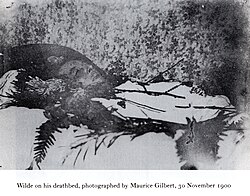
Dupoirier greeted the corpse, Father Dunne filled the coffin with catholic icons and Gilbert was taken a photo with flash. Four carriages followed the chariot. Wilde once said to André Gide:[198]
What remained of Wilde was first buried in the cemetery of Bagneaux. In the cemetery of Bagneaux, on his grave, surviving friends, who despite all that remained faithful even in the last very difficult years, had built a modest monument on which they had engraved the sentence (drawn from the book of Job): "In the dared to add to my words, and on them drip my speech a drop".[200]
From 1909 his remains rest at the cemetery of Père-Lachaise, under an imposing monument built by Jacob Epstein, depicting a sphinx, and with the epitaph from Reading Prison Ball (the verses are part of a heartfelt indictment against capital punishment, and refer to a man sentenced to death for uxoricide with whom Wilde befriended and then saw hanged in Reading). The transport was carried out by Mrs Carew, mother of Sir Coleridge Kennard.
Pity's long-broken urn,
For his mourners will be outcast men,
And outcasts always» mourn
«Unknown tears will fill
the urn of Pietà for him. He'll have it.
the laments of exiled men,
for exiles there is only crying."
(Epitaph of Oscar Wilde's grave, taken from Reading Prison Ballad trad.: Ettore Capriolo[201])
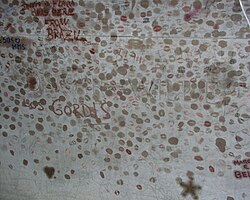
Dead Ross, the most faithful friend and former lover, his ashes were buried in the same tomb as Wilde. Over the years, numerous estimators of Oscar Wilde have succeeded in front of this monument leaving you, as a trace of their passage, prints of kisses[202] (tradition ended in 2011 when a glass barrier was erected to protect the sculpture from kisses[203]) .
The 14 February 1995 in London, a commemorative glass of Wilde was installed at Westminster Abbey, located on the south transept, in the so-called "corner of poets"; this was almost a symbolic legal rehabilitation of Wilde, by the United Kingdom that only in the years '60 decriminalized male homosexuality, the offence for which the poet and writer had been sentenced to life. At the commemoration, actors Judi Dench and Michael Denison took a few steps from The importance of calling yourself Ernesto, while Wilde's daughter-in-law, Thelma Holland, laid a bouquet of flowers.[204]
Literary criticism
For the fame obtained at the time and thanks to its preservation up to today we can count on many criticisms regarding his works, which provide...Explore this chapter
For the fame obtained at the time and thanks to its preservation up to today we can count on many criticisms regarding his works, which provide a broad analysis of them and his thought.
In mass culture
The name Oscar Wilde spread, passing the border of the printed paper; already at the time of travel to America: waltzes were created with the titles of Non ti scordar me...Explore this chapter
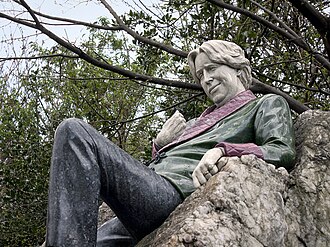
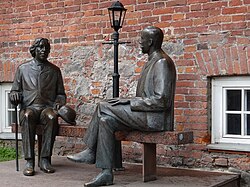
The name Oscar Wilde spread, passing the border of the printed paper; already at the time of travel to America: waltzes were created with titles of Don't forget me. by Wilde, the Dangling handkerchief And Oscar dear!. In addition to the countless caricatures on paper, the humorist Eugene Field even took on his appearance by disguising himself. There was also a pirated version of his first work[205]. International conferences on Wilde have been organized almost one hundred years after his death[N 44] and in his name was called a silver wire ("L'Oscar").[206]
There are also tourist agencies in which programs are proposed as travel destinations the places that most distinguished Wilde's life in London.[207] His phrases are very popular and are still used in the merchandising industry today.[208]
In 2008, Oscar Wilde was named the "Wilde Prize European Literary Competition" which occurs every year, sponsored by the European Parliamentary Observatory.[209]
Years after his death, Reggie Turner wrote to Robert Sherard saying that, according to him, there would never be a book that could be considered as satisfying to contain such a great character as Oscar Wilde.[210]
His biography, written by Richard Ellmann, was awarded a Pulitzer Prize.[211]
Work
AphorismExplore this chapter
| Type[212] | Italian title | Original title | Year |
|---|---|---|---|
| Poem | Ravenna | Ravenna | 1878 |
| Poem | Poem | 1881 | |
| The sphinx | The Sphinx | 1894 | |
| Reading Prison Ballad | The Dance of Reading Gaol | 1898 | |
| Romances | The portrait of Dorian Gray | The Picture of Dorian Gray | 1890 |
| Pages | Intentions | Intentions | 1891 |
| The soul of man under socialism | The Soul of Man under Socialism | ||
| Impressions of America | Personal Impressions of America | 1896 | |
| Theatre works | Vera or nihilists | Vera, Or the Nihilists | 1880 |
| La duchessa di Padova | The Duchess of Padua | 1883 | |
| Salome | Salomé | 1891 | |
| Lady Windermere's fan | Lady Windermere's Fan | 1892 | |
| A woman with no importance | A Woman of No Importance | 1893 | |
| An ideal husband | An Ideal Husband | 1895 | |
| The importance of calling yourself Ernesto | The Importance of Being Earnest | ||
| The holy courtesan or The woman covered with jewelry | The wise courtisane or the woman covered with jewels | 1908 | |
| A Florentine tragedy | To Florentine Tragedy | ||
| Prose | The ghost of Canterville | The Canterville Ghost | 1887 |
| The happy prince and other stories | The Happy Prince and Other Tales | 1888 | |
| The crime of Lord Arthur Savile | Lord Arthur Savile's Crime | 1891 | |
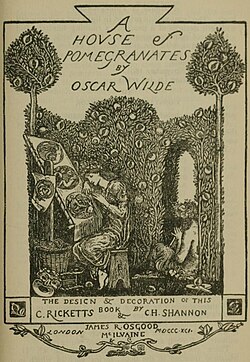
| The House of Melograns | A House of Pomegranates | ||
| The portrait of Mr W.H. | The Portrait of Mr. W. H. | 1889 | |
| Letters | De profundis | De profundis | 1905 |
| The Letters of Oscar Wilde | The Letters of Oscar Wilde | 2000 | |
| Poetry in prose | Poems in prose | Poems in Prose | 1894 |
- Teleny (Teleny or The Reverse of the Medal, Paris, 1893) novel attributed to Wilde, even if his characteristic trait is not found in the work.[213]
- Des Gris (1899): novel with a homosexual theme, never made available to the public, will be published by the University of British Columbia by researcher Justin O'Hearn. Exists in only 3 copies[N 45].
Aphorism
Wilde never published a collection of aphorisms: who speaks of it, then, extrapolates them from the entire corpus of his works. Yet the aphorisms represent the quintessence of his lifestyle, thought and writing. In life, the thought of creating such a collection came to him once, just before going to France in 1897, when he was still in Reading prison, but this project never followed realization.[214] The idea of a collection of this kind was shared by others, in fact some appeared before the process: Phrases and Philosophies for the use of the Young[N 46] and the preface of the novel The Picture of Dorian Gray (dated 1891), which was entirely composed of his aphorisms.[N 47] Ross published, to support him economically after the prison, the collection Aphorisms by Sebastian Melmoth.
His skill in citing aphorisms is considered by many unparalleled.[215]
Oscar Wilde Movies
Over the years, the figure of Oscar Wilde has appeared countless times on the stage of TV, cinema and theatre, while his works were created...Explore this chapter
Over the years, Oscar Wilde's figure has appeared countless times on the stage of TV, cinema and theatre, while his works have been widely used both directly and indirectly as a source of ideas for many directors and producers. Among all The portrait of Dorian Gray, already in 1910, and especially in 1945,[N 48] when the MGM version was nominated for three Oscar Awards[216] thanks also to the interpretation of Angela Lansbury. The film was dedicated to his life Wilde (1997), directed by Brian Gilbert, in which the role of the Irish poet is played by Stephen Fry. In 2009, the psychological thriller was shown in cinemas Dorian Gray, directed by Oliver Parker and starring Ben Barnes. It is from 2018 The Happy Prince - Oscar Wilde's last portrait, by and with Rupert Everett.
Theatre on Oscar Wilde
Over the years, the theatrical interpretations of Wilde's events are countless; among the most famous are: Diversions and delights, Osceni Acts - The three processes of...Explore this chapter
Over the years, the theatrical interpretations of Wilde's events are countless; among the most famous are: Diversions and delights, Obscene Acts - The Three Processes of Oscar Wilde And The Judas Kiss.[N 49]. Among the various actors who have played the role over time there have been, among others: Vincent Price, Simon Callow, Liam Neeson, Rupert Everett and Romolo Valli.
Works translated into English
Explore this chapter
- The portrait of Dorian Gray, translation by Nicola Manuppelli, Fidenza, Mattioli 1885, 2012, ISBN 978-88-6261-302-6.
- The crime of Lord Arthur Savile, translation by Livio Crescenzi, Fidenza, Mattioli 1885, 2013, ISBN 978-88-6261-323-1.
- Art, life and other lies, translation by Angelica Chondrogiannis, Fidenza, Mattioli 1885, 2011, ISBN 978-88-6261-183-1
- Reading Prison Ballad, In transit, Milan, 2022, plates by Frans Masereel, translation by Luca Sanfilippo, (with original text) ISBN 979-12-81011-08-3; translated by Franco Venturi, La Vita Felice, Milan 2026 ISBN 9788893469593.
- The portrait of Mr. W. H., edited by Franco Venturi, translated by Cesare Ferrari, Milan, La Vita Felice 2011. ISBN 9788877993571
- Aphorism and quotations, edited by Franco Venturi, translated by Cesare Ferrari, Milan, La Vita Felice 2012. ISBN 9788877993809
- The House of Melograns, illustrations by Jessie Marion King, Milan, La Vita Felice 2015. ISBN 9788877996657
- The ghost of Canterville, translated by Mariacristina Schiatti, illustrations by Wallace Goldsmith, Milan, La Vita Felice 2016. ISBN 9788877997883
- Salomé. Tragedy in a single act, illustrations by Aubrey Beardslay, Milan, La Vita Felice 2016. ISBN 9788893460323
- The happy prince and other stories, Milan, La Vita Felice 2019. ISBN 9788893463317
- The fisherman and his soul, edited by Franco Venturi, Milan, La Vita Felice 2023. ISBN 9788893466561
Notes
Explore this chapter
- Notes
- ^ In other sources, including Sherard, 1911, Oscar Fingal O'Flaherty Wills Wilde.
- ^ "The bourgeois public adores to have the feeling that he appeals to his intelligence" as Masolino D'Amico writes Friend's Masolino, Ten centuries of English theatre, Milan, Mondadori, 1981, p. 327.
- ^ In the Great dictionary of use, directed by Tullio De Mauro, Turin, UTET, 2000, the entry «expressing oneself through paradoxes» refers to «The paradoxes of O. Wilde».
- ^ Oscar Wilde, article by James Joyce published on the "Piccolo della Sera di Trieste" on 24 March 1909 and written in Italian by the author. The article is listed in Oscar Wilde, The portrait of Dorian Gray, Rome, Newton Compton, 1993, p. 9.
- ^ Among all The importance of calling yourself Ernesto, which was defined by Wystan Hugh Auden as «the only purely verbal work in the English language» (In the essay An Improbable Life up New Yorker of 9 March 1963).
- ^ Of his "incision of Wilde" is still spoken today, he published two studies: epidemic ophtalmia in 1851 and aural surgery in 1853 Diamond H, Hultcrantz M., History of Otitis Media, in North Medicinhist Arsb., 1996.
- ^ Irish Popular Superstitions, 1852, work dedicated to his wife.
- ^ From a correspondence with her husband's colleagues it turns out that Sir Wilde's wife believed the girl was crazy (See: Letters of Lady Wilde to Mrs, Olivecrona 1 January and 23 March 1865).
- ^ Masolino d'Amico reminds us how his boasted Italian descent (more precisely Tuscan) was actually fake: it descended from humble English workers, as written in Oscar Wilde, Wilde Works, edited by Masolino D'Amico, Milan, Mondadori, 2004, p. XII, ISBN 88-04-47906-X.
- ^ As he did during the trial at Old Bailey, during which he claimed to be thirty-nine years old when he was forty. (See: Jonathan Fryer, Wilde, Haus Publishing, 2005, p. 97, ISBN 978-1-904341-11-6.). On that occasion, the public prosecution focused on this contradiction by exhibiting a birth certificate as proof and maintaining the unreliability of his testimony. (See: Richard Ellmann, Oscar Wilde, Rocca San Casciano, Mondadori, 2001, p. 421, ISBN 88-04-47897-7. Translation of Ettore Capriolo).
- ^ In Dublin he remembered Sir William's dialectic ability that once he was opposed by another clever speaker as he, and on that occasion Sir William did not give it to him pretended to have fallen asleep loudly. (From Lady Wilde, letters 1852, 22 November 1854).
- ^ "Names are everything" (the names are all) reads in the portrait of Dorian Gray, p. 231. The mother thought about the size of the name as she accurately describes in Barbara Belford, Oscar Wilde: A Certain Genius, Random House, 2000, pp. 3-4, ISBN 978-0-679-45734-3.
- ^ "C33" was his prisoner number as written in: André Gide, The last years of Oscar Wilde, Dandy decayed, Viterbo, Fiabesca, March 2008, p. 51, ISBN 978-88-6222-027-9. Translation by Stefano Lanuzza.
- ^ Wilde altered to see the article appeared in the newspaper Pall Mall budget by William Archer (of 10 January 1895).
- ^ This information derives from a letter by Murroe Fitzgerald addressed to the director of theIrish Times (dated 28 August 1954). He said that in 1919 he had assisted in the compensation case for a woman who said she had been their carer in the town of Dungarvan.
- ^ Wilde had confused the time of two different exams. He arrived at 13:00 when he was supposed to attend early in the morning. As for the punishment that was committed to Wilde, there are two different versions: or the 27th chapter of the Acts of the Apostles or a translation from the Greek of the episode of Jesus' betrayal by Judas; in both cases when the professor told him to sign himself Oscar continued saying that he wanted to know how the story was going to end. For the two versions of the episode: Douglas Ainslie, Adventures p. 93 curated by Aldo Camerino, London, Casini, 1922.Douglas Sladen, Twenty Years of My Life, London, 1915, p. 110.
- ^ On 16 and 30 November 1877. Wilde confused the two convictions thinking of having to pay 3 pounds of judicial expenses for the debt of 5. It was actually a few shillings. As it is reported in Oscar Wilde, More Letters of Oscar Wilde, London, 1985, pp. 82 edited by Rupert Hart-Davis.
- ^ From the rector's diary of Lincoln College Mark Pattison 5 May 1878; other descriptions we find from Thomas Wright the biographer of Pater in 1907, where his attention is also told to a barber. Letter to the Brasenose College in Oxford.
- ^ Wilde with examiners discussing the term metaphysics present in the text, while according to him should have written metaphysics. For this event, Lewis Farnell was present Lewis Farnell, An Oxonian Looks Back, London, , pp. 70-71.
- ^ Frank Benson claimed that Wilde was not of any help, while the version of Wilde found her in Telegram New York of 13 January 1882.
- ^ From Athena. of 4 September 1880, pp. 301-302. the part attributed to Wilde starts from Mr.'s article. Jebb then ends in Athens.
- ^ Detailed description of the house is found in Laura Troubridge, Life Amongst the Troubridge, edited by Jacqueline Hope Nicholson, London, 1966, p. 152.
- ^ Frank Miles's father died shortly, and he ended his days in a madhouse.Frank Harris, His Life and Adventures, London, 1947, p. 303.
- ^ The contacts took place thanks to Colonel W.F. Morse.W. F. Morse, American Lectures in the Works of Oscar Wilde, the letter is found in a volume called His life (there is no list of pages inside), Boston – New York, 1999.
- ^ to b Robert Harborough Sherard was one of Oscar Wilde's greatest biographies, and later wrote three books: The Story of a Friendship of 1902, Life of Oscar Wilde 1906 e The Real Oscar Wilde of 1915, more small collections.
- ^ The The World for the occasion he had written a small poem, as from article of 23 May 1883.
- ^ From the newspaper cutout from which the news is processed, it is not understood neither the date nor what newspaper it was, in any case the news is reported also in Richard Ellmann, Oscar Wilde, Milan, Mondadori, 2001, p. 275, ISBN 88-04-47897-7. Translation of Ettore Capriolo.
- ^ Among the various letters that of Lady Wilde addressed to Oscar on 27 November 1883 was signed in Italian language "La Madre".
- ^ He was joking that in his lectures he always spoke of the "nice house", now, according to his interlocutors he had the opportunity to show one. From Sir Johnston Forbes-Robertson, A Player Under Three Regins, 1925 edition, p. 110.
- ^ More detailed description of the house in Charlotte Gere, Lesley Hoskins, Geffrye Museum, Wilde, London, Lund Humphries, pp. 79-82, ISBN 978-0-85331-818-7. The original version is located in the University of Michigan.
- ^ Improperly used term of popular use, probably due to a transcription error of sources. The correct term is cerebral edema: it showed among the various symptoms and clinical signs cephalea, dizziness, reaching the syncope. For the comparison of terms see Joseph C. Segen, Concise Dictionary of Modern Medicine, New York, McGraw-Hill, 2006, p. 171, ISBN 978-88-386-3917-3.
- ^ Among the various documents Morris B. Kaplan, Sodom on the Thames: Sex, Love, and Scandal in Wilde Times, Cornell University Press, 2005, p. 167, ISBN 978-0-8014-3678-9. And Harford Montgomery Hyde, The Cleveland Street Scandal, Coward, McCann & Geoghegan, 1976, p. 59, ISBN 978-0-698-10775-5.
- ^ From a letter by Robert Ross addressed to Frank Harris on May 2, 1914.
- ^ This information has been received in response to W.E.'s questions. Henley, another editorial director, complaining about working too much as reported in Morley Sheridan, Oscar Wilde, Holt, Rinehart and Winston, 1976, p. 69, ISBN 978-0-03-017586-2.
- ^ Many of these apologes considered to have always been lost were collected in a volume titled The words of the lily, published in Italy by Verba Volant, editions in November 2010.
- ^ This comment was heard by his parents while Wilde observed the house waiting for Proust's return Julian Philippe, Oscar Wilde, Paris, 1967, p. 246.
- ^ The agreement will then be banned in Switzerland in 1908, the USA in 1912, France in 1915, but not in Britain. Phil Baker, The Book of Absinthe: A Cultural History, Grove Press, 2001, p. 30, ISBN 978-0-8021-3993-1.
- ^ For the opera that Richard Strauss echoed from this drama see Fausto Cercignani, The tetrarch, the virgin and the prophet in Oscar Wilde's drama and Richard Strauss' booklet, in Richard Strauss 'Salome', edited by F. Degrada, Milan, Edizioni del Teatro alla Scala, 2002, pp. 81-109. The essay is also found in Studia theodisca IX, Milan, 2002, pp. 171-192.
- ^ George Lewis paid the blackmailer £100 to get the material he blackmailed as in Brian Roberts, The Mad Bad Line: The Family of Alfred Douglas, Philadelphia, H. Hamilton, 1981, p. 155, ISBN 978-0-241-10637-2.
- ^ It was issued by the queen, and it concerned only the acts of men. When asked why women were excluded, the queen replied that women did not do such things. Herbert F. Tucker, A Companion to Victorian Literature and Culture, Blackwell Publishing, 1999, p. 418, ISBN 978-0-631-21876-0.
- ^ He was courted later by Marc André Raffalovich, a man who had many tasters with Wilde.
- ^ Wilde had also had three children outside the weddingRichard Ellmann, Oscar Wilde, Milan, Mondadori, 2001, p. 438, ISBN 88-04-47897-7. Translation of Ettore Capriolo.
- ^ His distressed poverty The Journal of Paris who tried to scrape some money for him. Greene Graham, A Sort of Life, 1971, p. 26.
- ^ Like those of 1993 and 1997, held in Birmingham, with the presence among others of writers Russell Jackson and Ian Small.
- ^ "Rarity. Canadian University acquires two novels attributed to Wilde, January 16, 2015, «Corriere della Sera», p.48.
- ^ Short anthology of aphorisms published in 1894 on "The Chameleon", the Oxford University Magazine.
- ^ In March 1891, a month before the work appeared in volume, the preface was published on the "Fortnightly Review".
- ^ Original title The Picture of Dorian Gray, where for the 4 paintings necessary for the film the blood of various animals was used instead of the normal red. As described in Patrick Robertson, Movie records. Encyclopedia of the facts, curiosities and primates of world cinema, from the time of the mute to today, Gremese Editore, 2004, p. 218, ISBN 978-88-8440-273-8.
- ^ For a more detailed list see Oscar Wilde, Work, edited by Masolino D'Amico, Milan, Mondadori, 2004, pp. XVIII-XIX, ISBN 88-04-47906-X.
- Sources
- ^ (EN) WILDE | Confessions of Tastes, Habits and Convictions, authorial manuscript, 1877, up Sotheby's. Retrieved 12 January 2024.
- ^ Neil Bartlett, Who was that Man? Present for Mr. Oscar Wilde, London, Serpent's Tail, 1988, p. 41.
- ^ Barbara Belford, Oscar Wilde: A Certain Genius, Random House, 2000, p. XII, ISBN 978-0-679-45734-3.
- ^ Greta Jones, Elizabeth Malcolm, Medicine, Disease and the State in Ireland, 1650-1940, New York, Cork University Press, 1999, p. 88, ISBN 978-1-85918-230-7.
- ^ Richard Ellmann, Oscar Wilde, Milan, Mondadori, 2001, pp. 122-123, ISBN 88-04-47897-7. Translation of Ettore Capriolo.
- ^ Oscar Wilde, The ghost of Canterville (original mother), Baldini & Castoldi, 15 October 2014, ISBN 978-88-6865-235-7. Retrieved 19 August 2018.
- ^ Richard Ellmann, Oscar Wilde, London, Hamish Hamilton, 1987, p. 16.
- ^ Oscar Wilde, Right and Aphorisms, fifth edition, Milan, BUR, 2004, p. 218, ISBN 978-88-386-3917-3. translation by Alberto Rossatti.
- ^ Terence De Vere White, The Parents of Oscar Wilde, London, 1967, pp. 210-211.
- ^ Richard Ellmann, Oscar Wilde, Rocca San Casciano, Mondadori, 2001, p. 24, ISBN 88-04-47897-7. Translation of Ettore Capriolo.
- ^ Sherard, Life of Oscar Wilde, London, pp. 5-6.
- ^ Arthur Ransome, Oscar Wilde: A Critical Study, Martin Secker, 1912, p. 29.
- ^ Joyce Bentley, The Importance of Being Constance, London, 1983, p. 32.
- ^ Douglas Sladen, Twenty Years of My Life, London, 1915, p. 109.
- ^ Christopher John Murray, Encyclopedia of the Romantic Era, 1760-1850, New York, Taylor & Francis, 2004, p. 717, ISBN 978-1-57958-422-1.
- ^ Melmoth, Sebastian, in Treccani.it – Online encyclopedias, Rome, Institute of the Italian Encyclopedia.
- ^ (EN) Oscar Wilde, up The Guardian, 22 July 2008. Retrieved 13 August 2018.
- ^ The scandalous Oscar Wilde, in Republic.it, 19 August 2015. Retrieved 13 August 2018.
- ^ Vincent O'Sullivan, Aspects of Wilde, London, 1936, p. 80.
- ^ Oscar Wilde, The Letters of Oscar Wilde, edited by Rupert Hart-Davis, London, 1962, p. 720.
- ^ Coulson Kernahan, Good., 2nd edition, London, 1917, p. 208.
- ^ Frank Harris, Bernard Shaw, Oscar Wilde: Including My Memories of Oscar Wilde, Michigan State University Press, 1959, p. 15.
- ^ Siobhán Marie Kilfeather, Dublin: A Cultural History, Oxford University Press US, 2005, p. 82, ISBN 978-0-19-518201-9.
- ^ Stuart Mason, Bibliography of Oscar Wilde, London, 1914, p. 118.
- ^ Robert Sherard, The Real Oscar Wilde, London, 1917, p. 163.
- ^ Pearson Haskett, The Life of Oscar Wilde, London, 1946, pp. 20-21.
- ^ Reginald Turner, letter to AJA. Symons, 26 August 1935, the anecdote had been told by Wilde himself.
- ^ to b Oscar Wilde, Aphorisms. English Humor with artist's signature, second edition, Colognola ai Colli, Demetra srl, 1998, p. 5, ISBN 88-7122-433-7. Translation of Bettina Della Casa.
- ^ Chronology
- ^ to b Oscar Wilde, Aphorism, 21st edition, Milan, Mondadori, 1998, p. 53, ISBN 88-04-47791-1. Translation of Alex R. Falzon.
- ^ Robert Sherard, the real Oscar Wilde,, London, 1946, p. 148.
- ^ Review by Henry the Fourth at Oxford "Dramatic Review 23 May 1885", Henry James, Persons and Places, 1883, p. 246.
- ^ Joseph Pearce, The Unmasking of Oscar Wilde, London, Ignatius Press, 2004, p. 87, ISBN 978-1-58617-026-4.
- ^ Magazine of Masonry
- ^ Mr. Mahaffy's New Book from "Pall Mall Gazzette", November 9, 1887.
- ^ Francesca Amore, Oscar Wilde pays tribute to John Keats, up 5colonne.it, 4 April 2016. Retrieved 30 April 2016.
- ^ Lady Wilde, letter to Wilde autumn 1876 (Clark).
- ^ Oscar Wilde, The Letters of Oscar Wilde, London, 1962, p. 23, edited by Rupert Hart-Davis.
- ^ Oscar Wilde, The letters of Oscar Wilde, edited by Rupert-Hart-Davis, London, 1962, p. 39.
- ^ Wilde quote in Pater, Mr. Pater's Last Volume, I, n. 12 "The Speaker", London, 22 March 1890, pp. 319-320.
- ^ Bodley in an article about New York Times of 20 January 1882.
- ^ Letter of Robert Ross quoted in Eduard J. Bock, Oscar Wildes persönliche und frühste literarische Beziehngen zu Walter Pater, Bonn, "Cornhill Magazine" LXVI, 1913, p. 11.
- ^ William Rothenstein, Men and Memories, New York, Gallery, 1931, p. 139.
- ^ Thomas Wright, The Life of Walter Pater, London, gallery, 1907, , 2 volumes, II volume, p. 126.
- ^ Robert Formano Horton, An Autobiography, 1917, p. 44.
- ^ Richard Ellmann, Oscar Wilde, Milan, Mondadori, 2001, p. 36, ISBN 88-04-47897-7. Translation of Ettore Capriolo.
- ^ Ethel Smyth, Impressions that Remained, London, 1919, 2 volumes, volume I, pp. 115-117.
- ^ Letter to Archibald Henry Sayce, professor of comparative Philology in Oxford, and A.H. Sayce dated 28 May 1879 (Bodleian).
- ^ Louise Jopling, Twenty Years of My Life, 1867 to 1887, London, 1925, p. 79.
- ^ Frank Benson, present at the episode, describes the scene in Frank Benson, My memory, London, 1925, p. 138.
- ^ Tell Mrs. Julia Hawthorne and written in Harper's Bazar, 18 June 1881.
- ^ to b Claude Beddington, All that I have, London, 1929, p. 34.
- ^ Elizabeth Robins, Both Sides of the Curtain, London, 1940, p. 9.
- ^ Oscar Wilde, Work, edited by Masolino D'Amico, Milan, Mondadori, 2004, p. 1654, ISBN 88-04-47906-X.
- ^ As reported by Mrs. Julia Hawthorne in Harper's Bazaar.
- ^ Oxford and Cambridge Undergraduate's Journal of 17 November 1881.
- ^ Tribune of 10 January 1883 and 4 February 1883.
- ^ Louis Latourette, Dernières heures avec Oscar Wilde, , "Nouvelles Littéraires", December 1928.
- ^ John Augustus, Chiaroscuro Fragments of Autobiography, , First Series, December 1952, pp. 433-434.
- ^ Robert Sherard, letters to AJA. Symons of 31 May 1937 and 3 June 1937.
- ^ Robert Sherard, Oscar Wilde Story of an Unhappy Friendship, London, 1917, p. 72.
- ^ Louise Jopling, Twenty Years of My Life, 1867 to 1887, London, 1925, p. 80.
- ^ E. Terry, Memoir, p. 253.
- ^ As from Punch of 31 March 1883.
- ^ Description detailed by P.'s Weekly of 30 May 1913.
- ^ Merlin Holland, The Wilde, London, 1997, p. 112.
- ^ Constance Lloyd, letter to Otho Lloyd of 7 June 1881.
- ^ Oscar Wilde, Alvin Redman, The Wit and Humor of Oscar Wilde, London, Courier Dover Publications, 1959, p. 123, ISBN 978-0-486-20602-8.
- ^ The Truth, 18 July 1883.
- ^ Herald from New York on 12 July 1883.
- ^ Kenneth Rose, Superior Person, Cambridge, 1969, p. 72.
- ^ Constance Lloyd, letter to Otho Lloyd 26 November 1883.
- ^ Jonathan Fryer, Wilde, Haus Publishing, 2005, p. 53, ISBN 978-1-904341-11-6.
- ^ The Bat of 30 March 1886
- ^ Richard Ellmann, Oscar Wilde, Milan, Mondadori, 2001, pp. 307-308, ISBN 88-04-47897-7. Translation of Ettore Capriolo
- ^ Hyde H. Montgomery, Oscar Wilde, The Trials of Oscar Wilde, Courier Dover Publications, 1973, p. 45, ISBN 978-0-486-20216-7.
- ^ E.A. Brayley Hodgett, Mos From a Rolling Stone, 1924, p. 130.
- ^ L.B. Walford, Memories of Victorian, London, 1912, pp. 147-153 and 230-233.
- ^ Louise Jopling, Wilde, pp. 79-82.
- ^ Anne Clark Amor, Mrs. Oscar Wilde: A Woman of Some Importance, Sidgwick & Jackson, 1988, p. 51, ISBN 0-283-99743-5.
- ^ Jonathan Hyde, Oscar Wilde, pp. 21-23.
- ^ E. H Mikhail, Oscar Wilde: Interviews and Recollections, Barnes & Noble, 1979, p. XVI.
- ^ Coulson Kernahan, Good., 2 edition, London, 1917, p. 217.
- ^ Anna Dunphy. De Brémont, Oscar Wilde and His Mother at memoir, London, Everett, 1914, p. 89.
- ^ Frank Harris, Oscar Wilde His Life and Confessions, Kessinger Publishing, 2005, pp. 337-338, ISBN 978-1-4179-0483-9.
- ^ Peter Raby, The Cambridge Companion to Oscar Wilde, London, Cambridge University Press, 1997, p. XX, ISBN 978-0-521-47987-5.
- ^ Oscar Wilde, Anya Clayworth, Selected Journalism, Oxford University Press, 2004, p. XXXVII, ISBN 978-0-19-280412-9.
- ^ Claude Beddington, All that I have, London, 1929, p. 41.
- ^ Arthur Ransome, Oscar Wilde: a Critical Study, London, 1912, p. 32.
- ^ Oscar Wilde, Renato Miracco, Towards the sun: chronicle of the Neapolitan stay, Colonnese, 1988, p. 75, ISBN 978-88-87501-14-8.
- ^ Ada Leverson, Letters of the sphinx from Oscar Wilde and Reminescences of the Author, London, 1930, pp. 48-49.
- ^ Oscar Wilde, The Best of Oscar Wilde: Selected Plays and Literary Criticism, London, Signet Classic, 2004, p. 80, ISBN 978-0-451-52934-3.
- ^ Maureen Borland, Wilde's Devoted Friend: A Life of Robert Ross, 1869-1918, London, Lennard, 1990, p. 23, ISBN 978-1-85291-085-3.
- ^ From the article published on Pall Mall of 17 April 1888.
- ^ Barbara Belford, Oscar Wilde: A Certain Genius, Random House, 2000, p. 145, ISBN 978-0-679-45734-3.
- ^ Simon Nowell-Smith, Cassell & Company, The House of Cassell, 1848-1958, Cassell, 1958, p. 149.
- ^ Alvin Sullivan, British Literary Magazines, Greenwood Press, 1983, p. 454, ISBN 978-0-313-22871-1.
- ^ W. Rothenstein, As Were, p. 187.
- ^ Bernard. Shaw. Am Autobiography, 1970, p. 50. by Stanley Weintraub.
- ^ Rudolf Von Frank Liebich, Unpublished memoir, Clark.
- ^ Lionel Johnson, a letter to Arthur Galton of 18 February 1890 (held at Hart-Davis).
- ^ had done as reported inHenry Hyde Champion, Wilde As The Saw Him, Book Lover, December 1914, pp. 244-245.
- ^ Jean Paul Leverson, Raymond, Oscar Wilde, Recollections, London, Nonesuch Press, January 1932, p. 42.
- ^ Oscar Wilde, Letters, edited by Silvia De Laude, Luca Scarlini, translation by Silvia De Laude and Luca Scarlini, Milan, ilSaggiatore, 2014, pp. 864-865, ISBN 978-88-428-1927-1.
- ^ E. H. Mikhail, Oscar Wilde: Interviews and Recollections, Barnes & Noble, 1979, p. XX.
- ^ André Gide, Oeuvres complètes, vol. III, Paris, 1932-1939, pp. 476-477.
- ^ Don C. Seitz, Whistler Stories, New York, 1913, pp. 66-67.
- ^ Lady Wilde, letter to Wilde, June 1898.
- ^ David Bispham, A quaker Singer's Recollections, New York, 1920, pp. 150.
- ^ Robert Sherard, Aesthete and Realist Morning Journal of 22 March 1891.
- ^ In Max Beerbohm, Oscar Wilde in Anglo-American Times of 25 March 1893.
- ^ Richard Ellmann, Oscar Wilde a biography, Milan, Rizzoli, 1993.
- ^ Stuart Merrill, Prose et vers: oeuvres posthumes, Paris, 1925, pp. 142-145.
- ^ The various letters of Whistler were collected in C.F. Barbier, Matches, Paris, 1962, pp. 98-99.
- ^ Gédéon Spilett in Gil Blas of 2 November 1897.
- ^ Barbara Belford, Oscar Wilde: A Certain Genius, Random House, 2000, p. 185, ISBN 978-0-8129-9261-8.
- ^ Pierre Champion, Marcel Schwob et son temps, Paris, 1927, p. 99.
- ^ Pearson Hesketh, The Pilgrim Daughters, London, 1961, p. 185.
- ^ Robertson Graham, Time was, London, 1931, p. 135.
- ^ Unseen Cinema: Early American Avant-garde Film 1893-1941; a Retrospective, up books.google.it.
- ^ Count Louis (Cheiro) Hamon, Cheiro memoirs. The Reminiscences of a Society Palmist, Philadelphia, 1913, pp. 152-153.
- ^ Oscar Wilde, Right and Aphorisms, Milan, BUR, 20045. ISBN 978-88-386-3917-3
- ^ Gary Schmidgall, The Stranger Wilde, London, Dutton, 1994, p. 302, ISBN 978-0-525-93763-0.
- ^ From the Daily Telegraph of 18 April 1913.
- ^ Bernard J. Taylor. Feasting with Panthers, iUniverse, 2004, p. 1, ISBN 978-0-595-31294-8.
- ^ H. Montgomery Hyde, Trails of Oscar Wilde, Paris, 1928, p. 298, ISBN 978-0-486-20216-7.
- ^ André Gide, Oeuvres complètes, vol. III, Paris, 1932-1939, pp. 30-33.
- ^ Jarlath Killeen, The Fairy Tales of Oscar Wilde, 2007, p. 109, ISBN 978-0-7546-5813-9.
- ^ Max Beerbohm, letter to R. Ross (the text is found by Hyde).
- ^ George Percy Jacomb Hood, With Brush And Pencill, London, 1924, p. 116.
- ^ Dianne Jacomb, Journal, vol. IV, Paris, 1956, p. 395.
- ^ Trevor Fisher, Oscar and Bosie: A Fatal Passion, London, Sutton, 2002, p. 67, ISBN 978-0-7509-2459-7.
- ^ Jonathan Fryer, Andre and Oscar: The Literary Friendship of Andre Gide and Oscar Wilde, London, 1998, p. 82, ISBN 978-0-312-30387-7.
- ^ G.T. Atkinson, Oscar Wilde at Oxford, London, "Cornhill Magazine", LXVI, 9 January 1895, p. 561.
- ^ William Freeman, The Life of Lord Alfred Douglas: Spoilt Child of Genius, London, H. Joseph, 1948, p. 94.
- ^ As Emma Calvé tells us, My Life, London, 1922, pp. 97-98.
- ^ Lady Wilde, letter to Wilde of 29 March 1894.
- ^ Richard Ellmann, Oscar Wilde, Vintage Books, 1998, p. 412, ISBN 978-0-394-75984-5.
- ^ The letter of 28 April 1891 to Clark.
- ^ Edgar Saltus, Wilde: An Idler's Impression, Chicago, 1914, p. 18, ISBN 978-1-58617-026-4.
- ^ Joseph Pearce, The Unmasking of Oscar Wilde, London, Ignatius Press, 2004, p. 308, ISBN 978-1-58617-026-4.
- ^ (EN) Frederick S. Roden, Palgrave Advances in Oscar Wilde Studies, Springer, 30 September 2004, ISBN 978-0-230-52430-9. Retrieved 12 August 2018.
- ^ Hugues Rebell', Defense d'Oscar Wilde, Paris, 1895, p. 174.
- ^ De Profundis (letter) (1897) (PDF), up faculty.sgc.edu.
- ^ Oscar Wilde; De Profundis (PDF), up liberliber.it.
- ^ Marie Belloc Lowndes, The merry Wives of Westminster p. 174, 1946.
- ^ Richard Burdon Haldane, An Autobiography, 1929, pp. 164-164.
- ^ Oscar Wilde, The Letters of Oscar Wilde, edited by Rupert Hart-Davis, London, 1962, pp. 871-872.
- ^ Robert Sherard, Oscar Wilde Story of an Unhappy Friendship, London, 1917, p. 214.
- ^ Constance Wilde Letter to Hannah Withhall Smith of 15 October 1895.
- ^ Stuart Merrill, Pour Oscar Wilde: Epilogue The Plume of January 1896.
- ^ Frank Harris, Oscar Wilde His Life and Confessions pp. 232-235, Kessinger Publishing, 2005, ISBN 978-1-4179-0483-9.
- ^ John Gardiner, The Victorians: An Age in Retrospect, Hambledon, 2002, p. 182, ISBN 978-1-85285-385-3.
- ^ Martin Fido, Oscar Wilde, Viking Press, 1973, p. 132, ISBN 978-0-600-36714-7.
- ^ A.C. Amor, Mrs. Oscar Wilde, pp. 210-214.
- ^ Antony Edmonds, Oscar Wilde's Scandalous Summer. The 1894 Worthing Holiday and the Aftermath, 2014, [1]
- ^ Renato, Oscar Wilde, Towards the sun: chronicle of the Neapolitan stay, Colonnese, 1998, p. 32.
- ^ William Tydeman, Oscar Wilde, Steven Price, Salome Lifetime, Cambridge University Press, 1996, p. 31, ISBN 978-0-521-56545-5.
- ^ Matilde Serao, There is or there is, The Morning, 7 October 1897
- ^ Constance Wilde, a letter to Otho Holland (Lloyd) on 7 October 1897, is located in Hart-Davis.
- ^ Alfred Douglas, a letter to Edward Strangman on 29 November 1897.
- ^ As from Constance Wilde letters addressed to: Otho Holland, Carlos Blacker of 10 March 1898, Arthur Humphreys of 27 February 1898.
- ^ Luciano Mirone, When Oscar Wilde went to Taormina, in Information, 13 August 2017
- ^ Henry Davray, a letter to Walter Ledger, 26 February 1926, is located in Hart-Davis.
- ^ Frédéric Boutet, Les Dernières Années d'Oscar Wilde, 3 December 1925.
- ^ Claire De Pratz, G. de Saix, Souvenirs inedits – La Cruelle Charité, pp. 249-250.
- ^ Dame Nellie Melba, Melodies and Memories, 1925, pp. 74-75.
- ^ M. Steen, A pride of Terrys, 2004, p. 206.
- ^ Emma Calvé, My Life, pp. 96-98.
- ^ Constance Wilde, letter to Otho Holland (Lloyd) December 15, 1897, is located in Hart-Davis.
- ^ Ashley Robins and Merlin Holland, The enigmatic illness and death of Constance, wife of Oscar Wilde, in The Lancet, vol. 385, n. 9962, Elsevier, 3 January 2015, pp. 21-22, DOI:10.1016/s0140-6736(14)62468-5, ISSN 0140-6736 (Toilet · ACNP).
- ^ Charlie Lewis Broad, The Friendships and Follies of Oscar Wilde, Crowell, 1955, p. 257. The original is available at the University of Michigan.
- ^ Stuart Merrill, Pour Oscar Wilde: Epilogue and "La Plume" of January 1896
- ^ The Temptation of the Author: Therese Raquin by Zola
- ^ Introduction to Germinal
- ^ Oscar Wilde in Paris: insensitive or nasty? Was Oscar Wilde anti-Semitic?
- ^ Frank Harris, His Life and Adventures, London, 1947, p. 351.
- ^ Anthony Stokes, Theodore Dalrymple, Pit of Shame: The Real Ballad of Reading Gaol, Waterside Press, 2007, p. 77, ISBN 978-1-904380-21-4.
- ^ Peter Chalmers Mitchell, My Fill of Days, 2004, pp. 183-184.
- ^ Wisdom: Magazine of Philosophy and Theology, Italian Dominican Editions., 2010. Retrieved 11 August 2018.
- ^ When Oscar Wilde visited Palermo | http://www.palermoviva.it, up palermoviva.it, 22 April 2021. Retrieved 22 April 2021.
- ^ Mondadori edition, 1988, p. 17.
- ^ to b R. Ellmann, Oscar Wilde, Rizzoli, Milan 1991, p. 669.
- ^ Frank Harris, His Life and Adventures, London, 1947, pp. 361-364.
- ^ Anna de Brémont, Oscar Wilde and his Mother, pp. 178-188.
- ^ Oscar Wilde, Right and Aphorisms, fifth edition, Milan, BUR, 2004, p. 87, ISBN 978-88-386-3917-3.
- ^ Oscar Wilde, More Letters of Oscar Wilde, edited by Rupert Hart-Davis, London, 1985, p. 186.
- ^ Terence Cawthorne, The last illness of Oscar Wilde Proceedings of the Royal Society of Medicine LII pp. 123-127, February 1959.
- ^ Frank Harris, His Life and Adventures, London, 1947, p. 572.
- ^ Ross, letter to Sherard of 3 January 1934 (is located in Reading).
- ^ Introduction The portrait of Dorian Gray, Einaudi
- ^ Oscar Wilde: research reveals, died by a banal otitite AdnKronos, 23-11-2000.
- ^ In Oscar Wilde, American interviews
- ^ Max Meyerfeld, Gedenkblatter Robert Ross, in Das Literarische, XXI, January 1919, pp. 779-785.
- ^ R. Ellmann, Oscar Wilde, Rizzoli, Milan 1991, p. 670.
- ^ John Augustus, Chiaroscuro Fragments of Autobiography, First Series, December 1952, p. 396.
- ^ Reginald Turner, Letter to R.S. Meickeljohn of 31 December 1936. The comment was later denied by Turner himself.
- ^ (EN) Richard Ellmann, Oscar Wilde, Knopf Doubleday Publishing Group, 4 September 2013, ISBN 978-0-8041-5112-2. Retrieved 27 August 2018.
- ^ Oscar Wilde - Author and Books | Libri Mondadori, in Books Mondadori. Retrieved 27 August 2018.
- ^ Dante Paolo Ferraris, The fan, Youcanprint, 10 April 2017, ISBN 978-88-926-5799-1. Retrieved 27 August 2018.
- ^ Richard Ellmann, Oscar Wilde, Milan, Mondadori, 2001, p. 672, ISBN 88-04-47897-7.
- ^ Walling Off Oscar Wilde's Tomb From Admirers' Kisses, up nytimes.com.
- ^ (EN) Oscar Wilde's restored tomb unveiled, up BBC News. Retrieved 8 August 2018.
- ^ Oscar Wilde. Writer, Poet and Playwright - "Commemorations" in Westminster Abbey
- ^ Charles H Dennis, Eugene Field's Creative Years, New York, 1924, p. 213.
- ^ (EN) Sam Jordison, Oscar Wilde's West, up The Guardian, 5 July 2007. Retrieved 11 August 2018.
- ^ Oscar Wilde, Work, edited by Masolino D'Amico, Milan, Mondadori, 2004, p. XIX, ISBN 88-04-47906-X.
- ^ Oscar Wilde, Linda C. Dowling, The Soul of Man Under Socialism and Selected Critical Prose: & Selected Critical Prose, London, Penguin Classics, 2001, pp. VII-VIII, ISBN 978-0-14-043387-6.
- ^ Dreams Entertainment ACRI, PREMIO WILDE European Literary Competition, up awardwilde.org. Retrieved 11 August 2018 (archived fromoriginal url on 12 August 2018).
- ^ Peter Raby, The Cambridge Companion to Oscar Wilde, London, Cambridge University Press, 1997, p. 55, ISBN 978-0-521-47987-5.
- ^ (EN) Richard Ellmann, Oscar Wilde, Vintage Books, 1988, ISBN 978-0-394-75984-5. Retrieved 11 August 2018.
- ^ Following the proposed scheme in Richard Ellmann, Oscar Wilde, Milan, Mondadori, 2001, pp. 710-711, ISBN 88-04-47897-7. Translation of Ettore Capriolo
- ^ The analysis is found in Barbara Belford, Oscar Wilde: A Certain Genius, Random House, 2000, p. 218, ISBN 978-0-679-45734-3.
- ^ Oscar Wilde, Aphorisms: "Advertisement", edited by Alex Falzon, Milan, Mondadori, 2000, p. 63, ISBN 88-04-47791-1.
- ^ Oscar Wilde, The Complete Works Limited Edition, London, Collector's Library editions, 2006, p. VIII, ISBN 978-1-904633-98-3.
- ^ Oscar Wilde, Camille Cauti, The Picture of Dorian Gray, Spark Educational Publishing, 2003, p. 239, ISBN 978-1-59308-025-9.
Bibliography
Explore this chapter
- (EN) Oscar Wilde, Reviews. 1, Toronto, Musson Book Company ; John WLuce & Co, 1909. Retrieved 16 April 2015.
- (EN) Oscar Wilde, Reviews. 2, Toronto, Musson Book Company ; John WLuce & Co, 1909. Retrieved 16 April 2015.
- (EN) Oscar Wilde, [Opers.] Poetry!, Toronto, Musson Book Company ; John WLuce & Co, 1909. Retrieved 16 April 2015.
- (EN) Oscar Wilde, Miscellanies, Toronto, Musson Book Company ; John WLuce & Co, 1909. Retrieved 16 April 2015.
- (EN) Robert Harborough Sherard, Life of Oscar Wilde, 3rd ed., London, T. Werner Laurie, 1911, OL 13830182M.
Continue your journey