A closer look
Erminio Spalla: at a glance
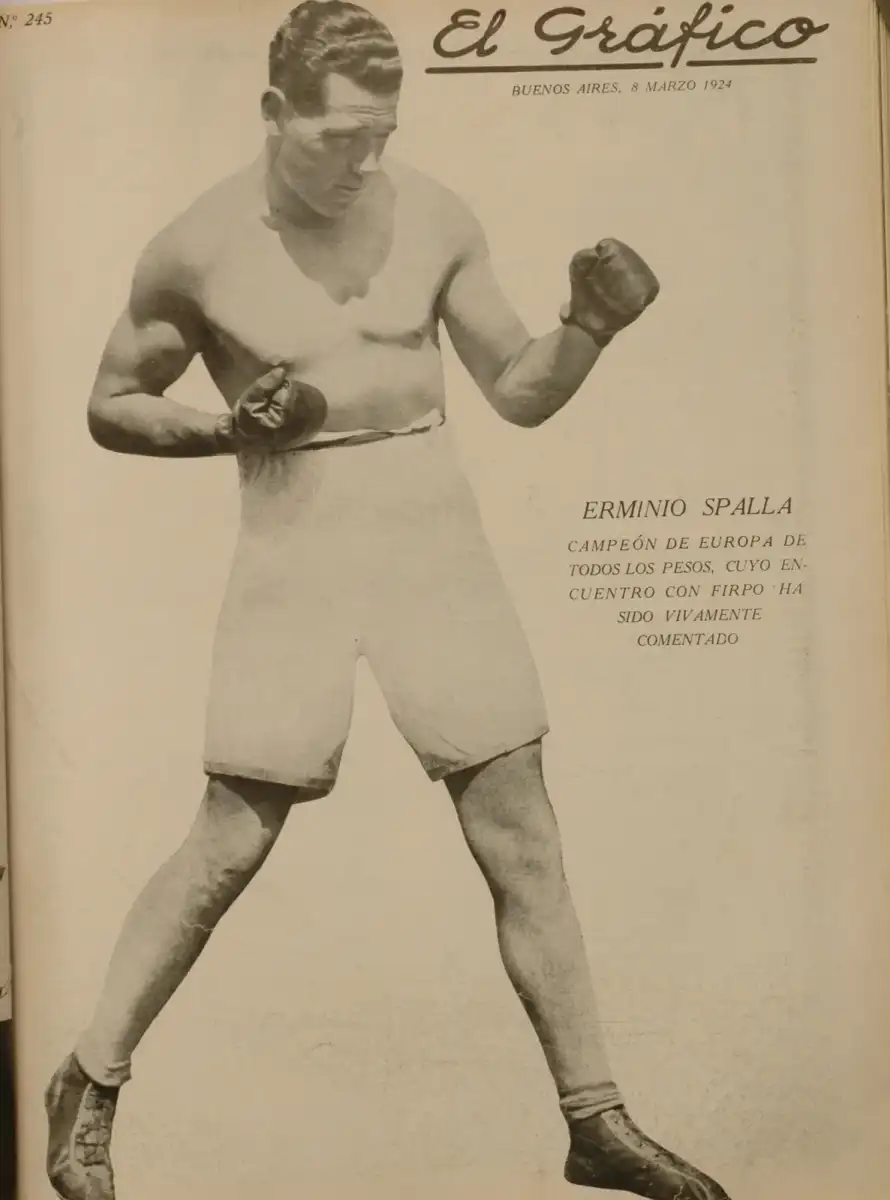
Erminio Spalla (Borgo San Martino, 7 July 1897 – Rome, 14 August 1971) was an Italian boxer, actor, sculptor and opera singer.
He was the first Italian boxer to win the title of European Champion in the 1920s. He was the younger brother of Giuseppe Spalla, also the boxer.
Biography
Training · Pugilistic Career · Artistic and cinematic careerExplore this chapter
Training
Son of a farmer and wine merchant Monferrato, his family moved to Milan in his teenage years. In the Lombardy capital Spalla began working in a sculpture workshop, where he highlighted his artistic talent and then enrolled in an evening course at the Brera Academy of Fine Arts[1]. According to legend, he decided to change his life after seeing at the cinema the film of the World Heavyweight Championship match between Jack Johnson and the former holder Jim Jeffries, which took place in Reno on 4 July 1910 and ended with the victory of the black boxer by knockout in the fifteenth round[1]. He then began attending the U.S. gym. Milanese with his older brother Giuseppe[2].
At the outbreak of World War I, Spalla was enlisted in the 41st Infantry Regiment and fought in the Judicial Valleys, where he was promoted to the rank of sergeant and deserved a war cross[2].
Pugilistic Career
Spalla began professional career at the end of 1918[3] and this did not allow him to participate in the Olympic Games of Antwerp in 1920. In the summer of 1919, he competed in the Paris International Games boxing tournament, an event reserved for allied military forces who had fought in World War I. There were 18 nations present (including Hegiaz - now Saudi Arabia - and Newfoundland who remained independent from Canada until 1949), 17 sports scheduled. Spalla was enrolled in the middle class (up to 175 pounds of weight, about 79 kg) and won the title right on the last day of the Games, Sunday 6 July, defeating in the final Australian John W. Pettybridge[3].
In 1919 he went up to the ring against his brother Joseph (both brothers were heavyweights) and the match ended in parity[4]. On 5 September 1920 he became the "absolute" Italian champion by defeating the still undefeated Milanese Eugenio Pilotta by knockout in the 4th round[3]. He subsequently undertook a tour that took him to fight first in Berlin, then in London and in the United States. In the German capital he drew against the local champion Hans Breitenstraeter and then suffered his first defeat, by KO in the sixth round under the punches of the Englishman Tom Cowler[3]. On British soil he achieved two victories before the limit and one defeat on points.
She debuted in the overseas ring on 21 May 1921, in Newark, sending out after only 2'06'' of the first Frank Hagney shooting[3]. He fought four more times in the United States, totaling two victories (one before the limit) and two defeats on points. On 7 May 1922, at the Sempione Velodromo in Milan, he demonstrated his superiority over the German Breitenstraeter, knocking him out in the seventh round. After nine more fights, all won (seven before the limit), Spalla took revenge on the Englishman Cowler, beating him by knockout in the sixth round, at the Teatro Adriano in Rome[5]. A few days later, for this feat he received compliments from the Head of Government Mussolini[5].
He returned to Italy, Erminio Spalla on 20 May 1923, at the Arena Civica in Milan, defeated the Dutchman Piet van der Veer at points in 20, becoming the first Italian to conquer the European boxing champion belt.[3]. He defended the title, again in Milan, against the Belgian Jack Humbeeck, drawing after twenty rounds[3].
In the meantime, in Patria, a valid fight for the Italian title of heavyweights between Giuseppe Spalla and the Roman Mariano Barbaresi, ended with the victory of Erminio's brother, for abandonment to the ninth resumption. The absolute category (of which Erminio was the defending champion) and that of heavyweights were unified by the Pugilistic Federation, with the recognition of Erminio Spalla as the only holder and the declassification of his brother Joseph[6]. This allowed Erminio to victoriously put the Italian and European titles up for grabs on 1 December 1923, defeating Mariano Barbaresi in the hostile ring of the Teatro Adriano, by technical knockout in the fifth round[3].
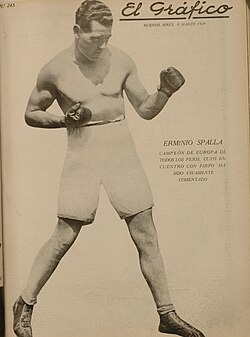
In 1924, Erminio Spalla departed for South America where, on March 7, in Buenos Aires, he faced the local idol Luis Ángel Firpo, called “The Wild Bull of Pampa”. On the stage of the world boxing, at that time, Firpo was considered a real "king without crown", for having faced and discarded outside the ring, at the first shooting, nothing less than the World Champion Jack Dempsey, before being put out of combat at the subsequent resumption, in a famous fight that was called "the meeting of the century". He resisted for fourteen shots after sending the Argentine champion to the ninth round, then he was defeated by Ko technician.[3]. He later entered the ring at the Palestra Italia in Sao Paulo to face the young Brazilian Benedicto Dos Santos, undefeated after three matches won in the first round. The Italian champion defeated him by knockout. in the ninth round after inflicting numerous knockdowns on him. Dos Santos would emerge crippled from the match and a few years later Spalla himself would donate the proceeds of one of his performances in Brazil to the Brazilian boxer's family.
Three months later, at the Yankee Stadium in New York, Spalla faced outclass Gene Tunney, a rising star of boxing and future world champion. At first, the European champion struck the American with a right-handed chin, putting it in great difficulty. In the end of the match, however, Tunney proceeded with a continuous series of blows by procuring series wounds to the lip and nose of the Italian. At the 7th round, according to the chronicles, Spalla's blind reaction turned the encounter "in a wrestling rage" ended with the fall to the carpet of his opponent. The match was then interrupted by the referee, not for disqualification, but for KO technical in favor of the boxer of the house[7]. According to Spalla, this defeat was undeserved, as the match would have been interrupted for no reason, due to a refereeing error[1].
On 28 September 1924, in Milan, Spalla granted the rematch for the European title to Dutch van der Veer, defeating him again at points in 20 shootings.[3]. In 1926 he returned to Argentina, where he played a new challenge with Firpo, which ended with a points victory on 12 rounds - as Spalla himself claims in his autobiographical book On the streets of the world - even if, officially, the Boxrec site reports his defeat[5]. He therefore lost the European title in May 1926, in Barcelona, defeated on points by the Basque Paulino Uzcudun, future opponent of Primo Carnera[3].
After a victorious encounter in Milan, for KO at the third resumption, against Dutch Daan Holtkamp, Spalla embarked on another trip to Argentina to face, in Buenos Aires, the gigantic Victorio Campolo, which was more than two meters high, from which he was defeated by KO at the seventh shooting. In 1927, he also lost the Italian title, against Riccardo Bertazzolo, for KO at the second resumption and retired from boxing.
Artistic and cinematic career
After retiring from boxing, Spalla emigrated with the family in Brazil, where he founded a sports magazine and opened a gym[1]; in 1934, in São Paulo of Brazil, he went back to the ring for a single meeting, probably just more than an exhibition. He moved to Rio de Janeiro, was taken by the passion of singing and, after attending a school, he was written as bass by a radio station in Rio and one of Petrópolis[1]. He was also a friend of great singers, such as Enrico Caruso, Beniamino Gigli and Titta Ruffo.
After returning to Italy in 1937, Spalla returned to work on sculpture and then began his career as a filmmaker since 1939.
During World War II, he was enlisted with the rank of sergeant in the Air Force and was assigned to the Parachute School of Tarquinia. After obtaining the military parachute patent, he was instructed to follow the instruction of Aeronautic Regia Destroyers regarding boxing, martial arts and defense techniques with bare hands.
Erminio Spalla filmed in all 53 films, with directors such as Mario Bonnard, Amleto Palermi, Goffredo Alessandrini, Carmine Gallone, Alessandro Blasetti (in: Fabiola 1949), René Clair, Vittorio De Sica and Dino Risi (Poor but beautiful in 1957 and The slaughterhouse 1960). Among his interpretations is the one of Barbo Gaetano in Miracle in Milan by Vittorio De Sica (1950), in which he improvised a fight of boxing with bare fists and that in An easy man by Paolo Heusch[1].
In 1969 he also starred in the television screenplay The brothers Karamazov by Sandro Bolchi[1].
Filmografia
Explore this chapter
- I, his father, directed by Mario Bonnard (1939)
- Invisible member, directed by Roberto Roberti (1939)
- The Bridge of Sighs, directed by Mario Bonnard (1940)
- The Lord of the tavern, directed by Amleto Palermi (1940)
- The company of the wedge, directed by Corrado D'Errico (1941)
- The Goodness of Venice, directed by Carlo Campogalliani (1941)
- Captain Storm, directed by Corrado D'Errico (1942)
- We're coming!, directed by Amleto Palermi (1942)
- The Lion of Damascus, directed by Corrado D'Errico and Enrico Guazzoni (1942)
- The two Foscaris, directed by Enrico Fulchignoni (1942)
- Giarabub, directed by Goffredo Alessandrini (1942)
- The West Child, directed by Giorgio Ferroni (1942)
- The Knights of the Desert, directed by Gino Talamo and Osvaldo Valenti (1942)
- The sample, directed by Carlo Borghesio (1943)
- Harlem, directed by Carmine Gallone (1943)
- The Sabine rat, directed by Mario Bonnard (1945)
- Every day is Sunday, directed by Mario Baffico (1946)
- Without family, directed by Giorgio Ferroni (1946)
- Return to the nest, directed by Giorgio Ferroni (1946)
- The Devil's Gondola, directed by Carlo Campogalliani (1946)
- The tyrant of Padua, directed by Max Neufeld (1946)
- Blood in Ca' Foscari, directed by Max Calandri (1947)
- Fumeria d'oppio, directed by Raffaello Matarazzo (1947)
- The Adventures of Pinocchio, directed by Giannetto Guardone (1947)
- The fiasure n. 13, directed by Raoul Andrè and Mario Mattoli (1948)
- Fabiola, directed by Alessandro Blasetti (1949)
- The pirates of Capri, directed by Giuseppe Maria Scotese (1949)
- Rondini in flight, directed by Luigi Capuano (1949)
- Holy disgrace, directed by Guido Brignone (1950)
- The beauty of the devil, directed by René Clair (1950)
- The Six Wives of Barbablù, directed by Carlo Ludovico Bragaglia (1950)
- The deported (♪), directed by Robert Siodmak (1950)
- Miracle in Milan, directed by Vittorio De Sica (1951)
- Uma Pulga na Balança, directed by Luciano Salce (1953)
- Cheri-Bibi (The Force of Guiana) (Chéri-Bibi), directed by Marcello Pagliero (1955)
- Avenge!, directed by Giuseppe Vari (1955)
- Come back, baby!, directed by Carlo Campogalliani (1955)
- I like it., directed by Giorgio Bianchi (1955)
- The red cloak, directed by Giuseppe Maria Scotese (1955)
- Wife and oxen..., directed by Leonardo De Mitri (1956)
- Goodbye dreams of glory, directed by Giuseppe Vari (1957)
- Poor but beautiful, directed by Dino Risi (1957)
- The Count of Matera, directed by Luigi Capuano (1957)
- Listen to me, directed by Carlo Campogalliani (1957)
- Only God will stop me, directed by Renato Polselli (1957)
- Ballerina and Good God, directed by Antonio Leonviola (1958)
- The maja desnuda (The Naked Maja), directed by Henry Koster (1958)
- An easy man, directed by Paolo Heusch (1959)
- Saracen's scimitar, directed by Piero Pierotti (1959)
- August, I don't know you., directed by Guido Malatesta (1959)
- The slaughterhouse, directed by Dino Risi (1960)
- Thesis against the minotaur, directed by Silvio Amadio (1960)
- Revenge of the Iron Mask, directed by Henri Decoin and Francesco De Feo (1961)
- The wrath of Achilles, directed by Marino Girolami (1962)
- Taur, the king of brute force, directed by Antonio Leonviola (1963)
Carousel
In 1957 he participated in the Carosello TV advertising column in a series of sketches that advertised the Brandy Gran Senior of Fabbri distilleries, with Virna...Explore this chapter
In 1957 he participated in the television advertising column Carousel in a series of sketches that advertised the Brandy Gran Senior of Fabbri distilleries, with Virna Lisi, Sylva Koscina, Dawn Addams, Luciana Peverelli, Nilla Pizzi, Sandra Milo, Isa Barzizza and Emilio Schuberth.
Recognition
In Rome, in the Ardeatino district, there is Viale Erminio Spalla.Explore this chapter
In Rome, in the Ardeatino district, there is Viale Erminio Spalla.
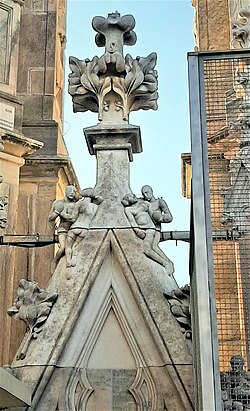
His image and that of Primo Carnera was immortalized in a wake of the Duomo of Milan to honor its sporting value, by the will of the fascist government[8].
Italian speakers
Explore this chapter
- Mario Besesti in The Goodness of Venice, The Sabine rat, Every day is Sunday, The Devil's Gondola, The tyrant of Padua, Come back, baby!, I like it.
- Mario Pisu in Poor but beautiful
Honors
Explore this chapter

Notes
Explore this chapter
- ^ to b c d And f g Boxenews, up boxenews.com. Retrieved 27 February 2015 (archived fromoriginal url on 27 February 2015).
- ^ to b The Monferrato (PDF), up ilmonferrato.it.
- ^ to b c d And f g h the j k Professional record of Erminio Spalla, up sportenote.com.
- ^ gazzetta.it.
- ^ to b c Boxing, up boxrec.com. Retrieved 27 February 2015 (archived fromoriginal url on 27 February 2015).
- ^ Orlando "Rocky" Giuliano, History of boxing, Longanesi, Milan, 1982, p. 321
- ^ Tunney-Spalla, up boxrec.com.
- ^ Two boxers on the cathedral, up minocittastato.it, Milan city state. Retrieved 20 October 2021.
Bibliography
Explore this chapter
- Erminio Spalla, In life and in the ring, Codara, Milan, 1928
- Erminio Spalla, A ton of fists, La Gazzetta dello Sport, Milan, 1932
- Erminio Spalla, On the streets of the world. Tales and adventures, S.E.R., Venice
- Aldo Rossi, The professional boxing in Italy from the beginning to 31 December 1957, Forlì typographic society, Forlì, 1958
- The actors, Gremese editore, Rome, 2002
- Luigi Ricagni (edited by), Monographic research on Erminio Spalla boxer, actor, opera singer and... «writer». Tribute to a distinguished compaesan on the 40th anniversary of his disappearance, Crescentino, 2011
- Mauro Parrini, Erminio Spalla. The Boxer Artist, Mursia editore, Milan, 2018 ISBN 978-88-425-5619-0
Continue your journey