A closer look
Chemical libration: at a glance
You have a chemical bond when an electrostatic force holds more atoms in a chemical species (strong or primary or intramolecular bindings) or multiple molecules in a condensed substance (weak or secondary or intermolecular alloys).
The "strong" chemical bonds have a greater energy content and are more difficult to break, while the "weaker" ties have less energy content and are easier to break. From this it comes that molecules which have weaker chemical bonds are more unstable.[1] Moreover, the more a bond is strong, the less the length of the bond, being the force that holds together the greater atoms.[2]
Electrostatic nature of the chemical bond
The nature of the chemical bond can be explained by observing the coulombian forces interacting between molecules. For example, we take the form of a cation: it consists of two H nuclei...Explore this chapter
The nature of the chemical bond can be explained by observing the coulombian forces interacting between molecules. For example, we take the station 


Primary Leagues
Covalent bond · Pure covalent bond · Polar covalent bondExplore this chapter
| Typical binding length and energy of bond[3] | ||
| Leaving | Length (pm) |
Energy (kJ/mol) |
|---|---|---|
| H — Hydrogen | ||
| H | 74 | 436 |
| H–O | 96 | 366 |
| H–F | 92 | 568 |
| H–Cl | 127 | 432 |
| C — Carbon | ||
| C–H | 109 | 413 |
| C–C | 154 | 348 |
| C=C | 134 | 614 |
| C.C. | 120 | 839 |
| C–N | 147 | 308 |
| C–O | 143 | 360 |
| C–F | 134 | 488 |
| C–Cl | 177 | 330 |
| N — Nitrogen | ||
| N–H | 101 | 391 |
| N–N | 145 | 170 |
| No. | 110 | 945 |
| O — Oxygen | ||
| O | 148 | 145 |
| O | 121 | 498 |
| F, Cl, Br, I — Halogen | ||
| F–F | 142 | 158 |
| Cl-Cl | 199 | 243 |
| Br–H | 141 | 366 |
| Br-Br | 228 | 193 |
| I–H | 161 | 298 |
| I–I | 267 | 151 |
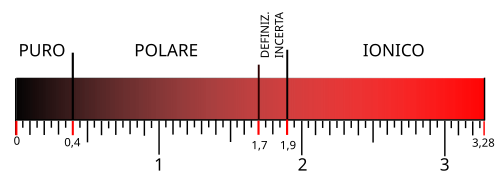
Primary chemical bonds are forces that hold together atoms forming molecules. A primary bond is carried out by the sharing or transfer of electrons between atoms and electrostatic attraction between protons and electrons. These bonds generate the transfer of an entire number of electrons, called binding order, although in some systems there are intermediate amounts of charge, as in benzene, where the bond order is 1.5 for each carbon atom. Primary ties are generally classified in three classes, in order of increasing polarity:
Covalent bond
The covalent bond is the link between two atoms belonging to non-metals (equal or having a difference of electronegativeness - Pauling scale - between 0 and 1,7) that put together a pair of electrons (called "binding pairs") in an external orbital that embraces both atoms. The covalent bond is represented by a hyphen that connects the two related atoms.
Pure covalent bond
A pure covalent bond (or apolar) is a covalent bond that does not necessarily establish between two atoms belonging to the same element.
A pure covalent bond (or homopolar or apolar) is when the difference in electronegativeness between two atoms is less than or equal to 0.4.

As the electronic cloud distributed symmetrically, the bond is not polarized.
The covalent bonds formed between two atoms that share two electron pairs take the name of "double bond". The covalent bonds formed between two atoms that share three electron pairs take the name of "triple bond".
To ascertain the number of covalent bonds formed between two atoms, one must know the value of the atom of the elements considered and after having made this discover how many electrons are lacking to be stable (regulation of the octet).
e.g. N=azoto V group= 5 valence electrons (+ 3 electrons to complete the octet)
The bonds between two nitrogen atoms are a triple bond.
Polar covalent bond
The polar covalent bond is established between two atoms with electronegative difference between 0.4 and 1.7. In this case, the electrons involved in the bond will be more attracted by the most electronegative atom, the bond will therefore be polarized electrically, that is each of the atoms involved in the bond will present a partial charge.
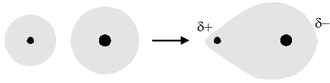
When a molecule is held cohesive by itself pure covalent bonds or has a symmetry such as to reciprocally cancel the polarities of its covalent bonds will be altogether apolar. Instead, a molecule consisting of two atoms linked to each other by a polar covalent bond is polar (or electric dipole); this generally does not mean that the molecule has an electrical charge because in its entirety it is electrically neutral. The polar structure of a molecule can be easily predicted if it is biatomic.
Coordination or dative bonds
It is a particular type of covalent bond called "dative", as the two electrons involved in the bond come from only one of the two atoms.
The atom that "gives" to the bond its "solo pair", i.e. both attached electrons present in an orbital is called "dator". The other, which provides an empty outer orbital (i.e. two empty places that can be occupied by two electrons) or reorganizes its electronic configuration to accommodate the pair of electrons (i.e. moving two electrons present on a odd orbital on another uneven orbital, effectively freeing an orbital) is called "adoption".
The dative bond can be represented with an arrow, from the donor to the acceptor, or more improperly it can be indicated with a double hyphen.
Delocalized alloys and metal bond
Some covalent bonds, called "delocalized", can bind together three or more atoms simultaneously, as in the bores and aromatic compounds.
Metal bond
The most extreme form of delocalization of the covalent bond is in the metallic bond. According to this model a metal can be represented as a crystalline reticle of positive ions held together by a cloud of shared electrons extended to all the lattice (sea di Fermi); being such electrons not linked to any particular atom, they are extremely mobile; such mobility is responsible for the high electrical conductivity of metals.
Ionian litter
The ionic bond is a bond between ions with an opposite sign charge. These ions are formed by atoms with electronegative difference (ΔE)No) higher than the conventional limit of 1.7 - 1.9: in these conditions, the more electronegative atom (therefore characterized by a high ionization energy and high electronic affinity, therefore more exposed to attracting an electron to itself) deprives the other less electronegative atom (characterized by a low ionization energy and an almost absent electronic affinity, therefore with less possibility of attracting an electron to itself) of an electron; the first atom becomes a negatively charged ion (negative ion), the second a positively charged ion (positive ion).
This bond is of a purely electrostatic nature; the arrangement of atoms in space does not have the directionality of covalent bond: the electric field generated by each ion spreads symmetrically into the space around it.
The ΔENo is in relation to the degree of polarity of a compound, this means that the greater the ΔENo, the greater the degree of polarity. It follows that the polarity in ionic compounds is very high as one or more electrons are transferred to the more electronegative atom.
It is the simplest type of chemical bond, both from a conceptual point of view and from that of its analytical description, being interpretable according to classical laws of electrostatic.
Such links break during the solvation process.
Secondary ties
Molecular dipoles may cause intermolecular attraction forces.Explore this chapter
Molecular dipoles may cause intermolecular attraction forces.
Intermolecular ties are essentially constituted by mutual attraction between static dipoles - is the case of polar molecules - or between dipolies and ions - is the case, for example, of a Sale that melts in water.
In the case of noble gases or compounds formed by apolar molecules, liquefare is explained by the random formation of a temporary dipole when electrons are randomly concentrated on one side of the molecule; this dipole causes an imbalance in electrical charge (the so-called "induced dipole") in molecules close to them, which generates reciprocal attraction and causes the condensation of the gas. The bond is then produced by these particular forces of attraction called "dispersion forces or Van der Waals".
A particular case of intermolecular bond, which can also be intramolecular when the molecule geometry allows it, is hydrogen bond.
A hydrogen atom linked to an oxygen atom (or fluorine), due to its positive polarization and reduced dimensions, attracts the oxygen atoms (and fluorine at a lower level) close by with a relatively high intensity.
This connection, although weak, is responsible for spatial conformation of proteins and nucleic acids, which depend on the biological activity of compounds themselves.
As an order of magnitude, the extent of the various binding forces can be indicated by the following table:
| Type of connection | Relative force |
|---|---|
| Ionian litter | 1000 |
| Dipolar interactions and hydrogen bond | 10 - 100 |
| Van der Waals force | 1 |
Notes
Explore this chapter
- ^ In this regard, an example is given by the ethylene molecule compared to the ethan molecule. In the case of ethylene, the two carbon atoms are linked by two bonds: a stronger σ bond and a weaker π bond. In the ethane molecule, however, the two carbon atoms are linked by a single σ bond. For this reason, the ethylene molecule is more unstable than the ethane molecule, as after heating it has the opening of the π bond, which is weaker.
- ^ In fact, the chemical bond acts as an attractive force, which is opposed to a repulsive force (which increases in intensity to decrease distance), so the reciprocal position of atoms is a balance position given by the conflicting action of the two forces. To deepen: potential of Lennard-Jones.
- ^ The binding length is expressed in pm and can be converted into à dividend per 100 (1 Š= 100 pm). The energy is expressed in kJ/mol. Data taken from [1] Archived on 14 December 2007 at the Wayback Machine..
Bibliography
Explore this chapter
- Paolo Silvestroni, Fundamentals of chemistry, 10th ed., CEA, 1996, pp. 38-97, ISBN 88-408-0998-8.
Continue your journey