A closer look
Michele da Acqui: at a glance
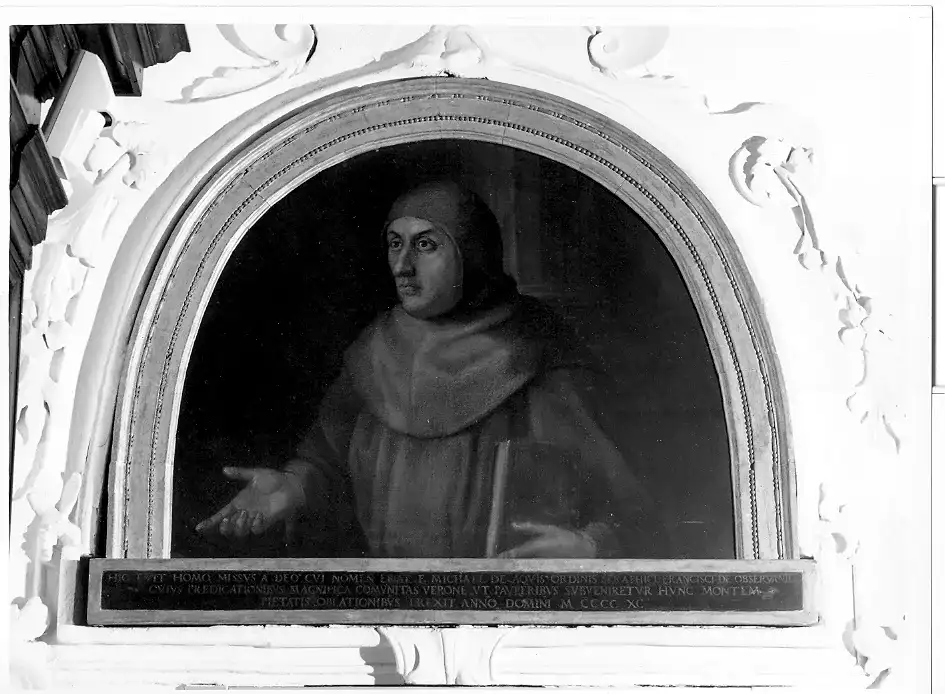
Michele Pevere also Michele da Acqui (Acqui Terme, mid-15th century – circa 1500) was an Italian preacher and religious man, friar of the Order of Friars Minor, who was active in central-northern Italy at the end of the 15th century, where he played an important role in the spread of the Monti di Pietà, whose foundation he promoted in Brescia, Verona and Cremona, supporting a model based on free lending.
Biography
The Pietà MountainsExplore this chapter
The news about the first part of Michele da Acqui's life is scarce and fragmentary. He was certainly born. Acqui Terme in the middle of the fifteenth century, with the local historiography that considers dubious the ascription of the friar to the Pevere family.[1]
Michele joined the Franciscans within the religious province of Genoa, which was also part of the convent of Acqui. It is not known when he entered the order or details of his formation, as it is believed that it took place within the path of future preachers, with a testimony of his coeva who praised its competence in canon law and civil law, typical characteristics of the formation of preachers of the time.[1]
The first documentary news about his activity dates back to 14 June 1482, when he was appointed provincial commissioner in Sardinia, a role he left the following year leaving the island with his collaborators and appointing his own replacement without the authorization of the vicar general. He justified the incident with health reasons, which he did not convince the vicar, who begged Michael to return to his duties. Michele, in the meantime, had returned to Genoa and had returned to move among Piedmontese convents. Inciting not to comply with the order of returning to Sardinia, with motives, in the opinion of the vicar, "excessly legalistic", he was finally relieved from the assignment on February 28, 1484.[1]
In 1487 he was appointed apostolic preacher and in charge of the Lenten preaching of the following year to Perugia, where he obtained from priori a first financing for the construction of a chapel at the castle of Brufa, where John da Capestrano had been imprisoned and had matured his religious choice. In May 1488, Michele da Acqui was in Assisi, where he intervened in the peace of the city, at the time affected by political violence, and participated in the approval of new statutes; following this result Pope Innocent VIII again entrusted him with the Lenten preaching in Perugia for the year 1489.[1]
The Pietà Mountains
Since the end of the 1480s, Michele da Acqui's activity has concentrated mainly in northern Italy and read itself to the promotion of the Pietà Mountains. In 1489 his preaching in Brescia contributed to the foundation of the Monte Citta, where he returned for Lent of the following year. Michele, in his preaching, supported a model of Monte based on the free loan, with the costs of managing the offers of the faithful and local authorities. To this end, Michael founded several confraternities which had the objective to contribute periodically to the financing of the Mountains.[1]
In 1490 Michele da Acqui played a decisive role in the foundation of Monte di Pietà in Verona, obtaining through his preaching the favor of citizenship and providing the chapters of the institution, favouring approval by the civic council; moreover, he organized a public celebration and a procession with the aim of raising funds, promoting subsequently the Scola del Santo Monte de la Pietà, confraternity responsible for financially supporting the institute.[2] These activities earned Michele da Acqui the honorary citizenship of Verona, a city in which he returned to preach in 1491 and 1496.[1]
In 1490 he also contributed to the foundation of Monte di Pietà in Cremona.[1]
In the debate between his contemporaries Michele da Acqui, with his idea of free loan, for him considered as a form of wear, he clashed with the ideas of Bernardino da Feltre, who instead was favorable to the application of a modest interest destined to the exclusive coverage of the operating expenses of the institutes.[1]
The two conceptions were discussed, in the presence of both religious, in 1493 to the Franciscan General Chapter of Florence, which established that in future only Mountains were founded in interest, as judged more solid financially, since they did not depend on the continuous collection of offers.[1]
In 1495, Michele da Acqui participated as a descriptor in the general chapter of L'Aquila, during which he was appointed commissioner for Observants in Poland and Austria, although it is not known whether he actually accepted the assignment and then abandoned Italy. In 1496 he was a preacher in the cities of Crema, Pavia, Verona and Padua, where he intervened in favor of the local Monte di Pietà, while in Crema organized public collections in favour of the Monte Citta, founded in 1493 following the preaching of Ludovico della Torre.[1]
In 1497 it was attested its presence in Genoa, where he founded a Schola Pietatis destined to the assistance of the poor, to which he attached a brotherhood, according to a model similar to that of his Mountains of Pietà. During this period, tensions emerged in the order with the vicar Gerolamo Tornielli and the provincial vicar Domenico da Ponzone, who in May 1497 asked Ludovico il Moro to discreetly prevent Michele da Acqui and some of his supporters from participating in the provincial chapter of Pavia, fearing that their presence could provoke disorders.[1]
It is believed that between 1495 and 1496 Michele da Acqui was also engaged in a preaching against the positions of Girolamo Savonarola. His last documented activity dates back to 1499, when he returned to Perugia for the Lenten preaching and obtained further funding for the chapel at Brufa. He died presumably around 1500, probably in Brescia.[1]
Bibliography
Explore this chapter
- Pietro Delcorno, Pevere, Michele, in Biographic dictionary of Italians, Rome, Institute of the Italian Encyclopedia, 2015.
- (PT) Pietro Delcorno, Miguel de Acqui and fundação do Monte de Piedade de Verona: um incunábulo inédito, in Varia Historia, vol. 31, no. 55, 2015, DOI:10.1590/0104-87752015000100006 (archived fromoriginal url on 17 November 2023).
Continue your journey