Atlas of Monferrato
Acqui Terme: sights, history and trails
Alessandria
- Elevation
- 156 m above sea level
- Area
- 33.3 km²
- Demonym
- aquesi or acquigiani
- Patron saint
- Saint Guido and Saint Majorinus
A closer look
Discovering Acqui Terme
Acqui Terme (Acqui to the 1956) is an Italian commune 18 966 inhabitants[2] from the province of Alessandria in the Piemonte. It is located in the middle-low river valley Bormida, in the top Monferrato, and is part of the geographical region ofAcquese. It is also one of the area centers of the province, as it is home to the hospital, the school center (middle and high school) and other services for the people.
Landscape and area
Acqui Terme is located in the south-eastern area of upper Monferrato on the left bank of the Bormida river, which, after the confluence of the two branches of Spigno and Millesimo,…Explore this chapter
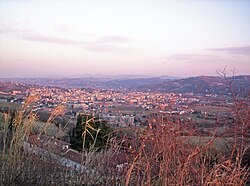
Acqui Terme is located in the south-eastern area of the Alto Monferrato on the left bank of Bormida river, which, after the confluence of the two branches of Spigno and di Thousandth, the road opens towards the plain of Alessandria, among gently rolling hills.
The city is located in a strategic position at the crossroads of some important roads: the Turchino state road which goes from Asti to Nizza Monferrato, Acqui, Ovada and Voltri and that of Val Bormida which gives Alessandria it leads to Savona, across the Colle di Cadibona; finally that of Sassello, from Acqui to Varazze and Savona via Colle del Giovo, a panoramic route but full of hairpin bends.
The oldest nucleus is Borgo Pisterna, adjacent to Borgo Nuovo and Borgo San Pietro: together they represent the current center of the city, which then gradually developed both towards the plain and towards the hills. In more recent times and beyond Bormida river the thermal and bathing area has developed, with the Hotel Antiche Terme, home to a grandiose park, the thermal establishments and numerous hotels, and the hamlets of Ovrano and Lussito[5].
History of Acqui Terme
The myth · Prehistory and the Roman age · Late antiquity and the early Middle AgesExplore this chapter
The myth
According to a legend, Acqui was founded by Greek colonists, attracted by the presence of thermal waters.[6]
The tradition perhaps arose from the "Greek-like" name (at least that is how Tito Livio passes it down) of Carystum, capital of the Ligurian Statielli, similar to that of some Greek cities.[without source]
Prehistory and the Roman age
Even if findings occurred in the surrounding area (Ponzone, Sassello) date back to the Paleolithic, the first evidence identified so far of human presence in Acqui dates back to the Neolithic (5500-3500 BC): a settlement was located near the Bormida river in the Fontanelle region. Already in the Bronze Age it was inhabited by Ligurian populations, in particular by the Statielli tribe whose main centre, Carystum, was probably in the place at peace with Rome. In fact, after being attacked and treacherously defeated, the Senate pronounced itself for the first time in favor of a "barbarian" population and decreed the liberation and compensation of the defeated. Between the 2nd and 1st centuries BC. the named urban center was formed Aquae Statiellae or Aquae Statiellensium, indicating that the ancient people, now Romanised, were not dispersed.
The city's importance grew with construction in 109 BC. of the Via Aemilia Scauri, which connected Dertona to Go Sabatia (today's Tortona and Vado Ligure), passing through Acqui and the Cadibona Pass. In the imperial age this road was renamed via Julia Augusta: it was among the major land connections and connected the Po Valley, through the Riviera di Ponente, with Narbonensis Gaul and Spain.
Like other centers of Cisalpine Gaul, it obtained the ius Latii in 89 BC and then full citizenship in the Caesarian age, becoming a municipality assigned to the tribe Tromentina, inserted in the Augustan Region IX. It governed a territory (municipium) extended between the left bank of the Orba stream and the Apennine ridge and including the middle and lower valleys of the stream Belbo (up to Cossano Belbo) and the two Bormides (up to Cortemilia and Dego), today administratively divided between the provinces of Alessandria, Asti, Cuneo and the hinterland of the provinces of Savona and Genoa.
Furthermore, the thermal springs of Acqui certainly enjoyed considerable prestige. The Latin writer Gaius Pliny Second remembers them among the most important in the Roman world, together with those of Puteoli (Pozzuoli) and of Aquae Sextiae (Aix-en-Provence). The Roman city was in fact equipped with at least three thermal baths, of which some remains survive today. Furthermore, a monumental aqueduct guaranteed the supply of common water for both thermal and domestic and productive uses.
Late antiquity and the early Middle Ages
In the late empire, perhaps already in the 4th century, a Christian community developed in Acqui and the city was the seat of a bishop, and was the seat of a garrison of Sarmatians.
St. Majorus was the first bishop of the city, perhaps at the end of the 4th century. The presence of the thermal baths (still in use in gota age - as Cassiodoro says - and Lombard - according to Paolo Diacono) and an episcopal chair ensured the survival of the city even during the difficult period of early medieval times, unlike many other centers of the Piemonte southern which were abandoned right at this time (Libarna, Pollentia, Augusta Bagiennorum, Vardacate, Industria, Forum Fulvii etc.).
The Lombard conquest probably occurred within the last decades of the 6th century: near the city in the Bossallesio area, a small Lombard necropolis was found, perhaps dating back to the first phases of the occupation. Acqui, perhaps included in the Duchy of Asti, was a border territory since coastal Liguria was in Byzantine hands. Under the Franks it was the seat of a committee within the Aleramic March.
Between Bishop and Municipality (10th - 12th centuries)
As in many cities of northern Italy, in the Ottonian age public power was exercised by the Bishop, who in 978 received an imperial diploma from Otto II. At that time, construction work began on the large cathedral, dedicated to the Assumption, on the initiative of Bishop Primo, and perhaps the construction of the first city walls.
In the following century, Bishop San Guido (patron saint of the city and the diocese) completed the construction work on the cathedral, which he consecrated in 1067, and founded two monasteries in the city, one female (Santa Maria de Campis) and one male near the ancient early Christian church of San Pietro. Already in the first decades of the 12th century the Municipality developed (the first attestation dates back to 1135), which tried to assert its autonomy towards the Bishop and over a modest extension of the countryside.
The development of Acqui came to a halt with the foundation of the new city of Acqui in 1168 Alessandria, promoted by Genoa and by the Municipalities of the Lombard League hostile to the emperor Frederick Barbarossa: the new city, in fact, tried to wrest the episcopal seat, with serious political-economic consequences, from Acqui, with the support of the then reigning Pope Alexander III (from which Alessandria he took the name).
Many times, the Alexandrians clashed with Acqui, wanting to take control of the territory around Acqui. For this reason, Acqui did not join the Lombard League but was almost allied with the imperial party (as revealed by the eagle in its coat of arms).
Once these wars ended in 1234 thanks to Frederick II of Swabia, internal struggles between the Blesi and Bellingeri families began.
Acqui nel Monferrato (the late Middle Ages and the modern age)
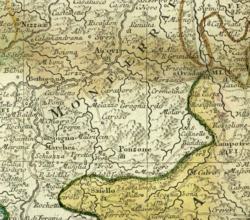
In 1278, no longer able to withstand the threats of Alessandria and other hostile powers, torn by internal struggles, Acqui preferred to hand himself over to the Marquis William VII of Monferrato.
Since then, except for brief periods, as under Charles I of Anjou, Acqui remained permanently part of Monferrato even when, in 1306, the Aleramici dynasty became extinct and the marquisate passed to a cadet branch of the Byzantine imperial family, the Paleologi (heirs of the Aleramici in the female line). Between 1322 and 1345 Acqui was occupied by Roberto d'Angiò, to subsequently return to marquises of Monferrato.
In 1431, it was occupied, like other parts of the marquisate, by the Visconti of Milan, but already in 1436 it returned to the Paleologi, who had requested the help of Amedeo VIII of Savoy. In 1533 the Palaeologan house also became extinct and all of Monferrato passed to the dukes of Mantua. In 1566 it was the seat of the local senate and damaged by the wars between the Spanish and the French and by the subsequent plague of 1630. The annexation of Monferrato (and Acqui) to Piemonte sabaudo occurred in 1708.
The contemporary age
In the first years of the Second World War, between 1941 and 1943, Acqui was with Casale Monferrato one of the two municipalities in the Alessandria area designated as a place of free internment for foreign Jews.[7] After 8 September 1943, with the German occupation, the group of refugees immediately left the country and dispersed; they will all manage to escape capture and deportation. Instead, 12 members of the local Jewish community were arrested in Acqui and deported (16 others were captured in other locations and 6 non-Jewish Acqui residents were deported as politicians).[8]
Symbols
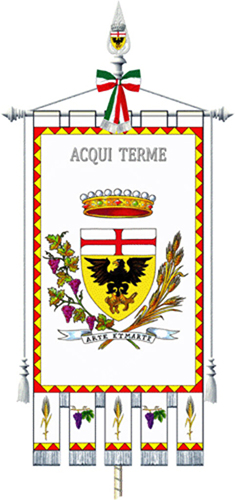
The historic coat of arms of Acqui Terme, adopted between the end of the 13th century and the beginning of the 14th, was officially recognized with the decree of the head of government of 30 May 1940.[9]
The civic banner was granted with the decree of the President of the Republic of 9 October 1981.[9]
The patent cross, according to some Acqui historians including Guido Biorci, would recall Acqui's participation in the Crusades[11]; more likely it is a symbol of the temporal dominion of the bishops and finds it on coins minted during the reign of Emperor Frederick (I or II). The eagle with the hare is mentioned for the first time in the fourteenth century by chronicler Benzo of Alessandria: «Civitas hujus sigillum habet aquilae figuram unguibus sustinentem leporem et versum talem».[12]
What to see in Acqui Terme
Religious architecture · Church of San Francesco · Cathedral of Santa Maria AssuntaExplore this chapter
Religious architecture
Church of San Francesco
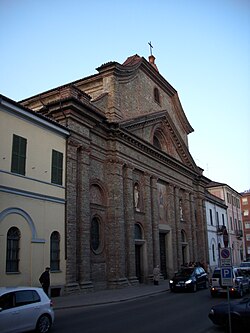
Not far from the Bollente stands the church of San Francesco (formerly San Giovanni), formerly connected to a Franciscan convent of which two fifteenth-century cloisters survive adjacent to it.
The church was almost entirely rebuilt (except for the Gothic apse and bell tower) in neoclassical style in the mid-19th century.
In addition to a fine wooden door by the sculptor Giulio Monteverde (1837-1917), it has a monumental façade with a large tympanum and an interior with a barrel vault, frescoed by Pietro Ivaldi da Ponzone known as "Il Muto".
A canvas by Guglielmo Caccia Moncalvo is preserved there.
Cathedral of Santa Maria Assunta
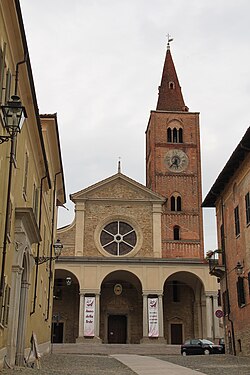
The cathedral of Santa Maria Assunta was built starting from the 10th century and consecrated in 1067 by Bishop Guido, venerated as the patron saint of the city and the diocese. It is a Romanesque building with a Latin cross plan, originally with three naves, which became five in the 18th century. The interior features eighteenth and nineteenth century decorations: the baroque altar of San Guido d'Acqui and the triptych of the Annunciation or the Madonna of Monserrat by the Catalan painter Bartolomeo Bermejo (late 15th century) are notable.
Church of St. Peter
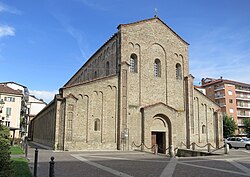
The church of San Pietro, also known as the church of Addolorata, has early Christian origins. It was almost entirely rebuilt between the 10th and 11th centuries in Romanesque style when a Benedictine abbey was established there.
Profoundly transformed in the 18th century, it was restored (and partially rebuilt in neo-Romanesque style) in the 1930s. The central nave and part of the side naves, the apses and the octagonal bell tower remain original.
It has the dignity of a minor basilica.[13]
Church of Sant'Antonio Abate
The church of Sant'Antonio Abate was built in 1608 by the Barnabites under the title of San Paolo, connected to the convent of the same name and rebuilt in 1701. In 1812 the brotherhood of Sant'Antonio was moved there. The rococo wooden furnishings are very valuable.
Civil architecture
The Boiler
In the center of Piazza della Bollente, on the side of the central Corso Italia, there is an octagonal marble aedicule, built in 1879 by the architect Giovanni Ceruti. This surrounds a thermal spring from which boiling, healing water flows: 560 liters per minute at 74.5 °C of sulphurous-salt-bromine-iodic water.
An ancient tradition tells that newborn children were taken to the spring to be immersed in it for a moment: if they came out alive, they deserved the nickname he scoffed, i.e. scalded.
The town hall
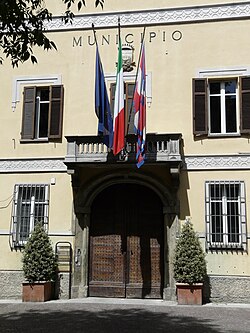
On the same Piazza Levi hosting the Church of San Francesco, there are two important buildings: the Town Hall, former home of the Counts Lupi of Moirano, built in the 17th century and which became the municipal seat at the beginning of the 20th century (when the civic tower was built) and the Casa Robellini, built in the 16th century with eighteenth-century transformations.
The regional wine shop is located in the basement.
The civic tower
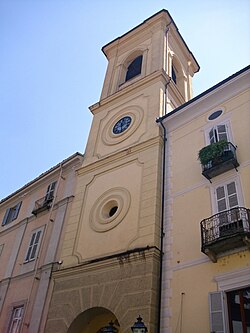
The Civic Tower overlooking Piazza della Bollente, the result of a raising of a floor of a door of the ancient city wall from the municipal age (12th-13th centuries) in 1763, is equipped with a bell and other devices and served as the city's civic clock starting from the end of the 18th century. Around the same square once stood the Jewish ghetto.
Other buildings of historical interest
Among other buildings of historical interest we can include the Bishop's Palace, whose construction began in the first half of the 15th century and ended in 1592, thanks to bishop Giovanni Francesco Biandrate of San Giorgio Aldobrandini. The ancient building stands in the adjacent Via Verdi Santa Maria Maggiore Hospital, also built in the 15th century and currently home to the Ottolenghi hospital, inside which there is a bronze group by the sculptor Arturo Martini. It is located in the sixteenth-century city hospital of which the triple order of loggias remains. Robellini Palace is built by Giovanni Antonio Robellini at the end of 500, as evidenced by the important colonnade, was re-launched in the 18th century by Dagna Sabina to whom the hull and the aulic environments are due. Today the offices of the city councillor are housed in culture and the municipal exhibition room. The wine cellars are located in the Regional Wine Shop. Palazzo Roberti, from the end of the 16th century, with a 19th-century façade on Piazza Addolorata. Timossi Palace in via Garibaldi, dating back to the early 18th century[14], apparently built on the site of an ancient Benedictine convent, with the internal façade embellished with mythological reliefs[15] by Gianni Remuzzi.[16]
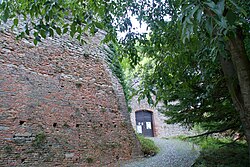
Military architecture
Palaiologi Castle
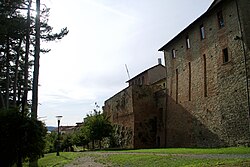
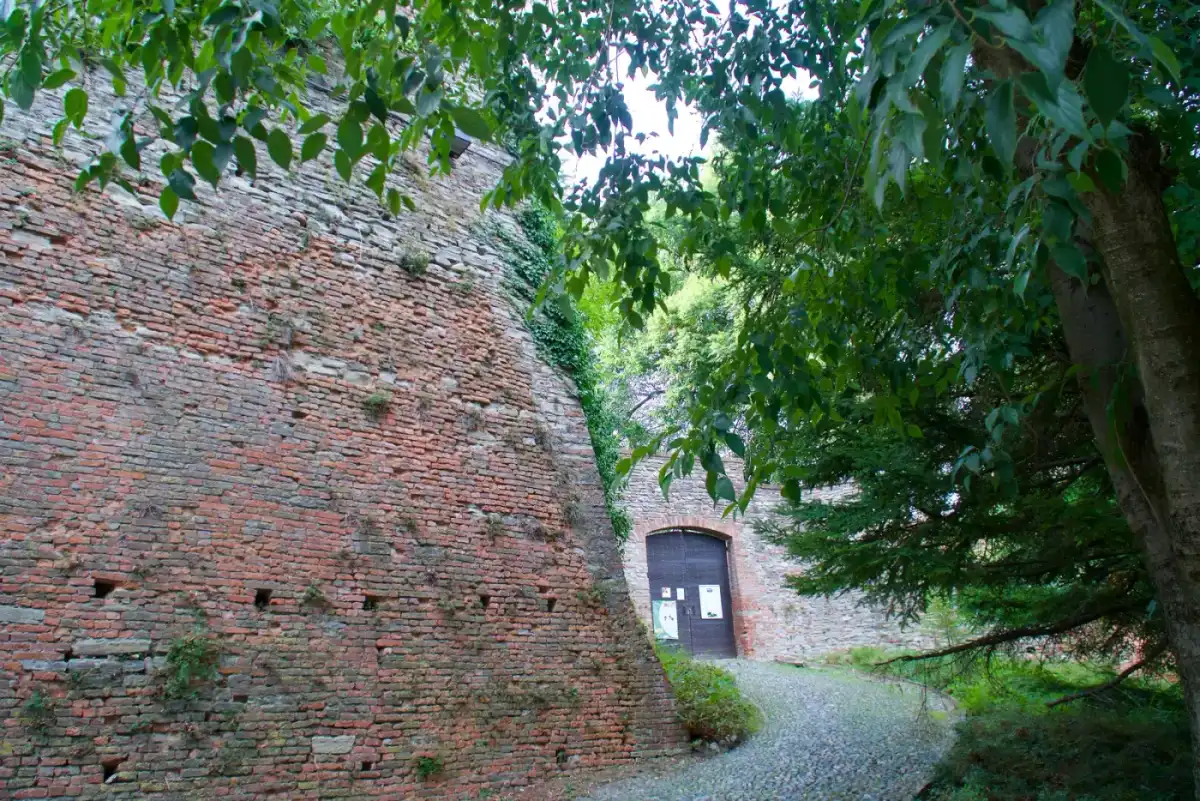
The Palaiologi castle is mentioned for the first time in 1056; it was rebuilt in the 15th century by the Marquis of Monferrato William VIII Paleologus.
With the use of gunpowder it became inadequate from a defensive point of view and was damaged and conquered several times.
Between the early 19th century and the 1980s it served as a judicial prison.
Part of the castle houses the municipal Archaeological Museum which houses numerous finds, especially from the Roman era, found in the surroundings of the city.
It is inserted in the system of "Open Castles" of Basso Piemonte.
Archaeological sites
The Roman aqueduct
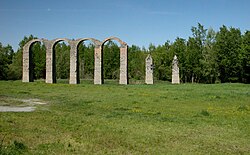
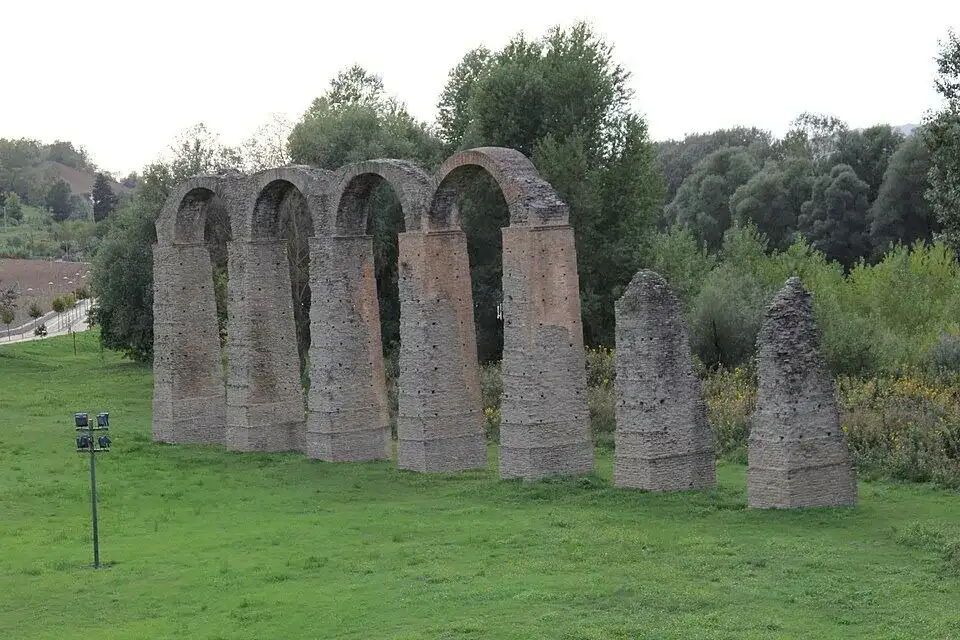
Visible from the Carlo Alberto bridge on Bormida river, are the remains of the Roman aqueduct made up of 15 pillars and 4 arches.
The structure, one of the symbols of the city, dates back to the imperial era; the pipeline was originally long 13 km and drew water from the Erro stream, near Cartosio also crossing the territory of Melazzo.
It is one of the best preserved structures of this kind in Northern Italy. Other important testimonies of the Roman period are found in the city, for example the remains of the swimming pool calidarium of a spa facility.
Roman tub
Remains belonging to a vast thermal complex dating back to the imperial age, found in the current Corso Bagni in 1913, during the construction of new porticoes next to the Hotel Nuove Terme.
Roman necropolis
Found in 2025 near via Badano, in an area long subjected to archaeological restrictions.[17]
History of hot springs
In the Bagni district, on the right bank of the Bormida, there are other thermal springs (Lago delle Sorgenti, made up of seven sources at 45-55 °C; the small fountain of Acqua Marcia, around 20 °C). Here, at the end of the fifteenth century, a spa called Antiche Terme was built, destroyed in the seventeenth century by a landslide. The current building, rebuilt in 1687, was expanded in the 19th century with the addition of pavilions and an entire floor. Nearby is the "Regina" spa and a vast swimming pool built in 1927.[18]
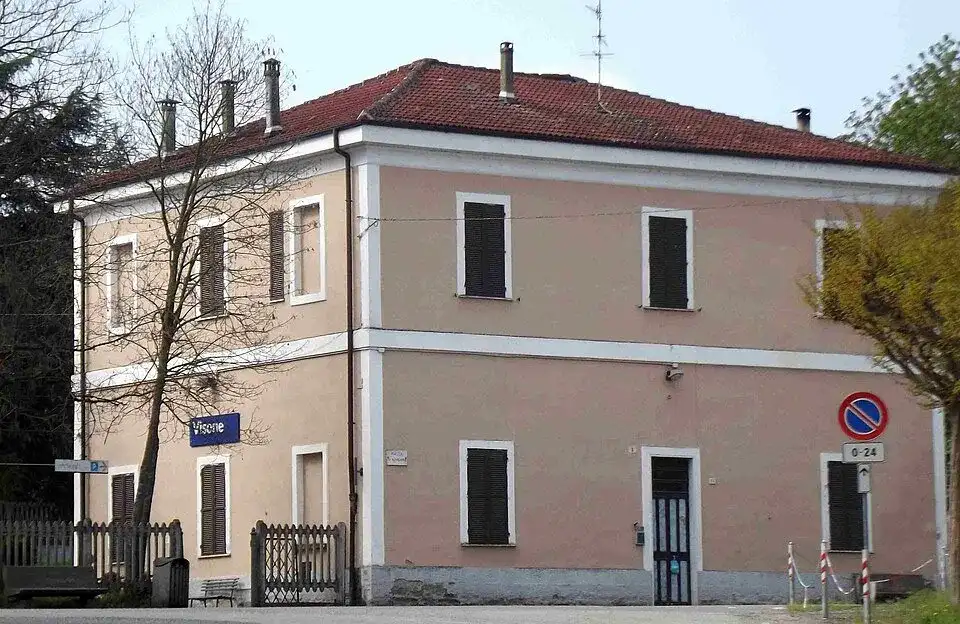
The hypothermal waters springing from the municipality of have a similar origin to the previous ones Visone from the so-called "Fontanino di Visone", near the train station. However, the latter immediately undergo considerable cooling during the ascent (temperature: 21.8 °C) and strong mixing with superficial groundwater.
The other thermal establishment dates back to the last decades of the 19th century and is called "Nuove Terme": it is located on the edge of the historic center (left bank of the Bormida), in Piazza Italia, where since 1 January 2000 there have been two monumental fountains called "delle Ninfe" and "delle Ninfee". Since 2009 the former fountain of the nymphs, no longer equipped as such, although remaining unchanged in geometry, presents itself as a flowerbed full of flowers and with centuries-old olive trees inside. This renovation improved the atmosphere of Piazza Italia from an aesthetic and practical point of view, making it less burdened by icy marble and more open to the tourist's eye, right in front of the entrance to the Grand Hotel Nuove Terme. The Carrara marble bas-relief of the fountain of the Nymphs, after its transformation into a flowerbed, was relocated to the garden of the Castello dei Paleologi.
Since 2023, the garden has also been replaced by a new fountain in the center of the city, characterized by tanks and nozzles that spray water features, all enriched by a LED lighting system that creates evocative scenographic effects in the evening hours.
Society
Demographic evolution · Foreign ethnic groups and minorities · The Jewish community of Acqui TermeExplore this chapter
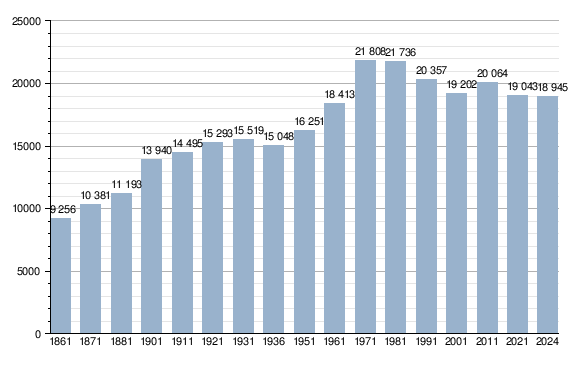
Demographic evolution
Inhabitants registered[19]
Foreign ethnic groups and minorities
As of 31 December 2019, there were 2076 foreigners resident in the municipality. The largest groups are shown below[20]:
- Morocco, 707
- Albania, 523
- Romania, 354
- Ecuador, 100
- China, 94
- Republic of Macedonia, 93
- Dominican Republic,34
- Bulgaria,27
- Ukraine, 25
- Senegal, 23
- Pakistan,18
- Moldova,13
The Jewish community of Acqui Terme
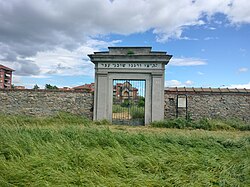
Acqui Terme was home to a thriving Jewish community until the years preceding the Second World War. As evidence of its history, the buildings of the old ghetto remain (but not the synagogue dismantled at the beginning of the twentieth century) and the ancient cemetery in via Romita.[21]
Languages and dialects
In Acqui Terme, an upper Monferrato dialect of the Piedmontese language is spoken.
Culture
Typical cuisine and products · Wines and spirits · EventsExplore this chapter
The city's motto is "Art and Mars", which can be translated "With ingenuity and with strength".
Typical cuisine and products
- Formaggetta - It is a goat's milk cheese, soft, more or less matured.
- Kissed fillet - It is a cured meat that is obtained by stuffing minced pork meat around a pork fillet previously preserved in brine. This cured meat is aged for approximately two months. It is served as an appetizer.
- Mushrooms - Porcini mushrooms, chanterelles, ovules, tacks, drumsticks.
- Truffle.
- Macaroons - These are small, round desserts made with sweet and bitter almonds, sugar and egg white.
- Farinata - Here the solid and constant relationship that links these territories to the Ligurian Riviera comes into play. Farinata is a thin chickpea cake of ancient Genoese origin, which spread to Acqui Terme in the last century; today it has fully become a local specialty. It is served piping hot and seasoned with black pepper.
- Acquese al rum - Dark chocolate filled with rum.
- Stockfish all'Acquese - typical dish of the city, also called "u stucafìs" is a recipe of horse-riding origins between Piemonte and Liguria. It falls within the PAT classification (traditional agri-food products)
Wines and spirits
- Dolcetto d'Acqui DOC - It is a red table wine
- Barbera d'Asti DOCG - It is a red table wine
- Brachetto d'Acqui DOCG - It is a sparkling or still red dessert wine
- Moscato DOCG - It is a sparkling white dessert wine
- Moscato passito DOCG - It is a sparkling white dessert wine
- Cortese passito DOC - It is a white table wine
- Moscato passito DOC - It is a white dessert wine
- Amaro Gamondi - Digestive liqueur
Events
Among the most important events are the Acqui History Award, a literary prize born in 1968, and the Acqui Ambiente Prize born in 1997[22], the International Biennial for Engraving, an event for the art of engraving from all over the world, and the Regional Dialect Poetry Competition, organized by the municipal department of culture and reaching its XXXVIII edition in 2025[23].
Economy
CraftsmanshipExplore this chapter
Craftsmanship
The work of wrought iron is notable, especially aimed at the production of furniture.[24]
Infrastructure and transport
Roads · RailwaysExplore this chapter
Roads
The Sassello state road 334 (ss 334) starts from Acqui. The southern part of the town is crossed by the Val Bormida state road 30 (SS 30) which connects Savona to Alessandria and intersects within the municipal territory, near the Bormida River, the Turchino state road 456 (SS 456) (known as Asti Mare road) that connects Asti and Genoa.
Railways
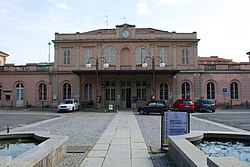
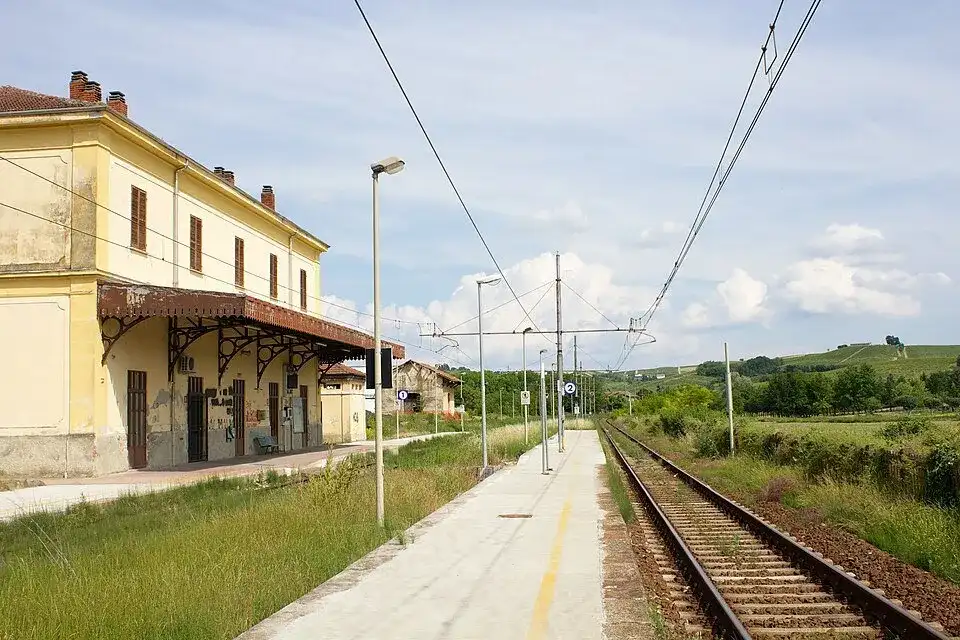
From the Acqui Terme station there are direct lines to Alessandria, Genoa Brignole, San Giuseppe di Cairo, Asti.
In the categorization of RFI stations, Acqui Terme is considered a category station silver.
Administration
Twinning · Other administrative informationExplore this chapter
Below is a table relating to the administrations that have succeeded one another in this municipality.
| Period | First citizen | Match | Load | Notes | |
|---|---|---|---|---|---|
| April 23, 1988 | December 11, 1989 | Enzo Balza | Italian Socialist Party | Mayor | [25] |
| January 15, 1990 | June 16, 1990 | Ubaldo Carlo Cervetti | Italian Republican Party | Mayor | [25] |
| June 16, 1990 | June 8, 1992 | Ernesto Cassinelli | Christian Democracy | Mayor | [25] |
| August 8, 1992 | December 28, 1992 | Giovanni Zito | Comm. pref. | [25] | |
| December 28, 1992 | July 27, 1993 | Bernardino Bosio | Northern League | Mayor | [25] |
| September 8, 1993 | December 15, 1993 | Paolo Mongini | Comm. pref. | [25] | |
| December 15, 1993 | November 17, 1997 | Bernardino Bosio | Northern League | Mayor | [25] |
| December 2, 1997 | June 10, 2002 | Bernardino Bosio | Northern League | Mayor | [25] |
| June 11, 2002 | June 12, 2007 | Danilo Rapetti | civic list | Mayor | [25] |
| June 12, 2007 | June 6, 2012 | Danilo Rapetti | centre-right | Mayor | [25] |
| May 21, 2012 | June 25, 2017 | Enrico Silvio Bertero | civic list: acquinsieme, Il Popolo della Libertà, civic list: for Bertero mayor | Mayor | [25] |
| June 25, 2017 | July 17, 2022 | Lorenzo Giuseppe Lucchini | 5 Star Movement | Mayor | [25] |
| July 17, 2022 | in office | Danilo Rapetti | civic list | Mayor | [25] |
Twinning
 Genoa
 Argostoli
 Tășnad
Other administrative information
Acqui was the capital of the district and district from 1859 until the suppression of these bodies in 1926.
In 1929 it incorporated the municipalities of Terzo and of Visone, made autonomous again in 1947.[26]
It was renamed Acqui Terme by decree of the President of the Republic of 16 March 1956.[27]
Sport
Acqui Terme has been the starting point of a stage of the Giro d'Italia three times: in 1937, in 1955 and in 2024.Explore this chapter
Acqui Terme has been the starting point of a stage of the Giro d'Italia three times: in 1937, in 1955 and in 2024.
The football club Acqui Calcio 1911 and Atletico Acqui are based in the municipality.
In Acqui there is a cycling club, Pedale Acquese.
In Acqui there is a basketball club, Basket Bollente.
There are two volleyball clubs in Acqui: Pallavolo Acqui Terme (in the women's B1 series from 2016 to 2023, now in the regional D series) and Pallavolo La Bollente (in the men's A3 series from the 2023/24 season)
There are many sports facilities, such as a golf course and the Mombarone multi-sports centre.
Notes
Explore this chapter
- ^ Municipality of Acqui Terme : Municipal Administration and Mayor - Municipality of Acqui Terme e città, Alessandria, Piemonte, up www.comune-italia.it. URL consulted on 4 August 2026.
- ^ to b Monthly demographic balance for the year 2026 (provisional data), up demo.istat.it, ISTAT.
- ^ Seismic classification (XLS), up risks.protezionecivile.gov.it.
- ^ Table of degrees/day of Italian Municipalities grouped by Region and Province (PDF), in Law 26 August 1993, n. 412, annex A, National Agency for New Technologies, Energy and Sustainable Economic Development, 1 March 2011, p. 151. URL consulted on 25 April 2012 (archived fromoriginal url on 1 January 2017).
- ^ For the importance of healing waters in the area, see also the tale of Idralea.
- ^ Acqui Terme, up ANCoT • National Association of Thermal Municipalities. URL consulted on 18 July 2026.
- ^ Two refugee families stayed there (5 people in total), the Landaus and the Reichs. A third family, the Deutsches, resided there for only a few months before being moved in 1942 Casale Monferrato. Foreign Jews interned in Piemonte.
- ^ CDEC Digital Library; The deportees from Acqui to the concentration camps, The anchor (January 28, 2021).
- ^ to b Acqui Terme, DCG 1940-05-30, recognition of coat of arms and Presidential Decree 1981-10-09, granting of banner, up Central State Archive. URL consulted on 22 October 2021.
- ^ Municipality of Aqui Terme, Municipal statute (PDF), art. 2, Coat of arms and banner. URL consulted on 22 October 2021 (archived fromoriginal url on December 29, 2021).
- ^ The city, up comune.acquiterme.al.it. URL consulted on 22 October 2021 (archived fromoriginal url on December 13, 2019).
- ^ Acqui Terme, up araldicacivica.it.
- ^ (EN) Catholic.org Basilicas in Italy, up gcatholic.org.
- ^ Anna Marotta, The decorated face of the city, in Vera Comoli Mandracci (ed.), Acqui Terme from classical archeology to bourgeois leisure, Cassa di Risparmio di Alessandria, 1999, pp. 149-150, ISBN 978-0000952844.
- ^ Patti Uccelli and Lionello Archetti-Maestri (P.U. – L.A.M.), The high relief sculptures of the Timossi house, in The Anchor, March 24, 2013.
- ^ Michela Valotti, Gianni Remuzzi (1894-1951): the honesty of sculpture, with an unpublished biography by Giuliana Donati Petténi, Bergamo/Bione, University of Sciences, Letters and Arts of Bergamo; Edizioni Valle Sabbia, 2019, pp. 91-96, 103, ISBN 978-88-97690-21-4.
- ^ A Roman necropolis under Acqui Terme, discovered after excavations for the pipes, up The Press, June 5, 2025. URL consulted on 24 June 2025.
- ^ Military Baths of Acqui, up Samuelesilva.net. URL consulted on 16 August 2025.
- ^ Data taken from:
- Resident population of the municipalities. Censuses from 1861 to 1991 (PDF), up ebiblio.istat.it, ISTAT.
- Resident population - Time series, up exploredati.istat.it.
Please note: 2021 data refers to permanent census data as of December 31 of that year.
- ^ Demographic balance and foreign resident population as of 31 December 2019 by gender and citizenship, up demo.istat.it. URL consulted on 28 August 2021.
- ^ Annie Sacerdoti, Guide to Jewish Italy, Marietti, Genoa, 1986
- ^ Acqui Ambiente Award, up acqui-ambiente.it.
- ^ Dialect poetry, up sites.google.com.
- ^ Cartographic atlas of craftsmanship, vol. 1, Rome, A.C.I., 1985, p. 8.
- ^ to b c d And f g h the j k l m https://amministratori.interno.it/
- ^ History of the municipality of Acqui Terme, up elesh.it.
- ^ Decree of the President of the Republic 16 March 1956, n. 341.
Bibliography
Explore this chapter
- Lorenzo Granetti "Notes on the Terme d'Acqui", Typography by Giacinto Ferrero, 1841
- The Piemonte country by country - Ed. Bonechi - 1993
- Alessandro Martini, The spa of Acqui. Cities and architecture for care and leisure, Umberto Allemandi & C., Turin-London-Venice-New York 2009 ISBN 978-88-422-1827-2
- Alessandro Martini, The Baths of Acqui. City Planning and Architecture for Treatment and Leisure, Umberto Allemandi & C., Turin-London 2010 ISBN 978-88-422-1831-9
- Pirni Alberto, The historic center of Acqui Terme: the different moments of an overall rebirth, De Ferrari 2003, 261 pages.
Where to stay · Acqui Terme
Find stays on Booking.comStories, places and people
More about Acqui Terme and the surrounding area
Follow a thread of history and see where it leads.
Acquese
There. Acquese (in Piedmontese Àichèis) is a geographical region of Basso Piemonte , which occupies the south-western portion of the province Alessandria , going to border with Liguria ( province of Savona and province of Genoa) south and the province of Asti south-west. It owes its name to the city of Acqui Terme , the center around which gravitates the area. Although afferent to the province of Asti from the 1935, are included inAcquese the southern municipalities of this province, historically linked to the diocese of Acqui Terme, then going to confine with the province of Cuneo .
Read the story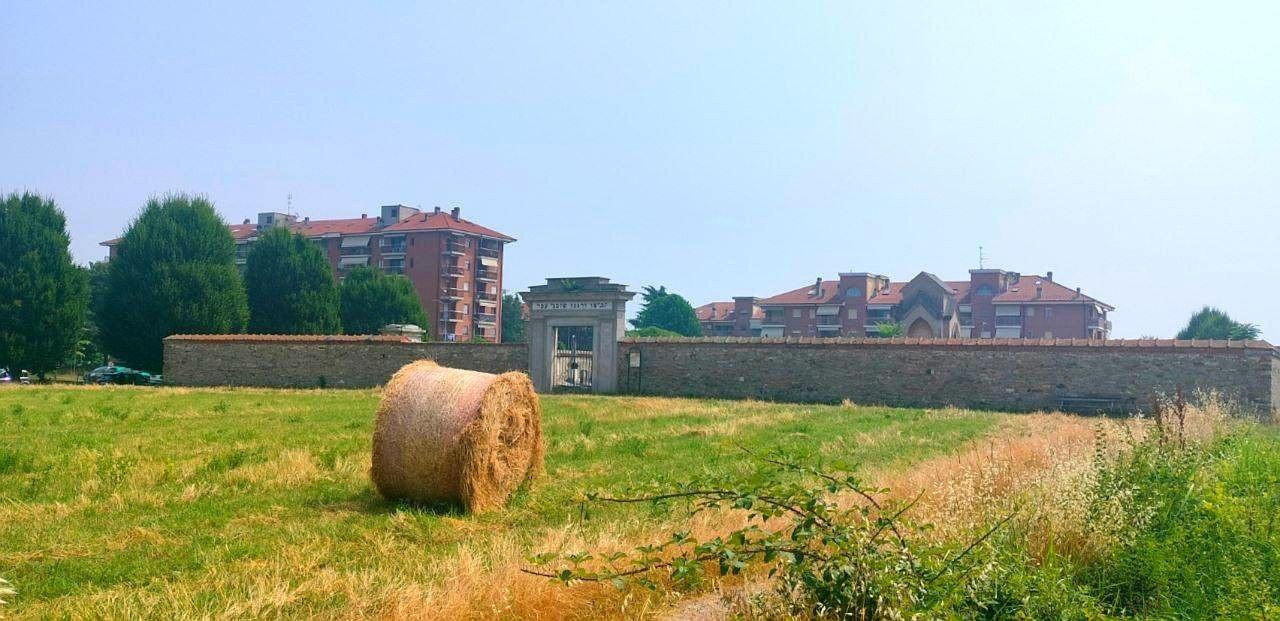 Murray Nozick · CC0
Jewish community of Acqui Terme
The Jewish community of Acqui Terme was present in the town until the years preceding the Second World War.
Read the storyAcqui History Award
The Acqui History Prize is an Italian literary prize awarded by the culture department of the municipality of Acqui Terme. It is considered the most important Italian recognition in the field of scientific and popular historiography, historical fiction and history in images on TV and cinema, and one of the most important at a European and international level.
Read the storyIdralea
Idralea is a mythological fable, published in 1585 by Orazio Navazzotti, a writer in the service of the dukes of Mantua.
Read the story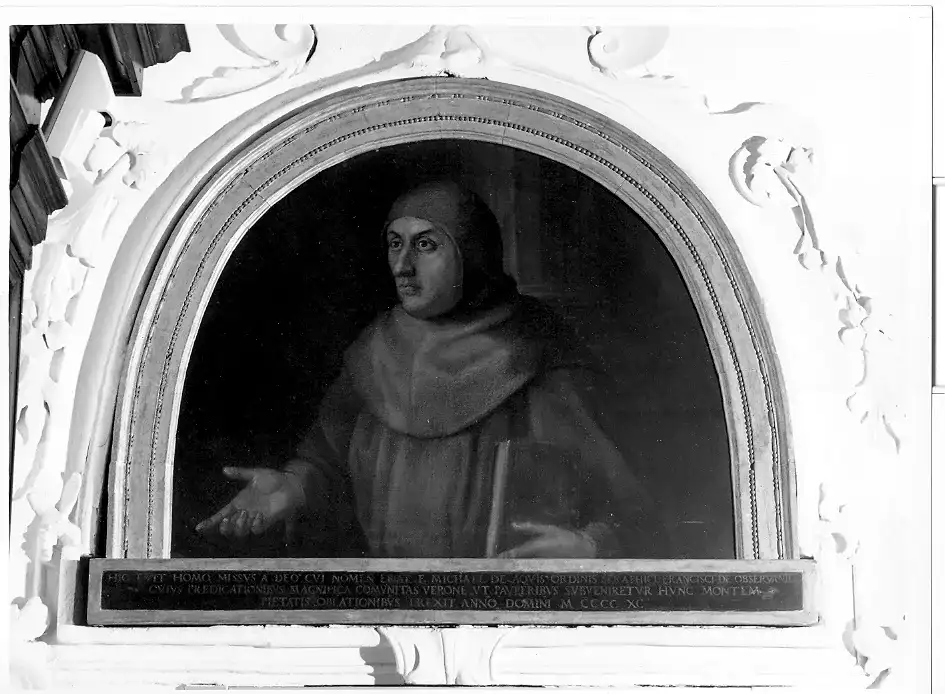 Sconosciuto Unknown author · Public domain
Michele da Acqui
Michele Pevere also Michele da Acqui (Acqui, mid-15th century – circa 1500) was an Italian preacher and religious, friar of the Order of Friars Minor, he was active in central-northern Italy at the end of the 15th century, where he played an important role in the diffusion of the Monti di Pietà, whose foundation he promoted in Brescia, Verona and Cremona, supporting a model based on free lending.
Read the story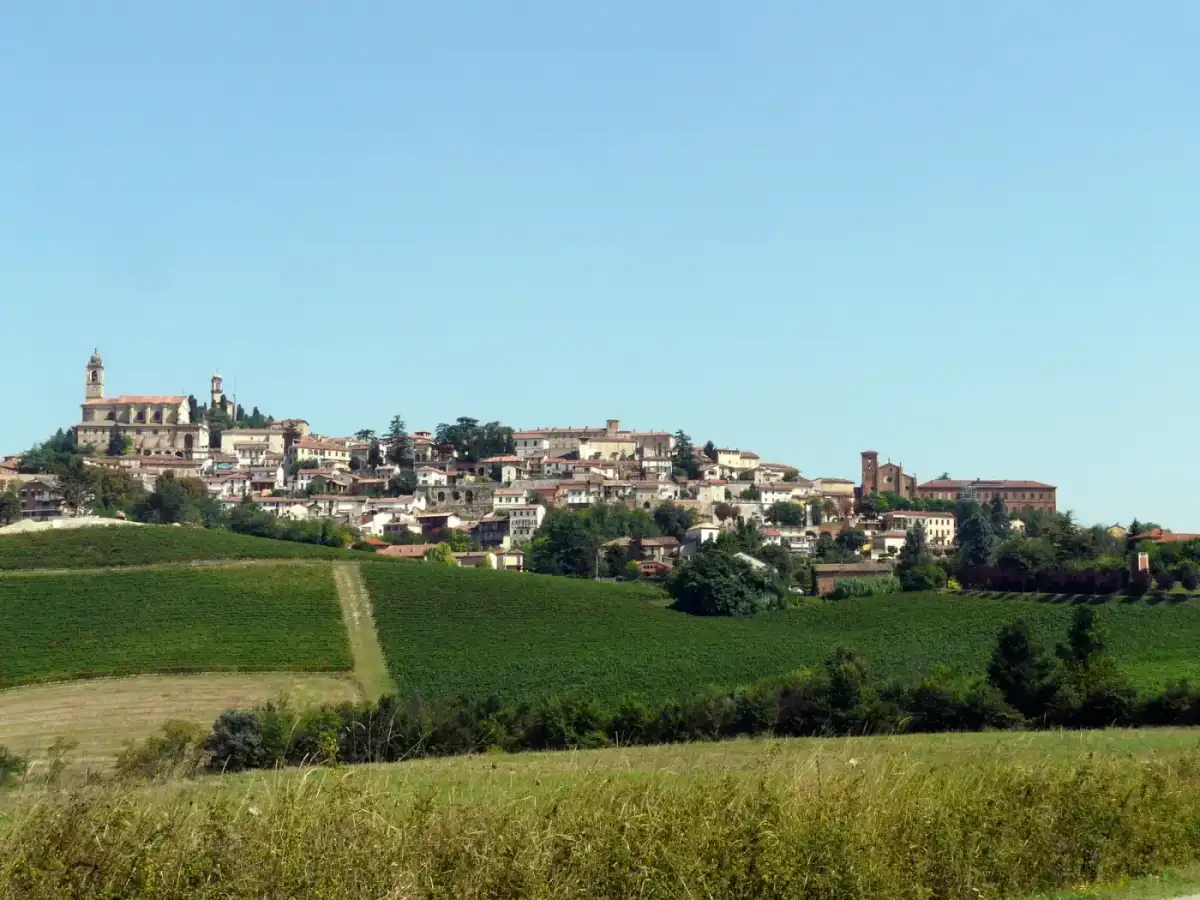 Davide Papalini · CC BY-SA 3.0
Monferrato
The Monferrato (Mr. Ferratus in Latin) is a historical-geographic region of Piedmont, Piemonte .
Read the story Andrea Marchisio · CC BY 3.0
Province of Alessandria
The province of Alessandria is an Italian province of Piemonte of the 408 765 inhabitants. It has as its capital the city Alessandria . In addition to the capital, in the province there are six centers-zone, where the main services are located, which correspond to the most important and populous cities, i.e. Novi Ligure , Tortona , Casale Monferrato , Acqui Terme , Valenza and Ovada .
Read the story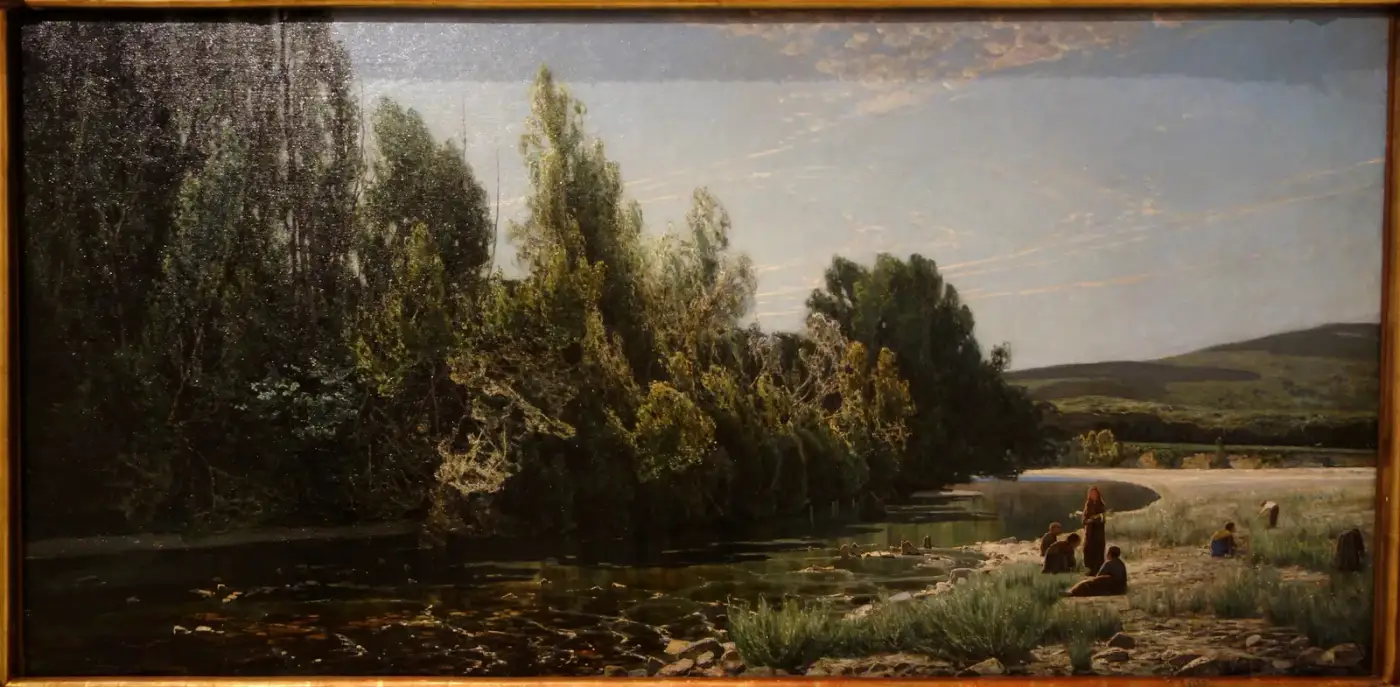 Serafín Avendaño Martínez · CC0
Bormida (river)
The Bormida (AFI : /ˈb大rmida/; Bormia AFI ): /bərmja/ in Liguria and Piedmont, Burnia in Valbormid dialect) is a river of the Piemonte and Liguria along altogether about 153 km, sub-affluent of Po and main tributary of the river Tanaro . It has a very wide basin (2 663 km2), distributed partly on the Maritime Alps (port of the high course of "Bormide") and in part on the Ligurian Apennines (portion of the tributaries Erro erro e Orba ).
Read the story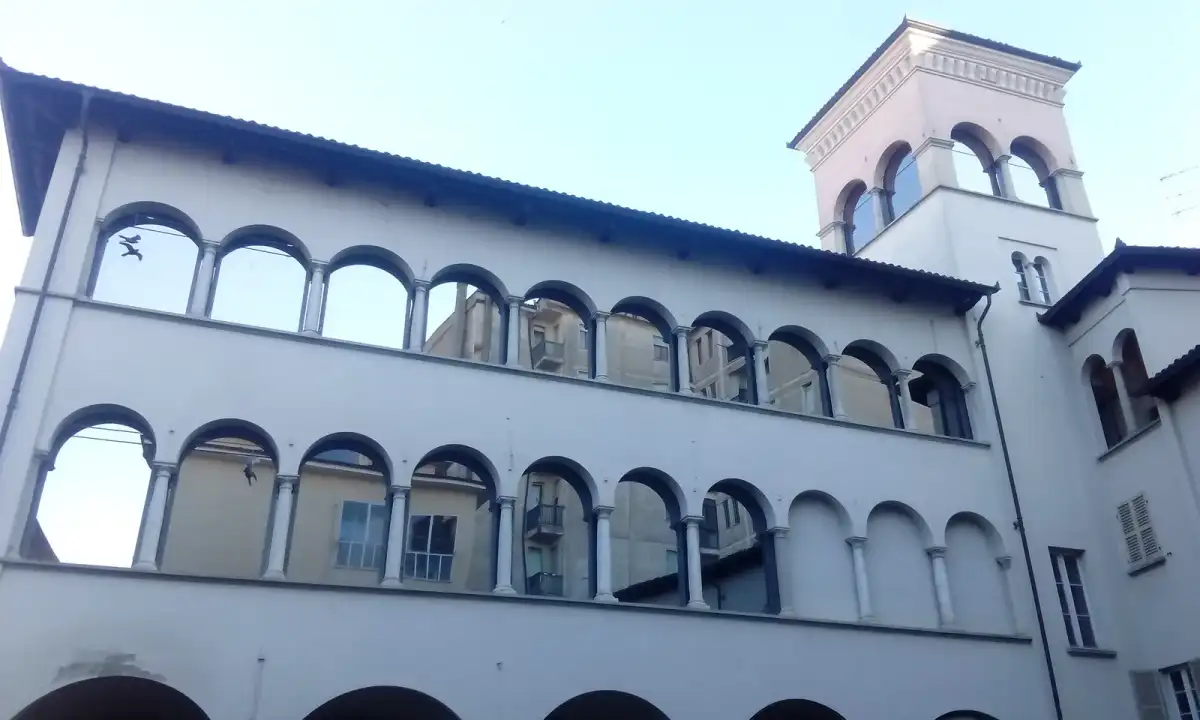 Giacomo cellerino · CC BY-SA 4.0
Palazzo Roberti in Castelvero
Palazzo Roberti is a historic residence in Acqui Terme located in Piazza Addolorata, which belonged to the Roberti family from Castelvero.
Read the storyThe wine landscape
This village in wine country
Follow the link between the country, the vineyards and the neighboring territories.
The area, step by step
Trails and routes in Acqui Terme


 CyclingPlaces and landscapes along the route

Asti, Alessandria and surroundings
Acqui Terme e la Valle dell’Erro

Asti, Alessandria and surroundings
Acqui, le Piagge e il Rifugio Banca
 CyclingAround the starting point
Asti, Alessandria and surroundings
Acqui and the Brachetto lands

Asti, Alessandria and surroundings
Acqui Terme e il Sentiero delle Ginestre
 CyclingAround the starting point
Asti, Alessandria and surroundings
Tour DOC del Vino Bracchetto d’Acqui

 WalkingAround the starting point
 WalkingAround the starting point

 WalkingAround the starting point

 WalkingAround the starting point
 WalkingAround the starting point


 WalkingAround the starting pointWalkingAround the starting point


 WalkingAround the starting point
 WalkingAround the starting point
