A closer look
Bormida (river): at a glance
The Bormida[3] (AFI: /ˈbɔrmida/; Bormia AFI: /bʊrmja/ in Liguria and Piedmont, Burnia in Valbormidese dialect) is a river of Piemonte and Liguria along altogether about 153 km, sub-affluent of the Po and main tributary of the river Tanaro. It has a very wide basin (2 663 km2), distributed partly on the Maritime Alps (port of the high course of the "Bormide") and partly on the Ligurian Apennines (port of the tributaries Erro and Orba).
Idronimo
The Bormida is so called by the pre-Roman Ligurian proto-form *bormo (hot water or gorgoglia'), also linked to the names of the Bormō and Bormānus springs. The...Explore this chapter
The Bormida[4] is so called by the pre-Roman Ligurian proto-form *bormo ('hot or bubbling water'), also linked to the names of the spring gods Bormō And Bormānus. The root *borm- in itself could have pre-Indo-European roots[5] and to be, thus, connected with the language (or languages) lost of prehistoric inhabitants of Europe, who occupied Northern Italy before the possible arrival of Indo-Europei.
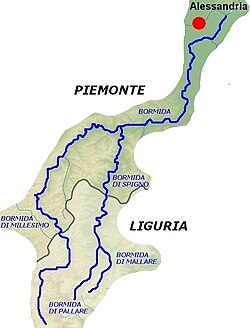
The Bormida spring auction includes four so-called "Bormide" minors (from the south to the north):
- the Bormida of Mallare, which is born from Mount Alto and the Bormida di Pallare, coming instead from Mount Settepani, both converging at the centers of San Giuseppe di Cairo and Bragno into a single watercourse called Bormida di Spigno;
- the Bormida of Millesimo, the main water course, which is born from with Scravaion (municipality of Castelvecchio di Rocca Barbena) and, once received after 90 km of course from the right the Bormida di Spigno near Bistagno (AL), becomes the Bormida proper, which flows into the Tanaro east of the city Alessandria.
The high section: the Millism Bormida
The first part of the Bormida, known as Bormida di Millesimo, was born in Liguria at about 800 m altitude from Rocca Barbena (Alpine Liguri). It initially flows into a...Explore this chapter
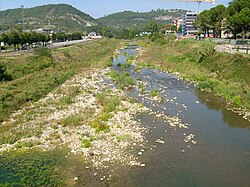
The first part of Bormida, known as Bormida di Millesimo, was born in Liguria at about 800 m altitude from Rocca Barbena (Alpi Liguri). It initially flows into a very suggestive valley by bathing the centers of Bardineto and Calizzano (SV), enriching itself with the contribution of countless rii and water streams (from left on the Rio Black, the Rio di Valle and the Rio di Vetria; from right the stream Ash, the Rio delle Giaire, the Rio di Parasacco, the Rio di S. John and the Rio Secco) until it reaches near Murialdo (SV), where it enters the "Valley of the Three Kings" park, flowing between suggestive rock walls.
Once arrived at Acquafredda, a hamlet of Millesimo (SV), the river receives the first remarkable tributary: the Osiglietta stream, coming from Mount Settepani (1 386 m) and which, disembarked by an imposing dam, forms the picturesque lake of Osiglia[6]. From here the river, with an almost doubled flow rate, continues flowing under the overpasses of the Turin-Savona motorway, and barred by a small dam flows through the municipality of Millesimo, also crossing the remains of an ancient medieval bridge. From this point, after receiving the flow of the Zemola torrent from the left, the Bormida di Millesimo ends its mountain course, opening up the road nestled at the foot of the rugged hills of the Langhe. It immediately crosses the municipality of Cengio where it is blocked by a small dam, after which it enters Piemonte following a very tortuous course through a suggestive wooded valley. It is home to a large number of towns all located in the province of Cuneo, including Saliceto, Camerana, Monesiglio, Gorzegno, Torre Bormida and Cortemilia.
At the latter center receives from the right the stream Uzzone (17.8 km and 1.7 m3/s), an important water course for its self-depurative process given the excellent quality of its waters (although scarce), and also famous for its unruly floods. From here he enters for a short time province of Asti flowing in the areas of high Monferrato bathing the municipalities of Vesime, Cessole, Loazzolo And Bubbio. At Monastero Bormida the river is overwhelmed by an ancient Romanesque bridge partly seriously injured during an exceptional flood in November 1994. In this section it has an annual average flow of about 9,2 m3/s and receives from the right the contribution of some small waterways including the two torrents named Tatorba, the Tatorba d'Olmo and that of Monastero. Continuing its run it gets wet Sessame to enter then province of Alessandria coming to the gates of Bistagno, where it receives the Bormida di Spigno from the right (7.6 m³/s, considered by many to be the eastern headwater branch of the Bormida river).
The medium-low section: the Bormida
After this confluence, which takes place about 90 km from the sources of Rocca Barbena, the river changes its name by simply becoming Bormida. Water flow doubles...Explore this chapter
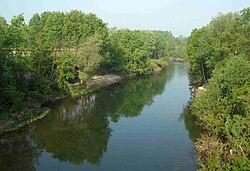
After this confluence, which takes place about 90 km from the springs of Rocca Barbena, the river changes its name by simply becoming Bormida. The water flow doubles at the same time on 17 m3/s annually while the valley expands to become sweeter and more regular. After wet Terzo and have received from the left the stream Bogliona and from the right the waters of the Erro stream (42 km and 4,6 m3/s), the river bathes the city of Acqui Terme, skirting the remains of an ancient Roman aqueduct and receiving the Rio Medrio from the left coming from the hills around the municipality of Alice Bel Colle. In the municipality of Visone then receives from the right the scarce affixes of the torrents Visone (0.8 m³/s) and Caramagna (0.6 m³/s). It then continues wetting Strevi, Rivalta Bormida And Cassine (where a dam perpetually removes 4 m³/s from the river to feed the Carlo Alberto Canal which then flows into the Tanaro at the Villa del Foro), then preparing to leave the findings of the Monferrato to enter the plain heavily clayed and with bends.
A Sezzadio, the river receives the small stream from the right Tired. after which crosses the municipality of Castellazzo Bormida where he joins at the Bridge of Maranzana with the Orba (73 km and c. 15.2 m3/s), its main right tributary, delimiting the boundary between the municipalities of Castellazzo Bormida, Alessandria And Frugarolo. From here on, with an average flow almost doubled again, the river laps the southern outskirts of Alessandria imposingly clayed by the tangential of Alessandria, to reach near the Pietra Marazzi where it flows from right into the river Tanaro.
Hydrological system
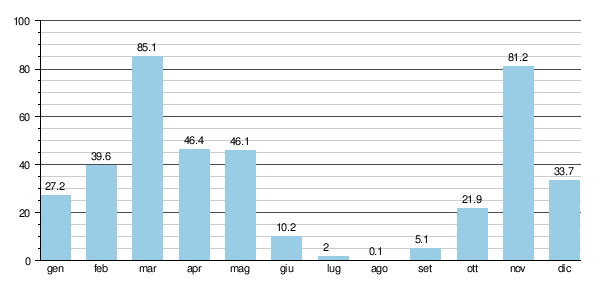
Monthly average portExplore this chapter
The average annual flow rate of Bormida is (after confluence with the Orba) on 33 m3/s, a fairly important value. In fact, the flow of the river is heavily affected by rainfall so as to be classified as a rainwater course. The same is characterized by its extremely capricious character (in the lower course and in particular downstream of the confluence with the Orba, practically annual straripa), made of tumultuous floods (sometimes catastrophic), which occur mainly in the autumn or late spring season, during which the river can reach in a short time flow values even close to 3 000 m3/s. On the other hand, in summer, it suffers very marked due to the low rainfall and massive water levies carried out on the affluent Orba. On November 15, 2014 following very violent rains throughout the basin, in particular in the portion of the tributary Orba, which caused various flood events in Liguria and Piemonte, the river reached Alessandria a full record level never touched before equal to 9,20 meters, seriously fearing the occurrence of a flood in the city; record however then beaten on date 24 November 2019 with 9,39 meters following an exceptional wave of bad weather and especially the 4 October 2021 where he touched the 9,41 meters (with a peak of flow rate 3 000 m3/s) following an exceptional precipitation that affected the high portion of basin on the branch of Spigno and the effluents Erro and Orba.
Monthly average port
Hydrometric station: confluence Tanaro (1951 - 1991)
History
Pollution and environmental problemsExplore this chapter
To manage the waters of the river, together with those of the stream Uzzone, was formed Hydraulic Consortium of third category of the Bormida river and the Uzzone stream, based in Cortemilia; the institution was subsequently dissolved and liquidated pursuant to a decree of the Ministry of the Treasury dated 16 December 1994.[7]
Pollution and environmental problems
In a recent past the valley of this river ended in the center of Italian chronicles for serious environmental problems caused by the chemical plant ACNA of Cengio, which for more than a century polluted the high section (the branch of Millesimo), directly discharged into its waters very toxic chemicals (benzene, phenol and many other derivatives of oil and dye processing), so as to make it biologically dead for more than one kilometers[8].
In 1994, after decades of struggle by the inhabitants of the valley, the industry was shut down from the Liguria regions and Piemonte so much that since then the general conditions of river waters have improved considerably. However, there are still heavy problems to be solved in relation to the reclamation of the site where the ex-factory stands.
The whole area is a real “ecological bomb” in the open sky: in its courtyards there are tons of waste processing in so-called “lagoons” (open air wells), consisting mainly of extremely toxic dried sludge for health. A bomb that is located right next to the Bormida mountain, therefore clearly at risk of flood in case of exceptional floods (see November 1994) and that, considering precisely the restless character of the same river, can not be excluded.
In addition to this, the soils on which the whole ex-establishment rests are totally impregnated with highly toxic substances for several meters of depth so as not to exclude (despite large concrete barriers on the banks of the river) possible phenomena of pollution of the river from "percolation".
And again, despite the improvement of surface water quality, deep waters of Bormida from Cengio and up to and over Acqui Terme (a good 80 km downstream from the factory), it would seem[without source] impregnated by unknown quantities of pollutants and heavy metals not easily detectable and classified at this point to make still today the waters of the river not usable, neither for agricultural uses nor so much less for poble uses, despite being almost twenty years since the closure of the industry in question (Ord. 5/89 Province of Alessandria). Currently there is an imposing work of reclamation of the polluted area of Cengio that would seem to be close to the conclusion. In any case, no one has yet pronounced himself on the possible re-use for potable purposes of Bormida water, also considered the presence of other important sources of pollution that still threaten the branch of Spigno (3M of Ferrania, Italian Coke of Cairo Montenotte, industrial area of San Giuseppe di Cairo)[without source].
La Bormida in literature
The river is quoted in the ode March 1821 by Alessandro Manzoni (Who will be able of the Dora / Bormida al Tanaro bride / Ticino and the Selvosa Orba / scerner onde...Explore this chapter
Notes
Explore this chapter
- ^ AA.VV., Processed I.c/5 (PDF), in Water Protection Plan - Review of 1 July 2004; Characterization of hydrographic basins, Region Piemonte, 1 July 2004. Retrieved 10 January 2016 (archived fromoriginal url on 4 March 2016).
- ^ to b AA.VV., Processed I.c/7 (PDF), in Water Protection Plan - Review of 1 July 2004; Characterization of hydrographic basins, Region Piemonte, 1 July 2004. Retrieved 18 April 2014 (archived fromoriginal url on 3 March 2016).
- ^ Normally considered a female toponym, see. Bormida, in Treccani.it – Online encyclopedias, Rome, Institute of the Italian Encyclopedia.

- ^ Celtic toponimi of Italy
- ^ Francesco Perono Cacciafoco, Pre-Indo-European Relics: The *borm- Root in the European Pre-Latin Context, in Acta Linguistica: Journal for Theoretical Linguistics, vol. 9, no. 2, 2015, pp. 57-69.
- ^ The strange dam of Osiglia, up radiuk.blogspot.it. Retrieved 15 February 2015 (archived fromoriginal url on 15 February 2015).
- ^ Closure of the liquidatorial management of the assets of the third category hydraulic Consortium of the Bormida river and the Uzzone stream, in Cortemilia. (Official Journal General Series n.41 of 18-2-1995 - Ordinary Suppl. n. 24; State Printing Institute and Mint) - online text on http://www.infoleges.it/ (consulted in April 2014)
- ^ Rebirth Association Valle Bormida, Langa Valle Bormida - The Retrovato River, Medialanghe, Cortemilia (CN), 2009.
- ^ Dora Baltea and Dora Riparia
- ^ Verses 17-18
Continue your journey