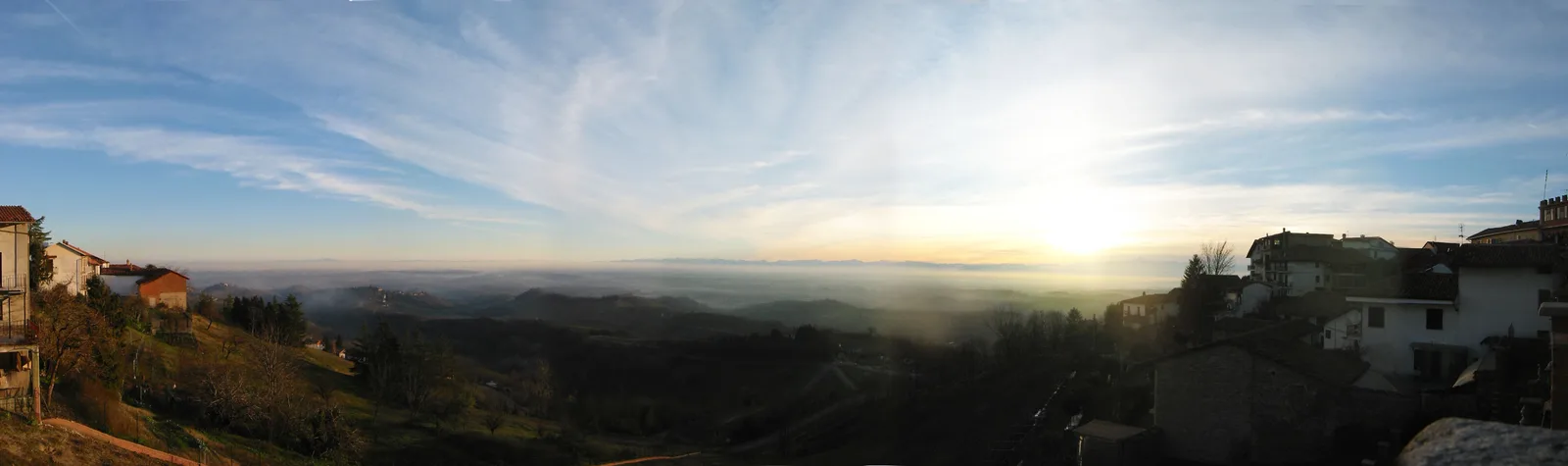
A closer look
Province of Asti: at a glance
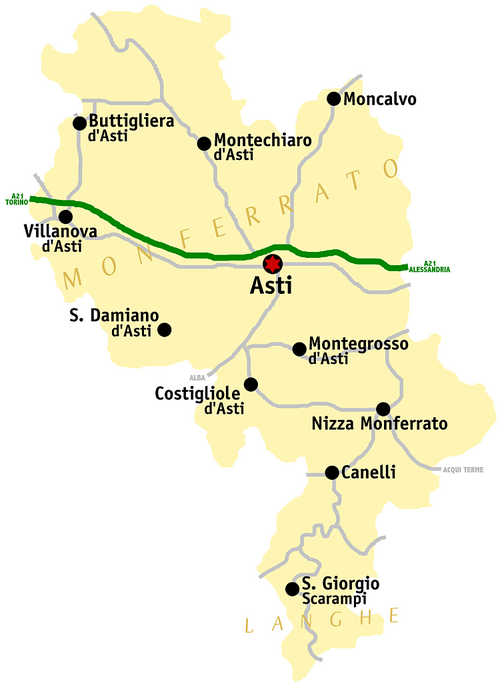
The province of Asti (Province of Ast in Piedmont) is an Italian province of Piemonte of 207 128 inhabitants[2], with capital Asti.
It borders to the north-west with the metropolitan city of Turin, east with the province of Alessandria, to the south with Liguria (province of Savona) for only 3 km in the municipality of Serole and west with the province of Cuneo.
Physical geography
Mountains · Colline · PlanExplore this chapter
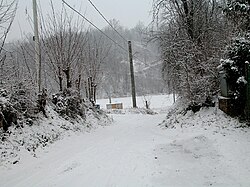
Mountains
The Province of Asti includes a small part of Appennino Ligure, where it reaches its maximum height with the Bric Puschera (851 m).
Colline
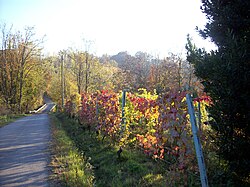
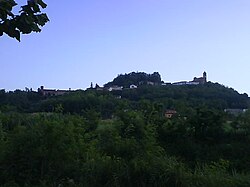
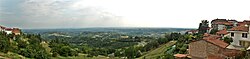
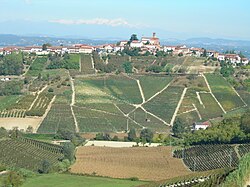
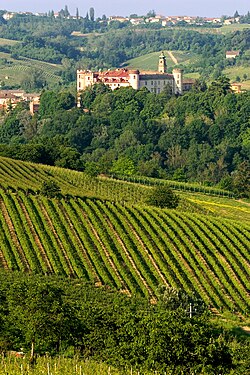
Most of the territory is composed of hill reliefs such as Monferrato, Po hills and Langhe.
Plan
In the province of Asti the plain is represented by the valleys of rivers and streams between the hills, in particular the Valle Belbo that crosses the south of the province. In these are built the capital and other main municipalities.
Water courses and lakes
The main water courses that bathe the territory are rivers Tanaro And Bormida and the streams Banna, Belbo, Tiglione, Borbore, Stura and Versa (mainly tributaries of the Tanaro and Po rivers). The only lake in the province is Lake Codana, in the municipality of Montiglio Monferrato.
Climate
The province has a typically Paduan climate, with very hot summers and cold and misty winters. The rainfall is below the national average.
History
From the Sabauda province to French domination · Restoration and surroundings of Asti · Reconstitution of the provinceExplore this chapter
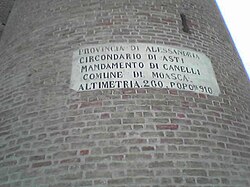
From the Sabauda province to French domination
A provincial constituency with capital Asti is documented in the Savoy order from 1560. The province of Astigiana, although with different functions and boundaries than the contemporary entity, remained one of the administrative constituencies of the Savoy State until the reorganization introduced during French domination.[3][4]
During the French period, the administrative arrangement was profoundly modified. In 1801 Asti became the capital of the Tanaro department, one of the districts established in Piemonte occupied by France. By decree of 11 September 1802 the Piedmontese departments were formally annexed to the French Republic. On 6 June 1805 the Tanaro department was suppressed and the Astilian territory, transformed into the arrondissement of Asti, was aggregated to the department of Marengo, with capital Alessandria. This order remained in force until the fall of the Napoleonic Empire.[5][6]
Restoration and surroundings of Asti
With the Restoration, the edict of 21 May 1814 restored the ancient administrative structures of Sabaude and was reconstituted the Intestination of Asti.[7] With the administrative reorganization of 1818 Asti was included in the Division of Alessandria, while retaining its own provincial intention.[7]
As a result of the Regies Patents of 25 August 1842, under the economic administration, the Intendence of Asti was placed on the dependencies of the General Intention of Casale Monferrato.[8] The General Intendence of Casale was then suppressed by the Regie Patenti of 30 October 1847, as part of the new administrative organization of the Kingdom.[9]
The law of 23 October 1859, n. 3702, issued in the Kingdom of Sardinia, reorganized the territory of the State in provinces, surrounding areas, sendings and municipalities. The ancient province of Asti was suppressed and its territory constituted the district of Asti, inserted in province of Alessandria together with the surrounding areas of Alessandria, Acqui, Casale, Novi and Tortona.[10]
Reconstitution of the province
The province of Asti was reconstituted in 1935. The Council of Ministers decided to reconstitute it on 30 March and the subsequent Royal Decree-Law 1 April 1935, n. 297, he dispose of the formation of the new provincial constituency through the detachment of 105 municipalities from the province of Alessandria.[11][4] The new province entered operation on 15 April 1935.[3][4]
The institutional sources of the period and subsequent archivists speak of "reconstitution" of the province, in view of the existence of the previous provincial constituency sabauda suppressed in 1859.[3]
After the Liberation, many municipalities were gradually reconstituted which during the fascist period had been suppressed and aggregated to other bodies. The first measures date back to 1946 and continued in the following years; as a result of these reconstitutions, the number of municipalities in the province reached 120.[12]
The provincial territory was affected by several serious flood events during the 20th century. Particularly relevant were the floods of 1948, which struck between the other Asti, Canelli, Incisa Scapaccino and Nizza Monferrato,[13] those of autumn 1968, which involved many municipalities in the Astilian region,[14] and theflood of November 1994, during which the Tanaro and its tributaries caused extensive flooding and serious damage even in the capital and provincial territory.[15]
In 1998 the number of municipalities fell from 120 to 118 following the merger of Colcavagno, Montiglio and Scandeluzza, laid down by regional law 22 December 1997, n. 65, which established the new commune of Montiglio Monferrato.[16] From 1 January 2023 the municipalities are 117, following the merger of Moransengo And Tonengo in the new commune of Moransengo-Tonengo, established by regional law 27 December 2022, n. 27.[17]
Symbols


- Coat of arms
The provincial coat of arms was granted by royal decree of King Vittorio Emanuele III of 28 March 1938.[18]
In the version granted in 1938, the coat of arms carried the head of the Littorio, an element made compulsory for the emblems of public bodies during fascism. The chief was eliminated following the legislative decree of 10 December 1944, n. 394.[20]
- Banner
The first provincial gonfalone was granted by royal decree of King Vittorio Emanuele III of 11 October 1938.[18] A new gonfalone was granted by decree of the President of the Republic Luigi Einaudi of 23 March 1954.[21] It is made up of a red drape, bearing in the centre the figure of San Second riding, accompanied by the provincial coat of arms.
- Flag
The flag is a red rectangular drape loaded at the center of the provincial coat of arms.[22]
Honors

— Decree of the President of the Republic Oscar Luigi Scalfaro 17 May 1996[23]
Monuments and sights
Religious architecture · Civil architecture · CastlesExplore this chapter
Religious architecture
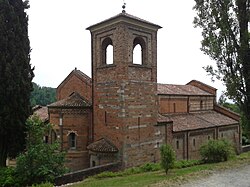
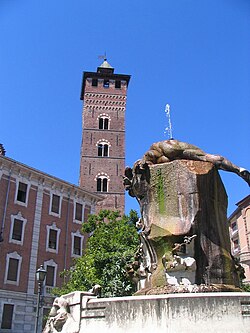
In the provincial territory there are many ecclesiastical buildings of great beauty and artistic and cultural importance, among which are worthy of mention the Abbey of Vezzolano, near Albugnano, and the Cathedral of Santa Maria Assunta (Asti). Of note are the presence of a mosque, a temple and a Jewish museum and the Kingdom Hall of Jehovah's Witnesses in Asti And Nizza Monferrato.
Civil architecture
Castles
Below are the main complexes and castles of the province of Asti:
- Belveglio (castle)
- Bruno (castello dei Faà)
- Bubbio (castle)
- Burio (fraz. by Costigliole d'Asti, castle)
- Calamandrana (castle)
- Calosso (castle Roero, circular tower)
- Camerano Casasco (castle of Camerano, Palazzo Balbo)
- Camerano Casasco (castle of Casasco)
- Canelli (castle Gancia ex Scarampi Crivelli)
- Casorzo (rest of the castle, tower)
- Cassinasco (torre, other remains of the castle)
- Castagnole Monferrato (remains of the castle)
- Castell'Alfero (Count of the Counts Friend)
- Castellero (castle)
- Castelletto Molina (castle)
- Castello di Annone (borgo, ruins of the castle)
- Castelnuovo Belbo (remains of the castle walls)
- Castelnuovo Calcea (castle)
- Cerro Tanaro (remains of the castle)
- Cessole (rest of the castle)
- Cisterna d'Asti (castle)
- Coazzolo (castle)
- Colcavagno (fraz. by Montiglio Monferrato, castle of the Balbiano)
- Corsione (rest of the castle)
- Cortanze (castle of the Roero)
- Cortazzone (castle)
- Corveglia (fraz. by Villanova d'Asti, castle, tower)
- Cossombrato (Silver's Castle)
- Costigliole d'Asti (castle)
- Cunico (rest of the castle)
- Dusino San Michele (castle)
- Frinco (castle)
- Gorzano (fraz. by San Damiano d'Asti, castle)
- Incisa Scapaccino (newcastle)
- Incisa Scapaccino (remains of the medieval castle)
- Loazzolo (remains of the castle)
- Maranzana (castle)
- Marmorito (fraz. by Passerano Marmorito, remains of the Castle of Radicati)
- Moasca (castle Pacherano-Secco Suardo)
- Mombaldone (borgo, ruins of the castle of the Marquis of Carretto)
- Mombercelli (remains of the castle)
- Monale (castle Scarampi)
- Monastero Bormida (castle)
- Moncalvo (remains of the Marquisi Castle of Monferrato)
- Moncucco Torinese (castle of Grisella)
- Mondonio (fraz. by Castelnuovo Don Bosco, castle of the Turks)
- Montaldo Scarampi (rest of the castle)
- Montegrosso d'Asti (castle)
- Montemagno (castle of Bergolo's Calvi Accounts)
- Moransengo (castle)
- Nizza Monferrato (municipalace and civic tower)
- Olmo Gentile (castle, tower)
- Passerano Marmorito (Railed Castle)
- Piea (castle)
- Pino d'Asti (castle)
- Rinco (fraz. by Montiglio Monferrato, castle, tower)
- Roatto (castle)
- Robella d'Asti (castle)
- Roccaverano (remains of the castle, tower)
- Rocchetta Tanaro (castle of Marchesi di Incisa della Rocchetta)
- San Giorgio Scarampi (back)
- San Martino Alfieri (castle)
- San Marzano Oliveto (castle of Asinari)
- San Paolo Solbrito (castle of Solbrito, "castle" of São Paulo)
- Schierano (fraz. by Passerano Marmorito, remains of the castle)
- Scurzolengo (castle)
- Sessame (ruders of the castle)
- Settime (castle of Riofreddo Bags)
- Soglio (castle)
- Tigliole (castle, Palazzo Comunale)
- Tonco (remains of the castle)
- Vaglio Serra (Star Castle, Palazzo dei Baroni Crova)
- Vesime (ruders of the castle of Scarampi)
- Viale (castle)
- Vigliano d'Asti (castle)
- Villa (fraz. of the Isola d'Asti, castle)
- Villanova d'Asti (castle De Robertis, Civic Tower)
- Montiglio Monferrato (castle)
Other
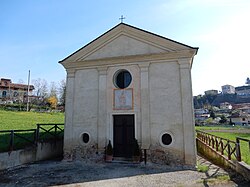
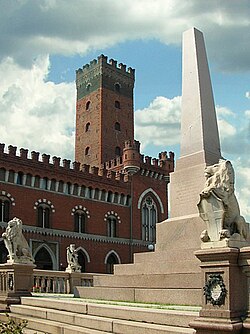
- Palazzo Mazzetti, home of the Museum and the Pinacoteca Asti
- Basilica of San Giovanni Bosco near Castelnuovo Don Bosco
- Church of San Secondo ad Asti
- Crypt of Sant' Anastasio, seat of the Lapidary Museum Asti
- Troyana Tower of Asti
- Church of San Pietro in Consavia Asti
- Roccaverano
- Piea
- Cisterna d'Asti Castle
- Palaeontological territorial museum of Astigiano ad Asti
- Museum of Resurrection Asti
- Monastero Bormida
- Church of San Nazario and San Celso in Montechiaro d'Asti
Society
Demographic evolution · Quality of life · Foreign ethnic groups and minoritiesExplore this chapter
Demographic evolution
From what is evident from the data ISTAT of December 2019, on that date there were 213 216 inhabitants, of which 24 596 foreigners.
The largest communities of foreigners, i.e. those over 1 500 people, are:
 Romeni: 7 135 people
 Albanians: 4 484 people
 Moroccans: 2 785 people
 Macedonians: 2 323 persons
Quality of life
In December 2014 the quality of life of the capital, Asti, had improved compared to the previous year, but the city ranked 97th for public order out of 107 ranked. Tied with Asti were the city of Savona while, in Piemonte, can be cited Turin (102) and Novara (104). These data were provided by the annual de classification The Sun 24 Hours, which compares, on the basis of a statistical survey that analyzes various parameters divided into six survey chapters, the quality of life in the various Italian provincial capitals. Better positions in the other categories.
Summing up Asti was approximately halfway through the general classification that saw on the podium Ravenna, Trento and Modena and last Agrigento. Compared to the previous year, Asti had recovered four positions.
Foreign ethnic groups and minorities
The foreign population living in the province of Asti on 1 January 2017, considering foreign citizens non-Italian nationality having habitual residence in Italy, is attested to 24 293 people, representing 11.2% of the resident population. The largest foreign community is Romania with 29.9% of all foreigners present on the territory, followed by Albania (19.4%) and Morocco (11.5%).
Religion
The prevailing religion is Catholicism; the province is divided between the ecclesiastical province of Turin (diocese of Alba, diocese of Asti and archdiocese of Turin) and the ecclesiastical province of Vercelli (diocese of Acqui and Diocese of Casale Monferrato), both belonging to the ecclesiastical region Piemonte.
Culture
Education · Museums · MediaExplore this chapter
Education
Museums
There are numerous museum complexes in the provincial territory. Noteworthy to Asti is the "Museo degli Arazzi". At the Castagnole delle Lanze It is very important the "Museo della Civiltà Contadina dell'Alto Monferrato e della Bassa Langa". Equally important are, Castelnuovo Don Bosco, the Museum of "Peasant Life" and the "Missionary Ethnological Museum". In the country of Cisterna d'Asti an important museum complex is represented by the "Museum of Arts and Crafts of a Time". A Grazzano Badoglio, representative of the "Badogliano Museum", centered on the life of the villager Pietro Badoglio. In Maranzana important the "Museo Giacomo Bove", while at Mombercelli The Museum of Modern Art is representative. A Nizza Monferrato Finally, there is the "Bersano" Museum of Farms and Old Wine Stamps. Finally, noteworthy are some unusual exhibitions such as the "Open-air Museum of Modern Art MAESTRI" to Cerreto d'Asti and the "Gipsoteca Gonetto" of Cinaglio.
Media
Prints
In the province of Asti the main newspapers are three: the Gazzetta d'Asti, the New Province and the Corriere dell'Astigiano.
Kitchen
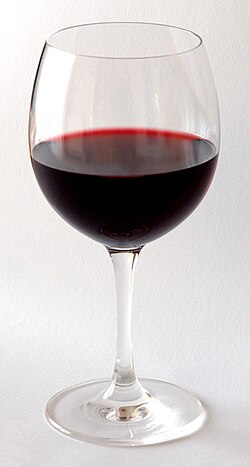
Among the best typical products of the province Asti you can count the robiola of Roccaverano and the Muletta (a big salami made of bacon, fillet, thigh, shoulder boned and degreased). Among the fruit and vegetable products of the province we count the cardo, used in the preparation of the typical dish par excellence, the cauda (or caôda), the peppers and the grape mustard. Abundant presence of the delicious and sought-after white truffles and hazelnut Piemonte. Typical dishes of gastronomy Asti are the risottos and tajerìn (or tajarin). Among the best wines of Asti Barbera, Moscato and Grignolino are the jewels of its hills. Also important is the Freisa.
Anthropic geography
Municipalities · Common at geographical ends · Most populated municipalitiesExplore this chapter
Municipalities
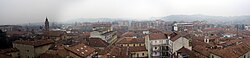
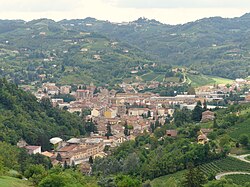
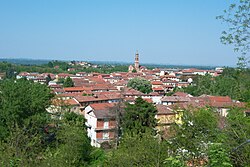
The following 117 municipalities belong to the province of Asti:
| Coat of arms | Cities | Population (ab.) | Area (km2) |
|---|---|---|---|
 |
Agliano Terme | 1592 | 15,38 |
 |
Albugnano | 541 | 9,47 |
 |
Antignano | 1 025 | 10,89 |
 |
Aramengo | 632 | 11,41 |
 |
Asti | 75 256 | 151,82 |
 |
Azzano d'Asti | 419 | 6,43 |
 |
Baldichieri d'Asti | 1 114 | 5,21 |
 |
Belveglio | 326 | 5,35 |
 |
Berzano di San Pietro | 431 | 7,42 |
 |
Bruno | 351 | 9,19 |
 |
Bubbio | 912 | 15,70 |
 |
Buttigliera d'Asti | 2 552 | 18,82 |
 |
Calamandrana | 1 784 | 12,74 |
 |
Calliano Monferrato | 1 392 | 17,44 |
 |
Calosso | 1 331 | 15,73 |
 |
Camerano Casasco | 480 | 6,69 |
 |
Canelli | 10 569 | 23,58 |
 |
Cantarana | 1 023 | 9,77 |
 |
Capriglio | 300 | 5,08 |
 |
Casorzo | 657 | 12,58 |
 |
Cassinasco | 590 | 11,71 |
 |
Castagnole Monferrato | 1 271 | 17,26 |
 |
Castagnole delle Lanze | 3 784 | 21,37 |
 |
Castel Boglione | 614 | 12,01 |
 |
Castel Rocchero | 396 | 5,64 |
 |
Castell'Alfero | 2 750 | 19,96 |
 |
Castellero | 302 | 4,34 |
 |
Castelletto Molina | 184 | 3,00 |
 |
Castello di Annone | 1 928 | 23,16 |
 |
Castelnuovo Belbo | 895 | 9,43 |
 |
Castelnuovo Calcea | 765 | 8,00 |
 |
Castelnuovo Don Bosco | 3 260 | 22,40 |
 |
Cellarengo | 714 | 10,81 |
 |
Celle Enomondo | 480 | 5,51 |
 |
Cerreto d'Asti | 220 | 3,98 |
 |
Cerro Tanaro | 670 | 4,69 |
 |
Cessole | 420 | 11,11 |
 |
Chiusano d'Asti | 226 | 2,48 |
 |
Cinaglio | 455 | 5,38 |
 |
Cisterna d'Asti | 1 286 | 10,65 |
 |
Coazzolo | 316 | 4,12 |
 |
Cocconato | 1 564 | 16,77 |
 |
Corsione | 205 | 5,15 |
 |
Cortandone | 323 | 5,02 |
 |
Cortanze | 288 | 4,46 |
 |
Cortazzone | 658 | 10,37 |
 |
Cortiglione | 611 | 8,43 |
 |
Cossombrato | 504 | 5,33 |
 |
Costigliole d'Asti | 5 981 | 36,86 |
 |
Cunico | 545 | 6,86 |
 |
Dusino San Michele | 933 | 11,64 |
 |
Ferrere | 1 558 | 13,93 |
 |
Fontanile | 556 | 8,01 |
 |
Frinco | 762 | 7,28 |
 |
Grana Monferrato | 638 | 6,03 |
 |
Grazzano Badoglio | 629 | 10,44 |
 |
Incisa Scapaccino | 2 256 | 20,85 |
 |
Isola d'Asti | 2 116 | 13,58 |
 |
Loazzolo | 357 | 15,48 |
 |
Maranzana | 314 | 4,50 |
 |
Maretto | 387 | 4,86 |
 |
Moasca | 425 | 4,14 |
 |
Mombaldone | 232 | 12,25 |
 |
Mombaruzzo | 1 152 | 22,11 |
 |
Mombercelli | 2 401 | 14,20 |
 |
Monale | 1 013 | 9,11 |
 |
Monastero Bormida | 987 | 14,15 |
 |
Moncalvo | 3 356 | 17,66 |
 |
Moncucco Torinese | 923 | 14,36 |
 |
Mongardino | 972 | 6,74 |
 |
Montabone | 368 | 8,52 |
 |
Montafia | 977 | 14,56 |
 |
Montaldo Scarampi | 728 | 6,66 |
 |
Montechiaro d'Asti | 1 409 | 10,14 |
 |
Montegrosso d'Asti | 2 175 | 15,61 |
 |
Montemagno | 1 239 | 15,90 |
 |
Montiglio Monferrato | 1 745 | 27,00 |
 |
Moransengo-Tonengo | 425 | 10,91 |
 |
Nizza Monferrato | 10 388 | 30,41 |
 |
Olmo Gentile | 95 | 5,11 |
 |
Passerano Marmorito | 439 | 12,09 |
 |
Penango | 547 | 9,47 |
 |
Piea | 619 | 8,89 |
 |
Pino d'Asti | 242 | 4,05 |
 |
Piovà Massaia | 706 | 10,80 |
 |
Portacomaro | 2 017 | 10,94 |
 |
Quaranti | 209 | 2,96 |
 |
Refrancore | 1 637 | 13,15 |
 |
Revigliasco d'Asti | 923 | 8,94 |
 |
Roatto | 394 | 6,46 |
 |
Robella | 520 | 12,16 |
 |
Rocca d'Arazzo | 941 | 12,62 |
 |
Roccaverano | 458 | 29,90 |
 |
Rocchetta Palafea | 371 | 7,83 |
 |
Rocchetta Tanaro | 1 438 | 16,04 |
 |
San Damiano d'Asti | 8 465 | 48,02 |
 |
San Giorgio Scarampi | 122 | 6,02 |
 |
San Martino Alfieri | 726 | 7,36 |
 |
San Marzano Oliveto | 1 083 | 9,75 |
 |
San Paolo Solbrito | 1 195 | 11,93 |
 |
Scurzolengo | 645 | 5,31 |
 |
Serole | 156 | 11,82 |
 |
Sessame | 286 | 8,48 |
 |
Settime | 572 | 6,66 |
 |
Soglio | 163 | 3,50 |
 |
Tigliole | 1 714 | 16,11 |
 |
Tonco | 930 | 11,81 |
 |
Vaglio Serra | 283 | 4,64 |
 |
Valfenera | 2 368 | 22,23 |
 |
Vesime | 683 | 13,44 |
 |
Viale | 282 | 3,96 |
 |
Viarigi | 1 000 | 13,67 |
 |
Vigliano d'Asti | 880 | 6,66 |
 |
Villa San Secondo | 396 | 6,02 |
 |
Villafranca d'Asti | 3 139 | 12,91 |
 |
Villanova d'Asti | 5 341 | 42,14 |
 |
Vinchio | 677 | 9,31 |
Common at geographical ends
| Coat of arms | Municipality | Geographical boundaries |
|---|---|---|

|
Moransengo-Tonengo | Most northern municipality |

|
Serole | Most southern municipality |

|
Mombaruzzo | More oriental municipality |

|
Villanova d'Asti | More Western Town |
Most populated municipalities
The province of Asti is divided into 117 municipalities, after the capital the most important cities at historical and cultural and agricultural level, as well as being the only municipalities in the province to reach 10 000 inhabitants are Nizza Monferrato And Canelli, both UNESCO World Heritage Sites since 2014 for their landscape assets and wine. The most populous municipalities in order are:
| Location | Coat of arms | Municipality | Population (ab.) | Region
(km²) |
|---|---|---|---|---|
| 1 | |
Asti | 76 164 | 151,31 |
| 2 | |
Canelli | 10 465 | 23,43 |
| 3 | |
Nizza Monferrato | 10 369 | 30,36 |
| 4 | |
San Damiano d'Asti | 10 003 | 47,87 |
| 5 | |
Costigliole d'Asti | 5 865 | 36,94 |
| 6 | |
Villanova d'Asti | 5 667 | 41,95 |
| 7 | |
Castagnole delle Lanze | 3 772 | 21,57 |
| 8 | |
Castelnuovo Don Bosco | 3 235 | 21,61 |
| 9 | |
Villafranca d'Asti | 3 064 | 12,88 |
| 10 | |
Moncalvo | 2 988 | 17,42 |
Hilly communities and mountain communities
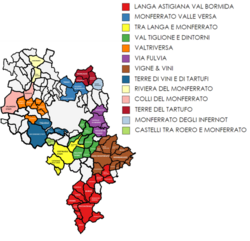
| Community | Type of community | Number of municipalities belonging | Common location of the office of the agency | Other municipalities belonging to the institution | Population (ab.) | Area (km2) | Density (ab./km2) |
|---|---|---|---|---|---|---|---|
| Hills between Langa and Monferrato | hilly | 4 | Costigliole d'Asti (5,771 inhabitants) | Castagnole delle Lanze, Coazzolo, Montegrosso d'Asti | 13.348 | 94 | 142,47 |
| Langa Astigiana Val Bormida | montana | 13 | Roccaverano (395 inhabitants) | Bubbio, Cassinasco, Castel Boglione, Cessole, Mombaldone, Monastero Bormida, Montabone, Olmo Gentile, Rocchetta Palafea, San Giorgio Scarampi, Serole, Vesime | 5.861 | 176 | 33,33 |
| Monferrato Valleversa | hilly | 3 | Tonco (809 inhabitants) | Calliano Monferrato, Castell'Alfero | 6.785 | 60 | 112,67 |
| Val Tiglione and surroundings | hilly | 8 | Montaldo Scarampi (747 inhabitants) | Agliano Terme, Azzano d'Asti, Castelnuovo Calcea, Mombercelli, Montaldo Scarampi, Rocca d'Arazzo, Vinchio | 6.676 | 68 | 99,11 |
| Via Fulvia | hilly | 4 | Cerro Tanaro (607 inhabitants) | Castello di Annone, Refrancore, Rocchetta Tanaro | 6.891 | 79 | 87.03 |
| Wines and Wines | hilly | 12 | Incisa Scapaccino (2,186 inhabitants) | Bruno, Calamandrana, Castelletto Molina, Castelnuovo Belbo, Cortiglione, Fontanile, Maranzana, Mombaruzzo, Nizza Monferrato, Quaranti, Vaglio Serra | 19.710 | 151 | 130,94 |
| Crosstalk | hilly | 7 | Castellero (290 inhabitants) | Cantarana, Maretto, Monale, Roatto, Cortandone, San Paolo Solbrito | 3.049 | 34 | 88,47 |
Other Unions of Commons
- The Union of Municipalities Wine and truffle lands
- Union of the municipalities Riviera del Monferrato
- The Union of Municipalities Monferrato and Pianalto Astigiano
- Union of Municipal Lands of the Truffle
- Union of municipalities the Monferrato degli Infernot
- Union of the common Castles between Roero and Monferrato
Economy
CraftsmanshipExplore this chapter
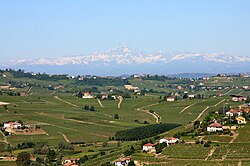
Asti is a substantially agricultural province, with particular emphasis on vineyards (also abroad the wines of Monferrato and the Astisan). The industry, developed especially in the capital and neighboring municipalities, is not of fundamental importance in the economy, although in any case the province constitutes the seat of numerous activities of the secondary sector.
Craftsmanship
Crafts are very important in the area of Astigiano. The Secondary Schools prepare young people in this area are different. These are both state institutions and private schools:
- the IPSIA Carlo Alberto Castigliano of Asti;
- the GAUSS Private Institute, also in Asti;
- the Pietro Andriano State Professional Institute of Castelnuovo Don Bosco;
- Norberto Bobbio Institute Quaranti.
Infrastructure and transport
Roads · Motorways · Regional roadsExplore this chapter
Roads
Motorways
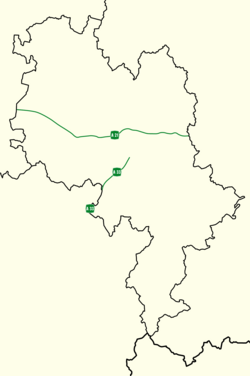
List of motorways in the province of Asti:
 |
Motorway Wines | (Turin - Piacenza - Brescia) |
 |
Highway of the Langhe | (Asti - Alba - Cherasco - Marene - Cuneo) |
Regional roads
This is a list of the former state roads present in the province Asti, became regional roads in 2001 following the legislative decree no. 112 of 1998, and finally became provincial roads in 2008 with regional law Piemonte 6 August 2007 n. 18 (BUR 9/8/2007 n. 32)[24] and the consequent abolition of ARES (Regional Road Agency) of which they were part:
 Lower Padana
 of the Colle di Cadibona
 by Moncalvo
Provincial Roads
Following are the main provincial roads of the province of Asti:
- SP1/A Dir. for Chiusano
- SP1/B Dir. for Cortanze
- SP1/C Dir. for the Piea
- SP1/D Dir. for Cerreto
- SP1/E Dir. for Aramengo
- SP2 Murisengo-Villanova
- SP2/A Dir. for Rinco
- SP2/B Dir. for staz. hardware. by Villanova
- SP2/C Bretella Villanova d'Asti
- SP3 Val Tiglione
- SP3/A Dir. for Vigliano
- SP3/B Dir. by Strada Annone - Castiglione Tinella
- SP3/C Dir. for Montaldo Scarampi
- SP4 Bruno - Alice Bel Colle
- SP5 Mombercelli - Castelnuovo Calcea
- SP5/A Dir. for Mombercelli
- SP6 Montegrosso - Bubbio
- SP6/A Dir. for Fonti di Agliano
- SP6/B Dir. for Opessina
- SP7 Santo Stefano Belbo - Agliano
- SP8 Asti - Govone for Antignano
- SP9 Piea - Baldichieri
- SP9/A Dir. by Baldichieri
- SP10/A Dir. for Cantarana
- SP11 of Valle Bormida
- SP12 Monale - Canal for Cisterna
- SP12/A Dir. for Castellero
- SP12/B Dir. for Vaglierano
- SP12/C Dir. for Tigliole
- SP12/D Dir. for San Damiano
- SP12/E Dir. for Channel
- SP13 Revigliasco - Tigliole
- SP13/A Dir. for Antignano
- SP14 Asti - Montemagno
- SP15 Rocca d'Arazzo - Vigliano
- SP15/A Dir. for Asti
- SP15/B Dir. for Mongardino
- SP15/C Dir. for SP59
- SP16 Casalborgone - Pralormo
- SP16/A Dir. for Cinzano
- SP16/B Dir. for Villanova
- SP16/C Dir. to Villanova station
- SP16/D Dir. for Isolabella
- SP16/E Dir. for Villata
- SP16/F Dir. for Montà
- SP16/G Dir. for Valfenera
- SP17 Gallareto - Castelnuovo Don Bosco
- SP17/A Dir. for Buttigliera
- SP18 Cunico - Lauriano
- SP18/A Dir. for Moransengo - Brusasco - Cavagnolo
- SP18/B Dir. for Cavagnolo
- SP19 Villanova - Govone
- SP19/A Dir. for Ferrere - Montà
- SP20 Cocconato - Valle Cerrina
- SP21/A Dir. for Robella
- SP22 of Valle Versa
- SP22/A Dir. for Villadeati
- SP22/B Dir. by Colcavagno
- SP22/C Dir. for staz. hardware. by Montiglio
- Costigliole SP23 - Alba
- SP23/A Dir. for Santo Stefano Belbo
- SP23/B Dir. for Castiglione Tinella
- SP24 Vesime - Mombaldone
- SP24/A Dir. for San Giorgio Scarampi
- SP24/B Dir. for Olmo Gentile
- SP24/C Dir. for Denice
- SP24/D Dir. for Mombaldone
- SP25 of Valle Bormida
- SP25/A Dir. for the Ponti
- SP26 Portacomaro - Quattordio
- SP27 Castello d'Annone - Nizza Monferrato
- SP27/A Dir. for Cerro Tanaro
- SP28 of Valle Belbo
- SP28/A Dir. for Bruno
- SP28/B Dir. for Castelnuovo Belbo
- SP29 Calliano - Quattordio
- SP29/A Dir. for Pergatti - Franchini
- SP30 Alessandria - Moncalvo
- SP30/A Dir. for Vignale
- SP30/B Dir. for the Ottiglio
- SP30/C Dir. for the Ottiglio
- SP30/D Dir. for the Ottiglio
- SP31 Grazzano - Moncalvo
- SP31/A Dir. for Alfiano Natta
- SP32 Cinzano - Riva di Chieri
- SP32/A Dir. for Marentino
- SP32/B Dir. for Casalborgone - Pralormo
- SP32/C Dir. for Riva di Chieri
- SP32/D Dir. for Castelnuovo Don Bosco
- SP33 Berzano San Pietro - Viale
- SP33/A Dir. for the Abbey of Vezzolano
- SP33/B Dir. for Capriglio
- SP33/C Dir. to Montafia
- SP34 Gallareto - Murisengo
- SP34/A Dir. to Montiglio
- SP35 Camerano Casasco - Settime
- SP35/A Dir. for the Cinaglio - SP458
- SP36 Cardona - Asti for the Tonco
- SP37 Asti - Grana for the Portacomaro
- SP38 Asti - Casorzo for the Scurzolengo
- SP39 Castello d'Annone - Castiglione Tinella
- SP39/A Dir. for Costigliole d'Asti
- SP39/B Dir. for Coazzolo
- SP39/C Dir. for Neive
- SP40 Mombercelli - Nice
- SP58 Palucco - San Damiano d'Asti
- SP410 Aramengo - Cisterna
This is not the complete list of provincial roads in Asti Province. It is instead available in the area dedicated to the institutional site of the province[25].
Railways
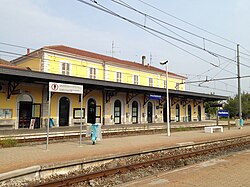
The Astigian railway network includes the following lines:
- the Alessandria-Cavallermaggiore railway, passing through the stations of Bruno, Castelnuovo Belbo, Incisa Scapaccino, Nizza Monferrato, Calamandrana, Canelli, Costigliole d'Asti And Castagnole delle Lanze;
- the Asti-Genova Railway, passing through the stations of Asti, of San Marzanotto Rivi, by Vigliano d'Asti, by Montegrosso d'Asti, by Agliano Terme-Castelnuovo Calcea, by San Marzano Oliveto, by Nizza Monferrato, by Bazzana and by Mombaruzzo;
- the Castagnole-Asti-Mortara Railway, passing through the stations of Moncalvo, Guazzolo, Penango, Tonco-Alfiano Natta, Castell'Alfero, Portacomaro, Casa dei Coppi, Asti, Asti Boana, San Marzanotto, Molini d'Isola, Isola d'Asti and Motta di Costigliole;
- the Chivasso-Asti Railway, passing through the stations of Cocconato, Sant'Anna-Robella, Montiglio-Murisengo, Cunico-Scandeluzza, Montechiaro d'Asti, Chiusano d'Asti-Cossombrato, Settime-Cinaglio-Mombarone, Serravalle d'Asti, Sessant, Asti;
- the Turin-Genoa railway, passing through the stations of Villanova d'Asti, San Paolo Solbrito, Villafranca d'Asti-Cantarana, Baldichieri-Tigliole, San Damiano d'Asti, Asti, Castello d'Annone e Rocchetta Tanaro-Cerro Tanaro.
The Alessandria-San Giuseppe Railway in Cairo, passes through the provincial territory of Mombaldone with the train station Mombaldone-Roccaverano Station, in the territory of Mombaldone, the Asti municipality of Roccaverano.
Airports
There are no airports in the provincial territory. The nearest airport is Turin-Caselle Airport, Cuneo-Levaldigi Airport and Alessandria Airport.
Administration
Presidents of the province · TwinningExplore this chapter
The organs of the province are the president of the province, elected among the mayors of the province, the provincial council, composed by the president of the province and by councilmen of the municipalities of the province and the assembly of mayors, constituted from the mayors of the municipalities of the province of Asti.
Presidents of the province
The president of the province in office is Maurizio Rasero, mayor of Asti, elected on 13 September 2022.
Twinning
 Miami-Dade County, since 1985[26]
Image gallery
Explore this chapter
-
-
-
-
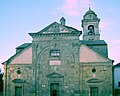
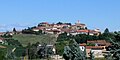
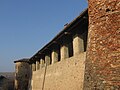 Castle Castelletto Molina
-
-
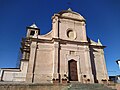 Sanctuary Virgo Fidelis, Incisa Scapaccino
-
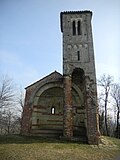 Church of San Vittore, Montemagno
-
-
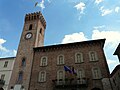 Municipal Palace with Civic Tower, Nizza Monferrato
-
-
-
Notes
Explore this chapter
- ^ Provincial Territorial Plan, (CONTENUTI DEL PIANO: The territorial characteristics (PDF), up province.asti.it, p. 12. Retrieved 26 April 2026.
- ^ to b Monthly demographic balance for the year 2026 (provisional data), up demo.istat.it, ISTAT.
- ^ to b c State Archives of Asti: 85 years after the entry into service of the Province of Asti, up Ministry of Culture. Retrieved 21 September 2026.
- ^ to b c History of the birth of the Province and the Government Palace, up Prefecture of Asti. Retrieved 21 September 2026.
- ^ Préfecture du Département de Marengo - Prefecture of the Department of Marengo, up State Archives Information System. Retrieved 21 September 2026.
- ^ Department of Tanaro, up State Archives Information System. Retrieved 21 September 2026.
- ^ to b Intendenza di Asti, up State Archives Information System. Retrieved 21 September 2026.
- ^ Paola Casana, An Intendant du Royaume de Sardaigne sous la Restauration: Carlo Ilarione Petitti de Roreto. Restauration et administration locales (PDF), up University of Turin, 2016. Retrieved 21 September 2026.
- ^ General understanding and provincial understanding, up State Archives Information System. Retrieved 21 September 2026.
- ^ Documentary heritage, up State Archives Alessandria. Retrieved 21 September 2026.
- ^ Regio Decreto Law 1 April 1935, n. 297
- ^ Province. Birth, life and requiem of an entity, up Astigiani. Retrieved 21 September 2026.
- ^ Piedmontese chronicles of floods and land (PDF), up ISPRA. Retrieved 21 September 2026.
- ^ Provisions for the population of municipalities affected by floods in autumn 1968, up Official Journal of the Italian Republic. Retrieved 21 September 2026.
- ^ 30 years since the Great Flood, up Region Piemonte. Retrieved 21 September 2026.
- ^ Statute of the Municipality of Montiglio Monferrato, up Region Piemonte. Retrieved 21 September 2026.
- ^ Merger procedures of Municipalities - year 2022, up Region Piemonte. Retrieved 21 September 2026.
- ^ to b Coats of arms and gonfalone of the Province of Asti, up Heraldic sections of the provinces, Central State Archives. Retrieved 8 August 2026.
- ^ In the crest hills, branches, white and black grapes, up 1935–1912 Province. Birth, life and requiem of an institution, archive.astigiani.it. Retrieved 8 August 2026.
- ^ Provincial stems with head of the littoral, up rbvex.it. Retrieved 8 August 2026.
- ^ Asti (province), up Heraldic office - Municipal files, Central State Archives. Retrieved 8 August 2026.
- ^ Province of Asti, up rbvex.it. Retrieved 8 August 2026.
- ^ Asti Province of - Gold Medal to Military Valor, up Presidency of the Republic. Retrieved 26 April 2026.
- ^ Regional Law no. 18, up nonprofitonline.it.
- ^ Copy filed, up province.asti.gov.it. Retrieved 10 November 2017 (archived fromoriginal url on 11 November 2017).
- ^ Miami-Dade County Online Services, Sister Cities - Miami-Dade County, up mymidade..
Where to stay · Asti
Find stays on Booking.comContinue your journey