Atlas of Monferrato
Cisterna d'Asti: sights, history and trails
Asti
- Elevation
- 350 m above sea level
- Area
- 10.73 km²
- Demonym
- tankers
- Patron saint
- Madonna of the Rosary
A closer look
Discovering Cisterna d'Asti
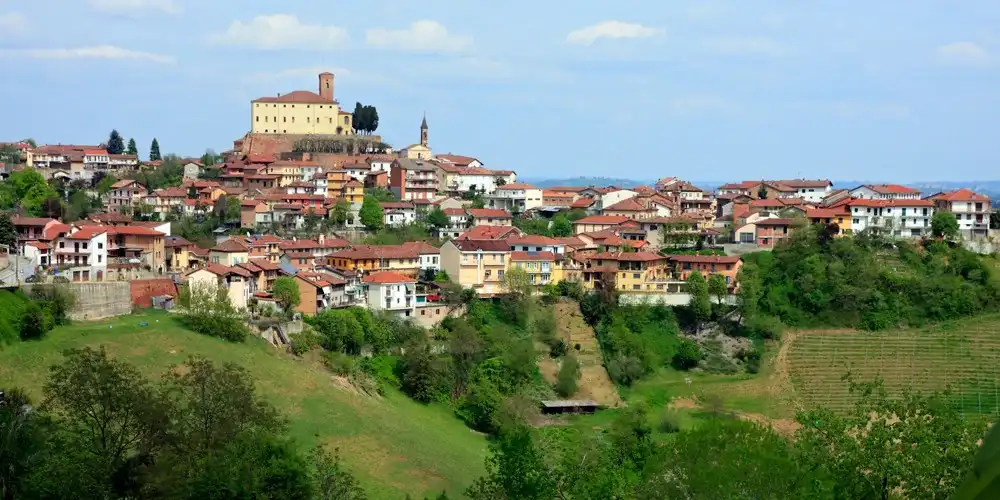
Cisterna d'Asti (Sisterna in Piedmont) is an Italian municipality of 1 211 inhabitants[1][4] from the province of Asti, on the border with the province of Cuneo. The municipality of Cisterna d'Asti is characterized by a mainly hilly territory, covered by woods and vineyards. It is a typical example of a village of ancient origins, once surrounded by walls and natural slopes and dominated by two building complexes: the castle and the parish church. The medieval castle dates back to the 11th or 12th century; the cistern it houses inside gives its name to the local toponym.
History of Cisterna d'Asti
Symbols · HonorsExplore this chapter
The territory of Cisterna was a place of insecration at least since Roman times: one of the most ancient sources found near the village is a Roman epigraph (quoted by Gian Secondo de Canis in the "Corography Astigiana" and today disappeared), probably a funerary plate. This epigraph, divided into "two pieces of Roman inscription, bearing around some ornate of foliage and small frames"[5] Say, come on.
"VERREDIUS SPE POL(I'm sorry.) M. (et et) L. FILI FECE(runt) ... M. PE ....... R.D."
It is most likely a funerary plate dedicated to the father, Verredius, children M. and L. The epigraph was found in the hamlet of Valmellana and, together with several finds of Roman coins in the same area, would suggest the existence of a small settlement.
Archaeological finds of Roman age were probably found in the localities of Mommiano (at the name almost certainly of Roman origin), Bogardo and Venre. The exact places of discovery of the various finds were not made known because of the "private" nature of such research; the same findings were not given to the Municipality and therefore having an exact idea of the extent of these findings is practically impossible.
In the Middle Ages Cisterna is an important fortified place. From the first half of the 12th century he passed to the Bishop of Asti then in 1242 was sold to the Municipality of Asti.
After several vicissitudes he passed to Gian Francesco della Rovere (1538) then, after a parentheses in which he returned to the Holy See, the fief was sold in 1650 to Francesco Dal Pozzo, Marquis of Voghera.[6]
The son of Francis, Iacopo Dal Pozzo della Cisterna obtained from Pope Clement X on 11 October 1670, the erection of the fief to principality[7]. The same Clement X granted the prince the right of mint, that is to beat money, with short dated 28 March 1673. This privilege, together with that of the third cognition of civil and criminal causes, granted by Clement IX even before the principality erection with short dated 30 November 1669, made the powers of the almost sovereign Pozzo.[8][7][9] Iacopo made some coins in his name. The prince's bust was straight, with long hair. On the reverse some carried a shield party showing at 1 and 4 a well supported by two winged dragons and faced, 2 and 3 of an eagle to one head and with open wings, and in the center six stars in an oval shield[7]. Some of these elements are still present in the municipal coat of arms.
During World War II and Nazi-fascist occupation of Piemonte, Cisterna and its wooded surroundings are an important partisan centre. [10]
In the help of partisans, in the country arrived the English Major Alexander Hope, who died then due to an accident during resistance.
Famous to Cisterna is the story of Giacomo "Rino" Rossino: Rossino was a young partisan coming from a fraction of San Damiano D'Asti who was captured by the Nazi-Fascist forces and shots by autoblindo on the main square of the country, which today still bears its name.
Symbols
The coat of arms and gonfalone were granted with DPR on 2 May 1996.[11]
The banner is a blue cloth.
Honors
Cisterna d'Asti is one of the cities decorated with military valor for the liberation war, awarded the silver medal to the military valor for the sacrifices of its populations and for the activity in the partisan struggle during World War II.[13]:

Region
The territory is hilly, covered by woods and vineyardsExplore this chapter
The territory is hilly, covered by woods and vineyards
It is the only municipality in the province of Asti to be part geographically and geologically of the Roero, and it is the last village of summit that concludes the ridge of the Rocche.
It is a village of ancient origin, once surrounded by natural walls and slopes and dominated by two building complexes: the castle, which houses inside it the "cisterna" that gives its name to the town, and the parish church.
What to see in Cisterna d'Asti
Castle · Parish Church of Saints Gervasio and Protasio · Church of San GiuseppeExplore this chapter
Castle
The Cisterna Castle rises on the top of the hill and from a fortified fence, mentioned in a document of 911, has become, in Baroque times, in a noble country residence.
The organization of a double circle of fences, although not yet fortified with brick bastions, dates back to the 11th - 12th century.
The first fence included a large area not accessible and with overhanging walls while the second, almost square in shape, occupied the top of the hill and in its interior was obtained the still existing collection tank, to which the name of the place itself is due.
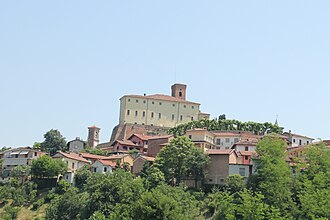
The tower, rising on the eastern edge of the castle, is the next stage and seems to be dated to the 13th century. Originally it had to perform the function of sighting, signalling and last refuge during enemy raids and have the symbolic purpose of manifesting the power and prestige of the feudal family that inherited it.
There is no evidence regarding the 14th and 15th century, except for the ogival arch (discovered during the restoration work of 1985) on the south-western outer wall.
Today it appears with the 18th century plant, when it was strengthened by Giacomo Del Pozzo, of the homonymous family.[14]
In the 19th century, the castle was owned by the princes Savoy-Aosta, sons of Maria Vittoria from the well of Cisterna, last of the family.
In 1912 the Castle was finally donated to the Commune by an act of donation from the heirs of princes from the well.
The fortified structure dominates the hilly landscape and boasts an imposing walls: it is accessed through an ancient arch on which the coat of arms of Pope Innocent XII, in memory of the high lordship exercised by the Church in the past of the country.[14]
The medieval castle of Cisterna d'Asti, located in the heart of the hills of Monferrato, has hosted the Arts and Crafts Museum of the Past since 1980, one of the most significant ethnographic collections of the Piemonte. Founded by a group of volunteers in 1990, the museum was created with the aim of preserving and passing on the memory of the rural and artisan material culture of the region. Today, the museum houses over 6,000 objects, dating back to between the seventeenth and twentieth centuries, distributed in 27 rooms that faithfully recreate the workshops and work spaces of ancient crafts, offering visitors an authentic immersion in the daily life of the past. The museum boasts of being the largest ethnographic museum in the Piemonte in the ancient medieval Cisterna Castle.
The castle itself, with its structure recalling the shape of a ship, represents an architectural example of great charm and historical value. Over the centuries, he has undergone numerous transformations, but maintaining his imposing and his role as custodian of collective memory.
The Museum of Arts and Crafts of a Time is not only a static exhibition, but a lively cultural center, managed with passion by volunteers who organize guided tours, events and workshops, actively contributing to the valorization of the local heritage. The visit to this museum is a unique opportunity to rediscover the roots of Piedmontese tradition and to understand the evolution of craft activities and peasants that have marked the history of the region.
The manor is part of the Lower Open Castles system Piemonte.
Among the noble titles that compete in Aimone di Savoia-Aosta is that of Prince of Cisterna as descendant and heir of Maria Vittoria from the Pozzo della Cisterna.
The walls of the castle and the surrounding area have been in the recent past the scene of numerous and fought elastic ball games, as it recalls a plaque on Hope Square.
Parish Church of Saints Gervasio and Protasio
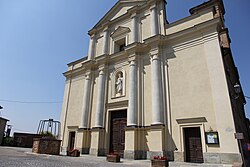
The parish church of Saints Gervasio and Protasio is dedicated to the two holy twin martyrs, it represents one of the main places of worship of the country, with a history that has its roots in ancient times. The church stands out for its sober but harmonious structure, enriched by architectural elements of the late Baroque and neoclassical era and sacred works preserved inside it. In addition to religious value, it is also an important cultural point of reference for the local community, often involved in liturgical celebrations and traditional events related to the Christian calendar. Its location in the heart of the country makes it easily accessible and well integrated into the urban fabric. The parish is active and an integral part of the community, with initiatives involving the faithful and residents.[15]
The spiritual heart of the country preserves elements of artistic and devotional value, including the main altar and a fine historical organ. The main altar, made of marble, dominates the presbytery area with an elegant oval tabernacle also in marble, symbol of solemnity and liturgical centrality. In addition to the main altar, the church has four side altars, each of which tells a fragment of tradition and local faith.[16]
The altar of the Sacred Heart of Jesus, once dedicated to the Suffragio, is made in scagliola and houses a painting with the souls of Purgatory, dominated by a scene of the Holy Family. The altar of Sant'Antonio Abate, owned by the Scapino family, is enriched by a painting depicting St. Anthony with St. Rocco and St. Sebastian. The altar of San Fedele, belonging to the Laferre family, instead houses a painting dedicated to the saint himself. Finally, the altar of the Rosary, in gilded wood, preserves a statue of Our Lady of the Rosary sculpted in the eighteenth century by Francesco Maria Riva, master sculptor from Piedmont.[17]
To complete the liturgical-musical system of the church there is the reed organ placed on the counterfaceted forum. Built in 1926 by the renowned organgar Giuseppe Gandini of Varese, the instrument represents an important part of the musical and cultural heritage of the parish, often used to accompany solemn celebrations and moments.[18]
The Church houses a series of frescoes by Luigi Morgari, a painter from Piedmont active between the end of the 19th century and the first half of the 20th century. Morgari is known for its numerous decorations in religious buildings of Piemonte and other Italian regions.
Church of San Giuseppe
The Church of St. Joseph in Cisterna d'Asti is a significant example of late baroque and neoclassical religious architecture in the Roero, located in the upper part of the village, along the road leading to the parish church and under the walls of the castle.
Built between 1656 and 1660 as the seat of the Brotherhood of St. Joseph's Disciplinates (called "Batu"), the church has a facade and a bell tower modified over time. The interior houses a valuable Baroque wooden altar of 1664, attributed to the "middle" Pietro Francesco Torneto, and an altarpiece depicting the Holy Family, work of the Astigiano painter Pietro Laveglia, which includes a view of the castle and the village of Cisterna of the time.
In 1903 the new bell tower, sacristy and a wall of support were built, while in 1940 a white marble statue of Carrara depicting St. Joseph with the Child Jesus was placed above the portal. Today, the church is used for the recitation of the Rosary during the Marian month and for some annual celebrations, keeping alive the bond with the local community.[19]
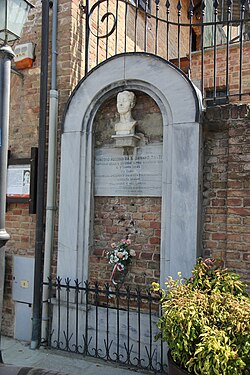
Piazza Rino Rossino
Cisterna d'Asti main square, entitled to the memory of Giacomo Rossino, a young partisan born on 4 December 1924 in San Damiano d'Asti, the square represents the heart of the social life of the town. Rossino also called "Rino", farmer by profession and active member of the Catholic Action, joined the Italian Resistance during the Second World War, fighting in the 21st "San Damiano" Brigade of the 6th Autonomous Alpine Division "Asti". Captured by fascist forces during the battle of Cisterna and Santo Stefano Roero in March 1945, he was tortured and shot on 6 March 1945 in the main square of the town, which today bears his name as a sign of recognition and memory. Surrounded by historic buildings and overlooking panoramic views of the Asti hills, the square is often the site of cultural events, markets and traditional events, acting as a meeting point for residents and visitors and helping to keep the community fabric of the village alive.[20]
Museum Arts and crafts of a time
Since 1980 the local Museum of Arts and Crafts of a time.
Events
Cisterna d'Asti Uses · MercandExplore this chapter
Cisterna d'Asti Uses
Enogastronomic and cultural event that takes place in the medieval village Cisterna d'Asti, in Piemonte. Organized by the local Pro Loco, the event is generally held at the end of spring or early summer, developing around the castle of the country. "Usanze" offers a traveling route that combines tastings of typical dishes and local wines, live shows, markets and cultural moments, enhancing the traditions of the roerino territory. The initiative stands out for the active participation of the towns and villages and for the evocative atmosphere that blends history, nature and conviviality. Another attraction is the “Ristorantino” with panoramic views, which offers an exclusive dinner in the castle garden.[21]
Mercand
Cultural and re-enactment event held annually at Cisterna d'Asti, in Piemonte, inside the medieval castle of the village. The event draws inspiration from the ancient privilege granted in 1673 at the Principality of Cisterna and Belreguardo to beat money, and celebrates its memory through theatrical animations, historical re-enactments and narrative paths. Mercandè combines tradition and imagination, with particular attention to popular Piedmontese fairy tales, and involves the public in interactive activities, guided tours and workshops at the Museum Arts and Crafts of a Time. The event is usually held in October.[22]
Administration
Below is a table relating to the administrations that have succeeded one another in this municipality.Explore this chapter
Below is a table relating to the administrations that have succeeded one another in this municipality.
| Period | First citizen | Match | Load | Notes | |
|---|---|---|---|---|---|
| June 4, 1985 | May 21, 1990 | Antonio Povero | Christian Democracy | Mayor | [23] |
| May 21, 1990 | July 24, 1991 | Michele Canta | - | Mayor | [23] |
| September 20, 1991 | April 24, 1995 | Sunday Massocco Natta | - | Mayor | [23] |
| April 24, 1995 | June 14, 1999 | Rosella Scapino | People's Party | Mayor | [23] |
| June 14, 1999 | June 14, 2004 | Mario Bodda | Lista civica | Mayor | [23] |
| June 14, 2004 | June 8, 2009 | Mario Bodda | Lista civica | Mayor | [23] |
| June 8, 2009 | May 26, 2014 | Renzo Peletto | Lista civica | Mayor | [23] |
| May 26, 2014 | May 26, 2019 | Renzo Peletto | Lista civica Cisterna | Mayor | [23] |
| May 26, 2019 | in office | Renzo Peletto | Lista civica Cisterna | Mayor | [23] |
Society
Demographic evolution · Foreign ethnic groups and minoritiesExplore this chapter
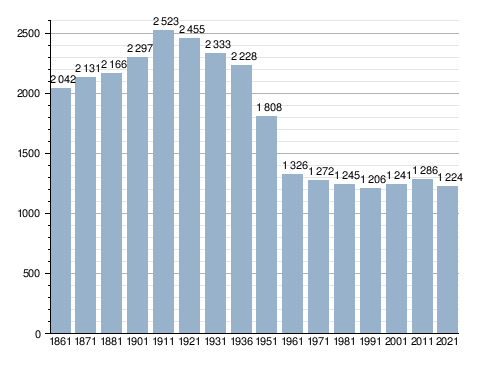
Demographic evolution
Inhabitants registered[24]
Foreign ethnic groups and minorities
According to ISTAT data at 31 December 2010 the resident foreign population was 171 people. The nationalities most represented by their percentage of the total population living were:
- Romania, 79 (6,00%)
- Republic of Macedonia, 50 (3.80%)
- Morocco, 19 (1.44%)
Image gallery
Explore this chapter
-
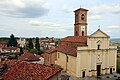 View of the village and parish church from the terrace of Cisterna Castle
-
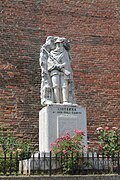 The monument to the Falls
-
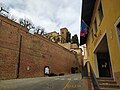 Walls of the Castle and Town Hall
-
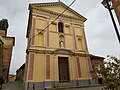 Façade Church of San Giuseppe
-
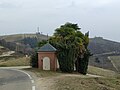 View of the chapel and hills and vineyards near Cisterna
-
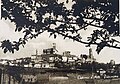 Cisterna d'Asti 1955
Notes
Explore this chapter
- ^ to b Monthly demographic balance for the year 2026 (provisional data), up demo.istat.it, ISTAT.
- ^ Seismic classification (XLS), up risks.protezionecivile.gov.it.
- ^ Table of degrees/day of Italian Municipalities grouped by Region and Province (PDF), in Law 26 August 1993, n. 412, annex A, National Agency for New Technologies, Energy and Sustainable Economic Development, 1 March 2011, p. 151. URL consulted on 25 April 2012 (archived fromoriginal url on 1 January 2017).
- ^ Cisterna d'Asti (AT), up Alltalia.it. Retrieved 18 July 2023.
- ^ Gian Secondo de Canis, Corography Astigiana.
- ^ Cisterna d'Asti :: Ecomuseo delle Rocche del Roero, up ECOMUSEODELLEROCCHE.IT. Retrieved 18 July 2023.
- ^ to b c Promis.
- ^ Alberto Casella, Cadets of the Real House, feudal lords of the Pope and Emperor, princes - bishops. The title of Prince in Piemonte (first part) (PDF), in Review of the Araldic College, year CXIX, 1 (June 2022), pp. 197-199. The Dal Pozzo were from 1660 also Marquis of the important center of Voghera
- ^ Text of the Bull
- ^ Baldassarre Molino, Cisterna D'Asti, Un Principato tra Roero e Monferrato.
- ^ Cisterna d'Asti, up Heraldic office - Municipal files, Central State Archives. Retrieved 12 June 2026.
- ^ Piedmontese civic coat of arms, vol. I, A-L, Regional Council of Piemonte, 2016, p. 173, ISBN 978-88-96074-98-5.
- ^ Istituto del Nastro Azzurro fra Combattenti Decorati al Valor Militare - Institutions decorated with Silver Medal to the Military Value, up institutenastroazzurro.it. Retrieved 2 December 2018 (archived fromoriginal url on 20 September 2024).
- ^ to b City of Cisterna, up common.cisterna.at.it.
- ^ Cisterna d'Asti Church of Saints Gervasio and Protasio, up churchromaniche.it.
- ^ Parishes Cisterna, up parishes.wordpress.com.
- ^ Parishes Cisterna Ferrere, up parishescisternaferre-asti.it.
- ^ The churches of the Italian dioceses, up churchesitaliane.chiesacattolica.it.
- ^ Parishes Cisterna and Ferrere, up parishescisternaferre-asti.it.
- ^ Giacomo Rossino, up biographiesresistent.isacem.it.
- ^ Prolocate Cisterna, up prolococisternadasti.it.
- ^ Museum of Arts and Crafts of a Time (Cisterna d'Asti), up museumartiemestieri.it.
- ^ to b c d And f g h the administrators. interno.it, http://amministratori.interno.it/ Missing title for url
url(help). - ^ Data taken from:
- Resident population of the municipalities. Censuses from 1861 to 1991 (PDF), up ebiblio.istat.it, ISTAT.
- Resident population - Time series, up exploredati.istat.it.
Please note: 2021 data refers to permanent census data as of December 31 of that year.
Bibliography
Explore this chapter
- Domenico Promis, Cisterna, in Coins Piemonte unpublished or rare - supplement, Turin, Royal Printing House, 1861.
Where to stay · Cisterna d'Asti
Find stays on Booking.comThe wine landscape
This village in wine country
Follow the link between the country, the vineyards and the neighboring territories.
The area, step by step