Atlas of Monferrato
San Damiano d'Asti: sights, history and trails
Asti
- Elevation
- 179 m above sea level
- Area
- 47.87 km2
- Demonym
- Sandamianese
- Patron saint
- San Rocco
A closer look
Discovering San Damiano d'Asti
San Damiano d'Asti (San Damian d'Ast in Piedmont) is an Italian municipality of 8 022 inhabitants[1] from the province of Asti in the Piemonte.
Landscape and area
Located 15 km from the provincial capital (Asti ), 45 km from the regional capital (Turin) and 50 km from Cuneo, the municipality of San Damiano d'Asti is a town in high Monferrato,...Explore this chapter
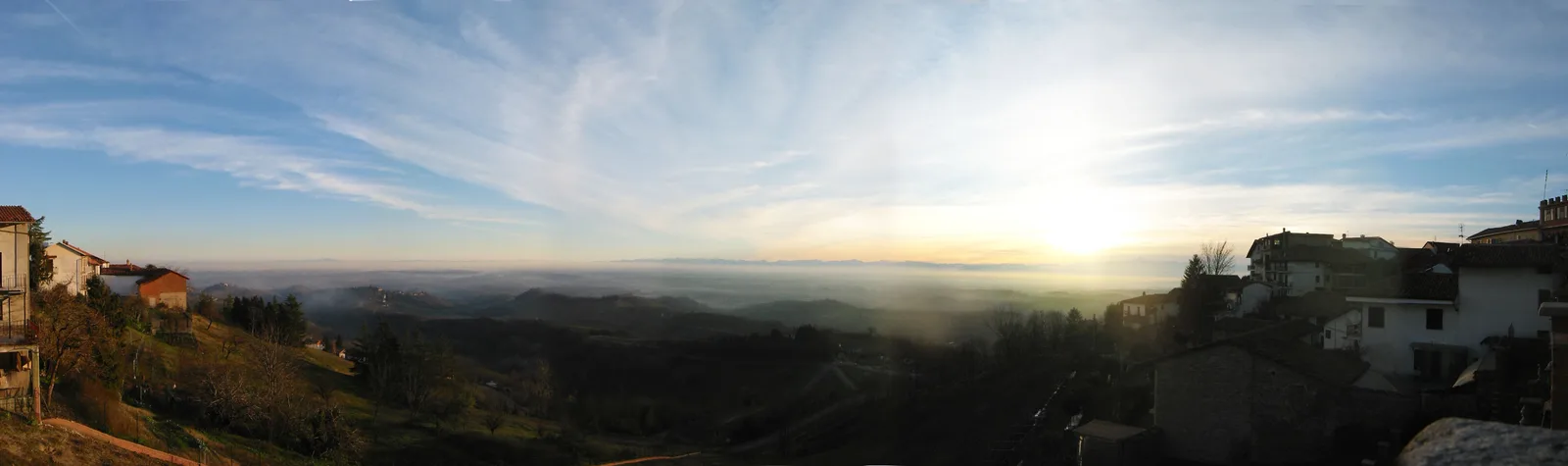
Located 15 km from the provincial capital (Asti), 45 km from the regional one (Turin) and 50 km from Cuneo, the municipality of San Damiano d'Asti is a town in the upper Monferrato, almost in the center of the Alfieri Hills, a territory made up of the extreme edges of the Langhe and the Monferrato.
The village stretches on a low hill (the highest point reaches 339 meters) on the left side of the Borbore stream and consists of three large villages developed around the historical center: Borgo Rondò north-east towards Asti, Borgo Piano west and Borgo San Rocco south. Among the vineyards of the surrounding hills are scattered the numerous farmhouses and hamlets of the village.
- Water courses: stream Borbore, rio Valmaggiore, rio Maggiore, rio Coasso, rio Blesio, rio Cravina, rio di Priocca, rio Sghiarotta.
- Seismic classification: zone 4 (irrelevant earthquake), Ordinance PCM n. 3274 of 20 March 2003, updated on 16 January 2006[4].
- Climate classification: E (the Grades day of the city are 2,632 and the maximum limit allowed for heating is 14 hours daily, from 15 October to 15 April), DPR n. 412 of 26 August 1993[4].
History of San Damiano d'Asti
Symbols · HonorsExplore this chapter
In 1275, during the conflict between the Republic of Genoa and Charles of Anjou, the astesani They conquered and razed the castles of Gorzano, Castelnuovo, Lavezzole and Marcellengo in the Borbore valley; in the surroundings they founded a new village where they were forced to live the villagers of destroyed villages. The settlement took the name of San Damiano from a pre-existing church dedicated to that saint and since then remained faithful to the municipality of Asti.[5]
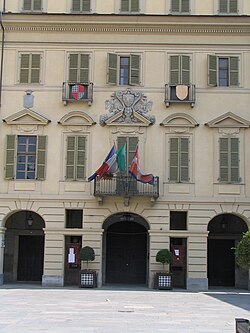
From the middle of the fourteenth century, San Damiano was annexed to the monferrini states of which he followed the alternating events in the wars with the Visconti of Milan, the principles of Savoia-Acaia and the so-called "wars of preponderance" between Spain and France. The Treaty of Cherasco of 7 April 1631 and the subsequent treatise of Mirafiori (1632) assigned San Damiano d'Asti to Casa Savoia that infeudated you the Marquis of San Martino d'Agliè, which followed the Aleramic Counts Carlevaris (their residence is the current Palazzo Comunale). Since then the history of San Damiano d'Asti coincided with that of the kingdom of Sardinia before and the Kingdom of Italy then. San Damiano d'Asti is also the home of the noble family Roberti of Castelvero.
Symbols
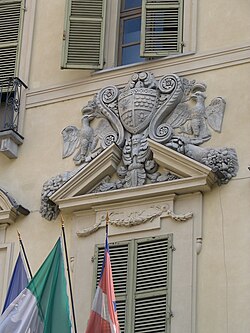
The coat of arms, gonfalone and flag of the municipality of San Damiano d'Asti were granted by decree of the President of the Republic of 7 March 2001.[6].
The gonfalone is a red and blue drape party.
Honors
On 14 February 2018 she was given the title of city by the President of the Republic Sergio Mattarella.[8]
What to see in San Damiano d'Asti
ArchitecturesExplore this chapter
The old town reflects the original Sancti Damiani Oppidum, the villa nova built in 1275-1276 by the Genoese Oberto Spinola, then Captain of the People of Asti, as a Roman military camp. It has the typical orthogonal mesh centered on the Contrada Maestra (current via Roma), intersected at regular distance from ten smaller districts, and closed on the four sides by the walls (which are preserved almost intact on the eastern side) with as many defensive banks (the current Magardienta, Solferino, Montebello and Palestro balus, become tree-lined avenues with lime trees and platani), towers.
The villa nova had only two doors of access: Porta Sottéra, towards Asti, and Porta Sovéra to the opposite head, towards Alba. In the fifteenth century, the castle and fortifications of Porta Sottéra were reused by transforming them into the parish church of Santi Cosma e Damiano and its bell tower (inside there is a circular wooden choir from the fourteenth century).
Architectures
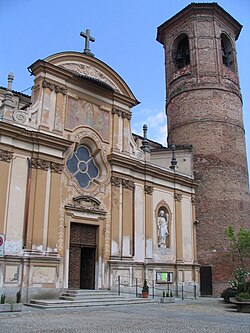
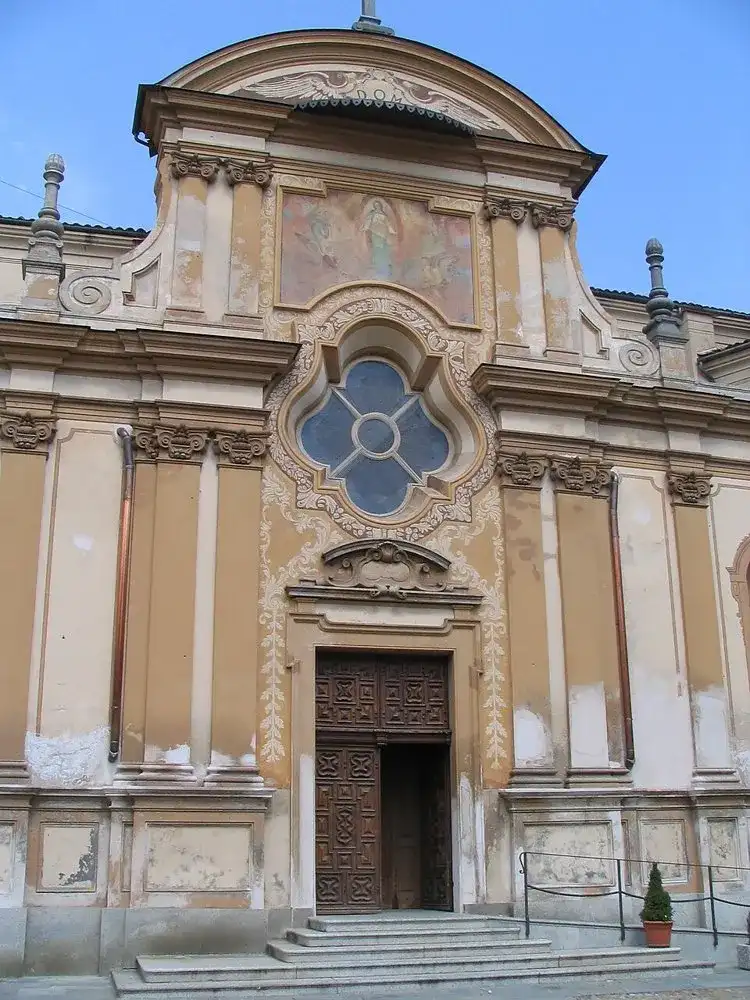
- Church of Saints Cosmas and Damian
- Church of San Giuseppe
- Castle of Lavezzole
Society
Demographic evolution · Foreign ethnic groups and minorities · Traditions and folkloreExplore this chapter
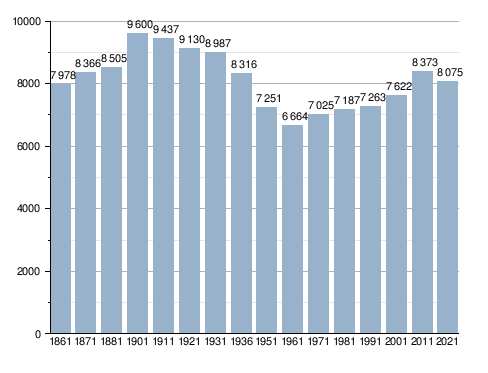
Demographic evolution
Inhabitants registered[9]
Foreign ethnic groups and minorities
According to ISTAT data at 31 December 2018 the resident foreign population was 1,292 people, equal to 15.6 % of the resident population.
The nationalities most represented by their percentage of the total foreign population were:
- Romania 830 (64.24%)
- Albania 168 (13%)
- Morocco 104 (8,05%)
Traditions and folklore
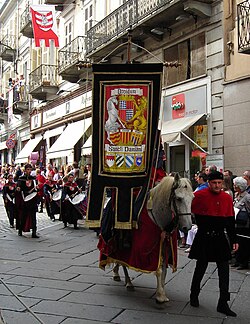
San Damiano is one of the 7 municipalities participating in Palio di Asti. It is a festival that culminates on the first Sunday of September with the horse race "bareback", i.e. without a saddle, in Piazza Alfieri in Asti. The participants (or brothers) are 21 in total, including 7 municipalities and 14 city districts and villages. In ancient times the brotherhood of S.Giuseppe of San Damiano d'Asti won the Palio on 27 April 1749 with the jockey Antonio Ranco. In modern times the municipality of San Damiano d'Asti won the Palio in 2011 with the jockey Massimo Coghe.
Economy
The hills of the area, cultivated with orchards, meadows and vineyards, are the main economic factor in the country, mainly devoted to agriculture and renowned for its production...Explore this chapter
The hills of the area, cultivated with orchards, meadows and vineyards, are the main economic factor of the country, mainly devoted to agriculture and renowned for the production of grapes (barbera, bonarda and freisa), fruit (peas, apples and peaches), vegetables (cardo, celery and pepper), honey, truffles, for livestock breeding (cappone di San Damiano d'Asti, Piedmontese cattle, olive grove. There are also small and medium-sized textile, metal and food industries.
Infrastructure and transport
Between 1882 and 1935 San Damiano d'Asti was served by the Asti-Canale tramway.Explore this chapter
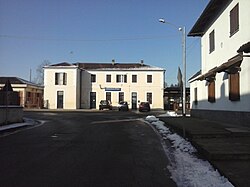
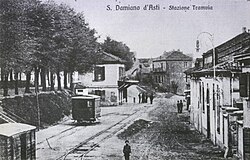
Between 1882 and 1935 San Damiano d'Asti was served by the Asti-Canale tramway.
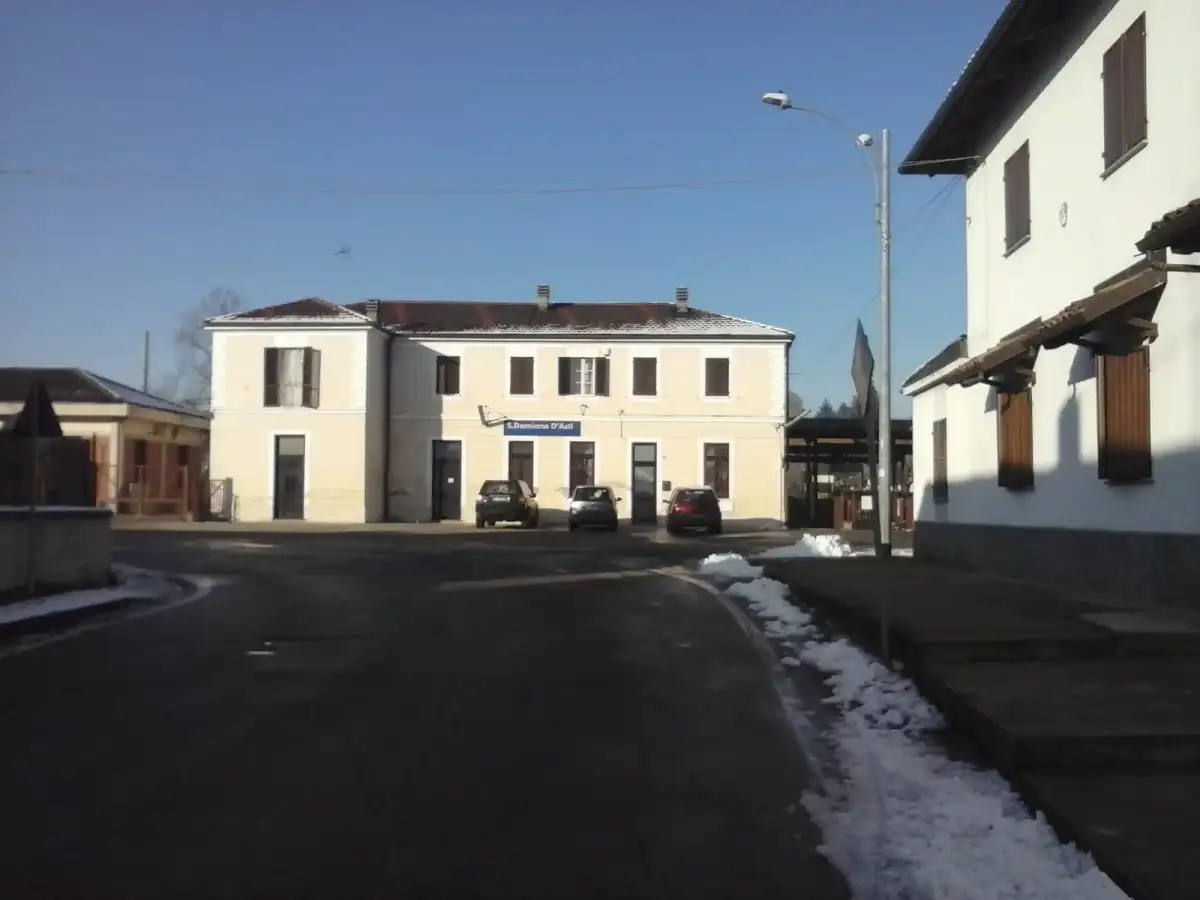
The current railway station, located along the Turin-Genoa line, is located a few kilometers from the centre, in the Asti area of Vaglierano Basso. It was built to serve the former municipality of Vaglierano but, after its suppression, it took on its current name.
- Provincial Roads
San Damiano d'Asti is connected to the municipality of Asti through the Provincial Road 58.
Administration
Twinning · Other administrative informationExplore this chapter
Below is a table relating to the administrations that have succeeded one another in this municipality.
| Period | First citizen | Match | Load | Notes | |
|---|---|---|---|---|---|
| June 20, 1985 | May 31, 1990 | Francesco Massobrio | civic list | Mayor | [10] |
| May 31, 1990 | April 24, 1995 | Francesco Massobrio | Christian Democracy | Mayor | [10] |
| April 24, 1995 | June 14, 1999 | Alberto Marinetto | centre-right | Mayor | [10] |
| June 14, 1999 | June 14, 2004 | Valter Valle | civic list | Mayor | [10] |
| June 14, 2004 | June 8, 2009 | Valter Valle | civic list | Mayor | [10] |
| June 8, 2009 | May 26, 2014 | Mauro Caliendo | civic list | Mayor | [10] |
| May 26, 2014 | May 27, 2019 | Mauro Caliendo | list civic Tradition - innovation | Mayor | [10] |
| May 27, 2019 | in office | Davide Miglia | civic list Together to grow | Mayor | [10] |
Twinning
San Damiano d'Asti is twinned with:
 Kriens, since 1998[11]
 Septèmes-les-Vallons
Other administrative information
San Damiano d'Asti was part of the hilly community "Colline Alfieri", and later of the hilly community "Terre di vini e di tartufi", together with the municipalities of Celle Enomondo, Tigliole And Revigliasco d'Asti.[without source]
Sport
Sports equipmentExplore this chapter
It is based in the municipality the football company A.S.D. Spartak San Damiano, who plays in the First Category 2021-2022 football championship[12]. The company was founded in 1992 by the union of two rival teams from two hamlets of San Damiano d'Asti.
Sports equipment
- Stadio Comunale Norino Fausone: is the largest sports facility in the city, home to the internal matches of Spartak San Damiano. The forum can accommodate up to 500 spectators.
- Sports field Vittorio Alfieri: it is the training camp of Spartak San Damiano and the youth sector of society.
- Bocciodromo Comunale di San Damiano d'Asti: in this bocciodromo there are the matches of the Union Bocciofila Sandamianese, main bowling club of the city.
Notes
Explore this chapter
- ^ to b Monthly demographic balance for the year 2026 (provisional data), up demo.istat.it, ISTAT.
- ^ Seismic classification (XLS), up risks.protezionecivile.gov.it.
- ^ Table of degrees/day of Italian Municipalities grouped by Region and Province (PDF), in Law 26 August 1993, n. 412, annex A, National Agency for New Technologies, Energy and Sustainable Economic Development, 1 March 2011, p. 151. URL consulted on 25 April 2012 (archived fromoriginal url on 1 January 2017).
- ^ to b From the site https://www.tuttitalia.it/piemonte/97-san-damiano-d-asti/.
- ^ Astigov, public portal of the Province of Asti, up astigov.it.
- ^ San Damiano d'Asti, decree 2001-03-07 DPR, concession of coat of arms, gonfalone and flag, up Heraldic office - Municipal files, Central State Archives.
- ^ Piedmontese civic coat of arms, vol. II, Regional Council of Piemonte, 2016, p. 476, ISBN 978-88-96074-98-5.
- ^ San Damiano d’Asti became City, the President of the Republic signed the decree, up atnews.it.
- ^ Data taken from:
- Resident population of the municipalities. Censuses from 1861 to 1991 (PDF), up ebiblio.istat.it, ISTAT.
- Resident population - Time series, up exploredati.istat.it.
Please note: 2021 data refers to permanent census data as of December 31 of that year.
- ^ to b c d And f g h https://amministratori.interno.it/
- ^ San Damiano and Kriens celebrate 20 years of twinning, up atnews.it.
- ^ site allcampo, up allcampo.it.
Bibliography
Explore this chapter
- Monica Agnoletti, The Sanamianese festivities: the Palio of the villages, degree thesis, University of Turin, faculty of foreign languages and literatures, tourism sciences, academic year 2006-2007. Available for consultation online online.
- Happy Daneo, The town of San Damiano d'Asti: historical and statistical news, Turin, Derossi, 1888.
- Christmas Iron (carefully), The ancient chroniclers Ogerio Alfieri, Guglielmo Ventura and Secondino Ventura. According to the text of "Monumenta historiae patriae" volume 5, Scriptores tomo 3, Alessandria, Edizioni dell'Orso, 1990.
Where to stay · San Damiano d'Asti
Find stays on Booking.comStories, places and people
More about San Damiano d'Asti and the surrounding area
Follow a thread of history and see where it leads.
 user:Luca.grieco · Public domain
Province of Asti
The province of Asti ( Province of Ast in Piedmont) is an Italian province of Piemonte of 207 128 inhabitants, with capital Asti .
Read the story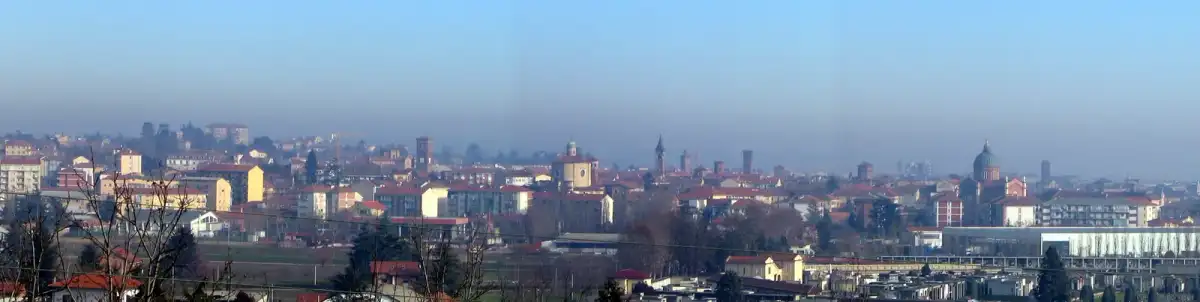 Faberh di Wikipedia in italiano · Public domain
Asti
Asti ( Listen , Ast in Piedmont and in the Astigiano dialect) is an Italian town of 73 681 inhabitants, capital of the homonymous province of Piedmont today commonly called Astigiano and main center of the historical region of Astesana . Roman Municipium, known as Hasta, was the seat of the duchy of Asti, Longobard Duchy of Neustria. Free common in the Middle Ages, with the right to "battle money", was one of the most important shopping centers between the 12th and 13th century, when its merchants developed commerce and credit throughout Europe.
Read the story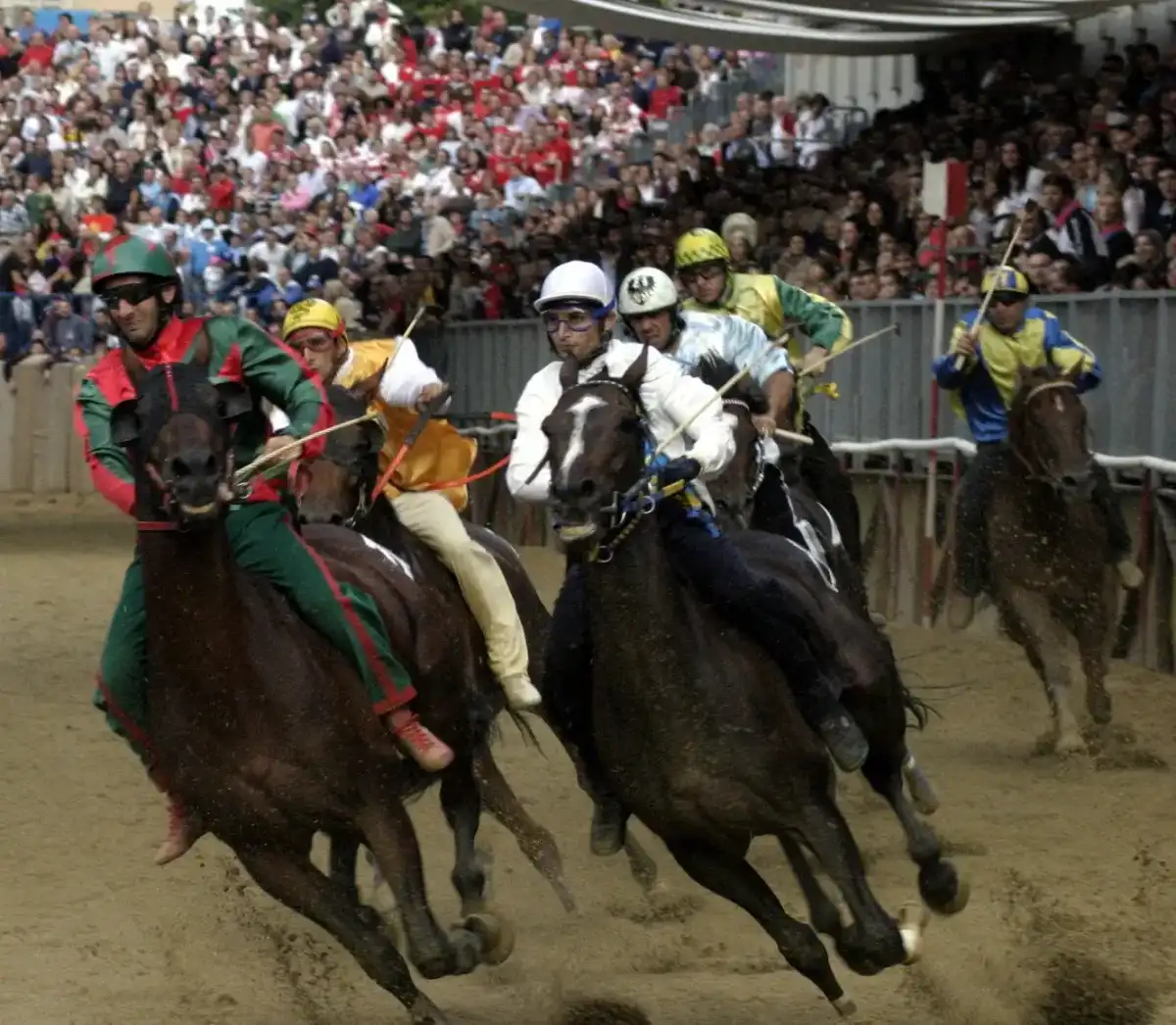 faberh · Public domain
Palio di Asti
The Palio di Asti or Palio Astese (in its most archaic nomenclature) is a traditional Astigian festival that has medieval roots, born in the patronal celebrations of San Secondo , and culminates with a horse race mounted by fur, i.e. without saddle.
Read the story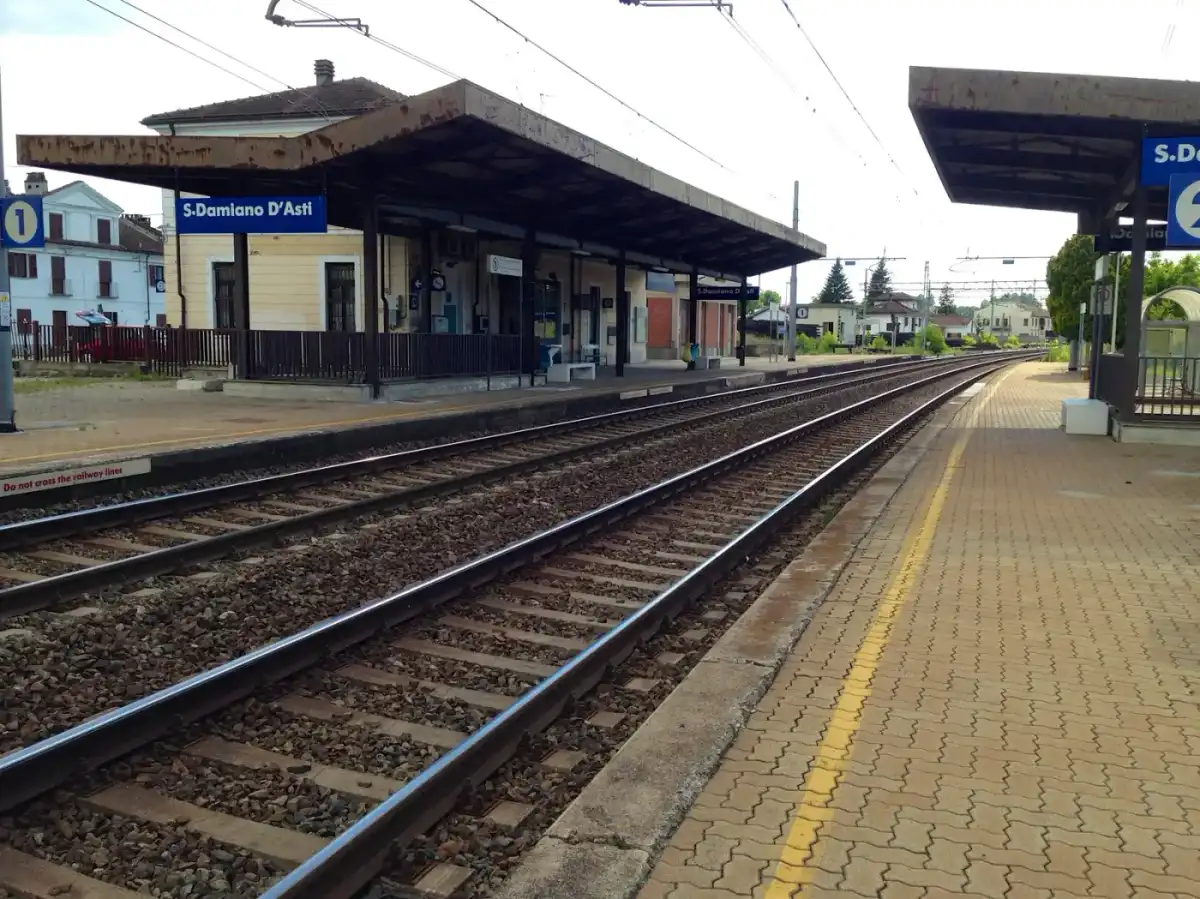 Incola · CC BY-SA 3.0
San Damiano d'Asti Station
San Damiano d'Asti station is a train station located on the Turin-Genova railway. The station, which since 1935 takes its name from the municipality of San Damiano d'Asti , is located in the town of Vaglierano Basso, a hamlet of Asti .
Read the storyThe wine landscape
This village in wine country
Follow the link between the country, the vineyards and the neighboring territories.
The area, step by step