A closer look
Palio di Asti: at a glance
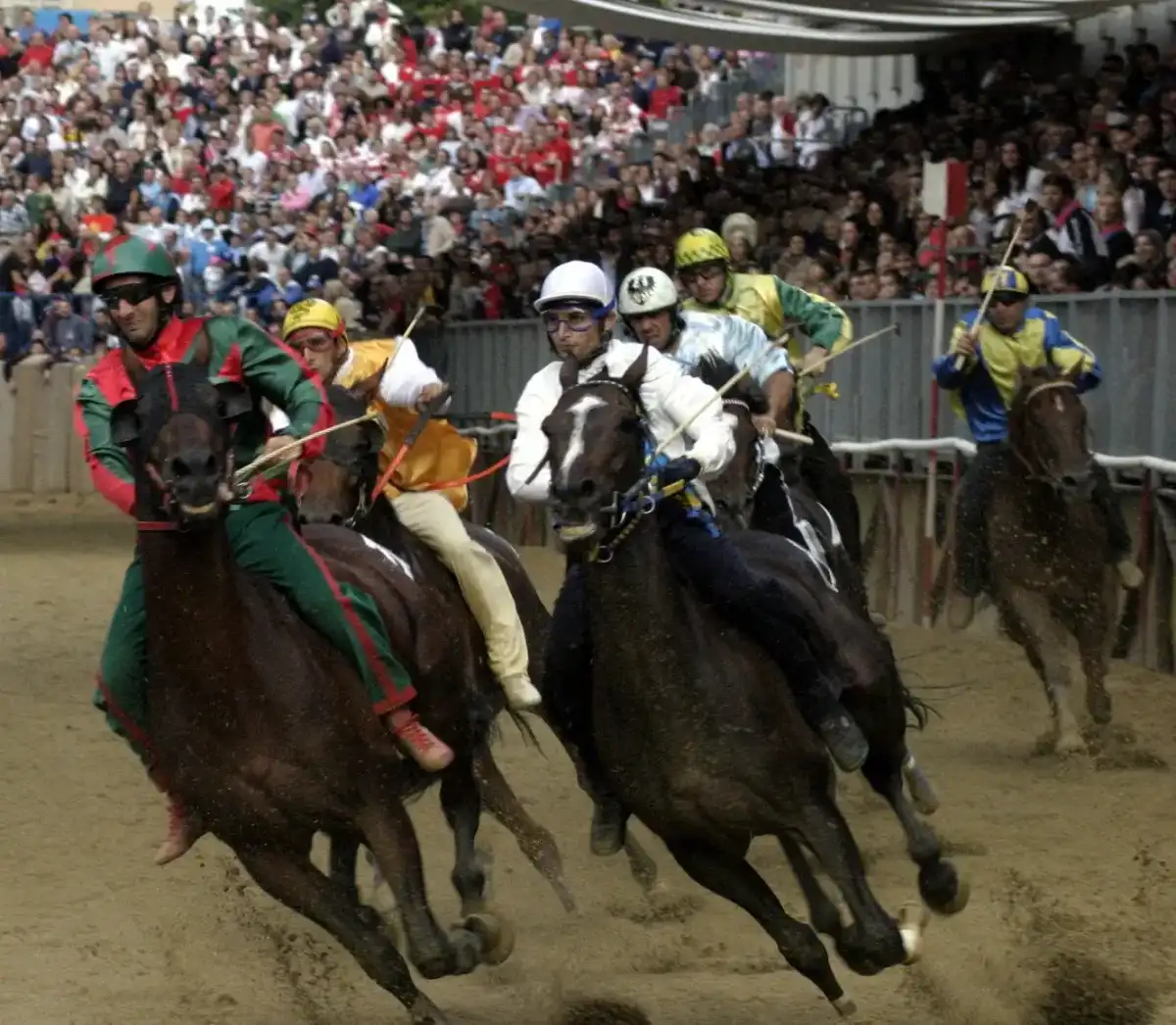
The Palio di Asti or Palio Astese (in its most archaic nomenclature)[2] is a traditional holiday Asti that has medieval roots, born in the context of the patronal celebrations of San Secondo, and culminates with a horse race bareback, or without a saddle.
The feast for the patron is held continuously since the 12th century[3] and the first news of the race, quoted by the chronicler Guglielmo Ventura,[4] date back to the third quarter of the 13th century; it also uninterruptedly takes place, except for two interruptions of seventy years in the 19th century and thirty in the 20th century.
The race, which once was held during the patronal feasts of May and that ran "in the long run" through the Contrada Maestra (the current Alfieri Course), since 1967 it is played within a special circuit (or "round"); until the 2017 edition Palio took place on the third Sunday of September. Since 2018, as officialised in the Council of Palio on 23 October 2017, Palio has been held on the first Sunday of September.
Since 1988 the race has been held in the central Alfieri square of Asti.
Etymology
The term palio, derived from the Latin pallium (the rectangular cloth worn as a coat above the Roman tunic), originally indicated only the piece of fabric...Explore this chapter
The term palio, derived from Latin pallium (rectangular cloth worn as an overcoat over the Roman tunic), originally indicated only the piece of precious cloth which was placed at the arrival point and which was awarded to the winner of the contest.[5]
Later the meaning was extended to the feast in general, meaning by palio the set of rites and customary practices closely linked to the real race.
History
The origins · The Savoy · The fascist period and the pole in the square of the same nameExplore this chapter
The origins
(from the ritual formula for the Palio race)
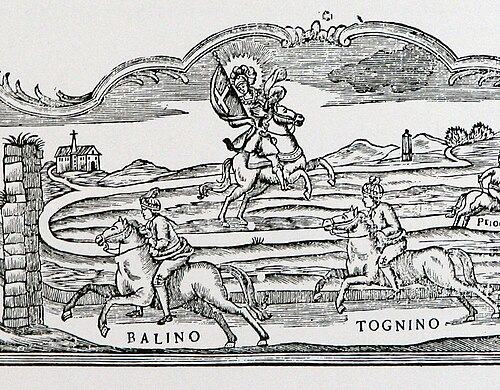
The Astigians have always struggled with perseverance to maintain the privilege of running the Palio on the day of their patronal feast, dedicated to the Astisan martyr San Second. The race is in fact mentioned in all the treaties, in all the alliances and in all the chapters of the agreements with the various regents, masters or dominators.
The first certain news of the race dates back to 1275: the local chronicler Guglielmo Ventura reports that the Asti, "sicut fiera solet Ast, in festo Beati Secundi" ("as it turns out to be usual in Asti, during the feast of Blessed Second"), ran the Palio for dilege under the walls of the enemy city of Alba, devastating the surrounding vineyards.
So if already in 1275 the "Corsa del Palio" was defined as a custom, it is likely that its origin should be placed after the year 1000, with rules already codified from the 13th century (period also coincides with the period of maximum splendor of the Municipality of Asti).
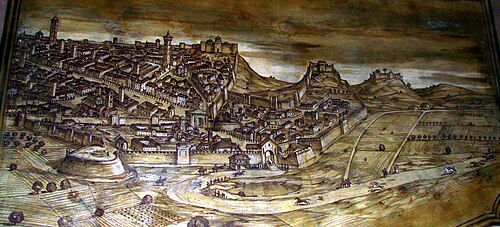
In this period, and until the first half of the fourteenth century, the race took place "tonda", in a circular press-appocal itinerary corresponding to the area of the current squares Alfieri e Libertà, already called in Lombard and Carolingian times. " curriculum ".
Gian Galeazzo Visconti, who became lord of Asti in 1382, to militarily strengthen the city, built a new fortified citadel right at the resume.
This resulted in the shift of the race no longer to the round, but on a linear path (i.e. "in the long run") of approximately two and a half kilometers along the main artery of the city (the current Corso Alfieri).
In addition, the Visconti established that the race continued to keep « ...in feast Sancti Secundi iuxta consuetudinem, omni contradiction remote» ("...the day of the feast of St. Second, as usual and rejected every objection").
In the documents kept in the Historical Archive of the Municipality of Asti it is noted that in the expenses incurred for the race are always indicated two poles, one offered to the church of San Secondo and one to be delivered to the winner. This detail also shows the characteristic devotional nature of the race.
The historian Niccola Gabiani, in his historical notes on the race, speaks of an ancient crème velvet pole enriched with three gilded lilies preserved at the Collegiate of Asti and supposes that he had been donated by the Dukes of Orleans during their lordship in the fifteenth century.[6]
Some documents from the Orleanese Treasure Fund inform that the palio for 1462 was packaged at the workshop of the Lupi brothers, in 1476 and 1477 by the Genoese Gregorio della Torre, in 1501 by Antonio Pugliese and in 1517 by Bernardo Capello di Santa Vittoria d'Alba.[7]
The Savoy
When Emanuele Filiberto assumed the regency of the city (20 May 1545), he confirmed and codified the ancient customs of the patron saint's feast and committed himself and his successors to provide the poles: one of 12 races for the race, the other of 9 rasis for the offering to the patron saint.
It is also read that they could present horses to the Palio Race "the city of Asti, that all the Churches of the same, including both those of Regular and of the Brotherhoods, College, University, Society and citizen of the same, both on their own name and of these Churches and Cappelle, all in accordance with the ancient style, customs and privileges of that City".
In the eighteenth century the "sendallo", a rectangular canvas bar, usually blue, packed in a silk/cotton mixed fabric, called zendale or "sangallo". The sendallo was adorned by the coat of arms of Casa Savoia, the Municipality, the Governor and the Podestà and was united in its terminal part, the real pole, usually rolled up and preserved in a wooden drawer.
Later the image of San Secondo on horseback made his appearance on the Palio labaro dedicated to the church and, at the end of the XIX century, also on that for the race.
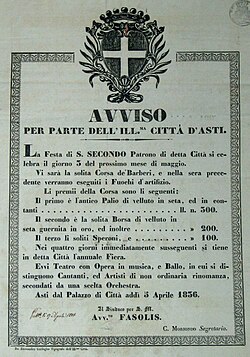
The race originally took place on 30 March each year, at the feast of St. Second. From the 15th century, however, it was moved, as well as the celebration of the saint, on the first Thursday after Sunday in Albis. In the early 19th century, the race was held on the second Sunday after Easter.
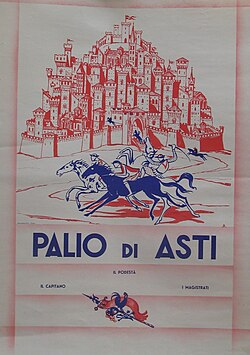
In 1818 the celebration of St. Second was again moved to the first Tuesday in May and consequently the race was also moved on that date.
In the 1861 the new "Regulation for the Horse Racing around the new Piazza del Mercato" (the current Campo del Palio square), radically changing the tradition of the Astigian race, which had been carried out until then always "in the long", that is, along a straight path that departed from the Roman stone that gave the name to Viale Pilone, passed through Porta San Pietro and, passing on the bridge in Rio Valmanera Corso, continued Almanstra 1754.
In 1863 the race became a common horse race, losing its traditional religious meaning.
The fascist period and the pole in the square of the same name
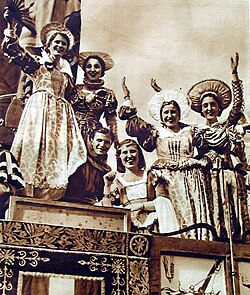
The feast was recalled in life in 1929 by the then podestà of Asti, Vincenzo Buronzo. For that year the Palio took place again in the long run, but on Corso Dante, along an uphill route of about 1300 m.
The resumption of the race (held until 1935), however, aroused some resentment in the municipality of Siena, guest of the same name Palio.
In 1936, for direct intervention by Benito Mussolini, who recognized the Siena alone the privilege of calling his own event under the name Palio, came the order to change the name of the festival in "Certame Cavalleresco", parallel to the interdiction for Legnano to call as palio the race held during the "Sagra del Carroccio". The race was then postponed first to the following year and later sine die.
The seven editions during the twentieth fascist period, however, allowed to renew the memory of Palio, avoiding the definitive loss of its tradition and its meaning.
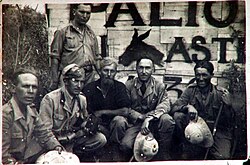
On May 3, 1936, during the Ethiopian War, the soldiers of the 104th Black Shirt Legion (prevalence consisting of Asygians) ran a special Palio on the shores of Lake Ascianghi. The chronicle of the race was reported on 23 May 1936 by the daily newspaper "The Province".[8] The participants were the Borgo di Santa Maria Nuova, the Rione di San Martino, the Borgo di Ponte Tanaro and the Rione Duomo. To win was the Borgo di Santa Maria Nuova.
In 1937 the Palio was again called by the name of the Certame Cavalleresco, where the Asti districts were reduced in their autonomy to the detriment of the fascist corporations. A week before the festival it was suddenly suspended, with the excuse of the arrival of agricultural work. It is probable, however, that the Palio underwent a notable downsizing primarily due to the deposition of Vincenzo Buronzo from the position of mayor. The new hierarch, Domenico Molino, not very sensitive to the party, had significantly reduced its budget, supported by the local secretariat of the National Fascist Party, which did not look kindly on a demonstration that it had failed to "manipulate".
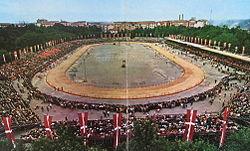
In 1938, a "Race of the Contrade" to which they participated only sodalizi Astigian citizens. The event took place in a minor tone and passed under the disinterest of local and national press. In 1967 the Palio was born again in the homonymous Piazza del Campo on the occasion of the 1000th anniversary of the foundation of the Marquisate of Monferrato and the 800th anniversary of the Lombard League. The race was finally moved to September, in conjunction with the festivities of "Douja d'Or", or "Settembre astigiano" and later on Festival of the Astigian festivals. The new route was in Piazza Campo del Palio, where grandstands with 5,000 seats and large partr. The first post-war edition saw the participation of 100,000 spectators, 600 participants and 14 villages, districts and municipalities in Asti.
The stake in Alfieri Square and the cancellations cause pandemic
Since 1988 Palio takes place in the central Piazza Vittorio Alfieri, as suggested by architect Antonio Guarene, in the heart of the city.[without source]
In 1992 the National Lottery was paired with Palio di Asti.
In 2020, due to the COVID-19 pandemic, Palio was postponed.[9] In 2021 he was mayor Maurizio Rasero to communicate the annulment of that year's edition with a letter to the rectors of the palio committees: [10]
I am sorry to have to communicate you officially, with the present, that I think there are no longer conditions to continue organizing the Palio di Asti scheduled for 5 September 2021. The too many uncertainties due to the evolution of the epidemiological framework that prevents us from knowing today what we will face in five weeks and the strong doubts about the success of Our private Feast of numerous aspects and irrelevant elements have made me mature the conviction that it is right to go in this direction. Of the numerous comparisons of these weeks with various institutions, the mayors of the seven municipalities who participate in the Palio, the Junta, the managing director Mario Vespa and the many people met even casually, I then collected more ideas and sufficient elements to make me feel that this is the only possible choice even if very painful and disproportionate. [...] In thanking all of you for believing us to the end, especially some, and being made available to you so that everything could go in a certain direction, I apologize if I failed you and if the same was not at the end the one desired. I remain at your disposal and from September I will start organizing the edition 2022. Viva Asti, Viva il Palio»
(Maurizio Rasero, mayor of Asti)
The Palio di Asti in detail
The esteem of the Palio in May · The rites of September · The historical paradeExplore this chapter
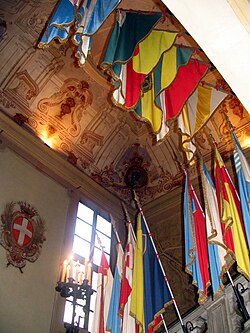
The esteem of the Palio in May
The year paliesco opens the first week of May on the occasion of the patronal celebrations of San Second.
The two sendalli commissioned by the municipality of Asti each year, on Saturday before the first Tuesday of May are "estimated" by three notable representatives of the ancient corporation of the draperies, who sang their good manufacture and measures. At the end, the two labars are presented to the population with exposure on the balcony of the municipality.
The same day takes place "rectors' oath" (i.e. of the 21 representatives of the same number of districts, villages and municipalities participating in the Palio) who, in front of the mayor, the captain of the Palio and the magistrates, make a solemn promise of loyalty towards the rites of the festival.
On the first Tuesday of May, feast of St. Second, with a solemn parade of all participants in the Palio, is the offer of the two sendalli to the Collegiate Church, at the chapel of St. Second.
The rites of September
The Palio di Asti, like other Italian poles, sees in the race the culmination of its celebrations.
In the two days before the race, official evidence is held. In many editions the "Palio degli scudieri" was held, a minor tournament intended to promote the generational replacement of fans. On the evening of the eve of the race, in the headquarters of the districts, villages and common participants, are held the "projective scenes".
The day of the race, in the morning, are carried out the blessings of horses and jockeys who will run to defend the colors of their parishes, with the usual formula of:
The historical parade
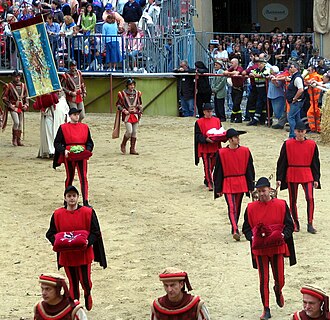
In the early afternoon the historic procession begins, starting from the Cathedral of Santa Maria Assunta, then winds through the streets of the old town and ends in Piazza Alfieri, where the race is currently held. The parade opens with the group on horseback of Captain Palio and magistrates. The Captain is supervised by the event, with the power to inflict sharks in case of irregular behaviors on the part of the fans during the course of the race.
Immediately after the group of heads, they parade the winners of the last edition of the Palio, followed by the other participants. At the end of the procession is placed Carroccio, an ancient symbol of free Municipalities, which bears with it the sendallo[11] depicting Saint Second on horseback and the signs of the Municipality of Asti. Every year the client is entrusted to a master of contemporary painting internationally renowned.
In the past, the fans (called at the time "paggi") departed each from their hotel or district of the city, from the Brotherhood, College or association for which they ran. They were usually accompanied by other men on horseback (also with the same colors) and by the crowd of adherents and sympathizers, to the sound of trumpets, drums and hunting horns. The meeting point was the so-called "Pilone", once a congressman at the start of the race "long".
In 1930 the villages, reions and common participants adopted the use of costumes of the 16th century, as a sign of homage and gratitude to Emanuele Filiberto di Savoia who, as said, provides confirmation and coding of the rules of Palio.
From the second post-war period onwards, the historical parade of Palio staged more than 1200 figures each year, through the representation of important episodes of medieval history of the city (XII-XV century), at the time when Asti was shining for wealth and vitality.
Since 1983 the best presence in the historical parade between districts, villages and towns of Palio has been awarded by the "Soroptimist club of Asti" with the Pergamena d'Autore: a work of art on parchment.
The race
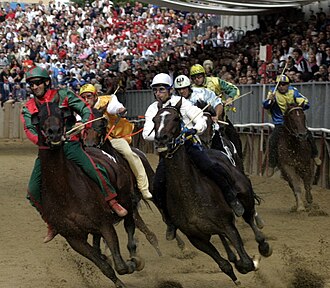
Before the real race, Palio's captain turns to the mayor, asking for a licence to run
The mayor, according to tradition, gives a licence to run under the protection of St. Second, when the captain, followed by the magistrates and knights of the Palio, travels all the way announcing:
This is how you get to the race, structured in three batteries from seven participants each. The first three classifications of each battery thus access the final race, which decides the allocation of Palio.
The drawn participants of each battery align themselves behind the canapo (a large rope that delimits the starting line). The start of the race is sanctioned by the mossiere, who decides at its discretion the best alignment of horses. In case of repeated false departures, the mover may decide to commit a penalty to the responsible, punishment that usually consists of a retraction in the starting blocks.
Once they leave, the horses must take three turns of square, for a total of about 1,350 m. The Palio is won by the horse, with or without a fan (rocky), who arrives first at "flag" of the finish line.
Currently there are 21 participants admitted, divided between districts, towns and villages of the city province of Asti.
Since the 2017 edition, the race is played, unlike previous years, with half-blood horses[12].
Prizes
In medieval times, the Palio race did not foresee that two awards: the pole, velvet drapes or precious cloth, for the first arrived, and a live rooster for the second, as well documented by the books of the accounts of the ducal treasury. If the first prize has a very high venal value, the second is practically devoid of it and has an especially symbolic and moral function.
During the 16th century, the awards underwent a radical transformation, increasing numbers and crystallizing permanently in their current ranking at least from the early 17th century.
- The first prize is the pole, crimson velvet drape "in three hairs, quality and usual goodness", which traditionally must be 16 satin Asti long[13]. The palio is placed, tied, under the sendallo, the canvas painted every year by a Master of the Palio, traditionally depicting the coat of arms of the city of Asti, San Secondo on horseback and the motto of the City "Auctions Nitet Mundo Sancto Custos Secundo".
- The second prize, since 1929, is a "basket with silver coins". In the ancient Palio, however bag bag It was all the other thing. It was in fact a scamp of the same velvet used in the box of the pole, enriched by fringes and gallons. Its dimensions were quite variable, but they were never more than 70 cm. The bag was basically like a small velvet square, but with rich decoration and, through a piece of handicraft, it was hung on the banner of the pole for all the event. Simbolically, he represented a joke of the first prize that the second arrived had not been able to achieve. From the 16th century, the bag became the second prize and, at the resumption of the Palio in the 1930s, the interpretation of the award changed, transforming the bag into "the silver coinage".
- The third prize is a pair of "speroni"; they make their appearance only in the early seventeenth century as an award for the third class. They were iron, silvery or more often golden. The spurs were introduced as a third prize, as an invitation to use them in the future to achieve better results. It should not be forgotten that until the first decades of the 19th century the use of spurs was admitted during the Palio race, provided that form and length compatible with what is prescribed by the regulations of the race.
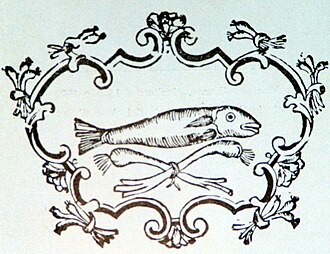
- The fourth prize is a "live stamp"; in the minutes of the fifteenth century of the race we mention the gall as a prize to the second fastest horse. At the beginning of the 17th century, the prize slipped to fourth place and remained such in the modern edition.
The rooster, from the beginning to today, has always been assigned live, contained and transported in a basket. It was and is a prize with strong symbolic values: it represents municipal freedom, the victory of good on evil, the arrogance and the collection of soul on sin. - The fifth prize is a "coccarda" with the colors of the city, white and red. It is a tradition that has been institutionalized, but very recent, affirmed with the need to increase the number of prizes as a result of the widening of the number of horses deployed to the canapo in order to dispute the Final Race.
- The last one is entitled "the nail", or salted anchovies. It is one of the most characteristic and felt awards of the Palio di Asti. Derived by the 14th century astigiano dialect anzoa, and subsequently too. Intended for the last place finisher, it is given as a prize as a sign of mockery and dishonor for the loser. The nail was accompanied, and is accompanied as a reward, by the salad. Sometimes they also appeared Sigolle (onions), which, in some editions of the past, represented another very bitter reward for the penultimate classified, but which were usually placed there to unequivocally evoke the tears of the loser.
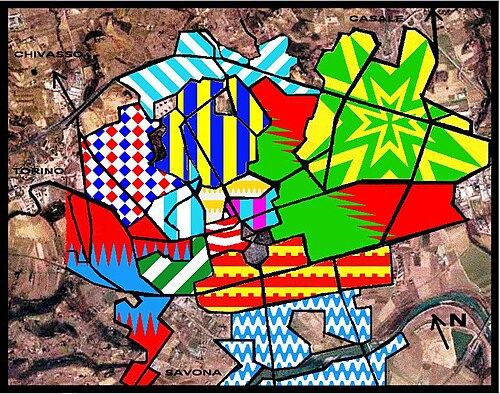
Territorial division of the city of Asti. From west to east:
 Rione Santa Caterina ·
 Borgo Torretta ·
 Borgo Viatosto ·
 Rione Cathedral ·
 Rione San Martino-San Rocco ·
 Borgo Don Bosco ·
 Rione San Silvestro ·
 Rione San Secondo ·
 Rione San Paolo ·
 Borgo Tanaro Trincere Torrazzo ·
 Borgo Santa Maria Nuova ·
 Borgo San Pietro ·
 Borgo San Lazzaro
The "Paliotto"
In 1977 the "Paliotto" was born, an event traditionally held on Thursday evening before the race of Palio, which competes among them the groups of...Explore this chapter
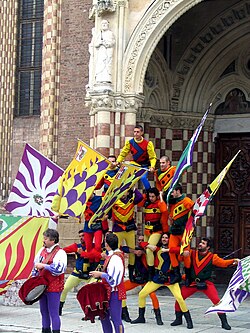
In 1977 the "Paliotto" was born, an event traditionally held on Thursday evening before the race of Palio, which competes among them the groups of flag holders of individual districts, villages or municipalities participating in the Palio.
The Council of the Palio of 18 December 2017 approved, as from the 2018 edition, the shift of the event to May in the context of celebrations dedicated to the Patron Saint of the city of Asti.[14]
The flags, in the Middle Ages and in the Renaissance, were born as military alphires who, in the clamor of the battle, with their own launches and "figures" incited morality and gave orders to the troops.
Afterwards, the flag has evolved, «... is handed down as a religious act: the player waves the flag symbolically and in the name of the Corporation for God, Queen and Homeland.» (Acts of the IV Congress of Vessillology, Netherlands 1971).
The prize for this competition is a drappo, smaller, but similar to what is awarded for the race (a "paliotto").
The initiative has been designed to better value this particular art, known and practiced in many national realities and that reaches its peak in the cities of Palio. In 1998, a special prize for the best music group was added to this event.
The Palio and the media
Since 2009 the race has been proposed live television on several local broadcasters ( GRP Television , Quartarete , Telesubalpina ).Explore this chapter
Since 2009 the race has been proposed live television on several local broadcasters (GRP Television, Quartarete, Telesubalpina).
Since 2014, it has been visible on Quartarete screens and transmitted in simulcast mode and unified networks through the Blue and 3D Quartarete channels of the Turinese broadcaster, as well as being visible live streaming on the web site[15].
Subsequently, the pole of Asti will be broadcast annually by GRP Television in competition with the national broadcaster Rai 3, condition where the local broadcaster benefits from the flexibility of his own palimpsest, allowing spectators to see the event in its entirety, while the national broadcaster, due to time limits due to the need to transfer the connection to the Tg3 evening edition in the past has often had to cut the direct[16] before the race could actually start.[17]
Since 2011, there has been a newspaper dedicated to the world of paliophile, called The Canapo which is freely consultable online.
Polemics and measures for equine safety
Veterinary visitsExplore this chapter
In recent decades, the Palio di Asti, as well as the other poles of Italy, has triggered protests from animal associations and veterinary medical association for the right of animals (AVDA), regarding the use of horses for the race.
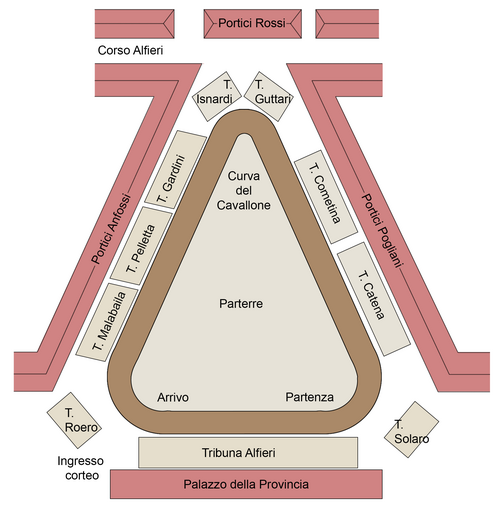
In particular, animal protests are directed to the use for the race of a city route (the trapezoidal Piazza Alfieri) not suitable for "purosangue" horses and cause of ruinous accidents in recent years.
In particular, the curve of "Horse" was the theatre in 2003 of some accidents during the "Palio of the Squires", which led to the killing of two horses and the injury of a third.
From the results ascertained by Nas dei Carabinieri, to seven of the nine horses that ran the final of Palio in 2002, were administered substances not allowed.
To try to turn off the protests, the municipality of Asti has created a committee of experts (technical commission) constantly updated to put in total safety the track, and protect the health of the jockeys and animals during the whole celebration.
In this regard, the track consists of a mixture of 800 cubic meters of Astigian sands coming from the top pliocene layer, dosed so that the race path does not cease for the whole period of the festival, but that can also slow down the horse race.
The curves are protected by robust “mattresses” and in 2004, the Cavallone curve has been modified and calibrated to prevent new accidents.
Three specific veterinary commissions, in collaboration with the faculty of Veterinaria of the University of Turin, verify the sports suitability of horses and provide assistance zootrics during the trials and subsequent races of the Palio di Asti.
A commission of veterinary doctors from the local Health Company, guarantees a service of pharmacosurance and organizes and carries out withdrawals of biological samples.
A veterinary emergency protocol was adopted (among the first in Italy) on the track, able to intervene immediately in case of need with guidelines of the local Health Company, veterinary area, regarding the track and running of the race.
However, the unfolding of this prevention apparatus does not seem sufficient to prevent bloody and deadly accidents for horses, such as that which occurred at Mamuthones in the 2013 edition.
Veterinary visits
According to the Veterinary Regulation, horses who are candidates for the race, presented by the Committees, must undergo a meticulous visit of fitness that certifies the state of health of the subject and which evaluates its morphological, aptitude and sport. The strict visits are made by two Veterinary Commissions, which were commissioned by the Municipality and chaired by the President of the Order of Veterinarian Doctors in Asti and are composed by University Professors, experts in the various branches of Veterinary Medicine.
In addition to ensuring animal well-being, a team of Medici Veterinari dell'Asl guarantees a high service of pharmacosurveillance and carries out withdrawals of biological samples. For each identified and visited subject opens a clinical folder, from whose outcome will depend on the participation or not of the horse to the race.
The Veterinary Commission will follow the horses on track and if at the visit before the final, some of them showed signs of suffering so as not to make it suitable for the final competition, the Commission has the right to order its withdrawal, with unbearable judgment.
On track, the Zooiatrica commission consists of veterinary doctors who carry out first aid service, if necessary.
Glossary paliesco
Explore this chapter
- Barbero
- for many centuries the Race took place with whole horses (barberries). Since the 19th century, the regulation has allowed horses “of every sex and race”. Barbéri were also the very agile horses of Barbéria (berbers in Africa) and therefore suitable for Palio races.
- Battery
- is one of the three elimination races to which 21 participants are subjected to the Palio in order to be able to play the final. The first three incomings of each battery will qualify.
- Borghigiano
- is the patron of one of the Borghi taking part in the Palio. He participates in the socio-cultural activities of the Borgo throughout the year.
- Borgo
- is one of three socio-territorial partnerships participating in the Palio. The Borghi are the socio-territorial organisms that present their own church and most of the territory, outside the first city walls (Enclosure of nobles).
- Rocky horse
- the horse that disassembled the jockey.
- Canapo
- is the rope that serves to delimite the area of the " move ", that is, from which they take the horses away at the departure of the Palio.
- Courses
- from the Latin cursàrius (corridore). It is synonymous with barber horse very used in ancient Palio.
- Fan
- (♪ in Astisan): a decrease of the word "infante", i.e., as in recent centuries, the drivers of horses were always of very young age and the ancient regulation provided that they could not be more than 21 years old. Vocabulary replaced between the 19th and 20th centuries the synonym Page 2. Before that period the two words were used interchangeably.
- Gavard
- is the lodge worn by the jockey during the Palio Race.
The first traces of this vocabolo are found in the documents of presentation of participants to the Palio at the end of the seventeenth century. The word comes from the Genoese "gabanin-a" that is small gabbano (small tunic), in turn borrowed from the Arabic "qaba".
- Mossa
- is the act that the mossiere performs by clearing the argan that keeps the canapo tense at the time of departure.
- Page 2
- (Pages in Astisan): it is the term used for the Palio fan, the first documents in which the vocabolo is present, date back to the beginning of the seventeenth century. In medieval terminology ♪ he was responsible for the good health of the war horse in periods away from battle.
- Palio
- (Pari in Astisan): is the prize awarded to the winner of the race. It is a piece of cremisi velvet (red-violaceous) whose width is about 1 meter and the length of about 7 meters. The pole, is rolled up, and tied to a painted banner called "Sendallo" or "Weapon".
- Partition
- any supporter of one of Palio's associates. The name comes from game, that is the people divided according to the rules of a game.
- Rionaiolo
- the one who belongs to one of the Rions participating in the Palio. He participates in the socio-cultural activities of Rione throughout the year.
- Rione
- one of the three socio-territorial partnerships participating in the Palio. The Rioni are the socio-territorial organisms that present their own church and most of the territory, inside the first city walls (Enclosure of nobles).
- Sendallo
- (Sendal in Astigiano): it is the name of the painted labaro to which the Palio is tied. The first appearances of Sendallo are at the end of the 15th century. From the end of the eighteenth century, Sendallo bears the image of St. Second on horseback with the signs of the City, the coat of arms, the motto of the Municipality and the year.
- Asshole
- by the French "crew" (troop, squad), is the group of participants sporting the handkerchief with the club colours. They can be preceded by their own insignia or sometimes followed or preceded by musicians on the occasion of the main rites of the festival.
Notes
Explore this chapter
- ^ (EN) AA VV, The land I trampled. For a new alliance with our existential and material sphere: For a new alliance with our existential sphere and material, FrancoAngeli, 4 June 2015, ISBN 9788891723680. Retrieved 16 August 2019.
- ^ Agostino Barolo, The pole of Asti, in Lares, vol. 2, no. 2, 1931, p. 51. Retrieved 16 June 2021.
- ^ Dear L., The ancient patronal feasts of San Secondo in Asti, Historical re-enactments. Asti 1928, page 5
- ^ Ventura G., Memorial (Capitolo X)
- ^ Galeazzo Nosari and Franco Canova, The pole in the Renaissance, E. Lui, 2003, p. 3.
- ^ Niccola Gabiani, The Palio race and the patronal feast of San Secondo in Asti. Historical notes, Asti, 1909, 2nd edition, pg. 34
- ^ Niccola Gabiani, The Palio di Asti, Asti 1931, 1st edition, pg.28
- ^ Below is an excerpt from the article: "The destriers were all the donkeys collected by the Company in its advanced and abandoned by the abyssini during their escape." [...] "For the occasion they were baptized with the names of the various ras defeated in correlation to their speed skills"
- ^ The Palio of Asti 2020 is officially canceled, up The Canapo, 1 September 2020. Retrieved 17 March 2026 (filed on 23 January 2026).
- ^ Officer: Asti's Palio 2021 is canceled, mayor Rasero communicates it with a letter to the Rectors, up _, 31 July 2021. Retrieved 2 August 2021.
- ^ The name attributed to Palio comes from the zendale (or sangallo) canvas that was used to weave it.
- ^ Mariachiara Giacosa, The Palio di Asti surrenders: for the first time no purebred horses in the field, up torino.repubblica.it, 8 September 2017.
- ^ The satin is an ancient Piedmontese measure that corresponds to about 60 cm.
- ^ Asti, the Palio of flagieratori will be in May: a return to the past, in _, 19 December 2017. Retrieved 21 December 2017.
- ^ Presented the Palio 2014, iron fist to the canapo after the tragedy of 2013. From this year direct TV of the event on Quartarete
- ^ Palio di Asti: Rai jumps, but the TV interviews the parades during the historical procession - ATNews.it, up ATNew, 3 September 2018. Retrieved 30 August 2019.
- ^ The Palio di Asti on TV - ATNews.it, up ATNew, 28 August 2019. Retrieved 30 August 2019.
Bibliography
Explore this chapter
- AA.VV., Brotherhoods, archives, buildings, furnishings in the Astilian from the 17th to the 20th century, A.Torre 1999 Torino
- AA.VV., The Palio di Asti, edited by Angelo Timò, Asti 1935
- Angelo Timò, The Palio di Asti, an ancient tradition, in "Alexandria, monthly magazine of the province", year 1, nº1, Alessandria, 1931
- Pier Luigi Bassignana (edited by). The pole of Asti. Turin, Ed. Umberto Allemandi, 2004, ISBN 88-422-1227-X
- Luigi Baudolin. The Palio di Asti. Turin, Ed. AEDA, 1970
- Gian Luigi Bera, Asti buildings and palaces in the Middle Ages., Gribaudo and Lorenzo Fornaca Editore Se Di Co 2004 ISBN 88-8058-886-9
- Don Alfredo Bianco. Asti Medieval. Asti, Ed. Savings Bank of Asti, 1960
- Asti at the time of revolution. Ed CRA 1960
- Cipolla Carlo, Notes for the history of Asti, 1891
- AA.VV. by the Palio Rione S Committee. Martin / S. Rocco. Borgo San Martino San Rocco in the history of Asti. Ed. Palio SMSR Committee, Asti, 1995
- Giuseppe Crosa, Asti in the eighteenth century, Gribaudo Editore. 1993 Cavallermaggiore
- Iron, Arleri, Campassi, Antique Cronists Auctionists, ed. dell'Orso 1990 ISBN 88-7649-061-2
- Niccola Gabiani. The Palio di Asti. attachment to "Alexandria, monthly magazine of the province", Asti, 1931
- Giovanni Giraudi. With flags the Palio di Asti in the world. Asti, Typography Graphic Arts, 1988
- Coming Malfact. The Palio di Asti: history, life, costume. Madonna dell'Olmetto, Ed. Agami, 1989
- Asti itineraries of memory, ed. Agami 1993
- Gianfranco Monaca. Asti: San Second of the merchants - A contribution to the mythology of the city. Cavallermaggiore, Ed. Gribaudo, 1997
- Anna Peyrot, Asti and Astigiano, typ. Torinese Ed. 1983
- Quintino Sella, Codex Astensis, Rome typ. of the Lincei 1887
- Paolo Raviola, Tears and smiles, Asti, Editor Advertising Promo, 2007
- Asti, his story, his Palio, Promo Pubblicità Editore, 2006
- Stefano Robino. Re-enactments and topicality of Santa Maria Nuova in Asti: historical, artistic, liturgical notes. Asti, Ed. Modern Typography, 1936
- Lodovico Vergano. The pole of Asti: chronicles and documents. Asti, S. Giuseppe Printing School, 1969
Continue your journey