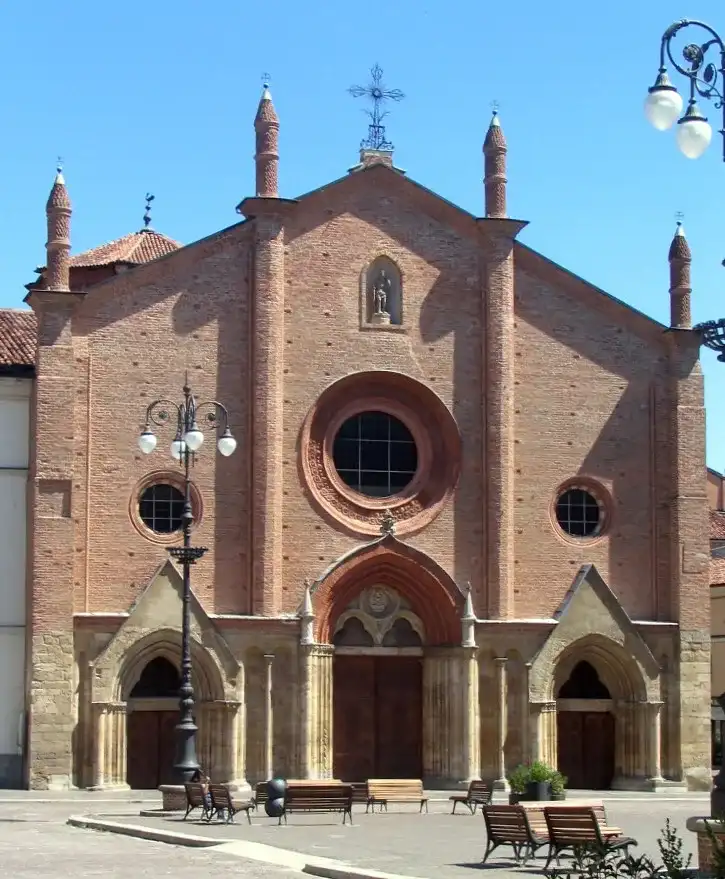
A closer look
Second of Asti: at a glance
Divo Second - Holy Victory.
And the nourished alma - of indomito ardir,
Support for Christ - Glorious martyr."
(Sebastiano Sillano, To the noble Patria of the glorious martyr Saint Second, 1932)
Second d'Asti (1st century – Asti, 30 March 119) is venerated by the Catholic Church as a saint, martyr and patron of Asti.
In the Roman Martyrology it is remembered on 30 March, Ferrari instead inserts it on 6 April.
History
In the light of studies, published in the journal of Astigiana culture Il Platano in 1976 and in the following years by the priest Fr Pietro Dacquino, the legendary figure of St...Explore this chapter
In light of studies, published in the journal of Astigiana culture The Platano in 1976 and in the following years by the priest Fr Pietro Dacquino, the legendary figure of St. Second is certainly from Lombard origin.
It shows the area of spreading memory and worship. It is not Piemonte, but the ancient area of the Lombard domain.
In fact, the cult is located in San Secondo Parmense, in Ludiano in the Canton Ticino and Venice.
Above all, we find it in Bobbio, in the Benedictine monastery of San Colombano founded by King Agilulf and Queen Teodolinda.
San Secondo d'Asti is certainly a historically identifiable figure for Dacquino in a bishop of Asti.
These probably gained fame and gratitude by fighting for peaceful coexistence between the original nucleus of inhabitants of the Gallo-Roman city of Hasta and the Lombard occupants: the Longobard occupation occurred elsewhere in a very violent manner, while at Asti it was carried out without damage; on the contrary, Asti was chosen as the capital of the vast duchy assigned to Gundoaldo, brother of Queen Teodolinda, and this position of political-administrative pre-eminence explains its subsequent economic and mercantile development.
In this case, According to d'Asti was not a martyr in the strict sense, but a witness of faith, easily identified as true protector (patrono) of the city.
The possible ambiguities in the knowledge of his historical figure are to be identified in the presence of other homonim saints such as St. Second, martyr venerated in Ventimiglia.
In light of a recent carbon dating 14 on the bones attributed to the Saint and preserved in a silver reliquary in the crypt of the Collegiate dedicated to the Astian patron, they would belong to an individual of male lived in the 2nd century AD. This reinforces the hypothesis that in case the relics belonged to Saint Second, it could be a martyred Roman soldier, as always recites the legend.[1]
In this case, the hypothesis of Fr. Pietro Dacquino could fall.
The legend
Sources · The meeting with the martyr Calogero · The condemnationExplore this chapter
Sources
The first news about the life of Saint Second is taken from the work Acta Sanctorum by Jean Bolland, a Jesuit, who in the 17th century, with his fellow brothers, began to collect the lives of the saints.
In particular, the acts of St. Second derive from four codes, different in form but similar in substance:
- defined code gallant;
- code taken from the imperial monastery of San Massimo near Trevi;
- code taken from the Vatican library;
- Membracean code dating back to 1474 in the archive of the Collegiate Church of San Secondo in Asti.
The legend handed down that Second, lived at the time of Emperor Hadrian of noble Astigian origins, was belonging to the noble family of "Vettii", who would have founded and named the village of Vezza d'Alba or the "Pallidi" or the gens Licinia.
He was a fervent idol written to the Roman militia and great friend of Saprizio, prefect of the Cozie Alps.
The meeting with the martyr Calogero
Calogero, commander of the guards of the prefect of Brescia, Italico, converted to Christianity, is imprisoned in the bottom of the Red Tower, the current bell tower of the church of Santa Caterina di Asti.
Second, he began to Christianity by Calogero (who was held in the prisons), then departed with Saprizio for a journey towards Tortona and just during the journey, according to the devotional legend, exceptional wonders would have happened.
He met with Tortona Martian, bishop of the city, who began it on the way of conversion and charity.
Second he came to Milan, where he had the blessing of Giovita who invited him to bring the sacrament of eucharism to Calogero and Martian.
Returning to Tortona, Second managed to enter the prisons in which Martian had been locked up by Sapritius who had already sentenced him to death.
According to him he remained next throughout the night and the following day, after the martyrdom, he buried his body.
Saprizio tried to convince Second to give up Christianity by all means, even with tortures, but Second remained unmissable in his choice.
The condemnation
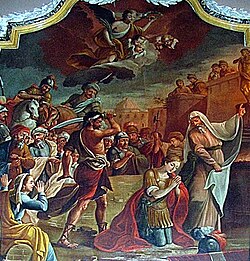
Sapritius then condemned him to death but, during the night before the supplication, Second would be freed from an angel sent from heaven and "transported" to Asti, in the prison where Calogero was already.
Saprizio, discovered the escape, returned to Asti, sent Calogero to Albenga where he was martyred, while Second, on March 30, 119, was brought outside the walls of Astigian and beheaded.
The burial
The legend still tells that Second was buried on the place where he was killed and that later the church dedicated to him.
The miracles
One of the miracles attributed to St. Second is that of the liberation of the city from the siege threatened in 1526 by conductor Fabrizio Maramaldo, at the service of Emperor Charles V, at the time commander of the presidio of Alessandria.
The latter, having attempted to enter the gate of St. Peter, was rejected and dismissed by the population that had invoked with fervour the protection of the Virgin Mary and Saint Second.
The important story was depicted in the fresco still visible in the right wall of the choir of the collegiate dedicated to him.
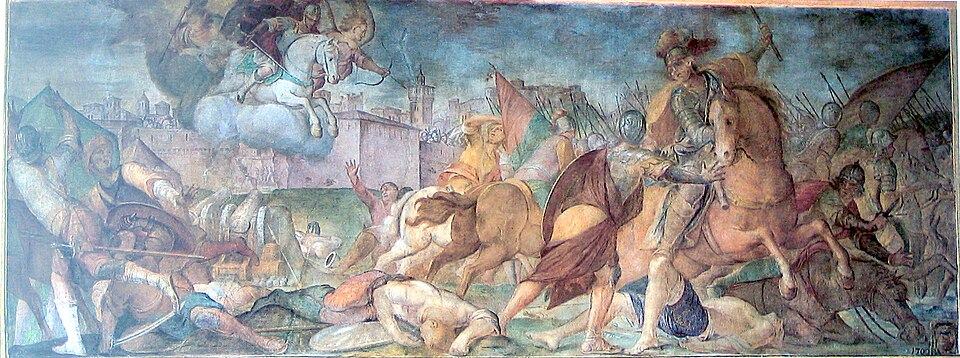
fresco 18th century, Collegiate of San Secondo, Asti
The cult
The relics · The patronal feasts of St. Second in Asti · FireworksExplore this chapter
The relics
In Asti in the Collegiate Church of San Secondo, his body rested in the ancient crypt, but the barbaric raids of the 9th and 10th centuries forced him to move into the Cathedral, more secure because placed inside the walls.
Of this translation there are no certain documents, but towards 880 the factory appears entitled to "Santa Maria and San Secondo" which would confirm the presence of relics in that building.
According to the Incisa (1742-1819), the definitive translation would have taken place under Bruningo's episcopate, who, before returning the relics of the Holy in the collegiate church again, would have restored and expanded the church.
In 1597 the relics were deposited under the main altar in a silver case, offered by Emanuele Filiberto di Savoia.
The patronal feasts of St. Second in Asti
The devotion that the Astigian faithful profess towards Saint Second, a fellow citizen elected to patron, has always been very alive.
In public acts after the name of Jesus and of Mary Virgin, it always appeared that of Saint Second. The feasts in his honor were always great and solemn and still last several days. At first the feast was celebrated on 29 or 30 March, then, as they say days often fall in the Holy Week or, if not, in Lent, the festival took place on Thursday after the first Sunday after Easter, that is, in Albis. In 1818, with a rewrite of Pope Pius VII, he settled it on the first Tuesday in May.
Fireworks
Already in 1100 the Municipality of Asti obliged its feudal lords to participate in the procession for the annual feast of the saint with torches.
The fireworks were then organized.
The pyrotechnic show started with the trumpets and the fire of Colombia, always entrusted to a lady of nobility.
So we find that in the chronicles of 1777 gave fire to the dove a dama of Dronero, in 1779 Countess Mola of Larissè, in 1781 the marquise of Incisa and madama of Robilante, in 1786 the Marquis of Gresy.
Today the tradition of fireworks is very lively: for the astigiani it is the Lundes d'j feu (fire Monday), and take place on the Monday before the feast of the patron saint, in the usual area of Lungo Tanaro.
Lighting
For several years, uninterruptedly, after the fires there was the lighting of the city.
In the year 1790 we read from Newspaper of Asti of the Incisa: "...after the fires there was lighting in almost all the districts of the city... The lighting was made up of candles in many windows, lights and lanterns in the middle of the... To make the most grateful thing they saw many inscriptions or sayings... Besides the reported inscriptions there were an infinite number of enlightened sayings, applauded to San Secondo, to citizens, to strangers...»
The Carolingian Fair
The Carolingian Fair is certainly the oldest, most famous and largest of the Fairs that take place on the territory of Asti.
In the orders of Books Statorum of the city of Asti of 1340, one of the two fairs is held eight days before and eight days after the feast of the patron saint of the city, along a part of the Maestra district (the current Alfieri Course) to which merchants from various parts of the country and Europe participated. This for the city of Asti was such an economic benefit that princes or regent lords granted to participants particular benefits such as the right of asylum and hospitality, exemption of duties on goods, the most tireless disbrigo of bureaucratic formalities. The products were the most varied: Florentine and English wool, venetian brocades, rhinestones, wines, spices, skins.
Today things have not changed: the event in honor of the patron saint keeps its freshness and completeness both with regard to the many participants, with a very great variety of products, as well as for visitors who always flocked from Italy and abroad; only the space occupied by the stalls that is now larger extending along the streets of the entire historical center has changed. The fair takes place on Wednesday following the feast of St. Second.
The Palio Race
The Palio races on the occasion of the feasts of St. Second are very ancient, probably before 1200. They could run for strangers and strangers.
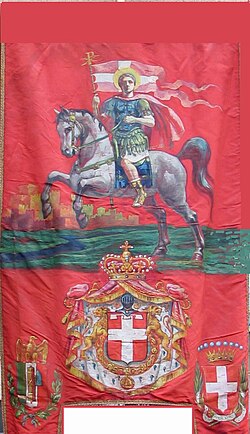
Emanuele Filiberto, on 20 May 1545, taking over the regency of the city, committed himself and his successors to provide the palii: one of rasis 12 for the Race, the other of rasi 9 for the offer to the patron saint. In the eighteenth century, the palii were united to a labaro of canvas, usually blue, decorated by the coats of arms of Savoy, the Commune, the Governor and the Podestà. The image of St. Second on horseback made his appearance on the Palio labarus dedicated to the church and, at the end of the 19th century, also on that for the Race.
Iconography
As, according to legend, Saint Second passed the Po on horse as if it were firm ground, it is often represented in the act of calming the recalcitrant horse to the unusual...Explore this chapter
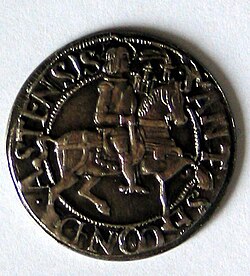
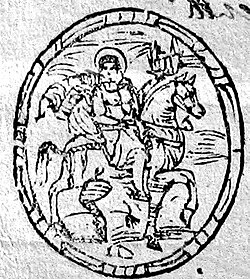
As, according to legend, St. Second passed the Po on horse as if it were firm ground, it is often represented in the act of calming the recalcitrant horse to the unusual path.
Ever since, the image of St. Second, that Asti had spread in the world through its powerful "Home" is the one that depicts him on horseback holding the red banner with a white cross in his hand. The image of the knight was often surrounded, on the seals of documents and parchments, by the motto Auctions Nitet Mundo Sancto Custos Secundo. The saint's effigy also appeared on the reverse of all the coins that Zecca di Asti From 1356 until the end of the 15th century, he conspired with the last domination, that Orleanese, before the definitive passage with Casa Savoia; to the verse that changes to every passage of power.
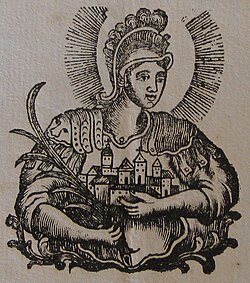
In 1590, Second was first depicted in Roman soldier's clothes, without sword and with the model of Asti's city in his left hand. The new effigy gave the character a Roman identity that, making it part of the empire, exceeded the concept of medieval municipal power.
From the oldest poles always appears the image of the saint, in a first time schematized in a small tondo painted, then, in the nineteenth century, always expressed with the iconography of the Roman soldier and, in the most recent period, characterized by the interpretation of the artist to which the work is entrusted.
Particular interest are the two military flags guarded once in the Royal Aircraft of Turin, but now owned by the municipality of Asti.
It is the case of the flag of the battalion called "colon" and that of one of the three subalternative battalions of the "Province Regiment of Asti" dating back to 1774.
The two flags have represented the image of St. Second Loricate to Roman with the sign and in the left hand a beautiful picture of the city.
But the most valuable work that concerns him is the fresco of the Parmigianino (sec. XVI) in the church of San Giovanni Evangelista in Parma: he appears to you in the act of calming the imperfect horse.
Cult in the world
Explore this chapter
- The Astigian immigrants in Argentina celebrate the feast of St. Second; in Buenos Aires, a teca with inside the Astisan land is preserved.
- In Ludiano, in Canton Ticino, the Church is dedicated to San Secondo d'Asti since 1400.
- In Guasti in California, in the County of San Bernardino, a church dedicated to Saint Second of Asti was built.
Notes
Explore this chapter
- ^ It is the result of the scientific investigations carried out by Dr. Cristina Cattaneo (Labanof laboratory of Anthropology and Forensics, founded in 1995 as part of the Institute of Legal Medicine at the University of Milan), in collaboration with the University of Lecce and with the University of Cambridge (Massachusetts).
Bibliography
Explore this chapter
- Anonymous, Life of the glorious martyr S. Second reading, Asti 1823.
- Sac. Giovan Battista Lemoyne, S. Second, the generous soldier of Asti, Turin 1876.
- Can. Lorenzo Gentile, The ancient patronal feasts of San Secondo in Asti, Asti 1928.
- Can. Lorenzo Gentile, The life of S. Second reading. (Second revised and enlarged edition). 1932.
- AA.VV. The Platano, magazine for the study of Asti culture and activities, Asti 1976.
- Gianfranco Monaca Asti, San Second of the merchants, Gribaudo and SE.DI.CO. by L. Fornaca Asti 1997.
- Paolo Edoardo Fiora di Centocroci, Ms. Collegiate of S. Second of Asti, U. Allemandi 1998.
Continue your journey