A closer look
Zecca di Asti: at a glance
The document attesting the birth of tick of Asti is of the year 1141, when Emperor Corrado III granted to Asti the right to beat money. The licence certificate is reported in the Codex Astensis. Before this concession, Asti use of mint coin minted in the mint of Pavia. Already in documents of 1143 there are payments with “libras bonorum astensis”, a sign that the Asti mint had immediately begun to mint money.
Municipal currency (1141-1366)
First period (1141-1220) · Second period (1220-1275) · Terzo period (1275-1356)Explore this chapter
According to a historically accepted subdivision the municipal currency of Asti can be divided into three periods[1].
However, this subdivision has been overtaken by more recent studies.[2]
First period (1141-1220)
| Money | |
|---|---|
| |
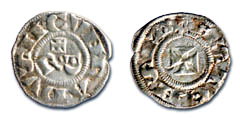
| CVNRADVS II, in the REX field | ASTENSIS cross driver's license |
| (1141-1356), CVNRADVS II | |
Money and oblivion
- Money is a silver coin of 18–16 mm in diameter.
The weight in grams usually varies from 0,80 to 0,60.
It was also called a minute or imperial, worth the fourth of the Grosso, that is, a twelfth of a Soldo.
- The opal is smaller than about 11 mm, weighs about 0,30 grams.
It was worth half the money.
Recano both straight to the writing _, in the field REX, with letters arranged in a triangle. On the reverse the patent cross with the legend ASTENSIS.
Second period (1220-1275)
| Big comeback | |
|---|---|
| |
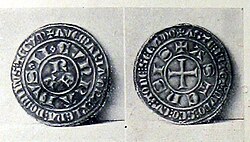
| +AVE MARIA : GRA : PLENA : DOMINVS : TECVM, in the second turn, the innermost, _, in the field REX | I'm sorry., in the second round cross e ASTENSIS, patent cross in the field |
| (1275-1356), CVNRADVS II | |
Keeping the beat of obolo and money, the Gross appears.
- The Grosso is a silver coin of 19 mm in diameter, weighs about 1,20 grams.
The image is equal to the previous coins.
Three "gross" made a "soldo", which always remained a theoretical currency, for this reason the big one was also called thirdrole.
Terzo period (1275-1356)
| Big comeback | |
|---|---|
| |
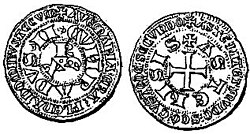
| +AVEMARIA : GRA : PLENA : DOMINVS : TECVM, in the second turn, the innermost, _, in the field REX | I'm sorry., + ASTENSIS, patent cross in the field |
| (1275-1356), CVNRADVS II | |
Continuing the previous beats, add:
- Large turnstile (silver), 27 mm in diameter and about 4 grams of weight.
To the right, two rounds of legend, in +AVE MARIA GRA PLENA DOMINVS TECVM, in the second turn, the innermost, _, in the field REX, with letters arranged in a triangle.
On the reverse, two rounds of legend: in the first I'm sorry., in the second cross e ASTENSIS, patent cross in the field. The Grosso tournois was the imitation of the French currency, the gros tournois, most renowned in Europe.
- Large double (silver), 21 mm in diameter and weight of about 2 grams.
The image of the coin is equal to the coins of the first and second period.
New subdivision in 6 classes (except MEC 12)
- Class A (1141-1160)
- Class B (1160-1200)
- Class C (1200-1240)
- Class D (1240-1260)
- Class E (1260-1290)
- Class F (1290-1325)
Summary
The coins of the municipal period are:
| metal metal metal | coins |
|---|---|
| silver silver silver | obolo (or half money), money, large smaller (from about 1 g: big and big thirdrole), big major (about 2 g: double big) and the big tornaese. |
Giovanni II Paleologo, Marchese del Monferrato, Signore di Asti dal 1356-1372
In 1338, the Marquis of Monferrato, leaning against the faction Ghibellina, occupied Asti, holding it for about thirty years.Explore this chapter
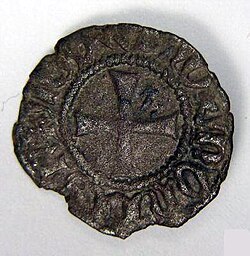
| Bianchetto | |
|---|---|
| |
| SECOND HEALTHS and head of San Secondo | crucified and written MARCHO MONTISF |
| (1356-1372), John II Palaeologus, | |
In 1338, the Marquis of Monferrato, supporting the faction Ghibellina, occupied Asti, holding it for about thirty years.
- Strong white (mixture), about 18mm diameter and 1 gram of weight.
The right crucified and written MARCHO MONTISF, triangle shield of Monferrato.
To the reverse crucified and SANTVS SECONDVS, or SECOND, patent cross.
- Bianchetto (mixture), diameter 19 mm and weight 1,20 grams.
To the straight cross and written SECOND HEALTH head of San Secondo, cross and writing on the reverse MARCHO MONTISF.
- Bianchetto type 2 in which the Saint is bearded.
Second hand Paleologo, Marquis of Monferrato, Lord of Asti from 1372 to 1377
SummaryExplore this chapter
The son of John II, Second Paleologos succeeded his father not yet an adultererer, he ruled the city under the protection of his uncle Otto of Brunswick. He died on 16 December 1378.
- Big (silver), 25 mm diameter and about 2 grams of weight.
To the straight cross and SECUNDUS OCTOM MOTISF, shield with helmet, crown and crest. On the reverse, cross e _.
Summary
The coins issued in the Aleramico period are:
| metal metal metal | coins |
|---|---|
| silver silver silver | Biggest |
| mistress | strong White, white |
Carlo Duke D'Orleans, lord of Asti from 1407-1422 and 1447-1465
First period · Second periodExplore this chapter
The son of Luigi d'Orleans and Valentina Visconti, he was taken prisoner in the battle of Angicourt (1414), liberated in 1441, he regained the Lordship in 1447 until his death in 1465. The currency of the period follows that of France.
First period
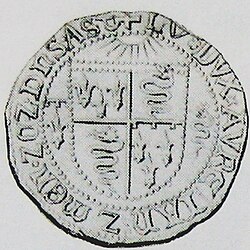
| Golden shield | |
|---|---|
| |
| leafy cross, adorned, set aside by 2 lilies and 2 biscioni | LV DUX AURELIAN Z MED Z Z DNS AST and unquarified shield Orleans and Milan |
| Charles duke of Orleans (1447-1465) | |
- Golden shield of the crown(gold), about 29 mm diameter and 3.50 grams weight.
A document of 1411 handed down the names of "zecchieri" for the first time: they are Giovanni Rezzetto di Moncalieri and Ruffino Stantero and Enrico Garretto orefici di Asti.
- Grosso tornaese (silver), diameter of 24 mm and weight of 1,74 grams, to the right KAROLVS AURELIANESIS, shield with flap on reverse.
- Half big, very similar for weight and size to the previous one, but with gilled cross.
- Fourth of large, 18 mm in diameter and about 0,85 grams.
Of this coin there were three varieties: the first two in mix and the second with the portrait of St. Second, the third in silver.
- Strong (measurement), smaller than the previous (17 mm diameter for 0.65 grams of weight), with fiorated cross.
Second period
- Golden shield (gold), two types for this coin of diameter 27 mm and 3.45 grams, to the unquarified shield law of Orleans and Milan, the first with lily and biscione on the sides.
To the leafy cross.
- Big white (silver), diameter 27 mm and weight 2,75 grams, with the verse San Secondo that for the first time is depicted regent the City with the left hand, on the right the sword and under this coat of arms of Asti.
- Half white (silver), diameter of 22 mm, weight 1,40 grams approximately.
- Fourth of large (measuring), diameter 19 mm, weight 0,80 grams approximately.
- Obole (mixture), diameter 16 mm for about 0,80 grams.
Ludovico II d'Orleans, Lord of Asti between 1465-1498
Lord of Asti (first period) · Lord of Asti (second period) · SummaryExplore this chapter
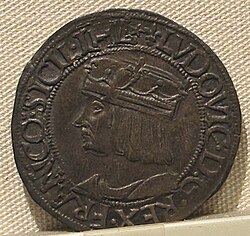
In 1465 he succeeded his father Charles of Orleans and succeeded in 1498 to Charles VIII on the throne of France under the name Louis XII. He died in 1515.
Lord of Asti (first period)
- Duchy wide (gold), on the coin the image of the duke on horseback, with the weapons of Milan and Orleans.
- Diameter 24 mm, weight of about 3.40 grams.
- Shield of the sun (gold), diameter 29 mm, with coat of arms Milan-Orleans to the obverse and to the reverse leafy cross.
- Testone(silver), diameter 29 mm.
- Double head (silver), weight 19 grams
- These last two coins go straight LVDOVICVS DVX AVRELIANENSIS, with the bust of the duke facing right.
- Big Turned (Silver), Big White(Silver), with image of St. Second.
- Parpagliola (mixture), diameter 26 mm and weight of 2,20 grams.
- Half white (measure), white (mixture), then terline (measure), with L between two rascals.
Lord of Asti (second period)
With legend in Latin characters. The coins present the image of the Duke of profile with cap, towards the inquarified shield Milan-Orleans.
- Golden Duchy (Gold)
- Testone (Silver)
- Half testone (Silver)
- Soldino (mixture) of diameter 20 mm, weight about 1 gram, with image of herring to the right and cross gigliata to the reverse.
- Knit sweater (mixture)
Summary
The coins issued during the Orleanese period are:
| metal metal metal | coins |
|---|---|
| gold gold | Golden shield of the crown, dukedom wide, sun shield, golden duchy |
| silver silver silver | large white, half white, big redhead, big red, big white, quarter big |
| mistress | obolo, parpal, half white, whitish, terlin, quarter big, money, white shirt |
Louis XII King of France (1498-1515)
SummaryExplore this chapter
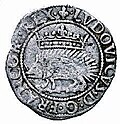
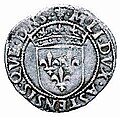
| Parpaglio | |
|---|---|
| |
| porcospino and written LVDOVICVS D G FRANCOR REX | coat of arms of France and written MLI DVX ASTENSIS QVE DNS |
| (1498-1515), Louis XII of France, | |
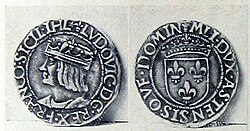
| Text | |
|---|---|
| |
| LVDOVICVS and bust of the Duke facing right | DUX ASTENSIS and shield of France |
| LVDOVICVS XII (1508). | |
Coins with the right portrait of the king of profile, crowned, to the shield of France crowned.
- Double duchy (gold), diameter 29 mm weight about 7 grams.
- Duchy (gold), halved.
- Textile(silver), Half Testo (silver) with profile of San Secondo on the reverse.
- Big dozzeno, parpagliola, half parpagliola, terlina, half terlina, obolo (in mistura)
After 1508, Ludovico XII wanted the gold coins to be cut on the weight of the Troyes marque, while the silver and mistress were to be cut on the Milan mark.
The double duchy in gold is 30 mm in diameter and weighs 6.89 grams, the silver head is 30 mm in diameter with weight of 9,50 grams.
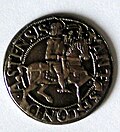
- Horse (silver), with the image of St. Second on horse, diameter 29 mm, weight about 4 grams.
- Half horse (measure), diameter 20 mm, weight about 1 gram.
- Soldino (mixture), with headset crowned to the straight and towards cross gigliata, diameter 19 mm, weight about 1 gram.
Summary
| Horse | |
|---|---|
| |
| LU D G FRAN REX MILES AC AST DNS and shield of France | SANT SECOND ASTENSIS and holy horse |
The coins issued during the period under the crown of France are:
| metal metal metal | coins |
|---|---|
| gold gold | double duchy, dukedom of gold |
| silver silver silver | half-headed, big-backed, big white, quarter-large |
| mistress | big dozzeno, parpagliola, half parpagliola, terlina, half terlina, obolo, half horse, money |
Guglielmo II Paleologo, Marquis of Monferrato, Lord of Asti from 1512 to 1513
After the battle of Ravenna ( 1512 ), Asti again passed under control of the Paleologhi . They held the regency about for a year, in June 1513 the city was occupied...Explore this chapter
After the battle of Ravenna (1512), Asti again passed under control of the Paleologhi.
They held the regency about for a year, in June 1513 the city was occupied by Massimiliano Sforza.
- Terlina (mixture), monogram GV gives the coin to William II.
Francis I King of France (1515-1529)
Francis I, after the victory obtained in Marignano, also secured the regency on Asti, but between 1516 and 1526, the city changed regency several times, until it was...Explore this chapter
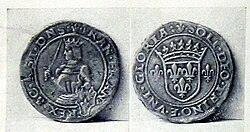
| Text | |
|---|---|
| |
| FRAN FRAN REX AC AST DNS and half figure of the ruler | _ and shield of crowned France |
| Francis I King of France (1515-1529) | |
Francis I, after the victory obtained in Marignano, also secured the regency on Asti, but between 1516 and 1526, the city changed regency several times, until the French troops in 1526 occupied it and held it until 1529.
The Promis argues that the coinage of Francis I begins after 1526, because it lacks the wording DVX MEDIOLA and being on that date invested Francesco II Sforza as Duke of Milan.
- The head has a diameter of about 32 mm and weight of 9,58 grams, the half is 32 mm in diameter and weighing 9.80 grams, both in silver and carry to the right the figure of the ruler and to the reverse the shield of France.
- Fourth of a cartridge, of 2,57 grams, in silver, with salamander between the flames to the right and bust of St. Second on the reverse.
- Soldino, diameter 19 mm, weight of 1,29 grams.
Charles V Emperor (1530-1531)
SummaryExplore this chapter
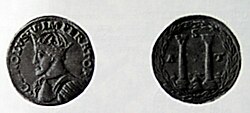
| Text | |
|---|---|
| |
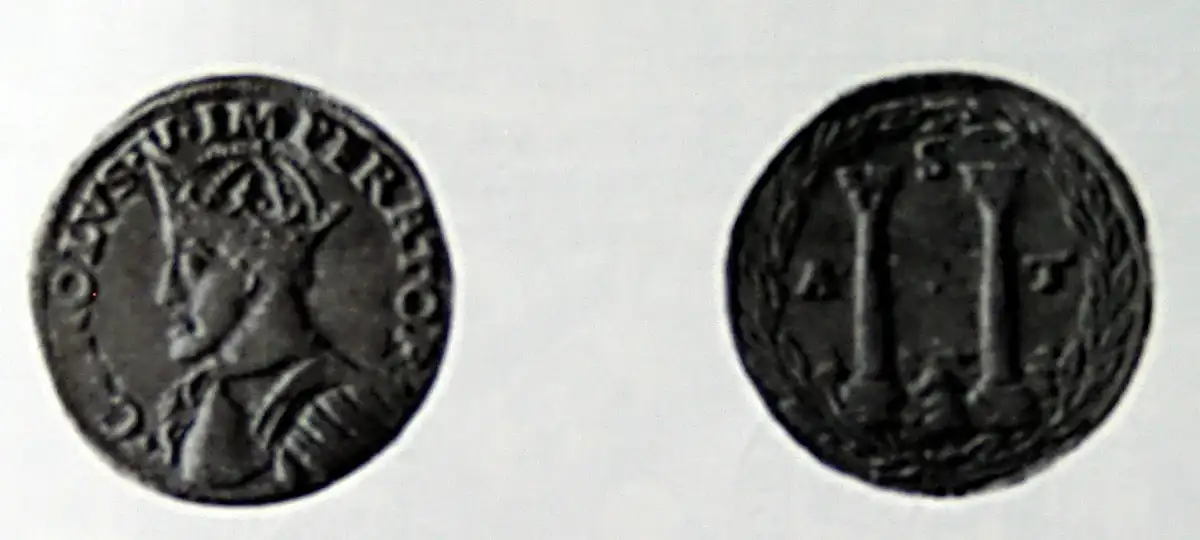
| Portrait of the Emperor | columns and AST |
| Charles V Emperor (1530- 1531) | |
With the Treaty of Cambrai (1526), the city returned under the direct rule of Charles V, with license letters of 22 November 1530 was appointed zecchiere Guido de Baretti.
- Textile and half silver lyrics with portrait of the emperor.
The lyrics present at the verse two columns with letters AST, the half-head, the double-headed eagle, on the obverse and bust of San Secondo in profile.
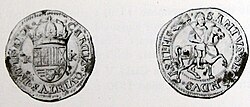
- The horse, the double Grosso, the money, the bucket (of 18 mm and 1 gram of weight) are also minted.
Summary
| Horse | |
|---|---|
| |
| CARVLVS QVINTVSwith arm crowned between 2 "K" | ♪ and San Second horse |
| Charles V Emperor (1530- 1531) | |
The coins issued during the period are:
| metal metal metal | coins |
|---|---|
| silver silver silver | I am sorry, Mr President, but I have to say that the Commission has not been able to do so. |
| mistress | You know, you little horse, big double, little money. |
Emanuele Filiberto di Savoia, Count of Asti (1538-1559)
SummaryExplore this chapter
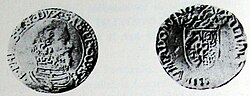
| Text | |
|---|---|
| |
| legend: And PHILIBERT DVX SABAVDIE CO AST and bust of the sovereign facing right | AUXILIUM MEUM IN DOMINO, crowned shield, quartered, with Savoy shield in the centre,A in the tip |
| Emanuele Filiberto (1538-1559) | |
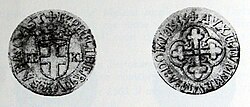
| Big | |
|---|---|
| |
| And PHILIBERTVS DVX SABAVDIE C AST and shield sabaudo | AVXILIUM MEVM TO DOMINO, star and Mauritian cross in a tetralobed frame |
| 7 Grossi, Emanuele Filiberto (1538-1559) | |
| Horse | |
|---|---|
| |
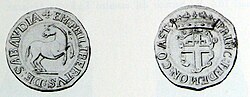
| EM PHILIBERTVS and horse | PRINC PEDEMON CO AST, crowned sabaudo shield |
| Cavallotto, Emanuele Filiberto (1538-1559) | |
The County of Asti had been donated to Beatrice of Portugal in 1538.
On his death, the son Emanuele Filiberto told her "iron head".
In 1559 the letter was replaced on coins. A always distinctive of the Zecca di Asti with a star, to avoid confusion with the Zecca di Aosta.
- Golden shield of the sun, was a gold coin of 25 mm in diameter and 3.38 grams of weight.
Recavate the crowned sabaudo coat and back Mauriziana cross adorned with leaves.
- Text in silver, envelope of the count and to the sabaudo coat of arms supported by two rampant lions.
- 7 big, horse, double big, big Piemonte, quarter of a big deal, Money, strong Piemonte, all in mix.
Gian Secondo de Canis, states that the Duke of Savoy Emanuele Filiberto I when he became lord of the County of Asti, constituted in Vercelli, on 20 May 1545, with delegates from the municipality of Asti a convention which guaranteed the city some ancient "consuetudes".
Among these was the dispute of the secular Palio Race, in honor of the patron San Second, in which the duke undertook to provide the prizes for the race (including the palio) and to cover the expenses of the party.
To confirm this, the Duke conjured the 1555 horse, which on the back engraved the legend: EMANUEL PHILIBERTVS DUX SABAUDIAE.[3]
Summary
Sabauda Coins:
| metal metal metal | coins |
|---|---|
| gold gold | golden shield of the sun |
| silver silver silver | I'm sorry. |
| mistress | 7 big, horse, double big, big Piemonte, quarter of a big deal, money, strong Piemonte |
The Zecca di Asti was finally closed in 1590 by Duke Carlo Emanuele I of Savoy.
The only Zecca operating in the Sabaudi domains of here of the Alps remained that of Turin.
Notes
Explore this chapter
- ^ D.Promis, Coins of the Zecca d'Asti, Turin, 1853; in-8 with 7 tab. inc.
- ^ William R. Day, Michael Matzke, Andrea Saccocci (2016) Medieval European CoinageVolume 12, Northern Italy.
- ^ Niccola Gabiani, The Palio race and the Patronal Feast of St. Second in Asti, historical notes, Asti 1909, pg 47, 48
Bibliography
Explore this chapter
- Berolini, Coins Asti, in Julius Friedländer. Numismata unedita commentariis ac tabulis ill. 1840
- Cesare Bobba, Luigi Vergano, Ancient ticks of the province of Asti, Bobba ed. 1971
- Luca Gianazza, Asti, in Italian ticks up to Unity, Rome, Polygraphic Institute and State Mint, 2011
- E. Mayer Vergano, Of two unpublished coins by Carlo d'Orleans jokes in Asti, in Italian numismatic magazine; Asti 1865
- E. Mayer Vergano, Letter on its numismatic collection, in Italian numismatic magazine; Asti 1865
- Domenico Promis, Coins of Asti Mint, Stamperia Reale Torino 1853 reprint Forni, ISBN 88-271-1771-7
- Coins of the Marquisi Paleologists of Monferrato, Turin 1858, reprint Forni, ISBN 88-271-1770-9
- Q.Sella, On the Coin Asti, in Codex Astensis de Malabayla, Rome, 1887; I,12.
Continue your journey