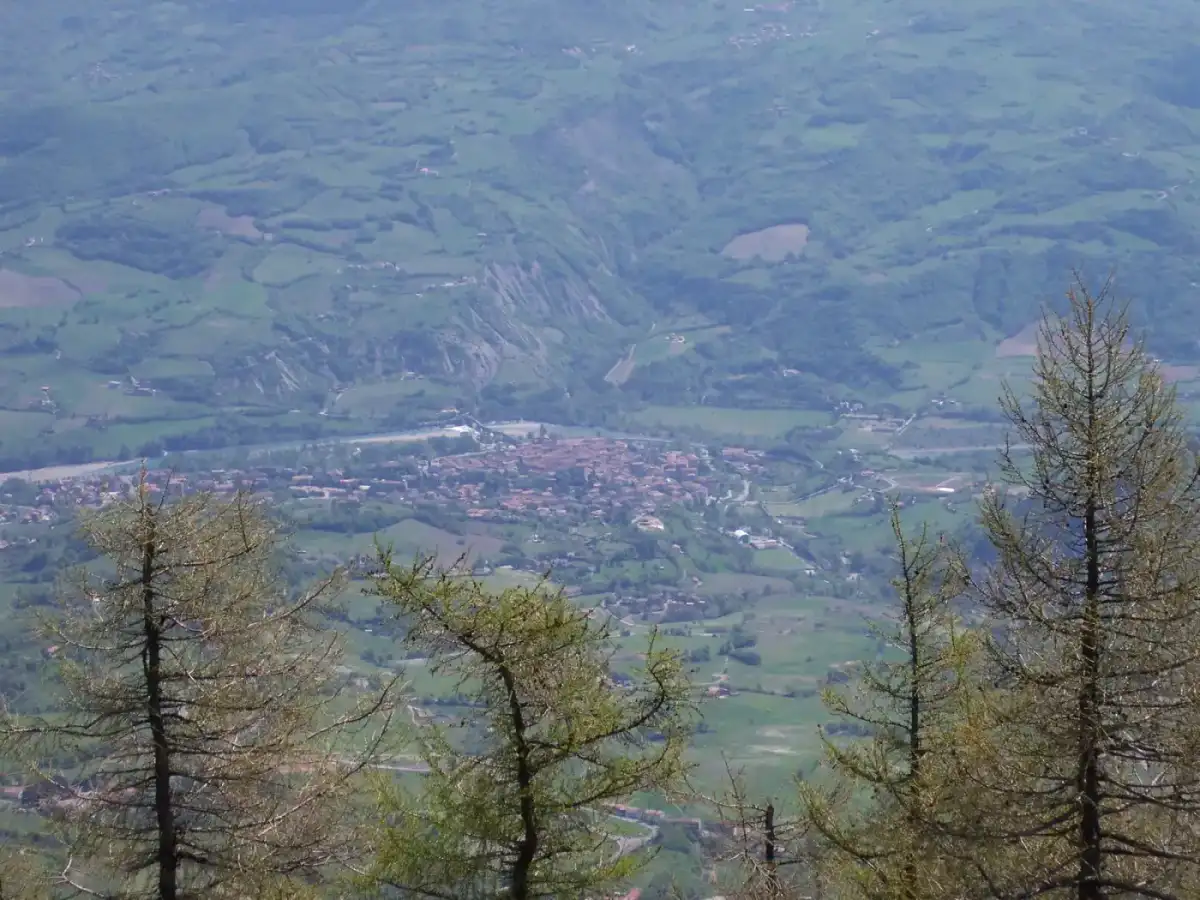
A closer look
Bobbio: at a glance
Bobbio (AFI: [Chuckles][6]; Bòbi in bobbiese dialect and Piacenza) is an Italian municipality of 3 328 inhabitants[3] of the province of Piacenza, in Trebbia valley, in Emilia-Romagna. The territory, inhabited since the Neolithic with celto-ligurian settlements, became Roman in 14 BC. and in the 4th century the fortified village of Castrum Bobium, but its history is identified with that of the Abbey of San Colombano founded in 614.
14 February 1014 had the title of City, becoming a Diocese, Episcopal County, Municipality and surrounding itself with walls; first independent as an imperial fiefdom, a brief parenthesis as the Lordship of Malaspina, then under the Duchy of Milan as an autonomous imperial county of the Dal Verme, and finally in the Kingdom of Sardinia under the Savoy. Free municipality from the beginning of the 12th century, it fought with the Lombard League against Barbarossa in Legnano. Province under the Department of Genoa until the unification of Italy, until 1923 it was part of the province of Pavia, then passed to the province of Piacenza. It was a resident bishopric until 1986, it is still a bishopric, when merged with the Diocese of Piacenza it forms the Diocese of Piacenza-Bobbio.
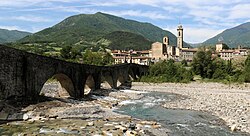
The city is home to the new Union of Municipalities: Mountain Union Valli Trebbia and Luretta. It is a tourist destination known for its history of art and culture. The old town has kept intact the characteristics of the medieval village. Symbol of the town is the Ponte Vecchio also called Ponte Gobbo[7] (or Devil Bridge), a Romanesque stone bridge of uncertain origin, which crosses the Trebbia river with 11 irregular arches. It dominates the Sanctuary of Santa Maria in Monte Penice, which is located on the top of the mountain of the same name.
Physical geography
Region · ClimateExplore this chapter
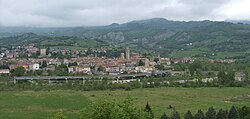
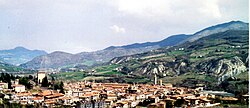
Bobbio is a common valley hill, with nearby Apennines mountains, whose capital is located on the left bank of the Trebbia river, between the Bobbio and Dorbida streams, at the foot of Mount Penice (1.460 m asl). The historic city centre and the town hall are located at a height of 272 m asl. There are then neighborhoods (S. Martino, Auxilia, Valgrana, Canneto, Rio Foino, Borgo, Candia, Corgnate, La Spessa, S. Ambrogio, Cognolo) outside the center adjacent to Trebbia at less elevated altitudes and neighborhoods in the upper part (Buffalora, Bargo, Monte Santo, Erta, Maiolo, Brada, Squera, Bosco, Sciola, Dorbida, Balzago), on average the share is between 250 and 400 m s.l.m.
The municipal territory borders to the south with the municipality of Corte Brugnatella, west with province of Pavia in Lombardy (Brallo di Pregola, Santa Margherita di Staffora, Menconico, Romagnese), north with the municipalities of Alta Val Tidone, Piozzano and Travo east with the municipality of Coli. The landscape has an alternation of cultivated fields and ceduan woods.
Region
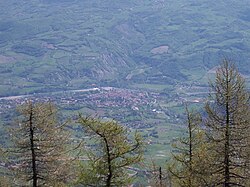
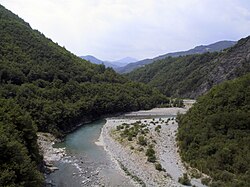
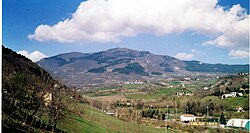
The bobbiese area is surrounded by west to north from the peaks of Mount Penice (1.460 m a.s.l.), Sassi Neri (1.034 m a.s.l.), Pan Perduto (1.008 m a.s.l.) and Pietra Corva (1.078 m a.s.l.) with the nearby hill of the Crocetta, Groppo (1.000 m a.s.l.), mountain Pradegna (960 m). From north to east and south there are the peaks of Mount Barberino (481 m asl) with the nearby Barberino Pass, of the Lake (537 m above sea level), Tre Sorelle (976 m a.s.l.), the Castle (943 m a.s.l.), and the Three Abati (1.072 m s.l.m.), up south along the Costa della Croce (727 m).
From south to west are the peaks of the Bricco di Carana (805 m s.l.m.), by Costa Ferrata (1.036 m s.l.m.) with the nearby wood of the municipality and Mount Gazzolo (498 m s.l.m.), continuing west along the Pavese border are the peaks of the Casone (or Colleri) Rocks (1.200 m s.l.m.), mountain lake (1.125 m s.l.m.) with the homonymous pass, Cima di Valle Scura (1.229 m s.l.m., Monte Scaparina (1.157 m s.l.m.) with the nearby Scaparina pass, until you return to Penice. To the north after Barberino, in the area of Mezzano Scotti, there are the peaks of Monte Mosso (1.006 m s.l.m., Monte Crigno (807 m s.l.m., Monte Lazzaro (987 m s.l.m.) with the nearby step of Caldarola, Parcellara Stone (836 m s.l.m.) and the Stone Marcia (722 m s.l.m.).
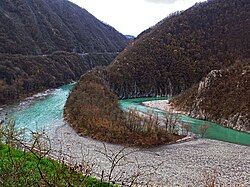
The territory, after the Parcellara Stone and the Perduca Stone and where you leave the angust Val Perino famous for the castle of Erbia, immediately after the village of Perino di Coli opens to the bobbiesi settlements of Cassolo and Mezzano Scotti. It includes the "Bobbio basin", part of the Trebbia valley, which here expands after the orrido of Barberino on the river northward, to narrow again towards south, in correspondence of the Bricco di Carana; at this point the course of the river becomes winding, with the meanders of San Salvatoreaglia dominated from above by the ancient village of Brugnello with the village and the small church overlooking the river. The peaks degrade softly, but near the bobbiese basin there are many squids that surround the whole town area.
The valleys of the Carlone, with the thermal waterfall San Cristoforo del Carlone and the Bobbio and Dorbida streams are inserted in the Trebbia Valley. The valley of the Bobbio on one side the village of Dezza and on top the town of Ceci, ends with the pass of Scaparina. Towards Mezzano Scotti to the north you have the affluent Dorba, while to the south to San Salvatore the Curiasca stream. In this area the waters of the Trebbia river flow fresh and clear in a winding path between rocks and stones opening itself in numerous small beaches populated during summer by many bathers.
At the Penice there is the homonymous step and the neighbors: Step of the Three Roads and Step of Brallo.
Climate
The Bobbio Weather Station places the municipal area in a climate zone corresponding to the temperate Ligurian microclimate. The landscape is characterized by Apennine mountains that influence the climate so that in summer it remains fresh enough, while in winter it is not affected by phenomena related to intense wind and fog.
Origins of the name
The name of the city derives from Boielis, a hypothesis based on the presence in the area mentioned on the Table of Veleia as Saltus Boielis (Pascolo Boieli ). The...Explore this chapter
The name of the city would derive from Boie., hypothesis based on the presence in the area of a place mentioned on the Veleia Tablet as Saltus Boielis (pasture Boieli).[8] The name Boie., in turn, would derive from the root Boi, in reference to the Galli Boi population, present in the area after the Ligurians. The toponym, as well as for the stream of the same name along whose banks the original settlement arose, is hypothesized to be the basis of other places in the vicinity (Penice, Buio, Bogleglio).[9]
History
Birth of the city (from the 4th to the 7th century) · From the 7th to the 8th century · From the 9th to the 11th centuryExplore this chapter
Birth of the city (from the 4th to the 7th century)
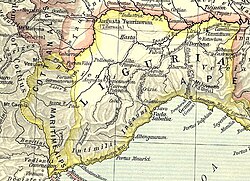
In the area where Bobbio stands, the first human settlements date back to the Bronze Age and later the Ligurians, the Celts, the Boi and in the 4th century the Romans arrived.[10]
The Roman nucleus of Bobium probably dates back to the period of Romanization before the 4th century during the first domination of the territory of Velleia, in the pagus called Bagiennus.[11]
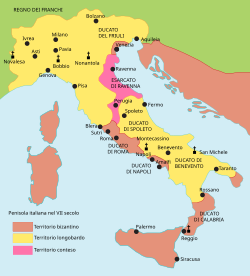
When in the second half of the 6th century the Lombards came to Italy and conquered Pavia, their capital since 572, the Roman garrison of Bobium was assigned to Duke Sundrarit, who also took the salts.
The construction of the Abbey of San Colombano in 614 represented a fundamental moment, for some a second foundation of Bobbio, and from that moment the convent complex became the central urban nucleus.[12]
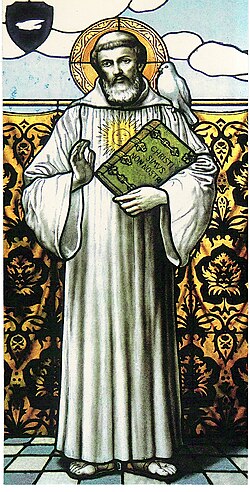
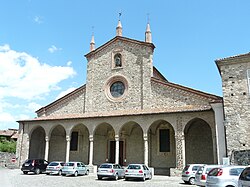
During the Early Middle Ages Bobbio, as Montecassino was later one of Europe's most important cultural centres,[7] reference for his library of the Scriptorium in Bobbio, connected with the various monasteries scattered in Italy and abroad.
From the 7th to the 8th century
The Franks of Charlemagne in 774 conquered Pavia and this contributed to the fall of the Lombard Kingdom. With the new domain, the monastery obtained imperial privileges and possessions in many parts of northern Italy.[13] In 834 he was appointed abbot Wala, cousin of Emperor Charles and his advisor.
From the 9th to the 11th century
There were built numerous castles and fortifications on the territory to protect even religious, especially during the period of Muslim invasions.
In 883 Abbot Agilulfo began the construction of the new monastery where it was located in the 21st century; in the 10th century the first decadence also began for the succession of imperial and papal protection and many feuds passed directly to the Obertenghi and then to the various family branches. A resumption is due around 983 to Abbot Gerberto of Aurillac, future Pope Silvestro II.
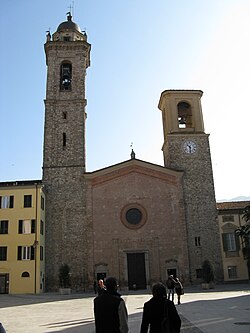
On 14 February 1014, thanks to the interest of Emperor Henry II, Bobbio became a bishop's seat, he obtained the title of city and formed the common citizen. First bishop was the abbot Peter, who combined the two positions (therefore becoming abate-vescovo with diocese exempt, that is subject to the Holy See). The union of the two offices was split immediately after Pietroaldo, the monastery then as a territorial abbey continued to have an abbot and the bishop's seat with two separate administrations and districts. In 1046 Bishop Luisone received the title of count, thus raising the imperial fief to the Episcopal Count. Bishop-Conte Guarnerio (1073 - 1095) began to build the new cathedral, but his policy, favorable to Henry IV, caused him to fall into disgrace. Discommunicated in 1081, in 1095 he abandoned the bishopric and county.
From the 12th to the 15th century
In 1133 the diocese of Bobbio, until then exempt diocese, became suffragan diocese to the new metropolitan headquarters of Genoa.
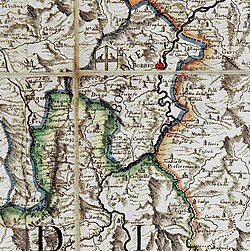
The County of Bobbio was reduced to the Val Trebbia up to Torriglia, Val d'Aveto until Santo Stefano d'Aveto (Ge), to the Oltrepò, to the Val Tidone (Pecorara, Pianello Val Tidone) and to the Val Curone; the other feuds are lost and given to the Obertenghi and this will also be confirmed by the Emperor Frederick the Barbarossa in 1164, who will take away other territories to the County for the benefit of Malaspina descended from the Obertenghi.
In February 1208, Pope Innocent III took the charge of mithorate abbots and finally submitted the abbey to the bishop of Bobbio, that is to say, that episcopate which at the monastery had its birth. Moreover, suppressing the territorial abbey of Bobbio (abbatia nullius dioecesis) took away to the monastery the remaining monastic property, terriere and feudal piemontesis, Lombardy, Emilian, Veneto and Tuscan, assogetting them to local bishops of the dioceses of territorial relevance, except for the Genoese archdiocese that already depended the Bobbiese diocese and which held good relations.
The Romanesque Cathedral dates back to the 11th century, the monastery of San Francesco (visible near the homonymous square) is 1230.
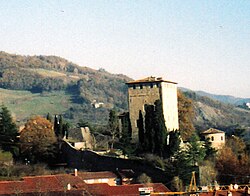
The first commune that existed since 1014 became a consoling type in the early 12th century and in 1176 joined the Lombard League by participating with its army at the Battle of Legnano, which was not forgiven in the subsequent peace of Constance of 1183. In 1216, the municipality of Bobbio was transformed into a new statute in the Podestarile Commune. In 1304 he became Signoria under Corradino Malaspina that built the castle over the ancient Proto-Roman monastery. Towards the end of the 12th century the city was surrounded by walls, still visible in some places, with five doors: Frangula, Alcarina, Agazza, Legleria and Nova. The urban fabric grew around the monastic complex of the 9th century; during the 14th century it was divided into third-party: the Castle, the Cathedral, Porta Nova.
In the 1341 passed to the Visconti and then from 1387 to the feudal counts Dal Verme (feuded by 1436), along with the county of Voghera with the Oltrepò and the Roman fiefs, and the lordships of Zavattarello, Romagnese di Pecorara and its valley, Pianello Val Tidone, Borgonovo Val Tidone, Castel San Giovanni (lost in the area) 1485) Sarmato and the Tidone valley and Valsassina (lost in 1647), until the abolition of fiefs in the Napoleonic era 1805.
From the 16th to the 18th century
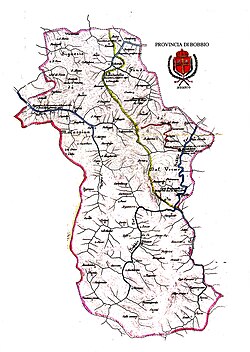
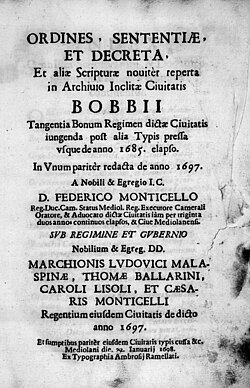
After several vicissitudes in 1516 Bobbio became Marquis and includes several counties [Bobbio e Voghera, Tortona (with the vescovado) and the lords of Malaspina], in 1593 Voghera becomes autonomous under another lordship, but always under the Marquisate. In 1743 Bobbio passed to the Savoy and the ancient county was transformed into Province of Bobbio, until 1861; in 1770 the Marquisate remained only as an honorific title, and now exceeded, is abolished. In 1797 with the abolition of imperial feuds by Napoleon and the reorganization of Bobbio territories became arrondissement French (the provinces had been abolished).
19th century
Since 1801 the city and territory, together with the Kingdom of Sardinia, are annexed to France. In 1815, the Napoleonic Empire fell, Bobbio returned to the Kingdom of Sardinia and always as the capital of the homonymous province, now included in the Division of Genoa. With the emanation of the Decree Rattazzi (1859), operating since 1861, the province was replaced by the homonymous district, without territorial modifications, but within the new Province of Pavia. In 1923 the district was abolished (its territory was divided between the provinces of Pavia, Genoa and Piacenza) and the city aggregated to the Province of Piacenza.[14] In that year the Mandatory Tribunal was also suppressed.
After the passage of the hamlet of Dezza and its territory, until 1746 under Brallo di Pregola and then under Bobbio, in 1766 you have the passages of Castellina, Cà di Malosso, Boschini, Casa Uccellone, Casa Costa, Colorazze for the redefinition of the borders with the Duchy of Parma and Piacenza, while in 1923 the town of Bobbio will incorporate the villages of Bertuzzi and Callegari, first under the municipality of Coli, in 1927 the fraction Mezzano Scotti is spotted by the municipality of Travo and is aggregated to the municipality of Bobbio.
In 1925 the new district of Bobbio was formed in the province of Piacenza, to which the municipalities of Coli and Pecorara were joined.[15]. Already modified in 1926, with the stormy return to Pavia of the municipalities of Romagnese, Ruino and Zavattarello after the so-called March on Bobbio and the municipal referendums that followed[16][17][18], had an ephemeral existence: in 1927 the reorganization of the provincial districts led to the suppression of all the Italian districts[19].
XX and XXI century
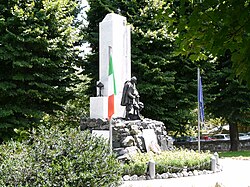
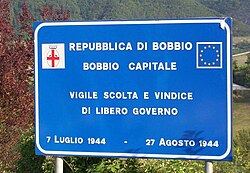
During World War II, it was released from the resistance movement in summer 1944, under the command of Ten. Fausto Cossus[20], Carabinieri officer who between the end of 1943 and January 1944 first formed the Banda La Senese, then the Compagnia Carabinieri Patrioti and became commander of the entire Piacenza GL division. The Republic of Bobbio was then formed[21] extended for about 90 km from Rivergaro to Torriglia with propaggini in Oltrepò and Val Tidone and Val d'Aveto. Radio London announced "Bobbio, the first city in Northern Italy is free".
The "Republic" was operational from 7 July until 27 August 1944, when it was again occupied by troops of the R.S.I.
The city had a partisan administration and was one of the first examples of "Free Cities" in northern Italy.
On 17 July 1908 a violent cloud occurred with an extraordinary full of Trebbia, which devastated houses and countryside especially in the territory of Ottone's sending, with serious damage to the town of Gorreto, destroying five bridges along the state road 45 interrupting road communications between Ottone and Torriglia, and the telegraphic line between Bobbio and Genoa. Damage and flooding also in the pleasure in Rivergaro and Sant'Antonio a Trebbia near Piacenza, the biggest damage to the countryside of Piacenza with the destruction of crops species of wheat; many materials, livestock and people were saved thanks to the ready telegraph notice started by Bobbio before the imminent full[22]. Massive destruction and more extensive damage occurred, however, with the flood that hit the Trebbia valley on 19 September 1953, caused by a storm that led to the fall of 280 mm of rain that in a few hours involved the high part of the valley, from Genoese to Marsaglia, and which provoked 10 dead, imposing destructions and huge damages among which in the upper valley put out use of numerous power plants, the interruption of the highway 45 with numerous landslides and the collapse of the bridge on the river in Marsaglia[23][24], which was then rebuilt between 1958 and 1959 based on a design by Riccardo Morandi[25].
On the night of September 14, 2015 a part of the province of Piacenza was devastated by sudden floods of the Nure dell'Aveto and Trebbia, due to bad weather and debris clusters, which caused huge damage, the collapse of the Ponte di Barberino on Trebbia[26] and the death of three people in Val Nure. The most affected locations were Roncaglia, Pontenure, Ponte dell'Olio, Bettola, Farini, Ferriere, Rivergaro, Bobbio, Corte Brugnatella and Ottone[27][28][29]; also hit the high valley of Genoa in the municipalities of Rezzoaglio and Santo Stefano d'Aveto[30], the upper Genoese Val Trebbia in the municipalities of Gorreto, Propata, Torriglia and the neighboring municipalities of Montoggio and Valbrevenna in the upper Scrivia valley[31].
Bobbio is also home to a large electoral district of the Val Trebbia and the Carabinieri Command. There is also a judicial district with the Justice of Peace.
Considering the presence of the mortal remains of San Colombano, the city has often been a destination for high foreign personalities, including Irish heads of state, presidents of the European Parliament and members of the diplomatic corps.
Symbols
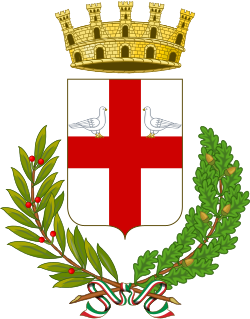
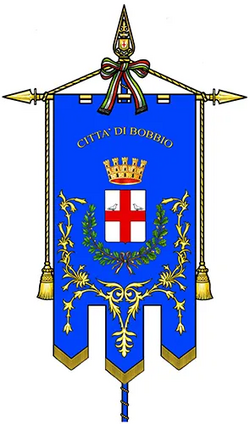
(Heraldic description of the coat of arms of the Municipality of Bobbio)
The coat of arms of the City of Bobbio[32] It consists of a sannitic shield of silver or white colour on which is overlapping a red cross, set in the upper part by two white doves to the natural, laid on the side arms of the cross, one to the right and the other to the left in the upper part and looking among them, symbol of San Colombano. The shield is stamped by a crown from black or gold city. The whole thing is enclosed on the sides by a branch of laurel and one of oak, tied together by a tricolor ribbon.
The crown of the city dates back to the imperial and papal concession by decree of 14 February 1014 of Emperor Henry II of Saxony with ratification of Pope Benedict VIII always at the end of February 1014.
The coat of arms was approved by Decree CG of 8 November 1929.
The coat of arms resumes the historical signs of the Municipality of Milan, in fact in 1167, with the oath of Pontida, it was formed among the main cities of northern Italy including Bobbio along with Piacenza, the Lombard League, with the aim to fight the Emperor and conquer independence. The League adopted the emblem of Milan as a symbol. In 1176, in the triumphal battle of Legnano, the emblem waved on the "carroccio". From that moment on, the Milanese emblem became a symbol of authority and autonomy, and Bobbio together with many cities in Northern Italy adopted it.
The coat of arms is also reproduced on the ancient tomb of the Holy in the crypt of the Abbey.
The heraldic profile of the gonfalone of the city of Bobbio is constituted by a blue drape, placed at the lower end and bearing in the middle the town coat of arms, surmounted by the gold word "CITTA' DI BOBBIO".
Honors

Monuments and sights
Religious architecture · Civil architecture · Military architectureExplore this chapter
Religious architecture
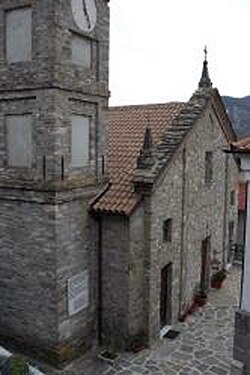
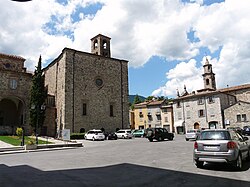
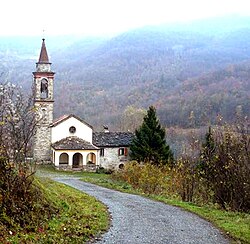
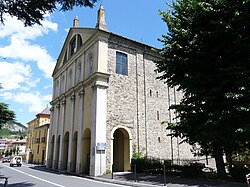
- Abbey of San Colombano (Basilica in Piazza S. Covenant[35], Monastery and museums, Portico and gardens of Piazza S. Fara) (IX century)
- Cathedral of Bobbio (Cathedral of S. M. Assunta[36], Bishop's Palace, Diocesan Museum of the Cathedral, Ancient Seminary and Historical Archives of Bobiensi) (11th century)
- Church of San Lorenzo[37] (12th century)
- Ex church and convent of St. Nicholas (XVII century)
- Monastery of San Francesco (XIII century)
- Sanctuary of the Madonna dell'Aiuto[38] (14th century)
- Former Church of Our Lady of Graces (former monastic hospital-farm of the 9th century, cinematographer from 1910 and hostel)
- Convent of the Sisters Gianelline (ex college born in 1960)
- Monastery of Santa Chiara (Clarisse) (XV century)
- New Episcopal Seminary (edified by mons. Pietro Zuccarino in 1957)
- Monumental statue of San Colombano, located at the entrance of the village for those coming from Piacenza
- Monumental statue of Sant'Antonio Gianelli, located at the entrance to the village for those coming from Genoa
Civil architecture
- Ancient prisons of Bobbio and Mulino del Monastero (monastery IX century)
- Ancient medieval high district Castellaro with arcade (IX century)
- Piazza del Duomo, the ancient porticos and historic Bobiens Palaces including:
- Palazzo Brugnatelli (ports of the 13th century, ancient meridiana and cubic capital with ancient apotropaic head)
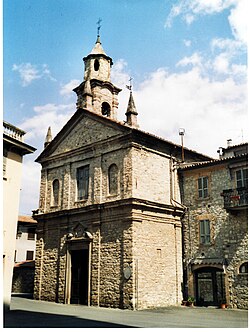
- Palazzo della Farmacia (XV century)
- Mulino del Vescovado (medium-eval complex of the vicolo Pertusello, private building, from the 12th century)
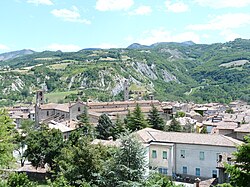
- Palazzo Castelli di Porta Nova (XVII century)
- Palazzo Agazzi di Porta Nova with arcades (XV century)
- Alcarini Palace and the Longobard Queen Teodolinda (XIV century)[39]
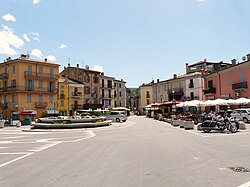
- Piazza San Francesco (fontana, gardens, monument to the fallen)
- Foro Boario (formerly the market of the medieval cattle fair, later became public parking)
- Old Hospital (XVIII century)
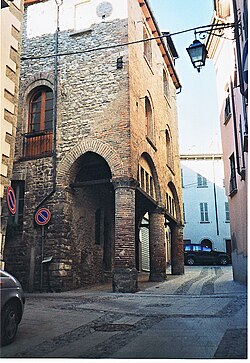
- Palazzo Comunale (room Auditorium S. Chiara, historical archive, cultural centre and library)
- Ancient inn at the Paolina (medieval building, later private, renovated with postal sign)
- Palazzo Calvi (XV century)
- Palazzo dei Donati con il vicolo della Stretta (XV century)
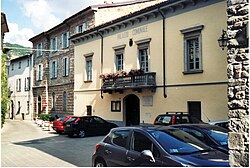
- Palazzo Buelli (XVI century)
- Palazzo Olmi (XVII century)[40]
- Palazzo Malaspina (XII century)
- Piazza di Porta Fringuella (Portuguese of the 12th century)
- Mill of the Municipality (XII century restored)
- Ancient contrada of S. Joseph (stone buildings of the 12th century)
- S. Joseph (XII century)
- Palazzo Tamburelli and municipal hostel (XVIII century)
- Ponte Vecchio or Gobbo (symbol of the city - Roman and later)
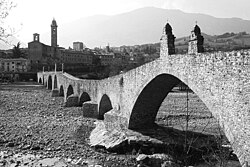
- Il Borgo le ancient mura e il Mulino Ocelli (XII century)
- Torretta di Valgrana (XIII century)
- Bridge of San Martino
- Villa Renati (private building built on the remains of the monastery of S. Martin of the 7th century)
- Terme di Bobbio
- Terme di rio Foino (300 m. after the Bridge Gobbo, source and free access tanks)
Military architecture
- Malaspina-Dal Verme Castle[7] (14th century)
Historical, religious and civil architectures of the surrounding area
- Parish church of San Policarpo, in the hamlet of Ceci. The church was built with the 9th century monastic cell, the current building, documented in 1153[41], was enlarged in 1744 and 1938.
- Parish church of San Pietro, in the hamlet of Dezza. The church rose with the monastery cell of the 10th century[42], rebuilt in the 16th century.
- Parish church of San Paolo, in the hamlet of Mezzano Scotti. The church was built as a monastery of S. Paul[43] in 891, destroyed in the 15th century, the current building was restored between the 18th and 19th centuries.
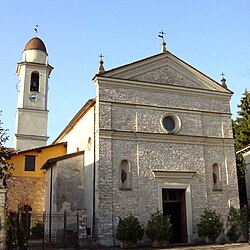
- Parish church of San Cristoforo, in the homonymous hamlet of San Cristoforo. The new church was built in 1910, replacing the previous sort in the 7th century as a monastic cell of Viulio[44] and documented in 972 of which few ruins remain.
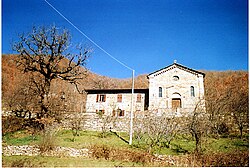
- Parish church of Santa Maria del Carmine, in the hamlet of Santa Maria. The church was built in the 15th century, replacing the former sort as a monastic cell documented in 862, and several times restored between the 17th and 18th centuries.[45]
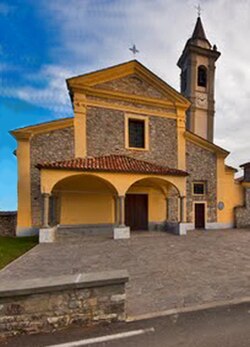
- Parish church of Sant'Eustachio, in the hamlet of Vaccarezza, which was erected as a monastic cell documented in 862 and several times restored until the 19th century.[46]
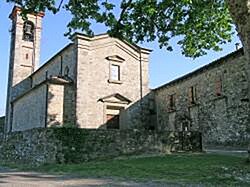
- Sanctuary of Santa Maria in Monte Penice (1460 m. - feast on the second Sunday of September), ancient place of worship perhaps of the 7th century, documented in the 9th century, and rebuilt in the 17th century.[47]
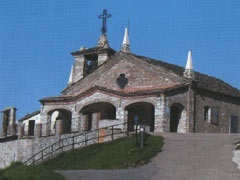
- Cappelletta of the soldiers of the garrison and RAI operators, located on the Passo del Penice just before the Sanctuary.
- Monument to San Colombano, patron and protector of motorcyclists. Located at the Penice Pass, it was inaugurated on November 23, 2002 by the primate of Ireland Seán Baptist Brady, by Paolo Sesti, president of the Italian Motorcycling Federation and the Amici di San Colombano Association.
- Oratory of San Carlo Borromeo (private), in the hamlet of Poggio d'Areglia, to the dependencies of the parish of Mezzano. Built in 1610 as a chapel of the Castle of the Scotts.
- Oratory Immaculate Heart of Mary, in the hamlet of Arelli. The little church was built as a chapel of the 10th century monastic cell[48] dependent on the church of S. Ambrose later disappears, the building refurbished several times is at the dependencies of the Duomo parish.
- Oratory of the Sposalitius of the Virgin (private), in the hamlet of Cadonica. The chapel was built in the 17th century as a chapel of the monastic centre, which was built in 1460 after the abandonment and destruction of the Monastery of St. Paolo di Mezzano. The building restored in the 19th century is at the dependencies of the parish of Mezzano.
- Chapel of San Lorenzo, in Case S. Lorenzo di Fosseri, to the dependencies of the parish of Mezzano.
- Church of Sant'Andrea[49], in the hamlet of Cassolo, built in the 16th century, dependent on the parish of Mezzano.
- Oratory of the Blessed Virgin of Caravaggio, in the hamlet of Castighino or Casteghino. Surprise on an ancient chapel[50] pre-existing in 1835, to the dependencies of the parish of S. Maria.
- Oratory of San Carlo (private), in the hamlet of Degara. He arose as the chapel of St. Gaudin of the monastic cell in the 10th century by the monk of Bobbio Auderado, in 1631 he was re-edified and dedicated to St. Carlo; to the dependencies of the parish of the Duomo.
- Oratorio di San Martino (privato), in the hamlet of Fognano. In the 19th century it was born as a place of worship and prayer of Sant'Antonio Gianelli near the villa of the bishopric, to the dependencies of the parish of the Duomo.
- Oratory of the Madonna del Rosario,[51] in the hamlet of Freddezza, built in the 13th century as a chapel of San Cristoforo, to the dependencies of the parish of Mezzano.
- Oratory of St. John the Baptist and St. Henry II Emperor (private), in the hamlet of Gorra, to the dependencies of the parish of S. Maria. Built in 1877 by Clara Fossa Della Cella, for his will he was also dedicated to S. Henry II Emperor of the S.R.I., who gave in 1014 to Bobbio the title of city and episcopal seat.[52]
- Church of the Blessed Virgin of Caravaggio, in the hamlet of Lagobisione, was built in 1970, replacing the chapel built in 1841 then restored, is at the dependencies of the parish of the Duomo.[53]
- Oratory of the Blessed Virgin of Caravaggio, in the hamlet of Lagobisione. Chapel built in 1841 in the village, once dependence of the church of San Carlo di Degara. Restored, she was recaptured to worship.[54]
- Church of San Rocco, in the hamlet of Piancasale. The church of medieval origin, arose as an addiction to the Church of St. Ambrose subsequently disappeared, was re-edified in 1855[55] after the urban development of the village, it is at the dependencies of the parish of the Duomo.
- Oratory of Our Lady of Caravaggio, an ancient place of worship near the Parcellara Stone and the hamlet of Brodo, to the dependencies of the parish of Mezzano.
- Oratory of San Salvatore, in the ancient village of the homonymous fraction. Sisters in 975[56], with subsequent modifications, as an oratory of the monastic cell documented in the 9th century, under the parish of S. Colombano.
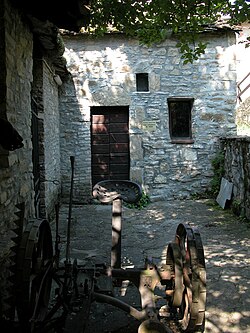
- Ethnographic Museum Val Trebbia (at Callegari di Cassolo)
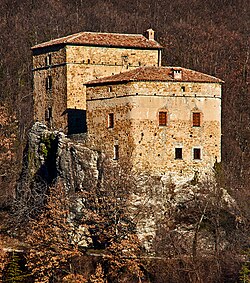
- Castello del Dego (or Barberino) (private property), fort built in the 13th century Malaspina.
- Ruderi of the Castle of Ajguera, fortified by the Scotti in the 14th century, destroyed in 1516 by Count Federico Dal Verme and rebuilt always by the Scotti, the ruins remain.
- Castello di Poggio Area, of the Scotti family, fortified in 1488 in the village of Poggio della fraction Areglia (or Area) by Bartolomeo Scotti, destroyed by Dal Verme in 1516, was rebuilt shortly after a refurbished.
- Mulino di Areglia, ancient mill of the village, still grinds cereals for animal feeding.
- The ancient Mulino Erbagrassa (private property).
- Castle of Mezzano Scotti (private property).
- Torre di Cadonica, built as a new monastic seat in 1460 together with the new monastery, after the abandonment and destruction of the Monastery of S. Paolo di Mezzano, near the Oratorio il Mulino.
- Cadonica Mill (private), built by the monks of Cadonica, near an ancient and wide underground tunnel in stone still visible, was also accessible to back of mule for the traffics of the monastery.
- Ancient furnace of Canneto, remains of the ancient furnace built in Roman times and remained in activity until 1950.
- Colonia elioterapica Carenzi, remain the remains of the colony of 1937, built on Terme di S. Ambrose and also exploiting the saline thermal springs of S. Ambrose.
- Villa Gorra refuge house (private), built in the 17th century for travellers and pilgrims who crossed the Penice.
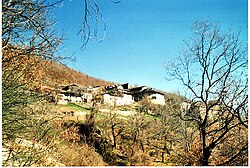
- Borgo di San Cristoforo, with the Fortified House, building of the 9th century built as a monastic cell and restored together with adjacent houses, near the remains of the chapel of S. Giacomo (private) turned into farmhouse and cellar. A few km on the Carlone stream, the Mill Peveri (now private house), built in the XIX century after the abandonment of the nearby and ancient mill of Cavanna, of which the few ruins remain.
- Fortified House of Moglia (private), ancient monastery documented in 862, the local monastic cell built in the 7th century. The building, refurbished, had a central refectory with arched vaults overlooking the monks' cells and the kitchen without fireplace was located in the center of the floor. One of the few remaining ancient architectural examples.[57]
- Mill of Piancasale
- Ruderi del Castello dei Monticelli (or Castel Pero), in the locality Poggiolo di Vaccarezza, the castle of the noble family of Monticelli is documented in the fourteenth century, abandoned after the passage to Malaspina, few traces remain.
- Villa Costanza (private property), ancient palace of Malaspina in the hamlet of Vaccarezza.
Via degli Abati
The Via degli Abati is a complete route of 192 km from Pavia to Pontremoli passing through Bobbio. It can be reached on foot or by horse or mountain bike. It ideally evokes one of the many variants of the Via Francigena.
Other
- Monte Penice
- Penice Pass and ski lifts
- Ceci and the cross-country skiing centre Le Vallette
- Barberino and the Orrido, the mountain is located on the right bank of Trebbia, an ancient Roman border of the pagus di Bobbio, always documented as border of the County of Bobbio in 972, remained border of the Duchy of Parma and Piacenza and Emilia until 1923, when Bobbio became Emilian and Piacenza.
- Midnight Scotti
- The village of San Salvatore and the meanders on Trebbia[58]
- The beaches on the Trebbia del Lido di San Martino and the Berlina
- Santa Maria
- Sassi Neri
- Ancient village of Monte Groppo (ruders and neolitic and Ligurian finds)
- Lost plant
- Stone Corva
- Monte Pradegna
- The Parcellara Stone and the oratory of Brodo, mountain reached from Mezzano Scotti towards the places of Freddezza, Parcellara, Brodo or the Pass of Caldarola
- Small village of Embrisi, now abandoned town of Embrici over Mezzano, there is the presence of ancient buildings in local stone and artefacts and sculptures made of carved sandstone, of considerable interest the faces and apotropic heads.[59]
- Carlone thermal waterfall and the ancient village of San Cristoforo[60]
- Valle del Carlone
- Mogliazze, a hamlet with typical stone houses and roofs in sandstone plates.
- Samboceto, a small ghost village above Mezzano now uninhabited with typical stone houses and sandstone roofs.
- Telecchio, a small village with celtic-ligure origins that became a monastic cell in the 10th century, surrounded by the municipality of Coli, linked to the church of S. Michele della Spelonca.
- Common Forest (on the road of Dezza and the step from Cernaglia above)
- Fountain of the Ramari of Bobbio
- Medieval Path for the Sanctuary of Monte Penice
Society
Demographic evolution · Foreign ethnic groups and minorities · Languages and dialectsExplore this chapter
Demographic evolution
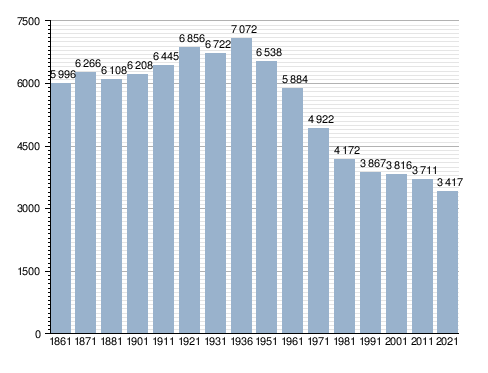
Inhabitants registered[61]
Foreign ethnic groups and minorities
According to ISTAT data foreign citizens in Bobbio on 1 January 2023 were 345 (10,11% among all residents).[62] The first population communities above 20 units were those from (date 31 December 2021):
- Romania, 74
- North Macedonia, 71
- Ukraine, 68
Languages and dialects
The dialect bobbiese, among those of the province of Piacenza, has some phonetic, morphological and lexical peculiarities. It differs from the most widespread dialect of Piacenza and this is due to the particular geographical position and its historical events. Bobbio is located along the road between the Padana plain and the province of Genoa and is adjacent to Lombardy and Piemonte. Its territory over the centuries has undergone the dominations of Ligurians, celtes, Romans, Lombards, franchi... The local dialect then underwent changes and influences but maintained unique features.[without source]
The dialect of Bobbio exists a dictionary, numerous texts are written in this dialect and are typical of the calendar and the lunar bobbiesi. The local, folklore and theatrical festivals curated by Ra familia Bubièiza They keep their use even more vital.
Religion
The majority of the population professed Catholic but there are no updated figures on the percentages of the faithful practicing. Bobbio is one of the two bishops' offices that make up the diocese of Piacenza-Bobbio. Small foreign communities are linked to their religions of origin, such as Macedonian Orthodox, Ukrainian Catholic and Muslim.
Traditions and folklore
Jubilee of St. Colombano
As an ancient tradition every 50 years we celebrate the jubilee of San Colombano in memory of the foundation of the abbey and the death of the Irish patron saint Colombano. Throughout the Jubilee year there are numerous cultural, sports, folklore, musical and gastronomic activities. Every year, moreover, for the patronal feast of 23 November (San Colombano), is held the Feast of San Colombano[63], with Eucharistic celebration and distribution of San Colombano bread, a giant loaf of bread reproducing the statue of the patron saint, then cut into pieces after the bishop's blessing. The previous evening is carried out Transit of San Colombano[64], with the lighting of thousands of candles, the procession of the reliquary bust into the abbey church and the celebration of the life of the saint. Typical local products are distributed in the portico of the abbey.
Carnival Bobbiese
Every year for the ancient Carnival Bobbiese[65] The traditional parades of allegorical wagons and masked groups are held in the streets and squares of the village coming from both Bobbio and the neighboring municipalities of the valley and its surroundings. There is also the typical cuisine of this traditional festival, such as tasty chat and pancakes. The last Sunday of carnival and as ancient tradition the parade will be repeated for the Ambrosian rite ending in Piazza Duomo with the Pentolaccia with the traditional hanging baskets made of chopped almonds and caramelized and filled with sweets, which will have to be broken with a stick from the blindfolded children, a fun party for both boys and big masked ones, as well as for families and children.
Falò di San Giuseppe – Fuiè a San Giusèp
The Feast of St. Joseph[66] Bobbio has a millenary tradition. As is custom, the 19 March, the day when the church remembers St. Joseph, on the plain of the Bobbio stream, in Candia, it is lit around 20.30, a great Falò, a rite that marks the passage from winter to spring, I'm not here., with foliage, boxes, paper, cardboard, vine shoots, prunings, waste from field work, to the sound of an ancient refrain that invokes Saint Joseph to bring back spring and the beautiful season: a typical example of how there was an ancient mix between pagan and Christian rites (the light that defeats darkness), in fact the bonfire ritual dates back to the ancient Ligurian people, on the occasion of the particular astronomical moment of the equinox, then the pagan tradition merged with the Celtic-Irish Christian one of the monks of San Colombano, who arrived in the Lombard era with the Irish patron saint who founded the famous Bobbio Abbey in 614. So much so that, on the bonfire, a puppet is burned, the Old old, symbol of the winter that is coming to an end. Depending on how the old one burns, the omens for the next season are drawn; according to popular belief, if the puppet burns quickly it will be a good year. Around the bonfire, once the largest of all those that covered the valley, in the fields and near the farmhouses, a rich banquet prepared by the women of the village is offered: hot drinks, mulled wine, cured meats, cheeses, wine, pancakes, brittles and other typical desserts of the festival.
Palio of the districts
The pole is a manifestation of medieval origin that takes place the last weekend of June is organized by Pro Loco. The tournament will challenge the contradaioli in various skill competitions for the conquest of the drappo that will become a trophy for the winning contrada. The five historical districts of Bobbio[67] take its name from the same gates of access to the medieval city already existing in the 12th century: Alcarina (blue), Fringuella (green), Agazza (blue), Legleria (yellow) and Nova (red). The village and the districts dress with the colors of its districts. The historic parade of the pole takes place on Saturday evening before the tournament, winding from the bridge swoop along the streets of the center to Piazza Duomo with the launch of the challenge and one of the various competitions provided by the pole.
Ireland in music
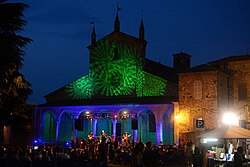
Festival of evening concerts of Celtic and Irish music with gastronomic stands, with which Bobbio celebrates the link between Val Trebbia and Ireland in the name of the Irish patron saint, founder of the abbey in 614. The event[68], organized by the municipality of Bobbio and the support of the province of Piacenza, includes three days of live music in July.
Pinolo Festival
Traditional evening festival[69] with food stands and live music organized on the weekend between the end of July and the beginning of August by Pro Loco The ones that Pontano.
Other events
Other events are held in May for Ascension: Blessing of the donuts[70], ancient procession from the castle with blessing Colombanian of nature, earth and fruit; blessings of buslanin, traditional savory donuts and sweets and May 31st for the end of the Marian month: Procession with Our Lady of Help[71], from the Sanctuary the pressure begins with the large statue of the Madonna dell'Aiuto through the city streets of the historic center, on the sides of the districts the lights are lit and in the middle of the street the floral compositions in homage to the patron saint of the city, the churches and the municipality are open and illuminated for the occasion, to accompany the procession the music of the band. Stop in Piazza Duomo with the traditional panegyric and return to the sanctuary for the final blessing of the children.
Legend of the Gobbo Bridge or Devil's Bridge
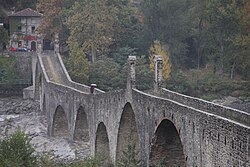
The construction of a bridge has always been considered a work of great ingenuity, almost prodigious. The birth of some bridges gave rise to some legends, and not infrequently these were the protagonist of the devil: combining two places that nature (and God) had wanted separated was seen by many as a work diabolical. It should be added, in this case, that every observer is struck by the absolute absence of any symmetry or logic in the arrangement of the bridge's arches.[72] The legend about the bridge Gobbo, also called Old Bridge or Bridge of the Devil It tells that San Colombano wanted to build the two banks of the river Trebbia.
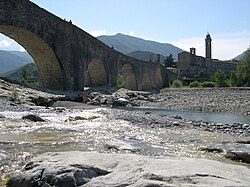
The Devil offered to help him by building a bridge in one night, provided he had the soul of the first who had crossed him. San Colombano accepted and the devil built the bridge with the help of a diavoli group of different height and body, each of which he erected his part in a personal and difform way from others obtaining the characteristic gibbocity and irregularity of the bridge.
In the morning the holy monk held faith to the given word, but justifying himself with the observation that the bridge had not been built according to the rules tricked the devil by first passing a dog (an ancient tradition wants the first animal to pass on those arches was the bear friend).
Institutions, bodies and associations
- Hospital of Bobbio
Quality of life
Since 2006 she has been awarded the Flag orange from the Italian Touring Club, as a high-medioeval centre of tourist-environmental interest, which stands out for an offer of excellence and quality hospitality. The recognition is part of the Italian project included by the World Tourism Organization (World Tourism Organization) among the programs implemented for sustainable tourism development.
Culture
Publisher · Cinema · MuseumsExplore this chapter
Publisher
From 9 July 1903 in Bobbio there is a Catholic weekly, called The Trebbia[73], distributed in the municipalities of Bobbio, Coli, Corte Brugnatella, Ottone, as well as by subscription in Italy, especially in the areas of Genoa, Chiavari, Piacenza, Pavia and Milan, and abroad. In addition to information of religious interest, the weekly is interested in cultural events and local news in the Bobbiese area and in the municipalities of Alta Val Trebbia, Val d'Aveto and Oltrepenice (territory of the Oltrepò beyond Mount Penice once under Bobbio and the municipalities once under the ancient county and then province of Bobbio, still today in the diocese of Piacenza-Bobbio and in the vicariate of Bobbio), as well as of local history and traditions.
Cinema
The director Marco Bellocchio, whose family is native to Bobbio, has filmed in the city and in the immediate vicinity his first successful film, The fists in the pocket (1965). Some people from Bobbie acted in the film as supporting actors and extras. Marco Bellocchio takes care of cultural activities related to cinema every year, in particular directing the Laboratory Making cinemas and the film festival ''Bobbio Film Festival'' (with performances in summer). Between 1999 and 2008, in his film Never sister, Bobbio is once again a film set to tell the story of a little girl from Bobbio who prefers to live with her great-aunts rather than leave her hometown. Again between 2013 and 2014 it was filmed in Bobbio Blood of my blood, a two-part film, set in the 17th century and modern times. The 2021 film directed by Daniele Misischia "The Monster in the Crypt" is set in Bobbio.
Museums
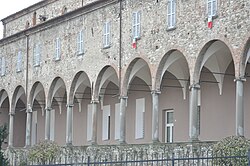
The monastery complex of the Abbey of San Colombano houses:
- The Museum of the Abbey of San Colombano, since 1963 in the premises of the monastery where the library was once housed and also part of the famous Scriptorium of Bobbio, houses finds ranging from the first centuries of the Christian era to the mid-16th century;
- The Museum of the city of Bobbio, located in the inner cloister, in the original premises of the 9th century, is constituted by the ancient refectory with the great fresco of the Crucifixion attributed to Bernardino Lanzani, the lavatory room of the kitchens (became in the Renaissance the laboratory of the library), the internal cave and the underground with the large cellar vaulted barrels and glacier. The museum is a historical multimedia didactic route of the abbey, San Colombano, scriptorium and Bobbio history.
The museum exhibition, first consisting of transparent exhibitors, in which the themes related to the life and work of San Colombano, the geopolitical situation of Italy Longobarda and the activity of the famous Scriptorium has been transferred to the monastery corridor; while in recent years the museum has digitized the installations by inserting multimedia audiovisual stations with video, touch screen with also the scanned bobiens codes of the Ambrosian Library of Milan.
- The Mazzolini Collection Museum[74], modern art museum and gallery that houses the "Collezione Mazzolini" which is located in the upper rooms of the ancient library of the monastery and scriptorium, premises on the upper floor therefore of the Museum of the Abbey, which formerly housed the monastic cells of the monks. The collection includes 899 works (872 pictures and paintings 27 sculptures) signed by the names of art of '900: from Giorgio De Chirico to Massimo Campigli, from Mario Sironi, to Lucio Fontana. The collection was donated by Mrs. Rosa Mazzolini of Brugnello di Corte Brugnatella to the diocese of Bobbio. Currently there are a hundred works on display, a rotation is planned to make the whole collection visible.
- The Diocesan Museum of the Cathedral, housed in the complex of the Cathedral of Bobbio in the halls of the right wing of the noble floor of the Bishop's Palace.
- The Ethnographic Museum Trebbia is located in Callegari di Cassolo di Bobbio. Born by the Magistrate family and in particular Dino Magistrati, he collects the objects of the family collection, including agricultural tools, utensils, furniture related to peasant life.
Literature
Among the books of the former abbey library, in 1815 Cardinal Angelo Mai renewed the famous "Palinsesto Ambrosiano" and later other Bobbie books in the Ambrosian Library and then in the Vatican Library including in December 1819 the De Re publica by Marco Tullio Cicerone, for which Giacomo Leopardi dedicates a song called "ad Angelo Maj".
The cenobio of Bobbio and its library – among the richest in the early Middle Ages – are mentioned in Umberto Eco's novel The name of the rose.
Music
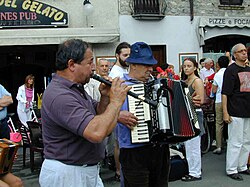
Bobbio, located in the territory of Four Provinces, boasts a very ancient musical tradition, linked to the use of an instrument, the fife, which, accompanied by the accordion, allows the performance of a vast repertoire of traditional songs. These were created to mark the various moments of the life of the community. Le dances of the Four Provinces are a typical dance expression linked to popular music recovered in recent times, and among these is famous the Monferrina (locally Bala Ghidon).
There are songs for singing, with the variant of the feast of the Holy Cross, marriage, lever (Leva levon in Santa Maria) and reminiscent of places and facts related to the past (the song of the Draghin). In dance parties, in addition to waltz, polka and mazurka, you can encounter archaic dances such as: the Alessandrina, the Monferrina, the deuce jig.
The musical group of I Müsetta animates festivals and celebrations and has brought these music abroad: in France, Ireland, Spain and the Netherlands. In the hamlet of Degara there is the laboratory of Bans where he builds piffers and cornamuses (including the Apennine müsa); thanks to his work the tradition of choral music, dances, music and the construction of instruments will not be lost but indeed found new vigor and diffusion among young people. Traditional appointment in Bobbio with the exhibition "Cori d'osteria e Canti popolare".
Since 1998 the Choir Gerberto has been operating in the city[75], revival of the choir of the same name founded in 1967 and named after the abbot of San Colombano, Gerbert of Aurillac, later elected pope with the name of Sylvester II. The choir's repertoire, comprising thirty elements, includes not only traditional mountain songs, but also songs from international folklore and reworkings of pieces by modern authors. The choir has participated in several concerts and events in Italy and abroad, recorded an album and organized the choral festivals "Salve o mia Montagna", "Chores in the cloister" and "Concerto di Santo Stefano". Marco Bellocchio shot the short film The Choir Master together with the choir, and presented in 2001 at Torino Film Festival.
Kitchen
Events
Fair-market of Bobbio
Every Saturday morning from 8 to 13, throughout the year is the ancient and traditional Bobbio Market Fair.[76] From all the valleys of Val Trebbia and Apennines come to the city many people for the market. It consists of numerous stalls of all kinds: typical products, food, biological, objects, clothing, DIY, agricultural machinery and tools and gardening, etc. The market fair is located in the main squares and in the city streets of the historic center. In Porta Fringuella square there is the fresh fish counter.
"Memorial Dino Cella" painting competition
The Lions Club Bobbio together with the Culture Department of the Municipality of Bobbio organize every year for May 1st the painting contest "Memorial Dino Cella"[77], which aims to develop the figurative arts. The event, dedicated to the painter Dino Cella, wants to invite participants to reproduce evocative and characteristic details of the city of Bobbio and its surroundings on canvas. The competition is open to professional and amateur artists.[78]
Bobbio Film Festival
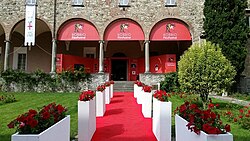
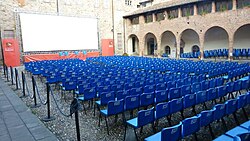
The Bobbio Film Festival was born in 1995 from the workshop Docinema by the initiative of director Marco Bellocchio and over the years has grown until, in 2010, the birthplace ofAssociation Marco Bellocchio, who has been managing the festival since then.[79][80]
Patronage of San Colombano
On November 23, the patron saint of the city is celebrated, San Colombano. On this occasion we meet the political authority represented by the mayor, and the religious one represented by the Catholic bishop, with the traditional gift of the clergy. The celebrations at the Abbey of San Colombano with the traditional "Blessing of the Bread of St. Colombano" by the bishop, which will then be distributed to the faithful, the solemn Eucharistic concelebration in the basilica of the abbey presided over by the bishop and religious authorities linked to the patron saint and coming from both Ireland and from the various parts of the world, Europe and Italian, as well as to the community of parish priests from the Italian parishes[81] The solemnity is preceded by the evening procession of the "Transit of San Colombano", with the procession of the ancient reliquary bust and the celebrations in the basilica of transit.[82]
Millennial of the city
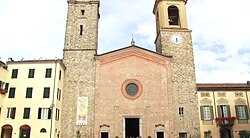
In 2014 the thousandth anniversary of the founding of the diocese and the elevation of the village of Bobbio to imperial cities took place on 14 February 1014 by Emperor Henry II the Saint who granted episcopal dignity to the Abbot Peter. To commemorate the thousandth anniversary, a banner approximately five meters high was created, mounted on a frame and affixed to the left bell tower of the cathedral, which depicts the Madonna Assunta, to whom the Bobbio Cathedral is dedicated. The municipality of Bobbio has also created various banners hung in the historic center in memory of the millennium which with the title of city and the imperial granting of the privilege of a different legal-administrative system which gradually gave the basis for municipal autonomy with the drafting of the ancient statutes and the actual birth between the 11th and 12th centuries of the medieval municipality, first of a consular type and then of a podestarial type.[83][84][85]
Literary competition "Ponte Gobbo - Città di Bobbio"
Since 2008 the local publishing house Pontegobbo and the daily newspaper La Libertà indicate a literary competition open to young Italian and foreign writers of narrative and poetry. The competition gives young unknown talents, participating, to emerge by making themselves known by public and critical.[86][87]
Anthropic geography
Urbanism · HamletsExplore this chapter
Urbanism
Hamlets
The municipality includes several villages: Altarelli, Areglia (or Area), Aregli, Arelli, Avegni, Barberino, Bardughina, Bargo, Barostro, Bellocchi, Bertuzzi, Bocchè, Bracciocarella, Brada, Cernerato, Bronzini, Brugnoni, Buffalora, Ca' di Sopra, Cadelmonte, Cadonica, Caldarola, Callegari, Caminata Embresi, Erta, Fasso, Fognano, Fontanini, Fornacioni, Fosseri, Freddezza, Gazzola, Gerbidi, Gobbi, Gorazze, Gorra, Lagobisione, La Colletta di Monte Gazzolo, La Residenza, Le Rocche, Poggio Scatti, Longarini, Mezzano Scotti, Mogliazzi, Mogliazza dei Larbcella San Cristoforo, Ponte, Ravannara, San Martino, San Salvatore, Santa Maria, Sassi Neri, Schiavi, Scrocchi, Spessa, Squera, Tamborlani, Telecchio, Terme di Bobbio, Vaccarezza, Valle, Verneto, Zanacchi, Zucconi.
- Areas (or Area) (378 m.): scattered hamlet made up of several nuclei of 15 inhabitants[88], is about 10 km from the municipal center above Mezzano Scotti, the small town was built after the construction of the nearby castle of Poggio d'Aregia[89], located in Poggio Area and the habitual residence of the Scotti family, the medieval fortress already witnessed in the 12th century, was rebuilt in 1488 by Bartolomeo Scotti, destroyed by the Dal Verme family in 1516, was rebuilt shortly after, in front of it is the 17th century oratory of S. Carlo Borromeo (privately owned).
- Cadelmonte (or Ca' del Monte) (236 m.): small historic village and tourist resort with 41 inhabitants[90], is about 9 km from the municipal center along the Strada del Penice and then briefly the provincial road 34 to Pecorara, the village consists of ancient buildings in local stone surrounded by the heights of Monte Pradegna, Pan Perduto, Pietra Corva and the nearby Neolithic settlements of Monte Groppo and Pianelli, an area very popular with lovers of excursions.
- Cassolo (236 m.): small historic village and tourist resort with 86 inhabitants[91], is about 8 km from the municipal center adjacent to State Road 45, the village consists of ancient buildings perched in local stone just below the ancient road towards the Trebbia river, is located in the area of the Ambitrebio pagus of the Roman territory of Veleia, and is already documented as a monastic cell in the Diplomatic Code of the Abbey of San Colombano of Bobbio in 967 and 972. Inside the the historical nucleus towards the river is the oratory of S. Andrea from the 16th century, remodeled in later times.
- Midnight Scotti (259 m.): large historic village and tourist resort with 175 inhabitants[92], is 6.5 km from the municipal center adjacent to state road 45, it was built in Roman times as a village Median[93](The Middle Earth), seat of the pagus Domitius. The area appears in a document of the Diplomatic Code of the Abbey of San Colombano of Bobbio from 747 and in 891 the Monastery of St. Paul. The monastery, fortified after the year 1000 with the adjoining castle, and the territory came under the control of the bishopric county of Piacenza in 1141. After the Scotti family took over the territory of Mezzano and the monastery, in 1460 the few monks had to retreat to the nearby hamlet of Cadonica, where they will found the new monastic headquarters, today visible in the fortified tower and in the nearby oratory. The current parish church of San Paolo was rebuilt in the 16th century, the building was remodeled several times in the 18th and 19th centuries and underwent a change in the orientation of the facade. The castle, restored in 1506, first passed to the Lateran Canons of the Church of Santa Maria della Passione in Milan, and in 1551 to Count Antonio Caracciolo and converted into a noble residence. Towards the middle of the nineteenth century it passed together with the properties of Cadonica and the Tower, Fools, one of the oldest and most important families in the area. In 1924 the castle collapsed during the modernization works, what remains of the fortress and the monastery is incorporated into the complex of buildings still owned by the Follini. The hamlet will then be incorporated into the territory of the municipality of Travo, until 1927 when it was transferred to the municipality of Bobbio.
- Homeland (260 m.): small historic village and tourist resort with 85 inhabitants[94], is about 3 km from the municipal center adjacent to state road 45, the village consists of ancient buildings in local stone surrounded by various scattered nuclei, arose in ancient times with the salt pans and Roman baths of Piano and House of Salt, and the surrounding village appears in a document of the Diplomatic Code of the Abbey of San Colombano in Bobbio from the 10th century. In 1896 the first spa center was built, the "Terme di S. Ambrogio" in Piancasale, by will of the Marquis Obizzo Landi, it was later transformed into a thermal heliotherapy colony, the "Colonia Carenzi", then abandoned. The oratory of San Rocco, located in the center of the village, is of medieval origin and was remodeled in 1855.
- Santa Maria (689 m.): large historic village and tourist resort with 125 inhabitants[95], is about 7 km from the municipal center along the Strada del Penice, the first settlement was that of Saltus[96], located on a hill at the confluence of the Rocca river with the Salto river, which dates back to prehistoric times together with the nearby Neolithic settlements of Monte Groppo and Pianelli. The name of the hamlet is recent and derives from the dedication of the parish. The monks of the Bobbio monastery established a monastic cell there with the oratory of San Bartolomeo in Sarti, documented in the Diplomatic Code of the Abbey of San Colombano di Bobbio in 862. In 1207, the church was dedicated to Santa Maria del Cerreto in Sarto. In the following centuries the settlement was abandoned and there was a progressive transfer to the current hamlet where the current parish church of Santa Maria del Carmine also arose in the 15th century. The building was remodeled several times and was enlarged in the 18th century.
Economy
Bobbio's thermomineral waterExplore this chapter
Agriculture, once a major means of support for the inhabitants of the bobbiese territory, has partly lost its characteristic as a result of socio-economic and migratory changes, which have occurred over the last decades. However, there remains a fundamental activity, also for the maintenance of hydrogeological balance. The main worsening factor was the dispopulation of the countryside, to benefit both the nearest cities (Piacenza, Genoa and Milan area) and, to a lesser extent, of the urban center of Bobbio. Among the main crops are those of vine, forage and cereal. Animal breeding is also practiced. Agricultural activity is often a second job, perhaps directed at self-consumption. There are signs of vitality, however, that manifest in greater attention to the prospects offered by organic agriculture and valorization, also in connection with the tourist offer, typical products, thanks to farms and agricultural cooperatives. The production of sausages is also linked to agriculture.
Industrial and craft productions are concentrated in the electromechanical, computer-based sectors of small automation, metal carpentry, small publishing, dairy, high quality and chemical carpentry (caglio manufacturing).
There are several companies operating in the construction sector. On Mount Penice there are important installations for telecommunications, including the RAI transmission center that serves much of the Padana plain.
The most important economic sector is the tertiary sector, concentrated in the capital. In Bobbio, in fact, there are several services (schools, hospitals, ASL clinics, bank branches, public offices, retail trade), indispensable given the distance from the provincial capital, to the service of a basin of users extended beyond the municipal borders and that ends up recombining much of the average and high Val Trebbia.
The important tourist welcome sector, active all year round, is also part of the service. The artistic value of the historic center and the natural environment attract many tourists, especially in summer. Local companies have begun to provide services dedicated to some of the activities possible on the territory, whether cultural, such as visiting museums and monuments of the city, or sports, such as hiking, rafting, horse riding. On the mountain Penice there are plants for winter sports (skiing down to Passo Penice and bottom in Ceci). The already good tourist offer could be exploited more by improving the hotel accommodation, as much of the tourism is so-called "dead and escape", that is composed of people who at the end of the day return home or go elsewhere, while the resident tourism avails mainly of second houses and apartments in lease. Since 2008 he is also part of the association The most beautiful villages in Italy.
Bobbio's thermomineral water
Thermomineral water sources were already known by the Romans. They were used mainly for the production of Sale and for therapeutic use. San Colombano obtained from the king Agilulfo the right to half of the proceeds of the saline, then owned by the Lombard leader Sundrarit.
- Piancasale: salso-bromo-iodiche waters (sorgente Roccia delle Saline).
- Canneto: sulphurous-salse waters.
- San Martino: salso-iodic-sulphurous waters. There is a thermal plant, under renovation.
- Source: Rio Foglino: over the bridge, turn right and about 300 meters at the first junction you will find a road that goes down, past the stream there will appear an old wall of circular shape from which the thermal water emerges.
- Fontana Ragazzi: ferruginosa water (near San Martino).
- Source of the Carlone Waterfall: salty-bromo-iodiche-sulphurous waters rich in magnesium.
Infrastructure and transport
State roads · State 45 · Penice 461 and 412 of the Tidone valleyExplore this chapter
State roads
State 45
The municipal territory of Bobbio and the capital is crossed from north to south from the path of the state road 45 of Val Trebbia that connects Piacenza to Genoa, passing through the main provincial towns of Rivergaro, Travo, Marsaglia di Corte Brugnatella, Ottone and the main local provincial cities of Gorreto, Montebruno, Torriglia, Bargagli.
Penice 461 and 412 of the Tidone valley
Moreover, the capital can be reached by the highway 461 of Passo del Penice that from Voghera goes up the Staffora valley passing through Varzi and the homonymous step, where also connects the state road 412 of Val Tidone (Milano-Castel San Giovanni-Borgonovo-Pianello-Nibbiano-Caminata-Zavattarello-Romagnese-Passo Penice).
Provincial Roads
In addition to the state 45 and 461 the municipal territory is routed by various road routes of the province:
- the provincial road 16 of Coli that, leaving from the state 45 near Bobbio (San Martino area), leads to the municipal capital of Coli grafting in the provincial road 57 of Aserei that from Coli through the pass of Santa Barbara passes into the Nure valley for Pradovera and the municipal capital of Farini where it stands in the highway 654 of Val Nure;
- the provincial road 34 of Pecorara that, leaving from the state 461 of Penice near Vaccarezza and the pass of the Colle della Crocetta, connects to Cicogni-Pecorara-Nibbiano where it stands in the highway 412 of Val Tidone;
- the provincial road 65 of Caldarola that, leaving from state 45 from the village Mezzano Scotti, through the passage of the Pass of Caldarola connects to the Luretta valley towards Piozzano, always at the pass of Caldarole also connects the provincial road 68 of Bobbiano which connects to the municipal capital of Travo and to the state 45;
- the provincial road 69 of Ceci that, leaving from state 461 of Penice near Brugnoni, passing through Ceci leads to the pass of Vallette and to the pass of Scaparina at the Lombard regional border on the ridge that connects the Passo del Penice with the Pass of Brallo and the municipal capital of Brallo di Pratola.
Urban mobility
Public transport is guaranteed by: SETA da Piacenza along the Val Trebbia on the route Piacenza - Bobbio - Ottone (Line E17; Piacenza-Quarto-Settima-Niviano-Rivergaro-Fabiano-Travo Casino Agnelli-Perino-Cassolo-Piancasale Bivio-Bobbio-S. Salvatore-Marsaglia-Cerignale Bivio-Ponte Organasco-Losso-Ottone). In addition, from Ottone starts the connection with the upper Val Trebbia genovese to Genoa managed by the AMT (Line OT-GE 725-925; Genova-Bargagli-Torriglia-Ottone), always from Ottone there is the service of Autoguidovie that connects with Varzi (PV) through the Pass of Brallo (Line 123; Varzi-Brallo di Voila-Ottone).
From Bobbio there are other local connections managed by SETA: Bobbio-Marsaglia-Salseminore-Rezzoaglio along the Val d'Aveto (Line E22 A-R; Bobbio-S. Salvatore-Marsaglia-Sanguineto-Salsominore-Ruffinati-Boschi-Rezzoaglio), Bobbio-Coli (Line E16 A-R upon reservation; Bobbio-Scrocchi-Coli Piazza-Coli Fontana), Bobbio-Passo Penice (Line E23 circular by reservation; Bobbio-Campore-Valle-Vaccarezza-Cadelmonte-Sassi Neri-Gorazze Maria-Valle-Campore-Bobbio).
Administration
TwinningExplore this chapter
Twinning
 Ybbs an der Donau
 Navan
 Palazzo Acreide
Sport
Sports equipmentExplore this chapter
In the commune, Canoe Club Bobbio that offers activities with the use of canoe, kayaking, dragonboat and rafting gommon[97] and there are several amateur societies like theASD Bobbio Track&Trail, theUSD Bobbiese 1912 (football club) militant in Promotion, theASD Bobbio 2012 - Perino (football club) member of the Second Category, the Bobbio Volley militants in Second Female Division, the Knights of the Lands of San Colombano (horse racing association), the Moto Club Bobbio, the Pedal Bobbiese (cycling association), ASD Penice Project (winter sports and mountain board track), lo Ski Club Bobbio, and the Tennis Club Camillo Bellocchio.
Sports equipment
Notes
Explore this chapter
- ^ Gaia Corrao - San Colombano: the Christian roots of Europe.
- ^ Municipality of Bobbio : Municipal Administration and Mayor - Municipality of Bobbio e città, Piacenza, Emilia-Romagna, up www.comune-italia.it. URL consulted on 5 August 2026.
- ^ to b Monthly demographic balance for the year 2026 (provisional data), up demo.istat.it, ISTAT.
- ^ Seismic classification (XLS), up risks.protezionecivile.gov.it.
- ^ Table of degrees/day of Italian Municipalities grouped by Region and Province (PDF), in Law 26 August 1993, n. 412, annex A, National Agency for New Technologies, Energy and Sustainable Economic Development, 1 March 2011, p. 151. URL consulted on 25 April 2012 (archived fromoriginal url on 1 January 2017).
- ^ Luciano Canepari - Dictionary of Italian pronunciation: il DiPI.
- ^ to b c Paolo Bertolin et al. - Emilia Romagna, p. 55.
- ^ Nicola Criniti, [VI, 70] (PDF), in The Tabula Food of Veleia: critical edition, Italian version, luck. Retrieved 31 October 2021 (archived fromoriginal url on 31 October 2021).
- ^ From prehistory to Colombian age, up appennino4p.it.
- ^ Cinzia Rando - 35 villages, p. 6.
- ^ Bobbio on Treccani, up treccani.it.
- ^ THE CAMMINO OF SAN COLOMBANO: THE TAPPENS OF BOBBIO AND COLI, up onormedisancolombano.it. Retrieved 24 April 2019.
- ^ Cinzia Rando - 35 villages, pp.7,8.
- ^ Regio Decreto 8 July 1923, n. 1726
- ^ Regio Decreto 15 November 1925, n. 2011
- ^ Historical dinners - Mountain community Oltrepò pavese, up cmop.it. Retrieved 15 March 2020.
- ^ The march on Bobbio and the Mother Province Archived on 22 October 2021 at the Wayback Machine. taken from the text From Malaspina to the last post-war period
- ^ Law 23 December 1926, n. 2246, article 2, regarding "Editing the territorial constituency of Parma, Pavia and Piacenza provinces."
- ^ R.D.L. 2 January 1927, n. 1, art. 3
- ^ Sardi antifascists and partisans - Tonino Mulas (PDF), up mulastonino.org (archived fromoriginal url on 29 October 2013).
- ^ Historical Institute Modena, up common.modena.it. Retrieved 5 November 2018 (archived fromoriginal url on 12 December 2022).
- ^ The Trebbia, 26 July 1908.
- ^ All the high Val Trebbia hit by unprecedented clouds, in The Trebbia, 25 September 1953. Retrieved 5 August 2019 (archived fromoriginal url on 5 August 2019).
- ^ Paschal gigi, Cento anni di storia bobbiese - 1903-2003, taken from the articles of the Bobbiese weekly The treble, Bobbio 2003, Chapter 2: The Trebbia river pp.15-27
- ^ Also in Marsaglia a bridge "Morandi": presents signs of degradation, in Freedom, 29 August 2018. Retrieved 6 November 2021 (archived fromoriginal url on 8 August 2020).
- ^ Bobbio, the Barberino Bridge collapsed. Turn off gas pipes, in Freedom, 14 September 2015.
- ^ REPORT ON THE ALLUVATIONAL EVENT OF 14 SEPTEMBER 2015, in Arpae Emilia Romagna - Service Idro Meteo Climate Sismic, Geological and Suoli, February 2016.
- ^ #alluvione_2015 - tutti gli articoli dal 14 settembre 2015 al 14 settembre 2021, in Freedom, 14 September 2015-14 September 2021. Retrieved 6 November 2021 (archived fromoriginal url on 6 November 2021).
- ^ A year after the flood: We start together - Report on the initiatives of proximity and support initiated by the Diocese of Piacenza-Bobbio (PDF), in Freedom, September 2016. Retrieved 6 November 2021 (archived fromoriginal url on 6 November 2021).
- ^ Alluvial in the Aveto valley, account of 6.5 million, in Il Secolo XIX, edition of the Levant, 28 September 2015.
- ^ Cristina Oneto, A million and 100 thousand euros for flooded municipalities, in TeleRadioPace Chiavari, 21 September 2015. Retrieved 16 November 2024 (filed on 9 September 2023).
- ^ Stemma Comune di Bobbio, up araldicacivica.it. Retrieved 10 June 2014 (archived fromoriginal url on 13 March 2016).
- ^ Copy filed, up araldicacivica.it. Retrieved 7 December 2016 (archived fromoriginal url on 20 December 2016).
- ^ Bobbio, up ACS - Heraldic Office - Municipal Issues.
- ^ Basilica of San Colombano Abate <Bobbio>, up The churches of the Italian dioceses, Italian Episcopal Conference.
- ^ Church of Santa Maria Assunta <Bobbio>, up The churches of the Italian dioceses, Italian Episcopal Conference.
- ^ Church of San Lorenzo <Bobbio>, up The churches of the Italian dioceses, Italian Episcopal Conference.
- ^ Sanctuary of the Blessed Virgin of the Help <Bobbio>, up The churches of the Italian dioceses, Italian Episcopal Conference.
- ^ Palazzo Alcarini - Municipality of Bobbio, up common.bobbio.pc.it. Retrieved 11 February 2014 (archived fromoriginal url on 22 February 2014).
- ^ Palazzo Olmi - Municipality of Bobbio, up common.bobbio.pc.it. Retrieved 11 February 2014 (archived fromoriginal url on 22 February 2014).
- ^ Church of San Policarpo Martire <Ceci, Bobbio>, up The churches of the Italian dioceses, Italian Episcopal Conference.
- ^ Church of St. Peter Apostolo <Dezza, Bobbio>, up The churches of the Italian dioceses, Italian Episcopal Conference.
- ^ Church of San Paolo <Mezzano Scotti, Bobbio>, up The churches of the Italian dioceses, Italian Episcopal Conference.
- ^ Church of San Cristoforo <San Cristoforo, Bobbio>, up The churches of the Italian dioceses, Italian Episcopal Conference.
- ^ Church of Santa Maria del Carmine <Santa Maria, Bobbio>, up The churches of the Italian dioceses, Italian Episcopal Conference.
- ^ Church of Sant'Eustachio Martire <Vaccarezza, Bobbio>, up The churches of the Italian dioceses, Italian Episcopal Conference.
- ^ Sanctuary of the Blessed Virgin of Monte Penice <Bobbio>, up The churches of the Italian dioceses, Italian Episcopal Conference.
- ^ Oratory of the Immaculate Heart of Mary <Arelli, Bobbio>, up The churches of the Italian dioceses, Italian Episcopal Conference.
- ^ Oratory of Sant'Andrea <Mezzano Scotti, Bobbio>, up The churches of the Italian dioceses, Italian Episcopal Conference.
- ^ Oratory of the Blessed Virgin of Caravaggio <Santa Maria, Bobbio>, up The churches of the Italian dioceses, Italian Episcopal Conference.
- ^ Oratory of Our Lady of the Rosary <Mezzano Scotti, Bobbio>, up The churches of the Italian dioceses, Italian Episcopal Conference.
- ^ A. Alpegiani The eight Parishes and Fragments of Bobbio, Ed. Libreria Internazionale Romagnosi (LIR) - Bobbio 2011 - The oratory of Gorra, pag. 185
- ^ Oratory of the Blessed Virgin of Caravaggio <Lagobisione, Bobbio>, up The churches of the Italian dioceses, Italian Episcopal Conference.
- ^ Blessed Virgin of Caravaggio, up The churches of the Italian dioceses, Italian Episcopal Conference.
- ^ Oratory of San Rocco <Piancasale, Bobbio>, up The churches of the Italian dioceses, Italian Episcopal Conference.
- ^ Oratory of San Salvatore <San Salvatore, Bobbio>, up The churches of the Italian dioceses, Italian Episcopal Conference.
- ^ A. Alpegiani The eight Parishes and Fragments of Bobbio, Ed. Libreria Internazionale Romagnosi (LIR) - Bobbio 2011 - The Moglia hamlet, pag. 178
- ^ Trebbia in Bobbio[interrupted link], up tourism.provincia.piacenza.it.
- ^ Valentina Cinieri "Embresi. A village to be valued" - Ed. Pontegobbo - Bobbio 2011 ISBN 978-88-96673-20-1
- ^ Carlone thermal waterfall, up tourism.provincia.piacenza.it (archived fromoriginal url on 22 August 2019).
- ^ Data taken from:
- Resident population of the municipalities. Censuses from 1861 to 1991 (PDF), up ebiblio.istat.it, ISTAT.
- Resident population - Time series, up exploredati.istat.it.
Please note: 2021 data refers to permanent census data as of December 31 of that year.
- ^ Foreign citizens Bobbio 2023, up demo.istat.it.
- ^ freedom.it, http://www.liberta.it/2015/11/23/il-vescovo-gianni-ambrosio-insignito-della-cittadinanza-onoraria-di-bobbio/ Missing title for url
url(help). - ^ freedom.it, http://www.liberta.it/2012/11/22/festa-patronale-a-bobbio-stasera-celebrazione-per-il-transito-del-santo/ Missing title for url
url(help). - ^ Carnival Bobbiese[interrupted link], up emiliaromagnaturismo.it.
- ^ Bobbio, the ancient rite for San Giuseppe, La Stampa, 19 March 2015. Retrieved 23 June 2024.
- ^ Palio delle Contrade, up I'm not going to be here..
- ^ Ireland in Music, up eventsesagre.it.
- ^ Pinolo Festival, up I'm not going to be here..
- ^ ilpiacenza.it, http://www.ilpiacenza.it/cultura/bobbio-benedizione-ciambelline.html Missing title for url
url(help). - ^ eventsesagre.it, http://www.eventiesagre.it/Eventi_Religiosi/21037675_Processione+della+Madonna+dell+Aiuto+in+Bobbio.html Missing title for url
url(help). - ^ Beba Marsano - Worth a trip, p. 180.
- ^ Website of the weekly The Trebbia - weekly newspaper from Bobbio, Val Trebbia, Aveto and Oltrepenice
- ^ Museo Collection Marzolini, up onormedisancolombano.it.
- ^ Website Archived on October 15, 2008 at the Wayback Machine. of the choir Gerberto.
- ^ Bobbio Market Fair, up eventsesagre.it.
- ^ Estemporanea and Painting Exhibition Dino Cella, up common.bobbio.pc.it. Retrieved 30 April 2015 (archived fromoriginal url on August 8, 2017).
- ^ Bobbio, Extemporaneous Painting Competition MEMORIAL DINO CELLA 2019, up ilpiacenza.it, Piacenza. Retrieved 25 April 2019.
- ^ Bobbio Film Festival, up bobbiofilmfestival.it, Bobbio Film Festival. Retrieved 25 April 2019.
- ^ Saturday at the start of the 22nd edition of Bobbio Film Festival, up piacenzasera.it, Piacenza Evening. Retrieved 25 April 2019.
- ^ Patronage of San Colombano 2018, up freedom.it.
- ^ Bobbio celebrates the patron saint San Colombano, up ilnuovogiornale.it.
- ^ Museum of the Cathedral, up bobbio.civitascolumbani.it, Bobbio Co-Cathedral. Retrieved 25 April 2019.
- ^ Millennial of the Diocese of Bobbio: celebration with Card. Bagnasco, up diocesepiacenzabobbio.org, Diocese of Piacenza Bobbio. Retrieved 25 April 2019.
- ^ Bobbio, Emilia-Romagna, up ansa.it, ANSA. Retrieved 25 April 2019.
- ^ Bobbio, the literary competition “Pontegobbo”. Published the call, up piacenzasera.it, Piacenza Evening. Retrieved 25 April 2019.
- ^ National Literary Competition, here is the call, up search.gelocal.it, Gazzetta di Modena. Retrieved 25 April 2019 (archived fromoriginal url on 25 April 2019).
- ^ Inhabitants of Areglia (or Area) on Comuniecitta.it, up communiecitta.it.
- ^ Castles of Emilia-Romagna - Castello di Areglia (Bobbio), up geo.regione.emilia-romagna.it. Retrieved 18 December 2018 (archived fromoriginal url on 18 December 2018).
- ^ Inhabitants of Cadelmonte on Comuniecitta.it, up communiecitta.it.
- ^ Inhabitants of Cassolo on Comuniecitta.it, up communiecitta.it.
- ^ Inhabitants of Mezzano Scotti on Comuniecitta.it, up communiecitta.it.
- ^ Michele Tosi - Bobbio: historical guide, pp. 121-122.
- ^ Inhabitants of Piancasale on Comuniecitta.it, up communiecitta.it.
- ^ Inhabitants of Santa Maria on Comuniecitta.it, up communiecitta.it.
- ^ Michele Tosi - Bobbio: historical guide, pp. 133-134.
- ^ Canoe Club Bobbio, up canoaclubbobbio.it. Retrieved 21 April 2019 (archived fromoriginal url on 21 April 2019).
- ^ Sciovie Passo Penice, up trapenice.it.
- ^ Ski Club Bobbio - Piste, up sciclubbobbio.it.
Bibliography
Explore this chapter
- Gaia Corrao, San Colombano: the Christian roots of Europe, Piacenza, Nuova Editrice Berti, 2014, ISBN 978-88-7364-655-6.
- Luciano Canepari, Italian pronunciation Dictionary: the DiPI, Bologna, Zanichelli, 2009, ISBN 978-88-08-10511-0, OCLC 847231104.
- Beba Marsano, It is worth a trip: 101 wonders of Italy to discover, Lucca, Cinquesensi, 2016, ISBN 978-88-97202-74-5, OCLC 959866520.
- Michele Tosi, Bobbio: historical artistic and environmental guide of the city and surroundings, Bobbio, At the Bobiensi Historical Archives, 1978, OCLC 38683704, SBN TO00710503.
- Paolo Bertolin et al. (texts), Emilia Romagna. Chairs. Art. Mosaic [...], Milan, A. Mondadori, 2004, ISBN 88-370-2526-2, OCLC 750759314.
- Cinzia Rando, 35 unmissable villages in Emilia-Romagna, Turin, Ed. del Capricorn, 2017, ISBN 978-88-7707-336-5, OCLC 994215300.
- Angelo Alpegiani The eight Parishes and Fragments of Bobbio, Ed. Libreria Internazionale Romagnosi (LIR) - Bobbio 2011
- Caesar Bobbi, History Ecclesiastica Diocesana di Bobbio - Parish churches and parishes of the Diocese - Bobiensi Historical Archives, Bobbio
- G. Easter Hundred years of history bobbiese 1903-2003, from La Trebbia - Ed. La Trebbia and Amici di San Colombano 2003
- AA. VV. - Bobbio in the kitchen - Edition by the Bobbio Lions Club, 2018
Continue your journey