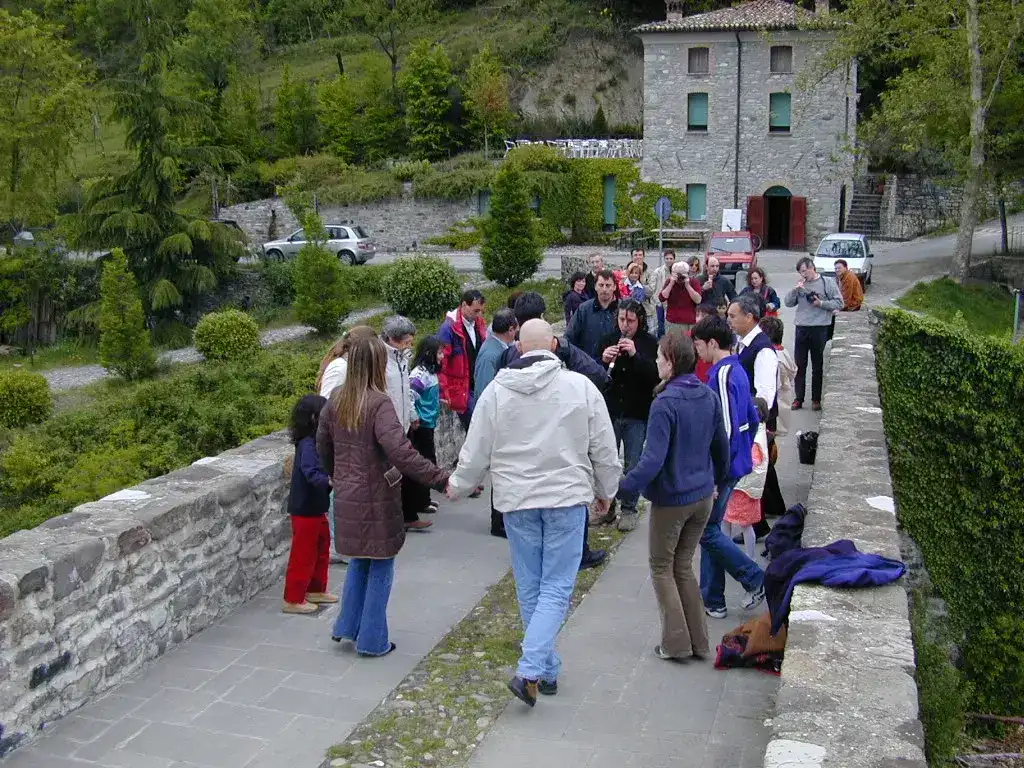
A closer look
Dances of the Four Provinces: at a glance
Le dances of the Four Provinces are a repertoire of dances spread over a homogeneous cultural area that includes the mountain areas of the provinces of Genoa, in Liguria (high Trebbia valley, high Scrivia valley, Aveto valley and Fontanabuona valley), Alessandria, in Piemonte (Val Borbera and Val Curone), Pavia, in Lombardy (Staffora valley) and Piacenza, in Emilia-Romagna (Trebbia valley, Boreca valley, upper Nure valley, Tidone valley and Luretta valley).
Characteristics
The particular geographical isolation of the high valleys has led to the fact that tradition has reached intact until today, both in the musical repertoire and in the...Explore this chapter
The particular geographical isolation of the high valleys has led to the fact that tradition has reached intact until today, both in the musical repertoire and in the choreutical one.
The melodies are performed by the piffer (popular oboe with double aunt), accompanied today by the accordion and until the 1930s by the müsa (apennine clomuse). Their presence is indispensable: there are no parties or other occasions where you dance with recorded music.
The coding of this repertoire is very recent and still in progress, being traditional dances on traditional melodies that were handed down orally and taught by the example of the most experienced or elderly. With the ease of communication and today's technical possibilities, there is an extension and dissemination of knowledge both of music and dances, even outside traditional areas, resulting in flattening of dances and style that once had peculiar characteristics, even substantial differences, depending on different countries or valleys and are now danced almost identical everywhere.
Although this repertoire was geographically restricted, it had a discrete diffusion in the context of traditional music and dances, both in Italy and in European countries, particularly in France.
The dances, all characterized by the "pass of the Four Provinces", can be divided into three groups: pair, circle and choreographic.
Couple dances
They're the most recent. Mutual from the smooth, include waltz, mazurca and polka . While waltz and mazurche are danced quite similar to the smooth, the poc, said to...Explore this chapter
They're the most recent. Mutuated by the smooth, include waltz, mazurca and polka dot. While waltz and mazurche are danced quite similar to the smooth, the poc, called to jumps, is performed in a particular manner with the typical "step of the Four Provinces".
Hoop dances
Moment of community union takes place in circles, in some cases with exchange of couples. They gave the opportunity, once, to get acquainted with other dancers...Explore this chapter
Moment of community union takes place in circles, in some cases with exchange of couples. They gave the opportunity, once, to get acquainted with other sex dancers. I understand. cry, thealessandrin, the Monferrina.
Choreographic dances
They're the oldest. They buy the giga, dancing in two versions: two-wheeled giga, dance that sees a knight bringing to the ball two ladies and the four-legged giga, with two...Explore this chapter
They're the oldest. I understand. giga, which is danced in two versions: giga to two, dance which sees a knight lead two ladies to the dance and the four giga, with two knights and four ladies. There is also the dance of poor woman performed by a man/woman couple and mainly to carnival, by two men of which one disguised as wife. Dances like the Sestrina they went lost while very rare is the perigordino and it seems to have been rebuilt biscuit, a dance lost in the 19th century.
Pass of the Four Provinces
This step, which exists with this structure only in this area, gives the characteristic movement to these dances. Composed of three supports, the first long and the other two shorts...Explore this chapter
This step, which exists with this structure only in this area, gives the characteristic movement to these dances. Composed of three supports, the first long and the other two shorts with rebound, obliges you to quickly detach your feet from the ground and gives the possibility to dancers to move, as often happens, on disageable soils such as selciati, meadows, streets, courtyards. The speed of music and the difficulty of the pitch require discreet athletic qualities and coordination, which make this repertoire very appreciated by good dancers and discreetly known also abroad, especially in France.
Ball parts
The choreographic and group dances are composed of small patterns that repeat themselves and compose the coreutical structure.Explore this chapter
The choreographic and group dances are composed of small patterns that repeat themselves and compose the coreutical structure.
- Walk: movement of dancers on the circle with the passage of the Four Provinces, made holding by hand is always eight steps, which can be all in the same direction or four of way and as many return.
- Ballet: you are performing as stops, in couple, in circle or online, it is always eight steps. The ballet is the moment when dancers can show their expertise, alternating different steps, building their own variants, dialogue with the partner.
Discography
Explore this chapter
- 1982: La Ciapa Rusa - Ten from chent the archet that the sunada is longa, Madau disks
- 1984: Baraban - Peas Musa, black wood pine..., Madau Dischi
- 1986: The Players of the Four Provinces -Traditional music of the Apennines, Robi Droli
- 1987: Baraban - The waltz of deserters, ACB
- 1988: The Players of the Four Provinces - Eiv' vustu u luvu?, Robi Droli
- 1989: AA.VV. - Popular songs and music from the Pavia Apennines. Ritual chants, dances, piff, ACB
- 1993: The Players of the Four Provinces - Colour stories, New Tone Records
- 1994: Stefano Valla and Franco Guglielmetti - Traditions of the oboe = Traditions du piffero, Silex mosaic
- 1995: Three Hammers - Omi and Paiz, Robi Droli
- 1999 The Players of the Four Provinces - Night at three zeros, Audiar Productions
- 2001: The Musettas - The vulp the vine, Folkclub-Ethnosuoni
- 2002: Stefano Faravelli and Franco Guglielmetti - Antiques: dances of the 4 provinces, Free space
- 2003: Enerbia - So far the blue, EDT
- 2004: Various Musicians - Tilion, Folkclub-Ethnosuoni
- 2001: Valla-Scurati - And before leaving, Buda Musique-Paris
- 2005: Valla-Scurati - Signs, Buda Musique-Paris
- 2007: Wild Music - ♪, ACB
- 2009: Enerbia - The Rose and the Purple, The ways of Sale
Continue your journey