A closer look
Four Provinces: at a glance
Le Four Provinces are an Italian historical-geographic region. The territory is located on the Ligurian Apennines, and divided between four provinces belonging to four different regions. Despite administrative fragmentation, the region has some common historical and cultural features.
In detail the region is included in the provinces of:
- Alessandria, in Piemonte (including Curone valley, Grue valley, Ossona valley, Borbera valley, Sisola valley, Spinti valley, middle Scrivia valley)
- Genoa, in Liguria (including high valley Scrivia, high valley Trebbia, high valley of Aveto, val Fontanabuona)
- Pavia, in Lombardy (including the Staffora valley, the Ardivestra valley, the Nizza valley, the upper Tidone valley, the upper Trebbia valley)
- Piacenza, in Emilia-Romagna (including high and medium valley Trebbia, Val Boreca, low valley of Aveto, average valley Tidone, val Luretta, high valley Nure).
The name Quattro Province has recent origins and is traced in some ethnological and musical studies carried out from the 1970s onwards. This name was coined and used to identify a territory, such as the one converging in the four aforementioned administrative districts, united by the same musical traditions, in particular instruments and traditional dances. Since the 2000s, the name has been extended to historical and geographical concepts that mark a precise cultural identity of the area in question[1]. However, the populations of these places have never attributed a particular or unique name to the area.[2]
Historically transit zone for traders, armies, pilgrims and travellers, there were ancient routes such as the via Postumia (traced by Aulus Postumius Albinus in 148 BC) which connected Genoa to Aquileia, the via Francigena, (which during the Middle Ages took pilgrims from France to Rome and from there to Jerusalem).
The socio-economic changes have totally changed the traditional ways of life. The inurbation and the consequent depopulation of the countryside, the difficulty of keeping alive customs no longer indispensable to the social life of small nuclei, the undeniable charm of new new that supplants a old man that brought with it memories and call back to a poor and difficult life, have greatly reduced the surface.
Tradition and territory
Geography · The inhabitants: abandonment, tourism, return · Political and administrative historyExplore this chapter
The cultural area of the "Four provinces" is a case of particular interest for those who, from a geographical point of view, want to reflect on Italian folk traditions. This area, in fact, after centuries of marginalization and decades of structural crisis, has been the subject of increasing interest for years precisely because of some specific aspects of traditional culture, essentially music and local collective events. The rediscovery and valorisation of elements of traditional culture in peripheral areas is not an element of novelty, since it has been a phenomenon spread for some decades throughout Europe and the subject of study in geographical area. The interest in this area was born from the fact that the rediscovery of traditional cultural heritage has not been realized as an isolated event, but rather as the departure of a process of reterritorialization which attempts to respond to the structural crisis that has invested the area since the second post-war period[3].
Geography
The northern Apennines area corresponding to the territory of the "Four provinces" was marked by a very articulated geological history that gave rise to a rather complex geomorphological landscape, marked by the presence of several dorsal ones that run transversal or longitudinal compared to the main direction of the mountain range. The present valleys are therefore a fundamental structure of communication between men, orienting their settlement choices. The core of the area is articulated around the valleys created by the streams Curone, Staffora, Tidone, the river Trebbia and their tributaries. Communications between these valleys focused on countries where access was relatively easy, which became nodal points in the system of relations of the Vallive communities. The most obvious example is Brallo di Pregola, which marks the step between the Staffora basin and Trebbia basin, but also Stone Gavina now peripheral center of the area, has built its past fortunes on communications between the Staffora Valley and the Tidone Valley. More indirectly, Varzi's very good fortune, the main center of the mountain area of Oltrepò pavese, was determined by the presence of a commercial route that through the passage of Juvà communicated the Po Valley with the Ligurian coast. The human settlement has been structured along these routes, thus allowing the mountain centers to support, despite the isolation caused by the particular geomorphological conformation, a continuous economic and cultural exchange with distant realities.[3].
From the economic point of view, the presence of these small commercial arteries allowed mountain centres to supply products such as salt, essential import of an otherwise self-sufficient economy. Culturally, the area is constituted as a fertile knot of relations between the coastal and Paduan cultural heritage, all within a specific system of relationships between man and the typical environment of the mountain area of the northern Apennines. Isolated from the strong areas of Italian economic and cultural space, the centers of the "four provinces" have been structured starting from those few and decisive ways of communication that connected territories and men far between them like the plain and the sea, thus elaborating an original cultural synthesis[3].
The inhabitants: abandonment, tourism, return
The equlibrium between isolation and communication that has allowed for centuries the survival of these mountain communities, however, has been inscribed with the advent of industrialization and the consequent economic, social and cultural transformation that has resulted in population losses also very intense and with them the disappearance of important patrimonies of popular culture (here as elsewhere on the Apennines). Since the 1930s, the entire area of Oltrepò pavese began to thrive in favour of the strongest areas of Lombard economic space. In this context, the mountainous area in question, which also began to lose population with a certain delay compared to the northernmost areas, was found in a particularly critical condition. The most worrying aspect was the constancy of depopulation with alarming rhythms, greater than 1% annually, in fifty years. Varzi, the polarizing centre of these mountains, also began to lose inhabitants from the second post-war period and continued until the 21st century, although with a slightly lower pace than the smaller mountain centres.[3].
The age pyramids of the four provinces are observed: the structure is strongly offset by birth rates close to zero and a number of elderly people near 60% of the total population. In this context the problem is not the loss of popular knowledge, but rather the risk that local culture does not find generations who keep it alive as a living and functional heritage. Attempts to exploit the territory through intensive tourism, especially sports, have had heavy cultural relapses: the alienation of the territory to groups of people culturally far from the area in question has resulted in the abandonment of traditional buildings in favor of new and standardized multi-family constructions and the loss of a cultural heritage that can obviously not be defended by those who to that culture is structurally foreign[3].
Political and administrative history
Many are the testimonies[4] of the presence of Ligurians since the age of stone (neolitic village in Travo, Trebbia piacentina valley) and in the Iron Age (castles, fortified village, of Guardamonte inAlessandrino)[5].
The presence of the Romans is well documented: many names, archaeological finds (returns of the city of Libarna in the Scrivia valley) and historical documentation (Traiana food tabula of the municipality of Velleia of the 2nd century AD). According to the historian Polibio, in December 218 BC, Hannibal inflicted a heavy defeat on the Roman consul Tito Sempronio Longo at the Battle of Trebbia. Some names of the Trebbia valley and the Boreca valley, such as Zerba seems to be traced from the passage of Hannibal troops.
Since the 4th century, under the increasing pressure of barbaric populations, a migration from the Ligurian coast and the plain to the mountainous areas occurred. New settlements were formed based on an agro-pastoral economy.
After the fall of the Lombards by Charlemagne, the Holy Roman Empire later reassigned the territory first forming the Brand Obertenga and then the imperial fiefs, with the aim of maintaining a safe passage towards the sea, in addition to the episcopal county of Bobbio, he assigned these territories starting from 1164, to families (at first descendants of the ancient Obertenghi) such as: i Malaspina, the Fieschi, the Doria, the Pallavicino, the Landi and the Farnese) who dominated these fiefdoms for centuries.
Napoleon abolished the feuds and the territory was divided between the Cisalpina Republic and the Ligurian Republic. In 1815 the Congress of Vienna ceded former imperial feuds to the Kingdom of Sardinia and in 1861 these territories were annexed to the Kingdom of Italy and divided into the provinces of Piacenza, Pavia, Alessandria and Genoa. The province of Pavia occupied a discreet territory of the Four provinces, having incorporated also the district of Bobbio until 1923, then ceded to the province of Piacenza. In 1970 the Regions entered into force under ordinary statutes of Emilia-Romagna, Lombardy, Piemonte and Liguria that bordered their borders on those provincial.
Culture
Among the common cultural elements of these valleys, the most famous is musical-coreutical. The way of singing choirs, influenced by the Genoese trallallero, the repertoire of piffer music and the Popular dances, precisely called some Four Provinces, are valuable testimonies of an ancient culture miraculously survived until today. These territories also include some popular festivals and calendar rituals such as calendimaggio, carnival and festivities of the patron saints.
Music
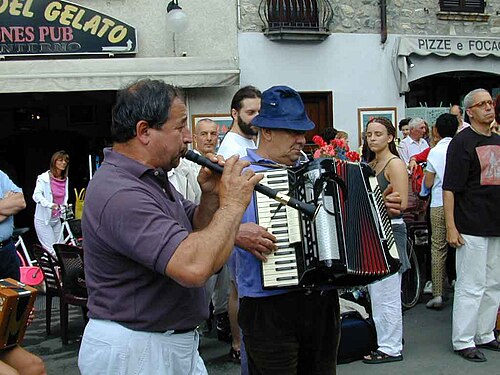
The couple of musicians who play piff and accordion animates all parties, never dance without live music. With the end of agricultural-Montanara civilization, they remained the bearers of tradition.
The musical repertoire is full-bodied, ancient, transmitted through the centuries. It includes, beyond the dance melodies, songs that mark the moments of peasant life: such as cantamaggio, la Galicia grisa, the May carlin, the Holy Cross; the carnival with the poor woman; leaving for the draft; marriage with Spouse (song to accompany the bride from her house to the church) and other "street" songs such as Sestrina to accompany the processions on various occasions.
The most famous pifferais remembered for the nineteenth and twentieth century were the "Draghino" of Suzzi, Lorenzo Bava "Piansereju" by Piancereto, Paolo Pelle "Brigiotto" by Bruggi, Carlo Agosti "Carlon" by Gregassi, Giacomo Sala "Jacmon" and Ernesto Sala di Cegni, Giovanni Agnelli "♪ Cana" by Costiere di Coli, Angelo Tagliani "Giolitti" by Colleri.[6]
The piffer- accordion pair bears the name or more often the nickname of its components. Some of the active ones today are:[7]
- Bani (Ettore Losini) and David (Balletti)
- Gabriele Dametti and Franco (Guglielmetti)
- Stefanino (Faravelli) and Matteo Burrone
- Danilo Carniglia and Cesare Campanini
- Stefano (Valla) and Daniele (Scurati)
- Massimo (Perelli) and Giampaolo (Tambussi)
Folk revival groups such as Baraban, La Ciapa Rusa, Tendachënt, Tre Martelli, the Musicians of the small village introduced piffer songs in their concerts.
Traditional instruments
The prince instrument is the piffer of the Four Provinces, a popular oboe generally in bosso or ebony, accompanied today by accordion and until the 1930s by müsa (typical bagpipe of this area). The fife is made up of three parts: the bocchetta which is the lip rest disc that carries the ances (mühts); the Cannabis which has seven front holes and one rear for fingering; the terminal pavilion (bell) which carries a rooster tail feather in a small hole which is used to clean the reeds.
The builders and adaptors of piffers are known in the territory of the Four Provinces since the nineteenth century, and include Ferdinando Cogo in Cantalupo Ligure, Giovanni Stombellini "♪" in Ozzola, Niccolò Bacigalupo "♪" (1863-1937) in Cicagna; semi-finished musical instruments and tools, including the pedal lathe, of the latter are preserved at the Ettore Guatelli Ethnographic Museum in Ozzano Taro (PR). Today the fifes continue to be built by Ettore Losini, known as Bani, from Degara di Bobbio and by Stefano Mantovani of Casanova Staffora.
Occasionally, the müsa is reintroduced alongside piffer and accordion in formations such as Müsetta, Epinfrai, Lampetron, Menconic Sounders, Enerbia, Ballatoio.
Traditional dances
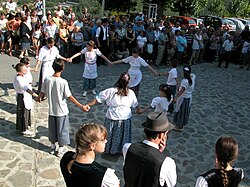
Dances that animate the parties belong to dances in closed couple, group dances with figures and pantomimic dances. Those most frequently practiced are the dances in closed pair, including waltz and mazurche the poc to jumps, performed with jumped pass typical of the Four Provinces, challenging both for the speed of rhythm and for the indispensable coordination between the two dancers. Group dances with figures present circular choreography as in the plain and often in the alessandrin and in the monferrine, or other choreographies to third parties, quartets or thirsty as in giga to two, giga to four, perigordino and presumably in the bisagna today in disuse. Pantomimic dance with theatrical valences is the poor woman, performed by couples who impersonate a woman and her husband who at one point remains on the ground as dead and then rise to the sound of a new musical strofa.
In northern Italy the ancient Korean traditions persist in a few areas besides the Four Provinces. These are the Occitan Valleys in Piemonte, the Val Resia in Friuli and the Apennines Bolognese in Emilia.
The holidays
Many are the occasions of celebration that bind communities, which, due to mountain depopulation, are very small and often recompose in summer with...Explore this chapter
Many are the occasions of celebration that bind communities, which, due to mountain depopulation, are very small and often recompose in the summer period with return for holidays in family homes. One finds himself to dance, eat typical dishes, listen to music, strengthen the links between those who remained and who left and who is not of the place but is willing to make a long way to meet and meet ancient characters and traditions.
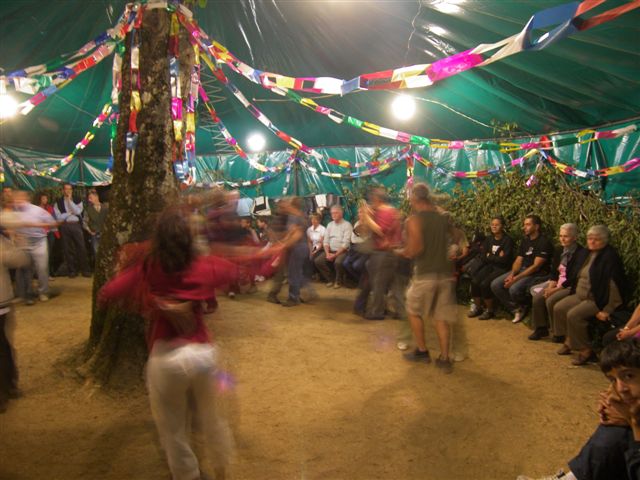
Many countries or even fractions build premises to gather and dance. Sometimes they are elegant structures, other times good-made constructions, with recovery materials; remarkable that of Pizzonero in the Boreca valley, built around a living tree with a roof of cloths and the walls of straws, so you dance around the trunk.
The most important holidays:
- The This is the case.: tour of the houses or pools of a group of canterini/musicians who, singing benaugurant stanzas, ask the hosts eggs (or wine or sweets or other type of food), which will be consumed by the company in the following biscuits. These are usually held for the first of May, but in some areas before Easter, on the friar or by the lever. They take a different name according to the countries: that of Marsaglia, in the municipality of Corte Brugnatella in Val Trebbia, is the carlin of May, that of Santo Stefano d'Aveto is the May, those of Cicogni and Romagnese la Galicia grisa (in Romagnese it takes place on Easter, Holy Saturday); while in the towns straddling the municipalities of Bobbio, Corte Brugnatella and Brallo di Pregola is celebrated on May 3rd and is called the Holy Cross.
- The Carnival: the most characteristic is that of Cegni in Val Staffora, with the history of Bad who wants to marry the poor woman. The array of music, dances and agnolotti also attracts spectators from abroad.
- The Curme of pines: annual gathering of all the pifferai and accordionists of local tradition. It takes place at the end of October in Cabella Ligure in the hamlet of Capanne di Cosola, on the ridge between the Boreca valley and the Borbera valley, heart of the Four Provinces. On this occasion, in addition to the musicians of the area, come those who play the piffer but live far away, and European musicians and dancers interested in repertoire and who find here the opportunity to have a roundup of all the protagonists and different styles.
Languages and dialects
From a linguistic point of view it is difficult to give an exact classification of the Gallo-italic language varieties still spoken today, together with Italian, in the area...Explore this chapter
From a linguistic point of view it is difficult to give an exact classification of the Gallo-italic language varieties still spoken, together with Italian, in the area of the Four Provinces[8]. In the territory in question, dialects of the Ligurian language and transition dialects between Ligurian, Emilian and Piedmontese intersect. On the other hand, among the provinces in question, only Genoa is at the center of the linguistic system of its administrative region. The province of Piacenza is characterized by Emilian varieties in contact with Lombard, which however, going up the Apennine valleys, are progressively influenced by Ligurian characters. The Emilian dialect then extends to the Oltrepò Pavese, where the continuity with the Piacenza dialect gives way to Piedmontese influences as one approaches the border with the province of Alessandria, whose easternmost portion – the Tortonese - is however still affected by the Emilian dialect continuum[9][10] until the river Scrivia[11]. In the Alessandria area, proceeding westwards there are gradual changes which slowly lead to an approach to the Piedmontese, while to the south we get closer to the Ligurian[11], similarly to what happens in province of Pavia and in the Piacentino.
Discography
Explore this chapter
- 1976: Ernesto Sala. The "piffer of Cegni", edited by Bruno Pianta, Regione Lombardia, Documents of Popular Culture 6, Albatros
- 1984: Baraban - Muse of leather, pinfio of black wood..., Madau
- 1986: The Players of the Four Provinces - Traditional music of the Apennines, Robi Droli
- 1987: Baraban - The waltz of deserters, ACB
- 1988: The Players of the Four Provinces - Eiv' vustu u luvu?, Robi Droli
- 1989: Popular songs and music of the Apennines Pavese. Ritual chants, dances, piff, edited by Aurelio Citelli and Giuliano Grasso, ACB
- 1990: Baraban - Naquane, ACB
- 1993: The players of the four provinces - Colour stories, New Tone Records
- 1994: Stefano Valla and Franco Guglielmetti - Traditions of the oboe = Traditions du piffero, Silex mosaic
- 1994: Baraban - Live, ACB
- 1999: Marco Domenichetti - For holiday trails, Felmay
- 1999: The players of the four provinces - Night at three zeros, Audiar Productions
- 2000: Eva Tagliani. The voice of the masked, edited by Aurelio Citelli and Giuliano Grasso, ACB
- 2001: The Musettas - The vulp the vine, Folkclub-Ethnosuoni
- 2002: Stefano Faravelli and Franco Guglielmetti - Antiques: dance of the 4 Provinces, Free space
- 2003: Enerbia - So far the blue, EDT
- 2004: Various Musicians - Tilion, Folkclub-Ethnosuoni
- 2006: Various Musicians - The musical traditions of the Four Provinces, SUPERP
- 2007: Wild Music - ♪, ACB
- 2009: Enerbia - The Rose and the Purple, The ways of Sale
- 2012: Various musicians: Martéla la Paja, Folkclub-Ethnosuoni
Notes
Explore this chapter
- ^ AA.VV., The "four provinces" area, in Italian reflections - the identity of a country through the representation of its territory, Piero Bonavero (coordinator), Sergio Conti, 2004, p. 4, ISBN 9788836531295. Retrieved 1 March 2022.
- ^ The names of the Four Provinces, up appennino4p.it, Where the Apennines begin. Retrieved 30 September 2014.
- ^ to b c d And Valerio Bini, Traditional culture and local design in the area of "four provinces", in Giorgio Botta (ed.), Traditions and modernity. Know that we belong to, Turin, Giappichelli, 2007, pp. 10-14.
- ^ Where the Apennine begins. The past, up appennino4p.it.
- ^ Municipality of Gremiasco, up common.gremiasco.al.it. Retrieved 27 February 2017 (archived fromoriginal url on 28 February 2017).
- ^ Popular songs and music of the Apennines: ritual chants, dances, piff, edited by Aurelio Citelli - Giuliano Grasso, booklet attached to MC/CD, Baraban cultural association, Gaggiano 1987. Claudio Gnoli - Fabio Paveto, U messié Draghin: research on the great pipers of the nineteenth century, in Paolo Ferrari et al., Who is born a mule must kick: journey into the traditional culture of the Four Provinces, 2nd ed., Musa, Cosola 2007.
- ^ Sounders of the four provinces, up danielapossenti.it.
- ^ Daniele Vitali, Dialetti of the Four provinces, up appennino4p.it, Where the Apennines begin. Retrieved 11 May 2014.
- ^ Bernardino Biondelli, Essay on the Gallo-italic dialects, up archive.org. Retrieved 11 May 2014.
- ^ Fabio Foresti, Italian Language Profile of Emilia-Romagna, Publisher Laterza, Bari, 2010, p. 120
- ^ to b Giacomo Devoto, Gabriella Giacomelli, The dialects of the regions of Italy, up archive.org, Sansoni University. Retrieved 11 May 2014.
Bibliography
Explore this chapter
- Aldo Ambrogio, Pleasant rustic dances - The axe. January 15—1928
- Carmen Artocchini, Folklore piacentino: traditions, life and popular arts— Typographic Union of Appeal publishers, Piacenza 1971
- Edward Neill, Popular Ligurian music - (La gazzetta del monday. 10 January-29 May 1972) -- 1972
- "Baraban"; Aurelio Citelli, Giuliano Grasso, Placida Staro, Leather muse, black wood pine... -- Madau 1984
- Italo Sordi, The Tree of Song, -- FormIcona Editrice, Pavia 1985
- Aurelio Citelli, Giuliano Grasso, The tradition of the pavese mountain piff - (Pavia and its territory / "Lombardy Region" ; Roberto Leydi, Bruno Pianta, A Stella: cura) -- Silvana, Milan 1989
- Ferdinando Scianna, Ernesto Sala, 1907-1989 - Pavia and its territory / Leydi, Pianta, Stella: care. p 381-390—Silvana, Milan 1989
- Roberto Leydi, Bruno Pianta, A Stella, Pavia and its territory / - Mondo popolare in Lombardia. 14—Silvana, Milano 1990
- Fabrizio Capecchi; Claudio Turrini, An island among the mountains: the high valleys of the Oltrepò between the Trebbia and the Scrivia—Croma, 1990
- Maria Bernabò Brea, The Valtrebbia from Paleolithic to the Iron Age— Cultural research group La Minerva: Travo 1991
- Aurelio Citelli, Mario Brignoli: a piffo singer - (Aes, n. 2, p 88-89) -- Diakronia, Vigevano 1993
- In ancient ways of saints and pilgrims—Bobiens historical archives, Centre for valley studies 1994
- Fiorenzo Debattisti, A journey through time—Walkboard, Varzi 2000
- Phoeo Guizzi, The instruments of popular music in Italy --- LIM, Lucca 2002
- Selvaggia val Boreca: history and nature of a border along 4 regions [video VHS] / Andrea Agogliati: conception, comments; Mauro Germano, Nando Bellani: filming, assembly - (History and nature of the high valleys of Piacenza) -- ASC: Salsominore, 2002
- Carmen Artocchini, The wheel of time - Popular traditions of Piacenza, vol. 1 -- Tep Edizioni d'Arte, Piacenza 2002
- Carmen Artocchini, Fantasia and wisdom - Popular traditions of Piacenza, vol. 2 -- Tep Edizioni d'Arte, Piacenza 2002
- Carmen Artocchini, The hours of joy - Popular traditions of Piacenza, vol. 3 -- Tep Edizioni d'Arte, Piacenza 2002
- Mauro Balma, Claude Bonnafous, Paolo Ferrari, Luciano Messori, Agostino Zanocco, James Jacmon Room—Note, Udine 2004
- Fabio Milana, Maddalena Scagnelli, Alessandra Cocchi, Cristina Ghirardini, Paolo Ferrari, The musical traditions of the Four Provinces—Soprip, Piacenza 2005
- Valerio Bini, Traditional culture and local design in the area of "four provinces", in Traditions and modernity. Know that we belong to, edited by Giorgio Botta, Turin, Giappichelli, 2007
- Paolo Ferrari, Claudio Gnoli, Zulema Negro, Fabio Paveto, Who's born mule must kick - Journey into the traditional culture of the Four Provinces—Ass. Muse 2008
- "Wonderful Oltrepò Pavese" - Guide to the beauties of Oltrepò Pavese by Giovanni Portinari - Primula Editore
- "Beyond the Paths - Oltrepò Pavese" on foot by mountain bike and horse - by Giovanni Portinari - Primula Editore
- Patrizia Ferlini, Le Quattro Province a tavola - Stories of culinary traditions - Voghera, 2023
Continue your journey