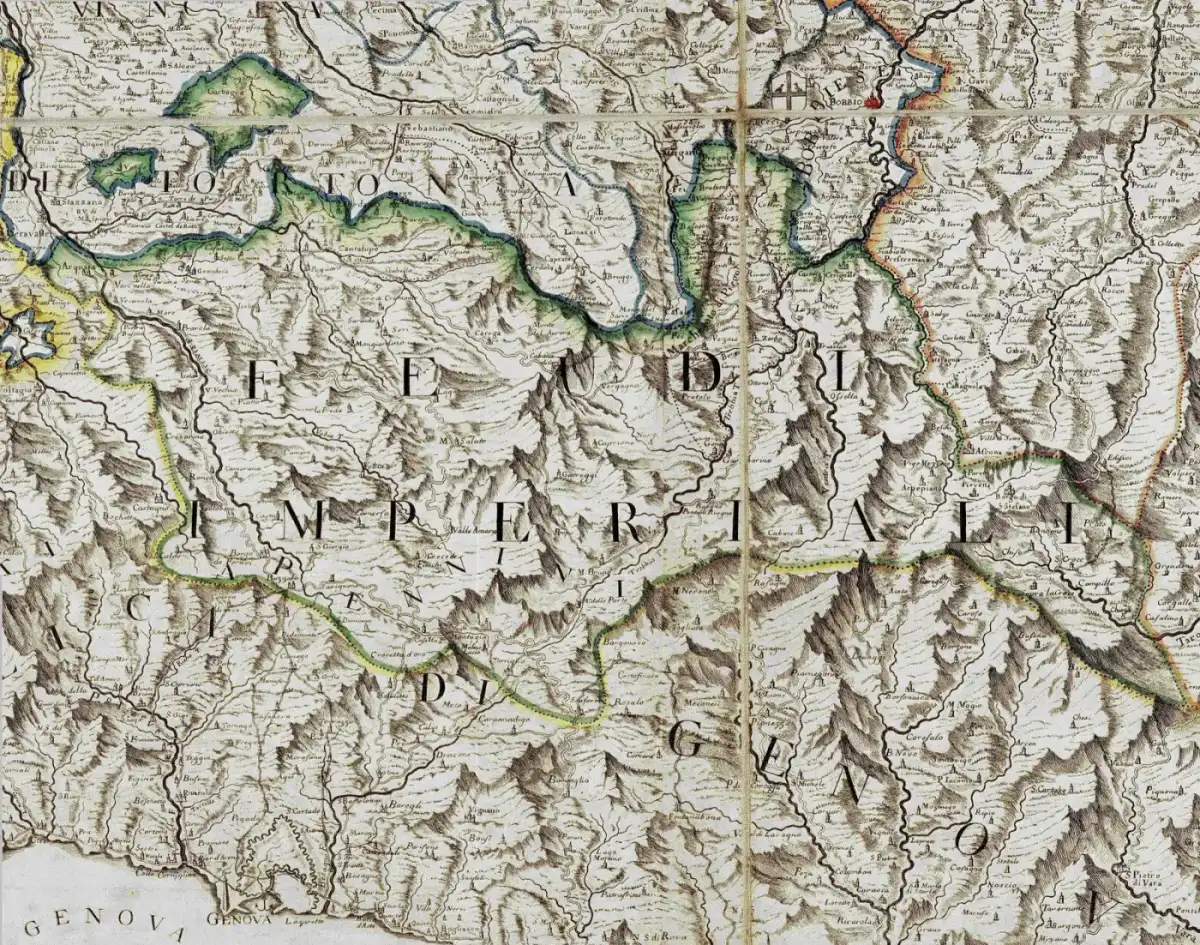
A closer look
Imperial fiefdoms: at a glance
With the term imperial fiefs were conventionally indicated all the individual territories subject - until the Napoleonic invasion - to the Holy Roman Empire. The fiefs that were part of the empire could only be dependent on the emperor (immediate or sovereign faiths), or subjected to the sovereignty of a prince or lord, an intermediary vasal of the Emperor (mediated faiths).
The immediate fiefs were in fact the sovereign states that constituted the imperial confederation. They were called "Emperial States" (Reichsstände, Unmittelstände), about three hundred and participated with their voting rights in the work of the Reichstag, distributed in 10 imperial circles and distinguished in electorates, principalities, counties, lords, imperial cities. To these were added a number of factual sovereignty that did not belong to the circles of the empire: the equestrian fiefs of the Knights of the Holy Roman Empire and the Italian and French fiefs, these last exclaves in Alsatian territory as mediated Feudi subjected to the protectorate of Paris.[1]
In the strict sense, in Italy, the term is used to historically define a series of tiny states, residues of ancient feudal lordships scattered along the borders of Liguria, Piemonte Lombardy, Emilia and Tuscany have full sovereignty (immediately, that is, subject only to the authority of the emperor or mediates, i.e. with a certain autonomy but subjected to the protectorate or authorities of closer states more powerful). In the 1559 the fiefs were subjected to the feudal jurisdiction of the Aulic Council in Vienna. In Italy the major imperial feuds (called "Latin faiths") were the Duchy of Milan, the Republic of Genoa, the Duct of Savoy, the Grand Dukedom of Tuscany, the duchy of Parma, and the Duty of Mantua. The Habsburgs of Austria, which ruled the Empire, and their cadet branches were settled in various feuds (Milan, Tuscany, Mantua, Parma, Modena) when local dynasties became extinct, especially during the 18th century succession wars.
Origin
The kingdom of Carolingian Italy had laid the foundations of German feudalism, also in the Italian peninsula and especially in the northern regions, while the...Explore this chapter
The Kingdom of Italy Carolingian had laid the foundations of German feudalism, also in the Italian peninsula and especially in the northern regions, while the papal authority, after the fall of the Hohenstaufen, managed to stray southern Italy and much of the pontifical territories that from the Marche reached Romagna. The imperial authority was later weakened by the advent of the Common Freemen, first, and then the lords. However, many Italian states continued to maintain a vasalization relationship with the empire, from which the Republic of Venice, the Papal States and kingdoms of Naples, Sicily and Sardinia were excluded. Vast imperial feuds, formally dependent on the Emperor, were infeuded to many Italian families (Adorno, Spinola, Doria, Fieschi, Medici, Malaspina, etc.) and were preserved until the Napoleonic feudal abolitions of July 1797.[2]
Location
The whole northern Italy north of the Papal State, except for the Republic of Venice, was part of the Holy Roman Empire, and the various lords who in the Middle Ages...Explore this chapter
All northern Italy to the north of the Papal State, except for the Republic of Venice, was part of the Holy Roman Empire, and the various lords who in the Middle Ages divided the territory exercised the power, at least formally, by delegation and investiture of the emperor, as his feudal lords. The same instrument of imperial investment, every time a reigning ruler was succeeded, was used to legalize the city lords and subsequent Renaissance principalities, thus marking the formal and direct bond with the emperor.[3]
Even the major Italian states, nominally divided into the Empire, until the 18th century were conventionally imperial fiefs or aggregates of them. They were subject to the jurisdiction of Reichshofrat, the Supreme Court of the Empire, with a specific Italian section, but they had no seat or vote in the imperial Diet with the exception of the Duchy of Savoy which from the second half of the 17th century was effectively no longer exercised by the Savoys, to underline their autonomy from the empire. Of these, six major ones were called "Latin fiefdoms" (Latin Feuda):
- the Grand Duchy of Tuscany, re-established in the imperial compagine from 1530, and then again from 1737 to 1766 when he returned to be autonomous with the second-generation of Lorraine,
- the fiefs that formed the State of Milan (the duchy of Milan, the principality of Pavia, the count of Cremona, etc.),
- the Savoy State (the Duchy of Savoy, the Duchy of Aosta, the Lordship of Piemonte, the farmer Asti etc.),
- the Duchy of Mantova,
- the Republic of Genoa, restored in 1530
- the Duchy of Parma and Piacenza, of papal origin, created for the Farnese, but since 1545, claimed in its status under the aegis of the Empire.
Among the other fiefs of the Middle Empire are remembered Monferrato, the duchies of Modena and Reggio, those of Massa, Sabbioneta, Bozzolo, the aforementioned Parma states (in addition to the duchies of Parma and Piacenza, the Pallavicino state, the Landi state, the marquisate of Zibello, the marquisate of Soragna, etc.) up to the small Po Valley principalities (the duchy of Guastalla, the principality of Correggio, etc.), all gradually absorbed by the larger states.[4]
There was then, a series of about 200-250 small fiefs, the so-called "Learnings" (Lesser Feuda), especially on the Ligurian mountains and the hills of the Lower Piemonte up to the Tuscan-Emilian Apennines; they consisted of a group of ancient fiefdoms, born from the disintegration of the historic marquisates of the Aleramici and the Obertenghi, which, also thanks to their isolated geographical position, managed to survive longer, well beyond the end of the Middle Ages (the typical period of these institutions), at least as long as the imperial power nominally lasted. For these states, investiture was much more than a formal matter, since only imperial protection could guarantee autonomy to such weak political entities. They were in the hands of around 50-70 noble families (Gonzaga, Del Carretto, Malaspina, Scarampi, Pico, Pallavicino, Spinola, Doria, Fieschi, Adorno, Brignole, etc.).
When the various Renaissance principalities were formed, many of them in modern times were absorbed, but others, placed under the direct protection of the Habsburgs, who held the imperial crown, and sometimes of Spain and then of Austria dominating Italy, managed to survive and even know a kind of revival in the eighteenth century, when the Austrian imperial house had direct dominion over Milan and, through its vassals of imperial fiefs, could have a wider control of the Apennines and Padana area.[5]
The 18th century situation
Since the last decade of the 17th century, the court in Vienna had implemented a policy of relaunching imperial power in Italy. The reasons were dictated by a program...Explore this chapter
Since the last decade of the 17th century, the court in Vienna had implemented a policy of relaunching imperial power in Italy. The reasons were dictated by an Habsburg programme of political, strategic and not least economic: the Lombard regions, Piedmontese, Tuscan were among the richest in the entire imperial territory and economically well prepared and for this to be appetable to the rulers. From many French chroniclers of the time in fact Italy was called "The Indies of the Empire".
In some areas the figure of imperial vicars, at least formally, had never failed. In Tuscany, after the conquests of Florence in the fourteenth century, the office of the vicar was transferred from the seat of San Miniato to the German (in memory of this function) to the Marquises Malaspina di Fosdinovo who took over the hereditary charge until the end of Ancien Régime.[6]
Emperor Leopold I of Habsburg thus pursued a policy to recover Italian lands in order to counter politically and economically French aggressive expansionism of those years and many local misters, also following the express imperial edict, rushed to be recognized their own possessions as fiefs of the empire, for greater political protection and independence towards neighbouring major states. As a result, the diplomatic tensions between Vienna and the Holy See were again sharpened for the disputed feudal legal nature of certain fiefs such as those of Comacchio, Carpegna or Apecchio in Montefeltro, which were actually integrated into the Church's states.[7]
The surviving imperial fiefs in Italy can thus be divided according to two categories:
- the sovereign fiefs that enjoyed political autonomy and had a direct formal relationship with the emperor (immediate faiths), with the connotation of real sovereign states;
- the fiefs, placed under the protectorate of other states, semi-sovrani (in relation to accomandigia) and the mediated fiefs that were or subject to the direct power of a ruler whose vassals were (intermediary principle between the feudal lord and the emperor) or had limited political autonomy.
The duchies of Savoy and Aosta were part of the first group, whose rulers, the Dukes of Savoy, then king of Sardinia from 1713, continued to be formally vassals of the empire with right to seat and vote at the Imperial Diet of Regensburg. Despite, on several occasions, the dukes had received many imperial fiefs from the emperor (Monferrato, Novara, Vigevanasco, la Lomellina, Voghera, the Langhe and Tortona), from the end of the 17th century they no longer recognized the relationship of submission to the empire, failing to send their deputies to the imperial Diet, nor paying the matriculation tax to the imperial treasury. This affirmation of its autonomy and sovereignty was repeatedly and decisively supported since 1738 with a series of legislative-administrative provisions and decrees aimed at guaranteeing royal power against the more or less hidden resistance on the part of the Milanese senate to whose jurisdiction and taxation until then the Langhe fiefdoms had been subjected before their transfer to the Savoys.[8] However, an exception in the Savoy House with the Empire was the crisis (1730-1731) between Vittorio Amedeo II and Charles Emmanuel III during which the first sent a request for arbitration to the emperor as superior ruler.
The case was then Tuscany and the same state of Milan (Milano, Pavia, Cremona, Mantova, Sabbioneta, Bozzolo, etc.). These states, in fact, besides being imperial fiefs, were also in personal union with the emperor (good allodials of the imperial house of Habsburg) and with Austria and, as such, governed by direct representatives of the ruler (general governors for Milan and presidents of the Regency Council for Tuscany from 1737 to 1765). The Milanese state with its dependencies had gone considerably reducing in the territorial extension with the cessions to the Savoy of the vast provinces west of Ticino and with the annexation to the Republic of Venice of Bergamo, Brescia and the exclave of Crema in the sixteenth century. [9]
The duchy of Mantua had been summoned to the emperor after the last sovereign duke of the line of Gonzaga-Nevers, Ferdinando Carlo Gonzaga, had been stripped of it for fellonia, because he had let the French troops into Mantua for fear that the latter operated aggressive twists against the mantovana population and confiscation of the French feuds that the Duke of Mantua possessed. With its annexation, the Austrian encirclement had completed with regard to the Republic of Venice, in secular antagonism for the predominance of the region. The court of Vienna was determined to maintain strong presence in northern Italy: from the last decade of the seventeenth century the small principality of Castiglione delle Stiviere had been occupied by imperial troops, despite the useless protests of the deceased lords of the Gonzaga cadet line, who will renounce their rights and demanded only in 1773.[10]
A separate case was, moreover, the Republic of Genoa that, while gravitating in the French orbit, was still linked by a formal feudal relationship with the empire, both for the Genoese state and for the Marquisate of Finale, acquired in 1713, confirmed in 1748 and independently administered by the rest of the republic.
The Duchy of Massa and Carrara, following the marriage of the last duchess with the Crown Prince of Modena, was indissolubly tied politically and economically to this dukedom which, in turn, closely allied to imperial and Austrian politics, thus saw the secular dream of having an outlet on the Tyrrhenian Sea with the port of Avenza.
The Republic of Lucca, an oligarchic republic, continued to live on the few proceeds that were now residual from ancient commercial wealth and, if it still retained its independence towards Tuscany, was thanks to its status of imperial fief from time immemorial (XII century), in contrast with Tuscany, until then philpagnola, then became an imperial fief.[11]
Finally, Tuscany: the Grand Duchy, with the extinction of the Medici dynasty, returned in 1737 to be a direct fief of the empire and good allodial of Emperor Charles VI of Habsburg, to compensate for the loss of the Duchy of Lorraine, when his daughter Maria Teresa of Habsburg had joined in marriage with the last Duke Francis Stephen of Lorraine. Tuscany, however, will not have its own real ruler until 1765, having been elected the Grand Duke, Francesco Stefano, Emperor of the Holy Roman Empire (1745), until he governs his son, an actual Grand Duke, Pietro Leopoldo who, freed from the heavy ingestion of his mother Maria Teresa and the directives of the imperial court, will free Tuscany from the formally feudal relationship with the empire.[12]
In the 16th century, with the distribution of the inheritance of Emperor Charles V, all southern Italy, with the Kingdom of Naples in the head (formally fief vassal of the Pope), had ceased its relationship of subditance with the empire, falling into the sphere of the Habsburgs of Spain and then the Bourbons of Spain.[13]
Alongside historically documentable feuds as imperial, arbitrary ingestion and doubtful legitimacy occurred: it was the case of the Duchy of Parma and Piacenza, whose constitution was of clear papal origin, having been created specifically for Farnese by Paul III for his son Pier Luigi.[14]
They belong to the second group a multitude of minor states that, in their relative independence, were politically linked, even in the form of protectorate, to the most powerful States and survived for a few decades thanks to the protection of the emperor. The numerous marquisates of the Malaspina, the last remnant of the great territorial heritage of this ancient family which extended across the entire Apennine range, from the Apuan Alps to the Piedmontese Langhe. Among these we remember, among others, the Lunigiana marquisates of Fosdinovo, whose sovereigns continued to hold the title of imperial vicars in Italy, and those of Mulazzo, which in the late Middle Ages were characterized by the patronage of its lords, hosting artists and poets such as the exile Dante Alighieri, and of Tresana then purchased by the Corsini princes of Florence. For the others, survival was linked to the political ties they had with Tuscany, Modena or Genoa. In the Genoese area, two types of fiefdoms had been established over the centuries: those so-called "of the Republic", i.e. acquired in the medieval era, for which following specific conventions they continued to be governed by the heirs of the ancient feudal lords and for which the Superb he tried to acquire greater ownership shares in order to eliminate the uncomfortable presence of these local lords, and the imperial fiefs, that is, purchased, even at the cost of heavy exorcisms, from the Viennese court, taking advantage of its constant financial needs, which depended on the direct domination of the Republic, by virtue of the imperial investigation, which administered them with real state officials, directly collecting their own profits from their own lordship.[15] This policy, beginning in the sixteenth century, was partly followed by other Italian regional states, such as the Republic of Venice, the Duchy of Milan and the Grand Duchy of Tuscany, which, however, unlike Genoa, often preferred to make new infeudations to families close to the State and its rulers.[16]
Another group of states that still held the qualification of imperial feuds was then constituted by the county of Vernio, purchased by the Bardi Counts, and by the marquisates of Monte Santa Maria, Sorbello and Petrella belonging to the three sovereign lines of the Bourbon del Monte.[17] Particularly important political importance took the two counties of Carpegna, because of their strategic position: placed in Montefeltro at the borders of Tuscany and the Papal States, in the mid-nineteenth century the county of Carpegna had passed to the Gabrielli and the Principality of Scavolino to the Orsini de' Cavalieri, families heirs by female way of the two branches, just extinct empire in the male line, of the Counts of Carpessa This situation legitimized the emperor to contest his heirs without his prior consent of acceptance and recognition to succession and its military intervention resulting in occupation as Emperor and Grand Duke (because of precise agreement, the Florentine republic heir de jure in case of extinction of the Carpegna House) with the logical disputes of the court of Rome and the Bourbons of Parma.[18] Analogues attriti were among the Empire and the Papacy also for the county of Apecchio in Montefeltro, already under the Florentine accomandigia (1513) and vassal of the dukes of Montefeltro, whose Popes were heirs. The question was further transposed between imperial Tuscany and Roman Curia, when with the disappearance of the last Earl, Frederick II Ubaldini, the fief was militarily annexed by papal troops (1752).
Among the other non-complete states are: the county of Desana (sold by Tizzoni to Savoy in 1693), the Principality of Castiglione delle Stiviere, occupied by Austria from the end of the 17th century, despite the local sovereign line of Gonzaga claimed its rights until their definitive cession in 1773, the principality of Soragna, in fact under the protectorate of du marches of Parma and Piacenza Montemarzino ceded by the Spinola of Los Balbases to Savoy in 1753, those of Oramala, Piumesana, Valverde and Santa Margherita dei Malaspina, the county of Bobbio, Voghera and Val Tidone of the dal Verme (the so-called "separate jurisdictions"), the lordships of Cecima and San Ponzo, of Bagnaria, the various marquisates of the Spinola, all under the protectorate with more or less broad autonomy granted by the Savoy, the imperial lordships of Balestrino of the marquises of Carretto under the Genoese protectorate and of Maccagno Inferiore of the Borromeo counts under the patronage Austrian.[19]
Imperial Feudi in Italy
Piemonte · Lombardy · Emilia - RomagnaExplore this chapter
Piemonte
Many imperial fiefs of Piedmont and the mountains were suppressed in 1736 by the preliminary pacts to the Treaty of Vienna and ceded to the Savoy (Tortona, Voghera, Castelnuovo Bormida, Castelnuovo Scrivia, Capriata d'Orba, Francavilla Bisio, Montaldeo, Mornese, Arquata Scrivia, Canton Island, Tassarolo County, Ronco Scrivia up to the Po and, towards the west, Carcare, Millesimo, marquisate of Spigno and Ceva).
A position of partial autonomy continued to enjoy the so-called "separate jurisdictions of the Oltrepò", which became part of the Saharan provinces of Voghera and Bobbio in 1748; they were formed by the county of Bobbio of the accounts from Verme, and from several malaspinian marquisates:
- Marquisate of Fortunago, Gravanago, Montepicco, Sant'Eusebio, Stefanago, Staghiglione: ai marchesi Malaspina 1540-1797;
- lordship of Montesegale and Castignoli: in Gerolamo Gambarana 1753-97;
- Marquisate of Oramala in Val di Staffora: in condominio dei Malaspina;
- Marquisate of Godiasco, Pianocozzo, Trebbiano: in condominium to the marquises Malaspina of Oramala, Valverde and Sant'Albano, of Piumesana, accounts of Adda, Ghislieri;
- Marquisate of Varzi and Cella: to the marquises Malaspina, from the fifteenth century accounts Sforza of Santa Fiora (poi duchi Sforza-Cesarini-Savelli);
- Marquisate of Sagliano: to the marquises Malaspina;
- Marquisate of Valverde and Sant'Albano: to the marquises Malaspina;
- Marquisate of Santa Margherita di Staffora, Sala, Menconico: to the marquises Malaspina;
- marquisate of Casasco: to Malaspina
- Marquisate of Prato and Campi: to the marquises Malaspina;
- Marquisate of Orezzoli and Volpedo: to the Marquises Malaspina;
- marquisate of Fabbrica Curone: to the Marquises Malaspina;
- Marquisate of Bosmenso and Monteforte: to the marquises Malaspina;
- Marquisate of Piumesana: to the marquises Malaspina
- marquisate of Montemarzino: to the Marquises Spinola of Los Balbases, who in 1753 gave it to the Savoy.
Autonomous, but not independent, was the lordship of Bagnaria, belonging to the Doria Landi, Marquis of Torriglia and princes of Melfi, while that of Cecima and San Ponzo belonged formally to the bishops of Tortona, who also possessed the lordship of Stazzano. However, the fiefdom was in the hands of the Sforza Cesarini Savelli princes, counts of Santa Fiora in Tuscany.
In the Piemonte south-eastern (current provinces of Savona, Cuneo and Alessandria), the last imperial fiefdoms were absorbed by the Savoy kingdom and often granted back to local noble families:
- Albaretto County (1613): to the Marquis of Bossolasco
- Marquisate of Altare: ai Millo (1701)
- marquisate of Altavilla Monferrato (1635): at the Masucci Canals
- marquisate of Belforte Monferrato: the Cattaneo
- marquisate of Belveglio: to the Savoy
- Brandy of Bossolasco: Valperga di Masino, Sangiorgio, del Carretto di Balestrino, Trotti
- Marquisate of the Carretto: del Carretto
- Marquisate of Cengio: ai del Carretto
- Marquisate of Ceva: at Pallavicino delle Frabose
- Marquisate of Garessio: to the principles from the Pozzo della Cisterna
- Marquisate of Giusvalla, Devo: ai Sanmartino d'Agliè
- Marquisate of Gorzegno (1735): ai del Carretto
- marquisate of Grana Monferrato: at the Carretto, then Duke of Aremberg (1744)
- Marquisate of Incisa: ai d'Incisa
- Marquisate of Malvicino: to the Invrea (1670)
- Marquisate of Millesimo and Cosseria: ai del Carretto
- Marquisate of Mioglia: to the Scarnafigi
- marquisate of Mombaldone: to the Carretto
- marquisate of Mombaruzzo: to the Imperial Lercaries
- Marquisate of Pontinvrea: ai Lercari (1730)
- Marquisate of Roccavignale: to the Duke of Arenamberg (1744)
- marquisate of Rocchetta Tanaro: the Incisa della Rocchetta (1535)
- Marquisate of Spigno and Malvicino (1724): to the Novarina family of S. Sebastiano
- marquisate of Tagliolo Monferrato: to the Pinelli-Gentile
- marquisate of Vinchio: to the Scaramp Crivelli
- Marquisate of Sannazzaro and Giaule: ai Malaspina
- county Vignale Monferrato (1536): to the Callori Provana Balliani
- county Mombercelli: to the Asinari
- County Arona, Baveno: to the Visconti
- county Arquata Scrivia: to the Marquises Spinola of Luccoli
- marquisates of Avolasca (1773) e Montegioco: at the Bussetti (1647-1768)
- Marquisate of Balestrino, Bossolasco, Serravalle Scrivia: to the Carretto
- marquisate of Belveglio And Mombercelli: to the Arborio di Gattinara, Patigno
- Marquisate of Brignano and Frascata: ai de Ferraris
- marquisate of Capriata d'Orba: to the dukes Grillo di Mondragone
- marquisate of Castelnuovo Scrivia: de Marini (-1778)
- Marquisates of Cirié and Maro: at the Doria
- Marquisate of Cengio: ai del Carretto
- marquisati di Devo, Pianezza: ai Imperiali (1725)
- Factory marquisate in Val Trebbia: to the principles Doria
- marquisate of Fabbrica Curone: to Malaspina
- Marquisate of the Frabose (Soprana and Sottana): ai Pallavicino (-1816)
- marquisate of Francavilla Bisio: to the dukes Grillo di Mondragone
- marquisate of Lerma: to the dukes Grillo
- Marquisate of Monforte: ai del Carretto
- marquisate of Montaldeo (1531): to the Doria family
- marquisate of Montaldo Bormida: to the Spinola Pallavicini
- marquisate of Morsasco (1599): to the Centurione Scotto
- Marquisate of Ormea (1722): to the principles of Este of S. Martin - 1752)
- Marquisate of Palazzolo (and Borgoforte): ai Gonzaga (-1751)
- marquisate of Ponzone
- Marquisate of Rezzo: at the Grimaldi
- marquisate of Rocca Grimalda: alGrimaldi Granada
- Marquisate of San Cristoforo: ai Doria
- marquisate of Silvano d'Orba: to the principles Botta Adorno
- marquisato di Zuccarello (1738): ai del Carretto
- Bosco County (1597, Marengo): at the Dukes Bonelli di Salci
- county Castelletto d'Orba, Caprarica: Botta Adorno to the princes
- county Tassarolo and Pietrabissara (1734): at the Spinola
- County Voghera: to the principles from the Pozzo della Cisterna
Other fiefs annexed were the Marquisate of Dolceacqua (1653), the County of Loano (1770) of the Doria Landi, Fabbrica Curone (1788) and the lordship of Seborga (1729).
Lombardy
Some imperial feuds survived under the Austrian domination, being reconfirmed with their privileges and autonomy, while others were suppressed and annexed to the Milanese state (Castiglione delle Stiviere, Solferino, Medole, Sabbioneta, Bozzolo, Gonzaga and Mantua):
- Lower Maccagno County (the imperial) at the Mandelli accounts (from 1536, as a fief, which they had already since 962, but not documented; then as county from 1613, under the title of S. R. I. from 1621, Vicariate of the S. R. I. with the right of gold, silver and copper mint, from 1622, and jurisdiction on part of Lake Maggiore, from 1659) from which it was sold to Count Carlo Borromeo Arese in 1692, which will be invested in 1718
- lordship of Castellaro: possession of the principles-vescovi of Trento from 1082 and confirmed until 1797
- Brandy of Gazzuolo, Dosolo and Pomponesco: granted until 1778 to the Ippoliti of Gazzuolo
- Marquisate of Gazoldo degli Ippoliti: confirmed from 1354 to Ippoliti
- lordship of San Martino Gusnago and Soave: granted in 1709 to the Giannini accounts until 1776
- lordship of Limonta with Campione and Civenna: to the abbots of Sant'Ambrogio in Milan from 835, with faculty to expose the banner with the imperial eagle (from 1697) until 1797; in some acts the abbot is called count, although there is no special concession in this regard
- lordship of Valsolda: the archbishops of Milan until the revocation of 1784
- Baronia di Retegno con Bettola: feudo anticassimo dei Trivulzio, was elevated to baronia del S. R. I. in 1654, with the right of mint; extinct the family in 1767, in 1768 was ceded, with gifts and goods, to Empress Maria Teresa; in 1778 the total tax immunity was granted to the imperial barony, except for the annual payment of a tribute of a double of Milan, under the title of domain recognitions
- Marquisate of Vescovato: immediate fief of the Gonzaga di Vescovato between 1519 and 1796, except for momentary interruptions of power.[20][21]
- In 1466 with Alessandro Gonzaga[22] the village of Castel Goffredo became an imperial fief[23][24] autonomous and saw the Marquisate of Castel Goffredo.
Emilia - Romagna
A small group of staterellis was absorbed from the 16th century by the two major lordships of the region (the dukes of Parma and the Dukes of Modena). In the turn of two centuries will gradually disappear the small duchies and principalities of Lower Parmense (the Pallavicino State, the Marquisate of Zibello, the Landi State, the Principality of Soragna, the County of San Secondo, the County of Mezzani of the Bishop) and Modenese (the Duchy of Mirandola, the principalities of Carpi, Correggio, San Martino in Riora).[25]
In Bolognese, being subject to papal sovereignty since 1278, there were no imperial lords, with the only exception of the County of Castiglione dei Gatti, fief of the Pepoli family in the Bologna Apennines.[26]
Between Romagna and Marche there was the County of Carpegna, a state lasted until the beginning of the nineteenth century, then divided between the County of Carpegna proper and the Principality of Scavolino, already Count of Gattara.
Liguria
Genoves
Genoa was also free from feudal burdens, and it was considered directly dependent on the empire as the Hanseatic cities. Only with the payment of three hundred thousand florins and laborious negotiations Genoa obtained towards 1640 to be no longer called "civitas et camera nostra imperialis" in the documents of investing some Ligurian fiefs.
In the period of greater imperial weakness, after the fall of the Swabians, Genoa had incorporated without problems in its dominion wide territories of the Aleramic Marquis and Obertenghi. The explicit recognition of feudal dependence on the empire was maintained only for a certain number of fiefdoms annexed starting from 1343, including: Arenzano, Cogoleto, Masone, Lavagna, Voltaggio and last Busalla ceded by the Spinola in 1728.[27]
They resisted, as enclaves near Genoa, the Marchesato then Principality (1760) of Torriglia dei Doria Landi then Pamphili, those of Campofreddo, Savignone, Crocefieschi.
Genoese land
North of Genoa (in the Oltregiogo) was the largest and most compact group of Feudi Imperiali, also largely of Malaspinian origin, but mostly handed over to the major Genoese houses, such as the Fieschi, the Doria and the Spinola, but also the Adorno and the Centurion.
They understood the part of the Padano side of the present Province of Genoa that was not directly governed by the Republic of Genoa (and therefore, for example, the enclave of Campofreddo), and some territories of the Oltregiogo elapsed in the current adjoining provinces of Alessandria (for example: Arquata Scrivia, Grondona, Vargo, Cecima and San Ponzio, Bagnaria, Fabbrica Curone, Carrosio, Garbagna and the upper Borbera valley), and Piacenza in Val Trebbia (Ottone, Zerba and Cerignale) of strong cultural and political influence genoese but formally independent, plus the County of Bobbio. It is remembered among the sovereign fiefs:
- County Bobbio, from 1014 episcopal county of the bishop of Bobbio, lordship of the Malaspina (1304-1341), county of Bobbio, Voghera and Val Tidone of the Dal Verme until 1743 when with the passage into the Kingdom of Sardinia it became the Province of Bobbio,
- the lordship of Bagnaria, from 1408 to the local Bussetti, then from 1485 to the Fieschi, from 1598 to the princes Doria and finally to the Biondi,
- the marquisate of Montemarzino And Montegioco from 1595 to the branch of the Spinola duchi di los Balbases until the sale made to the Savoy in 1753,
- the Marquisates of Borgo Adorno and Cantalupo Ligure, inherited from the Botta Adorno family,
- the marquisates of Cabella Ligure, Fontanarossa, Cremonte, inherited after 1647 by the Spinola Pallavicini family who sold it to the Doria family in 1784
- the marquisates of Torriglia, then from 1760 principality, Ottone, Garbagna, Vargo, Carrega, etc. to the Doria princes,
- Marquisate of Gorreto and Campi ai Centurione Scotto dal 1638,
- marquisate of Grondona (a) Malaspina from 1560,
- Marquisate of Mongiardino and Vergagni, in condominio dei Fieschi e Spinola di Luccoli,
- Marquisati di Roccaforte, Montessoro, Rocchetta, Castello della Pietra etc., to the Spinola of the branch of Luccoli,
- Marquisate of Orezzoli for centuries to a local branch of Malaspina,
- Marquisate of Prato, Zerba etc. in the condo of a local branch of Malaspina, Malaspina di Oramala, Malaspina di Santa Margherita, Malaspina di Orezzoli, Spinola Pallavicini di Cabella and a part to Centurione Scotto,
- The lordship of Rezzoaglio, the Della Cella, was not imperial, being an imperious medium dependent on the feudal lords of Santo Stefano d'Aveto (Malaspina, then Fieschi, and finally Doria).
These territories, infeuded to Genoese families and controlled by Genoa only indirectly, were the imperial fiefs for antonomasia: with Napoleon I's arrival they were aggregated in block to the Ligurian Republic, except the past feuds already in the Kingdom of Sardinia. With the Restoration and the subsequent passage to the Kingdom of Sardinia, they were divided between the provinces of Bobbio and of Novi Ligure within the Division of Genoa.[28]
Ponente ligure
More unified were the imperial fiefs of the hinterland of the Ligurian Riviera of Ponente and the hills of Basso Piemonte, where the ancient Brand Aleramica's wit survive, generally inherited from other families. The most lasting of the Casate Aleramiche was that of the Del Carretto, divided into many branches with fiefs in the lower Piemonte and in Liguria (Balestrino, Arnasco, Zuccarello, Garlenda, Stellanello, Paravenna), gradually absorbed by Genoa and Savoy between the first and second half of the eighteenth century.
Among them are the Marquis of Finale who exercised until the end of the 16th century the role of imperial vicar. After the extinction of the Del Carretto di Finale (1602), the marquisate was first purchased by the Spanish crown and then, after long disputes with the Savoy, in 1713 from the Aristocratic Republic of Genoa (reconfirmed in 1748 with the fiefs of Calizzano, Massimino, Osiglia, Bormida, Pallare and Carcare), but without losing the character of Feudo Imperiale or its medieval statutes: it appears in fact as an autonomous geographical unit until the definitive disappearance with the Ligurian Republic in 1797.[29]
In Liguria there were also the marquisate of Dolceacqua (under protected sabaudo), of Balestrino (until 1757; then to the Savoy) and the County of Loano of the princes Doria then protected by the Savoy (from 1735 until annexation of 1770), the Marquisate of Torriglia and finally the republic of Noli, strictly aggregated to the Republic of Genoa, which shared the character of city.
Lunigiana
The easternmost group of the Apennines imperial fiefs was that of Lunigiana, in which they still survived the remains of the Marquisate of Malaspina, mostly in the hands of the numerous branches of the ancient feudal family. Over time, many of them were progressively absorbed by the Grand Duchy of Tuscany (Calice al Cornoviglio, Fivizzano, Treschietto, Bagnone e Terziere, Pontremoli, etc.); those that survived until the 18th century were then united with the Duchy of Massa and Carrara.
The surviving feuds throughout the 18th century were the marquisates of the various branches of Malaspina: Fosdinovo (imperial vines), Mulazzo, Castagnetoli, Olivola, Aulla and Podenzana, Licciana Nardi, Villafranca, Castevoli, Oramala and Malgrate, Bastia, Suvero, Rocchetta di Vara, Ponte Bosio. The remaining marquisates had in the meantime passed into the hands of other families: Groppoli to the Brìgnole-Sale, Tresana to the Corsini princes, subjected to the Tuscan protectorate.[30]
Grand Duchy of Tuscany
Tuscany, imperial fief from the Middle Ages, with headquarters of the imperial vicars in San Miniato al Tedesco - was elevated in 1532 a duchy, thus confirming the supreme power of the emperor and to Grand Duchy of Tuscany in favor of the Medici in 1569. The new state, constituted by the duchy of Florence, the republic of Siena and the Pisan province, had gradually annexed other important imperial fiefs that were mainly at the border between this and the Papal State: they were the imperial counties of Chitignano, Montauto, Elci in the upper Valdicecina (in relation to accomandigia with Florence until the Leopoldine outbuildings of the late eighteenth century), of Santa Fidice 1601), Pitigliano County, Ottieri County at Monte Amiata. They survived, as an imperial exclaves of Tuscany, Lucca, Piombino (losing in 1735 the rank of imperial fief), Monte Santa Maria, Sorbello, Petrelle, in Valtiberina; County Carpegna and principality of Scavolino in Montefeltro, counties of Vernio and Castiglion dei Pepoli on the Bologna Apennines.[31] Some other fiefs, although included in the Church's states, maintained their imperial nature with a formal vasalage relationship with the court of Vienna:
- county of Piobbico, governed by the Brancaleoni;
- Apecchio County ruled by the Cardinal's Ubaldini until 1752, when with the death of the last count he was militarily occupied by the Pope, despite the formal protests of Tuscany;
- County Civitella Ranieri dei Ranieri, declared vassals also of the Church;
- Reschio county near the Tuscan borders and ruled by the Sienese Bichi Ruspoli.
List of sovereign imperial fiefs (immediate) in Italy in the 18th century
- County of Apecchio and lordship of Pecorari, to the Ubaldini until their extinction in 1752
- County Carpegna, of the accounts then homonim princes until their extinction
- Principality of Scavolino, already County Gattara
- Patriarchate of Aquileia, formally until 1751 when it is suppressed
- Marquisate of Aulla and Podenzana (Malaspina)
- lordship of Bagnara (Doria di Torriglia)
- Marquisate of Balestrino (Del Carretto) until 1735, then under the Savoia (province of Oneglia)
- Marquisate of Busalla (Spinola and from 1728 to Genoa)
- Marquisate of the Bastia and Varano (Malaspina)
- marquisate of Cabella Ligure and Fontanarossa (Spinola Pallavicini, from 1772 Pallavicini, from 1783 Doria Landi)
- Marquisate of Calice and Madrignano, from 1710 to 1772 at the Malaspina consignori di Mulazzo, under Tuscan protectorate
- lords of Campione and Civenna (at the abbots of Sant'Ambrogio in Milan)
- Marquisate of Campofreddo (Spinola di San Luca), until 1798
- Marquisate of Cantalupo and Dernice (Spinola)
- Carpegna County (Carpegna-Gabrielli)
- prince of Scavolino and Gattara (from 1741 Prince Orsini de' Cavalieri Sarnesi, 1817-1819, rejoined to the County of Carpegna)
- lordship of Castel d'Ario (Principe-vescovo di Trento)
- Marquisate of Castevoli, Castagnetoli, Stadomelli and Cavanella (Malaspina)
- Castiglione delle Stiviere, the Principality of Solferino (Gonzaga di Castel Goffredo, Castiglione e Solferino), formally independent until 1773, but occupied by Austria in 1691
- lordship of Cecima and San Ponzo (vescovi di Pavia e duchi Sforza Cesarini Savelli)
- episcopal county of Ceneda, until 1768 to bishops resident in the castle of S. Martin
- the Principality of Correggio, already fief of the (from Correggio) until 1635, then transited to the (Este) and erected by their governor until 1797.
- Marquisate of Croce Fieschi e Vobbio (Fieschi)
- Marquisate of the Final, from 1748 joined to the Republic of Genoa with autonomous administration
- Marquisate of Fosdinovo, Gragnola (Malaspina)
- Marquisate of Gazzuolo and Dosolo until 1776 (Ippoliti)
- republic of Genoa, formally imperial fief
- marquisate of Gremiasco (Doria Landi)
- marquisate of Grondona (Doria Landi)
- Marquisate of Torre, Campi, Zerba and Gorreto (Centurione Scotto)
- Marquisate of Groppoli (Brignole), under Tuscan protectorate
- Duchy of Guastalla, (Gonzaga di Guastalla) from 1748 joined the duchy of Parma
- lordship of La Guna, (to the archbishops of Ravenna), from 1778 annexed to the Grand Ducal Tuscany
- Landi State (Landi), annexed in the 17th century to Parma
- Marquisate of Licciana, Panicale (Malaspina)
- County Loano, Marquisates of Garbagna, Vargo (Doria Landi)
- Republic of Lucca, until 1798
- Imperial Maccagno (counts Borromeo since 1693)
- Marquisate of Malgrate, Oramala and Filetto (Malaspina)
- Duchy of Mantua, (Gonzaga di Mantova) from 1789 joined completely to the Duchy of Milan as an imperial province
- Duchy of Massa and Carrara (Cybo-Malaspina), then from 1790 to Maria Beatrice d'Este
- lordship of Mezzani (to the bishops of Parma), from 1768 annexed to the Duchy of Parma
- duchies of Milan, Mantua, principality of Pavia, etc., to the Habsburgs from 1714
- duchy of Mirandola and Concordia, (Pico della Mirandola), from 1711 annexed to Modena
- duchies of Modena and Reggio (Este)
- Principality of Monaco (Grimaldi then to the Goyon Mantignon-Grimaldi)
- duchy of Monferrato, annexed by the Savoys
- marquisate of Mongiardino Ligure to the Fieschi
- Montauto County (Barbolani di Montauto)
- marquisate of Montegioco (Bussetti by Avolasca)
- marquisate of Montemarzino, until 1753 to the Spinolas of Los Balbases then ceded to the Savoy
- Marquisate of Monte Santa Maria (Bourbon del Monte), under Tuscan protectorate
- Marquisate of Montessoro and Canton (Spinola)
- Marquisate of Mulazzo, Monteregio, Castagnetoli (Malaspina), under Tuscan protectorate
- republic of Noli, under protectorate Genoese
- Novellara and Bagnolo County, (Gonzaga di Novellara e Bagnolo) from 1728 joined in Modena
- Marquisate of Novello (Del Carretto) until 1633, then annexed by the Savoy
- marquisate of Olivola and Pallerone (Malaspina)
- Marquisate of Orezzoli (Malaspina)
- of Oneglia (Doria), under protectorate of the Savoy, then annexed since 1575
- Marquisate of Pallavicino and Borgo Adorno (Botta Adorno)
- Duchy of Parma and Piacenza (Farnese then Bourbon of Parma)
- marquisate of Petrella (Bourbon del Monte), under papal protectorate
- principality of Piombino and Elba Island (imperial faith until 1734[without source]; Appiani then Boncompagni Ludovisi)
- Marquisate of the Bosio Bridge (Malaspina)
- Marquisate of Prato (various lines of the Malaspina and from 1660 hereditary quota to Pallavicini)
- Baronia di Retegno e Bettola (Gallio Trivulzio)
- Marquisate of Rezzoaglio and Magnasco (Doria Landi)
- bishopric of the Riviera di San Giulio e Orta, until 1786 to the bishops of Novara then annexed by the Savoy
- marquisate of Roccaforte Ligure And Rocchetta Ligure (Spinola)
- Rolo County (Sessi) until 1776 then in Austrian Mantua
- San Martino in Rio, until 1752 at the cadet line of Este then at the dukes of Modena
- Marquisate of Savignone and Casella (Fieschi, De Ferrari and Morando)
- Duchy of Savoy (Savoy), with right to vote
- lords of Soave and San Martino Gusnago ( Giannini accounts until 1776)
- Marquisate of Sorbello, (Bourbon del Monte) under Tuscan protectorate
- Marquisate of Suvero and Rocchetta di Vara (Malaspina)
- Marquisato then Principality of Torriglia (Doria Landi)
- Grand Duchy of Tuscany, (Medici fief until 1648 and from 1737 Lorraine) until 1766
- Marquisate of Tresana and Giovagallo, (Malaspina then bought from Corsini), under Tuscan protectorate
- lordship of Valsolda (at the archbishops of Milan until 1784)
- Marquisate of Vergagni (Fieschi, from 1727 Doria, from 1735 Crosa, from 1738 Mancini of Nevers, from 1749 permanently purchased by the Crosa)
- County Vernio and Cantagallo (Bardi)
- Marquisate of Virgoletta, Villafranca and Garbugliaga (Malaspina Estensi), under Modena protectorate
- marquisate of Zuccarello, Marquis of Clavesana sec. XIII/XIV and then Marquis Del Carretto sec.XIV until 1624 (purchase by Genoa)
Germany
Direct expression of imperial power, the imperial fiefs prolificed in the German regions of the empire. Being closely tied to families who held their...Explore this chapter
Direct expression of imperial power, the imperial fiefs prolificed in the German regions of the empire. As they were closely linked to the families who held their title, they followed their fortunes in case of hereditary divisions, outbuildings, unions, hypothetical. Over the centuries, especially for hereditary reasons, many feuds were fragrant among the various heirs branches, thus forming in the empire over a thousand fiefs with more or less recognized autonomy. Many German feuds, differently from the Italian ones, participated in the active life of the empire, seeing itself granted by the emperor the right to seat and vote at the Imperial Diet of Regensburg (Reichstag). They were thus distinguished in fiefs that were part of the imperial circles with voting rights and therefore recognized as sovereign states to all effects, even under imperial supreme authority (immediate faiths; Reichsstände) and fiefdoms, on the other hand, which, even if they sometimes had de facto sovereign powers, were not granted the right to vote (equestrian fiefdoms governed by barons and imperial counts who could be part of the imperial circles and therefore have the right to vote in the regional diets or others excluded from each circle, as happened for many equestrian lordships, princely provostships, counties, princely abbeys, who could only have the right to vote in the regional diets of individual circles, in the diets of the various equestrian cantons, or even deprived of any vote.[32] Historically, the sovereign feuds in Germany were distinct in:
- Immediate Feuds belonging to the 10 imperial circles
- electoral principalities (e.g. ecclesiastical and lay electors);
- ecclesiastical principalities (arcivescovati, vescovati, prevostati, prelati del Reno e di Svevia represented by prince-abati);
- secular principalities (ducated, margraviated, langraviati, principalities, burgraviati);
- counties and sovereign lords (priest contee, burgraviati, counties, rulers) represented in the 4 counties of the accounts of Svevia, Wetterau, Franconia and Westfalia;
- imperial cities (the Rhine and the Swabian);
- equestrian lords distributed in 3 specific noble circles (Reno, Franconia, Svevia) and divided into 14 noble cantons.
- mediated imperial fiefs (subposed to the authority of a sovereign prince)
All imperial feuds gradually lost their sovereignty with the decadence of the Holy Roman Empire and French annexations (the French ones from 1790 to 1793, the Italian ones in 1797-1799, the German ones from 1801 to 1806).
France
The ancient western provinces of the empire in the 16th, 17th and 18th centuries were gradually annexed by the Kingdom of France. Westfalia's Peace in particular brought the...Explore this chapter
The ancient western provinces of the empire in the 16th, 17th and 18th centuries were gradually annexed by the Kingdom of France. Westphalia's Peace in particular brought the French borders to the High Rhine and the subsequent annexation of Alsace. However, many German rulers continued to maintain their feuds although under the superior authority of the king of France. This situation remained until the birth of the French revolution and the creation of the republic that promoted "the unity of national territory". Thus, an abnormal situation had been created in which some vasal princes of the emperor possessed imperial fiefs but subjected to the French protectorate in the regions of Alsace and Lorraine. These feudatories, known in France as "Princes possessionnés" (First possessors) were mainly: - the margrave of Baden, the Duke of Zweibruecken, the Baron of Gemmingen Hornberg, the Earl of Helmstatt, the Langravio of Hesse Darmstadt, the duke of Württemberg, the princes of Hohenlohe, those of Leiningen Dag Each possessed more or less large feudal portions in the Alzazia, which created a long legal dispute between the Empire and France for their power over these lands. Among the major feuds are those of Salm, Moerchingen, Bouxiller, Oberbronn, Puettlingen (Puttelange), Saarwerden.
Notes
Explore this chapter
- ^ Sisto, p. 5
- ^ Zanini, p. 5
- ^ Zanini, p. 6
- ^ Cremonini, Musso, p. 22.
- ^ Sisto, p. 35
- ^ Cremonini, Musso, p. 39.
- ^ Zanini, p. 7
- ^ Cremonini, Musso, p. 102.
- ^ Sisto, p. 31
- ^ Zanini, p. 8
- ^ Sisto, p. 120
- ^ Cremonini, Musso, p. 143.
- ^ Cremonini, Musso, p. 144.
- ^ Zanini, p. 9
- ^ Cremonini, Musso, pp. 150-152.
- ^ Shooters, p. 43
- ^ Shooters, p. 45
- ^ Shooters, p. 52
- ^ Cremonini, Musso, p. 168.
- ^ Giuseppe Bonisoli, Vescovated between history and news, Editrice Turris Cremona, ISBN 8879290983.
- ^ Giulio Girondi and Giada Scandola, The Gonzaga and the fortress of Vescovato, Il Rio Arte.
- ^ Bonfiglio (2005), p. 43.
- ^ The institute, pedagogical newspaper for infant, elementary, real and technical schools, Venice, 1858, p. 227.
- ^ Giovanni Scardovelli, Luigi, Alfonso and Rodolfo Gonzaga Marquis of Castelgoffredo, Bologna, Zamorani and Albertazzi Printing Plant, 1890, SBN CUB0585003.
- ^ Cremonini, Musso, p. 200.
- ^ Castiglione de' Gatti, up librariansalabora.it. Retrieved 17 January 2022.
- ^ Cremonini, Musso, p. 203.
- ^ Sisto, p. 130
- ^ Sisto, p. 207
- ^ Cremonini, Musso, p. 231.
- ^ Cremonini, Musso, pp. 222-224.
- ^ Sisto, pp. 130-132
Bibliography
Explore this chapter
- Giuseppe Caciagli, The Medici fiefs, Pisa, Pacini, 1980.
- Cinzia Cremonini and Riccardo Musso (edited by), The imperial fiefs in Italy between the 15th and 18th centuries, Rome, Bulzoni, 2010.
- Alessandra Sisto, The imperial feuds of the Cantonese, Turin, University of Turin, 1956.
- Andrea Zanini, Political strategies and feudal economy at the borders of the Republic of Genoa, series Study and Documentation Centre of Economic History Doria Archive, Genoa, 2005.
- Franca Balletti and Bruno Giontoni, The Imperial Feudi of Val Trebbia - Society and territory between Genoa and Piacenza, Genoa, De Ferrari Editore, 2019, ISBN 978-88-5503-057-1.
- Italo Cammarata, When the story was passing through here. Sforzesche Chronicles of the Borbera valleys, Curone, Grue, Ossona, Scrivia, Sisola, Spinti and Vobbia, Guardamagna, 2011, ISBN 9788895193441.
- Francesco Bonfiglio, Historical news of Castelgoffredo, 2nd ed., Mantua, Sometti, 2005, ISBN 88-7495-163-9.
Continue your journey