Atlas of Monferrato
Castelnuovo Scrivia: sights, history and trails
Alessandria
- Elevation
- 85 m a.s.l.
- Area
- 45,42 km2
- Demonym
- castelnovesi
- Patron saint
- san Desiderio
A closer look
Discovering Castelnuovo Scrivia
Castelnuovo Scrivia (Castarnöv in the dialect of the city) is an Italian commune 4 811 inhabitants[1] from the province of Alessandria in the Piemonte.
The municipality is located in Tortonese, on the right of the Scrivia stream, on the border with Lombardy.
The territory is also crossed by the Grue stream that flows into the Scrivia in the municipal territory and the Calvenza rio, a branch of the Grue that flows into the Scrivia north of the town. This richness of water, has made the chestnut lands one of the most fertile in the area contributing over the centuries to the sustenance and wealth of the population, once with the cultivation of gualdo and mulberry trees, in more recent times with intensive cultivation of vegetables and sugar beets, now with wheat, corn and cereals.
The territory is proportionally separated vertically from the bed of the river Scrivia crossed, near the town, from the nineteenth-century bridge to 13 brick arches.
With the realization of the highways, the municipal territory is crossed by the A7 (Milano - Genoa) and from the A21 (Turin - Piacenza). If on the one hand this type of infrastructure has affected the landscape, on the other it has given the possibility to have a highway toll on the A7 making the town connected with the major urban centers of the North West of Italy.
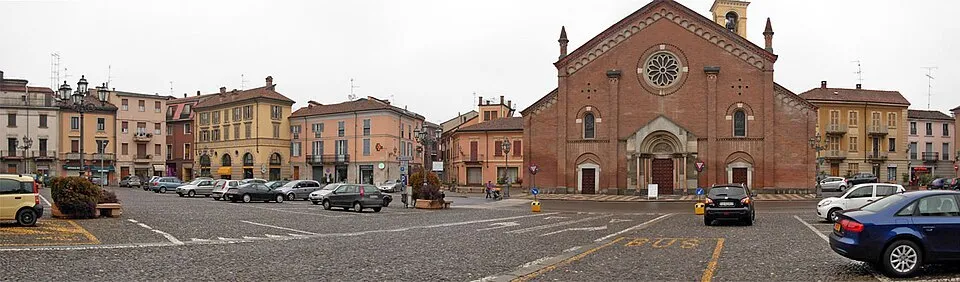
The first urban agglomeration boasts centuries of history, initially Roman camp, favored by gibbosity that naturally takes place in the historical center of the country (Piazza Vittorio Emanuele II and the surrounding streets).
It is, perhaps, the humanist Matteo Maria Bandello the most illustrious son of the country, who in the 12th century was the subject of bitter disputes between Tortona and Pavia.
is placed not far from the roots of the apennines, to the mouth where schirmia scares its for the ordinary clear waters in Po. Quivi is the air as tempered as in other place of lombardy, which makes very broad faith the many old men who make themselves and the health that continually perseveres you"
(Matteo Maria Bandello)
Landscape and area
Castelnuovo Scrivia rises in the Tuscan plain, along the right bank of the Scrivia that right here receives the waters of the Grue stream.Explore this chapter
Castelnuovo Scrivia rises in the plain of the Cantonese, along the right bank of the Scrivia that here receives the waters of the river Grue.
History of Castelnuovo Scrivia
SymbolsExplore this chapter
The site of Castelnuovo Scrivia was already inhabited in the 3rd millennium BC, as some excavations conducted in the city centre showed. Probably here was a landing place for the Po, which once flowed further south.[4] Traces of centuriation and Roman artefacts come from the areas of San Damiano, Bovera, Goide, Ova and Cadé.[5] Fortified by order of Theodoric, king of the Ostrogoths around 500,[6] was enlarged by the Lombard king Liutprando, in 722.[5] Ally of Federico Barbarossa, participated in the destruction of Tortona in 1155, obtaining in exchange privileges, including the right to expose the municipal flag, at yellow-gold and white-silver times.
In constant war with Tortona, it was a free municipality for a short time, until around 1300 Castelnuovo Scrivia was subjected to the political group that the Viscontis, already lords of Milan, were establishing. Since then the fate of the village was linked to the city of Milan. Among the lords who held it as a fief we remember: the leader Roberto Sanseverino of Aragon (1418–1487), created, in January 1474, Marquis of Castelnuovo Scrivia, Bandello, Torriani, Visconti, Carmagnola and Sforza. In particular, among the feudal lords, Borso d'Este should be remembered, who granted the benefit of exemption from military service, as evidenced by the flag on the tower.
In 1526 Castelnuovo was granted by Emperor Charles V of Habsburg to the renowned General Alfonso III of Avalos, Marquis of Vasto. Following the death of these heirs, Francesco Ferdinando d'Avalos, former governor of the Duchy of Milan and viceroy of Sicily, who nevertheless ceded the fief in 1568 to Giovanni Battista Marino (or de Marinis), Genoese and Milanese patrizio, nephew of the wealthy banker Tommaso Marino.
Giovanni Battista obtained in December 1568 the title of Marquis of Castelnuovo. The Marino family remained the owner of the fief until the 18th century. In 1778, with the death of the last exponent of this family, Maria Giovanna, the title perverted to her son Charles, born from marriage with Giovanni Battista Centurione Scotto, prince of the Holy Roman Empire and marquis of Morsasco.
Following the peace of Vienna in 1738 Castelnuovo passed to the kingdom of Sardinia.
In the 1800, cut off from the rough roads, despite the proliferation of philanthropists and furnaces, Castelnuovo declined, also because of the strong emigration to South America. Paid a strong tribute of victims to the Great War (102 fallen) and the Second World War (59), the headquarters of a partisan brigade particularly active during the Resistance, in the post-war period the country regained its vigour by focusing on new industries, agriculture, trade and revitalized with a strong immigratory wave of 300 veins between 1951 and the 1970, 1 500 Southern (especially Calabrian) in the years '60 It is70 last century and 300 from other Italian regions.
On August 27, 1901 a young Benito Mussolini tried in vain to win a public competition as a teacher at the elementary schools of Castelnuovo Scrivia, submitting the question to the mayor of the country who was rejected, contributing in part to the approaching of the then eighteen towards the world of politics.
-
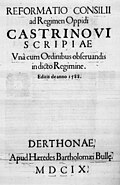 Reformatio consilii ad regimen oppidi Castronovi Scripiae, 1609.
Symbols
The coat of arms and gonfalone were granted by royal decree of 13 March 1939.[7] In the coat of arms is depicted a biturrito castle in silver, lying to the guelfa, on a red background, benderuolato on the left tower towards the right; the flag is three vertical bands yellow gold, silver and yellow gold; at the base of the castle a campaign in silver crossed vertically by a course of water.[8]
The banner is a blue cloth.
The historical emblem was: Silver, in the countryside tiled, with a red tower, crenellated to the Ghibelline, banderuolata of red on the right, coming out from the sea; all natural.[9]
What to see in Castelnuovo Scrivia
Civil architecture · Religious architecture · NatureExplore this chapter
Civil architecture
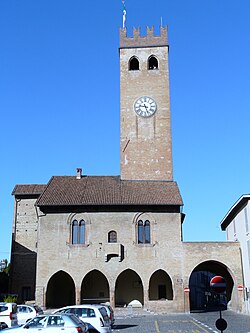
- Castello dei Torriani e dei Bandello (Castello Podestarile, Palazzo Pretorio), dating back to the 14th century[10], is now home to the "Pierangelo Soldini" civic library. It has a beautiful ogival portico, mullioned windows and arengo. On the upper floor there are some rooms with frescoes from the 15th and 16th centuries, including a Madonna, some Saints and coats of arms, including that of the Visconti family, which decorate the Hall of Administrators. The castle is dominated by a crenellated tower, 39 meters high. It is part of the "Castelli Aperti" circuit of the Basso Piemonte
- Palazzo Centurione, of Genoese imprint, of the seventeenth century, is home to the Town Hall and the Civic Museum, in via G. Garibaldi
- The Archaeological Teaching Room named after the Stella sisters, the first dowel of the Museum of Local History of Castelnuovo Scrivia, collects archaeological finds from the country, from prehistoric times to Roman age
- The Monument to the Gualdo, inaugurated in 2014, in honor of the herb dye that made the town's fortune between the 14th and 17th centuries
- Of the wall, which was destroyed in 1828, there is only a great sixteenth-century arch
- Some fifteenth-century houses and the birthplace of Matteo Maria Bandello in the historic center
- The ancient hamlet of Ova, enriched by the homonymous Villa Ova
- Torrione dei Gobba at the A21 motorway, not far from the car farm of Castelnuovo[11]
Religious architecture
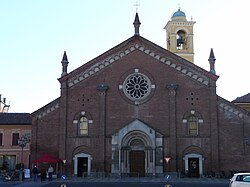
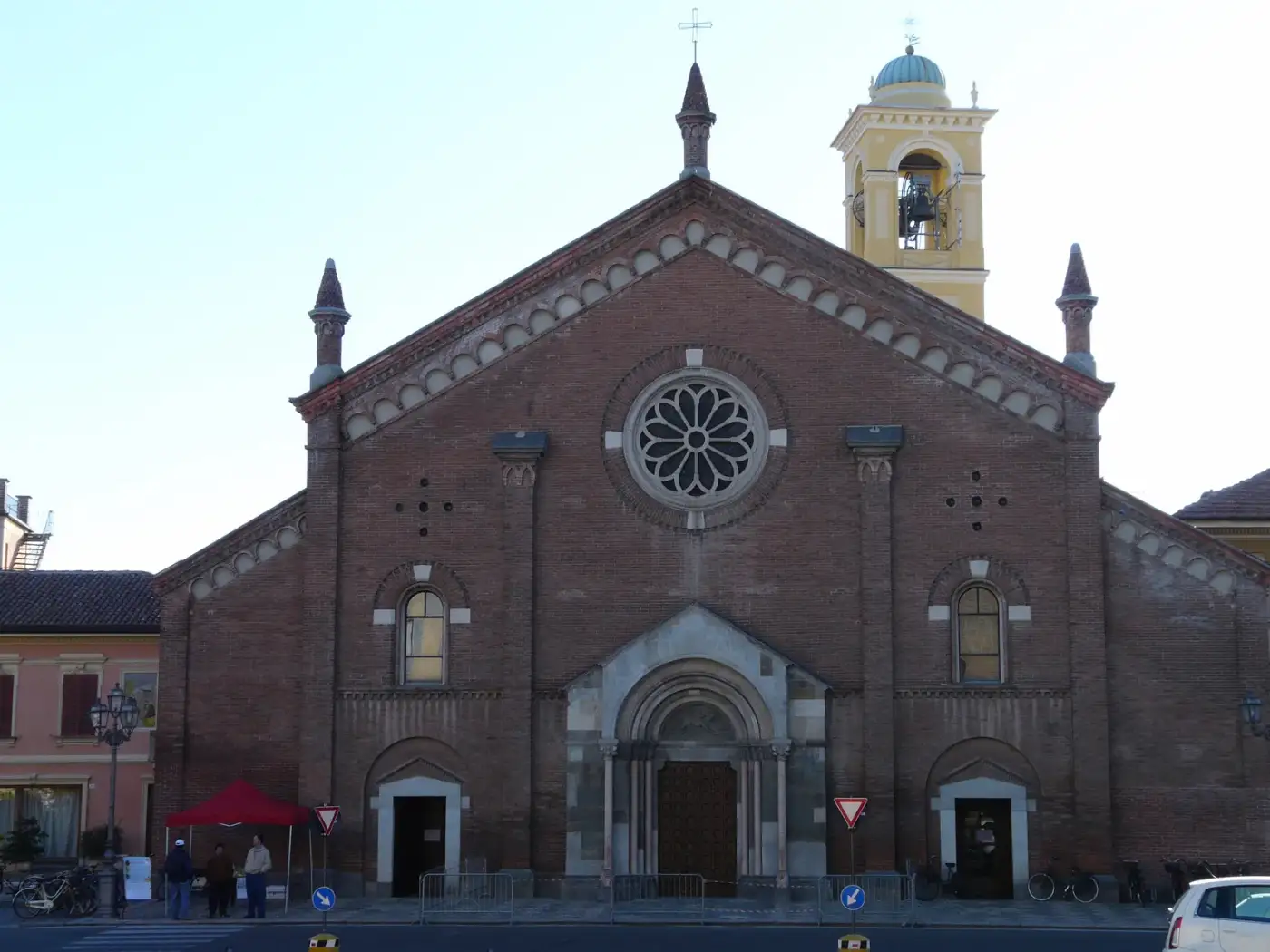
- The parish church of Saints Peter and Paul in Romanesque style dates back to the 12th century; it was restored in the 16th and 19th centuries. The portal has stilofori lions, bezel and capitals, executed by magisterium Albertus at the time of Federico Barbarossa (as attested by the inscription itself). The interior, with three aisles, built at the beginning of the '600 and inaugurated in July 1612 with all probability on project of the Architect Pellegrino Tibaldi, preserves a painting on plates by Alessandro Berri, theLast Supper, kept in the chapel of the SS. Sacramento, at the end of the left nave, a 15th century fresco representing the Our Lady of Mercy, on the entrance wall, and four capitals from the 1100s, remnants of the ancient parish church. Among the chapels, that of the SS. deserves a mention. Sacrament (long chapel). The church houses an organ built in 1612 by the Vitani brothers from Pavia, restored in 2012.
- The church of Sant'Ignazio (XVII century), first church in Italy to be named after Sant'Ignazio, in the year of its canonization. Built by the will of the feudal lord Giovanni Gerolamo Marini, it was built at the annexed Jesuit College. Both the church and the college were built following the great project of the famous Father Porta, Gesuita and Ing. Antonio Maria Corbetta in Milan. It was closed in 1792 with the suppression of the Cistercians succeeded to the Jesuits. A first restoration, following the damages for the passage of foreign troops due to Napoleonic wars, took place in 1833 with the consequent reopening to the cult, on December 10 of the same year. Meanwhile, the property has passed to the Municipality of Castelnuovo Scrivia. Back in disuse and used during World War II as a workshop for the repair of German tanks, in 1956, by the will of the Municipal Administration headed by then mayor Lelio Sottotetti, on the day of Pentecost, May 20, is reopened to the cult. The church, of majestic structure, enjoys a vast festival lifted from the altitude of the street by a staircase of three steps. Monumental is the sacristy and of value are the Christ deposed carved on rose wood and canvas Christ Risen by the castelnovese adoption painter, Michele Mainoli. The church is officiated the Sunday afternoons in summer while, the college is now home to the School of Childhood dedicated to Master Carlo Guerra, Primary School entitled to Novelliere Matteo Maria Bandello and the Polifunctional Room dedicated to journalist and poet Gennaro Pessini (the latter obtained in the College's refectory). It houses the valuable works already mentioned and the wooden statue of Santa Caterina d'Alessandria the table depicting Christ among saints attributed to Gabriel da Castronovo[12].
- The church of San Rocco that can be traced back to the end of the 16th century since there are documents of the time expressing the need to expand the existing structure and a manuscript, of 1599, confirms its work. From the catalogue of Bishop De Zanii dated 1523 it turns out that, at the church is erected the Brotherhood of the SS. Trinity called "of the Baptists". In 1789 the three lay confraternities present in the village were suppressed, with a special royal decree of 1792, a single Brotherhood was formed under the title of San Desiderio erected at the church of San Rocco. Also in 1792, with pastoral letter of Bishop Pejretti, the church is titrated to Saint Desire. In the sixties of the twentieth century, the oratory went into disuse and in 1973 it was closed to worship. In the early 1980s, on impulse of the then vice pastor Don Bruno Bottallo, a group of women and men of good will decide to reopen the church to worship and to make it the seat of charities. Bishop of Tortona, Mons. Bongianino, with a decree dated 1 May 1983 reconstitutes the Veneranda Confraternita di San Desiderio and the church is reopened to worship on 27 August of the same year. Inside the church, there is a 16th-century wooden system of value and numerous canvases from today's churches no longer existing. At present, the Mass is officiated monthly, during the month of May, the Holy Rosary is recited every evening and on the days of 28, 29 and 30 December the Saints Fortress are celebrated.[12]
Nature
- Platano of fraction Ova, monumental tree of about two hundred years of age located in the cited fraction of the municipality.
Society
Demographic evolution · Languages and dialectsExplore this chapter
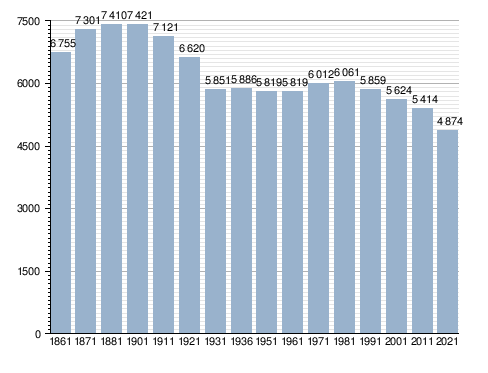
Demographic evolution
Inhabitants registered[13]
Languages and dialects
The dialect of Castelnuovo Scrivia, as well as throughout the Tortonese, is of Lombard-Emilian type.
Here is a famous saying of Castelnovese:
"A Castarnöv in cuàtȧr i mángen un öv and n'in v'nsa ancú na ciapȧ That I have a vend in pias,, if they find it from vend, to the slain suta i dent!"
"In Castelnuovo four eat an egg and they still have a piece left over which they go to sell in the square, if they can't sell it, they crush it under their teeth!"
Economy
The country's economy has always been based on agriculture. The sector is characterized by a high number of family companies. The production mainly covers vegetables, very...Explore this chapter
The country's economy has always been based on agriculture. The sector is characterized by a high number of family companies. The production mainly covers vegetables, very precious, and wheat. Industry in the past was marginal. In the last decades of the twentieth century there has been a strong development of small, but renowned activities: production of footwear (today practically absent); tensostructures (Canobbio); semitrailers for self-trading (Acerbi); plastic containers (Ramaplast); winding musical instruments (Brothers Patricola). Since the first two thousand years some of these activities or companies have resized, but still remain rooted in the territory and important in the economy of the area. Very developed is the artisanal activity, species linked to the building and its induced.
In the field of services, emerge the societies of road haulage (Autosped and G & A - Group Gavio, Autotrasporti Santi, Breglia Autotrasporti, Setti Trasporti); trade of seeds (Sottotetti); wholesale fruit and vegetables (Ferrari ortofrutticoli).
Several small and medium-sized enterprises of various kinds have arisen or recently moved to the nearby industrial area.
Administration
TwinningExplore this chapter
Following the Liberation by the Allies of 25 April 1945, C.N.L. (National Liberation Committee), at local level, appointed as mayor ling. Innocent Rigoni, from the PLI file (Italian Liberal Party), who ran the country until the 1946 elections.
I'm in. Innocent Rigoni, he married studies aimed at exercising his profession with the passion for local history, thus bringing to completion architectural projects of great value that give prestige to the country. Only to make examples, can be mentioned here: the restoration of the arengo of the Castle Podestarile, the construction of the oldest part of the municipal cemetery and the design of the circumvallation that takes into account the ancient route of the walls of the village (now Viale IV November).
With the free elections of the following year, the Castelnoans voted in majority for the Italian Communist Party (PCI) and the City Council chose Master Osvaldo Mussio as Mayor. During World War II, the master was first engaged in Alta Val Maira on the French front as an infantry officer (he had attended the course in the XXI Regiment in La Spezia) and then, after the events of 8 September 1943, he returned home to become a partisan with the name "Andrea". He made contact with the Cantonese Mario Silla and organized a brigade of plains in Lower Scrivia Valley. There are numerous volumes written and preserved by him in the local libraries about the story of Liberation. He distinguished himself by a great civic sense and never went back when he was given the opportunity to bear witness to the partisan experience of young generations.
The 1951 elections saw the vote for Christian Democracy (DC) prevail and the City Council chose Lelio Sottotetti who will be continuously reconfirmed to lead the country for the next three elections until 1970. He graduated as an accountant at the Mario Baratta Institute in Voghera (PV), together with his brother Gian Pietro, was part of the third generation that led to the company Subtetti Sementi. Laic engaged and passionate about local history, he spent much time promoting and recovering the cultural heritage of the village both during the term of first citizen (the recovery of the Jesuit College which became elementary school and the church of Sant'Ignazio in 1950) that after the political period (the reopening to the cult of the church of San Rocco in 1983 and that of San Damiano in 1993). From 1983 to 2009 he was prior of the Veneranda Confraternita di San Desiderio, based in the church of San Rocco and from 1993 to 2017 he was president of the Committee of the Church of San Damiano. Lelio wrote, in 1984, a book of local history focusing on the events that affected the Brotherhoods present in the village and then, in 2007, published Leaves to the wind, a miscellany of stories of village life that actually happened which moved many readers. These publications are also kept in local libraries.
The mayors Osvaldo Mussio (PCI, 1970-1975 and 1982-1985), Pietro Curone (PSI, 1975-1980), Renzo Maggi (PSDI, 1980-1981) and Pierangelo Luise (PSI, 1985-1988).
The following is a table on the administrations which, since 1988, have succeeded in this municipality as described by the website of the Ministry of Interior:
| Period | First citizen | Match | Load | Notes | |
|---|---|---|---|---|---|
| September 17, 1988 | June 21, 1991 | Osvaldo Mussio | Italian Communist Party, Democratic Party of the Left | Mayor | [14] |
| June 27, 1991 | 7 June 1993 | Gianfranco Antonio Isetta | Democratic Left Party | Mayor | [14] |
| 7 June 1993 | April 28, 1997 | Gianfranco Antonio Isetta | Democratic Left Party | Mayor | [14] |
| April 28, 1997 | May 14, 2001 | Gianfranco Antonio Isetta | civic list | Mayor | [14] |
| May 28, 2001 | May 30, 2006 | Gianni Tagliani | civic list | Mayor | [14] |
| May 30, 2006 | May 16, 2011 | Gianni Tagliani | together | Mayor | [14] |
| May 16, 2011 | 5 June 2016 | Pierangelo Luise | civic list Together for Castelnuovo | Mayor | [14] |
| 6 June 2016 | October 3, 2021 | Gianni Tagliani | civic list Together for Castelnuovo | Mayor | [14] |
| October 3, 2021 | in office | Gianni Tagliani | civic list Together for Castelnuovo | Mayor | [14] |
Twinning


Notes
Explore this chapter
- ^ to b Monthly demographic balance for the year 2026 (provisional data), up demo.istat.it, ISTAT.
- ^ Seismic classification (XLS), up risks.protezionecivile.gov.it.
- ^ Table of degrees/day of Italian Municipalities grouped by Region and Province (PDF), in Law 26 August 1993, n. 412, annex A, National Agency for New Technologies, Energy and Sustainable Economic Development, 1 March 2011, p. 151. URL consulted on 25 April 2012 (archived fromoriginal url on 1 January 2017).
- ^ Alessandro Mandolesi, Archaeological Landscapes of Piemonte and the Aosta Valley. Guide to sites and museums from Prehistory to the Tardoanti, Turin, Editurist, 2007, p. 79, ISBN 978-88-902381-0-9.
- ^ to b Historical vices, up Municipality of Castelnuovo Scrivia. Retrieved 13 October 2019 (archived fromoriginal url on 14 September 2017).
- ^ Roberto Marchese, Castelnuovo Scrivia - The Beyond Po, up robertomarchese.it. Retrieved 13 October 2019.
- ^ Castelnuovo Scrivia, up Central State Archive. Retrieved 15 September 2024.
- ^ Municipality of Castelnuovo Scrivia, Statutes (PDF), Art. 6 Coat of arms and banner.
- ^ Antonio Manno, Castelnuovo Scrivia, in Historical Bibliography of the States of the monarchy of Savoy, vol. 4, Turin, Fratelli Bocca Editori, 1892, p. 189.
- ^ Arcgeocarta: Castello Podestarile/Castelnuovo Scrivia (AL) : Medieval traditions
- ^ vigevano24.it, https://www.vigevano24.it/2020/01/13/leggi-notizia/argomenti/territorio-1/articolo/castelnuovo-scrivia-una-torre-misteriosa-e-davvero-particolare.html Missing title for url
url(help). - ^ to b P. L. Zeme, "That land south of the Po", CEO, Voghera 1989.
- ^ Data taken from:
- Resident population of the municipalities. Censuses from 1861 to 1991 (PDF), up ebiblio.istat.it, ISTAT.
- Resident population - Time series, up exploredati.istat.it.
Please note: 2021 data refers to permanent census data as of December 31 of that year.
- ^ to b c d And f g h the https://amministratori.interno.it/
- ^ to b Celebration of the 50th anniversary of twinning with the Municipalities of Port Sainte Marie and Bazens. (PDF), up common.castelnuovoscrivia.al.it. Retrieved 8 December 2016 (archived fromoriginal url on 20 December 2016).
Bibliography
Explore this chapter
- Further reading
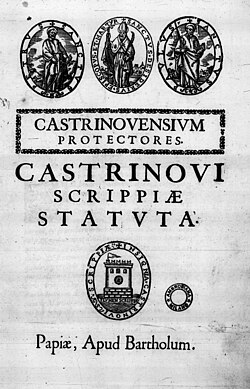
- (THE) Fixed Scrippiae Castrinovi, Pavia, Girolamo Bartoli, 1596.
- (THE) Reformatio consilii ad regimen oppidi Castronovi Scripiae, Tortona, heirs Bartolomeo Bolla, 1609.
Where to stay · Castelnuovo Scrivia
Find stays on Booking.comStories, places and people
More about Castelnuovo Scrivia and the surrounding area
Follow a thread of history and see where it leads.
Potato di Castelnuovo Scrivia
Castelnuovo Scrivia's potato is a variety of potato cultivated mainly in the Alexandrian areas of Castelnovese and Castellazzese, having as an epicentre of production Castelnuovo Scrivia , with Molino dei Torti , Guazzora , Isola Sant'Antonio , Sale e Alluvioni Cambiò .
Read the story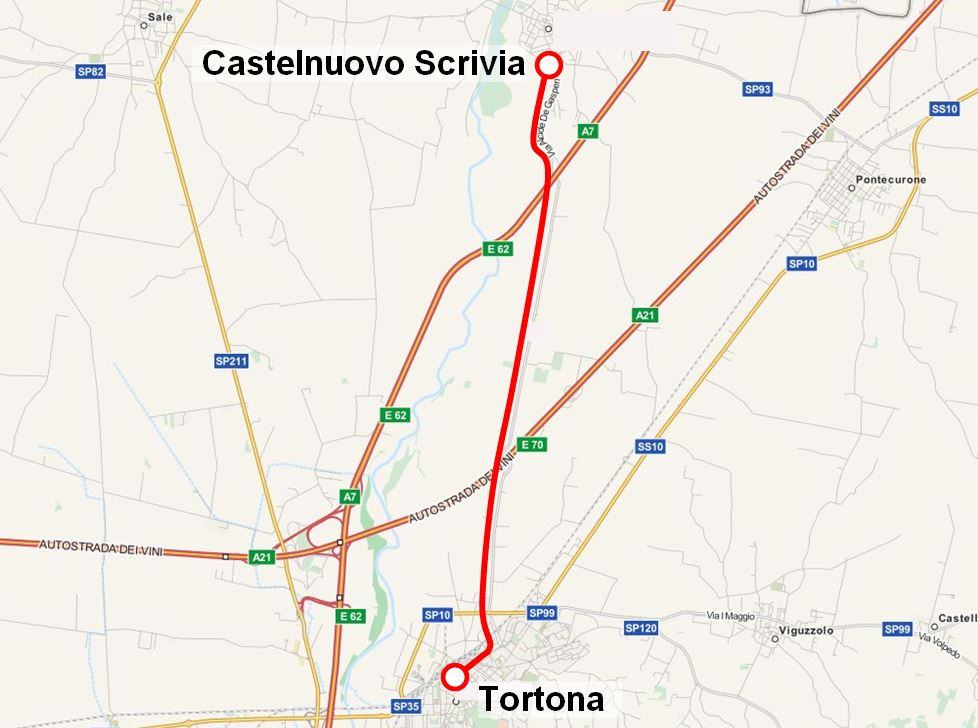 Ale Sasso · CC BY-SA 3.0
Tortona-Castelnuovo Scrivia railway
The Tortona-Castelnuovo Scrivia railway was a local railway that connected the cities of Tortona and Castelnuovo Scrivia from 1895 to 1933, so called economic, realized with tranviary characteristics.
Read the storyThe area, step by step
Trails and routes in Castelnuovo Scrivia
 WalkingAround the starting point
Asti, Alessandria and surroundings