Atlas of Monferrato
Serravalle Scrivia: sights, history and trails
Alessandria
- Elevation
- 225 m above sea level
- Area
- 15.95 km²
- Demonym
- greenhousevallesi
- Patron saint
- San Martino di Tours
A closer look
Discovering Serravalle Scrivia
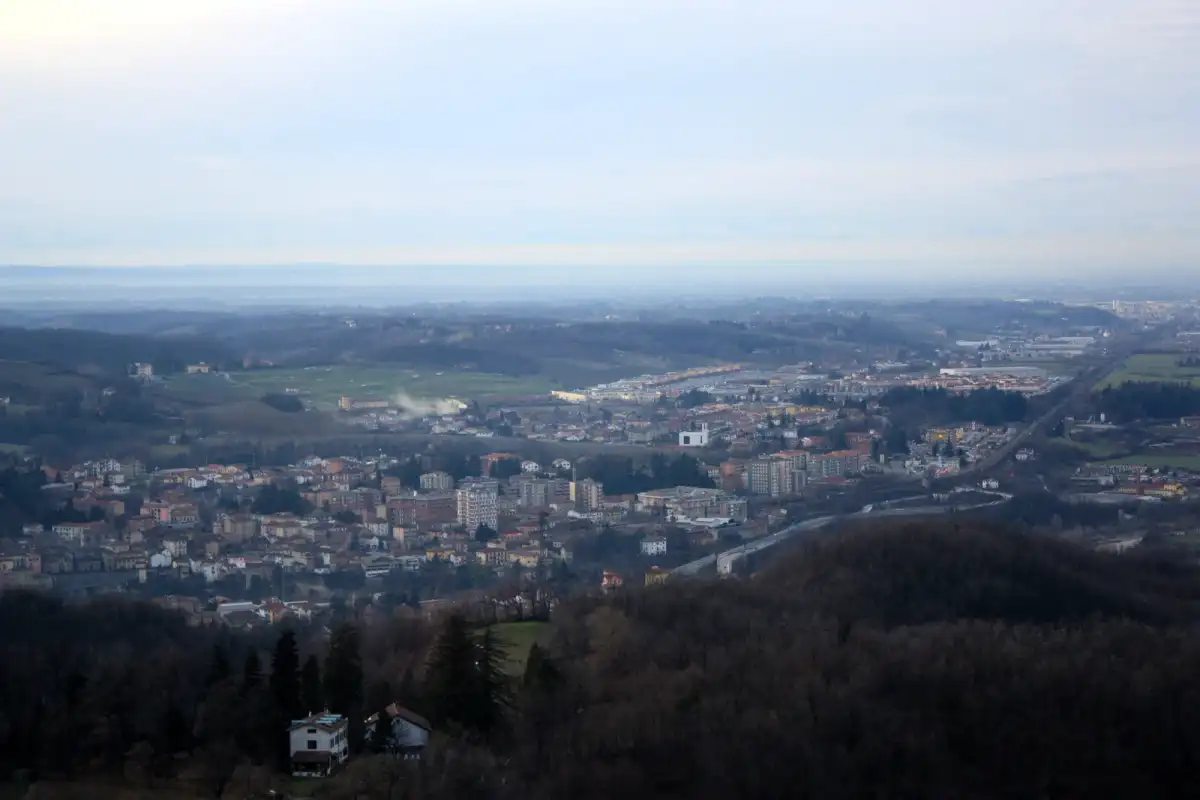
Serravalle Scrivia (Seraval Scrivia in Piedmontese, Seravalle from 1937 to 1946 Serravalle Libarna) is an Italian commune 6 061 inhabitants[1] from the province of Alessandria in the Piemonte. The municipality is located in Ninety-six, geographical area which takes its name from the city of Novi Ligure and a few kilometers from the border with Liguria.
Landscape and area
It is located at the confluence of Borbera in Scrivia near the last smugglers of the Ligurian Apennines and at the beginning of the plain.Explore this chapter
It is located at the confluence of Borbera in Scrivia near the last smugglers of the Ligurian Apennines and at the beginning of the plain.
History of Serravalle Scrivia
SymbolsExplore this chapter
Fortified village, perhaps built by the inhabitants of the ancient city of Libarna, a Roman center located on the Via Postumia between Genoa and Tortona, after the destruction of the same (452), overwhelmed by the collapse of the Roman Empire and the barbaric invasion. It was reduced to a small village harvested around the Pieve called del Winter[4].
Subsequently, with the Lombard domination, an urban agglomerate developed on the Armanina hill, which dominates the plain of Libarna, the Mons Arimannorum, mentioned for the first time in a Carolingian chapter diploma of Charlemagne from 774 which confirms the ancient territorial possessions of the Monastery of Bobbio[5][6].
From 1122 Serravalle Scrivia belonged to the bishops of Tortona, until they gave it to the Municipality of Tortona. Tortona, in exchange for the defense of their lands.
The name Serravalle it is found for the first time in a public act dated 1140, through which the Municipalities of Tortona and Genoa agreed their boundaries. The original nucleus of the village closed the valleys Scrivia and Crenna, from here Serra Vallis.
High to the rank of imperial fief, Serravalle passed to the Spinola (1313), then to the Visconti (1381) Adorno (1391), and finally back to the Spinolas in 1482, maintaining however their jurisdiction. Included in the Duchy of Milan in 1580, after the War of Spanish Succession it passed to the Austrians in 1713 and in 1738, with the Tortonese, it entered the possessions of the Savoy. During the War of the Austrian Succession it was occupied by the Franco-Spanish (1745); during the Napoleonic wars (1798), it was annexed to the Ligurian Republic. The French, conquered Serravalle after the battle of Marengo, they had the castle demolished there. In 1815, following the Congress of Vienna, Serravalle returned to the Savoy family.
In 1863 the municipality of Serravalle assumed the new name "Serravalle Scrivia".[7]
Serravalle is important road junction between the Po Valley and the Ligurian Sea. In October 1935 the opening was held Camional Genoa-Serravalle[8], which became the quickest way to connect the Ligurian city and the sea with Milan and Turin. The artery, now part of the A7 motorway, is still referred to today by its original name truck, to indicate the mainly commercial function that the new road immediately took on.
Symbols
The coat of arms and gonfalone were granted by decree of the President of the Republic of 28 March 1966.[9]
The gonfalone is a drape party of red and white.
What to see in Serravalle Scrivia
Archaeological area of Libarna · Collegiata dei Santi Martino e Stefano · Oratory of WhitesExplore this chapter
Archaeological area of Libarna
Libarna archaeological site. Village founded by the Ligurian Dectunini, could be one of fifteen opaste who, according to Livio, surrendered to the Q console. Minucio Rufo in 191 BC. Obtained soon the legal recognition of Latin citizenship, it was erected to colony only later in the 1st century AD, when it reached its maximum splendor.
Collegiata dei Santi Martino e Stefano
The church, mentioned for the first time in 1228 as S. Martin assumed the current denomination in 1239, when Pope Gregory IX joined the church of S. Stephen of Lwinter. Originally equipped with a portico, the church took its present form following the works of 1572. The present travertine façade dates back to 1939, while the interior decorations of 1911 were by Luigi Gainotti and Rodolfo Gambini.
Inside there is a baptismal font with marble quadrangular tub, dating back to 1486; the painting of Blessed Virgin of the Rosary (1607), work by the Serravalle painter Bernardo Montessoro; that of the Martyrdom of Saint Stephen, attributed to Giovanni Andrea Carlone (second half of the seventeenth century); the chapel of Our Lady of Sorrows, equipped with a fine altar '600, in inlaid polychrome marbles and containing a nineteenth-century wooden group depicting the Madonna surrounded by four angels.
The organ kept in the collegiate was created in 1834 by the organ masters Serassi.
Oratory of Whites
The Oratory of the Disciplinates of the Assumption and of the S. Cross, called "Bianchi" for the color of the dress of the brethren, is dated between the 13th and 14th centuries. Inside it preserves a wooden group depicting the Deposition of Christ, a complex composed of eight figures with expressive strength in their faces and gestures. The banner of the Assumption is the work of Nicolò Barabino.
Oratorio dei Rossi
The Brotherhood of St. John the Baptist and Holy Trinity was founded in 1532 and was dedicated to the assistance of pilgrims and prisoners. The oratory dates back to 1727, replacing the oldest located, perhaps, near the castle. Typical example of Genoese Baroque, it has a remarkable entrance portal characterized by two large columns of Doric order, coming from Libarna.
Administration
Below is a table relating to the administrations that have succeeded one another in this municipality.Explore this chapter
Below is a table relating to the administrations that have succeeded one another in this municipality.
| Period | First citizen | Match | Load | Notes | |
|---|---|---|---|---|---|
| 9 February 1988 | May 27, 1989 | Giorgio Gennaro | Christian Democracy | Mayor | [10] |
| July 18, 1989 | April 16, 1992 | Giorgio Gennaro | Christian Democracy | Mayor | [10] |
| May 25, 1992 | June 13, 1994 | Antonio Molinari | Democratic Left Party | Mayor | [10] |
| June 14, 1994 | May 25, 1998 | Antonio Molinari | Democratic Left Party | Mayor | [10] |
| May 25, 1998 | May 28, 2002 | Antonio Molinari | civic list | Mayor | [10] |
| May 28, 2002 | May 29, 2007 | Emanuele Dazzi | civic list | Mayor | [10] |
| May 29, 2007 | 7 May 2012 | Antonio Molinari | civic list | Mayor | [10] |
| 7 May 2012 | June 12, 2017 | Alberto Carbone | list da Serravalle new | Mayor | [10] |
| June 12, 2017 | June 13, 2022 | Alberto Carbone | Civic list The force of common sense | Mayor | [10] |
| June 13, 2022 | in office | Luca Biagioni | Civic list Renewable Serravalle | Mayor | [10] |
Society
Demographic evolution · Foreign ethnic groups and minoritiesExplore this chapter
Demographic evolution
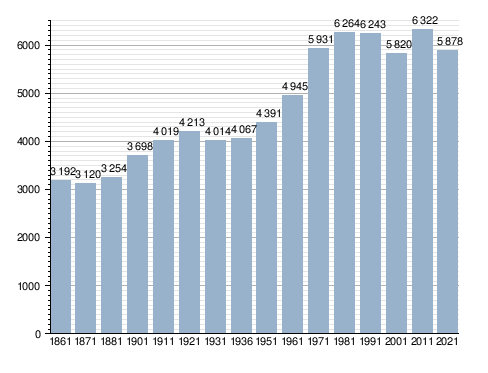
In the last fifty years, since 1961, the resident population has increased significantly by 26 %.
Inhabitants registered[11]
Foreign ethnic groups and minorities
Foreigners resident in the municipality are 1 163, or 18.0% of the population. Below are the largest groups[12]:
- Morocco, 397
- Romania, 267
- Albania, 150
- Ecuador, 74
- Sri Lanka, 53
- India, 43
- China, 25
- Ukraine, 23
Culture
Two kilometers south of the town, towards Genoa, rises the archaeological area of Libarna, a Roman city located on the ancient Via Postumia . In June there is the...Explore this chapter
Two kilometers south of the town, towards Genoa, rises the archaeological area of Libarna, a Roman city located on the ancient Via Postumia. In June there is the concert of the summer solstice. Inside the building, seat of the Municipal Administration, in the exhibition hall located on the ground floor you can visit a small but significant exhibition of archaeological finds from the excavations of the Roman city.
Events
Explore this chapter
- Stories of the twentieth century National literary competition that combines the relationship between history and literature (First edition in 2001)
- The town was chosen as the starting point of the 11th stage of Giro d'Italia 2007 (Serravalle Scrivia-Pinerolo, 198 km)
- San Martino, 11 November - feast of the patron saint, with stalls along the streets of the village and amusement park.
- Third Sunday of September - patronal feast of Our Lady of Sorrows with procession and handicraft stalls in the street of the historic center
- 15 August - in the evening, Procession of the Assumption (Oratorio dei Bianchi)
Economy
Explore this chapter
- Serravalle Designer Outlet. Serravalle has been known for a few years also for the presence of what in 2013 was considered the largest outlet in Europe[13], which has 250 designer shops. It is connected with special buses to Milan, Genoa and Turin. Opposite the outlet, there is the "Retail Park" with large shops selling various goods, including the hypermarket of the "Iper" chain and next to it is the "Palabingo", a modern structure for gaming enthusiasts.
Notes
Explore this chapter
- ^ to b Monthly demographic balance for the year 2026 (provisional data), up demo.istat.it, ISTAT.
- ^ Seismic classification (XLS), up risks.protezionecivile.gov.it.
- ^ Table of degrees/day of Italian Municipalities grouped by Region and Province (PDF), in Law 26 August 1993, n. 412, annex A, National Agency for New Technologies, Energy and Sustainable Economic Development, 1 March 2011, p. 151. URL consulted on 25 April 2012 (archived fromoriginal url on 1 January 2017).
- ^ Municipality of Serravalle - History, up common.serravalle-scrivia.al.it. Retrieved 21 June 2019 (archived fromoriginal url on 21 June 2019).
- ^ F. Gabotto, For the history of Tortona in the age of the Municipality, Turin 1922, p. 36 note 1.
- ^ Municipality of Voltaggio, History of the Overseas (PDF), up common.voltaggio.al.it.
- ^ Royal decree 11 January 1863, n. 1126, regarding "Decree authorizing various municipalities in the provinces of Milan, Alessandria, Brescia, Cremona, Turin, Ascoli, Macerata, Cuneo, Piacenza, Porto-Maurizio, Ravenna and Sassari to take on a new name."
- ^ (EN) The Camionale Genoa-Serravalle for Lorry Traffic, in Nature, vol. 136, n. 3428, 1 July 1935, pp. 62–62, DOI:10.1038/136062b0. Retrieved 7 July 2025.
- ^ Serravalle Scrivia, up Central State Archive.
- ^ to b c d And f g h the j https://amministratori.interno.it/
- ^ Data taken from:
- Resident population of the municipalities. Censuses from 1861 to 1991 (PDF), up ebiblio.istat.it, ISTAT.
- Resident population - Time series, up exploredati.istat.it.
Please note: 2021 data refers to permanent census data as of December 31 of that year.
- ^ Demographic balance and foreign resident population at 31 December 2010 for sex and citizenship, up demo.istat.it, ISTAT. Retrieved 24 December 2012 (filed on 22 June 2013).
- ^ Piemonte: the largest in Europe, up www.turismo. Retrieved 7 July 2025.
Bibliography
Explore this chapter
- Further reading
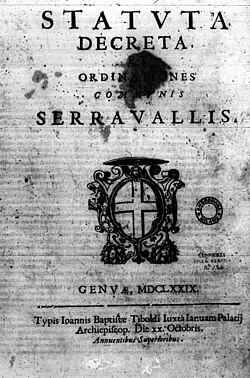
- Statue, decreed and ordered, Genoa, Giovanni Battista Tiboldi, 1679.
Where to stay · Serravalle Scrivia
Find stays on Booking.comStories, places and people
More about Serravalle Scrivia and the surrounding area
Follow a thread of history and see where it leads.
Biagio Assereto
Biagio Assereto (Recco , 1383 circa – Serravalle Scrivia, 25 April 1456) was an Italian admiral at the service of the Republic of Genoa .
Read the story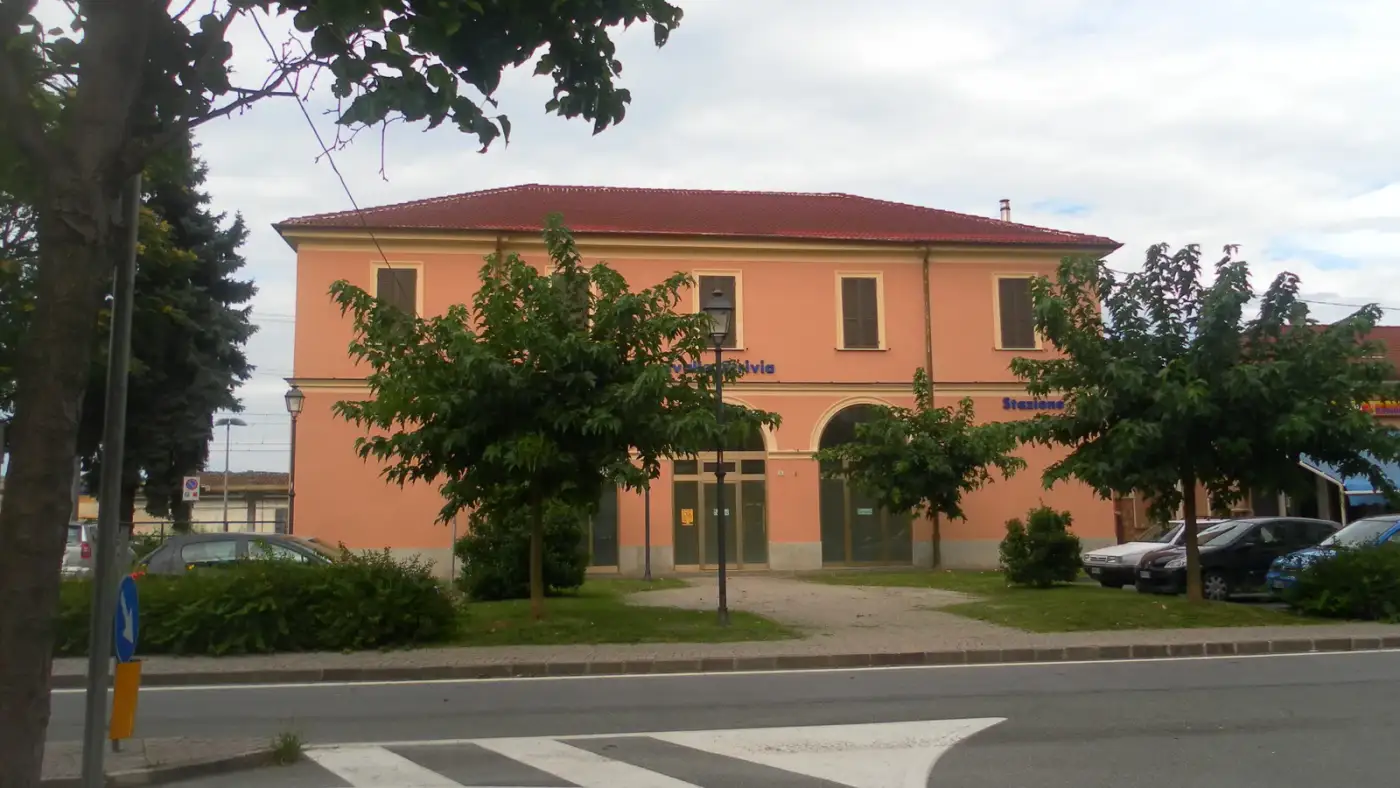 Andre86 · CC BY-SA 4.0
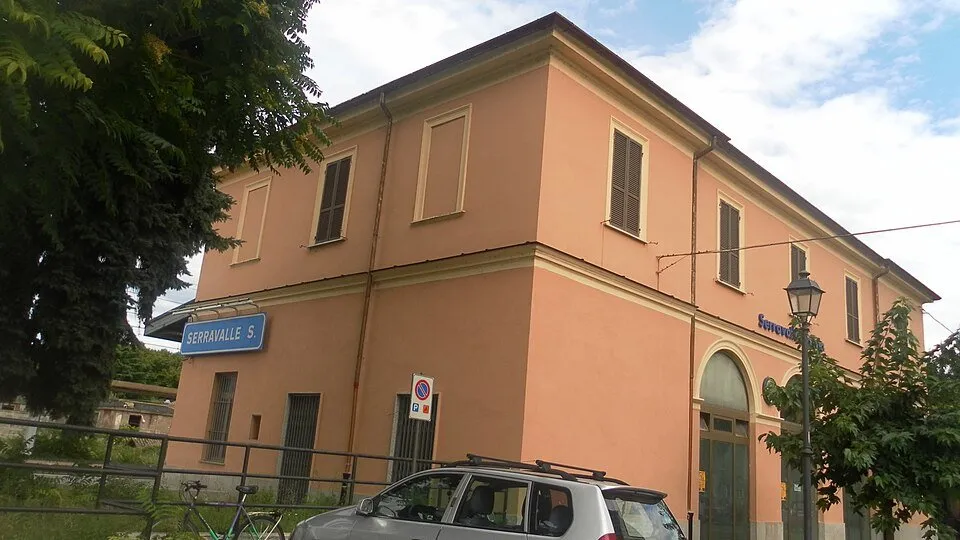
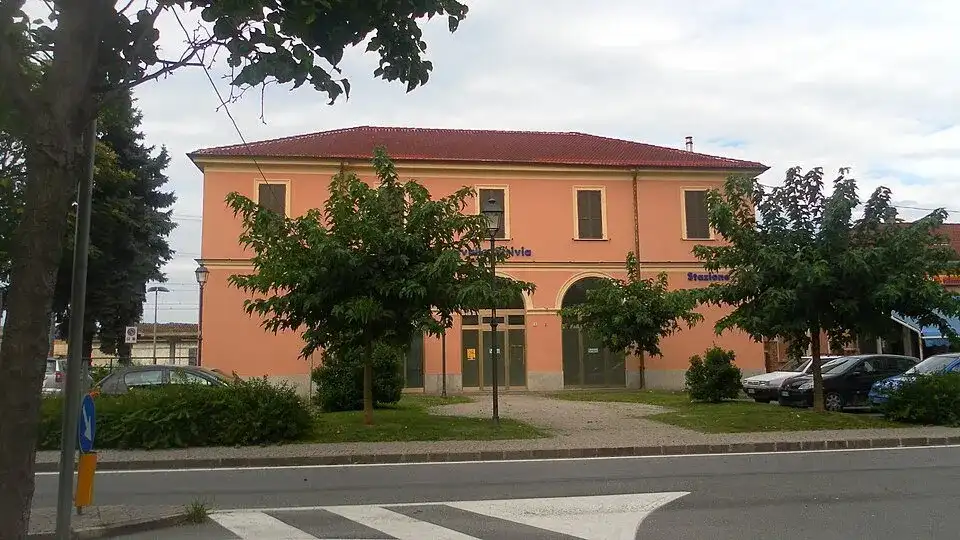
Serravalle Scrivia Station
Serravalle Scrivia station is a train stop on the Turin-Genova line. It serves the town of Serravalle Scrivia .
Read the story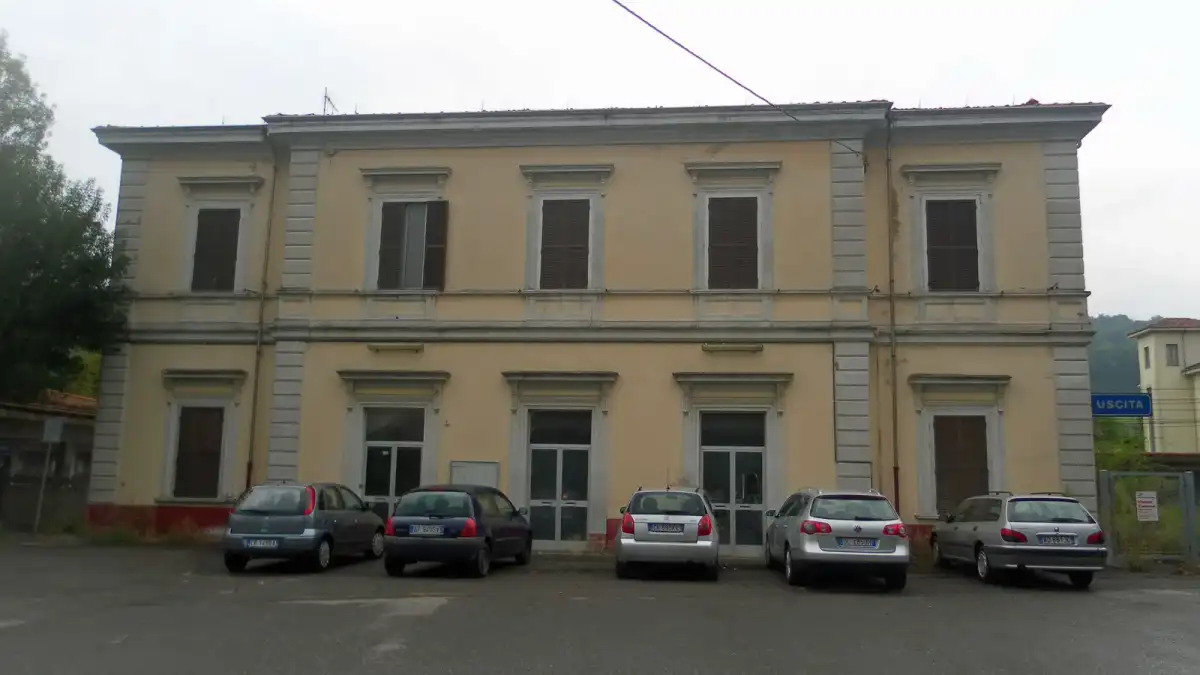 Andre86 · Public domain
Stazzano-Serravalle station
Stazzano-Serravalle station was a railway station located on the Tortona-Arquata Scrivia line. Located in the town of Serravalle Scrivia in the hamlet of Lastrico, it also served the neighboring Stazzano.
Read the story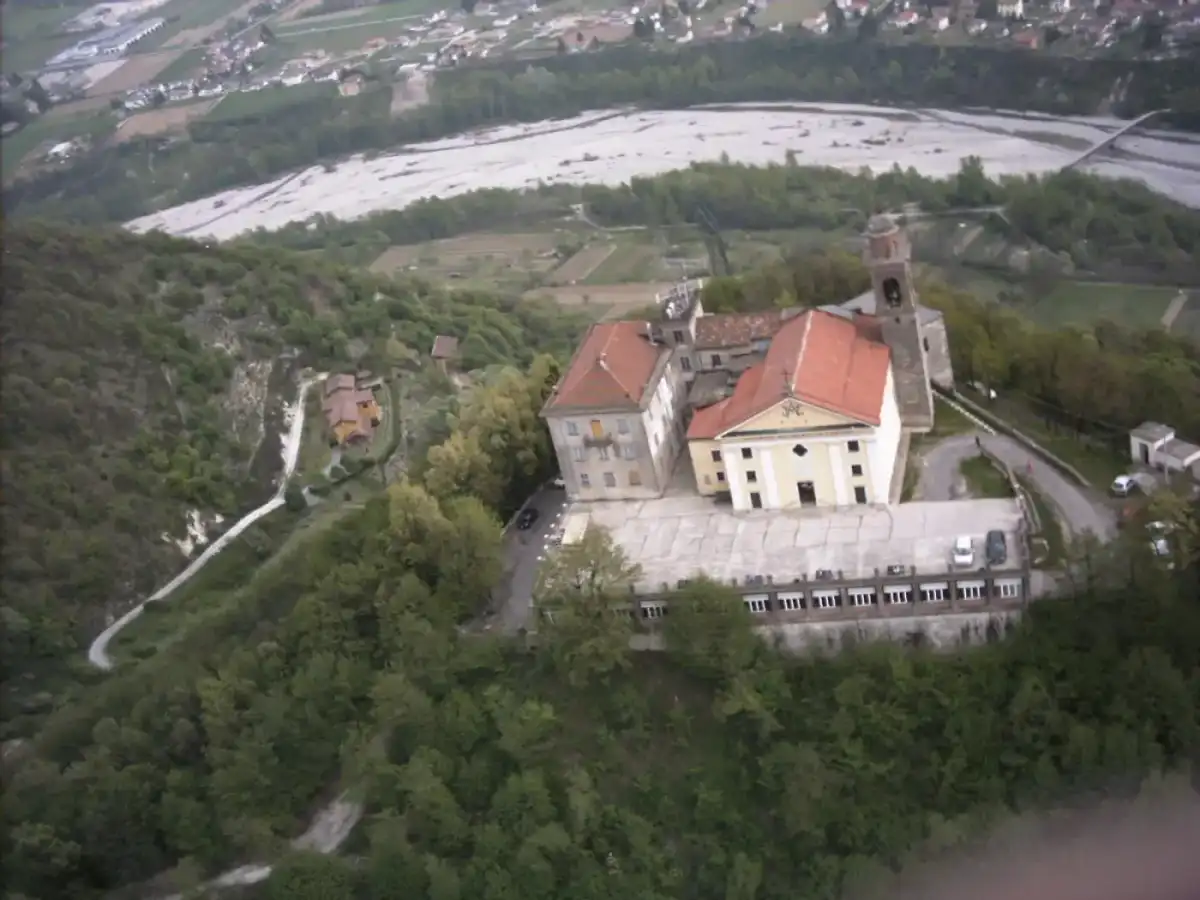 myself · Public domain
Mount Spineto
Monte Spineto (Monte Spinè in Liguria and Piedmont, 459 m a.s.l. ) is the last counterfeit of the Ligurian Apennines located between the Scrivia valley and the Borbera valley.
Read the story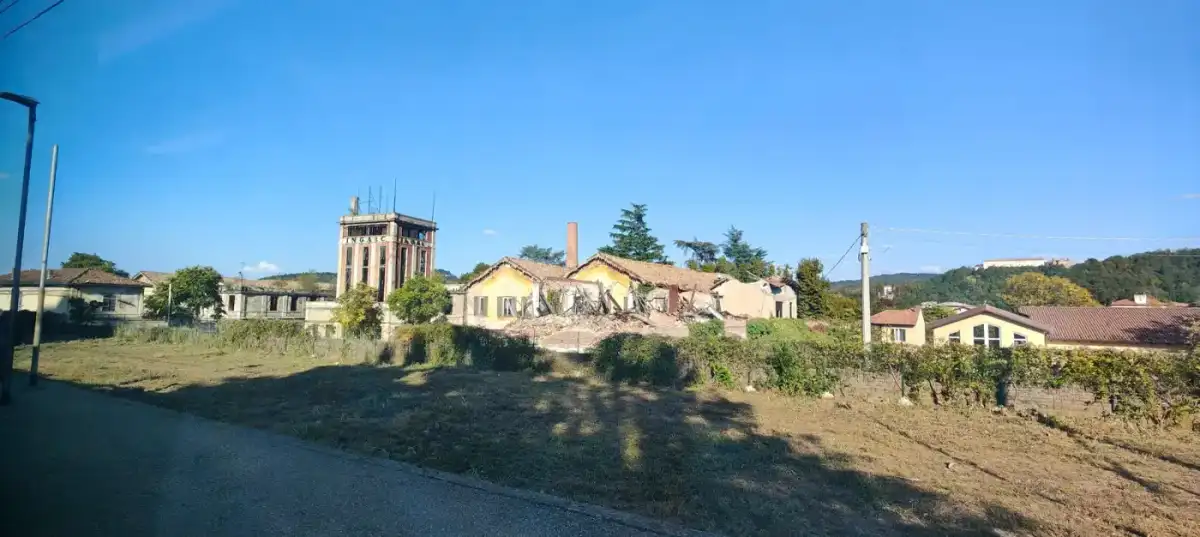 Al*from*Lig · CC BY-SA 4.0
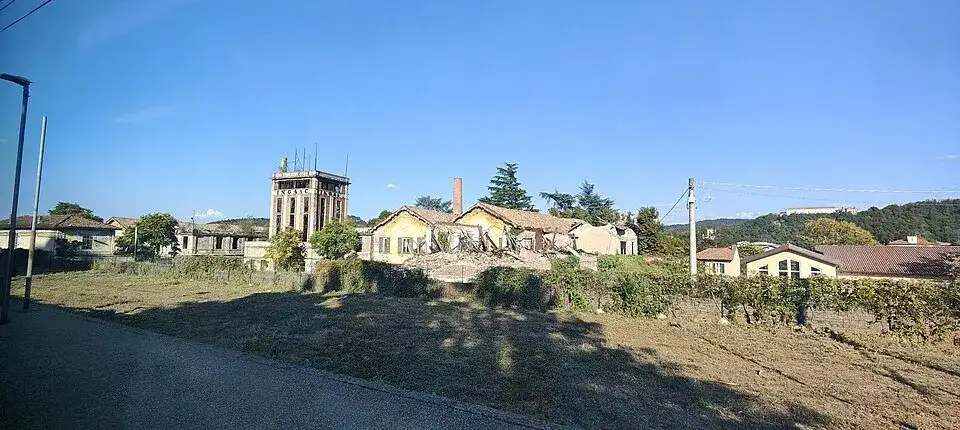
Inga & C distilleries.
The G.B. Distillery Gambarotta & C. then Distillery Inga & C. was an active distillery in Serravalle Scrivia from 1906 to 2008 .
Read the storyThe wine landscape
This village in wine country
Follow the link between the country, the vineyards and the neighboring territories.
The area, step by step
Trails and routes in Serravalle Scrivia
 Mountain bikeAround the starting point
Asti, Alessandria and surroundings
Le colline del Gavi DOCG
 CyclingAround the starting point
Asti, Alessandria and surroundings
Sulle strade di Serse e Fausto Coppi

Asti, Alessandria and surroundings
Anello borbera - spinti tappa 01 (stazzano - ca' del bello)

Asti, Alessandria and surroundings
Sentiero pratolungo - innesto sentiero e1
 WalkingAround the starting point
Asti, Alessandria and surroundings
Sentiero serravalle - colle ratto
 WalkingAround the starting point
Asti, Alessandria and surroundings
Sentiero chiesetta montei - serravalle scrivia

Asti, Alessandria and surroundings
Sentiero colle ratto - chiesetta di montei

Asti, Alessandria and surroundings