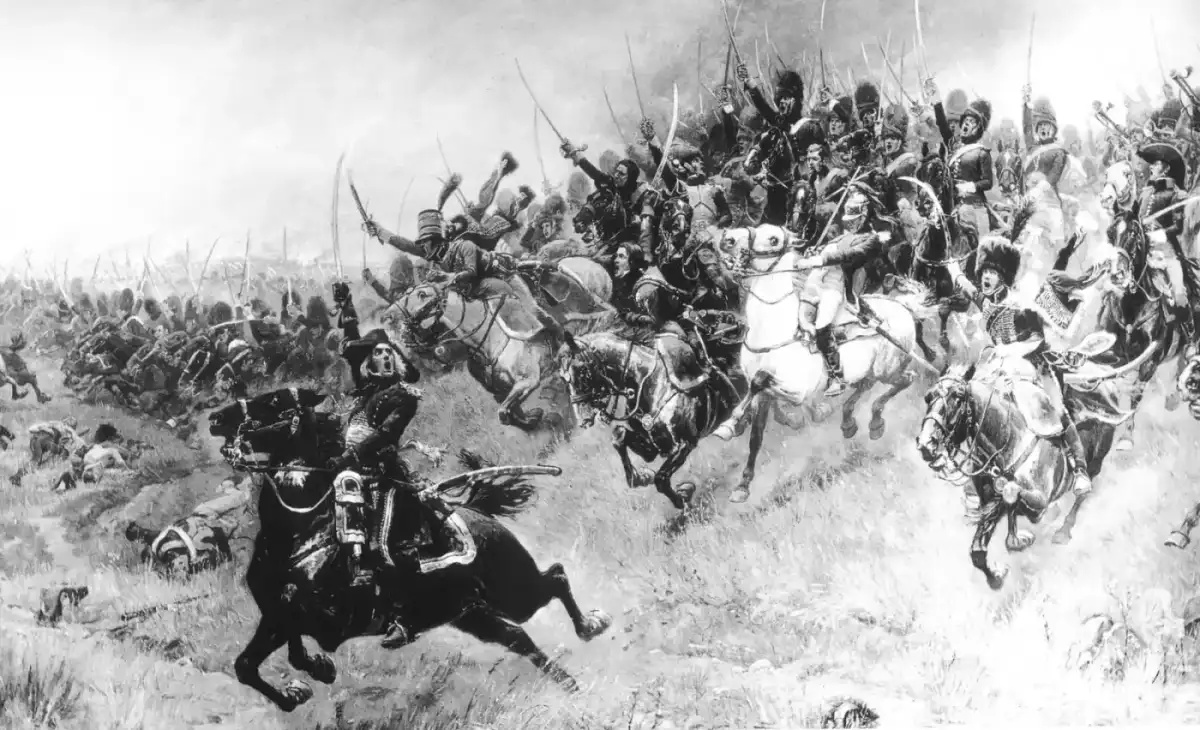
A closer look
Battle of Marengo: at a glance
The battle of Marengo It was fought on 14 June 1800 between the Republican forces of the French general and First Consul Napoleon Bonaparte and the imperial forces of the Austrian General Michael von Melas. The clash represented the last act of the Second Campaign in Italy and its outcome was decisive in influence of the war.
Napoleon, in an attempt to consolidate his position within the French government, had decided to plan and implement an ambitious military campaign in Italy, believing in this way to succeed in bringing to conclusion the conflict with Austria and attracting to itself the consents necessary to legitimize somehow its power after the coup d'état of 18 Brumaio. After gathering an army, the Reserve Army, the general course crossed the Alps, defeated the weak Austrian opposition in Valle d'Aosta, descending into the Piedmont plains and continuing its march towards Milan. Having surrounded and trapped the Austrian army in Piemonte, he prepared to attack him and defeat him permanently.
After a day of torrential rains, seizing the same Bonaparte, General von Melas decided to attack the French on 14 June with all the forces he had managed to accumulate near the French. Alessandria, his headquarters: the weak French avant-gardes, clearly outnumbered, tried to put up a strenuous resistance while waiting for reinforcements. Despite the arrival of various waves of French soldiers and Bonaparte himself at the scene of the clashes, the republicans were unable to stop the pressure of the imperial soldiers and initially moved away from Marengo, almost as if admitting defeat.
In the meantime, however, the Desaix division came to the place, bringing with it numerous fresh forces and raising the morale of the French: with a last decisive attack, the French overwhelmed the enemy soldiers, who convinced of victory they wandered in a disorderly manner on the battlefield, completely overthrowing the outcome of the fight and tearing a decisive but costly victory. The following day, the Austrians signed an armistice with the French, withdrawing their forces behind the Mincio. The victory, whose echo spread rapidly throughout Europe, consolidated Napoleon's position at the centre of the French government and marked the beginning of French hegemony in continental Europe for the next decade.
Historical context
After the end of his victorious campaign led by the Army of Italy, Bonaparte left Europe trying to make his fortune with a military expedition to Egypt...Explore this chapter
After the end of his victorious campaign led by the Army of Italy, Bonaparte had left Europe trying to make his fortune with a military expedition to Egypt, hoping to compromise the British economy and bring the overseas power to surrender.[4] Taking advantage of the departure of the French general, the European powers hostile to the newly-born republic warped against France.[5] Soon the expectations of the French clashed against the sharp superiority of the coalition forces: Republicans were stopped in Germany by Archduke Charles and heavily defeated in Italy by Marshal Suvorov first and by von Melas later. Among the French, only General Massena had managed to bring back victories in Switzerland.[6][7]
On his return to France, Napoleon decided to take part in the Sieyés Cartoons and overthrow the Directory, the inefficient and corrupt French government, replacing him with a consulate. The coup d'état, which was implemented on 18 July, was successful: the Directory was dissolved, as well as the other main organs of the republic, and Napoleon obtained for himself the role of First Consul, thus becoming the new leader of France and inciting to itself power.[8]
Antefactor
Despite the coup d'état, Napoleon and the other conspirators had guaranteed the political power needed to act freely, the position of the 18-brown coupists...Explore this chapter
Despite the coup d'état, Napoleon and the other conspirators had guaranteed the political power necessary to act in freedom, the position of the 18-brown coups was far from solid: fears of the past blows of state against the republican regime, Napoleon and his collaborators immediately tried to attract to him the consent of the civilian population, hoping in this way to legitimize, at least partially, their power and avoid a uprising.[9] Bonaparte's first act was to seek peace with the other European powers: Prussia, which remained neutral until then, reiterated its position while Russia, whose Tsar Paul I was extremely disappointed by the disasters of Zurich, the Swiss Suvorov campaign and the invasion of Holland, accepted a good degree to go out of war and withdraw their men from conflict. No British and Austrian exmosses, intended to continue in hostilities.[10]
The First Consul sent two of his best generals to command the forces still engaged against the Austrians: Massena was entrusted with the Army of Italy while Moreau touched the Army of the Rhine. Meanwhile, in the heart of France, Napoleon had commissioned Berthier, his right arm and war minister, to gather an army, known as the Reserve Army.[9][11] The formation of this army, of which no one outside a few generals in the circle of Bonaparte knew about existence,[12] it served for a very precise purpose: to force the Austrians to surrender with strength. Napoleon, in fact, had understood that he could use Switzerland, reconquered the previous year by Massena and still held French, as a basis for launching his own undisturbed operations both in Italy and Germany. After Moreau's refusal to cooperate, Napoleon decided to turn his attention to Italy and exploit his army to destroy the Austrian army under the command of von Melas: the French would cross the Alps, swooping behind the Austrians; they would take Milan to cut off every possible escape route and then they would encircle them and destroyed.[13][14][15]
Napoleon's plans suffered a sudden acceleration when the forces of von Melas attacked the weak army of Massena in Liguria, breaking it into two trunks and besieging Genoa. The only defense left between the Austrians and France was General Suchet, who defended the Var line.[16] After waiting for the army of Moreau to start their campaign and open a path to undisturbed Italy, the men of the Reserve Army began to head towards Geneva, from which they would go to Italy.[17] The Reserve Army crossed the Colle del Piccolo San Bernardo and arrived in mid-May in Valle d'Aosta. After defeating a small group of Austrians at Châtillon, the French found in the soldiers of the Fort of Bard a far more hospitable obstacle to overcome. The position, the French vanguards, led by Lannes, arrived early in the plain, where they collided with the Austrians near the Chiusella River, bringing a first victory. He soon followed a new success near Turbigo, where the Republican army passed Ticino, quickly heading to Milan. The entrance of the French to the city was very warm, different from what had happened four years earlier.[18][19]
The sudden appearance of the French in the plains alarmed von Melas, committed until then on the Var, who quickly returned to Alessandria to reorganize the army and plan its strategy quickly.[20] Meanwhile, however, the city of Genoa, where Massena and much of his army had bravely endured two months of siege, capitulated on 5 June, freeing thousands of soldiers under the command of Vice Marshal Ott: in the following days the divisions under the command of Ott sought a passage to escape from the French encirclement but were intercepted on 9 June by Lannes between Montebello and Casteggio and were put away.[21][22][23] Lannes' victory prevented the imperials from escaping the French encirclement, which was getting closer with the passing of days.[21] On June 13th, under a shoving rain, Napoleon's forces crossed the Scrivia and encamped in San Giuliano, only a few kilometers east of Alessandria, where thousands of Austrians under the command of von Melas were gathered.[24]
The two sides
French Army · Battle Plans and General Situation · Order of battleExplore this chapter
French Army
Battle Plans and General Situation
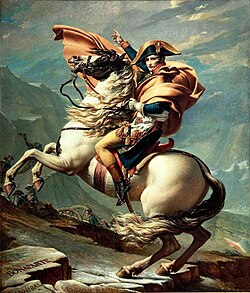
Napoleon and the bulk of the Reserve Army arrived between San Giuliano and Tortona on 13 June, after passing the Scrivia, enlarged by recent rains. The console was particularly concerned because of the small numbers of its cavalry: the reconnaissance and perlustration operations of the area were therefore impossible. While not able to rely on the cavalry, Napoleon decided to send Victor's body into avant-garde, asking the general to occupy the town of Marengo and to make a brief search along the Bormida to verify the presence of enemy forces. Victor found himself in front of a weak rearguard, about 3000-4000 Austrians, who managed to drive towards Alessandria without too much difficulty. Gardanne would have wanted to continue the pursuit oltra la Bormida, but the passage on the river was heavily covered by enemy artillery. With regard to his reconnaissance on the Bormida, this resulted in a negative outcome: no trace of other major Austrian departments.[25][26][27][28]
This new information dismissed Bonaparte: if von Melas was not in Alessandria but had left the town of Marengo covered, it could have moved only southward, towards Genoa, where the forces of Hohenzollern were located. Once in Liguria he could then cross the Apennines again and arrive in Mantua after a long march or, thanks to the support of the English fleet, mount a resistance in the Ligurian capital.[25] As a result, Napoleon decided to send Desaix, just arrived from Egypt, with the Boudet division at Rivalta to cut them off to Novi Ligure, Acqui Terme and Liguria. In the same way, to protect his right flank, he sent Monnier's division towards Castelnuovo Scrivia.[29] Napoleon, who maintained a certain sense of restlessness, at some point manifested his intention to return to Pontecurone, to receive updates on the divisions of La Poype and Moncey, but the flooding of the Scrivia forced him to remain in Torre Garofoli, his headquarters near Tortona.[30][31]
The positioning of his troops was the following:
- the Gardanne division, sent forward by Victor, occupied the Pederbona farmhouse,[32] between Bormida and Marengo;[28][29]
- the rest of Victor's forces, constituted by the Chambarlhac division, are located in Marengo;
- the cavalry of General Kellermann was behind the village while that of Champeaux covered the road to Sale;
- Lannes was in the plain of Marengo, near San Giuliano, to form a second line of defense a few kilometers behind Victor;
- Monnier and his division remained on the Scrivia;
- Napoleon along with the Consular Guard was in reserve at Torre Garofoli;
- the division under Desaix's command was moving away in the direction of Rivalta.[25][28][30][33]
These forces were accompanied by 40 guns. However, Napoleon for the next day imagined obtaining information about Austrians and clearing his ideas on their intentions, certainly not to engage in battle.[25] Leaving his men so scattered, the French commander stood at a big risk: if he knew that the Austrians intended to attack him, he would probably have kept Desaix's forces close and would call La Poype from Ticino.[34]
Order of battle
The army at the beginning of the battle was so composed:[35]
Corps: General of Division Victor
- Division: Brigade General Gardanne
- 44th Semi-Brigade (3 battalions)(1748)
- 101st Semi-Brigade (3 battalions)(1890)
- 102nd Semi-Brigade (1 platoon)(53)
- Division: General of Chambarlhac Division
- Brigade: brigade general Malher
- 24th Light Semi-Brigade (3 battalions)(1801)
- 43rd Semi-Brigade (3 battalions)(1901)
- Brigade: Brigadier general Rivaud
- 96a Semi-Brazide (3 battalions)(1586)
- Brigade: brigade general Malher
Corps: General of Division Lannes
- Division: General of Watrin Division
- Brigade: brigade general Malher
- 6v Semi-brigade (3 battalions)(1114)
- 40th Semi-Brigade (3 battalions)(1716)
- Brigade: brigade general Gency
- 22nd Semi-Brigade (3 battalions)(1255)
- Brigade: brigade general Mainoni
- 28th Semi-Brigade (3 battalions)(998)
- Brigade: brigade general Malher
Corps: General of Desaix Division
- Division: General of Monnier Division
- Brigade: brigade general Carra Saint-Cyr
- 19th Light Semi-Brigade (2 battalions)(914)
- Brigade: brigade general Schilt
- 70a Semi-Brazide (3 battalions)(1460)
- 72a Semi-brigade (3 battalions)(1240)
- Brigade: brigade general Carra Saint-Cyr
- Division: General Boudet
- Brigade: Brigadier general Musnier
- 9th Lightweight semi-brigade (3 battalions)(2014)
- 30th Semi-Brigade (3 battalions)(1430)
- Brigade: brigade general Guènand
- 59a Semi-brigade (3 battalions)(1872)
- Granatieri and hunters of the Consular Guard (1 battalion)(800)
- Brigade: Brigadier general Musnier
Cavalleria: General of the Murat division
- Brigade: brigade general Kellermann
- 2nd Heavy Cavalry Regiment (3 squadrons) (120)
- 20th Heavy Cavalry Regiment (3 squadrons) (300)
- 21st Heavy Cavalry Regiment (1 squadron) (50)
- Brigade: Brigade general Champeaux
- 1st Dragoon Regiment (4 squadrons)(450)
- 8th Dragon Regiment (4 squadrons)(328)
- 9th Dragon Regiment (3 squadrons)(220)
- 6th Dragon Regiment (4 squadrons)(300)
- 12th Mounted Chasseurs Regiment (4 squadrons)(300)
- 11th Hussar Regiment (2 squadrons)(200)
- Brigade: Brigadier general Rivaud
- 21st Mounted Chasseurs Regiment (4 squadrons)(359)
- 12th Hussar Regiment (4)(400)
- 3rd Heavy Cavalry Regiment (2 squadrons)(150)
- 1st Hussar Regiment (1 squadron)(151)
- Granatieri and hunters of the Consular Guard (2 squadrons)(360)
Artillery
- Horse and walking artillery (618)
- Consular Guard artillers (72)
Austrian Army
Battle Plans and General Situation
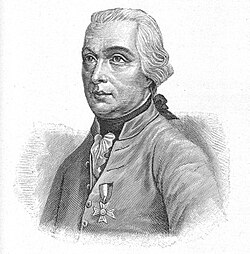
After the defeat of Ott in Montebello, the French landed on the Austrian army's way to Stradella, which would quickly lead them to Mantua.[36] As he could no longer escape the enveloping French maneuver without defeating them in open field, von Melas, puzzled on the actions to be taken he summoned a war council on June 12.[37] The Austrian army officers were able to conceive only three possible plans given the situation:
- cross the Po to Valenza and force a passage on Ticino to Pavia;
- to reach Genoa and prepare for a siege;
- immediately engage in battle with the French.
With little surprise, considering that the first two plans proposed were of difficult realization and poor chances of success, the majority of Austrian officers, including the same von Melas, decided to opt for an immediate fight.[36] The Austrians could count on about 31000 men, of whom at least 7000 were cavalry, and over 200 cannons:[38][39] it was, at least theoretically, an army well suited to fight on an open plane like that in front of Alessandria.[38]
The von Melas plan consisted first of all in moving 8000 men under the command of Ott on the left, to sink towards Sale. He himself, with the main body, composed of divisions of Hadik, Kaim, Morzin and Elsnitz (about 20000 men), he would march on Marengo and San Giuliano, then fold on the left to overwhelm the opposite enemy to Ott. Finally, O'Reilly on the right, advancing with 3000 men on La Stortigliona, would have covered the right of the main body and would have supported him by attacking the enemy on his side,[40][41] keeping ready to move towards Acqui if anything Suchet's forces were in the south.[40] Obviously, the loss of Marengo and the withdrawal of the vanguard on the bridgehead of Bormida made more uncertain the success of this plan, based on the assumption that the army would start completely lined up by the right bank of the Bormida.[41]
It should be noted that not all men at the disposal of von Melas enjoyed full health: the men of Elsnitz, for example, had returned only a few days before the Var, after facing a week of forced marches and fighting against the forces of Suchet. Only a group of 3000-4000 garters were in a position to fight while the rest of his soldiers were relegated to the garrison of Alessandria.[42]
Provision
The army at the beginning of the battle was so composed:
Avanguardia:
- Division: Field Marshal Quosdanovich
- Colonel Frimont.
- Light Infantry Battalion Bach (277)
- Light Infantry Battalion Am Ende (291)
- 4 companies of Jäger Mariassy (164)
- Dragon Regiment Kaiser (2 companies) (272)
- Jäger's Horse Riding Regiment Bussy. (2 companies) (186)
- 1 company of horse artillery
- 1 pioneer company (100)
- Colonel Frimont.
Central column:
- Division: Lieutenant Marshal Hadik von Futak
- Brigade: Major General Pilates
- Dragon Regiment Kaiser (4 squadrons) (309)
- Dragon Regiment Karczy (6 squadrons) (1053)
- Brigade: Major General Bellegarde
- Infantry Regiment Jelačić (1 battalion) (613)
- Infantry Regiment Erzherzog Franz Anton (2 battalions) (855)
- Brigade: Major General Saint-Julien
- Infantry Regiment Michael Wallis (3 battalions) (2209)
- Brigade: Major General Pilates
- Division: Lieutenant Marshal von Kaim
- Brigade: Major General de Briey
- Infantry Regiment Franz Kinsky (2 battalions) (1604)
- Brigade: Major General Knežević
- Infantry Regiment Erzherzog von Toskana (3 battalions) (2188)
- Brigade: Major General de la Marselle
- Infantry Regiment Erzherzog Franz Josef (3 battalions) (111)
- Brigade: Major General de Briey
- Division: Major General Morzin
- Brigade (2116): Major General Lattermann
- Battalion of grenadiers Weber.
- Battalion of grenadiers Pers
- Battalion of grenadiers Paar
- Battalion of grenadiers Scythes
- Battalion of grenadiers Czerwenka
- Brigade (2240): Major General Weidenfeld
- Battalion of grenadiers Gorschen
- Battalion of grenadiers Saint-Julien
- Battalion of grenadiers Weissenwolf
- Battalion of grenadiers Pertusy
- Battalion of grenadiers Pire
- Battalion of grenadiers Khevenhüller
- 4 pioneer companies (400)
- Brigade (2116): Major General Lattermann
- Division: Lieutenant Marshal Elsnitz
- Brigade: Major General Nobili
- Dragon Regiment Erzherzog Johann (6 squadrons)(859)
- Dragon Regiment Liechtenstein (6 squadrons)(1014)
- Brigade: Major General Nimsch
- 7th Regiment of Wesaries (8 squadrons)(1353)
- Wear Regiment Erdödy (6 squadrons)(1214)
- Artillery reserve
- Brigade: Major General Nobili
Left column: Lieutenant Marshal Ott
- Avanguardia: Major General Gottesheim
- 1 Jäger company Mariassy (40)
- Dragon Regiment Lobkowitz (2 squadrons)(248)
- Infantry Regiment Frölich (1 battalion) (523)
- 1 horse artillery battery
- Division: Lieutenant Marshal Schellenberg
- Brigade: Major General Retz
- Infantry Regiment Frölich (2 battalions) (1046)
- Infantry Regiment Josef Mittrowsky (3 battalions)(853)
- 1 pioneer company (100)
- Brigade: Major General Sticker
- Dragon Regiment Lobkowitz (4 squadrons) (492)
- Infantry Regiment Spleny (3 battalions) (737)
- Infantry Regiment Josef Colleredo (3 battalions) (1359)
- Brigade: Major General Retz
- Division: Lieutenant Marshal Vogelsang
- Brigade: Major General Ulm
- Infantry Regiment Stuart. (3 battalions) (1282)
- Infantry Regiment Hohenlohe (2 battalions) (9l2)
- Artillery reserve
- Brigade: Major General Ulm
Right column: Lieutenant Marshal O'Reilly
- 1 Jäger company Mariassy (40)
- Wear Regiment Mauendorf (3 squadrons)(426)
- 5th Regiment of Welders (2 squadrons)(230)
- 1 horse artillery battery
- 4th Infantry Regiment Grenz Banat (1 battalion)(533)
- 1st Grenz Infantry Regiment Warasdy (1 battalion)(755)
- Infantry Regiment Grenz Ougliner (1 battalion)(602)
- Infantry Regiment Grenz Ottochaner (1 battalion)(298)
- Dragon Regiment Württemberg (1 squadron)(113)
As for the artillery, however, the Austrians brought 92 guns to the battlefield,[43][44] although they still had about a hundred Alessandria.
The battle
The first clashes and battle for Marengo · The Austrian advance · The arrival of Bonaparte and the fold towards San GiulianoExplore this chapter
The first clashes and battle for Marengo
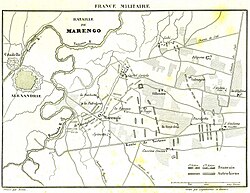
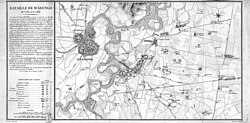
At five o'clock in the morning of 14 June, shortly after dawn, the imperial army started. The bulk of the Austrian forces had been bivaccinating Alessandria and had to pass the Bormida on a single bridge, slowing down considerably the Austrian attack. The O'Reilly division, anticipated by Colonel Frimont's column, was the first to pass the bridge and attack General Gardanne's outpost near Pederbona. Supported by the fire of 20 cannons, Austrians were right of the French division, which despite everything fought valiantly, and repelled it to nearby Marengo. The fight, which began at 8:00 a.m., lasted for almost two hours before the French were forced to grant land to avoid being encircled. Victor, after hearing the first signs of the clashes, made Chambarlhac prepare for a first concrete resistance. Ott and Elsnitz would head north, form the extreme left of the Austrian side, pointing to Castelceriolo; Hadik and Kaim would go to form the center with their divisions while O'Reilly, after taking the Pederbona cascina, would be placed on the right.[29][45][46][47] Desaix, alerted by the Austrian cannon echoes, stopped his march.[48] Instead Bonaparte, at least in the beginning, considered them only a diversion of the enemy and did not overly care to investigate what was happening.[49]
While the Austrians used precious time to deploy properly and place their batteries, the French prepared to defend Marengo. In front of the village there was a canal, the Fontanone, which enlarged from the rains went to form the main line of defense that Victor's body went to protect. Behind the infantry, General Kellermann's cavalry units were placed on the French left and Chapeaux on the right. Further south, instead, near the farmhouse La Stortigliona, a small group of Republican soldiers would try to prevent O'Reilly from continuing in its advanced state. Obviously, these measures would not have been enough to hold the entire Austrian army on place, but they had the sole purpose of earning sufficient time to allow other French divisions to arrive in place and support Victor's efforts.[50] At 8:00 a.m., the first Austrian attack on the French defences of Fontanone finally arrived: General Hadik, who advanced against Victor's center at the head of the Bellegarde brigade under the protection of five artillery batteries. Behind him, General Kaim was ready to support his effort while Ott, after waiting for the rest of the army to stand and that the road to Castelceriolo was free, moved northward, threatening to circumvent the French line from the north.[51] Hadik threw his men in addition to the canal, but was welcomed by the bullets and bayonets of the Rivaud brigade, who managed not only to arrest the advance of the imperials but also to hunt them back. Despite the fire of the enemy guns being pointed to the position of Rivaud, on the left of Marengo, the French continued with gunfire and were able to bring back the enemy to the other side in the canal. During this phase of the clashes, General Hadik, who led his troops from the first lines, was struck by a bullet, dying on the blow. His division ended with the withdrawal in disorder and the command of operations on Fontanone passed to Kaim.[52]
The Austrian advance
(Message from Napoleon to Desaix[53])
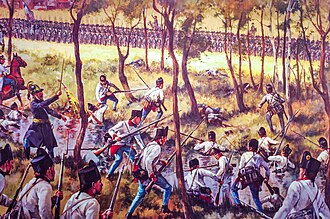
Between 9 am and 10 pm, the first relations arrived before Bonaparte who finally convinced himself that a battle was taking place in Marengo. Immediately, he ordered both the La Poype division and the Desaix division. La Poype, who was in Valenza, received the message too late; Desaix, however, less than a twenty-mile distance, received the message and immediately marched towards Marengo. In turn he sent a courier to Napoleon: he and his division would arrive on the battlefield around 17.[54] In the meantime, even for the greater Austrian state there were some scratches to be resolved: a report just arrived informed of the presence of General Suchet's forces near Acqui. Not being able to allow the arrival of other French divisions on the battlefield, Melas was forced to detach a body of 2200 men under General Nimsch's command to block the threat.[48][55][56] In fact, Suchet had not arrived at Acqui and sighted troops were part of a small vanguard.[48]
In the meantime, Bellegarde's brigade had gathered to itself the remains of Hadik's forces and had sided along the Fontanone, covering Kaim's left. Bellegarde managed to cross the Fontanone, passing in a point north of Marengo, so as to completely evade the French disembarkation of Victor's divisions. His forces occupied the La Barbotta farm. Lannes, who came to strengthen Victor a Marengo's men, brought forward the Watrin division, and engaged against Bellegarde: the Austrians were quickly rejected in addition to Fontanone.[57] Further south, however, not far from La Stortigliona, General Pilati had managed, with great difficulty, to open a gap between the French lines and to cross the Fontanone with a regiment of dragons. The Austrians were about to charge the French infantry when the providential intervention of Kellermann's cavalry, which had noticed the appearance of the imperials, completely destroyed enemy formation. Only a few of the soldiers of Pilates managed to return to the Austrian bank of Fontanone.[58] In those same moments, the Republicans who defended La Stortigliona were overwhelmed by the Austrian assault and the cascina fell into imperial hands.[58]
Unfortunately for the French, Ott had finally managed to get to Castelceriolo, virtually defenseless, and now threatened the side of the French. Lannes sent his cavalry reserves to counter them:[58][59][60] General Chapeux twice charged the forces of Ott, who also continued their march forward. During one of these charges, Chapeux was severely wounded; he died a few days later.[29][48][59] Coming back to Marengo, Bellegarde's forces managed to cross the canal and compete for Victor's men. It was General Rivaud who took them away, taking over the village's possession: both Rivaud and the Austrian general Lattermann were wounded at this stage.[48][61] The Austrian pressure finally began to bear fruit: the artillery of de la Marselle put in extreme difficulty the men of Chambarlhac at Marengo, who was forced to reverse.[48] In fact, after hours of fighting under the constant bombardment by the enemy artillery and with the ammunition now poor Victor's forces began to yield and, though slowly, they began to fold.[62] Behind, Victor discovered the left flank of Lannes, whose position became vulnerable. The general immediately gave the order to fold in order to avoid unnecessarily exposing himself to the Austrians.[63] They began to pour into mass on the other side of Fontanone, forcing the whole French line to retract. Among the prisoners was General Rivaud.[48]
The arrival of Bonaparte and the fold towards San Giuliano
Around 11 am, Bonaparte finally managed to reach Marengo with reinforcements: he had the Monnier division, the Consular Guard and two cavalry regiments, for a total of 7000 about men, however insufficient to fill the gap of forces between the two sides. A few moments were enough to take a picture of the situation and take appropriate measures: he understood that the main threat was given by Ott's men. He gave his orders to General Dupont and sent the brigade of Carra Saint-Cyr, belonging to the Monnier division, to Castelceriolo to hold them.[48][63][64][65] The impact of the men of this brigade was remarkable: Ott's advance was arrested and the pressure of the Austrians on Lannes' divisions decreased considerably.[66][67] Later, he dismissed the Consular Guard squarely and sent it against the enemy cavalry of Schellenberg. These measures, although initially effective, failed to stop the Austrian moment: Ott, recalled part of the cavalry, managed to expel Carra Saint-Cyr from Castelceriolo and forced the French to retire to Villanova while the Consular Guard, turned on his side by Gottesheim's men while he was engaged in colliding with the dragons of Lobkowitz, suffered heavy losses and struggled.[60][63][65][67]
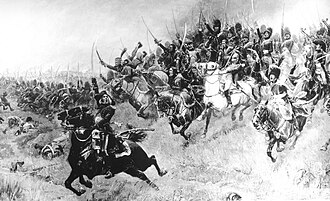
With the Victor division now exhausted and in the process of performing a disorderly retreat, Napoleon ordered Murat to protect the center of the line as he could. French conduct during the retreat, especially that of Lannes' men was remarkable: while folding, they continued to respond to Austrian attacks, prolonging the fight for at least two hours,[63] while the rest of the French forces, especially Victor's, gathered behind San Giuliano.[64] The French line, which was at least three kilometres, passed from Marengo to San Giuliano, and the forces of Monnier retreated further north towards Villanova, leaving room for Ott's advance.[68] Even the men of Lannes, tired and demoralized, gathered in front of the same town.[63] In all this fringe, Bonaparte held a watchful eye on the rear, waiting for the arrival of Desaix or La Poype.[69][70]
The efforts of Lannes and Bonaparte, in conclusion, were not enough and soon the entire line followed Victor, moving towards San Giuliano with a lot of order.[69] If the Austrian cavalry had not been heavily weakened during the previous hours, given the destruction of the Pilate brigade and Nimsch's removal, Commander von Melas could have attempted a bypassing manoeuvre and ended the confrontation with a rapid victory.[68] Elsnitz led several charges against the retreating French forces, but Republicans resisted.[64] He believed that he had the victory at hand, towards two o'clock in the afternoon von Melas, exhausted by the heat and was slightly wounded during the battle, retired to Alessandria to lay down a report of his victory, leaving command on the field to his chief major state, General von Zach. Around four o'clock in the afternoon, the replacement of von Melas continued in advance, bringing his army over Cascina Grossa, while the French, almost a kilometre distant, continued in their retreat.[71] By now his men waited for only two possible orders: to continue the march or to stop on the battlefield and celebrate victory.[72]
The arrival of Desaix and the French victory
(Desaix addressing Bonaparte shortly after his arrival on the battlefield)
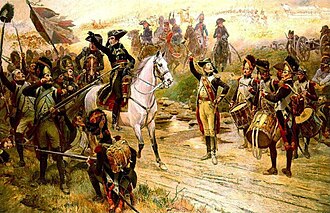
Von Zach brought his 6000 men at the Republican positions in column: before there was the Brigade Saint-Julien, followed by the grenadiers of Lattermann and the dragons of Lichtenstein; behind them, about half a kilometer westward, there was the Kaim division, with the brigades Knesevich, Bellegarde and de la Marselle. At the same distance, even further back, was the reserve, consisting of the Weidenfeld grenades and a cavalry brigade. On the sides, de Briey took the road to Cassina Grossa with three battalions while, further north, Ott continued towards Villanova, then taking the direction of Villa Ghilani.[72] This provision, in addition to requiring different time to be adopted,[70] He left the individual brigades too far away from each other to be able to support one another.[73] They were the four in the afternoon when he began his movement: the imperials were tired, especially the departments from Nice and Liguria, and not even arranged in a good order, but convinced that the French were now defeated and unable to react moved towards San Giuliano.[70]
The French, on the other hand, were demoralized and exhausted. Lannes, retired between Villanova and Buschetta, was exchanging a few cannon shots with the vanguard of Frimont and Ott; Victor, taking advantage of San Giuliano's throat, had gathered 2 or 3 thousand men under the protection of the cavalry of Kellermann and Champeaux; Monnier had folded following the rest of the army. The cavalry brigade of Rivaud, which had left Sale, finally went towards Piovera.[74] The forces of General Desaix began to be seen near San Giuliano: their appearance was enough to make the morale of other republicans impede. Desaix came immediately to interview with other officers: the opinion of the majority was to accept defeat and save the remaining troops but neither Napoleon nor the commander of the Boudet division were of this view. Specifically, Desaix believed that there was still enough time to resume the fight and end the day with a victory.[75] Using his usual charisma and energetic style, Napoleon turned directly to his men saying:
(Napoleon to his soldiers[69])
Bonaparte immediately enlisted the division of Desaix and the rest of his troops around San Giuliano. Desaix was deployed in front of the main road, the one on which the Austrians advanced. On his right there were Lannes, Monnier and the Consular Guard; behind him was Victor. Kellerman's cavalry brigade was placed on the left and behind Desaix, and the Champeaux brigade on the right and behind Lannes.[75][76][77] All the remaining cannons, which were added to the Boudet division, were put to the right of Desaix and entrusted to General Marmont.[73]
When von Zach and his soldiers were sufficiently close to San Giuliano, Marmont opened fire of his battery against them, hitting them repeatedly. At the same time, escaping from the village, the entire division of Desaix poured on the first two rows of the Austrian avant-garde. Completely surprised by the mass of soldiers who had just arrived against them, they gave themselves to a disorderly escape, leaving Lattermann's grenadiers to suffer shock with the French. Von Zach, who personally commanded the brigade temporarily stopped the French. The same cannot be said of Lichtenstein's cavalry, which was loaded by Kellermann quickly diluted. Unfortunately, Desaix, who had been leading his troops and bravely led the attack from the first lines, was struck by a bullet to the heart, dying on the blow. The general's death prompted the Republicans to fight more vigorously, in an attempt to avenge their commander.[78][79] The Boudet division struggled to have reason for Lattermann's grenadiers until Kellermann's cavalry, after liberating the Austrian counterpart, rushed on their side: far from other departments and hard pressed, almost 2000 Austrians laid down their weapons. Among the captured was von Zach himself.[78][80][81]
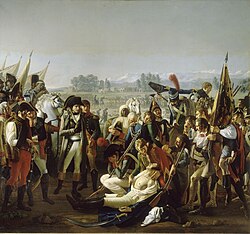
The success of the Boudet division dragged the rest of the French army: Lannes, having seen the successes of his colleague, moved quickly into the space between Kaim and Ott, then turning his attention to the troops of the first commander: the vanguard of Kaim, formed by the brigade Pilati, seeing first the cavalry of Lichtenstein beat in retreat and then standing before the rapidly advanced French, gave their example. Kaim tried to deploy his battalions but Kellermann charged them, throwing them into the disorder and making prisoners inception. The rest of the Austrian army, without any indication and equally surprised by the unexpected attack of the Republicans, fled, trying to reach the bridges on Bormida and return to Alessandria. In less than an hour, the French resumed the ground that the Austrians had severely conquered in a struggle lasting throughout the rest of the day. The advance of the French did not stop and soon arrived to Marengo, where Melas, who was franticly back on the battlefield, had collected his forces and hoped to maintain his position. It was not so: the French divisions arrived quickly and expelled the remains of the imperial army, forcing the few Austrian departments remaining in the plain of Alessandria to abandon the position and return to the walls of the nearby town. Only the forces of O'Reilly and Weidenfeld remained temporarily in Spinetta. They also began to lose ground: they initially defended near the Pederbona but with the passing of time they were forced to retreat beyond the Bormida.[81][82][83] The same was that of Ott: being against the forces of Lannes, Monnier and Rivaud, he continued to retreat, always in perfect order, until he reached the gates of Alessandria, where he returned before being further attacked by the French after helping the last battalions left outside the walls to fold with order.[81][82][84] At ten o'clock in the evening, all Austrians had returned to Alessandria.[85]
Napoleon, as soon as he received the news of his friend Desaix's death, was tremendously discouraged. Desaix's body remained lost for a long time between the thousands of soldiers who fell into battle, but was later identified because of his clothing, being in fact the general usually wearing civilian clothes under the uniform. Napoleon took care of tumulating his friend in the hospice of the Piccolo San Bernardo hill, letting it be a place at the height of his fellow fallen into battle, making erect a monument to his memory.[86] Curiosously, that same day, in Egypt the commander Kléber, friend and close collaborator of Desaix, was killed by a Syrian student.[87]
Consequences
Marengo's defeat finally sealed the fortunes of the army of von Melas: surrounded by the French had no escape. The Austrians, in theory, had...Explore this chapter
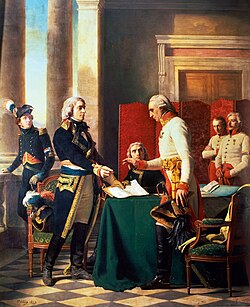
Marengo's defeat finally sealed the fortunes of the army of von Melas: surrounded by the French had no escape. The Austrians, in theory, had almost 100000 soldiers in northern Italy but were too far away and distributed in groups too small to be of any help in this circumstance.[88] The French, however, still had at their disposal the forces of Moncey, who remained in Milan, and the remains of the Italian Army of Suchet and Massena, which, however stremous they could quickly reach the plain of Alessandria.[89] von Melas summoned a war council on the same evening of 14 June: most Austrian officers were set up to obtain an agreement with the French and evacuate the Piemonte, hoping to be able to resume the fight later. The following morning, an Austrian diplomat came across from the French outposts, asking for the return of General von Zach and to be able to deal with the terms for a armistice. Napoleon, delighted with this, sent Berthier to Alessandria to treat the Austrian surrender.[90]
The agreement mainly provided that the Austrian army retreated behind the Mincio while the French forces could occupy all the Piemonte and part of Lombardy, up to the course of the rivers Oglio e Chiese. Thus, with the battle of Marengo the French returned to masters of much of northern Italy, obtaining also a six-month armistice. Moreover, after the events of the second Italian campaign, Bonaparte's position as Primo Console was strengthened. The news of Napoleon's victory spread rapidly throughout Europe: a few days later, the forces of Moreau and Kray, who fought in Germany, entered into an almost identical convention in Parsdorf, stopping the clashes also on the German front.[91]
After the ratification of the Convention by the Austrian authorities, the diplomats of both nations attempted to reach an agreement for peace but, under the influence of the United Kingdom, which was pressing for the continuation of the conflict, it did not settle and hostility resumed in the final part of the year. Both in Germany and Italy, the strongholds were profoundly changed and Austrians were heavily defeated both at Hohenlinden by General Moreau and Pozzolo by General Brune. After these two defeats, a new armistice arrived[92][93] and finally the Habsburgs decided to sign peace with Republicans.
The impact of the battle on Napoleon
Napoleon, for the rest of his life, was always fond of the memory of the Battle of Marengo, which on one side finally consolidated his political ascent and...Explore this chapter
Napoleon, for the rest of his life, was always fond of the memory of the Battle of Marengo, which on one side definitively strengthened his political and military ascent while on the other deprived him of one of his very few friends, as well as one of the best French commanders. For example, he decided to call his own Marengo horse, bringing it with him in many of his own campaigns, and made a new coin, the "gold seam". Two other famous battles, those of Friedland and Raab, fell both in the anniversary of Marengo: Napoleon in the first case, a few days after victory, surrendered his soldiers, saying that they had honoured the anniversary of Marengo,[94] While in the other case, he congratulated his daughter Eugenio, commander of the Victorious Napoleonic forces, saying that his victory at Raab was "a little daughter of Marengo and Friedland".[95] During the Battle of Waterloo he was repeatedly felt imprecise by his undergoing "oh, if I had here my general Desaix... he would know how to solve the situation..." because much of the merits of French victory at Marengo depended on the arrival of Desaix's fresh troops, while at Waterloo Napoleon waited in vain for the arrival of Grouchy forces (who had with him a third of the French army). On 5 May 1821, in St Helena the emperor's body was wrapped by the helper Marchand in the blue cloak he had worn at Marengo.[96] At the point of death, and in prey to the delirium, Napoleon would pronounce both the name of Marengo and that of Desaix and seemed to relive the battle.[97]
Historical memory of the battle
Memories · The Battle Museum · Memorial monumentsExplore this chapter
Memories
For a fortuitous case, General Soult, after the surrender of Genoa, was to Alessandria, where he was admitted to treat some serious injuries suffered during the siege of the Ligurian city. Close enough to hear the noise of the battle, he described his experience in his memoirs, in which he tells about his dialogue with an Austrian doctor shocked by the outcome of the battle. After the Austrian surrender, in order to continue on-site care, he was treated as a prisoner of war.[98]
The Battle Museum
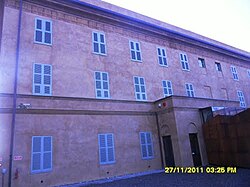
A Spinetta Marengo, fraction of Alessandria, stands the Marengo Museum, located inside Villa Delavo. The Museum of the Battle of Marengo is the oldest Napoleonic museum in the world, founded in 1847 inside Villa Delavo in Spinetta Marengo; recounts the political and military preparation for the event of 14 June 1800, and analyzes the causes and effects of the battle, both for pre-unification Italy and for the whole of Europe. Every year a historical re-enactment of the Battle of Marengo is organised, consisting of movements of troops in costume, with the participation of the Italian and French Napoleonic clubs. The museum has an enclosed park with inside a chapel of the unknown soldier containing some remains of 2000 Soldiers died only on the day of June 14, 1800 in the battle. In the park there is also a 4 meters high column with a Napoleonic eagle on top of the battle era. It was first removed under the Austrian domination and then found by Gabriele D'Annunzio is not known as in the city of Rijeka and relocated in 1922 in the park of the museum of Marengo during the Kingdom of Italy.
Memorial monuments
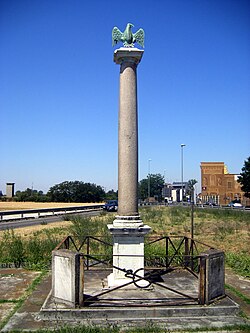
Napoleon tried to make sure his victory was not forgotten, so in addition to the propaganda campaign, he entrusted General Chasseloup with building a pyramid on the site of the battle. On May 5, 1805 a ceremony took place on the field of Marengo. Napoleon, dressed in the uniform that he wore on June 14, 1800, together with Empress Josephine sitting on a throne placed under a tent, cured a military parade. Chasseloup gave Napoleon the foundation stone, on which it was written: "Napoleon, emperor of the French and king of Italy, to the ridge of the defenders of the homeland who lost the day of Marengo". This pyramid was actually part of a very ambitious project aimed at glorifying Bonaparte's conquests in Italy. The field of Marengo had to become the site of a "citizenship city" whose avenues, so called by Italian battles, converged towards the pyramid. In the end, the project was abandoned in 1815 and the stones recovered by farmers. It was also removed the column erected in 1801, except to be restored in 1922.
In the territory of San Giuliano Vecchio, in via Piacenza, near the area called already at the time of the battle "Vigna Santa", is situated a small memorial dedicated to the valiant general Desaix dead in the battle.[99] General Louis Charles Antoine Desaix, based on the most reliable testimonies of the time, was killed by a muskete bullet in the area between Cascina Grossa, San Giuliano Vecchio and Torre Garofoli. The general was found at the evening of 14 June 1800 dressed only in a white shirt, robbed of other garments, from his Savary field helper and transported by them wrapped in a cloak in rump to a horse until Napoleon's headquarters in Torre Garofoli.
Out from Alessandria in the direction of Spinetta Marengo, just before the bridge on the Bormida river, there is a platanum, called for the purpose of the Platian Napoleon, that the tradition wants was planted in 1800 by Napoleon to honor the approximately 2000 dead soldiers on the day of battle and 10000 wounded by both sides, of which 7000 They died later because of the serious injuries and infections that medicine of time could not cure.[100] A plaque near this platano attests its historicity. It is over 200 years old and is about 40 meters tall; its leafs cover an area of approximately 400 m2 when it is spring/summer.
In mass culture
Kitchen · Music · ComingExplore this chapter
Kitchen
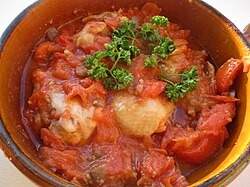
The "Pool alla Marengo", prepared with shrimps of river, eggs and mushrooms, was cooked for Napoleon who was greedy of chicken; the tradition wants that, short of supplies, the cook of French troops Dunand had opted for this strange combination that the French general found of his taste.
The steward also prepared a dessert with the few things available in the kitchen. In fact, having at its disposal the corn flour processed a dessert that called "polenta", made also with raisins, almond paste and maraschino. Pleasant to Napoleon this sweet developed in Alessandria and later (in 1900) it was called "Polenta del Marengo" and finally patented.
Music
It is said that General Lasalle composed Fanchon, considered the song of Napoleonic soldiers, also known as The Madelon de Marengo or Le Chant des Marie-Louise, during the meal that followed the battle and in which Bonaparte participated.[101]
The Battle of Marengo is also a composition for piano or organ of the French composer Bernard Viguerie. It is a descriptive music that narrates, in fact, the Battle of Marengo: it is divided into several episodes explained by short texts. It is curious to note what Vigurie writes on the second page: "The cannon shots will be expressed by laying the right arm and two flat hands above the three octaves of bass to make all the notes sound ring indistinctly, and it will support the sound as long as the vibrations are almost damped".[102]
The Battle of Marengo also makes the background to Tosca by Giacomo Puccini, who recalculates the alternation of the moments: good part of the first act (starting from the air of the sacristan "All here the singing..." and, especially, the final) rotates around the preparation and subsequent development of the Te Deum of thanks for the alleged victory as announced by the untimely dispatch of von Melas; in the second act, in the middle of the dramatic scene of torture of Cavaradossi, the subsequent news of the definitive defeat of Austrians, marks the acme and the subsequent dissolution of the scenic action (air: "Vittoria, victory..." of Cavaradossi).
In honor of the battle a march was made, entitled Marche de la garde consulaire à Marengo.[103]
Coming
In January 1989 he went out on the weekly Mickey Mouse (n. 1731) a story, entitled Mickey Mouse and the chicken at Marengo, in which the battle of Marengo is the setting. The story in question, written and illustrated by Giampiero Ubezio, sees Mickey and Goofy go back in time to the day in which the clash between the French and the Austrians took place, to solve the mystery behind this battle.[104]
Sergio Bonelli Editore published, in February 2015, a comic book entitled The Battle of Marengo, written by Pasquale Ruju and illustrated by Franco Saudelli. Protagonists of the comic book, part of the series The stories, they are two boys, one of whom tells the other the story of one of her ancestor during the battle between the Austrians and the French.[105]
Notes
Explore this chapter
- ^ (EN) Brauer and William E. Wright, Austria in the Age of the French Revolution: 1789-1815, Berghahn Books, 1 December 1990, p. 34, ISBN 978-1-57181-374-9. Retrieved 21 April 2013.
- ^ (EN) Holger Afflerbach and Hew Strachan, How Fighting Ends: A History of Surrender, Oxford University Press, 26 July 2012, p. 215, ISBN 978-0-19-969362-7. Retrieved 17 April 2013.
- ^ to b c d Bodart, p. 355.
- ^ Mathiez and Lefebvre, pp. 428-430.
- ^ Mathiez and Lefebvre, pp. 471-473.
- ^ Lefebvre 2009, pp. 43-44.
- ^ Lefebvre 2009, pp. 85-99.
- ^ Cust V, pp. 257-261.
- ^ to b Sargent, pp. 17-18.
- ^ Coppi, pp. 377-382.
- ^ Coppi, p. 380.
- ^ Andrew Roberts, Napoleon the Great, translation by Luisa Agnese Dalla Fontana and Aldo Piccato, Utet Libri, 2023 [2014], pp. 305-306.
- ^ Sargent, pp. 25-27.
- ^ Hugo., pp. 115-129.
- ^ Sargent, pp. 136-159.
- ^ Hugo., pp. 98-107.
- ^ Cust I, pp. 17-19.
- ^ Bottatta, pp. 423-424.
- ^ Coppi, pp. 393-397.
- ^ Coppi, pp. 397-398.
- ^ to b Bottatta, p. 425.
- ^ Coppi, pp. 398-399.
- ^ Bodart, pp. 354-355.
- ^ Coppi, pp. 399-400.
- ^ to b c d Sargent, pp. 159-161.
- ^ Jomini XVI, pp. 265-267.
- ^ Panckoucke, p. 60.
- ^ to b c Coppi, p. 400.
- ^ to b c d Bottatta, p. 426.
- ^ to b Jomini XVI, pp. 267-268.
- ^ Hugo., p. 130.
- ^ Sometimes it is also reported as "Fathern", "Padrebona" or "Pietrabuona".
- ^ Panckoucke, p. 62.
- ^ Sargent, pp. 199-200.
- ^ (EN) French Order of Battle - Battle of Marengo (PDF), up Napoleon Series. Retrieved 04/10/2025.
- ^ to b Sargent, pp. 161-162.
- ^ Jomini XVI, p. 268.
- ^ to b Jomini XVI, p. 271.
- ^ Sargent, p. 162.
- ^ to b Cust I, p. 27.
- ^ to b Jomini XVI, pp. 270-271.
- ^ Jomini XVI, p. 269.
- ^ (EN) Austrian Order of Battle - Battle of Marengo (PDF), up Napoleon Series. Retrieved 04/10/2025.
- ^ James R. Arnold, Marengo & Hohenlinden, 2005, pp. 272-273.
- ^ Coppi, pp. 401-402.
- ^ Jomini XVI, pp. 272-273.
- ^ Panckoucke, p. 63.
- ^ to b c d And f g h Cust I, p. 28.
- ^ Roberts, p. 319.
- ^ Jomini XVI, pp. 273-274.
- ^ Jomini XVI, p. 274.
- ^ Jomini XVI, p. 275.
- ^ Magazine of history, art, archaeology of the province of Alessandria semiannual periodical of the municipal commission of Alexandria, 1900, p. 244.
- ^ Roberts, p. 321.
- ^ Sargent, pp. 164-165.
- ^ Jomini XVI, pp. 275-276.
- ^ Hollins 2006, p. 608.
- ^ to b c Jomini XVI, p. 277.
- ^ to b Panckoucke, p. 65.
- ^ to b Bottatta, p. 427.
- ^ Jomini XVI, p. 278.
- ^ Panckoucke, p. 66.
- ^ to b c d And Sargent, pp. 166-167.
- ^ to b c Coppi, p. 403,
- ^ to b Jomini XVI, pp. 280-281.
- ^ Jomini XVI, pp. 279-280.
- ^ to b Cust, pp. 28-29.
- ^ to b Jomini XVI, pp. 282-283.
- ^ to b c Cust, p. 29.
- ^ to b c Sargent, p. 169.
- ^ Sargent, pp. 167-169.
- ^ to b Jomini XVI, pp. 283-284.
- ^ to b Coppi, p. 404.
- ^ Jomini XVI, pp. 285-286.
- ^ to b Sargent, p. 170.
- ^ Cust, pp. 29-30.
- ^ Panckoucke, p. 70.
- ^ to b Jomini XVI, pp. 288-289.
- ^ Panckoucke, p. 71.
- ^ Panckoucke, p. 72.
- ^ to b c Cust, pp. 30-31.
- ^ to b Jomini XVI, pp. 291-295.
- ^ Panckoucke, p. 73.
- ^ Coppi, pp. 404-405.
- ^ Sargent, p. 171.
- ^ Cust, p. 32.
- ^ Hugo., p. 133.
- ^ Sargent, pp. 173-174.
- ^ Jomini XVI, pp. 297-298.
- ^ Jomini XVI, pp. 298-300.
- ^ Coppi, pp. 406-407.
- ^ Coppi, pp. 407-416.
- ^ Bottatta, pp. 431-439.
- ^ Napoleon's Addresses: 1814 Campaign, up www.napoleon-series.org. Retrieved 10 October 2025.
- ^ (FR) Alphonse Rabbe, Biographie universelle et portative des contemporaneorains, vol. 1, Paris, L'Editeur, 1836, p. 288.
- ^ Bainville 2006, p. 584.
- ^ Bainville 2006, p. 225.
- ^ (FR) Nicolas Jean-de-Dieu Soult, Mèmoires du maréchal-général Soult, duc de Dalmatie, vol. 3, Paris, Librairie d'Amyot, 1854, pp. 275-277.
- ^ GPS: 44°53'16.05N and 8°45'26.93And
- ^ Coordinates of the platano: +44° 54' 28.17", +8° 38' 23.70".
- ^ (FR) Chants de France - Fanchon, up Chants de France. Retrieved 11 October 2025.
- ^ (EN) Bataille de Maringo (sic), up napoleon.org. Retrieved 11 October 2025.
- ^ (EN) St. Hilaire's History of the Imperial Guard: Music of the Imperial Guard, up Nepoleon-series.org. Retrieved 10 May 2021.
- ^ Mickey Mouse and the chicken at Marengo, up inducks.org. Retrieved 21 September 2022.
- ^ A comic book by Tex publisher dedicated to the Battle of Marengo, up lastampa.it, 14 June 2016. Retrieved 29 September 2022.
Bibliography
Explore this chapter
- Jacques Bainville, Napoleon, Milan, Baldini Castoldi Dalai editore, 2006, ISBN 88-8490-920-1.
- (DE) Gaston Bodart, Militär-historisches Kriegs-Lexikon (1618-1905), Vienna and Leipzig, C. W. Stern, 1908.
- Carlo Botta, History of Italy from 1789 to 1814, Paris, 1824, ISBN 9-788-82810116-1.
- David G. Chandler, Napoleon's campaigns, vol. I, Milan, Rizzoli Universal Library, 1992, ISBN 88-17-11577-0.
- David G. Chandler (curated by), The Marshals of Napoleon, Milan, Rizzoli, 1988, ISBN 88-17-33251-8.
- Antonio Coppi, Annali d'Italia dal 1750, vol. 2, Stamperia de Romanis, 1824.
- (EN) Sir Edward Cust, Annals of the Wars of the Eighteenth Century, vol. 5, London, J. Murray, 1862.
- (EN) Sir Edward Cust, Annals of the Wars of the Nineteenth Century, vol. 1, London, J. Murray, 1862.
- David Hollins, The Battle of Marengo 1800, Osprey Publishing, 2000, ISBN 1-84176-117-6.
- David Hollins, "Battle of Marengo" in The Encyclopedia of the French Revolutionary and Napoleonic War, 2006, ISBN 1-85109-646-9.
- (EN) Herbert Howland Sargent, The Marengo Campaign with comments, Chicago, A. C. McClurg and company, 1897.
- (FR) Abel Hugo, France militaire. Histoire des l'armées françaises de terre et de mer de 1792 a 1833., vol. 3, Paris, Delloye, 1833.
- (FR) Antoine Henri Jomini, Campagne de 1800 - Première Période, in Histoire critique et militaire des Guers de la Révolution, vol. 16, Paris, Chez Anselin et Pochard, 1824.
- Georges Lefebvre, Napoleon, Bari, Editori Laterza, 2009, ISBN 978-88-420-5902-8.
- Albert Mathiez and Georges Lefebvre, The French Revolution, Turin, Einaudi, 1992.
- (FR) Charles-Louis-Fleury Panckoucke, Victoires, conquêtes, désastres, revers et Guerras civils des Français de 1792 à 1815, vol. 13, Paris, C. L. F. Panckoucke Éditeur, 1819.
- Andrew Roberts, Napoleon the Great, translation by Luisa Agnese Dalla Fontana and Aldo Piccato, Utet Libri, 2023 [2014].
Continue your journey