A closer look
Spinetta Marengo: at a glance
Spinetta Marengo (The Spinëta in Piedmont and Ra Spineuta in alessandrino dialect) is a village of 7 337 inhabitants of the town of Alessandria.
History
Marengo · Battle of MarengoExplore this chapter
Marengo
News of the area Marenghum well before the foundation of the city of Alessandria.
Marengo was a curia regis longobarda and the first documented sources come from that flourishing period. It is known for certain that the Lombard kings frequented the forests of Marengo and Orba in times before those of Liutprando: King Cuniperto and the usurper Alachis used to hunt on those lands.[2].
The importance of the western backland, Marengo included, was favored in Carolingian age to preside and participate in the defense of Ligurian coasts especially against Arab piracy. In February 825 Lotario I organized an expedition against the Saracens of Corsica during a stay at the court of Marengo[3].
Another example from the chronicles before the city of Alessandria it can be found in the year 898 when the news of the death of Emperor Lamberto II of Spoleto spread. Lamberto had an accident during a hunting trip to Marengo, «On site Marinco [...] cecidisse collumque fregisse»[4]. According to Liutprand of Cremona, the emperor did not have an accident, but was murdered by Hugh of Maginfred, during the hunting trip, to take revenge for the killing of his father Maginfred[5][6]. To date, however, historians accept the thesis of accidental death[7].
Battle of Marengo
On June 14, 1800 it was the scene of an important battle between the French army under Napoleon and the Austrian army led by General Melas. The French victory strengthened the power of the future emperor and allowed him to regain the dominion of Italy. During the battle, French general Desaix died.
Culture
The Treasure of Marengo · Marengo Museum · Torre dei GamberiniExplore this chapter
The Treasure of Marengo
In 1928, at the village of Marengo, during agricultural excavations in a field owned by the Pederbona farmhouse, precious finds from Roman times were found.[8] of the 2nd century.
The objects, all in bad conditions, included among others: a loricated bust depicting the Emperor Lucio Vero made to embalzo in silver foil, a "ansata car" also of silver, with a dedication "Fortuna Melior" by Marco Vindio Veriano, commander of the Fleet Flavia standing in the Mesia at the end of the second century, a silver vase decorated with female leaves.
Bottino of a plunder, probably in late Roman times, is believed that the finds come from a sacello dedicated to "Fortuna Melior" or a college used for imperial worship, located in the city of Pavia, the ancient Ticinum.
Subposed to restoration, the objects are now preserved in the Museum of Antiquities of Turin.
The story linked to the discovery and delivery of the treasure to the state is wrapped in mystery. The official version of the prof. Bendinelli says that the owner of Pederbona, the Cavalier Romualdo Tartara, attempted to sell the treasure to Genoese antiquarians, but he was convinced to take them to the general direction of Antiquities and Fine Arts in Rome, receiving in 1935 a payment of 550 000 lire. Witnesses and facts later showed that much of the findings disappeared after delivery to Roman authorities.
A first attempt to reconstruct the events of that time took place in 1968-1969 by a graduate, with a limited research which revealed the almost certain disappearance of a substantial quantity of finds and all relevant official documents. Recently a renewed interest in the issue, strongly promoted by the nephew of the discoverer interested in escaping every shadow on the honorability of the family, is confirming what has always been asserted by the Tartara in the reconstruction of the affair: the Tartara have never cashed any reward.
Marengo Museum
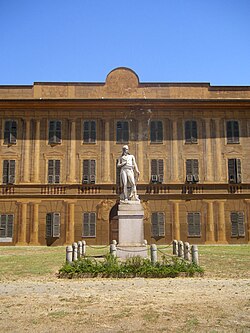
The museum dedicated to the battle is located inside Villa Delavo, built in 1846 by pharmacist Giovanni Antonio Delavo. Inside are preserved artefacts and relics of the time.
The new Museum, inaugurated in 2010, has a strong multimedia and interactive footprint, with works created by contemporary artists. Outside the Museum there is the park of the villa. The symbol of the Marengo Museum is the Pyramid, built in 2009 taking inspiration from an idea of Napoleon himself, who wanted to remember in this way the glory of victory and soldiers fallen into battle, first among all his General Desaix.
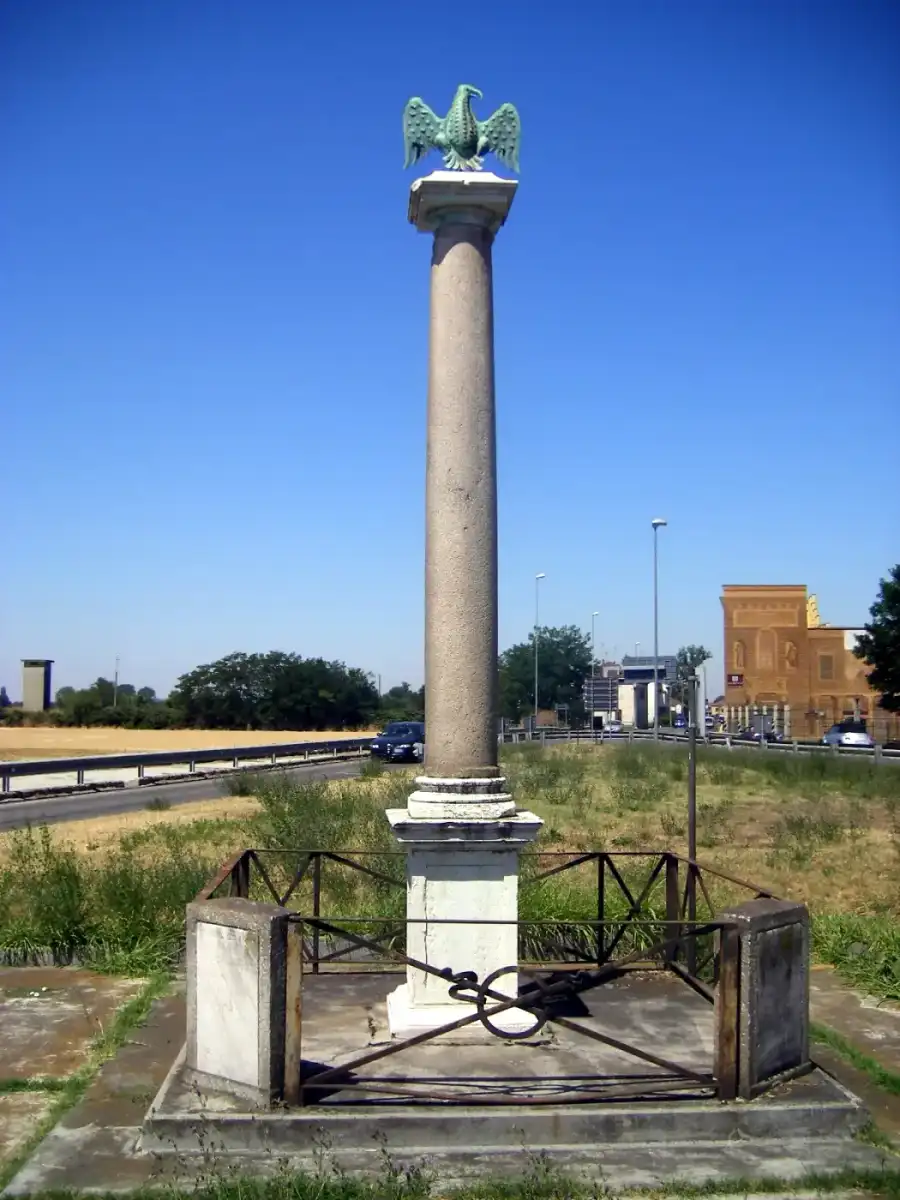
In front of the museum there is a column with bronze eagle, installed by the administration of Alessandria, in 1801, subtracted by the Austrians after the fall of Napoleon and reported on site in 1918.
Torre dei Gamberini
A short distance from the museum rises the fourteenth-century "Torre dei Gamberini" (or the Stortiglioni), by the name of two of the ancient families who founded Alessandria[9][10][11] The square-based tower is also known as the "Torre di Teodolinda" because it is associated with the popular tradition of the Lombard queen lived between the 6th and 7th centuries.[10][11]
Economy
The site of an important chemical center, founded in 1905 by the "Society of Marengo" for the production of copper sulphate, in 1933 acquired by Montecatini then Montedison (from...Explore this chapter
The site of an important chemical center, founded in 1905 by the "Society of Marengo" for the production of copper sulphate, in 1933 acquired by Montecatini then Montedison (since 1966), since 2002 is part of the Solvay group, second plant in Italy after Rosignano Solvay, and only national site for the production of fluorurated polymers.
Infrastructure and transport
Railways · TranvieExplore this chapter
Railways
Spinetta Marengo has a station located on the railway Alessandria-Piacenza.
In the 1920s-1940s, the railway connection was created at the service of the chemical plant.
Tranvie
Between 1880 and 1933 Spinetta Marengo was served by two tram lines:
- Alessandria-Sale;
- Marengo-Mandrogne.
Sport
The main team after the disappearance of Bevingros Eleven Spinetta became Spinettese and militated in first Category.Explore this chapter
The main team after the disappearance of Bevingros Eleven Spinetta became Spinettese and militated in first Category.
There is also the seat of the training center of the Sports Union Alessandria Football 1912.
Notes
Explore this chapter
- ^ Residential population divided by suburbs and districts City tav.4
- ^ Italian Historical Archives, p. 450.
- ^ Italian Historical Archives, p. 449.
- ^ Liutprando di Cremona, Antapodosis, I 42, p. 30.
- ^ Alexander Canduci.
- ^ Pompeo Litta Biumi, tab. I.
- ^ Matthew Taddei, p. 75, note 213.
- ^ The Little.
- ^ Treccani.
- ^ to b Touring Club Italiano, p. 118.
- ^ to b Tower of the Stortiglioni.
Bibliography
Explore this chapter
- Pompeo Litta Biumi, Pico della Mirandola, in Popular Italian families, vol. 14, Milan, Giulio Ferrario, 1823. Retrieved 18 October 2021. Hosted on https://gallica.bnf.fr/.
- Carlo E. Patrucco, Augusto Telluccini, Pietro Gribaudi, Mariano Borgatti, Alessandria, in Italian encyclopedia, Rome, Institute of the Italian Encyclopedia, 1929. Retrieved 18 October 2021.
- Liutprando di Cremona, All Artworks: Restitution - The Deeds of Otto I - The Report of an embassy in Constantinople, edited by Alessandro Cutolo, translated by Alessandro Cutolo, vol. 1, Milan, Bompiani, 1945.
- Guide of Italy - Piemonte (not included Turin), in Italian Touring Club Guide, 8th ed., Milan, Touring Editore S.r.l., 1976 [1914], ISBN 88-365-0001-3. Retrieved 18 October 2021. Hosted on https://books.google.it/.
- Aldo A. Settia, Viabilità e Corti Regie In Western Italy: Marengo e Le Vie «marenche», in Italian Historical Archives, vol. 158, Florence, Leo S. Olschki, 2000. Retrieved 17 October 2021. Hosted on http://www.jstor.org/.
- (EN) Alexander Canduci, Triumph and Tragedy: The Rise and Fall of Rome's Immortal Emperors, Pier 9, 2010, ISBN 978-1741965988.
- The deeds of Berengario Emperor. "Gesta Berengarii Imperatoris" (X century), translation by Matteo Taddei, Pisa, Pisa University Press, 2013, ISBN 978-88-6741-062-0.
- The story of Marengo's treasure, in The Piccolo. Newspaper of the province of Alessandria, Alessandria, SO.G.ED Publishing. Srl, 11/15/2013. Retrieved 18 October 2021 (archived fromoriginal url on 22 February 2014).
- Giulia Quarantini, Tower of the Stortiglioni, up medioevoinalessandria.wordpress.com. Retrieved 18 October 2021.
Continue your journey