Atlas of Monferrato
Castellazzo Bormida: sights, history and trails
Alessandria
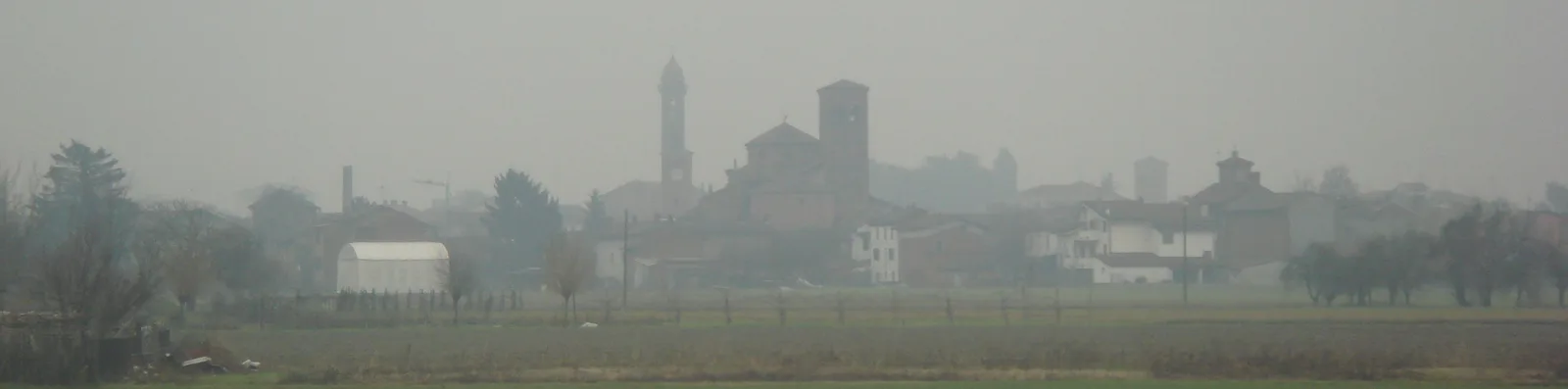
- Elevation
- 104 m above sea level
- Area
- 45,13 km2
- Demonym
- castellazzese
- Patron saint
- Saint Stephen
A closer look
Discovering Castellazzo Bormida
Castellazzo Bormida (Castlass an Bormia in Piedmont), once called Gamond, is an Italian commune 4 505 inhabitants[1] from the province of Alessandria, in Piemonte.
The municipality is located in the plain between the Orba and the Bormida.
Landscape and area
The territory of Castellazzo Bormida has an area of 45,19 km2. The height of the municipality is between 90 and 132 m s.l.m. The town hall is at a height of 104 m asl.Explore this chapter
The territory of Castellazzo Bormida has an area of 45,19 km2. The height of the municipality is between 90 and 132 m s.l.m. The town hall is at a height of 104 m asl.
The municipality borders to the north with the municipality of Alessandria, to the east with the municipalities of Frugarolo and Casal Cermelli, to the south with the municipalities of Predosa and Castelspina and to the west with the towns of Gamalero, Frascaro, Borgoratto Alessandrino and Oviglio.
The town has a small part of the municipality.
The municipality has two hamlets: Fontanasse And Rampina; the hamlet of Fontanasse is divided by the border between Castellazzo Bormida and Casal Cermelli.
The territory is dotted with many farms spread throughout the area. Many farmhouses, large and far from the town, have become in history almost hamlets with an annexed church. The farms saw the last repopulation in the early years of immigration from Veneto and meridian becoming very populous centers.
The main farms are:
- Cascina Santa Barbara with church of the same name
- Cascina San Leonardo with church of the same name until 1300, then the church was dedicated under various titrations to Our Lady (heart: in 1746 the estate provided shelter to Carlo Emanuele III of Savoia)
- Cascina Countryside with the church of Santa Maria della Neve
- Cascina Campagno
- Cascina Scacca with the church of Santa Caterina alla Scacca.
- Cascina Bruciata
- Cascina Zerba with the church of Santa Maria Maddalena
- Cascina Maddalena (a time with the church of Santa Maria Maddalena)
- Cascina Maranzana (a time with the church of Sant'Antonio di Padova).
- Cascina Bergamina (the church of San Giovanni del Martuzzo is also known as San Giovanni dei Cavalieri di Malta or San Giovanni delle Rane).
- Cascina Rampina
- Cascina Costantina, once home of nobles
The municipal territory is crossed by the A26 motorway, from the Alessandria-Ovada in the town, from the line Alessandria-Acqui Terme and from the line Alessandria-Nizza Monferrato-Canelli on the west side towards the border with Oviglio. The river Bormida in the south-western part of the municipality forms a rift in the territory that takes the name of Isola Grande; the inhabitants of that area to reach the town must pass through Borgoratto Alessandrino.
In the western part of the municipality beyond Bormida in the Micarella region there is the new industrial area.
History of Castellazzo Bormida
Origins · XII-XIII century · Fondazione di AlessandriaExplore this chapter
Origins
The oldest document in which Gamondio is mentioned, as Court of Justice, is from 938 (937). In this diploma, Queen Berta receives various areas from the emperors Hugh and Lothair, including the royal court of Gamondio[4]. Before this diploma, only conjectures and hypotheses exist, in addition to the very flattering phrase of Iacopo di Acqui.
XII-XIII century
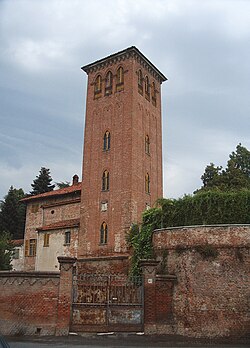
Gamondio is court direct then imperial property, but with secure presence of land and free men. In January 1106 with a document written in the Parish of San Martino, you have the first trace of Gamondio as a free municipality and in 1146 stipulates with the Republic of Genoa a very important commercial pact. It's the most beautiful time for Gamondio.
In 1154 the Arab geographer Muhammad al-Idrisi reported Gamondio in his Italian paper, and described it as follows: Towns populated and large on which villages and hills depend [...] It is fenced by walls and has rich population, active markets and trade with import and export. For some historians this description cannot be attributed to Gamondio, but the territory was vast, and included the places of Casal Cermelli, Casal Cermelli, Castelspina, Gamalero, Borgoratto Alessandrino, Cantaloupe.
In 1155 Gamondio's militias joined Federico I Barbarossa to besiege in 1158 Milan.
Fondazione di Alessandria
Alliances change in a very short time and only ten years after Gamondio, together with Marengo and Bergoglio, they found a civitas nova. The city of Alessandria was born[5] it was founded at first, as already written, by the demic union of Gamondium (Gamondio), Marenghum (Marengo) e Bergolium (Bergoglio). This can be seen in the text of Emperor Frederick's complaints against Cremona in 1184 where he indicates the promoters and authors of the foundation of the new city: "de tribus locis, Gamunde vicelicet et Meringin et Burgul". The name of the meeting place is not described, although it seems already indicated with a certain precision in the specification of the site on Tanaro where the transfer was shorter: Bergoglio[6]. The three places mentioned were added later Roboretum (Rovereto), Solero (Solero), Forum (Villa del Foro), Oviglio (Oviglio) e Quargnento. In this the populations were supported, economically, by the "Superba" and by the municipalities of the Lombard League in contrast with the Marquisate of Monferrato Federico Barbarossa's main ally.
The official foundation date of Alexandria is 3 May 1168, although at that time it has already reached a topographic, urban and administrative configuration defined. The name "Alessandria", confirmed later, will be assumed in honor of Pope Alexander III, a broad supporter of the Lombard League's actions against the Holy Roman Empire and who had excommunicated Frederick Barbarossa.
In the 12th century there are news for at least seventeen churches in the territory of Gamondio, and among these many are reproduced in the new city under construction; among the most important San Martino, Santa Maria dei Campi, San Giacomo, Sant'Andrea. For the centrality of its position, the village offers at least three "hospitals" for the comfort of pilgrims: the convent probably present to the Holy Trinity from Lungi, on the Roman road called Aemilia Scauri, the hospital of San Ranieri in Cantalupo, and the hospital of San Lazzaro, founded by members of the homonymous military order.
Gamondio and Castellacium
With the passing of time we start to confuse in official documents the name of Gamond, used for both the municipality and a neighborhood of Alessandria. From the 14th century the toponym Gamondio would indicate the territory and the inhabited center with Castellacium, after a short time the toponym Gamondio would remain with the city and the entire territory of Castellazzo would be given the toponym Castellacium, certainly derived from the various ruins of fortifications present in the municipality.
After a few years of not just peaceful relations, enters the orbit of the new city; the Contad of Alessandria, sort of administrative-commercial consortium of which Castellazzo will remain the main exponent until extinction in the eighteenth century.
14th century
In the fourteenth century churches are attested in at least twenty-three.
At the end of the century Castellazzo is separated from the Alexandrian domain by Visconti (arrived in Alessandria since 1347), which guarantee the country's autonomy and therefore economic. During these years of domination the inhabitants of the various villages rebel against the raids of Facino Cane, but they are destroyed, only Castellazzo resists the siege of 1404.
XV-XVII century
In 1437 the village was infeuded by the Visconti to Vitaliano Borromeo, and in the Autumn of 1499, to Francesco Bernardino I Visconti, Lord of Brignano (Bergamo). The fief remained in the orbit of Milan until the death of Francis II Sforza, in 1535. After the Milanese control, Spanish domination begins that will last 146 years. The Neapolitan family of Spanish origin of the d'Avalos held the fief of Castellazzo from 1531 (with the investiture of Alfonso III d'Avalos by Charles V of Habsburg) to 1651, when the brothers Andrea and Francesco d'Avalos gave it to the Pallavicino family of Genoa.[7]
18th century
In 1707 the area of Castellazzo passed under Casa Savoia and in 1778, dead without descendants the last feudatario, Giovan Battista Pallavicino, Castellazzo passed to the direct dependencies of the reigning house.
19th century
In 1863, the country took on the current denomination by royal decree.
19th and mid-twentieth century see the emergence of craft activities related to the seric industry (many spinning mills working in the country) and construction, starting from the direct construction of furnaces (Hoffman system) for the raw material of the time, bricks.
At the time of the French Revolution in Castellazzo were already operating three spinning mills, in 1850 there came to eleven factories, in 1880 the three companies of the brothers Boidi, Pistarini and Ricagni were consolidated. The local seric production was particularly valuable for gloss and quality. There were two million died-gelsis (Mario Prati: Tesi di Laurea in Economics and Commerce, University of Turin).
The village has been recompiled since the second half of the nineteenth century, with the creation of agencies, circles and societies for welfare and recreational purposes: born the Asylum Prigione, the Banca Popolare di Castellazzo, the Circolo di Reading, the Società Operaia di Mutuo Soccorso, the band "Giacomo Panizza", the MotoClub, the Touring Club cycling.
20th century
At the beginning of the 20th century, the confraternities lose their vigour, and in various ways the small churches of San Rocco, San Michele, Santissima Annunziata, San Giovanni and Santa Croce disappear.
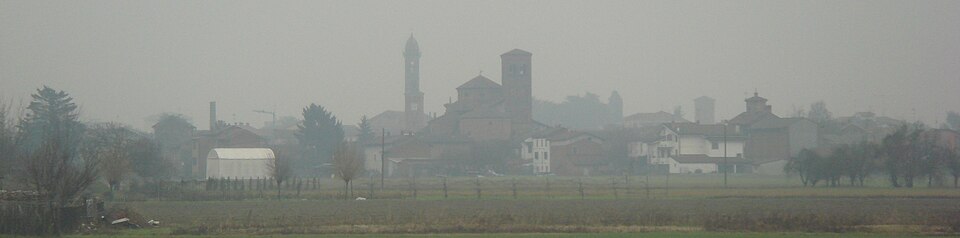

Symbols
What to see in Castellazzo Bormida
Religious architecture · Church of Santa Maria della Corte · Church of San MartinoExplore this chapter
(Imaginis Mundi, Iacopo da Acqui[11]. 1320 approximately)
Religious architecture
Church of Santa Maria della Corte
The church of Santa Maria della Corte is mentioned for the first time in an education of 1005 that appoints the foundation of the church "in curte regia Gamundii" (from which the suffix of the Court) by Mary daughter of the Anscaric king Adalberto II d'Ivrea. From the beginning, the church is parish.
In 1443 the church with an annexed convent, built at the beginning of the fifteenth century, passed to the fathers served.
The church is repeatedly demolished and rebuilt. The first church is probably in a single room and also very small. In 1494, at the end of the Mass of the Holy Spirit, the solemn demolition began. The church is rebuilt with three aisles, probably in late Gothic style. The consecration takes place on 2 February 1534, the day after the consecration of St. Martin just enlarged.
Inundated by Bormida in 1647, and burned by the French in 1651 of the church remains only the bell tower and a crucifix declared miraculous by Pope Benedict XV. Between the 1665 and the 1717 the church is reconstructed according to the old project to exploit the remaining foundations; the works are entrusted to the Alexandrian architect Guglielmo Trotti who however modifies the interior aspect.
In 1802 the never ever Napoleonic declared the community of Santa Maria dissolved and in 1807 the fathers served abandoned the convent that will return to the hands of the secular clergy in 1817. The convent is divided between the parish and the municipality.
In 1894, the renovation of the flooring and interior frescoes were undertaken.
The church of Santa Maria della Corte is the first parish in the village and boasts a winged lion symbol of Venice, left precisely by the serene republic of Venice.
Church of San Martino
Surely it is the oldest church in Castellazzo, founded before 1000. The first document that cites is an act written in 1106 in the adjacent square where there is also the indication of Gamondio free common
The church has always been a parish church, and finds its twin built in the new city of Alessandria. Since 1264 the church is governed by the Augustinian Fathers. During the various extensions, the façade is placed on a meridian basis compared to the original one that was positioned at a height. The church is enlarged in the 14th century, incorporating part of the primordial church. In 1534, the works were completed by moving the façade further forward until they incorporated the tower that was Albo Pretorio. On 1 February the church was consecrated by Leonardo di Vercelli, bishop of Bethlehem. The façade is completed in 1561. In 1895 the back bell tower was burned. It is rebuilt over 15 meters above the structures of the previous one by architect Giuseppe Boidi Trotti. In the 1930s, the church was restored to bring it back to its original state, scrutinising the exterior that was coloured with horizontal rigons. The church of San Martino is the second parish of the village.
Church of Saints Charles and Anna
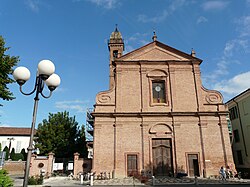
The church was built by the will of Magdalene Trotti and in 1631 the first stone was laid. The wars of the period delayed the work, which were interrupted due to lack of material and labor (in the meantime the title of parish was held by the very nearby oratory of Santissima Annunziata). In 1665 the choir was finished and in 1714 it was consecrated. In 1892, the bell tower was raised by engineer Crescentino Caselli.
Inside it is preserved a wooden statue of the Madonna del Carmine (described by the castellazzesi "of providence") of the workshop of Maragliano.
The church of Saints Charles and Anna is the third parish in the village. In 1720, Paolo Francesco Danei (Ovada, 3 January 1694 – Rome, 18 October 1775), feeling called by God to found a new institute, after wearing a penance dress on 22 November 1720, with the consent of the Bishop of Alessandria, Mons. Francesco Giuseppe Arborio di Gattinara, lived for 40 days in the small room adjacent to the sacristy of the Church of Saints Charles and Anna, in total isolation with fasting and much prayer, he wrote the rule of what would later become the Congregation of the Passion of Jesus Christ (Passionists).
Church of Santo Stefano
The church of Santo Stefano "extra muras" has a certain monastic origin for its distance from the village of then. The foundation dates back approximately to the middle of the 11th century by the Romanesque imprint that the building retains: three apses (remained over the centuries) and the crypt. The apses find their twins inSezzadio from which he died, of the same period, but also in Castellazzo there is another church with three apses: St. John of Mortuzzo or frogs. The ancient Saint Stephen sees periods of abandonment in 500 and only at the end of the century (1596-97) restoration works that will last in the middle of 1600. The church is raised and the facade completely remade. The church, now owned by the municipality, has undergone restorations in 1997-98 that led to the light that the plant size of the original oratory was the same as that arrived at today.
Church of the Holy Trinity from Lungi
Founded by the regular canons of Santa Croce di Mortara, probably around 1130, the church (priorate, but also parish) is mentioned for the first time in 1134. It was definitely built within a monastic complex, of which in the nineteenth century there are still abundant traces of ruins, in the sixteenth century it is used as a haystack. The interventions of the Ghilini in 1731 made us reach many ancient parts of the church. The Ghilini, raised the walls to allow a vaulted cover.
In 1836 with the renovation of the vault and the paint painting of the walls, the building is reopened to the cult. The last interventions were from the 1930s by the architect Mesturino of the Superintendence of Fine Arts in Turin, who reopened the monophs of the apse that had been closed. Of Romanesque importance remain today most of the apse, perimeter walls and capitals, perhaps the greatest sign of art in Castellazzo.
Sanctuary of the Blessed Virgin of Crete
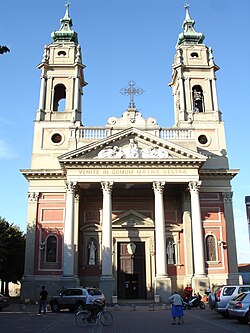
The first construction took place around the 17th century as a thanks to protection during the plague epidemic of 1630; the chapel was demolished, by intrigue, in 1764.
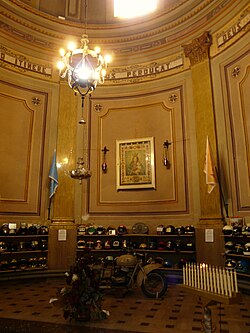
In the period 1802-1848 we have the construction of the new church and the so-called "Rotonda" around the pylon, while the beginning of the building of today's sanctuary took place at the end of the 19th century. In 1947 Pius XII gave the title "Madonnina" (called by all Castellazzesi) of Patroness of Centauri.
On the walls of the corridor leading to the Round and Round itself there are many former vows to mean the great devotion to the Blessed Virgin of Crete.
Orators
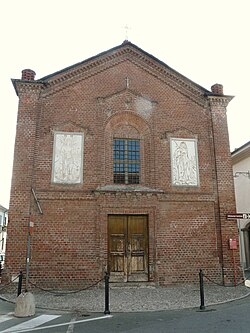
- Oratory of St. Anthony Abbot: the brotherhood of St. Anthony was the only one who had two churches at once, one in the center and one in the countryside. The current building is 1699. The façade is a finishing of the late nineteenth century.
- Oratory of Santissima Pietà: the brotherhood already present in 1298 reappears in history around 1496 with the oratory of San Sebastiano in Borgo Nuovo that will be replaced by the current oratory. Until the eighteenth century, the oratory was flanked by the hospital of Santa Caterina, then merged into the hospital. Christmas is home to a large mechanical crib
- Oratory of San Sebastiano: the oratory is not mentioned in the list of churches of 1576 but knowing that there was a church of San Sebastiano in Borgo nuova already in 1496 surely this is older. The confraternity of the oratory had also purchased the hospital of San Bernardino, which became Saints Bernardino and Sebastian; the hospital confluted in 1760 with St. Catherine will form the hospital of Saints Bernardino and Catherine. The oratory certainly backwards from the original presents once and a facade built in the nineteenth century.
- Oratory of the Most Holy Trinity] by Via Roma or Contrada Grande: its first building was possible thanks to the recovery of material from the now demolished church of Sant'Andrea, near the door of San Lazzaro. Around 1790 work began for the re-edification of the oratory that weighed in very bad conditions. Various internal and external assonances with the deceased oratory of San Michele suggest that the architect was always Giuseppe Zani.
Churches and Orators used for other uses
- Oratory of San Giovanni Battista: according to an oral tradition the current oratory was built with the material recovered from the destruction of the oratory of San Giovanni da Paravano that stood in the present Piazza Vittorio Emanuele II. After the change of use in 1940 the choir was knocked down to enlarge the road seat and in a second time the bell tower was also destroyed. The oratory was used as a minor church in the parish of Santa Maria della Corte. The statue of the Saint is now placed in a newspaper in front of the oratory.
- Church of Saints Mary and Francis to Capuchin: founded together with the convent on August 16, 1608 by the Capuchin Friars, was consecrated in 1667. Various works were made for the various needs of the convent and there were also suspensions of presence due to the Napoleonic period. In 1897 the Milanese painter Rodolfo Gambini refected the internal and external plasters. The convent was closed in 1961 and the structure passed to the commune in 1973. The former convent was intended for residential construction. The church is used as a public hall.
- Oratorio di San Nicola da Tolentino: the only quotations of the oratory are in the catasts of 1563 and 1633. Visible from the outside the apse area is front of the rest of the oratory, therefore it is assumed that the oratory has been partially re-edified. Before changing use was the minor church of the parish of San Martino.
Orators no longer exist
The speakers listed are those who were shot down in the 20th century.
- Santissima Annunzia: already existing in the registers of the 1563 disaster. He occupied a small lot alongside the church of Saints Charles and Anna. It was separated from the parish first by a small strip of land then by a sacristy. The oratory was shot down in the 1940s. It was a parish church during the construction of San Carlo and then used as a minor church.
- Holy Cross: cited for the first time in the disaster of 1584 from the 1633 to its demolition has not undergone any changes. During the two world wars it was used as a storage room. After two years of periciousness 50, was sold in 1958. In its place there is a private house that has maintained part of the supporting walls. It was the twin oratory of Santissima Pietà.
- Saint Michael: San Michele was a church of Gamondio mentioned in 1156, the last building dates back to the end of the eighteenth century by architect Giuseppe Zani. The drawings of the oratory, preserved at the State Archive Alessandria, present many similarities with the oratory of the Holy Trinity in via Roma, so much to make it think that Zani himself did the project. The oratory collapses on October 11, 1942. In 1944 he was demolished and in 1951 he was ceded. The ancient church in Gamondio, very important, gave its name to a neighborhood and a bridge of the municipality.
- San Rocco: San Rocco is spoken already in 1534, the oratory was enlarged in 1630-31 by devotion as the great contrada (the present street Rome where the oratory was located) was spared from the plague. The oratory was built in an old fortification gate. It was shot down in 1922. The statue of the Saint is placed in a niche in the wall where the church was adjoined.
Civil architecture
Clock Tower
The clock tower is the oldest tower left in Castellazzo. It rises on the perimeter of the ancient walls, built in XI-XII. The route of the first walls is elliptical and Via General Moccagatta where the tower rises follows the path of the ancient walls. The tower plant is three quarters of a circle. The tower has undergone renovations over the centuries. Curiosity: in 1858 during excavations in the current Via Gamondio (also on the path of the old walls) were highlighted the foundations of an analogous tower, certainty more than the municipality was surrounded by walls with various towers for safety.
Tower of Gattara
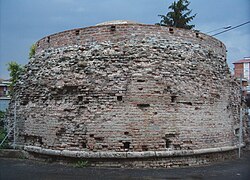
The tower said by Gattara from the name of the Rione on which it stands, is the only survivor of a defensive system, consisting of walls and towers, made erect by Commissioner Cotta, at the will of the Duke of Milan Ludovico il Moro, between 1496 and 1498. The walls of the fifteenth century called "the new walls", formed a pentagon around the municipality; today the path of the walls is still visible from the sides that faithfully trace the route by dividing the old town from the outskirts. The tower is circular, it is connected through a system of underground walks that lead to the Castle. The tower was recently an ice deposit.
Municipal Palace
The Palazzo del Municipio of Castellazzo Bormida began to take shape in 1883, replacing the old Pretorio Palace and demolishing the historic church of San Giacomo dei Serviti, which was located in the current Via Emanuele Boidi.
The project was entrusted to the engineer Giulio Leale di Alessandria and officially approved on 7 December 1882. The new building had to accommodate both the municipal offices and the schools of obligation. To realize the work was contracted a mortgage of 179,000 lire with the Cassa dei Depositi e Prestiti, to be refunded in thirty years, as enshrined by a decree of the Provincial Deputation of Alessandria on 29 January 1883. On 2 December 1883, a Royal Decree signed by Umberto I declared its public utility.
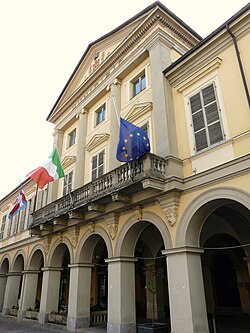
The municipal offices, according to the project, included a series of premises: a meeting room for the city council, one for the junta, the office of the mayor, the office of the secretary, an archive hall, the office of the civil state, the office of the cadastral, that of the head of the country guard, the pretura, a courtroom, the cabinet of the pretore, the office of the chancellers, the office of the There was also an accommodation for the Carabinieri, equipped with bedrooms and kitchen.
For schools, the project provided for a division between the male and female section. Each section was composed of several classrooms, a room for the meetings of the masters, one for the management, the housing of the bidello and the pan and its latrines. In addition, there were two distinct courtyards, one for female schools and one for male ones.
The entire complex covered an area of about 2,700 square meters. The construction was entrusted to Sebastiano Ratti's company, which formed the contract in 1884. The building was completed and tested in 1886, with full use since 1890. The building is located between the streets XXV April, via Emanuele Boidi and Via Cavour. The construction process was not without difficulty, since numerous complaints and appeals emerged from the former landowners, as well as a public survey on the regularity of the supply of the inferrites of the building and a quotation from the Municipality against the impresario for contractual failures.
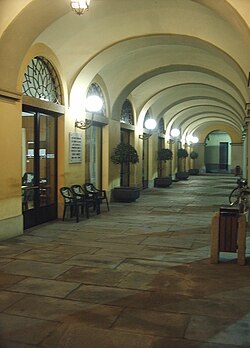
The building stands out for a long portico on the ground floor and a higher central section, enriched by ionic parastes of giant order with a triangular timpane. Of particular value are the stone staircase and the council hall. The latter, located on the first floor of the building, still retains today the original nineteenth century ballots of the Pretura di Castellazzo, suppressed in 1890.
Society
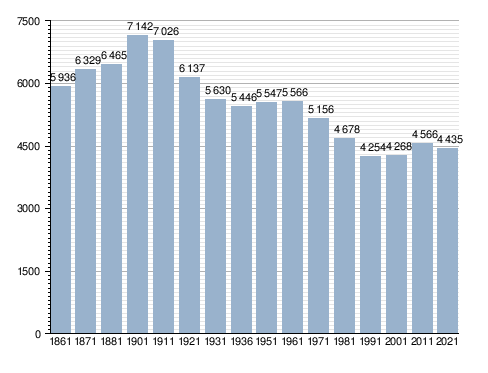
Demographic evolutionExplore this chapter
Demographic evolution
Inhabitants registered[12]
Culture
Events · Motor · September castellazzeseExplore this chapter
Libraries
The Civic Library Francesco Poggio was founded in 1976.
Events
Motor
The international motoraduno "Madonnina dei Centauri" takes place every year, during the second week of July, and culminates with the religious function for the blessing of pilots and machines. The event has been held since 1946, organized by the local motoclub and conceived by then president Marco Re, pharmacist Castellazzese. The ceremony is attended by thousands of motorcyclists from all over Europe. Curiosity: the first biker of each country enters, to follow the religious function, in church with the motor on and the biker who has traveled several kilometers to reach Castellazzo Bormida is rewarded.
September castellazzese
September is the container of all manifestations of the holiday of the country. It begins at the end of August with the press conference, in which the program of the celebrations is officially presented, and ends with the pumpkin market exhibition.
Gallery Gamondio
Born in 1968, it is a contemporary art collective that takes place in the central weeks of the festival of the country. The group until 2006 was organized on the ground floor of middle schools. Since 2006 the gallery has not yet found a definitive accommodation: in 2006 it was organized at the San Martino canon, in 2007 at the church of Santo Stefano and in 2008 at the oratory of San Nicola. Since 2007 the gallery has been hosting the works created during the extemporaneous painting organized by the municipality.
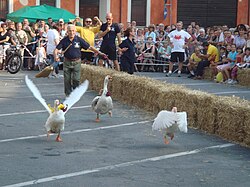
Goose Palio
The Palio dell'oca is a folkloristic event that is organized every year on the 3rd Sunday of September. It takes place in Piazza Vittorio Emanuele II (the central square), where with straw bales is created a path in the form of "U", where geese are run. During the pole there are also games among the various participants of the reions such as: rope shooting, needle in the haystack etc.
The table shows the reions participating in the last editions:
| Rioni | XXIII (2008) |
XXIV (2009) |
|---|---|---|
| Borgo San Carlo | 41 | |
| Bruera Santo Stefano | 45 | |
| Contrada Grande | 45 | |
| Gattara-Torrione | 4 | |
| Madonna | 53 | |
| Ponte Borgonuovo | 56 | |
| San Michele Bridge | 47 | |
| Saint Sebastian | 55 |
Pumpkin Market Exhibition
The Pumpkin Market Exhibition is the last event in September of Castellazzese. Born in 1992, it is organized every year to praise one of the typical products of Castellazzesi, pumpkin. During the event, local producers organize an exhibition of their products and prepare different pumpkin dishes that can be tasted; live music and animations accompany the festival.
Typical local products
Explore this chapter
- Red beet: thanks called in castellazzese Biarava
- Scorzonera: root consumed mainly in Liguria
- Pumpkin
- Giacometta: cream of chocolate spreadable patented by chocolate maker Giacomo Boidi.
Administration
Below is a table relating to the administrations that have succeeded one another in this municipality.Explore this chapter
Below is a table relating to the administrations that have succeeded one another in this municipality.
| Period | First citizen | Match | Load | Notes | |
|---|---|---|---|---|---|
| 8 June 1985 | May 26, 1990 | Pietro Guglielmero | Italian Socialist Party | Mayor | [13] |
| May 26, 1990 | April 24, 1995 | Pietro Guglielmero | Italian Socialist Party | Mayor | [13] |
| April 24, 1995 | June 14, 1999 | Gianfranco Ferraris | centre-left | Mayor | [13] |
| June 14, 1999 | June 14, 2004 | Gianfranco Ferraris | Civic list Solidarity progress | Mayor | [13] |
| June 14, 2004 | June 8, 2009 | Domenico Ravetti | Civic list Solidarity progress | Mayor | [13] |
| June 8, 2009 | May 26, 2014 | Domenico Ravetti | civic list | Mayor | [13] |
| May 26, 2014 | July 21, 2015 | Gianfranco Ferraris | Civic list Solidarity progress | Mayor | [13] |
| July 21, 2015 | 7 June 2016 | Raffaele Ricciardi | - | Prefectious Commissioner | [13] |
| 7 June 2016 | October 4, 2021 | Gianfranco Ferraris | civic list Lealtà experience renewal | Mayor | [13] |
| October 4, 2021 | in office | Gianfranco Ferraris | list Civics Ferraris Gianfranco said Gil | Mayor | [13] |
Sport
Explore this chapter
- Football team: U.S. Castellazzo, milita in the Promotion Championship
- Basketball team: B.C.C.Castellazzo Bormida
- Group Podistico Cartotecnica Piemontese di Castellazzo Bormida
- Moto Club Castellazzo Bormida founded in 1933
- Castellazzo Calcio a 7
Image gallery
Explore this chapter
-
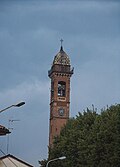 Campanile of the parish church of Saints Charles and Anna
-
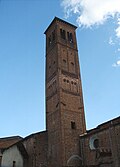 St. Martin parish church bell tower
-
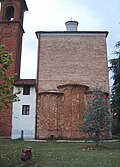 Details of the apses of the church of Santo Stefano
-
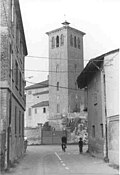 Castle Tower
-
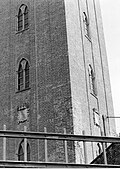 Torre del Castello (detail)
-
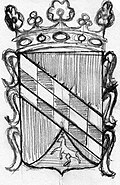 Stemma Canefri depicted on the Castle Tower
-
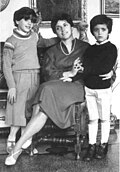 Last descendants of Canefri, for which the Honorary Citizenship was recognized.
-
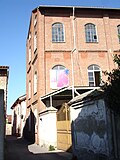 Sliding of an old spinning mill recently restored
Notes
Explore this chapter
- ^ to b Monthly demographic balance for the year 2026 (provisional data), up demo.istat.it, ISTAT.
- ^ Seismic classification (XLS), up risks.protezionecivile.gov.it.
- ^ Table of degrees/day of Italian Municipalities grouped by Region and Province (PDF), in Law 26 August 1993, n. 412, annex A, National Agency for New Technologies, Energy and Sustainable Economic Development, 1 March 2011, p. 151. URL consulted on 25 April 2012 (archived fromoriginal url on 1 January 2017).
- ^ "[...] In the name of the Holy Trinity We Ugo with Lotario, made king by the clemency of God, we give in dow the court of Gamondio di Sezzadio, of Orba [...] with all their appurtenances to Queen Berta. We transfer and delegate to you all the rights over these possessions: churches, chapels, castles, male and female servants, farmers, lands, fields, vineyards, meadows, woods, mountains, valleys, waters, mills, fishing rights and all movable and immovable things of the aforementioned courts and abbeys. We also provide that the owner has the right to keep or sell, alienate or exchange and no man dares to oppose it. Iseprando notary and bishop Atrone sign." Document written in Burgundy in the Columbaris court, and preserved in the State archives of Milan, Diplomatic Museum fund, folder 5-37-179.
- ^ In the first twenty years of its history, the city presents four different names in sources: Alessandria Caesarea (The Ghilini in his Annals of Alessandria, p. 2-1168/1 erroneously wants that the birth of the city took place on 22 April 1168, that is the same day as the foundation of Rome: "[...] пеl what day Romulus gave rise to the fabrica of the City of Rome [...]"in reality the foundation of Rome is officially set on April 21st.), Palea, Rovereto, in addition to the generic designation, quite frequent, of civitas nova or nova civitas, and to the rarer designation of urbs nova. (Geo Pistarino, p. 15).
- ^ Geo Pistarino, p. 14.
- ^ Francesco Guasco, feudal dictionary of the ancient Sardinian states and Lombardy, volume 1, Pinerolo, 1911, in Library of Subalpina Historical Society, Volume 54, p. 454
- ^ Municipality of Castellazzo Bormida, Statutes (PDF), Article 4 - Stem and Gonfalone.
- ^ Antonio Manno, Castellazzo Bormida, in Historical Bibliography of the States of the monarchy of Savoy, vol. 4, Turin, Fratelli Bocca Editori, 1892, p. 172.
- ^ Castellazzo Bormida, up Central State Archive. Retrieved 9 August 2025.
- ^ Paul Church, Iacopo from Acqui, up treccani.it, Treccani, 2004. Retrieved 15 June 2016.
- ^ Data taken from:
- Resident population of the municipalities. Censuses from 1861 to 1991 (PDF), up ebiblio.istat.it, ISTAT.
- Resident population - Time series, up exploredati.istat.it.
Please note: 2021 data refers to permanent census data as of December 31 of that year.
- ^ to b c d And f g h the j http://amministratori.interno.it/
Bibliography
Explore this chapter
- Francesco Moscheni & F.lli, Codex Statuterum magnifice communitatis atque diœcæsis Alexandrinæ, Alessandria, 1547. Retrieved 9 June 2016.
- Girolamo Ghilini, Annals of Alessandria, Milan, Gioseffo Marelli, 1666.
- Giovanni Battista Moriondo, Monument to Aquensia, Turin, Royal Typography, 1790. Retrieved 10 June 2016.
- Domenico Testa History of Monferrato, Tipogr. Piano, Castello d'Annone, 1979. With a chapter on the transition to the Savoy Dynasty.
- Giacomo Ursino The figure of Sant'Ugo Canefri, in Castellazzo News March 1989. With the description of the Canefri Stem on the Tower.
- Milena and Giannetto Re The Madonnina of the Centauri. Testimonials of an idea of motorcycle brotherhood realized and continued over time. Fratelli Pozzo Editions, 1995.
- Geo Pistarino, The double foundation of Alessandria (1168, 1183) (PDF), in History magazine Art Archaeology for the provinces of Alessandria and Asti, single volume, Alessandria, Society of History Art Archeology - Accademia degli Immobili, 1997, pp. 5-36. Retrieved 11 June 2016.
- Gianfranco Calorio, Bergolium: the Territory and the Abitato, first volume, Castelnuovo Scrivia (AL), Favolarevia Publishing House, 2000.
- Christopher Moretti Catalogue of ecclesiastical building in the territory of Castellazzo Bormida, Boccassi Editore, Alessandria 2001.
- Castellazzo's ex-voice, history of a devotion and sanctuary. Edition edited by Mimma Caligaris. IL PICCOLO editions, 2004.
- Milena Re Reposi Silk in Castellazzo Bormida Editions of the Bear, 2009.
- Francesco Poggio, Paola Lanzavecchia, Ugo Boccassi History of international motorcycle races Madonnina dei Centauri. Edition by the Cassa di Risparmio of Alessandria.
- Moto Club Castellazzo Bormida 70 years of passion.
- Simone Caldano, Echoes of transalpine architecture in the Aleramic brand, Santa Giustina di Sezzadio and Santo Stefano extra muras by Gamondio, Pisa, ETS Editions, 2013.
Where to stay · Castellazzo Bormida
Find stays on Booking.comStories, places and people
More about Castellazzo Bormida and the surrounding area
Follow a thread of history and see where it leads.
 Lampofinale · CC BY-SA 4.0
Alessandria (Italy)
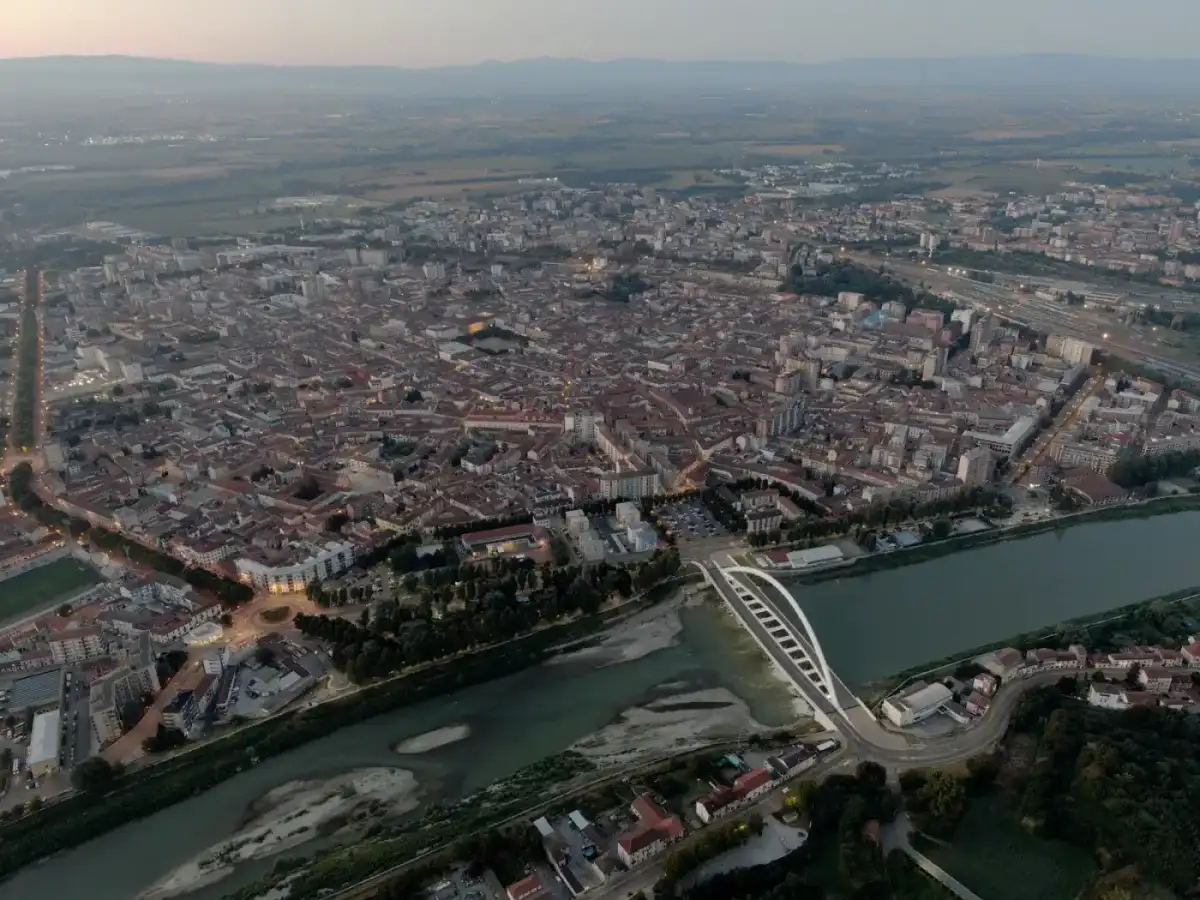
Alessandria (AFI : /alesˈsandrja/ listen; in Piedmontese Lissandria , AFI : /liˈsaةdrja/ ; local pronunciation , AFI : [liˈsŋ王d dij di] ; in Liguria Lusciandria , AFI : /lyˈaʃdrja/ ) is an Italian commune 93 823 inhabitants, capital of the homonymous province in Piemonte .
Read the story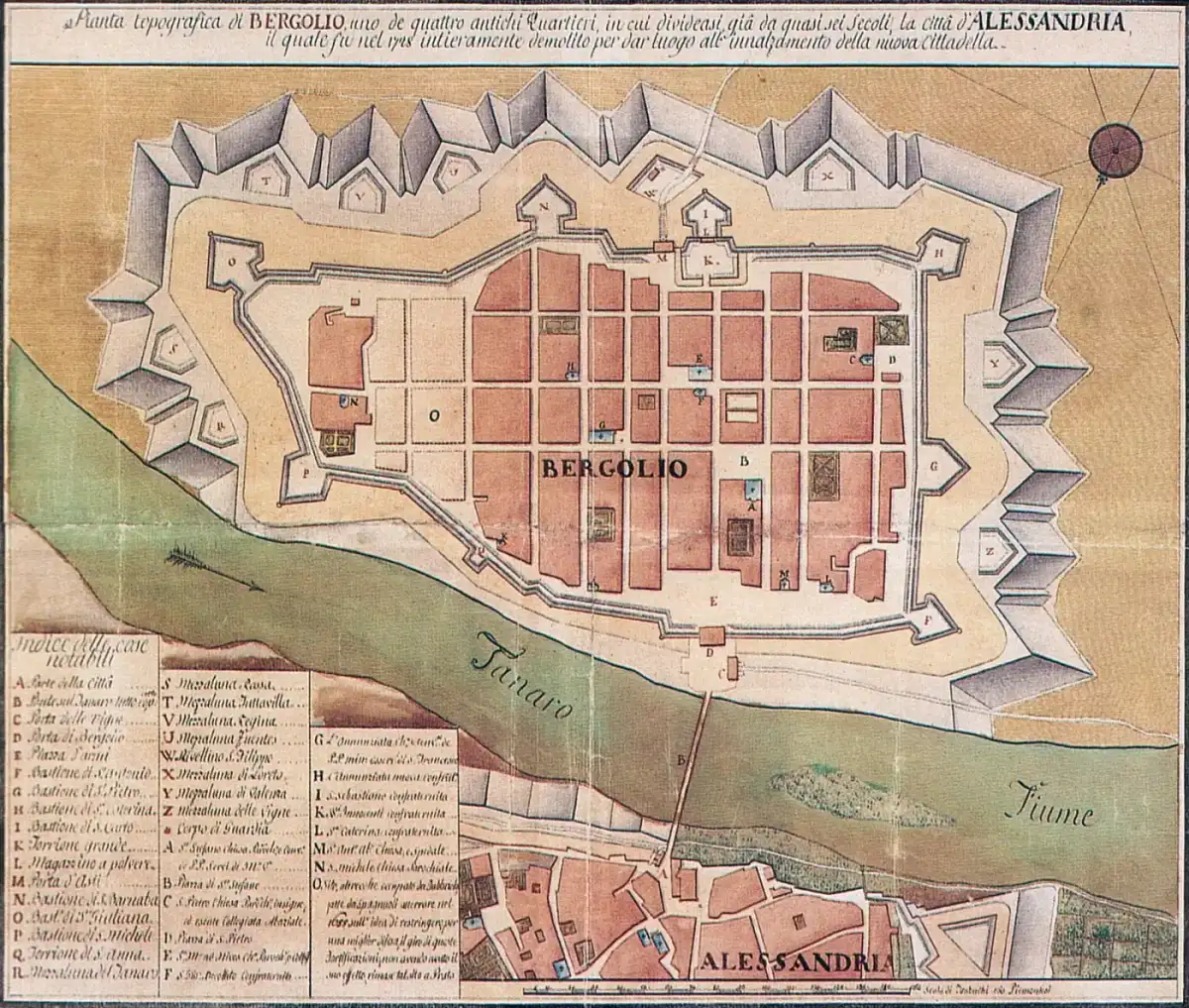 brigante mandrogno · Public domain
Bergoglio (Alessandria)
Bergoglio (also Bargolium , Bergolio or B Pride , Bergolium , Bergul , Burgulium ) was an urban settlement built on the left bank of Tanaro , located in front of Rovereto and the city of Alessandria all. Demolished during the 18th century, starting from 1728, to make camping the walls of the citadel, protected by walls and moats, defended by a small detached fortress called “la Pozzolana”, originally belonged to the Archdiocese of Milan. Bergoglio was one of the eight settlements that contributed to the foundation of the city of Alexandria in the second half of the 12th century.
Read the story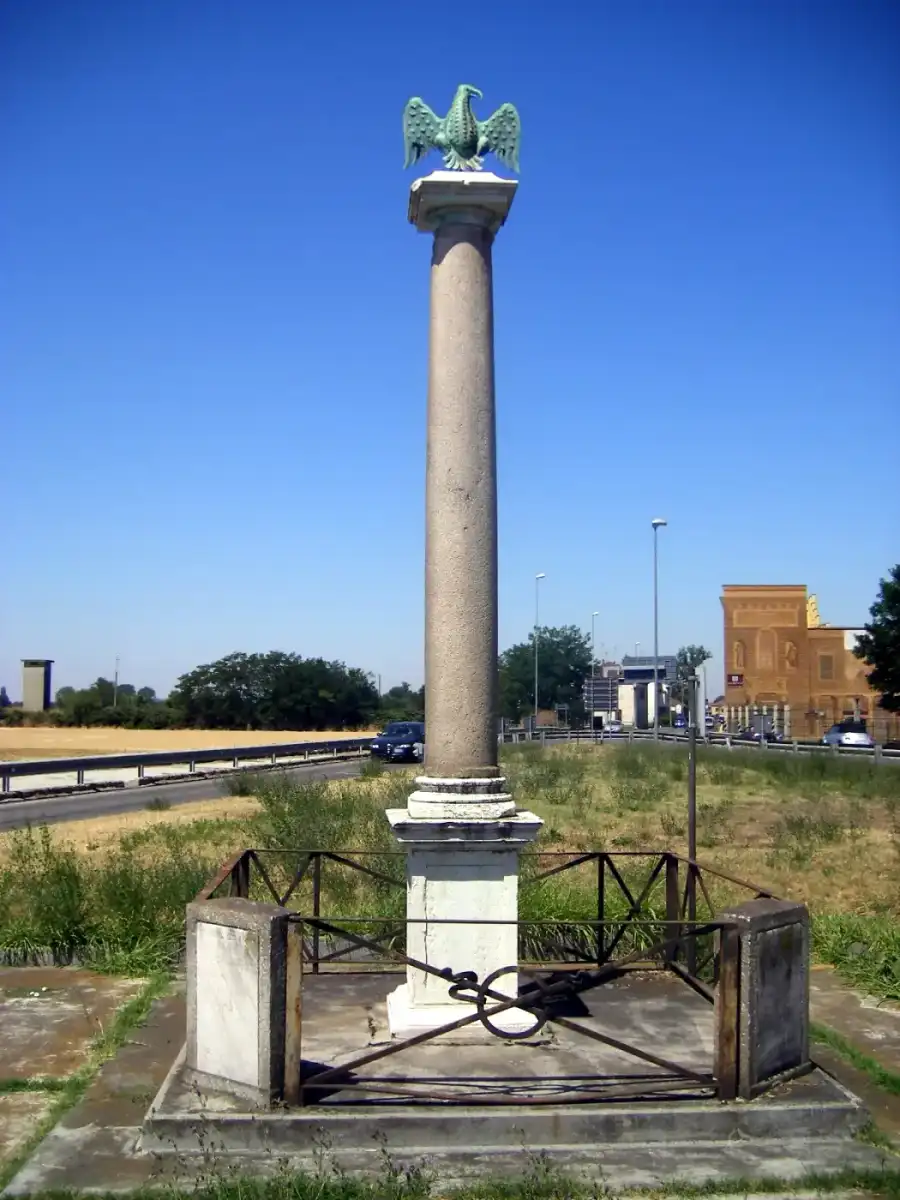 Szeder László · CC BY-SA 4.0
Spinetta Marengo
Spinetta Marengo (La Spinëta in Piedmont and Ra Spineuta in Alexandria) is a hamlet of 7 337 inhabitants of the town of Alessandria.
Read the story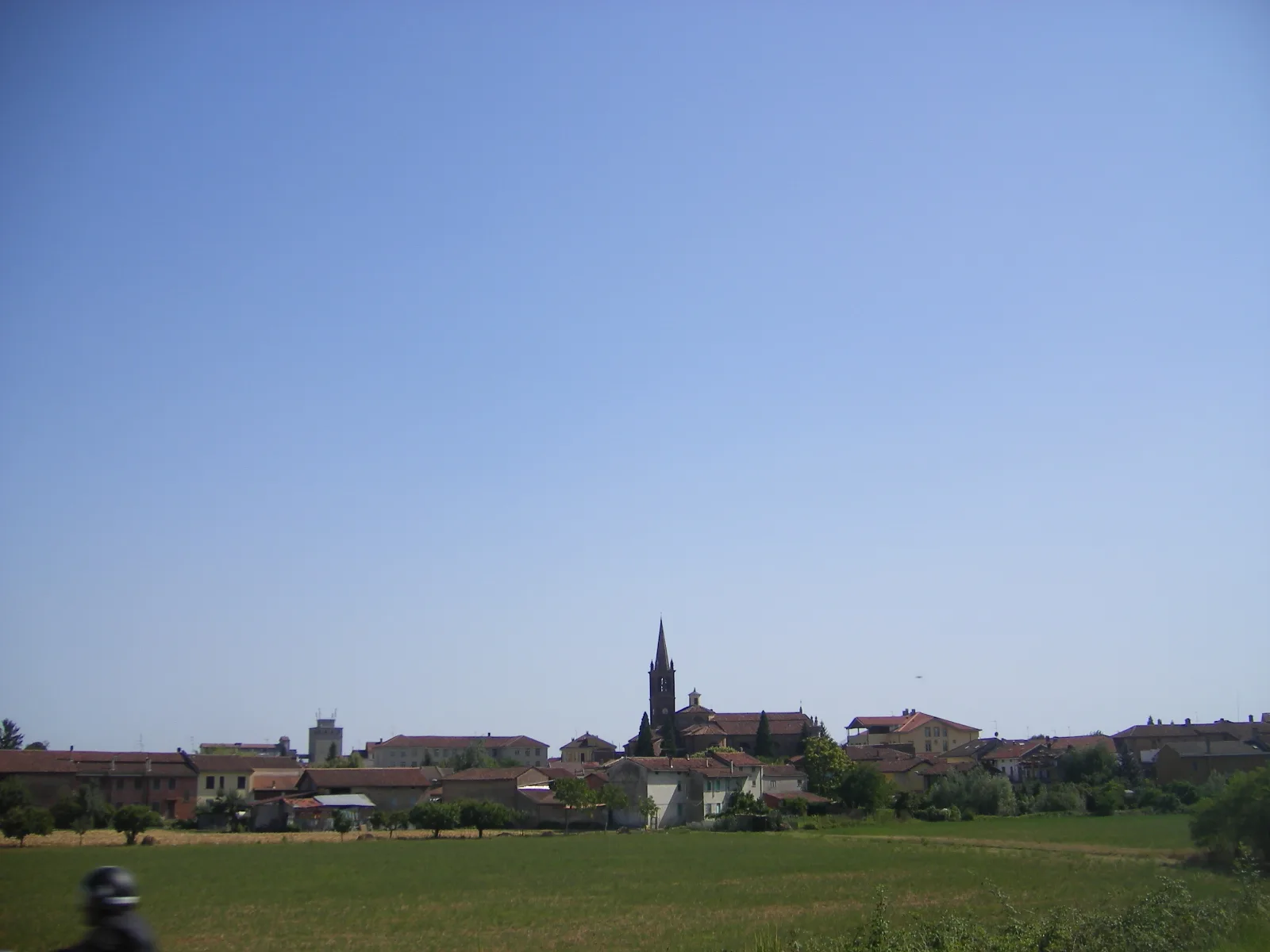 Szeder László · CC BY-SA 4.0
Solero (Italy)
Solero ( Soleri in Piedmont (Pronuncia Suleri ), Sulìare in local dialect) is an Italian municipality of 1 577 inhabitants of the province of Alessandria in Piemonte, located on the left bank of Tanaro . Its historical foundation dates back to the time of Roman domination.
Read the story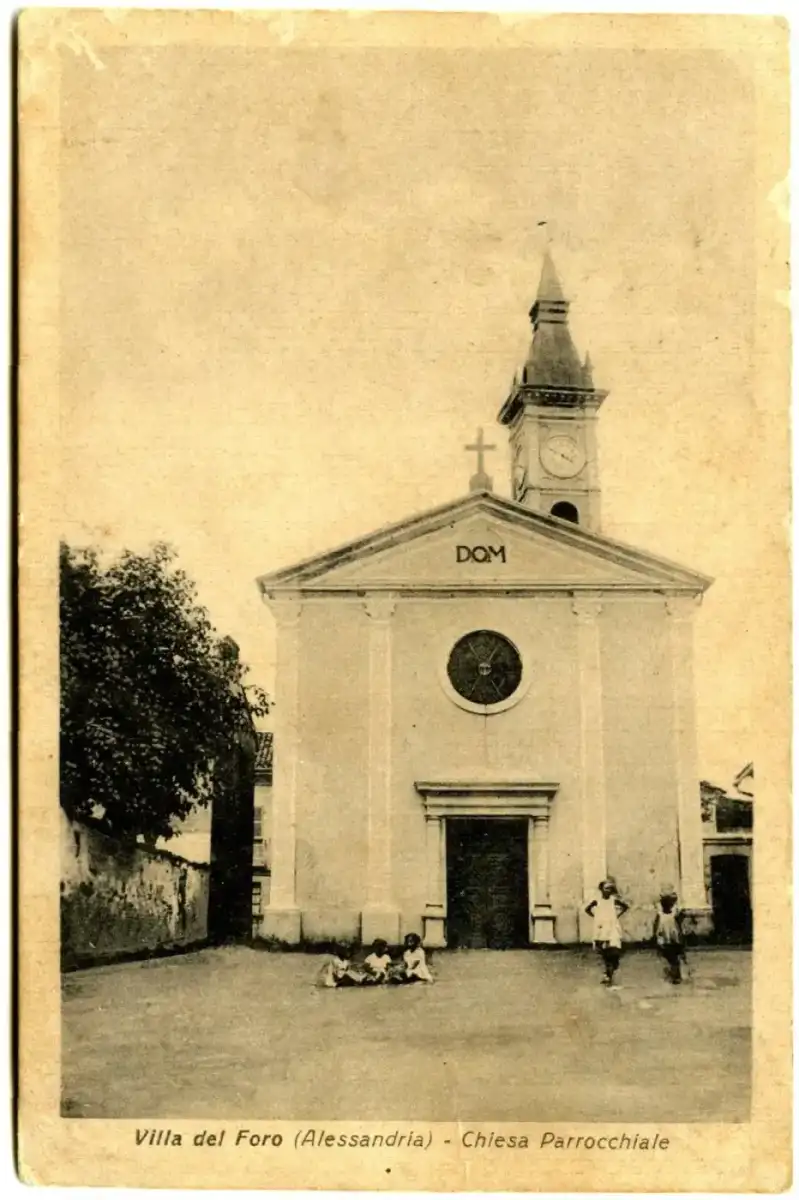 Ignoto. Caricato da Tony Frisina · Public domain
Villa del Foro
(Pliny the Elder thus recalls one of the main centers of the IX Regio Augustea)
Read the story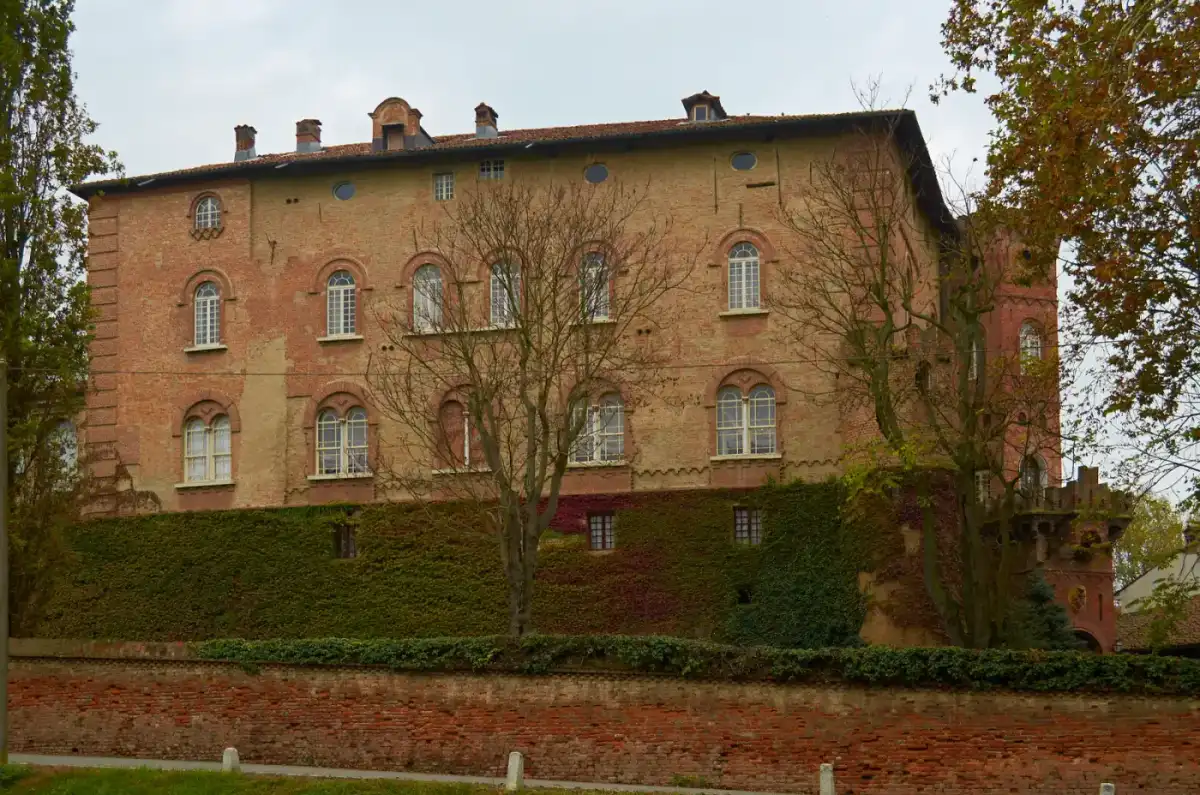 Terensky · CC BY 3.0
Oviglio
Oviglio (J'Ovij or J'Oij in Piedmont) is an Italian town of 1 232 inhabitants of the province of Alessandria in Piemonte .
Read the story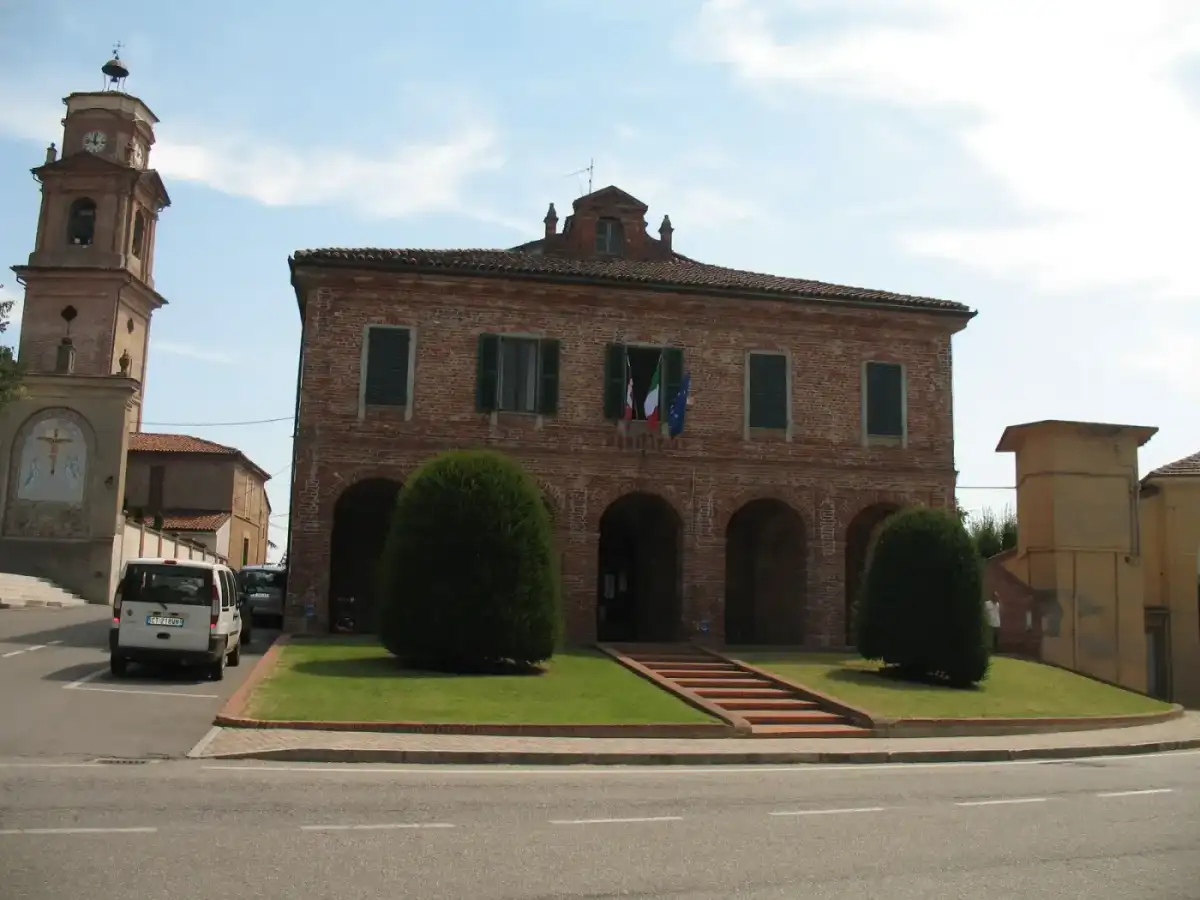 Twice25 · CC BY 3.0
Quargnento
Quargnento (Quar gnent in Piedmont) is an Italian municipality of 1 390 inhabitants of the province Alessandria , in Piemonte , located in the plain of Alessandria , on the edge of the hills of Lower Monferrato Casalese.
Read the story Tony Frisina di Wikipedia in italiano · Public domain
History of Alessandria
The oldest traces found in the province bear witness to sporadic but very ancient human presences. The first settlements are mainly marked in the eastern centre area: at Castel Ceriolo there were several quaetical instruments of paleolithic tradition. With the Neolithic ancestors of the Alexandrians pass to agriculture and breeding, produce ceramics, tease and spin the fabrics and smooth the stone. The settlements develop on the roads of communication (fiumi and streets) and near the areas of supplying raw materials, wild and above all green Apennines that is exported throughout Europe. The Alexandrian territory is one of the first to be colonized: Casalnoceto, Brignano Frascata , Monperone in the province and above all in the area where today the Christ district is located in which at the end of the 21st century a burial and numerous liturgical instruments were found. In recent Neolithic, the area of Alessandria (Cascina Chiappona), is affected by a profound change affecting the entire western cisalpine area and the transalpine area, highlighting a common cultural identity (the "Chasseano") in the areas occupied today by Piemonte , Valle d'Aosta , South-East of France and Switzerland .
Read the story Tony Frisina di Wikipedia in italiano · Public domain
Diocese of Alessandria
The diocese of Alessandria (Latin Dioecesis Alexandrina Statiellorum) is a seat of the Catholic Church in Italy suffragan of the archdiocese of Vercelli and belonging to the ecclesiastical region Piemonte . In 2023, 140.000 were baptized on 152.900 inhabitants. The seat is vacant.
Read the storyFrancesco Giuseppe Arborio di Gattinara
Francesco Giuseppe Arborio di Gattinara (17 June 1658 – 14 October 1743) was an Italian Catholic archbishop.
Read the storyCastellazzo-Casalcermelli Station
Castellazzo-Casalcermelli station is a train station located on the line Alessandria-Ovada . Sita in the town Castellazzo Bormida , also serves the common limitrofo of Casal Cermelli .
Read the storyThe area, step by step
Trails and routes in Castellazzo Bormida

Asti, Alessandria and surroundings