Atlas of Monferrato
Sezzadio: sights, history and trails
Alessandria
- Elevation
- 127 m above sea level
- Area
- 34.32 km²
- Demonym
- ♪
- Patron saint
- sant'Innocent
A closer look
Discovering Sezzadio
Sezzadio (Atz in Piedmont) is an Italian municipality of 1 177 inhabitants[1] from the province of Alessandria, in Piemonte. It is located in the Alexandrian plain, to the right of the Bormida river, on the Stanavazzo stream. The municipality was originally called Sezz. The current name was adopted in 1916.[4]
History of Sezzadio
SymbolsExplore this chapter
There are no sources and the scarcity of archaeological finds does not allow to date the birth of the village. It is assumed that Sezzadio originated between the 2nd and 1st centuries BC.
After the construction of the Via Aemilia Scauri, which took place in 109 BC, that ran from Piacenza to Albenga passing through Tortona, Acqui Terme, Vado Ligure needed a post station to reach Ventimiglia which gave rise to the first nucleus of primitive and rudimentary houses.
According to a local tradition, Aleramo del Monferrato was born here, founder of the Aleramica dynasty, in 1504 he was the lordship of Francesco Bernardino I Visconti (born 1458), former lord of Brignano (Bergamo), Gallarate (Varese), San Giorgio Lomellina, Gamalero, Castellazzo Bormida, Bosco di Alessandria, Castano Primo (Milano).
Symbols
The coat of arms and gonfalone were granted by decree of the President of the Republic of 11 March 1953.[5]
The municipal emblem is a variation of the coat of arms of the capital Alessandria.
The gonfalone is a drape party of white and red.[7]
What to see in Sezzadio
Santa Giustina Abbey · Church of Mary Immaculate · The other churchesExplore this chapter
Santa Giustina Abbey
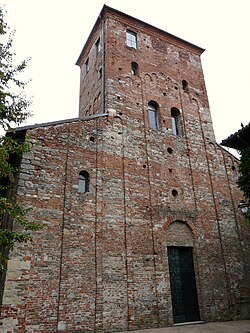
The Abbey of Santa Giustina was founded in 722 by the will of the Longobard king Liutprando on the occasion of his journey to Pavia for the translation of the body of Saint Augustine. Expanded in 1033 by the Marquis of Sezzadio, Oberto, it reached its maximum splendor between the 12th and 13th centuries, remaining in possession of the Benedictines until 1474.
Church of Mary Immaculate
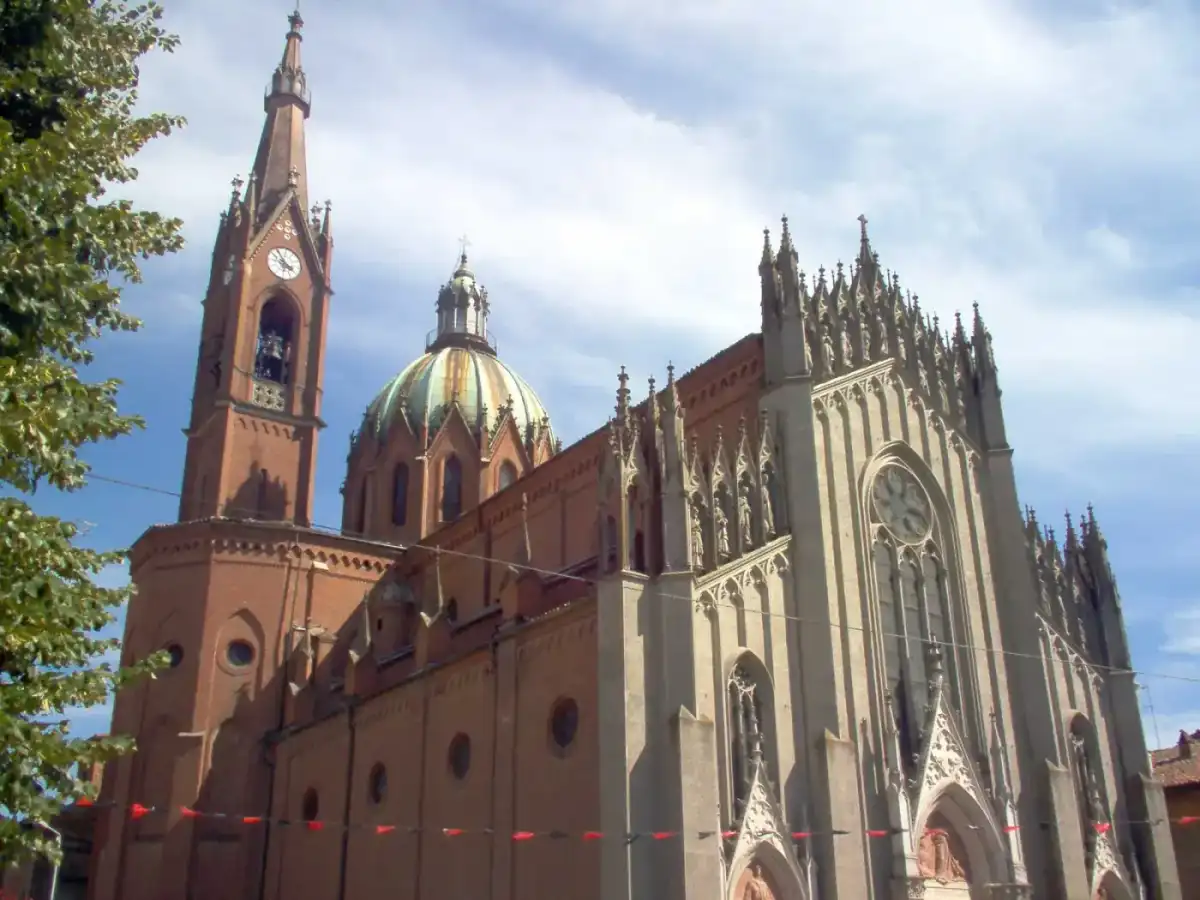
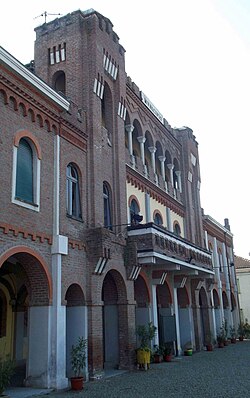
The parish church, dedicated to the Blessed Virgin Immaculate is the work of the Bologna engineer Giuseppe Gualandi. Built since 1900, the construction is considered one of the best works of Gualandi as it most consons with Italian traditions and less influenced by an idea of greatness that, in other works, will lead the engineer to develop architectures with excessive proportions. The simple linearity of the interior as well as the right proportion between the various external elements (fabric, dome) count it as one of the best "fabrics" of the minor neo-gothic in Italy.
The other churches
- Oratory of the Assumption
- Church of the Annunciation
- Church of San Giacomo
- Monastery of Santo Stefano or Santa Maria di Banno[8], documented in a bull of Pope Innocent III, dated 16 June 1135, in which Santo Stefano di Sezzè is included among the possessions of the abbey of Santo Stefano of Genoa. In 1235 the monastery was donated to the Cistercian nuns of Santa Maria di Banno di Tagliolo, and in 1244 upon taking possession Santo Stefano di Sezzè changed its name to Santa Maria di Banno di Sezzè. Closed at the end of the 18th century, today the building is owned by the municipality which carried out its restoration and recovery.
Society
Demographic evolutionExplore this chapter
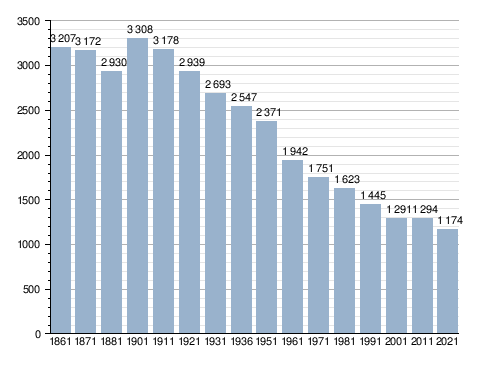
Demographic evolution
In the last fifty years, since 1971, the resident population decreased by 29 %.
Inhabitants registered[9]
Administration
Other administrative informationExplore this chapter
Below is a table relating to the administrations that have succeeded one another in this municipality.
| Period | First citizen | Match | Load | Notes | |
|---|---|---|---|---|---|
| 1 June 1985 | May 28, 1990 | Giuseppe Domenico Ricci | Italian Democratic Socialist Party | Mayor | [10] |
| May 28, 1990 | April 24, 1995 | Giuseppe Domenico Ricci | Italian Democratic Socialist Party | Mayor | [10] |
| April 24, 1995 | June 14, 1999 | Giuseppe Domenico Ricci | centre-left | Mayor | [10] |
| June 14, 1999 | June 14, 2004 | Giuseppe Domenico Ricci | civic list | Mayor | [10] |
| June 14, 2004 | June 8, 2009 | Giovanni Battista Sardi | Civic list Democratic Union | Mayor | [10] |
| June 8, 2009 | March 22, 2013 | Pier Luigi Arnera | civic list Together for Sezzadio | Mayor | [10] |
| March 22, 2013 | May 26, 2014 | Mountain enrolment | - | Prefectious Commissioner | [10][11] |
| May 26, 2014 | May 27, 2019 | Pier Giorgio Buffa | Civic list Democratic Union | Mayor | [10] |
| May 27, 2019 | June 9, 2024 | Enzo Daniele | list of Sezzadio in the heart | Mayor | [10] |
| June 9, 2024 | in office | Giancarlo Triggiani | list of people Viva Sezzadio | Mayor | [10] |
Other administrative information
In 1929 the territory of the common suppression was aggregated to Sezzadio Castelspina, which will be reconstituted only in 1954.[4] From 1859 the town was a mandamental capital, belonging to the surrounding area of Alessandria, until 1927, the date of the abolition of the agencies surrounding and mandamental.
Notes
Explore this chapter
- ^ to b Monthly demographic balance for the year 2026 (provisional data), up demo.istat.it, ISTAT.
- ^ Seismic classification (XLS), up risks.protezionecivile.gov.it.
- ^ Table of degrees/day of Italian Municipalities grouped by Region and Province (PDF), in Law 26 August 1993, n. 412, annex A, National Agency for New Technologies, Energy and Sustainable Economic Development, 1 March 2011, p. 151. URL consulted on 25 April 2012 (archived fromoriginal url on 1 January 2017).
- ^ to b Administrative history of Sezzadio, up elesh.it.
- ^ Sezzadio, up Heraldic office - Municipal files, Central State Archives.
- ^ Piedmontese civic coat of arms, vol. II, Regional Council of Piemonte, 2016, p. 512, ISBN 978-88-96074-98-5.
- ^ Coats of arms and gonfalone of the Municipality of Sezzadio, up Collection of drawings from the coat of arms of municipalities and cities, Central State Archives. Retrieved 28 September 2024.
- ^ In Sezzadio, the church of Santo Stefano di Sezzè or Santa Maria di Banno di Sezzè, up storiesditerritori.com.
- ^ Data taken from:
- Resident population of the municipalities. Censuses from 1861 to 1991 (PDF), up ebiblio.istat.it, ISTAT.
- Resident population - Time series, up exploredati.istat.it.
Please note: 2021 data refers to permanent census data as of December 31 of that year.
- ^ to b c d And f g h the j https://amministratori.interno.it/
- ^ Decree of the President of the Republic of 15/04/2013 and published in the Official Gazette n°96 of 24/04/2013, up Officer gazette.biz. Retrieved 7 December 2013.
Bibliography
Explore this chapter
- F. Gasparolo, Historical memories of Alexandrian Sezzè: the Abbey of S. Giustina, the monastery of S. Stefano or S. Maria di Banno, Volume I History 494 pages, Volume II Documents, Alessandria, Stab. Tipo-Litografico Succ. Gazzotti & C., 1912;
- E. Checchi, The Abadia of S. Justina of Sezzè, in Acts of the X Congress of History of Architecture, Turin, 8 - 15 September 1957, Rome, Study Center for the history of architecture, 1959, pp. 277 – 292;
- G. Buffa, History of Sezzadio, Volumes I and II, Alessandria, Cassa di Risparmio di Alessandria, 1980;
- A. Scolars, Notes on the abbey church of S. Giustina di Sezzadio, Turin, Piedmont Studies Center, 1976;
- A. Scolars, The abbey church of S. Giustina di Sezzadio, Turin, Edizioni dell'Orso, 1983;
- E. Podestà, The monastery of S. Maria di Banno, in “Novi Nostra”, XXIV (1984), pp. 83–98;
- L. Tacchella, Monastic settlements of the Valli Scrivia, Borbera, Lemme, Orba and Stura, Novi Ligure 1985, pp. 68–70;
- E. Cau, The “paper bidders” of the Spigno Abbey and other documents of monastic and canonical foundations in subalpine area, in Magazine of history, art and archaeology for the provinces of Alessandria and Asti, number 100, Alessandria, Graphic impressions, 1991, pp. 27–40;
- S. Arditi, C. Prosperi, Sezzadio: Santa Giustina Abbey, in Between Romanesque and Gothic: medieval art trails in the millennia of San Guido (1004-2004), bishop of Acqui, Acqui Terme, Graphic Impressions, 2004, pp. 191–199;
- S. Caldano, Echoes of transalpine architecture in the Aleramic brand, Santa Giustina di Sezzadio and Santo Stefano extra muras by Gamondio, in A. Segagni Malacart, L. C. Schiavi, Architecture of the XI Century in Northern Italy - historiography and new research, Pisa, ETS Editions, 2013, pp. 215–222.
Where to stay · Sezzadio
Find stays on Booking.comStories, places and people
More about Sezzadio and the surrounding area
Follow a thread of history and see where it leads.
 Brigante mandrogno · CC BY-SA 4.0
Ghilini
(Carlo A-Valle, History of Alessandria, volume IV, Book VI, pages 348 and 349)
Read the story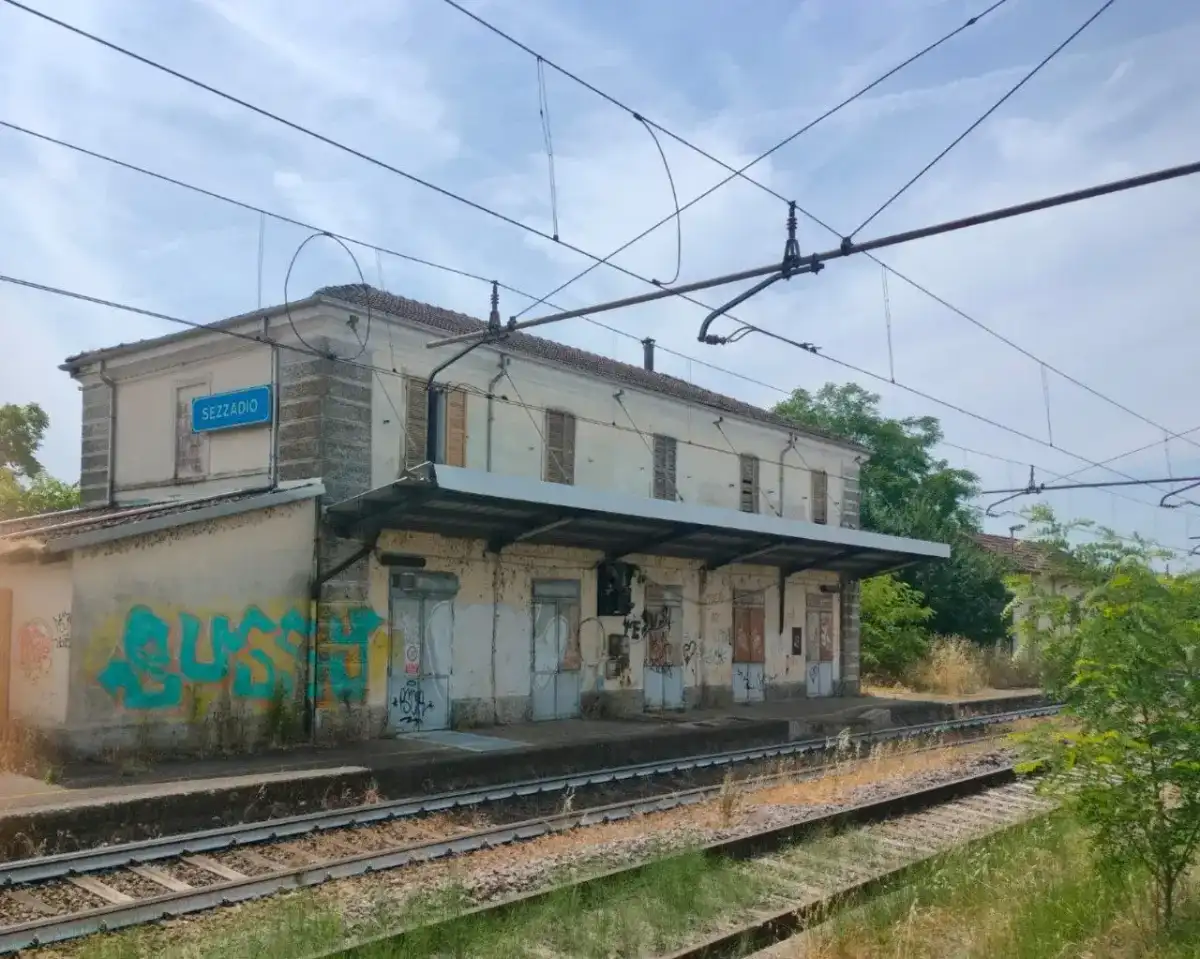 Murray Nozick · CC0
Sezzadio Station
The station Sezzadio is a railway station located on the line Alessandria- Saint Joseph. Sita in the municipal territory of Gamalero , originally served the adjacent town of Sezzadio .
Read the storyThe area, step by step
Trails and routes in Sezzadio

Asti, Alessandria and surroundings
The Wine and Flavor Route · Wine Rivers · Oviglio–Castelnuovo Bormida
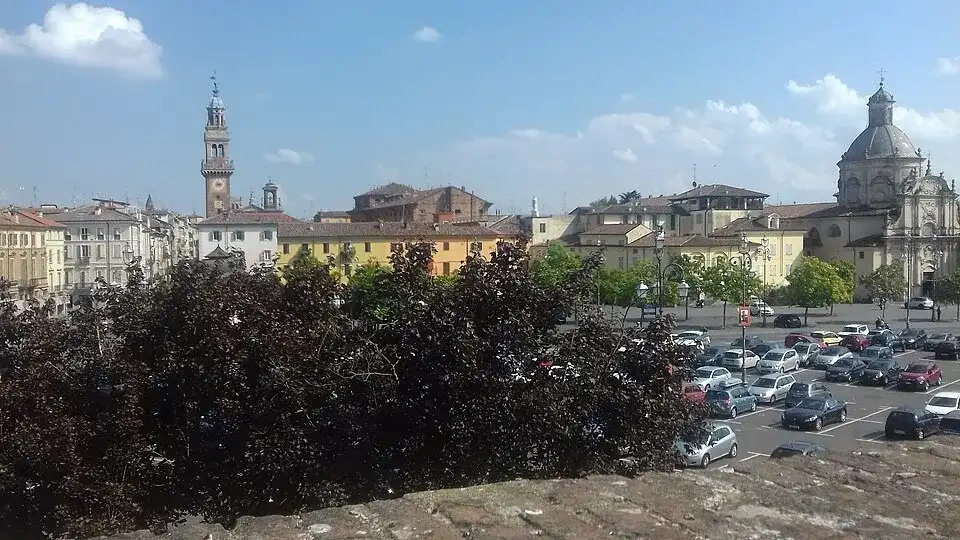 CyclingPlaces and landscapes along the route

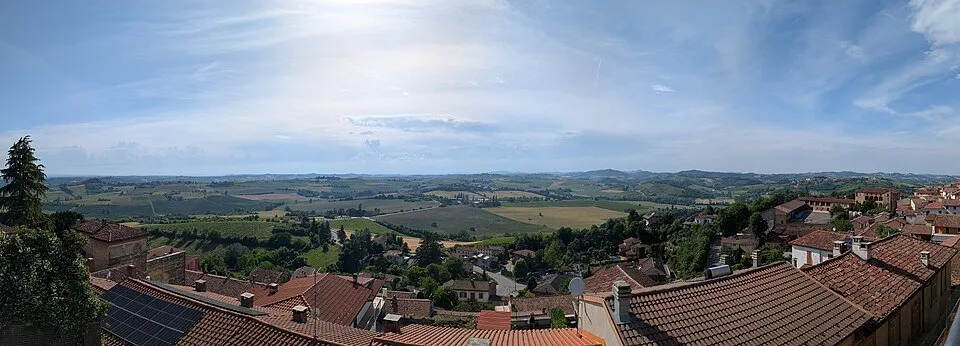 CyclingPlaces and landscapes along the route