
A closer look
Ghilini: at a glance
(Carlo A-Valle, History of Alessandria, volume IV, Book VI, pages 348 and 349)
The patrizia family of Ghilini was one of the oldest in the city Alessandria. According to tradition, the Ghilinis moved from Milan when Alessandria was founded in 1168 by the Lombard League as an extreme front against Frederick Barbarossa. More likely the Ghilinis come from a branch of the Lords of Marengo e Sezzadio and therefore rooted in the territory[A 1]. In any case, it remains certain that the Ghilini family was among the architects of the Guelph faction, together with other families, of the foundation of Alessandria.
As belonging to the decurional ceto, they were one of eight families of Alessandria with the right to guard the key of the ark, preserved in the ancient Cathedral of St. Peter[F 1] demolished by order of Napoleon between February and July 1803, which guarded the relics of the Holy Cross and the Sacred Spina. With the passing of centuries they acquired several titles and fiefs[A 2]: they were marquis of Maranzana, Sezzadio And Gamalero, accounts of Rivalta Bormida, Pavone and Asuni, counts of the Empire, lords of Borgoratto Alessandrino, Castelceriolo and Movarone.
History
Family genesis · XII-XIII century · 14th centuryExplore this chapter
Family genesis
Two are the versions on the historical and geographical origin of the family. The local historian Carlo A-Valle defines the Ghilini family as "one of the oldest, most noble and most fruitful men in all kinds"[F 2]. Identical thesis is supported by the annalist Gerolamo Ghilini[F 3] even if it is said that his reconstruction was judged "wonderful and fabulous" tense to "magnify the origins of their own people"[F 4]. Ghilini would maintain that Charlemagne in 773, once Desiderius had been defeated and Pavia conquered, left one of his lieutenants who - having reconciled Italy and then settled in Milan - married a rich lady from the city. The lieutenant would have been General Lodovico, Duke of Ghienna, from whom the gens ghilinia. The duke's children would have been called first Guineans, then Ghiini and finally Ghilini. A Pro-memo, preserved in the State Archives of Milan, describes that "the name "Ghilini" came in the Latin idiom written over the centuries handed down in different ways, and firstly with two syllables "Ghinus", then with three "Ghijnus", and later "Ghiglinus", and lately "Ghilinus""[A 3]. With subsequent possessions of the family, especially in the Alessandria countryside, the duke's descendants would have been responsible for supervising the new city of Alessandria from Milan, settling in the neighborhood of Marengo from the Frascheta.
Two more historians agree with the Milanese origin of the family but without pushing beyond the likely slender fanciful Carolingians by Girolamo Ghilini. Giovan Battista di Crollalanza declares "the Ghilini family would have transplanted Alessandria from the time of manufacture of the City"[F 5]; Pompeo Litta Biumi, scrupulous in the confirmation of his research, states that "[...]when the Milanese, who professed the Guelph party, were determined in 1168 to erect in the place, where between Tanaro and Bormida stood the castle of Roboreto a city that was sufficiently vast and strong and to cope with ' pavesi and' marquisi di Monferrato, who were Ghibellines, wanted their followers to go and populate it. Among the families who went to stay in the city erected by the Lombard League against the arrogance of Federico Barbarossa was that of the Ghilini.[...]"[F 6]. Litta goes on to assert that "in the Milanese annals is unknown this surname, but in the soil of building Alessandria the surnames were not universally established yet. But it gives us for sure this news, and since the Ghilini are infallibly mentioned in the oldest cards of Alessandria, it will be much more reasonable to believe that it was a family coming from Milan to popular the new land, than retaliating it derived from a leader, who accompanied Charlemagne in the eighth century in the enterprise against the Lombards.".
A second version on the origins of Ghilini is supported by two other local historians, also attentive and scrupulous in the certainty of sources: Francesco Guasco[F 7] and Francesco Gasparolo[F 8]. According to them the Ghilini family, "since it was annexed on the basis of authentic documents such as "Lords of Marengo" and "Sezzè"", would be firmly anchored in the lands of Alessandria. In this case the progenitor would date back to Aimone III, count of Vercelli in the mid-9th century, descendant of Manfred who came to Italy following the Austrasian king Theodebert who died on 12 June 539 in Galliano near Cantù[F 9]. Francesco Guasco therefore thinks that the Ghilini did not come from Milan but were already residents in the vast region of Fraschetta and Marengo. Only later would they all move to the newly founded city to populate it and thus give life to the Marengo neighborhood.
XII-XIII century
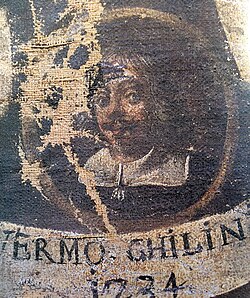
(† 1253)
The first name linked to the Ghilini, which is still known as certain news, regardless of their origin, is that of Gherardo which is present in the founding acts of the city of Alessandria in 1168. Later, in 1229, there is news of the son Vermo († 1253), or William, united with the Guelph faction and present among the families of the nobility with the right to be part of the council of elders. With this office he ratified, in 1234, the treaty of alliance between Alessandria and Acqui Terme. Again in 1280 Vermo's son, John († 1289), captain of the militias of Alessandria was sent to the aid of Ottone Visconti, archbishop of Milan, against the Torriani[F 10].
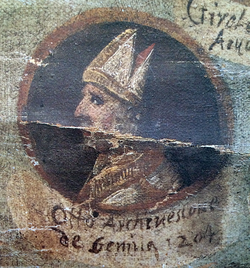
(† 1239)
Another son, or brother, of Gherardo - Brass - he was probably appointed second bishop of Alessandria in 1176 or 1177 upon the death of Arduino. Subsequently, in 1185 he was bishop of Bobbio and in 1203 archbishop of Genoa, a position he held until his death in 1239. There are conflicting versions of Otto regarding the chronology of the events of his life. According to the two papal legates Opizzone and Buongiovanni, bishop Ottone was not consecrated but appointed bishop of Alessandria motivating this belief for a "certain hatred and scandal born from the erection of the bishopric Alessandrino for the assignment made to the same of many churches in the diocese of Acqui"[F 11]. This led the Alexandrians in 1180 to no longer be bound by the obligation of obedience, and Otto ceased "to be bishop of Alessandria"[F 12].
Pompeo Litta also supports the same argument "was not consecrated, indeed for the many discussions born with other Ordinarij on the occasion of the foundation made in 1175 of the Vescovado Alessandria, in 1179 was removed, having Alexander III ordered, that the Bishop of Acqui transferred his seat to Alessandria."
Francesco Guasco does not consider the hypothesis that Otto had been appointed Bishop of Alessandria, but it is limited to reporting his election as Bishop of Bobbio in 1185 and the passage as archbishop of the diocese of Genoa in 1203. In 1214, with the appointment of the archbishopric of Genoa, he was created a cardinal by intervening at the General Council in charge of Innocent III.[F 13].
The chronic discordances of Ottone's life that has been discussed before, are related to doubts about the possibility that the bishop elected Ottone is the same Cardinal in Genoa. If so, he should have been 93 years old at his death in 1239, "certainly rare age, but not impossible in robust uom"[F 14]. According to Pompeo Litta, in agreement with Francesco Guasco, "is likely that the Bishop of Alessandria and the Bishop of Bobbio are two different characters; it can be concluded, that the first is not de' Ghilini but the second is".
There are therefore no sufficient and certain elements to establish whether Ottone, bishop elected by the Alessandria, be the same bishop of Bobbio and cardinal archbishop of Genoa. The Litta leans out with the words that "the Alexandrian writers perhaps to increase the splendor of the homeland, assert him".
14th century
Thomas († 1402), nephew of Gerard I and marshal of France, who in the summer of 1391 participated in the Visconti victory at Alessandria against Count John III of Armagnac. He was Tommaso's cousin Andrea († 1343), cardinal in 1342, "poured into philosophy and theology, expert in law". A man of trust of Philip of Valois had a position as a papal bond with Alfonso XI King of Spain and later in Paris where he gave life to the College of Lombards in 1334.
15th century
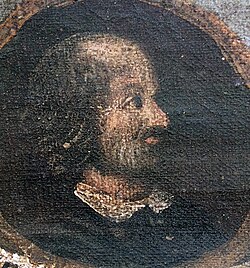
(† 1449)
Simonino († 1449), favorite of Filippo Maria Visconti, was born in Alessandria towards the end of the 14th century.
Facino Stefano Ghilini († 1472), son of Simonino, was first Abbot of the Basilica of Sant'Ambrogio in Milan and later bishop of Bobbio.
Biagio, († 1473), nephew of Simonino, was also Abbot of the Basilica of Sant'Ambrogio, succeeding his cousin Facino Stefano.
16th century
Gian Giacomo († 1532), a learned man of letters, an ornament of the Milanese court, wrote a history of the last days of Ludovico il Moro.
Your son Camillus († 1535) was Sforza ambassador to Charles V.
Giuliano († 1531), great lord, sumptuous guest of princely figures and Gianantonio (died 1616), butler of Christina of Denmark, widow of the Duke of Milan. they were part of the branch of the lords of Castelceriolo who became extinct in 1810.
17th century
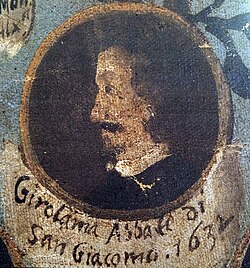
(1589-1668)
Girola (1589-1668), known for his Teatro degli men literati (Milan, 1636) and for the Annals of Alessandria of 1666, was part of a branch that became extinct in 1742.
18th century
Vittorio Amedeo Giacomo Ottaviano (1714-1776), marquis of Maranzana, was born in the aftermath of the Treaty of Utrecht which sanctioned the passage of Alessandria to the Savoy. He was captain of the fair and, with the full trust of the House of Savoy, in 1746 he joined the Accounting Office, a newly established body at the end of the Gallispan siege during the War of the Austrian Succession.
In the 18th century a prominent figure of the house was certainly Thomas Maria (1718-1787), archbishop of Rhodes, apostolic nuncio to Brussels, elevated by Pope Pius VI to the dignity of cardinal in 1778. The cardinal's elder brother was Thomas Ottaviano II, marquis of Maranzana, Gamalero And Sezzadio and author of the construction of the sumptuous "Palazzo Ghilini", overlooking Piazza della LibertÃ, designed by Benedetto Alfieri.
The Marquis Ambrose Maria (1757-1832)[A 4], son and universal heir of Vittorio Amedeo Giacomo Ottaviano, played important roles during the Napoleonic period at the end of which he resumed military service in the Sardinian army and was commander of the Novara division. Passionate about botany, he reorganized and expanded the sumptuous garden park of approximately 11 hectares, near the family's summer residence, the Big-haired Ghilina, in San Giuliano Nuovo of Alessandria. With his death, which occurred on December 15, the branch to which he belonged and the entire house became extinct. His body was buried in the Ghilina church, and the inscriptions that decorated his funeral are preserved[F 15][A 5].
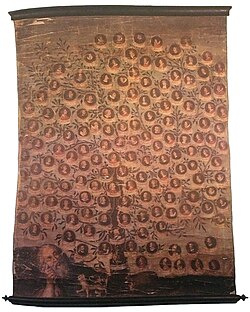
Genealogical table
The genealogical table follows the line dictated by Francesco Guasco di Bisio in the sixth volume of his work cited in bibliography, recognized by historians to be the most important source...Explore this chapter
The genealogical table follows the line dictated by Francesco Guasco di Bisio in the VI volume of his work cited in bibliography, recognized by historians to be the most reliable source.


Armors
Below the coat of arms that distinguished the various branches of the Ghilini familyExplore this chapter
Below the coat of arms that distinguished the various branches of the Ghilini family
| Coat of arms | Copper and blasoning |
|---|---|

|
Ghilini Title: Lords of Marengo and Sezzè Description: D'azzurro, al leone d'argento, armi e linguato di rosso |
| Coat of arms | Copper and blasoning |
|---|---|

|
Ghilini Title: Marchesi di Maranzana, Gamalero e Sezzè, Conti di Rivalta Description: D'azzurro, al leone coronato d'argento, armi e linguato di rosso |
| Coat of arms | Copper and blasoning |
|---|---|
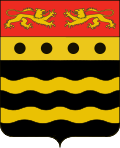
|
Aribaldi-Ghilini Title: Description: Of black, two bands of gold, waves, with the head of red, load of two lions of gold, illeopardized and faced, backed of gold, the belt loaded with four tortelli, of black |
| Coat of arms | Copper and blasoning |
|---|---|
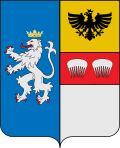
|
Ghilini-Pettenari Title: Description: Party, semi-thrown, on the 1st of blue, to the silver crowned lion, at the 2nd of gold, to the crowned eagle, of black, to the 3rd of full silver, with the red band, loaded with two silver combs, one next to the other, crossing on the truncature |
Family Feeds and possessions
Explore this chapter
- Feuds of Borgoratto Alessandrino And Gamalero
- 28 May 1438 - Filippo Maria Visconti gives Simonino Ghilini, his favorite secretary, the fiefdoms of Gamalero and Borgoratto[A 6]. A confiscation interrupted their possession, they were then returned in 1450.
- 6 April 1726 - Tommaso Ottaviano Antonio Domenico Maria Ghilini (1667-1748) defines and acquires the fief of Gamalero (together with that of Sezzadio) for 32,000 Piedmontese liras.
- Feudo di Castelceriolo
- 1 February 1439 - Upon the death of Cristoforo Ghilini (?-1439), secretary of the Duke of Milan, his sons inherited the possession of Castelceriolo thanks to the important position achieved by their father within the ducal administration.
- Feudo di Movarone e Possementi del "Bosco di San Giuliano"[A 7]
- 19 September 1494 - Ludovico il Moro, for the services offered by Giovanni Giacomo Ghilini (?-1532) his advisor, donated the fief of Movarone, in the Pavia area, and the Cascina Filippona[8] - with all the farms - in the Fraschetta of Alessandria.
- 26 February 1613 - Ottaviano Ghilini (?-1613), upon his death, established primogeniture in favor of his grandchildren[A 9] of the place called "La Ghilina" of San Giuliano in the Fraschetta.
- Feudo di Pavone (d'Alessandria)
- 1676 - Giovanni Battista Ghilini, son of Gerolamo (1589-1668), purchases the fiefdom of Pavone d'Alessandria.
- 6 May 1681 - Giovanni Battista Ghilini had the Investiture as Count of Pavone.
- Feed of Maranzana
- 1670 - Giacomo Ottaviano Francesco Ghilini (1619-1703) acquires the marquis title over the fiefdom of Maranzana.
- Feed of Sezzadio
- 6 April 1726 - Tommaso Ottaviano Antonio Domenico Maria Ghilini acquires the fief of Sezzadio[A 10] (together with that of Gamalero) for 32,000 Piedmontese lire.
- Feed of Rivalta Bormida
- 2 May 1680 - Giacomo Ottaviano Francesco Ghilini purchases the county of Rivalta Bormida for 62,000 Milanese lire.
- Feed of Asuni - Michele Ghilini was count of Asuni on 10 October 1749 for the purchase made by Fernando Marghens-Nin, Count of Castillo. He then sold the fiefdom on 23 March 1753 to the merchant Guglielmo Tauffani[F 16].
Incarichi and tasks
Public credits · Teachers and literal persons · CardinalsExplore this chapter
Public credits
- Giovanni Ghilini (XIII century) - captain of the Militias Alessandria (1280)
- Andrea Ghilini (XIV century) - decurione di Alessandria
- Giovanni Ghilini (XIV century) - decurione di Alessandria (1377)
- Tommaso Ghilini (aged 14-1402) - governor of Bergamo (1395)
- Giovanni Giacomo Ghilini (Seventh-XV century) - judge of the summits[A 11] (1413)
- Cristoforo Ghilini (second half century XIV-1439) - decurione di Alessandria (1397), Captain of Monza (1415), Secretary of the Duke of Milan (1434)
- Simonino Ghilini (end of the 14th century - 1449) - Secretary and State Councillor of Duke Filippo Maria Visconti
- Giovanni Nicolò Ghilini (XV century) - causidico in Ferrara
- Giuliano Ghilini (?-1474) - podestà di Pavia (1465)
- Camillo Ghilini (~1490-1535) - Ambassador of Francis II Sforza to Charles V
- Giovanni Tommaso Ghilini (?-1502) - decurione di Alessandria (1466), castellano di Caravaggio, podestà di Valenza (1496)
- Gian Giacomo Ghilini (?-1532) - secretary of Gian Galeazzo Maria Sforza, special adviser to Ludovico il Moro
- Ghilino Ghilini (~1477-1559) - Podestà di Finale Emilia (1506)
- Giovanni Giacomo Ghilini (?-1612) - podestà di Tortona (1582), mayor of Monza (1588), secretary of the Senate of Milan (1593)
- Ottaviano Ghilini (?-1613) - council of jureconsultes of Alexandria (1585), orator of Alexandria at the governorate and the Senate of Milan (1586), first of the twelve priors of commission of Alessandria (1589), vicar of the podestà of Pavia (1590)
- Tommaso Ghilini (1576-post 1630) - jureconsulto, general auditor of the State of Piombino, apostolic protonotarian
- Giovanni Ambrogio Ghilini (1577-1630) - decurione di Alessandria (1615)
- Lodovico Ghilini (1592-1660) - governor of Nizza Monferrato
- Tommaso Ottaviano Antonio Domenico Maria (1667-1748) - decurione di Alessandria (1704)
- Ambrose Giovanni Maria Ghilini (1716-1792) - governor of Valenza, governor of Casale Monferrato
Teachers and literal persons
- Pietro Ghilini (~sec. XV) - Professor of Law at the University of Pavia
- Gian Giacomo Ghilini (?-1532) - literary
- Camillo Ghilini (~1490-1535) - literary
- Girolamo Ghilini (1589-1668) - Practicabiles casum coscientiæ resolutiones (1636), Teatro d'huomini letterati (1647), Annali di Alessandria (1666)
Cardinals
- Andrea Ghilini (late 13th century-1343) - Bishop of Arras, bishop of Tournai, Cardinal (1342)
- Tommaso Maria Ghilini (1718-1787) - Archbishop of Rhodes (1763), Apostolic Nuncio in the Austrian Netherlands (1763), Cardinal (1778)
Bishops and Abbas
- Ottone Ghilini (?-1239) - bishop of Alessandria (~1176-1178/~1180/1185), Bishop of Bobbio (1185-1203), Archbishop of Genoa (1203-1239)
- Facino Stefano Ghilini (?-1472) - Abbey of the Basilica of Sant'Ambrogio in Milan (1436-1437), Bishop of Bobbio (1465-1472)
- Biagio Ghilini (†1473) - Abbey of Sant'Ambrogio di Milano (1437-1441)
- Ghilino Ghilini (~1477-1559) - Bishop of Comacchio (1514-1559)
Religious and religious
- Anna Ghilini (XVI century) - nun and abbess of Saint Mary of the Annunciation (sub titulo Santa Monica, Alessandria
- Giuliano Ghilini (1580-1625) - Capuchin friar with the name of Gabriele
- Cecilia Ghilini (Sixteenth and 17th centuries) - abbess of the convent of St. Clare of Alessandria
- Laura Ghilini (Sixteenth and 17th centuries) - nun of the convent of St. Clare of Alessandria
- Anna Ghilini (1583-1630) - nun of the convent of San Martino, Monza
- Lucrezia Alciati[A 12] (?- ~1590) - nun of Santa Maria del Monte, Milan
- Lodovica Ghilini (1574-1624) - nun and abbess of the convent of San Martino, Monza
- Marianna Francesca Ghilini (?-1769 - abbess Sister Agostiniane, Alessandria
Men of arms
- Tommaso Ghilini (age of the 14th-1402) - Marshal of the Kingdom[A 13] (1385)
- Giovanni Ambrogio Ghilini (1577-1630) - Spanish Army Infantry Captain
- Lodovico Ghilini (1592-1660) - Spanish Army Infantry Captain
- Giacomo Antonio Ghilini (XVII century) - infantry captain serving in the Lombard army[1]
- Giovanni Giacomo (Seventeenth century) - infantry captain serving in the Lombard army[1]
- Giacomo Ottaviano Francesco (1619-1703) - captain of cavalry in service in the Lombard army[1]
- John Thomas (1634-1681) - infantry captain serving in the Lombard army[1]
- Giovanni Battista Ghilini (?-1680) - infantry captain serving in the Lombard army[1]
- Giovanni Ambrogio Gaspare Ottaviano Giacomo Filippo Ghilini (1663-?) - Infantry Colonel
- Ambrose Giovanni Maria Ghilini (1716-1792) - General of the Dragons
House
Of the dwellings built and inhabited by the Ghilini, they are remembered in particular:Explore this chapter
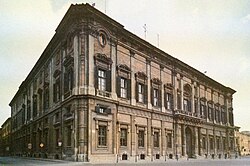
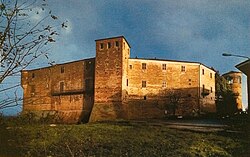
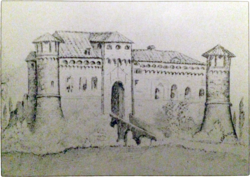
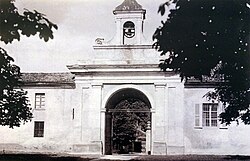
Of the dwellings built and inhabited by the Ghilini, they are remembered in particular:
- Palazzo Ghilini, Alessandria. Designed by Benedetto Alfieri;
- Maranzana (Asti);
- Castelceriolo Castle, (Castelceriolo);
- Castello di Pavone, (Alessandria);
- Ghilina Grossa (San Giuliano Nuovo).
Notes
Explanatory statement · BibliographicExplore this chapter
Explanatory statement
- ^ Cf. Family genesis
- ^ Cf. Family Feeds and possessions
- ^ Pro-Memo on Cristoforo Ghilini existing at the State Archives of Milan: Indexes, Registers, Letter G., published in Magazine of History, Art, Archaeology of the Province of Alessandria, year 1908, p. 609
- ^ Ambrogio Maria Ghilini had the following titles and assignments: IV Marchese di Maranzana, IV Conte di Rivalta, III Marchese di Sezzé e Gamalero (1767), Decurione di Alessandria, Officer of the Royal Sardo Army (1775), Gentiluomo di Bocca del Re di Sardegna (1778), First Auditor of the Duchess of Aosta (1789), Lieutenant Colonel of the Province Regiment of Tortona del Regio Sardo Army (1792), Noble of Alexandria and Tortona, Commander of the Companies of Honor of the Department of Marengo (1807), Vice President of the Electoral College of Marengo Department (1808), Knight of the Legion of Honour (1809), Count of the French Empire (1810), Chairman of the Electoral College of the Marengo Department (1811), Officer of the Legion of Honour (1811), the Chamberlain of the Emperor of the French (1811), Colonel of the Province Regiment of Tortona del Regio Sardo Army (1815), Major General of the Sardo Army (1816), Interim Governor of the City and County of Nice Sea (1817), Commander of the Novara Division of the Sardo Army Royal (1818), Mayor of First Class of Alexandria (1818-1823), General Commander of the Militias of the Division of Alexandria (1819), Knight of the Grand Cross of the Order of Saints Maurizio and Lazzaro (1820), Member of the Government of the Kingdom of Sardinia (1821), Head of the Province of Alexandria of the Maurtian Order (1831)
- ^
TO THE TEMPUS PORTA
Ambrosio Mariæ Ghilini, former brand. Maranz. Sexap. et Gamal. comit. Ripaltæ, ab Augustiss. Sardin. Rege in Equites magn. cruc. Ord. SS. Maur. et. Lazari, nec non maior. Agnm. duces militiæque Alexandr. divis. magistros common plauso adscito, vetusta patricia nobilitate conspicabili, qui cunctas sibi lineapitus infixas virtutes iugi in Deum cœlitesque religions et pietatis exercio, mirifica in egenos maxime pudibundos liberalitate, in ommune humanitate, integritudine Jan. an. MDCCCXXXII, iustis undique exorientibus lacrymis, bonorum votis erepto, pientes inclitæ familiæ superstites, non ex inan. ostentat., sed intimate naturæ gratique animi sensu, XIX kal. febr. an. MDCCCXXXI sponso ac beloved relatives inferius iterum rependunt mœstivsime.
IN THE SARCOFAGUERich, poor, inhabitants, foresaw, weep the common loss: his wife, his daughter, the nepots make the legitimate suffrage of the trigism to the excellent groom, to the tenderest of the fathers, to the sweet avo Don Ambrogio Maria Ghilini: pray to him from God the wicked joy of the righteous: lived LXXVI years, but very little to the universal desire.
TO THE DESTING LATEThe Marquis Don Ambrogio Maria Ghilini patrizio alessandrino, knight of great cross, head of the province of equestrian order of SS. Maurizio and Lazzaro, formerly a sculptor of Queen Maria Teresa of Austria, colonel of the regiment of Tortona, made the war of the Alps under Vittorio Amedeo III, followed by Charles Emmanuel IV in Sardinia, recalled at home from the ceased government, was donut to the imperial court of France. Returning the sovereign to Piemonte, promoted to the rank of major general, he was elected to the interinal government of Nice, then under the command of the division of Novara, for last commander of the militias of this division.
_A worthy citizen, the homeland, the times more learned mayor, the spedals, the hospices, prisons and all sorts of pious institutions, chief in all desires, dear, tried his generous liberality: shameful poverty had him to common father and refuge in the affannose his needs. Oh! men who imitate him and draw him in the use of riches in their own.
FROM THE SINISC LATEMirable for the sake of costumes and words, beautiful in manners and life, always that he could benefit, made it with lovingness and good degree: he loved everyone for the goodness of his heart: he was strong and generous soul, perspicacious ingenuity and mature advice: of botanical studies lovers: this academy would be among him: axes of utmost piety and sincere divotion in God. Anima informed to every virtue, will take care of your memory at home.
- ^ On these fiefs he had full availability of castles, possessions, mills and duties relevant to them. The donation decreed that the fiefs were separated from the jurisdiction of the city of Alessandria in which Simonino was domiciled. Borgoratto and Gamalero Simonino Ghilini was already owner of the estate: a mill with adjacent lands near Vaprio to which were added those of Castelceriolo.
- ^ So called that part of the Fraschetta to be the hunting territory of Filippo Maria Sforza, brother of Ludovico il Moro, rich in woodland near the parish of San Giuliano di Alessandria (Cfr. San Giuliano Nuovo and San Giuliano Vecchio)
- ^ The farmhouse was a property of Filippo Maria Sforza brother of Lodovico. Thus, for this reason, it was called "La Filippona"
- ^ The sons of Gian Giacomo Ghilini (?-1612), secretary of the Senate of Milan and his brother
- ^ the Ghilini had appeared as landowners before boasting feudal titles on Sezzadio until when Giacomo Ottaviano had been repaid a loan granted in 1689 to this Giacomo Cortona with a plot
- ^ Appointed by Filippo Maria Visconti
- ^ Daughter of Peter and Maria Ghilini of the age Giuliano died in 1474
- ^ Appointed by Charles VI of France
Bibliographic
- ^ Cf. Giulio Ieni, The ancient cathedral, up diocesealessandria.it, Diocese of Alessandria, 1988. Retrieved 1 March 2015 (archived fromoriginal url on 9 February 2015).
- ^ Carlo A-Valle, Book VI, in History of Alessandria, volume IV, Tip. Falletti, Turin, 1885, p. 348.
- ^ Girolamo Ghilini, Famelia de Ghilini Origin and world famous, Alessandria, 17th century.
- ^ Thomas Santagostino, 18th century in Alessandria, History - Politics - Literature - Art - Chronicles and new documents, Alessandria, Tip. Ferrari-Occella, 1842, p. 268.
- ^ G.B. of Crulliance, Blasonino Historical Dictionary of Families Nobili and Notabili Italiane, Pisa, 1886.
- ^ Pompeo Litta Biumi, Table I, in Celebrated Italian Families, volume IV, Alessandria, 1842.
- ^ Francesco Guasco, Genealogic tables of families Nobili alessandrine and monferrine from the 9th century to the 20th century, volume VI, Casale Monferrato, Tip. Coop. Bellatore, 1930.
- ^ Francesco Gasparolo, Vittorio Amedeo Ghilini - sec. XVIII, in Magazine of History, Art, Archaeology of the Province of Alessandria, Alessandria, Tip. G. Jaqueroud Sons, 1898.
- ^ Giuseppe Aldo di Ricaldone, Annali del Monferrato, volume I, p. 87.
- ^ Francesco Guasco, op. C., T. 1
- ^ Giuseppe Antonio Chenna, The Bishop of the Bishops and Churches of the City and Diocese Alessandria, Volume one, Book four, Alessandria, Ignazio Vimercati Stampatore, 1785, p. 216.
- ^ Giuseppe Antonio Chenna, op. c., p. 218
- ^ Carlo A-Valle, op. c., p. 371; Young Baptist of Crollalance, op. Cit.
- ^ Giuseppe Antonio Chenna, op. c., p. 220
- ^ Carlo A-Valle, op. cit., pp. 351, 352
- ^ Francesco Guasco di Bisio, Genealogic tables of noble families Alessandrine and Monferrine from the 9th to the 20th century, volume VI, table IX.
- ^ Lucio Bassi, Ghilini. The palace and its history, Alessandria, Province of Alessandria, 1989, p. 13.
Bibliography
Explore this chapter
- AA.VV., Insignia Urbium Italiae Septentrionalis Nobilium Mediolanensium, BSB Cod.icon. 270, Milan, 1550.
- Girolamo Ghilini, Annals of Alessandria, Milan, Gioseffo Marelli, 1666.
- Giuseppe Antonio Chenna, of the bishopric and churches of the city and diocese Alessandria, Alessandria, Ignazio Vimercati, 1785.
- Carlo A-Valle, History of Alessandria from origin to our days, vol. 4, Turin, 1855.
- Francesco Guasco, I-IX, in Genealogic tables of noble families Alexandrian and Monferrine from the 9th to the 20th century, volume VI, Alessandria, 1930.
- Lucio Bassi, Ghilini. The palace and its history, Alessandria, Province of Alessandria, 1989.
- David Maffi, The citadel in weapons. Army, society and finance in the Lombardy of Charles II, 1660-1700, Milan, Franco Angeli, 2010, p. 140.
Continue your journey