- Elevation
- 272 m above sea level
- Area
- 4.37 km²
- Demonym
- Maranza
- Patron saint
- Saint John the Baptist
A closer look
Discovering Maranzana
Maranzana (Maransan in Piedmont) is an Italian municipality of 204 inhabitants[1] from the province of Asti, located in Monferrato.
Landscape and area
The town centre is pushed to the edge of the park called "Bosco delle Sorti" within which there are marked paths for walk, bicycle and...Explore this chapter
The town is pushed to the edge of the park called "Bosco delle Sorti" within which there are marked paths that can be reached on foot, by bicycle and on horseback.
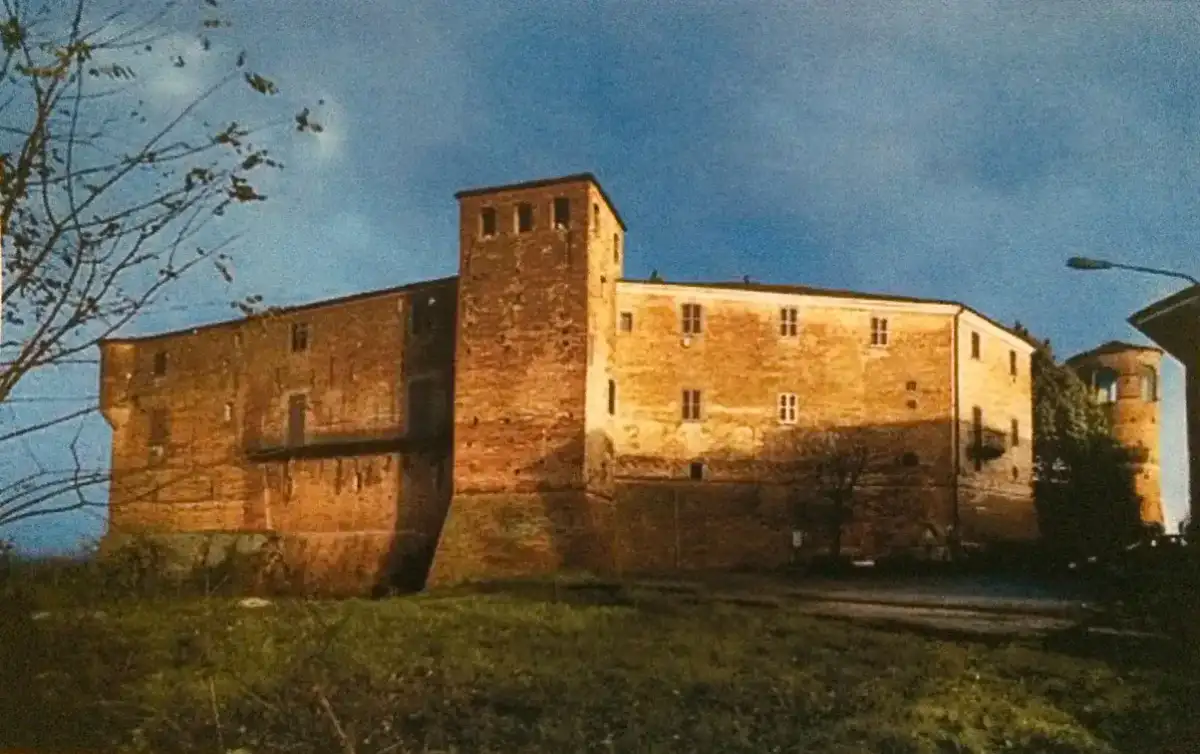
In the centre of the village, on top of a hill from which you can enjoy a magnificent view, rises the castle of 1300 very well preserved, as well as the towers and the walls. Also in the village is the museum house of Giacomo Bove, an important Italian explorer lived between 1852 and 1887.
History of Maranzana
SymbolsExplore this chapter
From studies made, the name Maranzana could be of predial origin, namely a noun that refers to a territory, a land. The media documentation proposes us: Marencanus (found on papers from 1188); Maranzana of 1199; Marenzana of 1257; Maransana 1353. Some scholars interpret it as derived from the Latin verb emere or from the personal Roman name emerentius or directly from emerential. The decisive name of Maranzana dates back no later than the 16th century, a period in which the term did not present further variations. In ancient times this territory was inhabited, according to legends, by the Celts who invaded Italy attracted by its rich agricultural products.
According to Livio, the Galli invaded Italy around 500 BC. and this area became Gallia Cisalpina. At the time Maranzana was born as a small settlement of shepherds and farmers. From the 5th century onwards, the invasion of Ostrogoths, Longobards and Franks continued. Until the 8th century Maranzana and the surrounding territories suffered devastation. In 900 these lands undergo the incursions of Saracens, then in 951 the Aleramic dynasty began which gave rise to Marquisate of Monferrato. In 1536 this marquisate passed to the Gonzagas of Mantua.
In 1670 Giacomo Ottaviano Francesco Ghilini (1619-1703), of the homonymous noble family Alexandria, acquires the title mark on the fief of Maranzana that will be kept until the death of the last Marquis, Ambrogio Maria Ghilini (1757-1832).
With the Treaty of Utrecht Maranzana, along with other lands, passes under the Savoy House and from that moment followed the fate of the Savoy history, participated in the Risorgimento and the events that bind the Piemonte to Italy until our days.
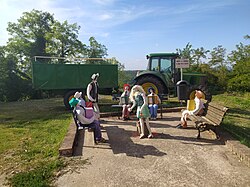
Recently Maranzana took the appellation of Country of the Babaci, or puppets in dialect, due to the presence in various places of numerous life-size stuffed characters produced by a group of skilled and willing women, as a welcome to visitors and tourists.[4]
Symbols
The coat of arms and gonfalone of the Municipality of Maranzana were granted by decree of the President of the Republic of 3 November 1987.[5]
The gonfalone is a drape party of white and blue.[7]
Society
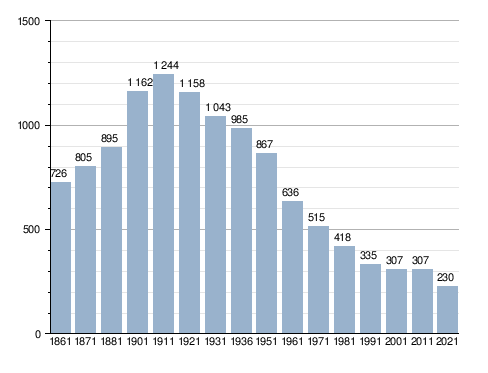
Demographic evolutionExplore this chapter
Demographic evolution
In the last hundred years, as of 1921, the resident population has reduced by 75%.
Inhabitants registered[8]
Economy
The economy is purely agricultural, with almost exclusive wine address. The only large industry is the social winery "La Maranzana" which produces fine DOCG wines such as...Explore this chapter
The economy is purely agricultural, with almost exclusive wine address. The only major industry is the social winery "La Maranzana" which produces fine DOCG wines such as Moscato, Cortese, Dolcetto, Barbera, Brachetto and Chardonnay that trades in Italy and abroad.
Administration
Below is a table relating to the administrations that have succeeded one another in this municipality.Explore this chapter
Below is a table relating to the administrations that have succeeded one another in this municipality.
| Period | First citizen | Match | Load | Notes | |
|---|---|---|---|---|---|
| 6 June 1985 | May 22, 1990 | Evasio Polidoro Marabese | - | Mayor | [9] |
| May 22, 1990 | April 24, 1995 | Evasio Polidoro Marabese | Italian Socialist Party | Mayor | [9] |
| April 24, 1995 | June 14, 1999 | Evasio Polidoro Marabese | centre-right | Mayor | [9] |
| June 14, 1999 | June 14, 2004 | Evasio Polidoro Marabese | civic list | Mayor | [9] |
| June 14, 2004 | June 8, 2009 | Marco Lorenzo Patetta | civic list | Mayor | [9] |
| June 8, 2009 | May 26, 2014 | Marco Lorenzo Patetta | civic list | Mayor | [9] |
| May 26, 2014 | in office | Marilena Ciravegna | Lista civica Lavorare Uniti | Mayor | [9] |
Notes
Explore this chapter
- ^ to b Monthly demographic balance for the year 2026 (provisional data), up demo.istat.it, ISTAT.
- ^ Seismic classification (XLS), up risks.protezionecivile.gov.it.
- ^ Table of degrees/day of Italian Municipalities grouped by Region and Province (PDF), in Law 26 August 1993, n. 412, annex A, National Agency for New Technologies, Energy and Sustainable Economic Development, 1 March 2011, p. 151. URL consulted on 25 April 2012 (archived fromoriginal url on 1 January 2017).
- ^ The Country of the Babaci, up ilpaesedeibabaci.it.
- ^ Maranzana, up Heraldic office - Municipal files, Central State Archives. Retrieved 7 January 2023.
- ^ Piedmontese civic coat of arms, vol. II, Regional Council of Piemonte, 2016, p. 287, ISBN 978-88-96074-98-5.
- ^ Municipality of Maranzana – (AT), up araldicacivica.it. Retrieved 6 March 2021.
- ^ Data taken from:
- Resident population of the municipalities. Censuses from 1861 to 1991 (PDF), up ebiblio.istat.it, ISTAT.
- Resident population - Time series, up exploredati.istat.it.
Please note: 2021 data refers to permanent census data as of December 31 of that year.
- ^ to b c d And f g http://amministratori.interno.it/
Bibliography
Explore this chapter
- E. Colla, Maranzana in the centuries.
Where to stay · Maranzana
Find stays on Booking.comStories, places and people
More about Maranzana and the surrounding area
Follow a thread of history and see where it leads.
 Brigante mandrogno · CC BY-SA 4.0
Ghilini
(Carlo A-Valle, History of Alessandria, volume IV, Book VI, pages 348 and 349)
Read the story · Public domain
Ceresara (family)
According to some historians, the family would have transplanted into the mantova coming from Milan, while others would like it to come to Italy following Emperor Frederick I Barbarossa, who would have assigned them the fief of Ceresara, now common in province of Mantua .
Read the storyThe area, step by step

