
A closer look
Saracens: at a glance
Saracen It is a term used from the 2nd century until the whole Middle Ages to indicate people coming from the Arabian Peninsula or, by extension, of Muslim religion.
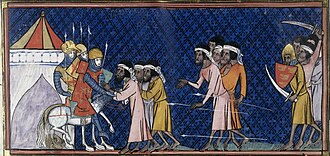
Generic, since birth it is a term without a strict ethnic or linguistic meaning, nor religious (just think about the Chanson de Roland, where the Basques were also so called), with several variations over time. Initially it did not only identify Arabs, but also Berbers.[1]
Synonyms
Explore this chapter
These are not used:
- Arabs: nomadic people of the Arabian Peninsula, protagonists of the first Islamic history in the 7th century. Later, the ethnonymity was extended to all people who professed Islam or spoke Arabic. Between the 2nd and 5th centuries, the "Arabi" are replaced in Greek and Latin sources by the "Saraceni", while in Aramaic sources it is spoken of tayyaye.[2]
- Mori: that is, people of Mauretania, with particular reference to the Berber populations which constituted the majority of troops who conquered a part of the Iberian Peninsula (al-Andalus) in the eighth century, Byzantine Sicily, Sardinia and South Italy in the 9th century.
- Muslims: the word mentioned for the first time in French in 1551, English in 1615.
- Islamic, Ismaelites, Agarenes, Maomettani.
Etymology
There are many etymologies and muramologies.Explore this chapter
There are many etymologies and wallymologies.
Through the Latin «Saraceni» comes from the Aramaic «I'm not going to be here.» meaning «inhabitants of the desert» (from «Sraq», «deert»)[3] or 'oriental' («♪ I don't know what I mean», from the Arab noun «SharqThe question of some is that of those who have created the term, or what are they to 'orient'; the obvious answer is: with respect to those who have created the term),[4] or directly or through the Greek Σαρακηνός («Sarah's»).
As described by Tolomeo[5] i Σαρακηνοί («)will be») were an Arab population or derived the name from «Saraka», a city of Sinai. So also according to Stefano di Bisanzio.
Famous is the etymology of Isidoro in Seville:
(Isidore of Seville, Etymology, IX, 2,57.)
So also for Giovanni Damasceno.
The incursions
The purpose of Saracen incursion was to kidnap men, women and children to make slaves or ransom goods and to rattle loot.Explore this chapter
The purpose of Saracen incursion was to kidnap men, women and children to make slaves or ransom goods and to rattle loot.
The Saracen pirates had fixed bases in the Maghreb; also some coastal towns were occupied for a long time by the Saracens (who founded the Emirate of Taranto and the Emirate of Bari), as well as some mountainous areas (but always easily accessible from maritime landings) of the French Riviera (La Garde Freynet, a place called then Frassineto).
From these bases, the Saracens departed to attack the cities, villages and neighboring monasteries: divided into bands, quickly plundered buildings and then escape by sea; other times they occupied the city, imposing heavy taxes on those who did not submit themselves converting to Islam (this was the cause of the dispopulation of these lands).[6]
Sources
Ancient sources · Medieval sourcesExplore this chapter
Ancient sources
The word "Arabs" means "nomads", is used by all ancient sources of the neighboring populations: axle (ar-ba-a-a And a-ri-bi), the Bible (carab), Greek sources (αραβες, αραβιοι), Latin (arabes), the South Arabian texts (crb And )rb) and Aramaic (cArabya), to indicate the desert nomads neighboring them, regardless of whether they were Arabic speakers or not, since none of these names seems to have a linguistic connotation.[7]
Between the second century and the fifth century, a progressive disappearance of Arabs from ancient sources is observed, and more frequently the term "saraceni".
Tolomeo, in his Geographia, nomination Sarakene as a region between Egypt and Palestine, which includes Sinai, called so to the city of Saraka, and also mentions the tribe of ♪ who lived in the north-east of the Arab.
Hippolytus of Rome, Bardesane and Uranio Antonino mention three distinct ethnic groups in Arabia since the first half of the 3rd century: Saracens, Taeni (to be identified with the tayyaye) and the Arabs. The Tayyi were located to the east, in the direction of the Euphrates, while the Saracens were located to the north of these.
In the Notitia dignitatum, dated to the 3rd century, some Saracens fought in units of the Roman army, participating in forming the cavalry. The enemies defeated by Diocletian in one of his campaigns in the Syrian desert were also Saracens. The Saracens fought both in the regular Roman groups and among the Sassanid ones during the Roman-Persian wars.
In theHistoria Augusta, Aureliano reports how Queen Zenobia of Palmyra inspires fear even among the Saracens. From the same period, a Byzantine chronicle written by Giovanni Malalas defines the Palmyrenes as "Saracens", while forHistoria Augusta The Palmyrenes were neither Saracens nor Arabs.
In a later time in Ammiano Marcellino, the word "saraceno" had become popular in Greek and Latin literature, so much to be confused with "Arab".
Medieval sources
According to the Arabist Jan Retsö, the Umayyads arrogated the term "Arabi" for themselves, leaving the most recent kinships the ethnym of belonging (Syrians, Persians, ...). The term "Saraceni" then spread in a proruptive way towards the west, following the gradual Islamic conquest of the western Mediterranean, which took place in exceptionally short times (Nordafrica in 698, Iberian peninsula in 711, Settimania in 719).
According to Philippe Sénac,[8] the construction of the image of Islam and Muslims in Christian Europe in the Middle Ages results primarily from secular-religious relations between the Saracens (Arab-berberbers Andalus) and the Franks. And "saraceni" become all the populations hostile to the free power, in particular the Basques who land the army of Charlemagne and the Arpitani who control the alpine passes.
History
The Maghreb · Crete and return to the western Mediterranean · The conquest of Sicily and the incursions in southern ItalyExplore this chapter
The Maghreb
The Islamic conquest of countries such as Egypt and Syria had allowed Muslims to create in a relatively short time of a fleet capable of insidiating Byzantine supremacy in the Mediterranean.
Above all, on the Maghrebine coast and on the Spanish coast they had gone by forming various hemirates where the local component soon melted with the Arab and Berber. Each hemirate had at its head an emirate who, apart from a formal subditance to one of the three caliphs that between the 8th and 9th centuries the Islamic Empire (Cordova, Cairo and Baghdad) were substantially independent.
Crete and return to the western Mediterranean
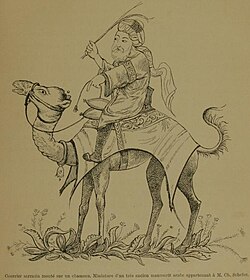
The repressions of the insurrectional movements by the Umayyad power in al-Andalus were bloody and is at this time (818) which places emigration in mass of Andalusians (as indicated, regardless of ethnic origin and religion) along two directives, partly towards Morocco and others in Egypt. From here they gave strong support to the co-religionaries for the Islamic conquest of Sicily begun in 827. Always in this year, to Alessandria of Egypt was founded an autonomous Andalusian kingdom, to which the Abbasid Caliphate ended in 825. Andalus then departed at the time of the Aegean, where they established the emirate of Crete, independent and flourishing from a commercial and cultural point of view, as well as powerful from a military standpoint, until the Byzantine reconquest of 961.
Crete became the center of numerous military expeditions in the Aegean. In Italy there was the plundering of Rome in 846 and in the South were founded the colony of Traetto, in 876, and the hemirates of Bari and Taranto. In the western Mediterranean, due to the weakening of the Carolingian Empire and its fleet, Marseille was raided in 838 and 846, Arles in 842 and 850 and Fréjus in 869. The Muslims established a refuge in Camargue during these years, as the chronicles of San Bertino tell, and from there they imperverted into the Rhone valley.
Balearics are finally conquered to the Umayyad Andalusian cause in 902.
The conquest of Sicily and the incursions in southern Italy
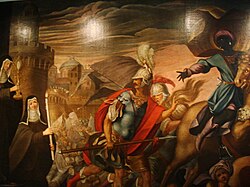
Santa Chiara hunts the Saracens (1630 ca),
San Marino State Museum
Since 827 the Aghlabids of Qayrawan, in today's Tunisia, began the conquest of Sicily, which took a long time but that marked the apogee of Saracen domination in the Mediterranean for at least two centuries. The conquest was completed in 902, thanks to the offensive against the Byzantines, which had been cut off supplies taking them Crete (827) and Malta (870).
The settlement of the Saracens was sometimes encouraged and supported by local lords, as aid in disputes, as in the case of Andrea, Duke of Naples, who was harassed by the Lombard prince of Benevento Sicone and, after having turned unnecessarily to Ludovico il Pio, asked help to the Saracens. The intervention was again called for against the successor of Sicone, Sicardus: the Saracens behaved correctly towards the Neapolitans, helping them to defeat the Beneventans and signing peace and trade agreements. In return the Neapolitans rescued the Saracens during the siege of Messina in 843 and maintained an accomplice neutrality, until they fell under Islamic rule Punta Licosa and the islands of Ischia and Ponza: at that point the Duchy of Naples reacted by joining Amalfi, Sorrento and Gaeta in the Campana League.
Previously, the Neapolitans, to weaken Benevento, had invited the Saracens to assault Brindisi in 838, from which they extended to Taranto and Bari, which became the seat of the homonymous emirate from 840 to 871.
Defeat a Venetian fleet in the Kvarner, the Saracens took advantage of rivalry between local powers, becoming masters and putting themselves at the service of the same unscrupulous Beneventans.
In the year 840 Siconolph, Lord of Salerno, in struggle with Radalgiso (or Radelchi) and Landolfo lords of Benevento and Capua, called in his help the Saracens, often and willingly hired by the Duke of Naples Andrea II and who later settled in the colony under the hill of Traetto, at the mouths of the Garigliano. After bloody raids in some parts of southern Italy, the Saracens found a way to prosper thanks to their rockets and to offer themselves as mercenaries to the most different Christian lords of the time.
In 846, after the plundering of Rome, completed by reaching Ostia and going up the Tiber, raiding the ancient basilica of St. Peter in the Vatican and that of Saint Paul outside the walls, the Saracens pushed to destroy Fondi and Formia, beginning to threaten the territories of the Abbey of Montecassino.
The gesture prompted a reaction against "the black pearl that vien from the sea" which did not delay. A first attempt to hunt the Saracens was made by the future Emperor Lodovico II who, descended into Italy with a Franco army, strengthened by the Allied troops of Pope Sergio II, was defeated.
Saracen truppe were now uncontrollable by Adelchi, Duke of Benevento: he forced the barns to accept the protection of the Khalfun Berber, to which as payment was promised nothing less than permission to plunder and fire some sacred buildings in the area, but he pushed himself to the ground the city of Capua ancient. Ludovico, then in Italy, managed to liberate Benevento from mercenaries and pacify the Lombard princes, making as a guarantee to the division of the duchy in the two principalities of Salerno and Benevento and in Capua County.
The compromise solution did not like Pope Leo IV, who in those years was making cingere Roma with the "Leonian city" of walls, to prove fear still alive; the pontiff therefore called in relief the fleet of the Campan League that in 849 defeated Saracens in the battle of Ostia, fading new devastations.[9]

Vatican rooms
Lodovico, appointed in the meantime emperor, moved towards Bari, also begged by the abbots of Montecassino and San Vincenzo al Volturno. In Bari there was a hemirus who was drawn between the various local powers, without denying the concession, after payment, of salvation for pilgrims who wanted to board the Holy Land. He also protected the Jewish community of Oria.
The campaign against the emirate of Bari was long and – among various negotiations, alliances and treatises – took place from 855 to 871, with the active phase of fighting in five years between 866 and 871, period in which Lodovico II went down in Italy with an army of Franchi, Burgundi and Provenza Ducali, besides the allied troops of Pope Adriano II, of the Doge of Venice
The emir Sawdan – who had also plundered the sanctuary of St. Michael the Archangel on the Gargano – was captured, but he had permission to spend the rest of his life in golden captivity by his friend Adelchi, Prince of Benevento. However, this move proved wrong for the Carolingian emperor due to the entry into stage of Byzantine Emperor Basil I, who saw badly eye surgery in Southern Italy, for centuries a territory of Byzantine prerogative: Basilio trained with Sawdan and gave rise to an uprising of the Lombards of Benevento, who were captive, for about two months, Lodovico II, while a new army of the Lombards of Benevento was held. 20 000 men, sent by Qayrawan, devastated Calabria and Campania. In the873 Ludovico returned to Campania and defeated the Saracens, but died two years later.
The Saracen port of Taranto remained, from which a very rich slave trade was unfolded. The Byzantines were able to recover the city, putting an end to the emirate taranthin (876). The Saracen raids on the Adriatic did not end with the reconquest of Taranto: in those years, indeed, Muslims completed the conquest of Sicily (Siracusa fell in 878, Taormina in 902). In 882, allied again with the bells, they destroyed the abbeys of San Vincenzo and Montecassino, establishing a nest at the mouth of the Garigliano (Traetto, near today Minturno), from which they held under fire also Rome and the entire Lazio: they were definitively driven only in 915, when the Byzantine emperor Zoe Carbonopsina managed to put together the Italian lords on the need of hunting
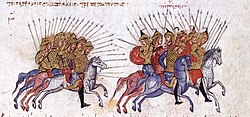
in a miniature from the Scilitze di Madrid, manuscript of the 12th century
In fact the raids continued; one of the most serious episodes seems to be in fact the new sack of Oria and Taranto occurred in 925/926: on that occasion the family of the well-known Jewish scholar Shabbetai Donnolo was captured. Although Muslims had been driven out of Bari at the end of the 9th century and defeated many times, by different peoples, their nucleus gathered at Monte Matino (the Mons matinus by Orazio), on a hill that therefore took the name of Monte Saraceno, on the Gargano. From there they often came down to desecrate temples, to commit all sorts of cruelty and nefariousness and to depredare and rade on the ground villages, villages and cities of Roman times, including Siponto and Matino, around 970. The inhabitants, landed by the massacres and robberies, were forced to ask for help from Emperor Otto I of Saxony who defeated Muslims permanently, expelled them from Mount Saraceno, where they had been severely trenched for years.
In 1002/03 Doge Pietro Orseolo II successfully led a fleet of 100 ships against the Saracens who had been besieging Bari for months. As thanks was built the church of San Marco dei Veneziani in Bari old.
From Sicily, in the 9th and 10th centuries, the Arabs continued to plunder the coasts of southern Italy, establishing also new, occasional bridgeheads, as at Agropoli or Santa Severina, which, despite the failure of Emperor Otto II (culminated in the battle of Capo Colonna of 982), lasted for a long time, coming less only after the 1036, when the death of Sicilian emir This ended with the conquest by the Normans, who hunted the Saracens in 1071, after ten years of war.
The coastal towers along the Tyrrhenian Sea, connected with each other to exchange signals, were intended to alert from afar the ships to run in order to be able to give for some time alarm to the defenseless populations, but they only rose in the sixteenth century to protect themselves from the Ottoman fleet. The name of common use, Saracen tower, is therefore incorrect.
The base in Provence and the raids in north-western Italy
Starting from Spain and often especially from the Balearic Islands, where they had settled, the Saracens began to perform raids along the Provençal and Ligurian coasts. In 838 and 848 they attacked Marseille, in 842 and 850 Arles and in 869 invaded Camargue.[10] The frequency of incursions increased after 888 for the anarchy established in Europe after the death of the last Carolingian emperor. By 890, the Saracens formed a stable base in Provence at Frassineto (golf of Saint Tropez).[11] In the following decades, the coastal villages of Provence and western Liguria were abandoned and the surviving population sought refuge away from the coast or in the few fortified cities. Crossing the maritime Alps, the dying plundered the bass Piemonte, especially the Albese, killing or forcing the Langhe population to escape. Between 934 and 935 riders♪ they came to plunder Genoa. The control of the Ligurian coasts and their hinterland was resumed only in the third quarter of the 10th century. In 967 Berengario II repaid with the donation of lands reconquered and under the title of Marquisi Oberto, Marquis of Milan and Genoa (and of eastern Liguria), Aleramo, Marquis of Monferrato and Savona and Arduino il Glabro, Marquis of Turin (and Imperiese).

From Frassineto, the dies had gone into the hinterland: it seems that the same Ugo of Provence, wanting to prevent an invasion of Berengario II of Ivrea, invited the frassinetans to take control of the alpine passes. The dying took control of all the Western Alps, from which they could make incursions both in the Piedmont valleys (in 912 they plundered and destroyed the important Abbey of Novalesa) both in those of Delphitus and Savoy. The Moriana valley (Maurienne) would take its name from these Moorish incursions. In the second quarter of the 10th century the Moors also settled in the Pennine Alps, from which in 937 an expedition left that destroyed Chur, the capital of Grisons, in Switzerland.
The control of the Alpine passes also allowed the dies to impose tolls or capture hostages, whose ransom was an important source of gain. According to Liutprando, between 972 and 973, a very important hostage was captured, the famous and powerful abbot Maiolo di Cluny, who through the passage of the Grand Saint Bernard was going to Rome. The episode triggered the joint reaction of the provenzali and the Piedmontese for a final victory against the dying. William I of Provence with the help, among others, of Arduino the glabro destroyed Frassineto, which was infeuded to Gibellino Grimaldi. There is no agreement on the date of the event, which took place between 973 and 983, perhaps in the fall of 979.[12]
The incursions in Sardinia and central Italy
Sardinia had not escaped the Saracen raids and in 1005 the emir Mujāhid al-'Āmirī of Denya (known in Italian as Muse or Muscote), from the Balearics, attempted to occupy it by creating a base in Porto Torres, useful for conquering the Tyrrhenian Sea. In 1005 he also attacked Pisa and in 1016 he destroyed the city of Luni, trying to establish his new base there. Urged and supported militarily by Pope Benedict VIII, the Pisans and Genoese joined forces and expelled Musetto not only from Tuscany, but also from Sardinia.[13] Musetto, however, established a new base to Bona, the ancient Hippo in northern Africa and with a new fleet resumed raiding the Tyrrhenian Sea, including the assault on Civitavecchia in 1023. Only in 1034 the Pisani made a counter-offensive to Bona, succeeding, apparently, to kill him, now eighty-four years.[14] Finally, around 1056, a new Saracen settlement attempt in Sardinia was rejected.[15]
Notes
Explore this chapter
- ^ (EN) Norman Daniel, The Arabs and Mediaeval Europe, London, Longman Group Limited, 1978, ISBN 0-582-78088-8.
- ^ (EN) Jan Retsö, The Arabs in Antiquity: their History from the Assyrians to the Umayyads, London, Routledge, 2003, ISBN 978-0-7007-1679-1.
- ^ (ES) Sarraceno, na, up Diccionario de la lengua española (22a edición), Real Academia Española, 2001.
- ^ There.Oxford English Dictionary qualifies the etym «not well founded», «not well founded».
- ^ Trésor de langue française: Empr. au lat. médiév. Saraceni, nom des populations mussulmanes du Proche-Orient, d'Afrique du Nord et d'Espagne, et celui-ci au gr. byz., att. dep. I'll see you. comme appellation gén. des Arabes (KAHANE Byzanz, col. 402 et 429); Latef, désignait une population nomade d'Arabie, mentionnée au IIe s. par Ptolémée (cf. FEW t. 11, p. 219a), où le b. Lat. Sarraceni (IVe-Ve s.). The gr. doit prob. être rattaché au topon. Saraka, no. d'une ville d'Arabie heureuse citée par Ptolémée, et d'une région de la péninsule du Sinaï mentionnée au VIe s. by Étienne de Byzance (FEW) loc. Cit.; Kl Pauly, s.v. Saraka), et non à l'ar. 'oriental', dér. de «Orient» (cf. FEW t. 11, pp. 220-221, notes 23). Bbg. DAUZAT Ling. fr. 1946, p. 326. RICHARD Kirchenterminologies 1959, pp. 54-55. TOURNIER (M.). The Envers de 1900. MOTS. 1982, 5, p. 118.
- ^ Silvio Paolucci and Giuseppina Signorini, The Time of History 1, Edizione Rossa, Bologna, Zanichelli, p. 170.
- ^ Daniele Mascitelli, Pre-Islamic Arabic, Rome, Bretschneider's herm, 2006.
- ^ (FR) Philippe Sénac, The medieval West face in Islam: the image of the aurtre, Paris, 2000, pp. 20-59.
- ^ A fresco that represents the event is present in the Rooms of Raphael in the Vatican.
- ^ Rinaldo Panetta, Saracens in Italy, series GUM, Milan, Mursia, 1998, p. 147.
- ^ Liutprando from Cremona, Antapodosis, no. 22, 1, 1.
- ^ Bruno Luppi, Saracens in Provence, Liguria and the Western Alps, International Institute of Ligurian Studies, Bordighera, 1952. Reprinted by SASTE, Cuneo, 1973.
- ^ Masons, Annali, 1017.
- ^ Masons, Annali, 1035.
- ^ (EN) Travis Bruce, Piracy as Statecraft: the Mediterranean Policies of the Fifth/Eleventh-Century Taifa of Denia (PDF), in Al-Masāq, vol. 22, no. 3, 2010, p. 240.
Bibliography
Explore this chapter
- Egle Lauzi, Western and Saracens in the Latin Middle Ages: traces of a meeting, in Responsible, vol. 132, fasci. 2, Istituto Lombardo Accademia di Scienze e Lettere - Class of Letters and Moral and Historical Sciences, 1998, pp. 437–453 (I); 485–502 (II).
- Flavio Russo, From Sanniti to the Italian Army. The fortified region of Matese, Army General Staff, Historical Office, Rome, 1991.
- Flavio Russo, The Coastal Defense of the Kingdom of Naples, Army General Staff, Historical Office, Rome, 1989.
- Flavio Russo, The Coastal Defense of the Kingdom of Sardinia, Army General Staff, Historical Office, Rome, 1992.
- Flavio Russo, The Coastal Defense of the Kingdom of Sicily, Army General Staff, Historical Office, Rome, 1994.
- Franco Cardini and Marina Montesano, Medieval history, Florence, Le Monnier University, 2006, ISBN 8800204740.
- Rinaldo Panetta, The Saracens in Italy, Milan, Mursia, 2009, ISBN 978-88-425-4367-1.
- Bruno Luppi, Saracens in Provence, Liguria and the Western Alps, International Institute of Ligurian Studies, Bordighera, 1952. Reprinted by SASTE, Cuneo, 1973.
- Marco Di Branco, 915: the battle of Garigliano. Christians and Muslims in medieval Italy, Bologna, il Mulino, 2019, ISBN 978-88-15-28015-2.
Continue your journey