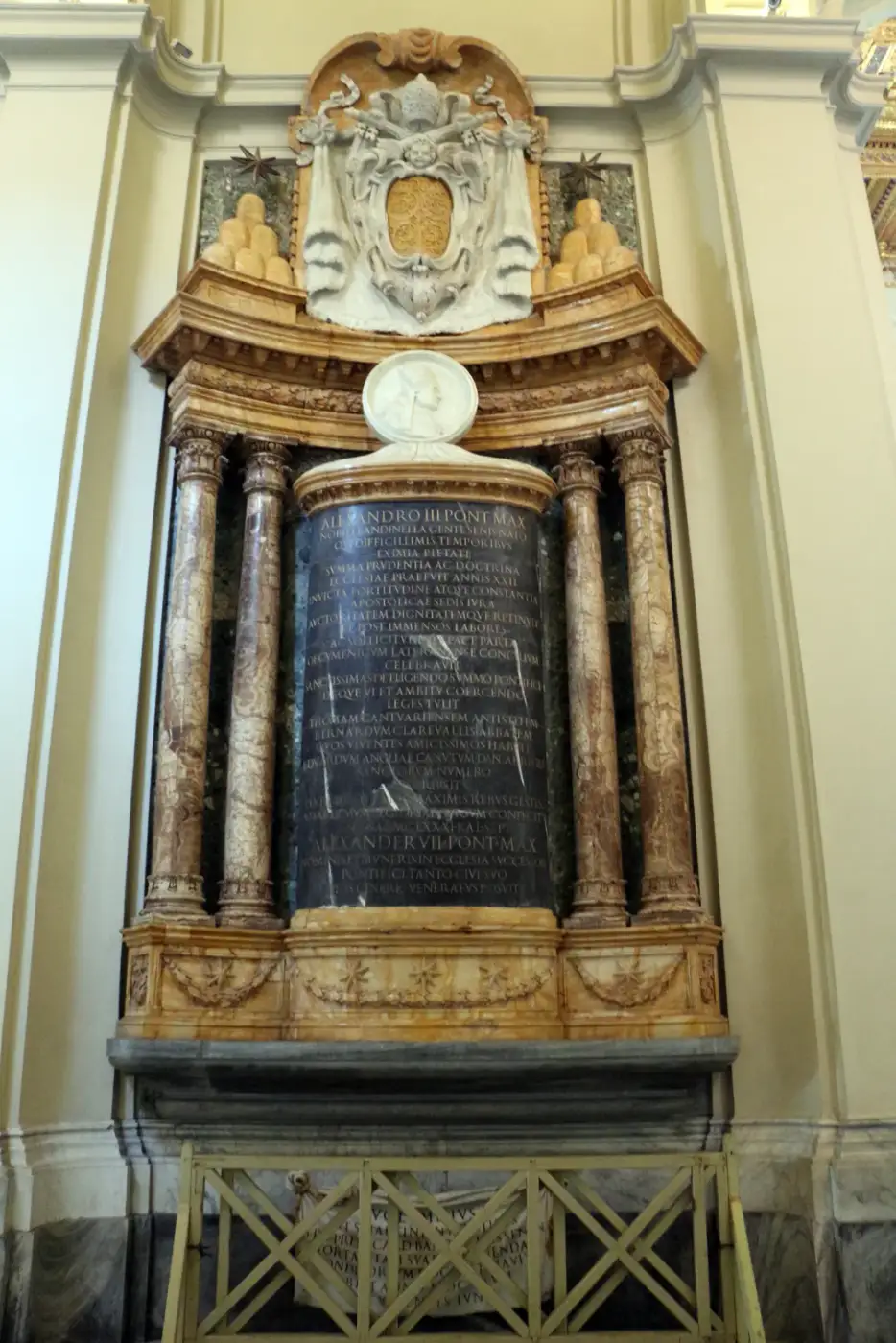
A closer look
Pope Alexander III: at a glance
Alexander III, born Rolando Bandinelli (Siena, around 1100 – Civita Castellana, 30 August 1181), was the 170th pope of the Catholic Church from 1159 to his death.
It was in his honor that, in 1168, it was called the city of Alessandria, whose nucleus, built a few years earlier, was previously called Civitas Nova, near the confluence of the Bormida river in the river Tanaro: in the Lombard League the city played anti-imperial function, to hold brakes Marquis of Monferrato and the Marquis of Pavia, allies of Federico Barbarossa.
Biography
Formation and ecclesiastical career · The Pontificate · Contrapposition with three appetizersExplore this chapter
Formation and ecclesiastical career
Born in Siena by Ranuccio Bandinelli[1], he obtained a doctorate in canon law in Bologna. Contrary to what has long been claimed by historiography, magisterium Rolandus, a canonist from Bologna, is no longer identifiable with Rolando Bandinelli[2].
Regular canon in Pisa and then in San Giovanni in Laterano[3], in October 1150 Pope Eugene III appointed him cardinal deacon of the SS. Cosmas and Damian; he later became cardinal priest of San Marco. In 1153 he became Chancellor of the Church of Rome. In 1157 he was sent to Besançon to ask Frederick Barbarossa to release Bishop Esquilo of Lund, who, returning home from Rome, had been robbed and imprisoned by imperial knights. Bandinelli gave the emperor a letter signed by the pope, in which Hadrian IV recalled all the favors granted to the emperor.
In this circumstance the Bandinelli, to confirm papal superiority over the emperor, spoke the phrase:
According to tradition, on 18 November 1179 consecrated the cornerstone of Siena Cathedral[4].
- Papal elections
During his period of Cardinal Rolando Bandinelli participated in three papal elections:
- Papal Election of 1153, which elected Pope Anastasio IV
- Papal Election of 1154, which elected Pope Adrian IV
- Papal Election of 1159, which gave rise to a dual election: that of the same Bandinelli who took the name of Alexander III, and that of Cardinal Ottaviano de' Monticelli, who took the name of Vittore IV, considered then antipope.
The Pontificate
Contrapposition with three appetizers
On September 7, 1159 the cardinal electors chose it by a large majority as successor to Pope Adrian IV; a minority of cardinals instead elected Cardinal Ottaviano of the Eighth Crescents, who assumed the name Victor IV.
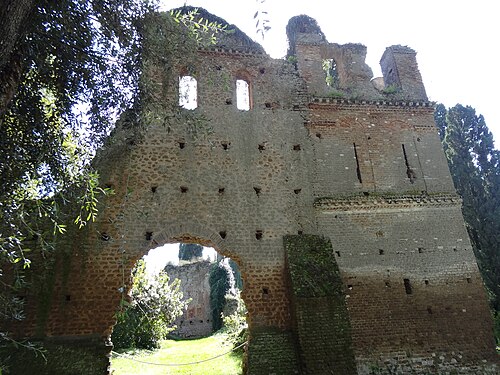
Hunted by the city of Rome, who wanted to be a free commune, Alexander III fled into the lower Lazio. His consecration took place in 1160 at Ninfa, a city bordering the Kingdom of Sicily (established in 1130 by Ruggero II d'Altavilla). After he communicated his consecration to the main dioceses, he threw the excommunication against the emperor and Victor IV.[5]. He subsequently moved to France, where he lived from 1162 until 23 November 1165; he took refuge for a period on the Gallinara Island of Albenga, where he was protected by the Benedictine monks who had a seat there, for this reason he subsequently gave the monastery autonomy and placed it under the protection of the Holy See[6]. In 1167 he was back in Italy, first in Gaeta, then in Benevento, Anagni and finally Venice.
Victor IV appetizer, and his successors Pasquale III (1164-1168) and Callisto III (1168-1178), enjoyed imperial support. Alexander joined the Communes, fighting against Federico Barbarossa, because these, disobeying the Worms agreements (1122), aimed at a policy of intervention and dominance also on the Church.
The battle of Legnano (1176) marked the final defeat of the German emperor. With the peace of Venice in 1177 Frederick reconciled with the pope. The Emperor submitted himself to the will of Alexander III and promised to recognize the Worms Treaty, as it concerned the relations between the Empire and the Papacy. As a counterpart, the pontiff summoned him the excommunication.
After the peace of Venice Alexander III recognizes the independence of the Republic of Ancona (Comunitas Anconæ), who had resisted Barbarossa with such tenacity in 1173; in exchange the city recognized the pope's right to collect an annual tax. On March 12, 1178 Alexander finally returned to Rome.
Government of the Church and relations with Christian kingdoms
In March 1179 Alexander held the third Lateran Council, enumerated by the Church as the eleventh ecumenical council. His acts welcome several of the Pope's proposals for improving the conditions of the Church, among them the norm - still in force - which requires that no one can be elected pope without the vote of at least two thirds of cardinals. This decree first established a true election from the ancient age according to the principle of majority, instead of the acclamations that had determined until then access to the throne of popes, kings and emperors[7].
This synod marks the summit of Alexander's power. In addition to putting the Barbarossa in his pocket (respecting the episode of Canossa), he humiliated Henry II of England on the case of Thomas Becket, confirmed the independence of the kingdom of Portugal under King Alfonso I of Portugal through the Manifestis Probatum of 1179 (with which the protection of the Treaty of Zamora was confirmed in 1143) and, during the years of exile, enjoyed favour and France VII.
He also outlaws the albiges.
In 1181 Alexander disconnected William I of Scotland and placed his kingdom under the roof as a result of the failure to accept, by the ruler, the new bishop of St. Andrews. He was a promoter, among other things, of the superiority of the papal authority over the whole Christianity and the same emperor ('plenitudo potestatis'); line already adopted in the past by Gregory VII.
Other decrees
In 1170 Alexander III decreed that it was excommunicated who had not paid tenth in advance in the territories of the Patrimonium Sancti Petri. The tithe concerned, for example, mills, fishing farms, hay, wool, bees and had to be paid before the proceeds deriving from the sale of the product[8].
Deposition of the fourth appetizer: Innocent III
In 1179, shortly after the closure of the Lateran Concilius, the Roman republic forced Alexander to leave the city, in which he no longer returned; and on 29 September 1179, some nobles established the Antipapaan Innocent III. Through a careful use of his enormous wealth, however, Alexander managed to hold it in his power, so much that he obtained the deposition in 1180.
Alexander III died in Civita Castellana, on August 30, 1181.
Concistors for the creation of new cardinals
Pope Alexander III during his pontificate created 68 cardinals in the course of 15 distinguished conciseurs.Explore this chapter
Pope Alexander III during his pontificate created 68 cardinals in the course of 15 distinguished conciseurs.[9]
Alexander III in the Arts
Alessandro III is dedicated to the cycle of frescoes in the History of Alexander III made by Spinello Aretino in the Palazzo Pubblico di Siena in the two years 1407-1408.Explore this chapter
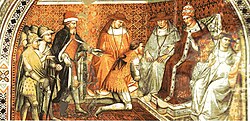
Alessandro III is dedicated to the cycle of frescoes History of Alexander III realized by Spinello Aretino in the Palazzo Pubblico of Siena in the two years 1407-1408.
Episcopal Genealogy and Apostolic Succession
Explore this chapter
The episcopal genealogy is:
- Pope Lucius III
- Pope Alexander III
The apostolic succession is:
- Archbishop Pons d'Arsac (1162)
- Archbishop Jean de Bellesmains (1162)
- Bishop Ingelram (1164)
- Archbishop Guichard of Pontigny, O.Cist. (1165)
- Cardinal Konrad von Wittelsbach (1165)
- Archbishop Pedro Suárez de Deza (1166)
- Cardinal Galdino of the Hall (1166)
- Archbishop Richard of Dover (1174)
- Archbishop Dionisio from Teramo (1174)
- Cardinal Rolando, O.S.B. (1178)
- Cardinal Henri de Marsiac, O.Cist. (1179)
Notes
Explore this chapter
- ^ Cardinal Bosone, his first biographer, makes no mention of the family belonging to Pope Alexander III. But four centuries later, Alfonso Chacón said "Ciacconio" writes about his belonging to the noble family of Siena Bandinelli, which was then called "Paparona" ("Paparoni") as a reference to the pope of Rome.
- ^ Stanisław Cierkowski, Legal kinship in the Decree of Graziano, in (idem) The impediment of legal parentage, Gregorian Biblical Library, 2006.
- ^ Elements of the History of Popes, vol. II (first edition).
- ^ Cf. in Aa.Vv., Tuscany, Touring Club Guide ed. 2005 p. 516.
- ^ The accounts of history with the Bible. Report of a teacher of religion, by Severino Proietti, Associazione Akkuaria, 2005 pag. 224.
- ^ First embryonic, Bishops and Gentlemen, the Albenganese church from the decline of authority directed at Genoese hegemony (XIII-XIII centuries), Savona, Marco Sabatelli Editore, 2004.
- ^ (EN) Christopher Brooke, The Saxon and Norman Kings, s.l., Fontana/Collins, 1967 [1963], p. 32.
- ^ Achille Mauri, Italian encyclopedia library volume XXVII page 366, for N.Bettoni, 1833."And in the course of time Alexander III determined around the year 1170 that it proceeded with scomuniche to make pay entirely the Decime de' molini, peschiere, fieno, lana, and of the bees; and that the tenth was of all paid before, that the expenses made in collecting them were deducted"
- ^ (EN) Salvador Miranda, Alexander III, up fiu.edu – The Cardinals of the Holy Roman Church, Florida International University. Retrieved 26 July 2015.
Bibliography
Explore this chapter
- Federico A. Rossi di Marignano, Federico Barbarossa and Beatrice di Borgogna, Oscar Mondadori 2009.
- Manrico Punzo, Minimum history of the foundation Alessandria - Pope Alexander III / Federico Barbarossa - The two great rivals, in "Nuova Alexandria" Year III N°10, Alessandria, Ugo Boccassi Editore, 1997
- Luca Fusai, Thousand years of history through the events of the Cerretani Bandinelli Paparoni family, ETS Editore, 2010
Continue your journey