A closer look
Bergoglio (Alessandria): at a glance
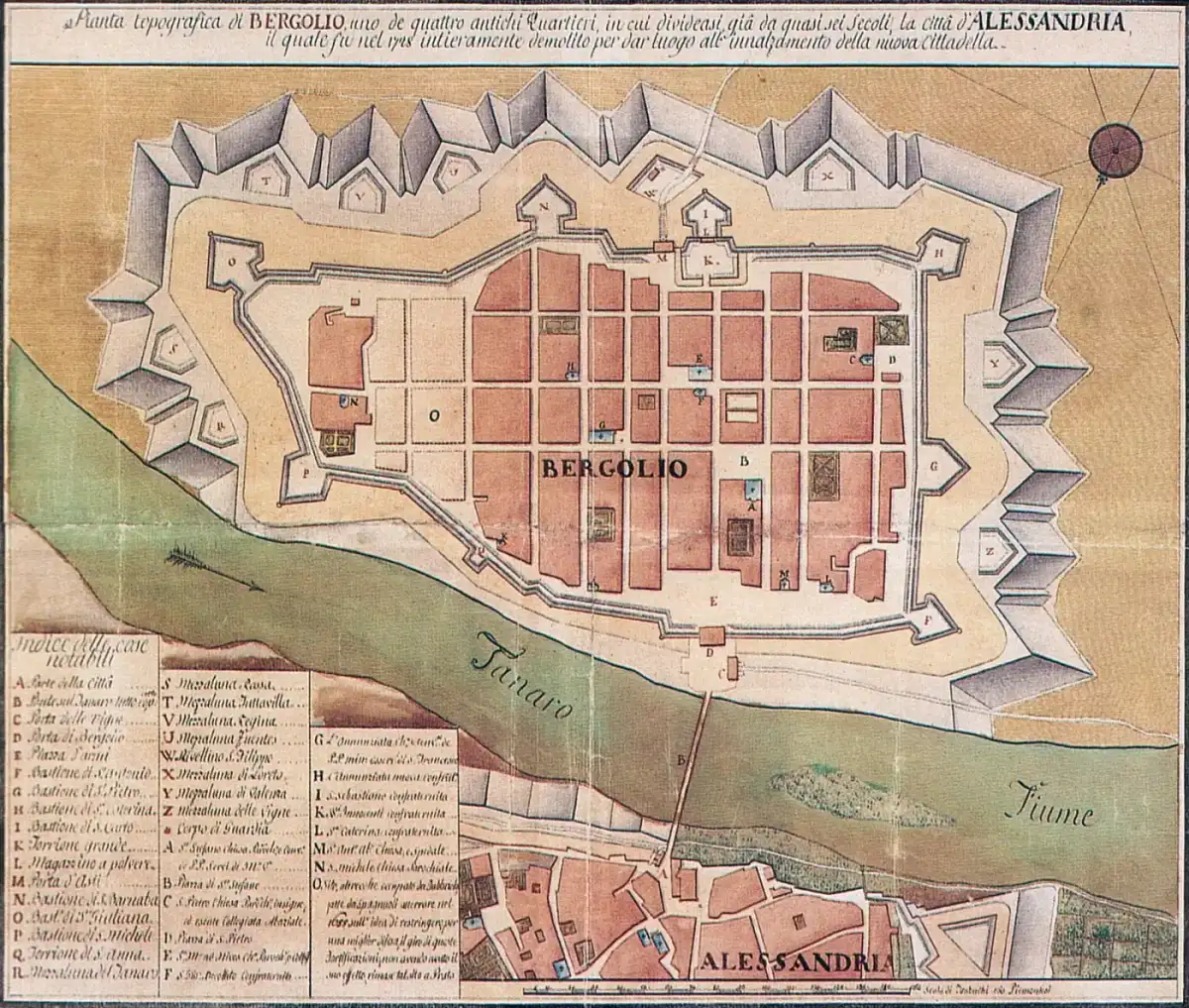
Bergoglio (also Bargolium[Note 1], Bergolio or Bordine[Note 2], Bergolium[Note 3], Bergul[Note 4], Burgulium[Note 5]) was an urban settlement built on the left bank of the Tanaro, located in front of Rovereto[Note 6] and the city of Alessandria All of it. Demolished during the eighteenth century, starting from 1728, to make camping the walls of Citadel, protected by walls and moats, defended by a small detached fortress called "la Pozzolana", originally belonged to the Archdiocese of Milan. Bergoglio was one of the eight settlements that contributed to the foundation of the city of Alessandria in the second half of the 12th century[2][3].
History
Origins: the "first" Bergoglio · 9th century · X centuryExplore this chapter
Origins: the "first" Bergoglio
The toponomastic interpretations and origins about the location of a "first" Bergoglio, that prior to the foundation of the city of Alessandria - a long period which extends, presumably, from the High Empire to the 12th century - are very lacking and must be drawn upon, and moderated, by Annales of the many local historians, who in different times have hypothesized more or less reliable solutions. Next to this documentary material, there are other sources.[Note 7], preserved in the State Archives, important for the purpose of identifying or not the place in a given period.
Many historians, including Calchi, Girolamo Ghilini, Giuseppe Antonio Chenna, Guglielmo Schiavina and Francesco Gasparolo are almost unanimous in considering that Bergoglio existed already before the foundation of Alessandria: «[...] This place, therefore, forward that Alessandria it was made, it was seen in the plain of the nearby hill outside the door from which you walk by Valenza [...]»[4]
A "first" Bergoglio was, most likely, geographically located at the foot of the hill on the road Valenza. There are some passages in the "Alexandrine Statutes"[5] determined, although with little precision, the geographical position of the first Bergoglio, before 1071: We order that the road that passes through the old village of B Pride and the Valley of Paul is remade and expanded, up to the path that goes from the valley, to the piece of Vigna di Pietro; the old road of B Pride to the Valley of Paul; and more this suburb or neighborhood was formerly located at the foot of the Hill in the place currently called the Altieni.
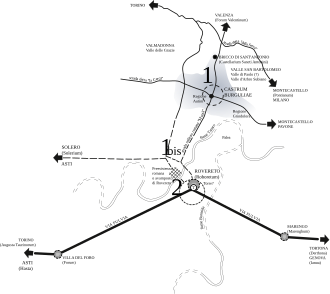
Another publication, by Biagio Gho, focuses on the description of the important viario link that is already present before Augusto's time. Main artery is the Via Fulvia, Roman road that from Tortona continues westward to Augusta Taurinorum passing south of the right bank of the Po river, connecting the streets from Rome and north-eastern Italy - via Postumia, via Julia Augusta - with the transalpine roads that departed from Turin - via Cozia, via Domizia. From Tortona to Turin the Via Fulvia lambiva Marenghum (Marengo), Roboretum (Rovereto) - on the right of the Tanaro, in front of Bergoglio - continued towards Solero (Solero) to then continue in the direction of Forum (Villa del Foro). Other paths were based on this direction, one of which originated from Bergoglio. It is a Roman military road, of which a stretch in the 21st century is named munity (climb), which led to Valenza (Valenza), located on the last hills of Monferrato[6].
On these foundations of communication routes are the hypotheses for the identification of the area on which he insisted the "first" Bergoglio (see image on Theory on the territorial identification of "first" Bergoglio):
- 1. Fortified village (castrum Burguliae) on the hills north-east of the present one Citadel (Autini locality - Bricco di Sant'Antonino); there is a crossroads of Roman roads to Turin in that area, Valenza, Milan;
- 1bis. Similar to 1, but with the presence in the same period of a castrum Roman, presumably high imperial sedimentation, which over time will become the "second" Bergoglio when the inhabitants move to the period of the foundation of the city of Alessandria;
- 2. Independent development of castrum, with a possible "watchtower" in front, which later became the castle of Rovereto, the castrum could have been an outpost over river, during the urban occupation of the surrounding areas and the hilly area of the "first" Bergoglio.[Note 8]
9th century
The first documented sources of the existence of settlements that will then form date back to the 9th century. Alessandria[7], and among these Bergoglio is also mentioned. According to the Chronic Aquensis[8] of the Dominican Iacopo d'Acqui[9] It is clear that Bergoglio followed the Ambrosian rite and that the Archbishop of Milan boasted some temporal jurisdiction: Verum est quod Bergolium quantum ad officium sequitur ritum Ecclesiae Ambroxianae, solum quantum ad Ecclesiam principalem, quia Bergolium fuit de Diocese Mediolanensi. The village was fortified with some towers and already with religious buildings.
X century
In the 10th century B pride already appeared as a defined inhabited center and there were already numerous buildings and churches: church and Monastery of the Order of St. John and St. Benedict (under the title of St. Peter), the Church of St. John, the Church of Saint Stephen. The presence of a district and hostels for foreigners is also described in the annals[7].
Girolamo Ghilini reports that Aleramo - for his privileges assigned to Ravenna in the diploma of 23 March 967 of Emperor Otto I[Note 9] - had Bergoglio's lands among his many possessions[10].
XI century
On 23 August 1071 in Bergoglio died, and was buried, the Archbishop of Milan Guido da Velate. In 1094, on the occasion of the first crusade, he departed from Bergoglio the Bengolian patritius Scipione Guasco, remembered by Torquato Tasso in the Liberated Jerusalem, who died in 1099 under the walls of Antioch: "Neither only discarded rib / the dead sword from the sweet world, / but pushed along with cruel death hole / Gentonio, Guasco, Guido and 'the good Rosmondo"[11].
12th century
In pride there were possessions of Oddonis Canefri, son of Count Oberto, who with instruction of 14 April 1107[12], drawn up by Ottone, notary on site Gamundensis apud Burmia, donated pro soul his all its substances, so mobile that still, at the church of Santa Maria di Rovereto, and among the donated lands there was one lying in the region Grindolara, a place that still maintains that ancient name.
In 1116 Emperor Henry V was received, with the whole family, in Bergoglio. A concrete signal of what was already a structured and important place. And, confirming what has just been mentioned, it is the same year a document of the emperor, which deals with the privileges and rights of Abbot Beregonz of the Abbey of San Massimino di Treviri, and which defines Bergoglio a castrum: Actum in Italy, castro Burguliæ[13].
In 1155, the Berrgolian power in the military field is underlined by Marquis of Monferrato William the Elder who is advising his militias not to go into the field with the Milanese and the doves, as "among the best in help of the doves are those of Gamondio and B pride"[14].
Foundation of the city of Alessandria: the "second" Bergoglio
The city of Alessandria was born[Note 10] it was founded at first by the demic union of Castellazzo Bormida (Gamondio), Marenghum (Marengo) e Bergolium. This can be seen in the text of Emperor Frederick's complaints against Cremona in 1184 where he indicates the promoters and authors of the foundation of the new city: "de tribus locis, Gamunde vicelicet et Meringin et Burgul". The name of the meeting place is not described, although it seems already indicated with a certain precision in the specification of the site on Tanaro where the transfer was shorter: Bergoglio[15]. The three places mentioned were added later Roboretum (Rovereto), Solero (Solero), Forum (Villa del Foro), Oviglio (Oviglio) e Quargnento (Quargnento). In this the populations were supported, economically, by the "Superba" and by the municipalities of the Lombard League in contrast with the Marquisate of Monferrato, main ally of Frederick Barbarossa.
Fra Giacomo di Acqui in his «Chronic Aquensia» says: «[...] Cause autem quare Alexandria fuit facta est ista, quia Marchiones Montisferrati gravabant illa loca, quae se simul posuerunt, quae sunt Rovetum, Marenchum, Gamondium et Bergolium»[8].
The official foundation date of Alexandria is 3 May 1168, although at that time it has already reached a topographic, urban and administrative configuration defined. The name "Alessandria", confirmed later, will be assumed in honor of Pope Alexander III, a broad supporter of the Lombard League's actions against the Holy Roman Empire and who had excommunicated Frederick Barbarossa.
And in those times of the foundation of Alexandria that the inhabitants of Bergoglio, finding uncomfortable the location of their village near the hills, and instead more sure that defense close to the new city, began to demolish almost all their houses and to transport their families, suppellettili and cattle, who in the new city, which they had built, and who instead on the left of Tanaro, outside of Alessandria, thus reedifying a new village. This was combined with a wooden bridge near the "Porta delle Vigne" on the road to Valenza and hills (later Valle San Bartolomeo).
This translation is supported by many local historians. For example, Schiavina says that Bergoglio was «transplanted poscia closer to the city» quod haud multo post totum prorsus est traslatum de Neighbors collis root; the Ghilini in turn writes: «Assured the city [...] it was divided into its districts [...] and that is Gamondio, Marengo and Rovereto, to which in a short time the fourth of B pride was added, separated from the others, flowing through the Tanaro river [...] Rovereto has always been in his first and old place; and this (Bergoglio) was almost all from the plain of nearby hill, transported to that site [...] beyond the Tanaro behind the shore towards the part of Rovereto»[16]; and more:B pride ahead that Alessandria it was made, it was seen in the plain near the Hill... not so much was given principle to the factory of Alessandria, as Bergoglio's inhabitants began to demolish their homes and transport the matter near the Tanaro River, they gave themselves to manufacture them.»[4].
The "first" Bergoglio was then completely demolished and grounded by the imperial coins, as during theSiege of Alessandria, in the winter between 1174 and 1175, Barbarossa himself had set up camp in the Autini region near Valle San Bartolomeo.
Of that place disappeared for about a thousand years, very little exists; you can still see a large moat surrounding the region and so also there is a paved, or slight wave of land, probable leftover of a bastion.
On 13 May 1168, the city became part of the Lombard League and became a free republic in Lombardy.
Siege of Alessandria
As already mentioned, a few years after its foundation, Alessandria undergoes a first Siege which took place in the winter between 1174 and 1175. The consequences of the blockage were found until the end of the 12th century. The siege was fought in the wars in Italy by Federico Barbarossa between Guelphs and Ghibellines, obstinate to subdue Italian municipalities to imperial authority. The anonymous Milanese attaches to Barbarossa a force of about 8 000 heavy knights, to which are added shielders and auxiliary, for a total of about 20 000 men. However, most of these were not soldiers put into the field by German princes, but mercenaries of Brabant. Considering also the pavesi reinforcements and balloons, it is possible to estimate a force of about 25 000 Men. According to the biography Pope Alexander III written in Liber Pontificalis by the chronicler Bosone, the population of Alessandria It was able to count between 10 000 and 15 000 inhabitants, which implies a number of men dedicated to defence between 2 000 and 3 000. Despite the significant numerical difference of forces in the field, the emperor's determination to destroy the city, the siege failed. The defeat, mostly with the disgrace of having violated a truce, convinced Barbarossa to surrender: on Easter Sunday he burned the camp to go to treat peace with the communal army.
The imperial army and the League met at Montebello, near Voghera, both very favorable to a diplomatic solution, so much so that Barbarossa settled in Pavia, dismissing most expensive mercenaries. However, it was precisely the state of Alessandria to blow up negotiations: the Emperor demanded its destruction, since it was the main reason why he had begun the war, but the League considered the new city as an important member, and could not accept that the victorious Alessandria It was treated as if it had been defeated. The negotiations officially jumped with the arrival of autumn and the Emperor, short of men and money, was forced to recall the German princes, but, when he arrived in Como, he discovered that very few had responded to his appeal; to desert it was even his cousin Henry the Lion, considered one of his most faithful vasals.
Federico's army, composed of a few thousand men, faced the Lombard League in the famous battle of Legnano 29 May 1176, and suffered a heavy defeat; this time the peace negotiations took place at Constance, and it was of course the League to dictate most conditions: the municipalities were recognized concessions in administrative, political and judicial spheres, including renouncing the appointment of podestà by the Emperor. The Barbarossa, however, obtained the destruction of Alessandria Although only symbolically: imperial officials decreed the act of foundation and, at the same time, set up the city of Caesarea (Kaiserstadt), directly subjected to imperial control. The name Caesarea was maintained until 1197, on 28 September the Emperor Henry VI died, from that moment the city re assumed the name Alessandria without ever abandoning it[17].
Ordinaries
On 22 September 1179 the "Consuetudini" was first drafted, for the first time since the foundation of the new city, a document that affirms the identity autonomy of the city of Alessandria. The four villages that contributed to the foundation, have the right to maintain their prior privileges of the city[Note 11]; each of the four villages undertakes to erect on its territory a church dedicated to the patron of reference that was already object of veneration. Between 1170 and 1178 the first three churches were erected in Bergoglio:
- - Benedictine Priory-Abbey of Saint Peter;
- - Convent served by Saint Stephen
- - Collegiate Church of Sancta Maria Ad Nives officiating the Ambrosian rite and dependent on the Archdiocese of Milan.
Notes
Explanatory statement · BibliographicExplore this chapter
Explanatory statement
- ^ From the vulgar Bargatta, boat. The historian Don Francesco Gasparolo proposes this hypothesis considering fishing as the main activity of the ancient inhabitants of Bergoglio, and therefore: "place of boatmen".
- ^ It appears as corruption of "bourgeois" from medieval Latin Borgolia, "small village". It is hypothesized either by Girolamo Ghilini in Short-term treaty of land concurring at the factory of the new city Alessandria (appendix of Annals of Alessandria, pp. 335 et seq.), and by Carlo A-Valle in History of Alessandria, (p. 30).
- ^ It is formulated by Ludovico Antonio Muratori the hypothesis that the name derives from Bro., "wood, pleasant villa", of medieval use, and of which Bergolium It would be a corruption.
- ^ The historians De Giorgi and Santagostino suppose a derivation from the German berg, hill, mountain.
- ^ Some speculate that comes from German Luxembourg, "castle, fortress" Bergolium, p. 22.
- ^ Castrum Roboreti was already a curtis directed in the eighth century
- ^ Ordinances, Statutes, Instruments, donations, etc.
- ^ There is a minimum common denominator among the various hypotheses, all of which are similar, namely the presence of a "first" Bergoglio on the hills. Precisely from this area are the Roman routes that will be cured, restored and expanded during the foundation of Alessandria. On the Roman origins of Bergoglio, in the 13th century one of the various bridges of the area was called Marble Bridge. The bridge - located on a Roman road, the Cerca - stood out in the area for its construction material, marble, unlike other buildings made of earth or wood. Marble is a symptom of the Roman presence in the area, especially when it comes to bridges positioned on already Roman communication routes.
- ^ In 951 Otto I of Saxony was crowned King of Italy in Pavia; in 961 he restored the Holy Roman Empire, making Germany the pillar of the new Europe.
- ^ In the first twenty years of its history, the city presents four different denominations: Alessandria, Cesarea, Palea, Rovereto, in addition to the generic designation, quite frequent, of civitas nova or nova civitas, and to the rarer designation of urbs nova, (Geo Pistarino, p. 15). Ghilini in his Annals of Alessandria, p. 2-1168/1 erroneously wants that the birth of the city took place on 22 April 1168, that is the same day as the foundation of Rome: «[...] пеl what day Romulus gave rise to the fabric of the City of Rome [...]». The Ghilini commits more than one mistake: the foundation of Rome is officially set on 21 April, and - in reality - the name Caesarea was imposed by the emperor in Reconciliatio Cæsareæ of 1183 (Germaniæ Historica Monument, pp. 181-182), which was soon abandoned by the inhabitants themselves as an element foreign to their collective conscience and individuality, (Geo Pistarino, p. 15).
- ^ Marengo was the only village to have a right of grazing and to be able to collect wood within the Fraschetta forest. The original text of the Ordinances was lost, but it was noted in 1538 in the minutes of a City Council. In that year, the text was reconstructed which was then given to prints and collected in appendix to Codex Statuterum (Codex Statuterum Magnifice Communitatis, atque Dioecæsis Alexandrinæ).
Bibliographic
- ^ Massimo Carcione, p. 12.
- ^ Codex Statuterum, p. 439.
- ^ Annals of Alessandria, p. 2-1168/1.
- ^ to b Annals of Alessandria, p. 335.
- ^ Codex Statuterum.
- ^ Biagio Gho, pp. 5, 6.
- ^ to b Bergolium, p. 26.
- ^ to b Monument to Aquensia, p. 144.
- ^ Paul Church.
- ^ Annals of Alessandria, p. 109.
- ^ Jerusalem Liberated, p. 290.
- ^ Monument to Aquensia, pars II, p. 2.
- ^ telma.fr.
- ^ Bergolium, p. 27.
- ^ Geo Pistarino, p. 14.
- ^ Annals of Alessandria, page. 2.
- ^ Giuseppe Antonio Chenna, vol. III, p. 8.
Bibliography
Archivisita · Biotechnology · Codes, worksExplore this chapter
Archivisita
- Original cards before 1121 preserved in France, up cn-telma.fr. Retrieved 3 January 2022.
Biotechnology
- Paul Church, Iacopo from Acqui, in Biographic dictionary of Italians, vol. 62, Rome, Institute of the Italian Encyclopedia, 2004. Retrieved 3 January 2022.
Codes, works
- (THE) Codex Statuterum Magnifice Communitatis Atque Dioecæsis Alexandrinæ, Alessandria, Francesco Moscheni & brothers, 1547. Retrieved 2 January 2023.
- Giovanni Battista Moriondo, Monument to Aquensia, Turin, Royal Typography, 1790. Retrieved 2 January 2022.
- (THE) Georg Heinrich Pertz (ed.), Reconciliatio Cæsareæ, in Germaniæ Historica Monument, II, Hannover, 1837. Retrieved 3 January 2023.
Poems
- Torquato Tasso, 20th Song, in Jerusalem liberated, vol. 1, Paris, Agostino Delalain, Pietro Durand, Gio. Claudio Molini, 1771 [1575]. Retrieved 3 January 2022.
Storica, analytical
- Girolamo Ghilini, Annals of Alessandria, Milan, Gioseffo Marelli, 1666.
- Giuseppe Antonio Chenna, The Bishop of the Bishops and Churches of the City and Diocese Alessandria, Alessandria, Ignazio Vimercati Printer, 1786. Retrieved 20 January 2022.
- Carlo A-Valle, History of Alessandria from origin to our days, vol. 1, Turin, Falletti brothers typography, 1853. Retrieved 14 December 2021.
- Biagio Gho, Historical dinners on the Old B pride of Alessandria, Turin, Tipografia Reano, Bossuto & C., 1926.
- Geo Pistarino, The double foundation of Alessandria (1168, 1183) (PDF), in History magazine Art Archaeology for the provinces of Alessandria and Asti, single volume, Alessandria, Society of History Art Archeology - Accademia degli Immobili, 1997, pp. 5-36. Retrieved 11 June 2016.
- Gianfranco Calorio, Bergolium: the Territory and the Abitato, first volume, Castelnuovo Scrivia (AL), Favolarevia Publishing House, 2000.
Studies, research
- Massimo Carcione, Case Study: The Enhancement of the Citadel Alessandria and the historical site of Marengo (PDF), in POLIS Working Paper, no. 211, Alessandria, University of Orientale Piemonte Amedeo Avogadro, December 2013. Retrieved 14 December 2021.
Continue your journey