A closer look
Siege of Alessandria (1175): at a glance
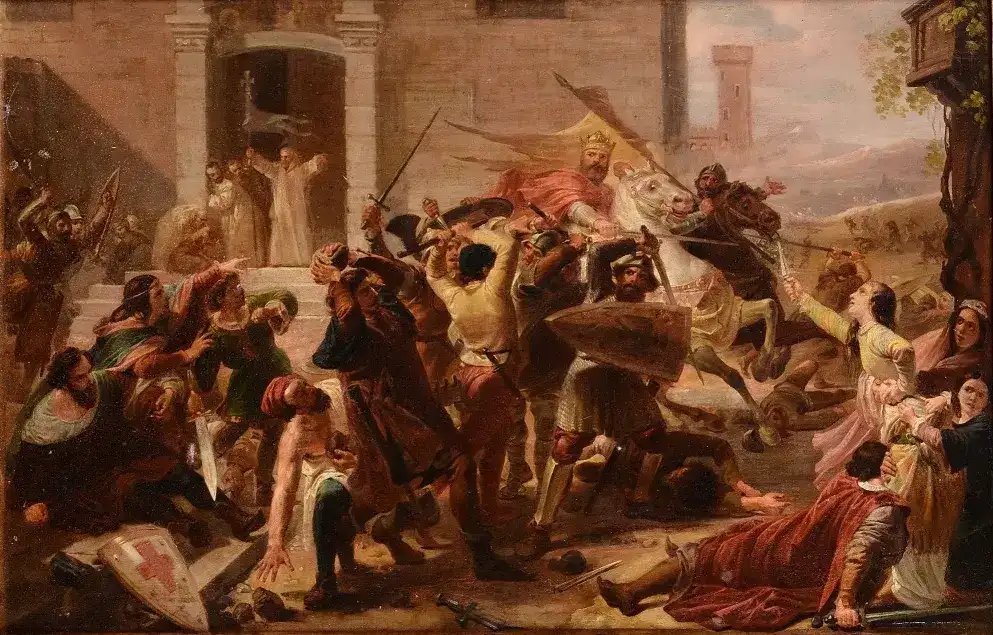
There.Siege of Alessandria It began in 1174 as part of the Italian wars by Federico Barbarossa, who was stubborn to subdue the Italian municipalities to imperial authority. The failed siege was an important defeat for the Emperor's army, which then decided to negotiate peace with the municipalities of the Lombard League.
Historical context
Starting from Roncaglia's diet, Emperor Frederick Barbarossa tried several times to bring the municipalities of northern Italy under his authority, often putting them...Explore this chapter
Starting from Roncaglia's diet, Emperor Frederick Barbarossa tried several times to bring back the municipalities of northern Italy under his authority, often putting them against each other. After the destruction of Milan in 1162, however, a feeling of unity was born against the Emperor, who led to the birth of a great alliance, the Lombard League.
One of the first acts of the League was the foundation of a new city, located both near the lands of the League. Marquis of Monferrato, a great supporter of the Empire, both on the road that Frederick Barbarossa took for his Italian campaigns. The city, initially known as Civitas Nova, was offered as a fief to Pope Alexander III and therefore took the name of Alessandria. The privilege of creating a civitas, however, was exclusively imperial: Barbarossa decided to respond to this affront with a fifth military campaign in Italy, not only to defeat the League, but above all to destroy Alessandria, which he himself referred to as "Rovereto castle".
Solved some German issues, the Emperor began his fifth military campaign in Italy in September 1174, crossing Moncenisio; he then dedicated himself to the siege and destruction of Susa, who had humiliated him in 1167. On his way he obtained, without great efforts, the submissives of Turin and Asti, thus preparing to take Alessandria in full force.
Forces in the field
The anonymous Milanese attaches to Barbarossa a force of about 8000 heavy knights, to which should be added shielders, infantry and auxiliary, for a total of approximately 20000...Explore this chapter
The anonymous Milanese attributes to Barbarossa a force of about 8000 heavy knights, to which should be added shielders, infantry and auxiliary, for a total of about 20000 men. These were largely not soldiers put in the field by German princes, but mercenaries of Brabant. Considering also the pavesi and monferrini reinforcements, it is possible to estimate a force of about 25 000 men.
According to Alexander III's biography, published in Liber Pontificalis by chronicler Bosone, the population of Alessandria It could count between 10 and 15 000 inhabitants, which implies a number of men dedicated to defence between 2000 and 3000, although they were mostly armed and untrained artisans and peasants.
The Siege
On 27 October 1174, the Imperial Army of Frederick Barbarossa reached Alessandria. The representatives of the city immediately offered surrender in exchange for peace, but...Explore this chapter
On 27 October 1174, the Imperial Army of Frederick Barbarossa reached Alessandria. The representatives of the city immediately offered surrender in exchange for peace, but Barbarossa declined. Accepting the negotiation would legitimize the position of Alessandria. Moreover, since the city walls were not yet complete and only 150 infants of Piacenza had come as reinforcements, the siege seemed a calculated risk for the emperor.
To integrate the obstacle of the walls, the inhabitants of Alessandria they had dug a wide and deep ditch before them, filled with the waters of the river Tanaro. This natural defense presented significant difficulties for enemy siege engines, which found themselves unable to get close to the fortifications to carry out the assault. As a result, Barbarossa opted for an indirect siege strategy, blocking supplies to the city in the hope of forcing it to surrender through starvation.
However, winter turned cold and humid, aggravating the situation for the imperial army. The weather conditions strengthened the obstacle of the ditch and transformed the area surrounding the imperial camp into an insidious swamp. The logistical difficulties were accentuated by the inability of Pavia and Monferrato to support the needs of the army, which was as large as a medium-large city. The position of the besiegers was further aggravated towards December, when the number of imperial soldiers began to decline drastically, especially after the Morave troops of Ulrich of Olomouc deserted during the Christmas holidays.
The situation remained in stall until the arrival of spring, when the army of the Lombard League began its advance to attempt to break the siege. During the Easter break, Barbarossa received news that the army of municipalities had arrived in Broni, about 50 km from Alessandria, and decided to attempt a final assault. The attack planned to infiltrate a team of soldiers inside the city using a tunnel dug under the walls. However, the Alexandrians, alerted according to legend by a miraculous intervention of St. Peter, discovered the plan and collapsed the gallery, trapping the assailants. In response to this attempt, a contingent of Alexandrian infantrymen and knights launched a counterattack, leaving the walls and burning a siege tower.
Following this failure and the disgrace of the violation of the Easter truce, Barbarossa was forced to retire. On Easter Sunday, he ordered to burn the camp and initiated what remained of his army towards that of the Lombards, to treat peace.
Consequences
The imperial army and the league met at Montebello, near Voghera, both very favorable to a diplomatic solution, so much so that Barbarossa...Explore this chapter
The imperial army and that of the league met at Montebello, near Voghera, both very favorable to a diplomatic solution, so much so that Barbarossa settled in Pavia, leaving most expensive mercenaries. However, it was precisely the fate of Alessandria to blow up negotiations: the Emperor demanded its destruction, since it was the main reason why he had begun the war, but the League considered the new city as an important member, and could not accept that the victorious Alessandria It was treated as if it had been defeated. The negotiations officially jumped with the arrival of autumn and the Emperor, short of men and money, was forced to recall the German princes, but, when he arrived in Como, he discovered that very few had responded to his appeal; to desert it was even his cousin Henry the Lion, considered one of his most faithful vasals.
Frederick's army, consisting of a few thousand men, faced the Lombard League in the famous battle of Legnano, and suffered a heavy defeat; this time peace negotiations took place at Constance, and it was obviously the League to dictate much of the conditions: the municipalities were recognized concessions in administrative, political and judicial sphere, including the renunciation of the appointment of podesties by the Emperor. The Barbarossa, however, obtained the destruction of Alessandria, although only symbolically: imperial officials decreed null the act of foundation and at the same time established the city of Caesarea (Kaiserstadt), directly subjected to imperial control.
In popular culture
In the centuries following the siege a famous popular legend was born, according to which Gagliaudo Aulari created the stratagem that convinced Federico Barbarossa to give up...Explore this chapter
In the centuries following the siege, a famous popular legend was born, according to which Gagliaudo Aulari created the stratagem that convinced Federico Barbarossa to give up the siege: past winter, the city had remained practically without food and resources and was ready for surrender; however Gagliaudo, a shepherd, fed all the remains in the city to his cow, the last remaining, and then brought it out of the woods. Captured and questioned by the Emperor's soldiers, he lied, stating that the city was full of food and, as a demonstration, killed the animal that accompanied him. The Emperor, at the sight of the enormous amount of food that had been given to the animal, believed Gagliaudo and resigned, taking away the siege.
The legend, along with other minors, is resumed by Umberto Eco in Baudolino, in which the siege and events that led to it are a background to the first part of the novel. Dario Fo was also inspired by the siege, imagining a city defended by floating walls and soldiers who used Greek fire to repel the besiegers.
Notes
Explore this chapter
- ^ COSTANCERS, in Italian encyclopedia, Rome, Institute of the Italian Encyclopedia. Retrieved 3 October 2014.
Bibliography
Explore this chapter
- Romualdo II Guarna, Chronicon sive Annales, 1178.
- Anonymous German, Chronic direction Coloniensis, 1197.
- Umberto Eco, Baudolino, Bompiani, 2000.
- Paolo Grillo, Legnano 1176 - A battle for freedom, Laterza Publishers, 2010.
- John B. Freed, Frederick Barbarossa - The Prince and the Myth, Yale University Press, 2016.
- Dario Fo, The Barbarossa and the moat Alessandria, Guanda, 2017.
Continue your journey