A closer look
Citadel of Alessandria: at a glance
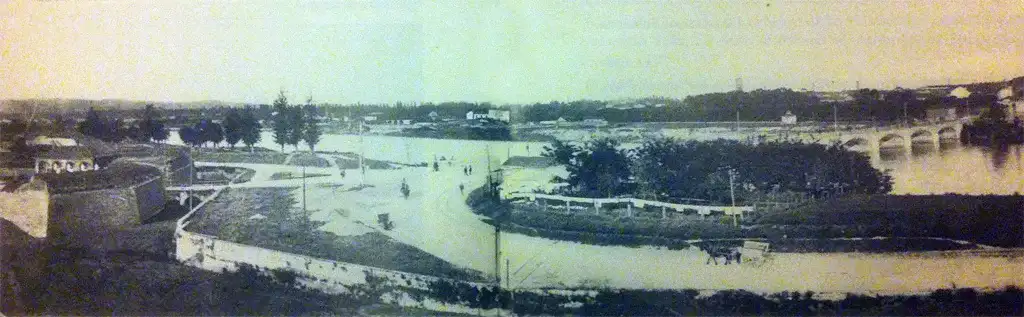
The Citadel of Alessandria is one of the greatest European monuments in the 18th century permanent fortification, one of the few still existing and certainly one of the best preserved in Europe. It is the only plain fortress built by the Savoy in the 18th century and it is the only European fortress still today inserted in its original environmental context: there is no screen of houses that closes the view of the ramparts, or a high road to surround the moats.
The Citadel Alessandria, a fortress of first rank, was conceived to function as the landing of the military transits of the Flander Road. It is a perfect example of modern fortification, it consists of six bastioned fronts equipped with knights, connected by thick straight curtains and routes from galleries and barracks. Among the best preserved in Italy, it rises on the left bank of the river Tanaro, in the municipality of Alessandria.
On the bastions of the citadel was raised on 10 March 1821, for the first time in Italy's history, the tricolor banner[5] by Lieutenant Colonel Guglielmo Ansaldi[Biblio 1].
Since 2006, the citadel (formerly a national monument) has been included in the "Tentative List" for the UNESCO World Heritage List.
History
Social context, historical, geopolitical · 18th century · ConstructionExplore this chapter
Social context, historical, geopolitical
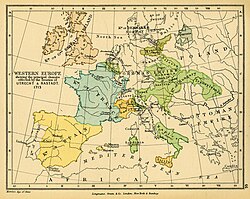
The area of the city Alessandria has always been destined to be a border land with a strategic-military vocation. Since the 14th century, it has joined the Viscounts of Milan against Monferrato And Asti, with the Sforza family then in the 15th century, and consequently under Spanish rule until the end of the 17th century.
At the end of the War of Spanish Succession with the Treaty of Utrecht of 1713, at the Duke of Savoy Vittorio Amedeo II, who renounced his claims on Milan, were ceded the provinces of Alessandria and Valenza and the lands between the Po and the Tanaro, as a reward for having sided with the Habsburg Empire. The city of Alessandria had already been officially annexed to the Savoy territories since 1707. All this had resulted in the acquisition of 4,000 square kilometers of new territories, 250,000 inhabitants and an annual tax revenue of 1.2 million lire. The new acquisitions increased the territory under his control by an eighth, the population by a fifth and the treasury revenues by a tenth. These were borders and conquests to be controlled and defended. The situation remained substantially unchanged until 1728, when the allocation of 421,642 Lire was decided which "must be used in Alessandria. For the construction of a Citadel in Borgolio according to the Plant, which will be determined by S.M."[6].
In order to meet the defence needs of the new Savoy state, it was decided to build an imposing fortress destined to function from disembarkation of military transits that traveled the Road of Flanders, the ancient Spanish military road that connected the ports of Genoa, Savona and Finale Ligure with the Netherlands.
The Citadel was part of a larger defensive plan that included the Fort of Bard (for the control of the Piccolo and Gran San Bernardo), the Forte della Brunetta[7] in Susa, the Fortress of Exilles in Val di Susa, the Fort of Fenestrelle in Val Chisone. Already existing were the fortresses of Cuneo, Saorgio and Forte di Ceva[8] in the valley of the Tanaro. The Citadel would thus become the central element of the widespread Savoyard defense network.
18th century
Construction
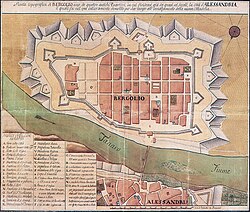
Raised on project of Ignazio Bertola is a stellar plant. The architect Bertola took advantage of the experience lived for the siege of Turin in 1706, during which he realized the defects and gaps of the defensive system now obsolete with respect to contemporary military technology. Its construction, commissioned by Vittorio Amedeo II of Savoy and built by Carlo Emanuele III of Savoy, king of Sardinia, began from 1732. The contract for the construction of the citadel is of 24 May 1732 and the laying of the first stone on 4 September 1732; in this document are listed the norms to be held in the execution of the works, vidimate by Bertola. The same year was elected as the factory's superintendent Francesco Ludovico Villencourt, in service from 1729 to 1739 at the forts of Alessandria, Casale and Valenza. The Marquis Roero of Cortanze, governor of the city, inaugurated the construction site on 17 September 1732.
The construction of the citadel had been a long debate since some problems emerged. The first was of a diplomatic nature: "The first was born from the filthy oppositions, which foreseen unevitable by the Cabinet of Vienna, empire in force of the convention stipulated with Emperor Joseph I in the act of the cession of Alessandria to the R. House of Savoy, it was established that this city should remain in the state where sold vein, without increase of fortifications"[bibliography 2]. Indeed, the Treaty of Turin of 8 November 1703, signed between Vittorio Amedeo II and Emperor Leopold I, provided for in point VI the transfer of Alessandria and Valenza. But point VIII of the document established, without a shadow of a doubt, that the cities of Valenza and Alessandria should not have been reinforced as well as those of Mortara, "Simpli wall reliced" and of Casale Monferrato[bibliography 3]. Denouncing the treaty was impossible, as the territorial claims and acquisitions obtained at the peace table of Utrecht in 1713 were based on it. In the meantime, however, the Franco-British protection made Turin quite safe from Austrian retaliation[library 4].
The second problem was the discrepancy of opinions about the way, and the site on which the new construction should be undertaken. At the end of the debate, the choice falls on the building of the citadel entirely at the expense of the old district. Bergoglio, motivated by the thoughts of the architect Bertola[5 libraries].
This choice provoked a decisive urban revolution: this is because the neighborhood would be too exposed to attacks becoming a potential danger in case of enemy attack[9]. It should not be forgotten that the project for the construction of the citadel also required a large external area, the so-called "spianata" or glacis[10].
The swampy land of B pride had to be strengthened through special systems of consolidation of the soil, in particular for the works of foundation of the walls of bastions and courtyards, and interior buildings. These systems, pilot, consisted of a row of wooden poles armed with iron tips, driven into the ground, joined together by iron chains.
The intention of creating the new Citadel and the first construction works were kept hidden by the Austrian government, the ancient ally: the agreements with the Court of Vienna forbade the fortifications of Alessandria, so that the beginning of the work was justified with the need to protect the district of B pride from the floods of Tanaro. The two nicknames ordered by the Emperor of Austria Charles VI failed to reveal the true nature of the works undertaken, also thanks to the fact that the demolition of the B Pride buildings as much as possible, used as a screen: they were knocked down when the six pentagonal bastions of the fortress definitively unveiled the real intentions of the Piedmontese.
The work lasted about fourteen years: in 1745 the fortress was complete in its main components of the complex defensive structure. The citadel was equipped with weapons and food necessary to the departments [...] for having everything ready and to use it at the occasion of siege awaited the walk of the Galli-spani towards that square [...] Within the fortified hexagon, Bergoglio's civil buildings were gradually demolished to make room for the new military quarters: in 1728 Vittorio Amedeo II had ordered his demolition and work lasted four years. The inhabitants were forced to move into the farmyard and on the opposite bank of the river while the nobles of Bergoglio rebuilt their residences within the city walls. The inhabitants and the nobles replaced an increasingly large military garrison.
This is how an immense fortress extends over about 60 hectares whose longer side is parallel to the river axis. The Citadel is located northwest of the city of Alessandria on the left bank of the river Tanaro. It is the lowest area of Piemonte at about 90 meters above sea level.
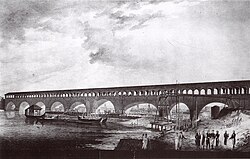
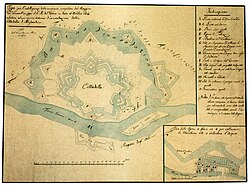
The Citadel is connected to the city through a bridge built in the 21st century on design by architect Richard Meier. In the past, the bridge was made of stone and covered by a roof. The square body is surrounded by a large ditch[11], protected by pincers, ravelins, counterguards and redoubts. It is accessed by a long stone bridge which leads to a large area surrounded by multi-storey buildings arranged along the axis of the ancient Bergoglio neighbourhood, all covered by resistant embankments built between 1749 and 1831.
Austrian Succession War
The Citadel was first tested between 1745 and 1746 when it lasted for seven months, during the War of Austrian Succession, to the Galispa army (French-Spanish). The fortress was still incomplete and not well armed.
First Italian Campaign
At the end of Italy's first campaign, the Citadel was in the hands of the French: in July 1799 it was besieged by the Russian Austro Army of Aleksandr Vasil'evič Suvorov. After three days of bombing, serious damage to the fortified structures and French forced to surrender were inflicted.
19th century
French employment
Napoleon Bonaparte, after the triumphs of battle of Marengo (14 June 1800) and the accession to the imperial throne of France (2 December 1804), he decided to expand and restore the fortress and to surround the city with new defenses and eight new fortifications with the aim of creating a large logistical base intended to support the operations of the French army deployed in Northern Italy; urban development was planned in the town of Marengo.
During the French occupation, the position and effectiveness of modern fortifications made the Citadel one of the most spectacular fortresses in the empire and the richest arsenal in Europe. The construction and conservation of the Napoleonic buildings are unique. Napoleon wanted to make the Citadel the “Eastern door” of France.
Restoration
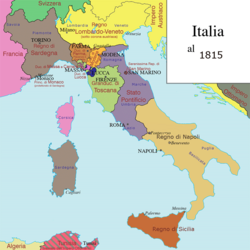
In 1814 the Austrian armies demolished the French trenched field, saving the Citadel that was delivered to the restored Kingdom of Sardinia. After the Restoration, the restoration of the ancient walls of Savoy once again gave a fundamental role to the Citadel.
Initially used as a bridgehead of the new trenched field, Alessandria became in the middle of the 19th century an important bastion against the Austrian Empire.
Resurgence
Economist, philosopher and politician, Engels did not disdain to write about military issues. In two minor works of 1859 he also dealt with it Alessandria and his Citadel.
At the confluence of Tanaro and Bormida, eight miles upstream of the confluence of the latter with the Po, is located Alessandria, the best fortress of Piemonte, which is now becoming the central point of a vast trenched field, and covers the southern wing, or right, of the position. The two cities are sixteen miles away, and the Po flows parallel to the road that unites them, at a distance of five or six miles. The left wing of an army deployed on this position is first covered by the Sesia, and then by Casale and the Po; the right wing is covered by Alessandria and from the rivers Orba, Bormida, Belbo and Tanaro, which all converge near Alessandria. The front (the first line) is covered by the Po loop. [...] But the location of Casale and di Alessandria offers a weak point: it lacks depth and its backdrops are completely discovered. The Austrians, between the Mincio and the Adige, have a quadrilateral protected by four fortresses, one in each corner; on the Po and Bormida the Piedmontese have a line with two forts on each side and a well defended front, but their backs are completely uncovered. Now, bypass Alessandria from the south would be risky and relatively useless; but Casale can be circumvented from the north, if not from Vercelli, at least from Sesto Calende, Novara, Biella, Santhià and Crescentino; and if a numerically superior army passed the Po, upstream of Casale, and attacked the Piedmontese, they would immediately have to give up the advantages of a solidly trenched position, and to fight in open field. This would be the counterpart of Marengo, although on the opposite bank of Bormida. […] [bibliography 6]
Even more than Belgium, northern Italy has for centuries been the battlefield on which Germans and French have fought wars who have seen them in front. The possession of Belgium and the Po Valley is, for those who attack, the necessary condition both for a German invasion of France and for a French invasion of Germany: only this possession makes completely safe the flanks and shoulders of the invader. Only the case of absolutely certain neutrality in these countries could be an exception; and this has not happened until now. [...] In Piemonte, a mile under Casale, the Po bends its course, until here facing east, it flows for three good miles in south-southeast direction, then turn again to east. In the northern curve flows from north Sesia, in the southern one, from south-west, the Bormida. With this they join immediately before the confluence, right near to Alessandria, the Tanaro, the Orba and Belbo, forming a set of flow lines confluent to a central point, whose main crossing point is protected by the trenched field of Alessandria. [...] The importance of this position for the defence of Piemonte from attacks from the east had already been recognized by Napoleon, who consequently had again strengthened Alessandria. The events of 1814 did not confirm the defensive strength of the place: how much it is worth today, we may soon have an opportunity to see. […] [Library 7]
With the mutiny of the Citadel on March 10, 1821 the Piedmontese insurrection begins. The tricolor flag is set for the first time in the history of resurrection. The insurrection spreads soon throughout the Piemonte but closes at the end of April with Austrian repression. Thus begins the second Austrian occupation of the fortress that will last until 1823. The Alexandrian affiliates at Giovine Italia Mazzini are imprisoned in the prisons of the Citadel. In addition to Andrea Vochieri, an Alexandrian patriot, there are five soldiers. At the end of a summary process, on 20 June 1833 they are all sentenced to the death penalty by evasion.
In 1849, after the defeat of Carlo Alberto di Savoia in Novara, marking the end of the First Italian War of Independence, Austrians returned to Cittadella again. After only three months they will be out already. Despite the brevity for Italians the symbolic and political significance of this occupation is very great and convinces them to join the fortunes of Italy with those of Savoy. Between 1854 and 1855, in anticipation of the Second Italian War of Independence (1859), were erected on the remains of the Napoleonic works a new urban cinta and a trenched field composed of three detached strong: Forte Ferrovia, Forte Bormida and Forte Acqui. In the spring of 1855, the 15,000 Sardinian-Piedmont expeditionary corps in Crimea gather together: participation in the war will allow Cavour to denounce the gravity of the Italian situation under the political, military and economic dominance of the Habsburg Empire.
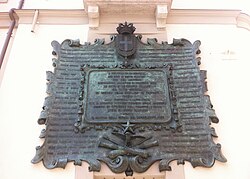
Between 1857 and 1858 with the anticipation of a war to Austria more and more certain, Norberto Rosa, lawyer and writer, from the pages of the Gazzetta del Popolo promotes a national subscription to equip the Citadel of 100 cannons (one for each of the 100 cities of Italy)[biblio 8]: 151,914,21 lire is collected in just over a year. So enthusiastic was the adhesion that in the end the fused cannons turned out to be a hundred-event; in the bronze plaque that collects in alphabetical order the names of the donors turn out to be one hundred and twenty-three because some cities gave more than one. The cannon placed in the north corner of Palatium Vetus, in the central Piazza della Libertà di Alessandria, is the only surviving vessel. It was donated, at its own expense, by the Alexandrian Carlo Perla, who emigrated to Switzerland. The cannon was walled, together with the laying of the bronze plaque, in Palatium Vetus in 1886, to commemorate the subscription.
On 14 May 1859 the new cannons welcomed Napoleon III of France in Cittadella, the main gathering base, the chief ruler in Piemonte and where the French command is based, while Vittorio Emanuele II and the Sardinian army are aquartierati out of town. On 30 May the Allies move against Austria starting the war that will lead in just under two years to unification of the peninsula. The minister of the Piedmontese War Alfonso La Marmora made a bronze plaque[12], the same one used to cast the cannons, for everlasting memory on the facade of the Palatium Vetus, in the central Piazza della Libertà of Alessandria.
Kingdom of Italy
After the proclamation of the Unification of Italy, numerous defence plans for the city of 1862 followed. Alessandria: in a plan of 1871 the complete transformation of defence works was examined Alessandria, considered as the defensive centre of the western frontier. The strategic and military fronts change, and in 1889 the Citadel from “first rank fortress” passes to headquarters of commands, barracks and logistic warehouse then. In any case the fortress remains a fundamental site of the territorial organization of the Italian Army.
20th century
In 1901, the military Genius decreed the dismissal of the magistral belt and in 1904 the radiation, from the nous of the fortifications of the state, of the Fort of Acqui, of the Opera di Valenza, of that on the river island of Tanaro and all the external defense works of the Citadel.
Several regiments were stationed in the Citadel. The 37th Infantry, together with the 38th, forms the Ravenna Brigade that fought bravely on the Russian front.
Second World War
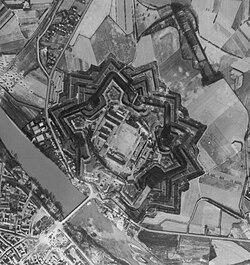
From 1920 to 1943, the Citadel was the seat of the 37th Infantry Regiment (Brigata Ravenna) which started from here at the time of the Russian Campaign.
On 17 May 1943, with Regio decree-law no. 566, the Governor's Palace (Belgian barracks) is declared a national monument[library 9].
After September 8, 1943 he was occupied by the Germans, then resumed by the partisans in 1945. In the days of the Armistice were aquarified the departments of the 371th Infantry Regiment, of the II Divisional Artillary Regiment, of the 2nd Autocentre, a Sussistence Company and a Health.
On the morning of 9 September 1943, the Germans entered the city and presided over strategic points. After an hour of truce, result of previous negotiations, the Germans bombed the Italian artillery in the citadel. The surrender was immediate and the Germans disarmed all the men who were loaded on the trucks to be taken to the railway station for deportation in Germany.
5 September 1944 Alessandria and the citadel were heavily bombarded On the area of the citadel, the damage was not many, as is known by the Allied military photo, but caused the destruction of an anti-aircraft shelter built between the outer walls of the citadel and the Jordan street Bruno which runs along the fortress. The destruction of the shelter caused the death of 39 civilians: men, women, elderly people and children. On the road, even in this case, there is a memorial stone.
On 20 February 1945, in front of one of the bastions, Luciano Scassi "Stefano", Amedeo Buscaglia, Ettore Gino "Kappa 13", all of GL and Pietro Scaramuzza della Brigata Matteotti - Val Tanaro, were shot by a German execution platoon. Today a memorial stone commemorates the event in the square of the bastion of Santa Barbara.
After liberation the citadel was also home to Força Expedicionária Brazilira (FEB).
Second post-war period
From 1953 to 1962 the Citadel was the seat of the 52nd Regiment on Earth's artillery "Turin" and then of the Corps of commissioner with logistic functions and warehouse.
In 1994, duringTanaro flood, the citadel was completely invaded by river water both in the moats and in the square and in every building, suffering serious damage. Even today some areas, especially the basements of the fortified buildings, are filled with mud from the flood.
21st century
In 2007 the dismissal of the Citadel by the Ministry of Defence is officially carried out, passing on ownership to the demanio Agency.
On June 18, 2010 the "Permanent Exhibition of uniforms, weapons and relics of the Italian Army Regio from 1848 to 1946", promoted and funded by the Fondazione Cassa di Risparmio di Alessandria, is located at the premises on the ground floor of the Governor's Palace (Belgium barracks). It includes, among other things, the combat uniform, in cloth, worn by S.M. King Umberto II with the rank of Lieutenant General of the Kingdom. The dress worn by Umberto II is also preserved on the day of departure for exile in Portugal. The section “Enrico Franchini” of Alessandria of the National Association Bersaglieri through its volunteer work, curates the exhibition and manages its visits. The collection comes mostly from the private fund of Cav. Anselmo Aliberti di Saluzzo is composed of 1500 pieces, all original and datable between 1848 and 1946.
On April 22, 2013 it was communicated by FAI -Fondo Ambiente Italiano- that the Citadel of Alessandria obtained the first position in the ranking of the Places of the Heart 2012 for The VIO census of the most loved Italian places in the world[video 1].
On 10 March 2014, the Agency of the Demanio, which on behalf of the State curates and manages the Cittadella di Alessandria, banned a contest for "Concession of Valorization of the property called Compendio Cittadella, site in the Municipality of Alessandria, via Pavia s.n.c., ex art. 3 bis of the D.L. No. Article 351/2001, converted, with modifications, by art. 1 of L.n. 410/2001”[13].
On 4 May 2014, during a press conference held in Vienna, the Cittadella di Alessandria was included by Europa Nostra and the European Investment Bank among seven European monuments for the program of protection of historical sites "7 Most Endangered", that is, in serious danger and in need of valorisation actions[14].
On February 8, 2016 it was officially formalized the delivery of the monumental complex of the Citadel of Alessandria from the Agency of Demanio (Regional Direction Piemonte and Valle d'Aosta) to the Superintendence for Architectural Heritage and Landscapes for the provinces of Novara, Alessandria and Verbano-Cusio-Ossola, peripheral organ of the Ministry of Cultural Assets and Tourism[Biblio 10]. With the organizational reform of the Ministry's peripheral offices, again in 2016, the Archaeological, Fine Arts and Landscape Superintendency was established for the provinces of Alessandria, Asti and Cuneo (responsible for the protection of all the cultural heritage of the southern Piemonte), which has its registered office in the Citadel.
Lapids and memorials
Explore this chapter
- Memorial monument for the victory of World War I - Piazza d'armi.
- Memorial in memory of the fallen of the 37th Infantry Regiment - Subterranean of the former military hospital (Giletti barracks)
- Memorial plaques in memory of the fallen infantry regiment - Façade of the former military hospital (Giletti barracks)
- commemorative tombstone in memory of the fallen bombing (5 September 1944) - Via Giordano Bruno, in front of the bastion San Michele
- Memorial tombstone in memory of the partisans shot in the citadel (20 February 1945) - Bastione santa Barbara
Architectural structure
Square body · System of fortifications · BastionsExplore this chapter
Overall view of the architectural structure of the Citadel.
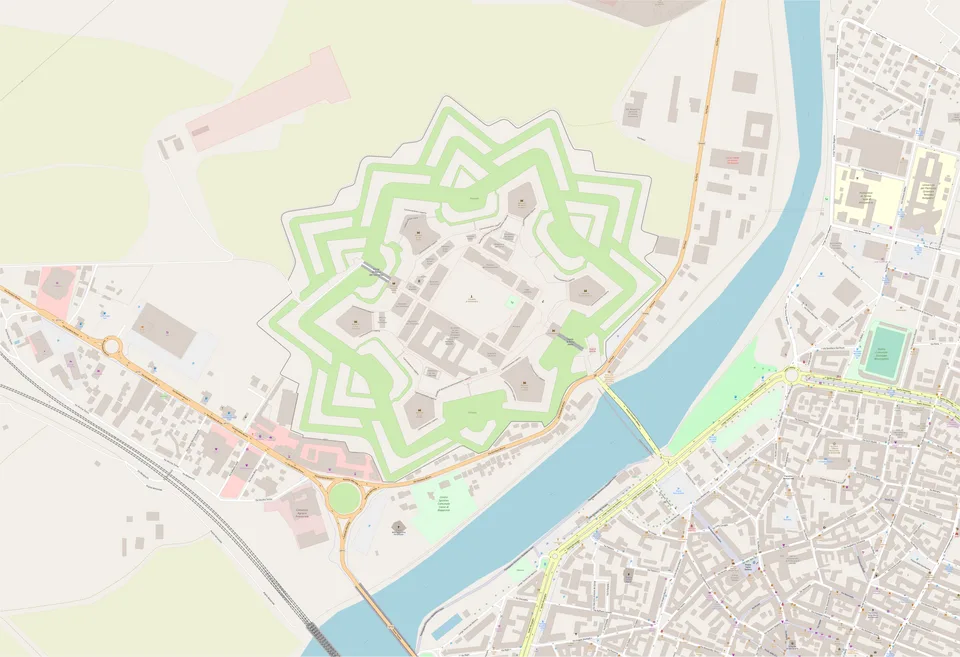

- Body of Guard
- Royal Gate
- Armoury
- Neighborhood Supply
- San Michele district
- Polveriera di San Michele
- San Tommaso district
- Officina San Tommaso
- St. Thomas
- Port of Asti
- Small arsenal
- Rain water tank, latrine
- San Carlo district
- Deposit San Carlo
- Deposit San Carlo
- Radio station
- Beato Amedeo Powder
- Genius Warehouse
- Palace of the Governor
- Artillery tits (demolished)
- Salle d'Artifice
- Powder of Sant'Antonio (demolished)
- St. Anthony's Bastion
- Bastione Santa Cristina
- Bastione San Michele
- Bastione San Tommaso
- Bastione San Carlo
- Bastion Beato Amedeo
- Falsabraga di Sant’Antonio
- Reduced by the crescent of Sant’Antonio
- St. Anthony's crescent
- Controguard of the crescent of Sant'Antonio
- Controguard of the bastion of Sant'Antonio
- Rivellino di Santa Cristina
- Rivellino di San Michele
- Controguard of the bastion of San Michele
- Falsabraga di San Tommaso
- Reduced by the crescent of St. Thomas
- Half moon of St. Thomas
- Controguard of the crescent of St. Thomas
- Controguard of the bastion of St. Thomas
- Falsabraga di San Carlo
- Reduced of the crescent of San Carlo
- Half moon of San Carlo
- Controguard of the crescent of San Carlo
- Controguard of the bastion of San Carlo
- Beato Amedeo Falsabraga
- Reducing the crescent of Blessed Amedeo
- Half moon of Blessed Amedeo
- Confrontation of the crescent of Blessed Amedeo
- Confrontation of the bastion of Blessed Amedeo
- Neapolitan lunettes
- Beato Amedeo Sortita
- Sortita di Sant'Antonio
- Sortita di San Michele
- St. Thomas's Sortita
- Gallery of San Carlo
- Covered walking (dotted line)
- Piazza d'Armi
- Taste
Square body
- Body of Guard. The gatehouse structure is characterized by a façade with a four-arch portico and is positioned in front of the main entrance (Porta Reale) before the sleeping bridge.
- Royal Gate. The two-storey rectangular building is the main entrance to the Citadel and is located between the bastions of Santa Cristina and Sant'Antonio. The access is connected by a sleeping bridge which connects it to the ravelin for the defense of the gate itself. The sleeping bridge, 74 meters long, spans much of the moat. It was rebuilt after 1945 by the military engineers, to replace the largely destroyed original one. The last stretch of the sleeping bridge consisted of a drawbridge. Today, inside the door, the lifting mechanisms called "Dobenheim" remain (after the creator, the French engineer Alexandre-Magnus d'Obenheim). The same mechanisms are also present in the Porta del Soccorso on the side facing the countryside Asti.
- Armoury. The structure was designed and built in 1812, during the Napoleonic period. It is a three-storey building, the first two of which are organized into three parallel naves with the central one wider than the two external ones. The third floor is characterized by a single nave with a pointed arch ceiling. It later took the name of "Montesanto barracks".
- Neighborhood Supply. This palace also dates back to the Napoleonic period and was designed in 1808 by the French architect François Charles Louis Chasseloup-Laubat. It is currently divided into three floors with a three-nave layout. It was the last headquarters of the Citadel Command. Inside there is a hall of honor.
- San Michele district. In the beginning the San Michele neighborhood was intended for use as a military hospital. In a second period it was transformed into a neighborhood by adding structures perpendicular to the main body, forming three internal courtyards. This solution recalls that of the courtyard of the Royal Academy of Turin. Construction work on this complex began in 1769 based on a design by Giovanni Battista Borra. It later changed its name to "Giletti barracks".
- Polveriera di San Michele. The powder magazine of San Michele, in front of the entrance to the basement of the bastion of San Michele, is in good general conditions of conservation. There are two internal courtyards that act as a cavity. The furnishings are still present including the wooden coverings to protect the black dust against humidity. Note that the internal wooden cladding does not have any nails but the structure is designed to be interlocking. This is to avoid potential explosion risks caused by possible sparks from the percussion of any metal nails during maintenance work.
- San Tommaso district. The San Tommaso neighborhood was the first of the buildings bomb-proof, to be built. The first works began in 1749 and ended after 1756.
- Officina San Tommaso.
- St. Thomas.
- Port of Asti. The gate is located in the north-western sector of the Citadel on the junction of the bastions of San Tommaso and San Carlo. There was a drawbridge, as for the Royal Door, of which the lifting mechanisms remain inside the entrance hall. Of the entire system of sleeping bridges and drawbridges that led outside the Citadel, towards Asti, some segments remain in ruins and visibly infested with vegetation.
- Small arsenal.
- Rain water tank, latrine.
- San Carlo district. The San Carlo district dates back to the first half of the 18th century and was designed by the architect Giovanni Battista Borra. It is divided into three levels (two above ground and one underground), with extrados of the raised arch vaults bomb-proof. It later changed its name to "Monte Grappa barracks".
- Deposit San Carlo.
- Deposit San Carlo.
- Radio station.
- Beato Amedeo Powder. This powder magazine, unlike that of San Michele, is in conditions of greater external degradation.
- Genius Warehouse. This warehouse was one of the last projects of the Citadel and was built between 1831 and 1833.
- Palace of the Governor. Lorenzo Bernardino Pinto designed this building in 1761 which is made up of three projecting foreparts. The structure is developed on three floors above ground plus an underground floor. The entrance hall is divided into three naves by pillars and is enriched by ribbed vaults. He later changed the name to "Caserma Beleno".
- Artillery tits (demolished).
- Salle d'Artifice. The first information on the projects for this building dates back to 1812 relating to a pavilion-shaped structure with four floors including a basement.
- Powder of Sant'Antonio (demolished).
- a. Beato Amedeo Sortita.
- b. Sortita di Sant'Antonio.
- c. Sortita di San Michele.
- d. St. Thomas's Sortita.
- g. Piazza d'Armi. The parade ground measures approximately 22,000 square meters and is overlooked by four structures: the Governor's Palace, the San Michele District, the Salle d'Artifice and the San Carlo District. All the other buildings can be reached from the square via wide streets and avenues.
System of fortifications
The great fortified system of the Citadel has reached the 21st century almost intact. It consists of six bastions or balconies, four of which are housed in the Napoleonic era and equipped with knights with galleries, four double half-helf moons, two small rivets without reduced arches in the throat, nine counterguards and four rods to defend as many courtyards, the system of the ditch with the wall of counterscarpa, a journey covered as an extreme line of fire, the outer spalto.
Bastions
The bastions are six, of a pentagonal shape. Two original and four modified in the Napoleonic era.
- St. Anthony's Bastion. Originally it was only a bastioned wall with demolition tunnels, in the Napoleonic era it was filled with the construction of the three large central galleries, the two lateral connecting galleries to access the six gunboats and, at the end, the demolition tunnel. The bastion is surmounted by Knights, masonry works and embankments inside which a perimeter gallery was built which served as a stable. It could also be used for defense, using the two rows of side openings. In the centre, as for the bastions of Santa Cristina and San Carlo, the rampart to bring the artillery to the top.
- Bastione di Santa Cristina. Embankment surmounted by Knights, in masonry, and embankments too, were used to carry the artillery upwards, to have the prevalence of artillery fire.
- Bastione di San Michele. v. St. Anthony's Bastion
- St. Thomas' Bastion. v. St. Anthony's Bastion
- Bastione di San Carlo. v. Bastione di Santa Cristina
- Bastion of Blessed Amedeo. v. St. Anthony's Bastion
- f. Covered walking (dotted line).
Defensive system of ditches
- Falsabraga di Sant’Antonio.
- Reduced by the crescent of Sant’Antonio.
- St. Anthony's crescent.
- Controguard of the crescent of Sant'Antonio.
- Controguard of the bastion of Sant'Antonio.
- Half moon of Santa Cristina.
- Half moon of San Michele.
- Controguard of the bastion of San Michele.
- Falsabraga di San Tommaso.
- Reduced by the crescent of St. Thomas.
- Half moon of St. Thomas.
- Controguard of the crescent of St. Thomas.
- Controguard of the bastion of St. Thomas.
- Falsabraga di San Carlo.
- Reduced of the crescent of San Carlo.
- Half moon of San Carlo.
- Controguard of the crescent of San Carlo.
- Controguard of the bastion of San Carlo.
- Beato Amedeo Falsabraga.
- Reducing the crescent of Blessed Amedeo.
- Half moon of Blessed Amedeo.
- Confrontation of the crescent of Blessed Amedeo.
- Confrontation of the bastion of Blessed Amedeo.
- Neapolitan lunettes.
- e. Gallery of San Carlo.
- h. Spalto.
Famous people in Citadel
Explore this chapter
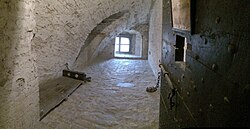
- Andrea Vochieri - imprisoned and then shot, May/June 1833
- Giuseppe Pomba - imprisoned on 24 December 1836, with a month in prison, for introducing from Paris copies of the Siege of Florence
- Giuseppe Garibaldi - imprisoned, September 1867[library 11]
- Giovannino Guareschi - imprisoned, 8 September 1943[library 12]
In the media
Explore this chapter
- In the Citadel Alessandria A TV miniseries, Violetta, was also filmed.
- The Citadel is dedicated a script for “teatralconcerto” titolato The child of the Citadel [library 13].
Image gallery
Tables · Portraits · Square bodyExplore this chapter
Tables
-
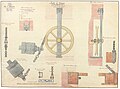 Particular constructions of a mobile bridge "alla Dobenheim". 1830
-
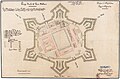 Location and surface of gardens within the Citadel. 1844
-
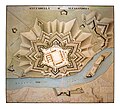 Expansion of fortifications. 1846
-
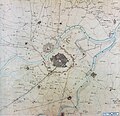 Field hypotheses drilled around the "plate" of Alessandria. Anonymous, 1856
-
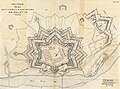 Plan of fortifications. 1886
Portraits
-
 Vittorio Amedeo II of Savoy
-
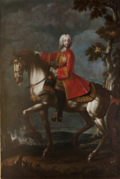 Carlo Emanuele III of Savoy
-
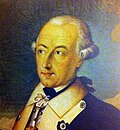 Count Giuseppe Francesco Ignazio Bertola d'Exilles, architect
-
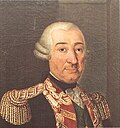 Count Lorenzo Bernardino Pinto, Gen. Commander-in-chief of the Genius Royal Corps.
-
 François Charles Louis Chasseloup-Laubat, Gen. of the French genius.
Square body
Varieties
-
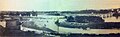 Panorama of the Citadel and Tanaro River
-
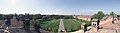 Piazza d'Armi
-
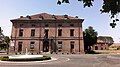 District of the Artiglieri
-
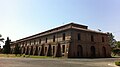 Arsenal
-
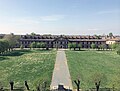 In the background of San Michele District
-
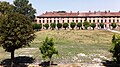 Palace of the Governor
-
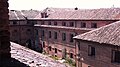 One of the interior courtyards in San Michele
-
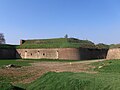 Bastion
-
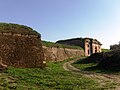 Rescue door or Door Asti
-
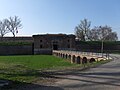 Royal Doors
-
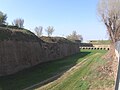 Wall damaged by a plane bomb during World War II
-
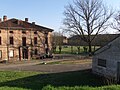 The inside of the citadel
-
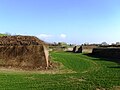 Bastion and walls with the city of alessandria on the second floor
-
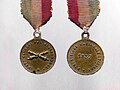 Commemorative Medal of the Cento Cannoni Subscription for Citadel
-
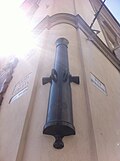 One of the two surviving cannons of the 128 fuses for the subscription of the Cento Cannoni for the Citadel
Notes
Explanatory statement · Bibliographic · VideosExplore this chapter
Explanatory statement
- ^ Officially dismissed by the Ministry of Defense in 2007 and delivered to the Demanio Agency. Ministry of Defense, List of properties delivered to the Demanio Agency pursuant to the Inter-directory Decree 25 July 2007 (PDF), up defence.it, 25 July 2008. Retrieved 26 April 2016.
- ^
 3rd Infantry Div. "Ravenna" which brings together the 37th and 38th "Ravenna" Infantry Regiment and the 11th "Ravenna" Artillery Regiment
- ^
 52nd Earth's artillery regiment "Turin" from 1953 to 1962
- ^
 Italian Army commissioner
- ^ It is actually one of the many resurgent myths. The tricolor was not the green-white-red banner of the current Italian flag, but the one with the colors of coal, blue-red-black
- ^ ASTO, Court, Military Materials, General Intendence Factories and Fortifications, Mazzo 1 of addition, Rest of expenditure from 26 February 1727 until 23 May around the fortifications of this city of Alessandria.
- ^ demolished at the end of the eighteenth century on order of Napoleon.
- ^ demolished at the beginning of the nineteenth century on order of Napoleon.
- ^ Bergoglio, during the sixteenth century, had already been besieged and taken by the French forces who had made it an advanced leap to offend the city.
- ^ The great pavement of land, which the fortified work needed, had to be left free to the sight of the defenders and therefore not constitute possible points of shelter for the enemy. In the area there was no cultivation or the presence of trees.
- ^ The ditch is 50 meters wide in front of the bastions and 120 meters in front of the courtyards. There are connections with the Tanaro River through a system of wallpapers and locks that could deviate the river to be flooded. In the image proposed on the side of the text it is possible to convince the flood system.
- ^ The plaque leads to the top of the Savoy coat of arms and, immediately below, to crown the names of the subscribers in the following order: Acqui, Alba, Albenga, Alessandria, Ancona, Annecy, Aosta, Arona Asti, Bassano, Bergamo, Belluno, Brescia, Biella, Bobbio, Bologna, Bormio, Cagliari, Carrara, Casal Maggiore Casale Monferrato, Castellamonte, Chambery, Chiari, Chiavari, Città di Castello, Colonia California, Colonia Chilì, Colonia Costantinopoli, Colonia di Lima, Colonia di Odessa, Colonia del Peru, Colonia Rio de Janeiro, Colonia Smirne, Como, Cortona, Crema, Cremona, Cuneo, Daniele Manin, Deputati, Domodossola, Emigrati in Piemonte, Army, Ferrara, Final, Florence, Genoa, National Guard, Guastalla, Intra, Italian Islands, Italy, Ivrea, Lecco, Lodi, Livorno, Lucca, Mantova, Massa Estense, Menton, Messina, Milan, Modena, Mondovì, Montebello, Monza, Moris Gius di Torino, Mortara, Naples, Nizza Marittima, Noli, Norberto Rosa, Novara, Novi, Pavia Ponzone, Marchese Filippi Alessandro, Reggio Modenese, Rimini, Rome, Saluzzo, Sarzana, Sassari, Savona, Senatori, Siena, Sinigaglia, Syracuse, Sondrio, S. Marino, Spezia, S. Remo, Stampa, Statuto, Studenti, Susa, Torino, Tortona, Trento, Treviso, Udine, Unione, Varallo, Varese, Venice, Vercelli, Verona, Vicenza, Vigevano, Vittorio Emanuele II, Voghera. In the central part of the stone is engraved the following text: "To perpetrate the MEMORIA / THE DONE OF CENTRE CANNONI / THAT IN MDCCCLVIDES / RESPONDING TO THE INVESTMENT OF RED ROSA / THE CITY AND ITALIAN COLOURS / ALL CONCORDERS / NEEDS In the MDCCCLXXXVI POSE
- ^ from the site of the demanio Agency, up agencydemanio.it (archived fromoriginal url on 10 March 2014).
- ^ Europe Our News, up europanostra.org.
Bibliographic
- ^ Giovanni Spadolini, preface to "The Citadel of Alessandria, a fortress for the territory from the eighteenth century to unification"
- ^ Memorie Guasco, 136v
- ^ Memorie Guasco, 135v-136r.
- ^ In his journey to Italy, between 1728 and 1729, Charles-Louis de Secondot, Barone de La Brède and Montesquieu, passed for Alessandria and assisted in the construction of the citadel, or rather the demolition of Bergoglio. In the short notes there are some controversial circumstances, and he also pointed out the diplomatic problems related to construction: On 8 September 1728 they entered the Alexandrian, leaving north of Monferrato. It is a very fat and very fertile country. We found the Tanaro about 1 mile from Asti; it goes to Alessandria, and receives the Bormida 2 miles beyond Alexandria [...]. The Tanaro separates the city from the suburb, which is joined by a stone bridge. This suburb is closed in a fortification; a year ago, about the king of Sardinia has made you demolish almost all houses, to build a citadel. But it is known that the Emperor has suspended the work. Since digging is the water, you will have to build the citadel on foundation poles when they dare begin work.. Montesquieu
- ^ "[...] The Head of Engineers Colonel Ignazio Bertola, a very experienced man of military architecture, highly esteemed by the King and on the era known the work undertaken (indefinitely) by the Spagnuoli in 1688 to narrower Bergoglio, and reduce it to Royal Fortress, opposed such project, and dared that the proposed site was not precisely at the erection of the new Citadel, which would be able to fail in many parts That being called Piazza on that site did not get the purpose of S.M. which was to cover the neighbouring provinces of his own, because on occasions of war the enemy could easily leave a body of troops in observation of the Citadel already circumscribed by the rivers, and freely flow the country. That the reduced proposed to the head of the Bridge was not enough to prevent hostile incursions, to be something short-sighted, unable to much trick, and easy to be overcome. He also proposed that the City should leave what it was, and only repair its old murals to keep them in the best possible way. That Bergoglio landed for raising a fort, and regular Citadel, from which you could dominate equally Alessandria, and the surrounding plain. That the inhabitants of this district would have convenient outcome to be located in the City, which would become more populated, and seen for the new fabrics of churches, public buildings, and houses, that without doubt would have been built over time. That the Citadel with erect cola could also receive in contingencies of enemy aggression the congruous aids from Cittadini for put of the Bridge, which leads to it. In addition, Bertola observed that erecting in the place he created the new Fortress, it avoided the maximum part of the over-described drawbacks, and made the same safer, stronger, and more defense.". (Guasco Memoirs, 137v-137r.)
- ^ Friedrich Engels, Probability of imminent war (PDF), in New York Daily Tribune, New York City, Greeley & McElrath, 17 March 1859, p. 42. Retrieved 26 April 2016 (archived fromoriginal url on 15 April 2016).
- ^ Friedrich Engels, Po und Rhein, in Po and Reno (PDF), Berlin, Franz Duncker, April 1859, p. 45. Retrieved 26 April 2016.
- ^ Norberto Rosa supports the need to indispettite Austria with an initiative, which is sure, "they would make membership not only Piemonte, but Italy all, but the distant Americas and every people enciviled". Norberto Rosa, Letter for the subscription of one hundred cannons[interrupted link], in Journal of the People n. 177, Turin, «Gazzetta del Popolo» printing house, 26 July 1856.
- ^ Official Journal of the Kingdom of Italy (PDF), up monumentsnazionali.it.
- ^ Citadel: official passage to the Ministry of Cultural Heritage, up alessandrianews.it, alessandrianews.it., 8 February 2016. Retrieved 20 April 2016 (archived fromoriginal url on 27 April 2016).
- ^ Mr. General, I hereby arrest you, up carabinieri.it, Ministry of Defence, 2007. Retrieved 26 April 2016 (archived fromoriginal url on 7 August 2016).
- ^ Guareschi, Diario clandestine (1943-1945)
- ^ Aldino Leoni, The child of the Citadel, Novi Ligure, Joker Editions, 2013.; In-depth profile, up edizionijoker.com. Retrieved 19 July 2016 (archived fromoriginal url on 17 September 2016).
Videos
- ^
 Valentina Tosoni Do, a million places of the heart, Gruppo Editoriale L'Espresso, 18 February 2013. Retrieved 25 April 2016.
Bibliography
Explore this chapter
- Giovanni Guareschi, Illegal journal (1943-1945), Rizzoli, 1949.
- Vincenzo G. Pacifici, Report 2, in Subscription for 100 cannons Alessandria: motivations, polemics and development, vol. 71, 1984, pp. 173-196.
- Anna Marotta, The Citadel Alessandria. A fortress for the territory from the 18th century to unity, Second volume of the series "Cities and fortifications in the Alessandria area", directed by Vera Comoli Mandraci. Paola Coppo, editorial coordination, Alessandria, SO.G.ED. Editions, 1991.
- Charles-Louis de Secondt, Travel to Italy, edited by Giovanni Macchia, Massimo Colesanti, Italian edition, Editori Laterza, 1995, p. 96, ISBN 978-88-420-4713-1.
- Gianfranco Calorio, Bergolium - 1: the Territory and the Abitato, Castelnuovo Scrivia (AL), Favolarevia Publishing House, 2000.
- Giovanni Cerino Badone, On the road to Fiandra. History of the Citadel Alessandria 1559-1859, Alessandria, FAI - Italian Environment Fund, Delegation of Alessandria, 2014.
- Aldino Leoni, The child of the Citadel, Joker ed., Novi Ligure, 2013 (with attached CD Citizen of the Group of the Enchanted).
Continue your journey