Atlas of Monferrato
Francesco Giuseppe Arborio di Gattinara
Local stories and places
A closer look
Francesco Giuseppe Arborio di Gattinara: at a glance
Francesco Giuseppe Arborio di Gattinara (Gravellona Toce, 17 June 1658 – Turin, 14 October 1743) was an Italian Catholic archbishop.
Biography
First years · Bishop of Alessandria · The Siege of AlessandriaExplore this chapter
First years
Fourth-born son of the Marquis Carlantonio Mercurino, patrizio of Vercelli, captain of the imperial army and Placida Besozzi, and elder brother of Giovanni Mercurino Antonio also bishop of Alessandria a few years later, Francesco Giuseppe was born on 17 June 1658. The date of the birth of Angelo Antonio[1] She's uncertain. The Manno puts it in 1656, while the Chenna in 1658.
In 1676 he entered the religious institute of regular clergy of St. Paul, popularly called barnabitates. He began his work in Milan in 1685 Lenten courses, continuing the numerous Italian cities including Udine, Venice, Genoa, Bologna, Florence and then again on the island of Malta. In 1703 he became provincial father of the institute until 1706 when the bishopric of Alessandria with the death of Filippo Maria Resta.
Bishop of Alessandria
Pope Clement XI appointed him bishop of Alessandria on 7 June 1706. He received episcopal consecration on 13 June of the same year by Cardinal Francesco Paolucci. On 29 September he finally took possession of the diocese.
On February 18, 1707 the pastoral visit of the city and diocese began. Two more were replicated in 1714 and 1722. After his first pastoral visit, on 27 and 28 May 1711 he celebrated the eleventh diocesan synod that gave prints[2] together with the ten other synods of his predecessors, all until then almost unpublished.
He had a particular care of the seminary: he did not limit himself to his restoration and embellishment, but still expanded it with new stables for pupils and two rooms for his own use and his successors for the time of spiritual exercises. On 19 November 1716 he also established a new chair of theology.
Gattinara was the master and inspiration of Paolo Francesco Danei, the future Saint Paul of the Cross, founder of the Congregation for the Passion of Jesus Christ.
The Siege of Alessandria
The early years of his Alexandrian government were tumultuous, coincident with the time of the Spanish Succession War. Alessandria was laid under siege by the troops of the Holy Roman Empire under the command of Prince Eugene of Savoy. In that time AlessandriaOn 5 July 1701, he was awarded by the French on behalf of Philip V king of Spain. During the siege mentioned, on 14 October 1706, a warehouse of the military citadel broke out. The damage was caused[3] and two monasteries, that of Santa Margherita and that of Saint Mary Magdalene, were severely damaged; two nuns remained buried by the collapse of the vault of the choir of the monastery of Santa Maria Maddalena. The bishop worked so that the religious of these monasteries could return to their family homes, then lodge them in two other monasteries, one of the Annunciation and the other of Santa Chiara.
During this siege he made a lot to the governor Fr. Francesco Colmeremo and the city administrators, for the health of people of Alessandria with recommendations and advice. On the morning of 21 October 1706, the white flag was set on the bell tower of the church of Santa Maria di Castello which determined the surrender of the city. The French retreated to Bergoglio and after two days, they departed at Susa's turn. The same governor Francis Colmeremo swore allegiance to the Emperor and Charles III[4].
On 8 March 1707 Baron Heinden, commander on behalf of Emperor Joseph I of Habsburg left Alessandria with his troops, giving it to Ercole Tomaso Roero Marquis of Cortanze, Knight of the Supreme Order of the Most Holy Annunziata, governor of the citadel of Turin, viceroy of Sardinia and captain general of the Sarda Army, who took possession of it for Duke Vittorio Amedeo II of Savoy to whom he was faithful on the following day.
Archbishop of Turin
On 25 June 1727 he was promoted to the Archbishopric of Turin. He departed for Turin on September 1 and celebrated the solemn entrance on day 14 of the same month. The appointment as archbishop of Turin was followed by the conclusion of the agreement between Rome and Turin that had put an end to the long dispute between Vittorio Amedeo II and the pope. According to the Memory concerning the requirements that should have the promovendi in order to remedy the abuses of dioceses, the new archbishop of Turin was required to have long experience, belonging to a "respectable" family, the ability to intervene with those numerous ecclesiastics who, taking advantage of the long vacant seat, had distanced themselves from the habit. The sovereign's choice therefore fell on Gattinara.
Between 1727 and 1731 the new archbishop made pastoral visits and, published the first diocesan synod in 1729, seemed now close to the cardinalate. The cardinal was granted to the Marquis Carlo Vincenzo Maria Ferreri Thaon who in 1727 succeeded him as bishop of Alessandria. He was however rewarded with the appointment of his younger brother Gian Mercurino Antonio Gattinara as bishop of Alessandria (Carlo Vincenzo was in the meantime become bishop of Vercelli) both with the appointment, on 29 January 1730, to great alms of His Majesty. His fortunes did not end with the abdication of Vittorio Amedeo II. His prestige, in fact, remained also at Carlo Emanuele III of Savoy. In September 1731, in an attempt by Vittorio Amedeo to regain power, Carlo Emanuele entrusted himself to the archbishop to decide on what to do. His intervention was decisive in convincing Charles Emmanuel III of the need to arrest and imprison his father.
He died in Turin on 14 October 1743.
Episcopal Genealogy and Apostolic Succession
Explore this chapter
The episcopal genealogy is:
- Cardinal Scipo Rebiba
- Cardinal Giulio Antonio Santori
- Cardinal Jerome Bernerio, O.P
- Archbishop Galeazzo Sanvitale
- Cardinal Ludovico Ludovisi
- Cardinal Luigi Caetani
- Cardinal Ulderico Carpegna
- Cardinal Paluzzo Paluzzi Altieri degli Albertoni
- Cardinal Gaspare Carpegna
- Cardinal Fabrizio Paolucci
- Archbishop Francesco Giuseppe Arborio di Gattinara, B.
The apostolic succession is:
- Bishop Dionigi Gioacchino Belmont, O.S.M. (1730)
- Bishop Ignace-Dominique Grisella de Rosignan (1741)
- Bishop Joseph-Nicolas Deschamps de Chaumont (1741)
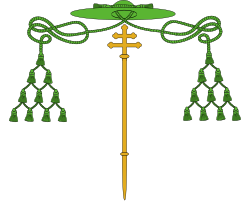
Coat of arms
From blue to the cross of St. Andrea anchored in silver, set aside by four golden lilies, to the head of the same charged by a black eagle, with the head of the empire.Explore this chapter
| Image | Blasting | |
|---|---|---|
|
Francesco Giuseppe Arborio di GattinaraArchbishop of Turin
From blue to the cross of St. Andrea anchored in silver, set aside by four golden lilies, to the head of the same charged by a black eagle, with the head of the empire.[5] Motto: Aut vincendum, aut moriendum |

Notes
Explore this chapter
- ^ These are his names of baptism, while Francis and Joseph go back to his entry into the order of the regular Church of St. Paul.
- ^ Universae constitutiones synodales Ecclesiae Alexandrinae hactenus repertae [...], Alexandriae, typis Joannis Baptistae Tavennae
- ^ "More than 2000 people crushed" according to History of Prince Eugene of Savoy
- ^ History of Prince Eugene of Savoy, p. 58.
- ^ (THE) Historiae Patriae Monvmenta Edita Ivsv Regis Caroli Alberti: Scriptores Tomus IV. 11, E Regio Typographeo, 1863, p. 1691. Retrieved 20 April 2023.
Bibliography
Explore this chapter
- Andrea Merlotti, GATTINARA, Francesco Giuseppe Arborio di, in Biographic dictionary of Italians, vol. 52, Rome, Institute of the Italian Encyclopedia, 1999.
- Girolamo Ghilini, Annals of Alessandria, Milan, Gioseffo Marelli, 1666.
- Giuseppe Antonio Chenna, of the bishopric and churches of the city and diocese Alessandria, Alessandria, Ignazio Vimercate, 1785.
- History of Prince Eugene of Savoy, Turin, Society of Booksellers, 1789, pp. 57-58.
- Carlo A-Valle, History of Alessandria from origin to our days, volume IV, Turin, Tipografia Falletti, 1855.
Continue your journey