Atlas of Monferrato
Montaldo Bormida: sights, history and trails
Alessandria
- Elevation
- 334 m above sea level
- Area
- 5.72 km2
- Demonym
- mountaineering
- Patron saint
- Saint Michael Archangel
A closer look
Discovering Montaldo Bormida
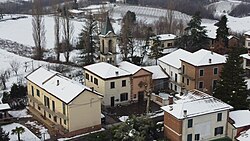
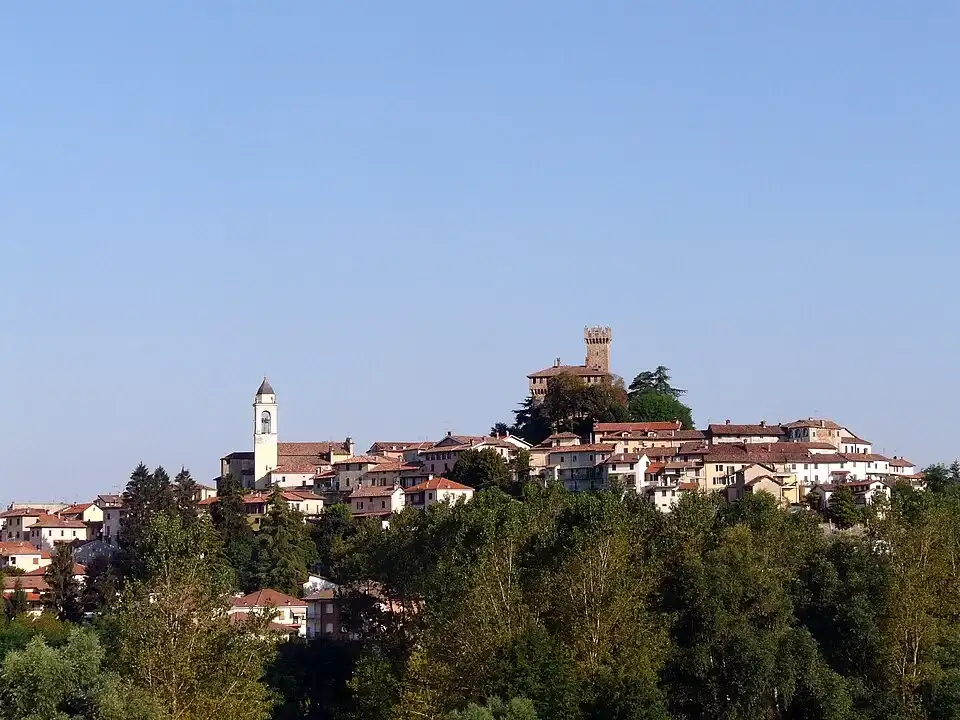
Montaldo Bormida (Montaud Bormia in Piedmont) is an Italian municipality of 587 inhabitants[1] from the province of Alessandria, in Piemonte, located in the Upper Monferrato, on the hilly spurs between the valleys of Bormida and the Orba. It is one of the municipalities of Ovadese, historical-cultural area of Basso Piemonte and the Monferrato, which takes its name from the city of Ovada.
Landscape and area
RegionExplore this chapter
Region
Montaldo Bormida is located in the hilly area ofHigh Monferrato, between the plain of the middle-lower section of the Bormida river and Ligurian Apennines, about 11,6 km from Ovada and 13.5 km from Acqui Terme.
History of Montaldo Bormida
The Battle of the Budello · SymbolsExplore this chapter
With the expression "Ambo Carpineta", in 1164, in a diploma from the imperial chancellery, both the site of the current Carpeneto, be that of Montaldo, a little-known village at the moment, so much so that it does not yet have an independent name.
Between the end of the 12th and the beginning of the 13th century, the Marquis Bonifacio of Monferrato asked to Alessandria the return of Sezzadio, by San Salvatore Monferrato and of "Utriusque Carpineti".
On 21 August 1203 Bonifacio signed a pact with the Alexandrians, to whom he granted several concessions, including half of the locality "Utriusque Carpineti". The ceremony took place on September 17th both at Carpeneto and Montaldo (called Carpeneto lower). The town is expressly mentioned only starting from the 14th century, under the occupation of the Marquis Tommaso Malaspina. Subsequently Montaldo returns under the jurisdiction of Alessandria; in 1488 the fiefdom passed to the Della Valle family, remaining its possession until 1605, when it was ceded to Sebastiano Ferrari, count of Orsara Bormida.
In the second half of the '600 the village is sold to the Spinola family of Genoa to pass in the hands of Pallavicini in 1759. Afterwards the country of Montaldo returned under the jurisdiction of Alessandria. By the decree of the King of Italy Vittorio Emanuele II, on February 1, 1863, the Municipality of Montaldo was authorized to assume the name of Montaldo Bormida.
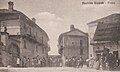
Towards the end800 and the first ones of '900 the country expands and thus rises Piazza Europa (now Piazza Nuova Europa). In the last post-war period there are Via De Gasperi and Via Boscogrosso. Always at the beginning of '900 on the road to Carpeneto there is the presence of a mill and a distillery for the production of grappa. In the 1956 The Cantina Sociale, better known as "Tre Castelli" Winery, is born, which collects the grapes of the Municipalities of Montaldo, Carpeneto and Trisobbio.
Montaldo was once defended by a castle, surrounded by walls and moat; the access was to the east, through a drawbridge; to the west, instead, it was defended by an unleavened slope. The building was probably destroyed in the 16th century and part of its ruins was used to build the current parish church.
The only rest of the ancient walls is a mastio facing the ground area where there was a moat, now transformed into a play field for the drum.
Today only a few names remind the ancient fortress: the "Bridge", where the drawbridge existed (today Piazza Gollo), the street Subcastle (today via Aldo Moro formerly via Sottocastello) and the "Fossil", name given to a well, now closed, near the tamburello playing field.
It's coming Montaldo in the 1943After studying at the University of Bologna, Dr. Giuseppe Notaristefano, comes from the province of Agrigento, to serve as a doctor. He will be one of the most important health workers in the area during those years, in fact here he comes in contact with the events of the liberation war and as a doctor is involved in several episodes to rescue the wounded. In the fall of ’44 collaborates directly with partisan formations operating in the area, especially with the “Brigata Carlino”, joint of the “7ª Division Viganò” which operates between Acqui, Ponzone and Ovada. From the 1º October ’44, with the battle name of “Alfonsi”, works in direct connection with the Division Command with the task of “Director of the Health Service of the Brigade”. From the 1º January to 7 June45 He plays the role of “Healthy Director of Division”. In the final phase of the war (April ’45), dr. Notaristefano assumes the responsibility of the hospital in Acqui Terme. After the war, the life of Giuseppe Notaristefano resumes for a short time in Montaldo, before returning with his family to his beloved Sicily where he will perform the service of health officer and where he will turn out in 1986.
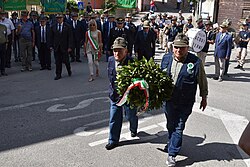
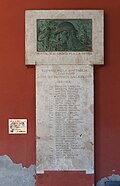
On June 16, 2019 Montaldo Bormida was the seat of the XIV Sectional Meeting of the Alpini belonging to the Section of Acqui Terme. A representative of the sections of Acqui Terme, Alessandria, Asti, Novara, Vercelli, Pavia, Brescia and some groups from the province and not only. The gathering began early in the morning with breakfast at the former elementary school of the country and continued with a parade through the streets of the old town to reach the Church of San Michele and attend the Holy Mass. First, however, a crown was laid in honor of the fallen wars on the tombstones placed by the City Hall. The procession took place with a large number of black feathers and the musical band to accompany. At the end, thanks to the field kitchen of the Alpini of Acqui Terme, lunch was held at Palavino Palagusto in Montaldo Bormida.
The Battle of the Budello
On 10 May 1799 between the countries of Orsara Bormida, Montaldo e Rivalta Bormida a clash, still known today as the “Battle of the Buddha”. It is not a real battle, but rather an ambush against a cavalry and French infantry drappello that from Alessandria he was moving to Genoa. The intention is to seize the group of French surprises and that is why, after passing Rivalta, it is directed, instead of towards Montaldo, along the small road that runs along the Budello rio. This road, which is narrowed by the Montaldo hills and the Cascine of Orsara and which enters into woody gorges, is very well prepared for a surprise attack. This is how it happens: rows of armed with sticks and forcons get out of the woods and climb and reject the group of French, depredando them all, money included. Several times in the fields that flank the Rio Budello were found French gold and silver coins and still today it is said that there is a hidden treasure in the rio.[4]
Symbols
The coat of arms and gonfalone of the municipality of Montaldo Bormida were granted by decree of the President of the Republic of 17 May 1979.[5]
- Coat of arms
The coat of arms, studied by the civic administration, recalls in the brand-name crown the possession that on earth had the Marchesi of Gavi; in the four grape bunches, the flourishing agriculture, particularly rich in fine wines.
- Banner
What to see in Montaldo Bormida
Religious architecture · Church of San Michele Arcangelo · Church of San RoccoExplore this chapter
Religious architecture
The first church built in Montaldo was erected within the walls of the castle's walls and corresponded to the current canonical house (although today it fell into disuse).
Church of San Michele Arcangelo
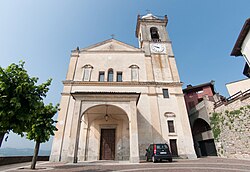
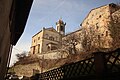
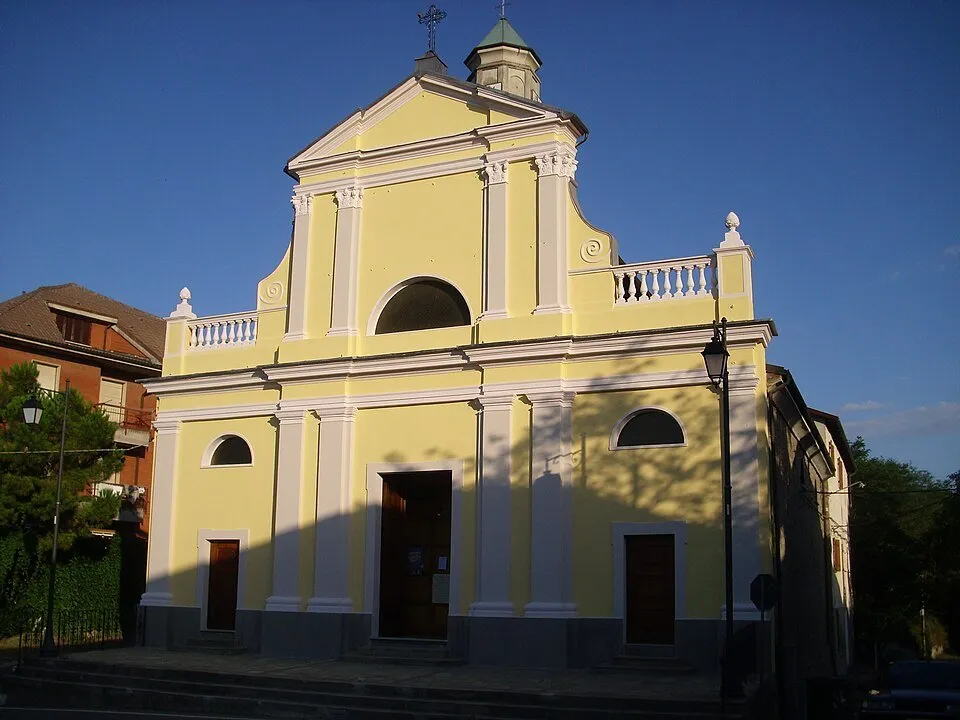
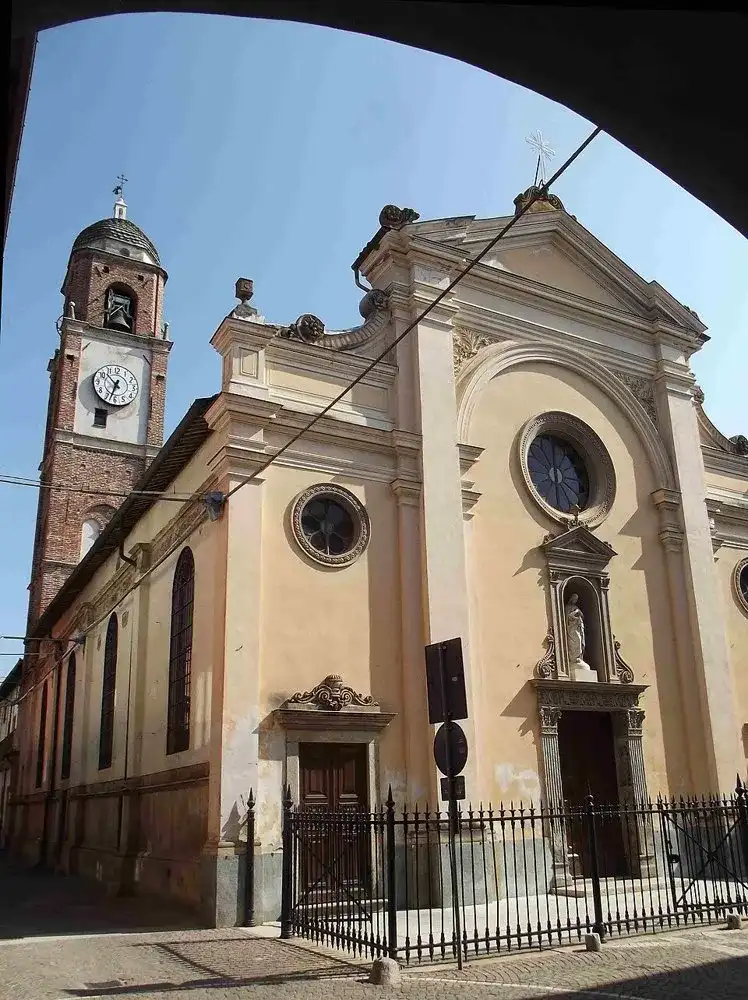
The parish church of Montaldo Bormida, dedicated to San Michele Arcangelo, was built from 1686, using material from the demolition of the castle present there. The work continued for several years, as it began to offend only in the 1700s.
Outside the church has a neoclassical façade, with vertical hinges; on the sides and on the top there are modal frames, with overly triangular timpane that houses the fresco of the Madonna with Child, work by Frixione from Ovada, dated 1875.
San Michele and San Rocco were frescoed by the same painter in the two niches on the sides of the three serlian windows.
The smooth stone portal, preceded by a small portico, frames the original wooden door and engraved the date of 1686. At the right corner of the facade stands the bell tower, built in 1870.
The interior, baroque, has a wide and unique nave, surmounted by a barrel vault. The main altar and balustrade are in polychrome marbles of rococo style, the work of Lombard sculptors Angelo Maria and Carlo Ganna; the wooden choir, sculpted and carved, is eighteenth century.
The floor was remade in 1924 in colored concrete tiles.
The frescoes were made entirely by the brothers Peter and Thomas Ivaldi in 1856-1857; the parish church of San Michele Arcangelo is the only church where Pietro Ivaldi, called "the Muto" signed and gave two frescoes, those on the walls next to the main altar, which represent theLast Supper and the Country. Two rare oil paintings by Pietro Ivaldi were also found in the church. The first depicts i Saints Defendente, Rocco, Francesco Saverio, Carlo Borromeo and the Purgating Souls; the second one Baptism of Jesus.
On 9 June 1844 it was decided by the parish council to equip the church of an organ. It was commissioned to the Agati, famous organ family of Pistoia. The precious instrument awaits to be brought back to the original sound splendor.
Between 2001 and 2006 the church had important developments at the level of recovery and restoration. It started with two consolidations of the damage caused by the earthquake: the first static type and the second with the reconstruction of displaced shells.
The two oil canvases were restored by Studio Nicola di Aramengo, with the contribution of the Region Piemonte and banking institutions, and returned to their former splendor.
The last recovery, carried out by Studio Gabrieli and Traversi in Bergamo, involved the recovery of the balustrade, the stairway and the main altar. The restoration work consisted of cleaning the marbles, integrating missing parts and fixing the columns.
In 2008 the restoration work of the entire Church’s pictorial apparatus began, works that were entrusted to the company “Gazzana restauri srl” in Acqui Terme.
The above restorations were strongly desired by the then mayor Rinaldi, believing that the preservation of the artistic heritage of the country should be a priority to attract new tourists.
Church of San Rocco
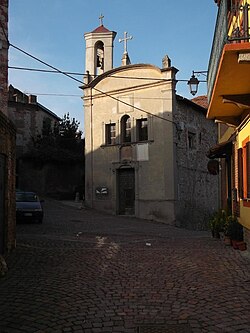
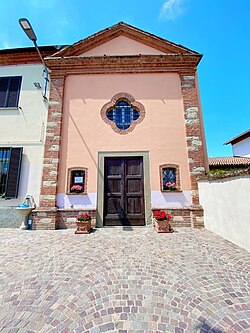
The oratory of Santissima Annunziata and San Rocco is located in the center of the town.
The documentary news of this building is fragmentary; however, the date 1600 engraved on the stone architrave of the facade, has its foundation these years.
The facade bears, clearly visible, a gravestone placed in memory of the plague epidemic that broke out in 1854 and that the population, thanks to the aid in San Rocco, could overcome without suffering numerous losses. The exterior was renovated around 1930 with frames in cement mortar on the hinges, portal, timpane and upper half-elliptic shape.
The oratory, like the parish church, also has three serliana windows above the portal, namely two rectangular and the arched-shaped central, also surrounded by recent frames in cement mortar. On the left corner stands the triangular sail bell tower.
The interior underwent various changes over the centuries: at first it was a single rectangular compartment without choir, as well as most speakers in the area, with central altar and two side altars. Later, probably in the course of the 19th century, next to the central altar was built on the left a neoclassical chapel and an edict in stucco inside which the wooden statue of San Rocco was placed.
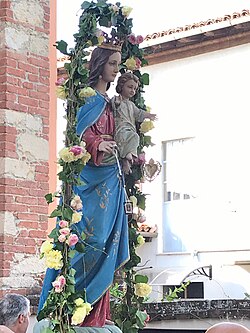
Of artistic interest are the eighteenth-century stucco altar, pulpit and some wooden statues. The wall decorations are not, on the other hand, of high invoicing, probably carried out during the work of enlargement of the building during the 20th century.
Church of the Madonna del Carmine
The church dedicated to the Madonna del Carmine is located in the center of the hamlet Gaggina. It was built in 1880 by the inhabitants of the village. Inside it is a unique nave, the main altar in white marble and with shades of gray, born with the church. The terracotta floor also dates back to the year of construction of the church as the solid wooden door. There are two statues: one of the patron and protector of the fraction, Our Lord of Carmine with the child Jesus and another of the Sacred Heart of Our Lord. Its festival was restored in July 2017.
Church of San Michele
This small church, today in ruins and dedicated to San Michele, is located in open countryside. During World War II, it was burned by the Nazis because they believed that the building was a partisan cove.
Adventist Christian Church of the seventh day
The Adventist Christian Church of the seventh day Montaldo Bormida dates back to 1925 and was officially the first place of adventist worship recognized in Italy.
Adventism was brought into Montaldo Bormida by Mrs. Maria Cambiaso, who had converted to Genoa in 1910 and was animated by a strong evangelist thrust. It was thanks to his testimony and unceasing work of sellers who are outsourced with sacred books (colporteurs) and pastors who gradually converted other people, giving rise to a large and flourishing community. A member of the church, eager to have a proper place to worship God, gave a land where it was built in 1925 the building used for sacred use. [6]
Civil architecture
Between 1600 and 1700 in Montaldo there were several Patrizie Houses, including Casa Bianchi, Casa Schiavina, Casa Ghiara and Casa Dotto. The presence of large cellars within these patrician houses shows how in those years the cultivation of the vine began progressively towards a flourishing development.
Initially the Montaldo houses presented the stone walls. From the ground was extracted the Stone Arenaria of Montaldo, very hard in the part in contact with the air, more tender and easily workable in depth. Only in800 a furnace for brick cooking was built between Montaldo and Carpeneto. Between the 1600 and the 1700 he used to make chalk between the beams, "arming" using twigs or reeds. The floors were all made of wood. The malls in putrelle with brick faces appeared only from the '900.
Palazzo Schiavina
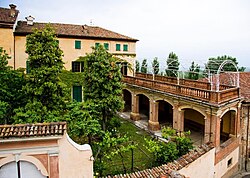
The history of Palazzo Schiavina has been documented since 1673, when the marquis Paola Lomellina, widow of Barnaba V Centurione Scotto and feudatory of the Count of Montaldo, acquires from Nobile Bernardino Schiavina the building placed on the edge of the medieval town.
The building, enlarged and embellished, is completed in 1678 with great satisfaction of the marquis, which, praising the beautiful view and good air, finds the way to reside there for a long time, administering the fief with intelligent participation.
The Palace thus becomes the local residence, that is the "Castello" of the feudal lords of Montaldo, who gradually take possession of it by inheritance and belong to the noblest and most powerful families of the Genoese patriziate: the Scotto Centurion, the Pallavicino Spinola, the Pallavicino.
At the beginning of the800 the last feudal property alienates the feudal and allodial goods and the Palace passes into the hands of the Bianchi family, eminent lawyers and notaries in Montaldo and Acqui Terme.
Finally, after two centuries, the Palace returns to the Schiavina family, when in 1878 the cav. Michele Schiavina, landowner and mayor of the country, buys it and resides there, enriching it with portico, terrace and gardens.
Winery "Tre Castelli"
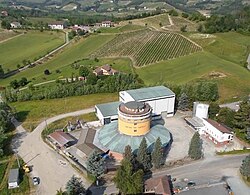
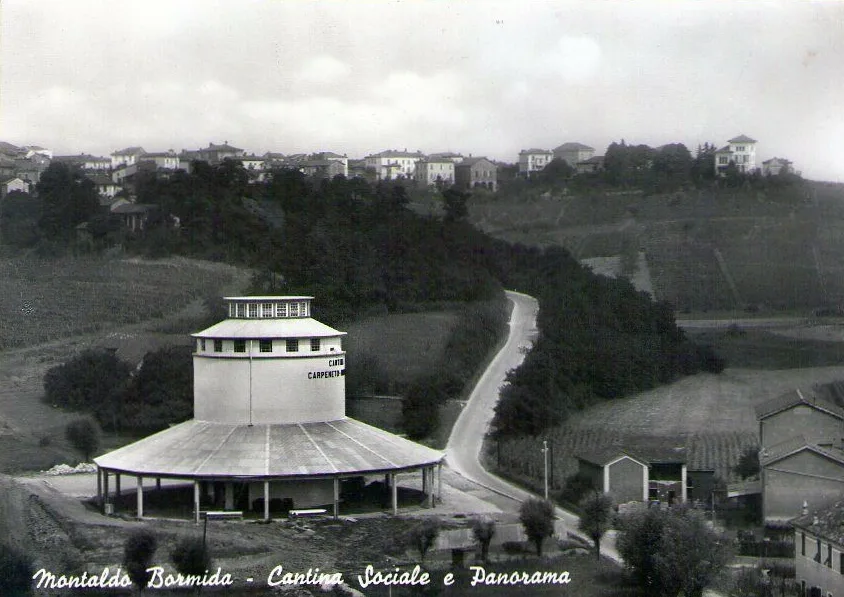
In 1955, by the will of a few members, Montaldo Bormida was born the Winery "Tre Castelli". It is a cooperative to which the members give the products of their vineyards for the production and processing of wine and for the wholesale and retail of the latter. The structure, with its characteristic tower, rises and enlarges in the decades at the foot of the village, on the border with the municipality of Carpeneto, on the SP 197 road.
Currently the winery has about 200 members for a total of approximately 420 hectares of surface cultivated with vines and a processing of grapes that is around 3000 to 4000 tons.
To the clayey/limous soils of the areas of Rocca Grimalda and Montaldo Bormida are added those of limestone type of the zones of Ovada, Trisobbio and Carpeneto. This mix of different types of soil gives the wines produced by the Tre Castelli different organoleptic characteristics; moreover, the particular microclimate of the territory of the hills of Alto Monferrato, close to the Ligurian Apennines, allows the grapes to reach an excellent maturation, that together with modern techniques of wine making, it is possible to obtain some of the most important Piedmontese wines.
Thanks to a careful selection of grapes, the Cantina Tre Castelli offers its customers Dolcetto in its different shades of young wine and aged wine in oak barrels.
Part of the production is sold to consumers within the Bottega del Vino, open every day Saturday and Sunday included. Other stores are located in Alessandria, Genoa and Milan.
In addition to the Dolcetto are also produced: Barbera, Cortese Alto Monferrato, Chardonnay, Moscato, Brachetto and Freisa.
At about 20 meters high, on the top of the wine tower, there is a restaurant that over the years has changed several gestures. Given the height, the structure offers the splendid panorama of the hills of Alto Monferrato, from which you can see the skyline of Montaldo Bormida and the neighboring municipalities Carpeneto And Trisobbio with their castles. Today the property bears the name of “Terrazza Tre Castelli” and offers restaurant and pizzeria service.
Every year between late August and early September, at the Tre Castelli, there is the traditional Stoccafisso Festival. In recent times the festival has moved to the Palavino Palagusto facility, always close to the winery.
Enoteca Comunale
In 2008 the new municipal enoteca was completed. The latter was made in the cellars of the municipality, thanks to a substantial regional financing that allowed the coverage of the entire amount of work.
Palavino Palagusto
It is a new construction within a project of renovation and enhancement, which also includes a “museo della grappa” in the adjacent ancient distillery. The property is home to festivals and celebrations and has hosted several editions of “Gardering in Hill”, exhibition-market florovivaistica.
Grappa Museum
2009 saw the realization, in the premises of Palavino-Palagusto, of the "Museo della Grappa". The museum, for which funding has been allocated by the Museum Service of the Region, allows articulated tours through educational and explanatory signs that are distributed to each visitor.
Dotto Park
It is a garden dating back to the early 20th century, irregularly planted and with terraced structure. The park has always lived in its own life; the patronal house (now Residence Dotto Assistenziale for the Third Age) which was dependence is separated from it.
The furniture is simple and among all stands a long pergola. The central route is on the ground, with a concrete strip in the center. In the garden there are masonry benches, some concrete fountains, some children's games and a terrace from where you can see the village Carpeneto and the valley towards Trisobbio.
The park has a main access and one service. From the main entrance there are three paths: the upstream pergola, the half-coasted path and the slope leading to the terrace. From anywhere you can decide to change your address, along paths or stairs that connect the three routes.
In the park you can find different varieties of plants and trees with high stem.
The Dotto Park has the dual valence of urban park and starting or ending point of the Green Route and is owned by the Municipality.
Green path
The Green Path, also called “Avsein au rian”, connect Montaldo Bormida to Trisobbio, following the path of the Stanavazzo stream for approximately 2 km.
It starts from the Dotto Park, at the limit of the historic center of Montaldo, and descends along Via Cesare Bianchi. Following the signs, you pass behind the Winery Tre Castelli and then continue towards the sports facilities of the country, equipped with playground for children, football field and tennis with attached changing rooms and a picnic area. From here we start to side with the Rio Stanavazzo, until you reach the conclusion of the Route, at the Swimming Pools of Trisobbio.
Administration
TwinningExplore this chapter
Below is a table relating to the administrations that have succeeded one another in this municipality.
| Period | First citizen | Match | Load | Notes | |
|---|---|---|---|---|---|
| June 18, 1985 | May 21, 1990 | Giuseppe Alberto Rinaldi | Christian Democracy | Mayor | [7] |
| May 21, 1990 | April 24, 1995 | Giuseppe Alberto Rinaldi | Christian Democracy | Mayor | [7] |
| April 24, 1995 | June 14, 1999 | Giuseppe Alberto Rinaldi | center | Mayor | [7] |
| June 14, 1999 | June 14, 2004 | Giuseppe Rinaldi | civic list | Mayor | [7] |
| June 14, 2004 | May 27, 2007 | Viviano Iazzetti | civic list | Mayor | [7] |
| April 14, 2008 | 7 October 2012 | Giuseppe Alberto Rinaldi | civic list | Mayor | [7] |
| June 27, 2013 | June 10, 2018 | Barbara Ravera | Civic list: Project for Montaldo | Mayor | [7] |
| June 11, 2018 | May 14, 2023 | Barbara Ravera | Civic list: Project for Montaldo | Mayor | [7] |
| May 14, 2023 | in office | Emiliano Marengo | list: Renewal Montaldo | Mayor | [7] |
Twinning
 Sigoulès
Society
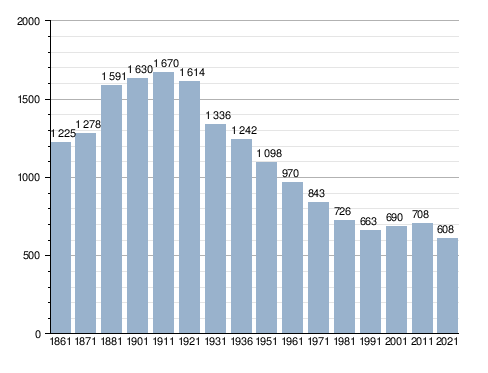
Demographic evolutionExplore this chapter
Demographic evolution
Inhabitants registered[8]
Culture
Typical cuisine and productsExplore this chapter
Typical cuisine and products
- Farinata (annually, in June, the "Sagra della Farinata" is held.
- Dolcetto D'Ovada
- Cortese dell'Alto Monferrato
- Chardonnay
- Moscow
- Brachetto
- Freisa
Sport
Podism · Cycle hikingExplore this chapter
Podism
For years in March the podistic race "La via dei Tre Castelli - Memorial Don Bisio" is held, which attracts many participants.
Cycle hiking
The Alexandrian territory boasts a tradition linked to the bicycle, due to the fame of Girardengo and Coppi and their sports companies. To promote sports and cycling tourism, a Montaldo Bormida It was thought of a cycling itinerary connecting the cycle paths of plains with the hilly and mountainous territories of the Alexandrian and crossing the places that saw the deeds of the two very Piedmontese champions. The variant of a stop that leads from Monte Colma to Montaldo Bormida crosses the territory of the ovadese which has the greatest concentration in Europe of medieval castles. Along the way you can admire the castles of Molare, Cremolino, Trisobbio, Carpeneto, Montaldo and you pass next to the motorhome area of Trisobbio. The route is marked with panels and dedicated posters[9].
Image gallery
Explore this chapter
-
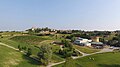 Montaldo
-
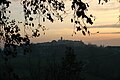 Montaldo - The evening
-
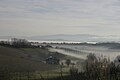 Vallata towards Carpeneto
-
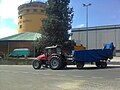 Winery Tre Castelli - The harvest
-
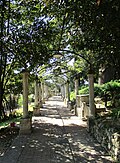 Viale in the Dotto Park
-
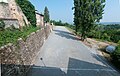 Drumpet field seen from Piazza Gollo
-
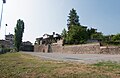 Drumpet field
-
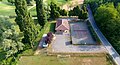 Tennis court and dressing room
-
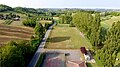 Football field
-
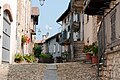 Scorcio del Centro Storico
-
 Scrolling Church S. Michael Archangel
-
 Lapide to the fallen and dispersed mountaineers 1915-1918
-
 The square many years ago
-
 Market day
-
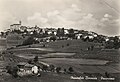 Panorama of a time
-
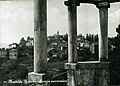 Panoramic swipe
-
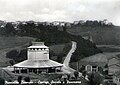 Panorama with Social Winery
-
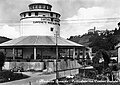 The Social Winery
-
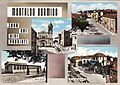 Postcard: area of fine wines
-
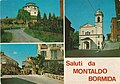 Postcard with greetings
-
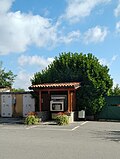 Water shed - Piazza Nuova Europa
Notes
Explore this chapter
- ^ to b Monthly demographic balance for the year 2026 (provisional data), up demo.istat.it, ISTAT.
- ^ Seismic classification (XLS), up risks.protezionecivile.gov.it.
- ^ Table of degrees/day of Italian Municipalities grouped by Region and Province (PDF), in Law 26 August 1993, n. 412, annex A, National Agency for New Technologies, Energy and Sustainable Economic Development, 1 March 2011, p. 151. URL consulted on 25 April 2012 (archived fromoriginal url on 1 January 2017).
- ^ L'Orso, April 2014
- ^ Montaldo Bormida, decree 1979-05-17 DPR, concession of coat of arms and gonfalone, up Central State Archive.
- ^ Giuseppe De Meo, Salt granel. A century of history of the Christian Church Adventist of the 7th Day in Italy (1864-1964). Claudiana, Turin. 1980
- ^ to b c d And f g h the http://amministratori.interno.it/
- ^ Data taken from:
- Resident population of the municipalities. Censuses from 1861 to 1991 (PDF), up ebiblio.istat.it, ISTAT.
- Resident population - Time series, up exploredati.istat.it.
Please note: 2021 data refers to permanent census data as of December 31 of that year.
- ^ pimonteoutdoor.it, https://www.piemonteoutdoor.it/it/attivita/cicloescursionismo/dei-campioni Missing title for url
url(help).
Where to stay · Montaldo Bormida
Find stays on Booking.comThe wine landscape
This village in wine country
Follow the link between the country, the vineyards and the neighboring territories.
The area, step by step
Trails and routes in Montaldo Bormida
 CyclingPlaces and landscapes along the route
 WalkingPlaces and landscapes along the route
Asti, Alessandria and surroundings
Carpeneto - Montaldo Bormida - Trisobbio
 WalkingAround the starting point
Asti, Alessandria and surroundings
Anello Rivalta e Montaldo Bormida
 CyclingAround the starting point
Asti, Alessandria and surroundings