Atlas of Monferrato
Trisobbio: sights, history and trails
Alessandria
- Elevation
- 341 m above sea level
- Area
- 9.22 km2
- Demonym
- trisobbiesi
- Patron saint
- Maria Assunta
A closer look
Discovering Trisobbio
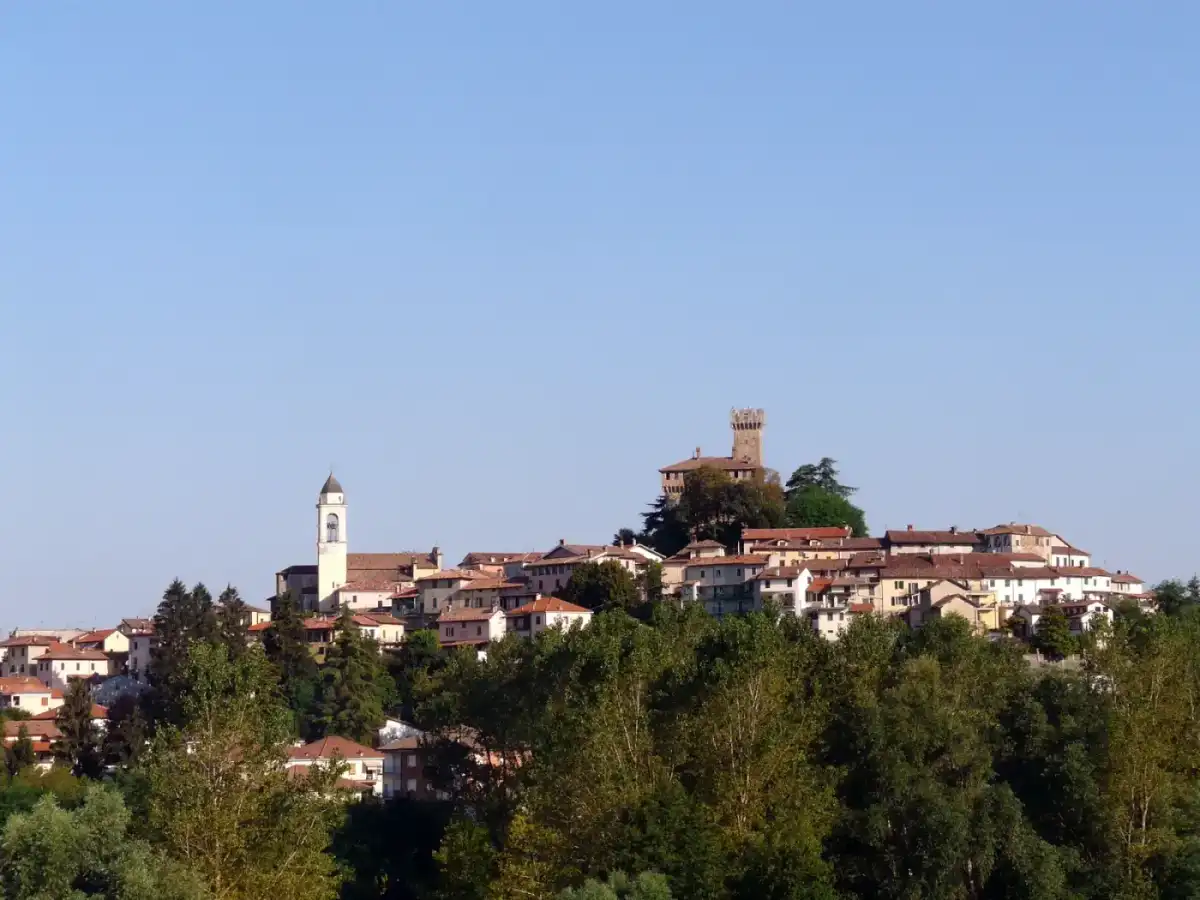
Trisobbio (Tërseubi in Piedmont) is an Italian municipality of 620 inhabitants[1] from the province of Alessandria, in Piemonte, located inHigh Monferrato. It is one of the municipalities of Ovadese, historical and cultural area of Basso Piemonte and the Monferrato, which takes its name from the city of Ovada. It was the capital of the former union of the Castles between Orba and Bormida.
Origins of the name
The legend on the name, that is the origin of the name, wants Trisobbio to be founded by three families of sober men, brothers of seven black men, founders of Strevi...Explore this chapter
The legend on the name, that is the origin of the name, wants Trisobbio to be founded by three families of sober men, brothers of seven drunken men, founders of Strevi, hence Tres sobrie. The documentary attestation of the name is instead in 1040-1041 Trexoblo, in 1186 Trixoblo, in 1202-1206 Trexobium or Trexoblo and in 1283-1289 Trisobio.
History of Trisobbio
SymbolsExplore this chapter
Trisobbio is a sort of hinge in the relationship between the Valle d'Orba (where the properties of Malaspina) on one side, and the Bormida Valley (where the Boccaccio assets are located) on the other. In 1531, following the marriage of Violante Malaspina, the last of the family, to Count Giovanni Battista Lodrone, it passed to the Lodrone family.
After the passage of Monferrato to the Gonzaga in Mantua, in 1536 the territory, devastated by the Franco-Spanish War, underwent the cutting of new and old fiefs that the Gonzaga put on sale between 1500 and 1600, granting noble titles to rich mantovan or genoese lords. So Giambattista Spinola was lord of Trisobbio. In 1708, Monferrato was assigned by Joseph I of Habsburg to Vittorio Amedeo II of Savoy.
In 1745, during the Austrian Succession War (1740-1748), Trisobbio was occupied by French troops of Marshal Maillebois, as they had been occupied. Acqui Terme, Visone, Morsasco And Cremolino, while the Austro-Sardinian troops had settled in Ovada, San Cristoforo, Parodi Ligure, Montaldeo, Castelletto d'Orba And Silvano d'Orba. Subsequently the French had pushed forward Rivalta Bormida, Orsara Bormida, Montaldo Bormida, Carpeneto And Rocca Grimalda, while the Austro-Sardinians had positioned themselves on the left of the last stretch of the Tanaro.
Symbols
The coat of arms of Trisobbio was approved by the municipal administration on 18 December 1973[4] and granted by the decree of the President of the Republic no. 1296 of 29 March 1982.[5]
In the head of the shield are reproduced the weapons of the Republic of Genoa (silver, at the cross of red), of which Trisobbio was part of for over a century; of the Aleramici (silver, the head of red), Marchesi del Monferrato that they held the land for 259 years and that it also indicates the belonging of the territory to Monferrato; that of the genoese family of the Spinola (of gold, at the shelled band of three silver and red rows, supporting a barrel plug of red), a branch of which had the lordship of the town with a marquis title from 1535 to 1798. To remember the tradition that Trisobbio was founded by three families of sober men, the allegory of three silver plinths on a blue background was used, enamel that indicates loyalty to the homeland and perseverance in profitable work. The castle on the mountain recalls the ancient Castrum Trexobrii and the two doors that over the past centuries gave access to the village.[4]
The banner is a blue cloth.
What to see in Trisobbio
The castle · The parish church · The town hallExplore this chapter
The castle
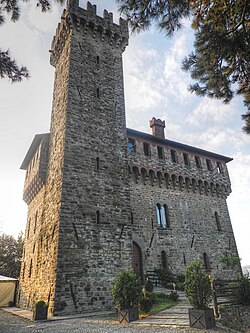
The castle of Trisobbio already existed in the beginning of the 13th century, although not in the current features. Its shape had to be, at least in the plant, what we still see. Further modifications probably date to the end of the 15th century, in conjunction with the establishment of the Malaspina and the necessary strengthening of the place.
At the end of the nineteenth century, the castle was in a state of degradation and ruin. In 1913, on 29 March, the architect Terenzio, architect of R. Superintendency to the monuments of Liguria, he writes to the architect Commendatore Alfredo D'Andrade, on behalf of the Marquise Carpaneto Spinola, owner of the castle, so that the incartamenti regarding this castle, from the office of Turin to that of Genoa, so that, as from agreements with the illustrious architect, you can start the restoration works. These works brought the Castle to the present outside aspect.
In 1989, the castle and the park annexed, became property of the municipality. In these years the Municipal Administration, attentive to the safeguard of the artistic heritage of its own property, has provided works of internal renovation: today the Castle is home to a suggestive restaurant, reserved for events, weddings, baptisms, communions, cresime, with 5 bedrooms (3 doubles and 2 triple), and the park open to the public.
In July 2002 Regional Presidency for Cultural Heritage and Activities for the Region Piemonte the Carpaneto Castle of historical-artistic interest, at the Conservatory of Real Estates Trisobbio. The castle of Trisobbio It is an example of the usability of significant development possibilities in sustainable tourism. The vineyards, castles, the healthy air in their simplicity represent a rich resource, the hospitality of the inhabitants makes it even more attractive. It is part of the "Open Castles" system in Lower Piemonte.
The parish church
The parish of Trisobbio is dedicated to Our Lady Assunta, not much is known about the ancient church of Trisobbio, which appears to have already been under reconstruction in 1398.
The frescoes were made by Pietro Ivaldi (called Il Muto), helped by his brother Tommaso and, for the ornate, by comic decorators, led by Giuseppe Ferraris.
In 1863, during the Sante Quarantore, preached by Father Atanasio from Nizza Monferrato, Capuchin, the now completed work was inaugurated. Driven by enthusiasm, the inhabitants of the town wasted no time and proceeded to build the orchestra and the organ case.
In the parish there are two paintings by Michele Beccaria, born in Trisobbio in 1568, pastor of Montaldo and a very prolific painter. Probably dated 1611 The apparition of Our Lady to San Giacinto: in a church interior, on his knees before the altar is depicted the Saint in the garments of the Dominican order. In front of him, on a step, there is an open book and a lily. Suspended on a mid-air cloud, on a background of light, the Madonna and Child appears in his arm. The structure of the painting, in its simplicity, with the alternating lighting and fading of chromatic tones, is of remarkable grip on the observer: human figures, arranged along a diagonal that connects high and low, earth and sky, in an ideal and spiritual continuity, cut into two the canvas, isolating from one side the vertical architectural elements, and on the other the candor of the giglio and the squadron. Date 1615 is The Madonna with the Child among Saints Giovanni Battista, Francesco d'Assisi, Carlo Borromeo, Chiara da Siena and Caterina da Siena. This painting is also preserved in the parish. A third canvas also by Beccaria and recently restored is preserved in the oratory adjacent to the church and depicts the Holy Family with Saint Stephen, St John the Baptist and St Sebastian but of this painting there is no certain dating (perhaps the first decade of the seventeenth century).
The town hall
The Palazzo Rossi Dogliotti, is today the municipal seat. It became such in 1932, eighteen years after the death of Paolo Luigi Dogliotti, Mayor of Trisobbio for almost forty years who donated it to the municipality with a bequest dated 10 July 1913.
The stylistic analysis of the architectural structure and decorations of the building highlight four highlights of the development of the palace through the sixteenth, seventeenth, eighteenth, and nineteenth centuries. In the noble floor, where the offices and the mayor's room are located, are preserved beautiful ceilings, floors and original decorations. During the restoration work a loggia was brought to light in the facade towards the Castle, made invisible until today by a wall.
Besides being the seat of the Town Hall, it is also home to the hilly community of the Union of Castles between the Orba and Bormida, established in January 2001, among the countries of Carpeneto, (who was part of it until 2011)Castelnuovo Bormida, Montaldo Bormida, Orsara Bormida and Trisobbio, in 2010 also joined the municipality of Cremolino, giving the possibility and opportunity to these municipalities to collaborate, managing some services in an associated form, while safeguarding the autonomy and individual historical-social realities. The suggestive cellars of the building house a wine shop and organic wine shop Biodiversity.
The church of San Rocco
Not far from the concentric is the church of San Rocco, from which you can enjoy a beautiful panorama and, on clear days, the view extends to the Alps. The church is one of the approximately 3000 dedicated in Italy to the saint auxiliary in diseases and mainly in the plague. Religious buildings often stood by vote at the end of an epidemic or for being safeguarded by it. The trisobbiesi do not miss to celebrate in this church the patron saint on August 16.
The green path
Starting from the park dotto of Montaldo Bormida, connects Montaldo Bormida and Trisobbio following the path of the Stanavazzo stream for approximately 2 km. Along the way, you can come across exercise equipment, a children's play cableway and a picnic area.
The church of Villa Botteri
The small church of Villa Botteri (main fraction of Trisobbio) has a very ancient origin.
It was never parish and probably the orientation of the original church was different from the current. The paintings date back to less than 50 years ago, but below them the oldest 19th century decoration. The parish priest, Fr. Giuseppe Olivieri, during works of restoration of the interior noticed that in the wall of the church, under the paintings, a sign emerged, an engraving with the apparent form of a horse. That strange engraving turned out to be the synopia of the fresco and such synopsis is an index of the antiquity of the work. It is thought that the Saint is San Bovo, because of the sword and the ox represented on the flag. San Bovo is a pilgrim saint, a holy warrior and tied to the rural environment, venerated as a protector of animals.
The small and beautiful church of San Giovanni Battista, during the last twenty years has been completely restored, bringing it back to the ancient buildings. The restoration works took into account the architectural and historical elements of the building and were carried out, as well as with the contribution of the municipal administration, also thanks to the offers and volunteering of the inhabitants of the Villa and the people who attend the church.
Society
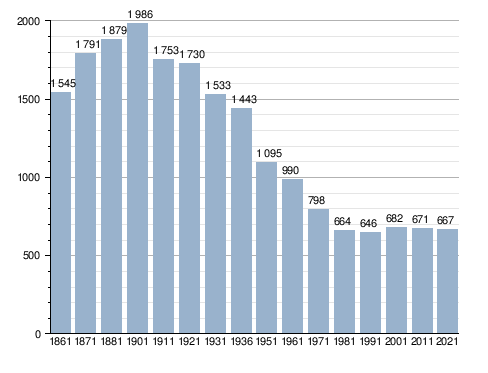
Demographic evolutionExplore this chapter
Demographic evolution
Inhabitants registered[6]
Culture
EventsExplore this chapter
Events
- "Villa Botteri: Feast of San Giovanni" refreshments in the botanical garden and bonfire 23 and 24 June
- "Festival at the Castle of Trisobbio" organized by the Pro Loco of Trisobbio the weekend in mid-July
- "Feast of Saint Anna" patron saint of Trisobbio on 26 July
- Podistic race "StraTrisobbio" on the first Sunday of August
- "Paese in festa" raviolata with covered stands and live music on mid-August
- "Tarsobi, Tartufi & Vino" organized by the Municipality of Trisobbio on the fourth Sunday of October
Economy
TourismExplore this chapter
Tourism
Trisobbio has received the Orange Flag, certificate of tourist-environmental excellence of the Italian Touring Club[7].
Administration
Below is a table relating to the administrations that have succeeded one another in this municipality.Explore this chapter
Below is a table relating to the administrations that have succeeded one another in this municipality.
| Period | First citizen | Match | Load | Notes | |
|---|---|---|---|---|---|
| June 19, 1985 | May 22, 1990 | Gian Franco Comaschi | civic list | Mayor | [8] |
| May 22, 1990 | April 24, 1995 | Gian Franco Comaschi | civic list | Mayor | [8] |
| April 24, 1995 | June 14, 1999 | Gian Franco Comaschi | centre-left | Mayor | [8] |
| June 14, 1999 | June 14, 2004 | Gian Franco Comaschi | civic list | Mayor | [8] |
| June 14, 2004 | June 8, 2009 | Antonio Facchino | civic list | Mayor | [8] |
| June 8, 2009 | May 26, 2014 | Marco Giovanni Comaschi | civic list: enthusiasm and experience | Mayor | [8] |
| May 26, 2014 | May 26, 2019 | Marco Giovanni Comaschi | civic list: together for Trisobbio | Mayor | [8] |
| May 26, 2019 | June 9, 2024 | Marco Giovanni Comaschi | civic list: together for Trisobbio | Mayor | [8] |
| June 9, 2024 | in office | Marco Giovanni Comaschi | civic list: together for Trisobbio | Mayor | [8] |
Image gallery
Explore this chapter
-
 Castle of Trisobbio
-
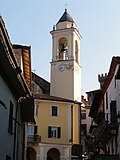 Campanile of the church of Our Lady Assumption
-
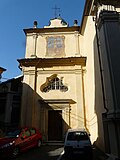 Oratory of the Church of Our Lady Assumption
-
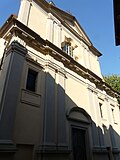 Church of Our Lady Assumption of Trisobbio
Notes
Explore this chapter
- ^ to b Monthly demographic balance for the year 2026 (provisional data), up demo.istat.it, ISTAT.
- ^ Seismic classification (XLS), up risks.protezionecivile.gov.it.
- ^ Table of degrees/day of Italian Municipalities grouped by Region and Province (PDF), in Law 26 August 1993, n. 412, annex A, National Agency for New Technologies, Energy and Sustainable Economic Development, 1 March 2011, p. 151. URL consulted on 25 April 2012 (archived fromoriginal url on 1 January 2017).
- ^ to b The civic coat of arms of Trisobbio, in The Province of Alessandria, January-March 1985. Retrieved 30 October 2021.
- ^ Trisobbio, decree 1982-03-29 DPR, concession of coat of arms and gonfalone, up Central State Archive.
- ^ Data taken from:
- Resident population of the municipalities. Censuses from 1861 to 1991 (PDF), up ebiblio.istat.it, ISTAT.
- Resident population - Time series, up exploredati.istat.it.
Please note: 2021 data refers to permanent census data as of December 31 of that year.
- ^ Trisobbio: what to see, where to sleep, where to eat | Touring Club, up Touring Club Italiano. Retrieved 2 May 2024.
- ^ to b c d And f g h the http://amministratori.interno.it/
Where to stay · Trisobbio
Find stays on Booking.comThe wine landscape
This village in wine country
Follow the link between the country, the vineyards and the neighboring territories.
The area, step by step
Trails and routes in Trisobbio

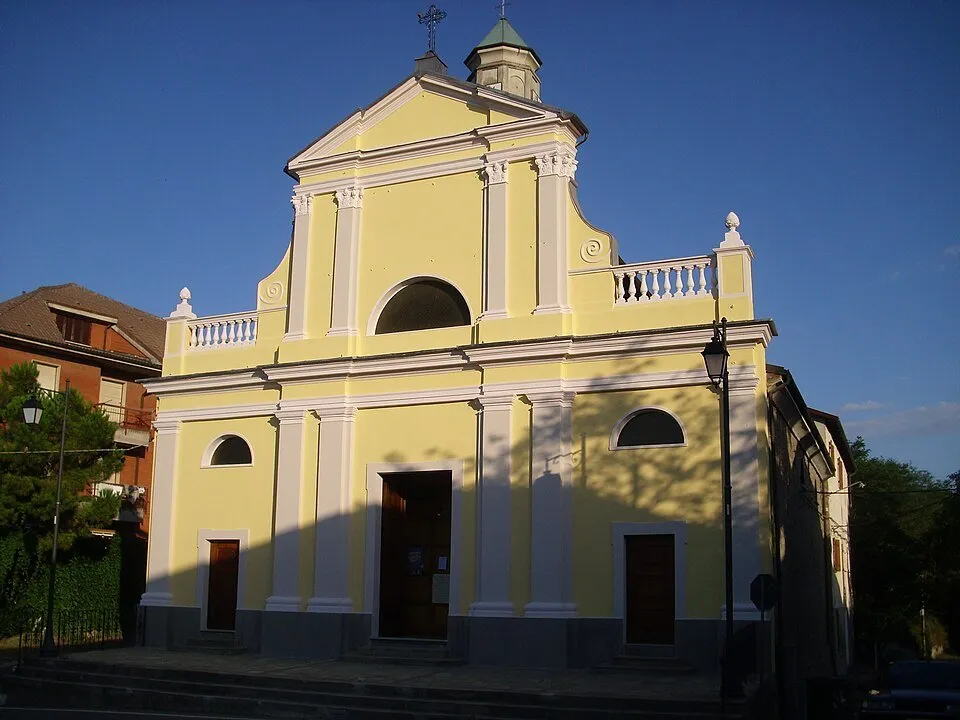 CyclingPlaces and landscapes along the route
 CyclingPlaces and landscapes along the route
Acquese area
The Streets of Coppi · Ovada–Ovada
 WalkingPlaces and landscapes along the route
Asti, Alessandria and surroundings
Carpeneto - Montaldo Bormida - Trisobbio
 CyclingAround the starting point
Asti, Alessandria and surroundings