Atlas of Monferrato
Visone: sights, history and trails
Alessandria
- Elevation
- 161 m above sea level
- Area
- 12.56 km²
- Demonym
- mink
- Patron saint
- Saints Peter and Paul
A closer look
Discovering Visone
Visone (Visón in Piedmont) is an Italian municipality of 1 172 inhabitants[1] from the province of Alessandria, in Piemonte. Located on the outskirts of Acqui Terme, along the road that connects the spa town with Ovada, Visone is one of the municipalities ofAcquese, geographical region of the Lower Piemonte which takes its name from the city of Acqui Terme. It takes its name from the namesake torrent Visone, which crosses it and which in its territory, not far from the center of the town, enters the Bormida.
15 March 2022 obtained from the Region Piemonte the recognition of "tourismal communion"[4].
Landscape and area
The stone of Visone · The thermal springsExplore this chapter
Visone is part of the historical-geographic region ofHigh Monferrato.
The territory includes a section of the Bormida River, to which streams flow Visone and Caramagna, determining a wide flat area of alluvial origin widely cultivated with cereals and horticulture. The southern part, on the other hand, has a progressively more steep profile, where gentle and rounded hills alternate with harsher cliffs and cravings in limestone and tuff, excavated from the course of numerous rii. These areas, where they are not cultivated preferentially with vineyards, remain covered with stain and oak and chestnut woods.
The urban centre is located in the center of the world on the north-west limit, connecting between the hilly area (to which it partly extends) and the river alveo (which compresses it on the ancient Rocca).
The stone of Visone
There is a characteristic geological formation throughout the area (Visone Formation), consisting of biocalcarenite deposits[5] dating from the Miocene (Burdigaliano) and belonging to the Piedmontese Tertiary Basin, also known as stone of Visone, widely used since Roman times as an ornamental stone.
Among the oldest artefacts made with this material are some roman-aged stems and capitals, preserved at the Archaeological Museum of Acqui Terme, and the columns of the crypt of the Cathedral of the same city, built in early medieval times reusing more ancient materials.
After an apparent suspension of extractive activity in the 12th-XV centuries, the use of Visone stone resumes with new vigor from the end of the '400, to realize the central door of the Cathedral of Acqui, but also more and more widely to embellish churches and mansions of the nearby Acqui Terme. When, after 1572, Cardinal Michele Bonelli took over the direction of the works for the completion of the great monumental complex of Santa Croce of Bosco Marengo, commissioned by his uncle Saint Pius V, the use of the stone of Visone to create jambs and columns was such that on the heights of Visone a new quarry was opened specifically, called of Santa Croce.
Precisely the monolithic column in stone of Visone, increasingly present in porticos, loggiati and modular elements of local aulic architecture, gradually determines, until the entire 18th century, an address and a stylistic taste not detectable in any other area beyond the aqueous[6].
In more recent times, gradually dismantled the use in architecture, the quarries are converted to produce lime. This activity continued until all the 70s of the last century with the large Canepa and Zanoletti plants located close to the urban center, which however had to close for reasons of public hygiene due precisely to the excessive proximity to the town.
The thermal springs
The local geological system is affected by various tectonic discontinuities, such as the transtensive fault system developed in the direction about East-West among the Baths of Acqui Terme and Visone, which determines the presence of sectors with high permeability, where it is easier to climb underground waters. This phenomenon, at the origin of the well-known aquatic spa system, is actually passed to much of the Fanese territory, determining also in it the presence of several sources of chloride-sodium water with high salinity and temperature often higher than that seasonal environment[7].
Since there is no volcanic activity locally, the thermal water of this system is heated only because of the normal geothermal gradient and its origin is meteoric: it is estimated that filters in the ground through fractures present on the Apennine heights of the genoese hinterland and that stays in the subsoil for a very variable time (between 42 and 1000 years) before re-emerged in the aquatic and Fanonesian springs[8].
The main thermal springs of Visone are:
- the "Caldana", located in the urban concentric in the street of the same name near the parish church;
- the "fontana del Quaré", located immediately outside the village in the direction of Grognardo.
The knowledge and use of these sources, as for those aqueous ones, date back to the late Roman period and, still at the end of '800, both waters and muds of the Fanonese springs were widely used for treating disorders such as goiter, joint pain and menstrual irregularity.[9].
History of Visone
SymbolsExplore this chapter
The first historical news concerning the village of Visone refers to its castle, where on May 4 991 Marquis Anselmo I of Monferrato and his wife Gisla sign the foundation card of the Abbey of San Quintino di Spigno. In this period, an important share of the population of Milan is constituted by families of Lombard origin. Already about fifty years before, however, was mentioned the presence of a parish church near the confluence of the river Caramagna with the Bormida, on the edge of the current municipal territory towards the border with Orsara Bormida And Morsasco[10].
At the beginning of the 13th century, many possessions in Visone are held by the aqueous Manfredo Boccaccio, whose bishop of Acqui recognizes rights together with his brother William. The Boccaccio will hold possessions in the country for over a century and a half, often in dispute with the Episcopal Month of Water for issues of borders.
In October 1450 the Chapter of the Cathedral of Acqui, gathered to elect the new bishop, is forced to move to the church of S. Maria delle Grazie di Visone to escape the grave epidemic of plague that was raging in the city[11].
In 1469 the Marquis of Monferrato granted the fief of Visone to Antoniotto Malaspina, whose family will actually hold it for a few decades. In this period, the castle is almost completely rebuilt and expanded, assuming the forms that will keep up to '900. The disputes between the aquatic prelate and the Famous feudal lords continue in this case, so much so that 1480 is the same Pope Sixtus IV to have to intervene in order to sedate a quarrel between Bishop Tomaso Deregibus and Antoniotto[12]. In 1519 John Malaspina but already sells the castle of Visone to Maria Boverio della Corba, first waitress of the Marquisa Anna of Alençon.
In 1623, Count Francesco della Corba left the College of St. Paul, who, however, renounced his possession in favour of Francis' nephew Ferrante de Cardona. The successor, Raimondo de Cardona, sells the castle and the feudal title of Visone to the Genoese patrizio Luigi Centurione Scotto, whose family will keep them uninterrupted until the 19th century.
On the night between 18 and 19 April 1861 an flood and the consequent overflow of the river Bormida cause a terrible landslide in the fraction Malborghetto (the old village), causing the collapse of many houses located around the castle and of the church of Santa Maria delle Grazie, which also stood within the castle walls, causing the death of fifteen people and radically changing the appearance of the village[13]. Following this disaster, Prince Centurione made a large part of his lands located to the east of the town available to the displaced population, thus leading to a significant new urban expansion of the town.
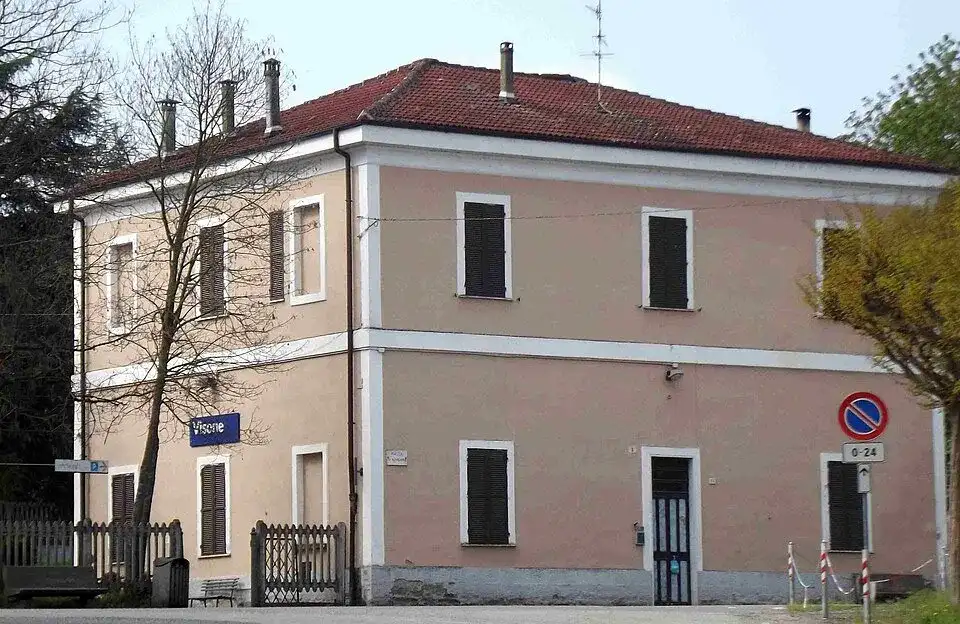
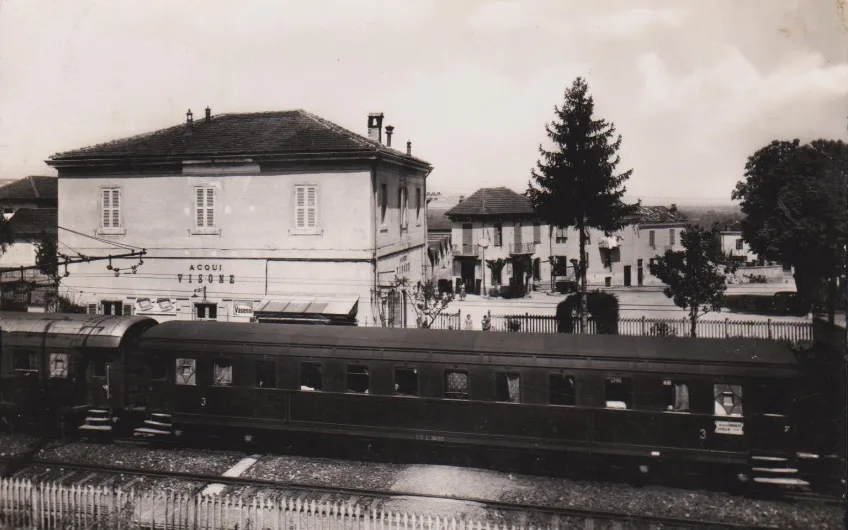
In 1893 the Acqui-Ovada railway line was inaugurated, extended the following year to Genoa, which brings considerable advantages since it connects aqueous with the Ligurian Riviera, opening the road to intense social and cultural relations that characterize the entire territory still today. It's just the railway station, in fact, to give a notable boost to the economic development of the area, so much so that in 1895 the Rossi family opened a spinning mill in the center of the town for the processing of silk and wool and a few years later, in 1897, the "modern" exploitation of the limestone quarries began, with the construction of furnaces for cooking the stone to obtain hydrated lime.
The intensive industrial activity of the area requires equally intense energy availability, so at the beginning of the '900 a small power plant for hydroelectric energy production along the Bormida, still active today.
From 8 June 1929, as part of the territorial reorganization promoted by the fascist regime, the municipality of Visone is suppressed and its territory was shortened to that of Acqui Terme[14] and you will have to wait on 1 January 1948 for its reconstitution[15].
Symbols
The coat of arms and gonfalone were granted by decree of the President of the Republic of 20 June 1956.[16][17]
The gonfalone is an intertwined drape in red, yellow and blue pole.
What to see in Visone
Rocca and ruins of Malaspina castle · Palazzo Madama Rossi and Oratorio di S. Rocco. · Church of Saints Peter and PaulExplore this chapter
Rocca and ruins of Malaspina castle
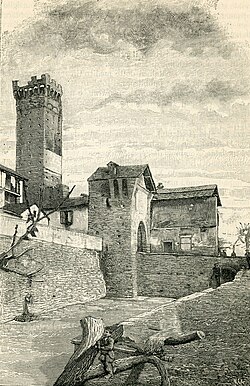
At the end of Piazza Castello there is the Rocca, the oldest urban nucleus in the village, overlooking a river bend Bormida. The original layout of the defensive structure certainly dates back to at least the 10th century, since it is attested at that time as the residence of the Aleramic lineage that dominated the Acqui countryside.
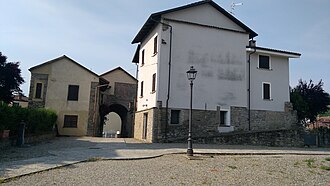
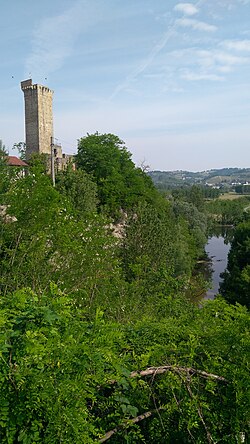
Of the deep reorganization operated by Malaspina at the end of the 15th century there are still few ruins of the building, but the tower is still substantially intact (visitable up to the top thanks to the recent restoration of the internal stairs), the door to access the defensive walls and a large part of the ditch on the eastern bastions. The late-medieval receptacle originally present within the walls, which has been greatly reduced due to the collapses caused by the imposing flood of the 1861, it was almost completely demolished in the years '90 to place a belvedere square, which is used today as the seat of the main tourist and cultural events of the country.
The tower inspired in 1968 the sculptor and artistic blacksmith Ernesto Ferrari (1894-1973) for the realization of a remarkable overhanging medallion, now preserved at the Ferrari Museum of Acqui Terme, and for the composition of a poem dedicated to it.
At the foot of the Rocca, until the years '70, was running an ancient public ferry service to connect the country with the Cavallera region, located beyond Bormida but still belonging to the municipal territory of Visone.
Palazzo Madama Rossi and Oratorio di S. Rocco.
The building is located on Via Acqui, at the eastern limit of the country.
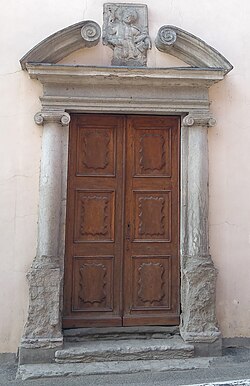
One of the most illustrious members of the noble family in Milan was Cardinal Michele Bonelli, nephew for maternal part of Pope St. Pius V. At the same time he followed his work to complete the Holy Cross in Bosco Marengo (16th century), had this grandiose palace built for his family in Visone, probably also using part of the same workers employed in the construction of the papal complex. In the 18th century the Rossi family, the new owners, carried out many restorations in the western wing, restoring the Italian garden and embellishing it with fountains, basins, water features and exotic plants. In 1872 San Giovanni Bosco was hosted, passing through during one of his many journeys between Turin and Mornese. The wife of the cavalier Tranquillo Rossi, called The Madame, was the last resident of the building and the name by which it is known today derives from her.
Many interesting works, lost today, adorned the house. Among these are the valuable paintings of the Great Hall of Receptions on the noble floor and a fresco work by painter Pietro Ivaldi called Il Muto in the inner loggia of the courtyard. The main entrance gate to the western body and the inner courtyard remain, with a nice loggia on two levels connected and a large staircase. The most significant part is however without doubt the 16th-century loggia with Doric columns in Visone stone, on the eastern side of the facade, completely frescoed inside in 1575 by the painter from Milan Giovanni Monevi (1634-1714) with grotesques reminiscent of the Raphaelite style of the Vatican Palaces. Through an internal window from which one could witness religious celebrations, the palace is directly connected to the adjacent oratory of San Rocco, the ancient seat of the Confraternity, which preserves a valuable wooden statue of the saint (17th century) and various processional furnishings (17th-19th century).
Church of Saints Peter and Paul
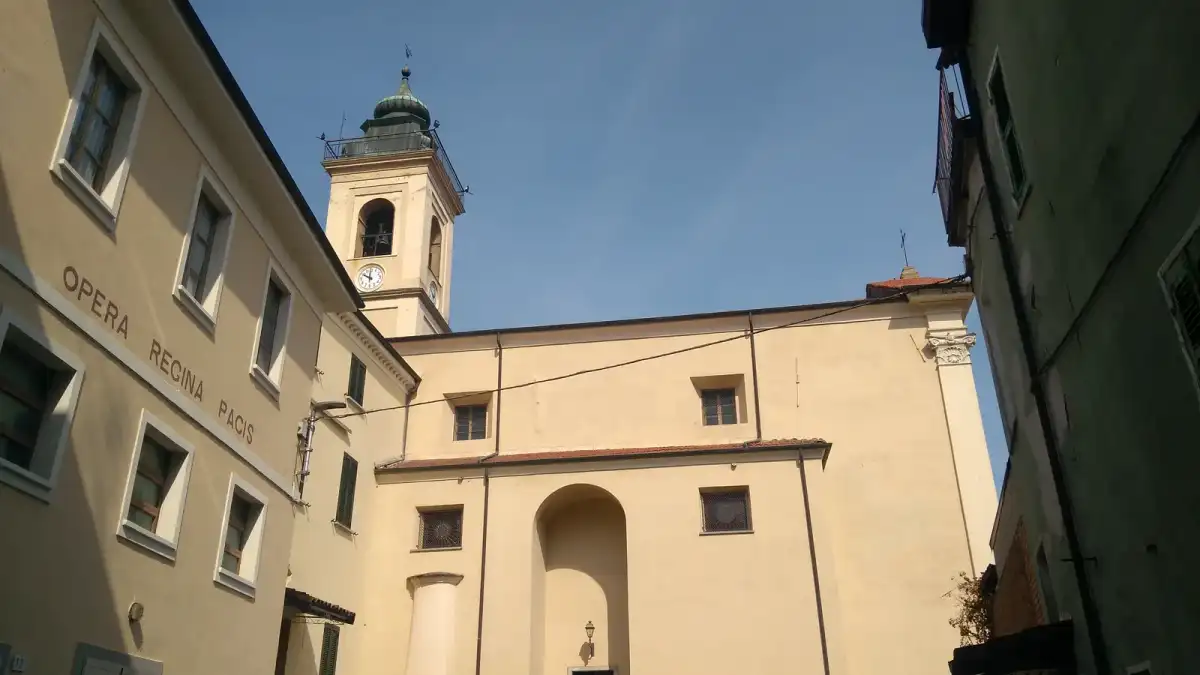
The construction of the present parish church, dedicated to Saints Peter and Paul, began in 1604 to replace the former parish church of Santa Maria delle Grazie now billy, but it will be necessary to wait until 1695 for its definitive completion and consecration.
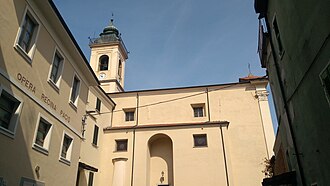
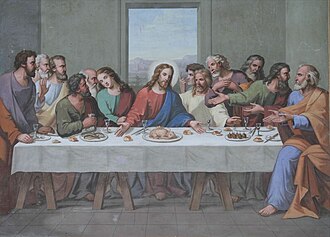
The plant is a unique nave, with four side chapels dedicated respectively to St. Anthony, the Sacred Heart, the Madonna del Rosario and Saint Joseph. The vault of the nave is frescoed with works by Pietro Ivaldi, as well as frescoes on the sides of the altar:Last Supper (left) and the Predication of Saint John the Baptist (right). Also noteworthy are four late seventeenth-century canvases by the painter from Vino Giovanni Monevi: Purgatory Souls, the Country, the Country with St. Bovo and Our Lady and the Battle of Lepanto. Facing the left side of the altar (in the horns Evangelii) is placed a wooden pulpit of the second half of the seventeenth century, while in front of the right side (in hornus Epistolae), in a small room, a reproduction of the beginning '900 of the grotto of Lourdes made of sack canvas and chalk according to a scenic style common to many other churches in the area. At the centre of the apse, a niche houses two wooden statues of Saints Peter and Paul, which on June 29th of each year are drawn to be carried in procession and exposed to the veneration of the faithful.
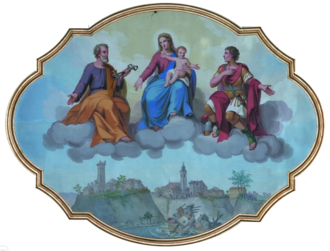
The façade, decorated with statues of the patron saints and of the Sacred Heart, was enriched in 1927 by a fresco depicting the Madonna of the Rosary with Saint Dominic and Saint Catherine from Siena, work by the painter Lorenzo Laiolo (1877-1947).
The church also houses a fine canine organ dating back to 1897, the work of Alessandro Mentasti's varesina workshop with subsequent interventions by Mentasti himself in 1907 and Edoardo Negri in 1928.
Roman architectures
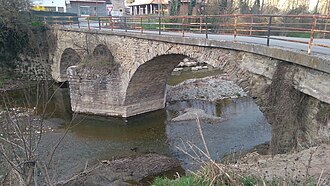
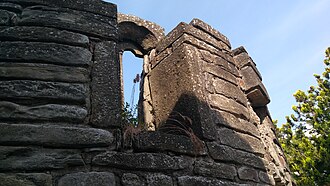
At the age of the country, two still visible architectures date back to date. The first consists of a small Romanesque apse belonging to an ancient church of S. Peter (XI century), visible on the right side of the main fields in the municipal cemetery, probably belonged to a primitive parish extra wall[18].
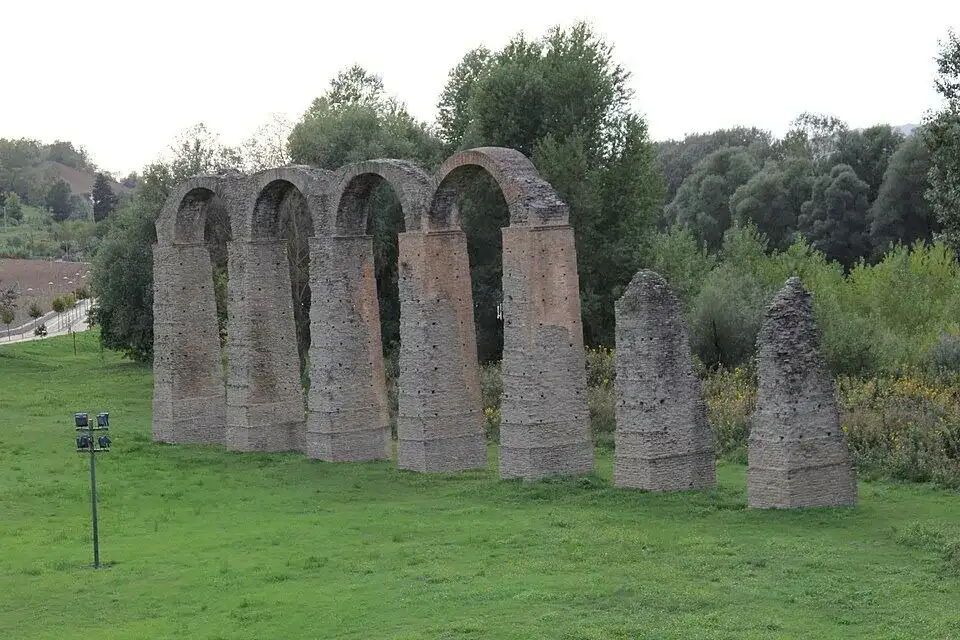
A little further east near the village S. Second, there is a three-arch bridge, also Romanesque, which unites the banks of the torrent Visone: in good condition of conservation, despite a deturbing consolidation of reinforced concrete made at the height of the road seat, it is still passable and are still perfectly visible the original structural lines.
Society
Demographic evolution · Traditions and folkloreExplore this chapter
Demographic evolution
Inhabitants registered[19]
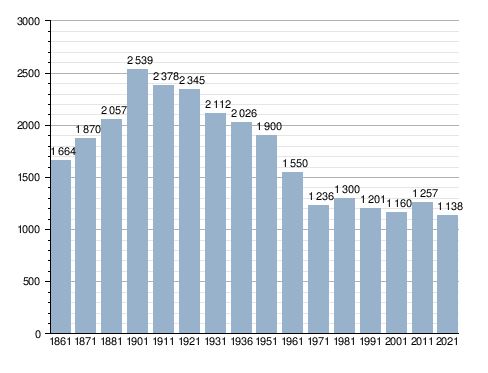
Foreign ethnic groups and minorities
- Albania ,30
- Morocco,30
- Romania,22
- Ecuador,14
- North Macedonia,4
Traditions and folklore
Every year, on November 2, a free distribution is still organized in the square of chickpea soup (cisrò in Piemontese). The habit of preparing this dish on the occasion of the day when the dead are commemorated is typical of the Langhe and the Monferrato: The local tradition of distributing it free of charge in the square is especially from an ancient habit of the Famenese feudal lord, who with this gesture was to remind himself and his subjects that, in front of death, all men are equal.
Culture
Music · Kitchen · EventsExplore this chapter
Music
Between 1978 and 1984 a jazz club was active in Visone, which left an important mark on the local music scene, hosting some of the names that most have made the national and international history of this art such as Paolo Conte, Lino Patruno, Romano Mussolini, Ralph Sutton, Joe Newman, Kenny Drew, Harry “Sweets” Edison, Chet Baker. In 2008, on the occasion of the thirty-year opening of the Jazz club Visone, a popular summer jazz festival was started which still continues today, called Visone in Jazz.
Kitchen
The Lies (Busy, in Piedmontese), are the characteristic dessert of the town and every year they are the protagonists of a large traditional festival in the square, during which they are kneaded, fried and distributed in large quantities. In 2020 and 2021 the party did not take place, due to the Covid-19 pandemic.
One of the most renowned products typical of Visone since the second half of the nineteenth century is also the torrone, still today prepared in the ancient workshop of "Canelìn". Visone's torrone, over the years has received several awards and awards (premio Gold face by Papillon in 1994 and 2002 Nonino Risit d'ur in 2002, Three cones Gambero Rosso continuously from 2017 to 2022, becoming a true symbol of this country.
Events
- Feast of lies, last Sunday in May;
- Patronage of the SS. Peter and Paul, 29 June;
- Musical review “Visone in Jazz”, July;
- Ancient fair of Our Lady of the Rosary, first Sunday of October;
- Traditional distribution in the square of chickpea soup, 2 November.
Infrastructure and transport
In Visone there is a railway station of the line RFI Asti-Acqui-Ovada-Genova .Explore this chapter
In Visone there is a railway station of the RFI Asti-Acqui-Ovada-Genova line.
The municipal territory is crossed by the highway 456 of the Turchino and the provincial roads 205, 206 and, for a very short stretch, 201. Public transport on rubber is ensured by the Acquesi Line (linea Acqui Terme-Morbello), and by Autostradale srl (lines Acqui Terme-Ovada And Acqui Terme-Trisobbio).
Not far from the Cavallera Region and the municipal border, but already in territory Acqui Terme, there is also an airfield.
Administration
Other administrative informationExplore this chapter
Below is a table relating to the administrations that have succeeded one another in this municipality.
| Period | First citizen | Match | Load | Notes | |
|---|---|---|---|---|---|
| January 22, 1989 | June 10, 1990 | Carlo Caprifoglio | Italian Socialist Party | Mayor | [20] |
| June 10, 1990 | April 24, 1995 | Domenico Buffa | Christian Democracy | Mayor | [20] |
| April 24, 1995 | June 14, 1999 | Domenico Buffa | center | Mayor | [20] |
| June 24, 1999 | June 14, 2004 | Domenico Buffa | civic list | Mayor | [20] |
| June 14, 2004 | June 8, 2009 | Marco Cazzuli | civic list | Mayor | [20] |
| June 8, 2009 | May 26, 2014 | Marco Cazzuli | list: for Visone | Mayor | [20] |
| May 26, 2014 | May 25, 2019 | Marco Cazzuli | list: for Visone | Mayor | [20] |
| May 26, 2019 | June 9, 2024 | Manuela Delorenzi | list: New Visone | Mayor | [20] |
| June 2024 | in office | Manuela Delorenzi | list: New Visone | Mayor | [20] |
Other administrative information
The Municipality of Visone has been part of theMountain union between Langa and Monferrato from its institution until 31 December 2024.
Sport
The sports centre of Visone is home to the ASD Virtus Acqui Terme sports company, specializing in amateur triathlon.Explore this chapter
The sports club of Visone is located in the city centre ASD Virtus Acqui Terme, specialized in amateur triathlon.
From Visone are transited:
- the 36th Giro d'Italia (24 May 1953, twelfth stage Genoa - Bordighera);
- the 47th Giro d'Italia (4 June 1964, 19th stage Alessandria - Cuneo);
- l'85o Giro d'Italia (18 May 2002, sixth stage Cuneo - Varazze);
- the 32nd Giro d'Italia donne (4 July 2021, third stage Casale Monferrato - Ovada).
Image gallery
Explore this chapter
-
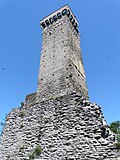 The tower and ruins of the castle
-
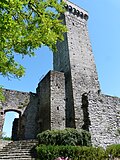 The tower and ruins of the castle
-
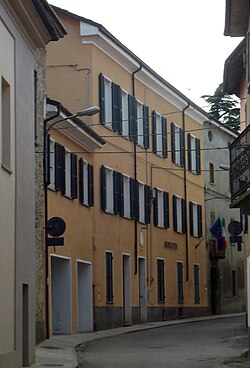
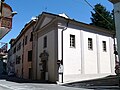 Oratory of S. Rocco.
-
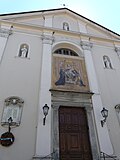 Parish church of SS. Peter and Paul
Notes
Explore this chapter
- ^ to b Monthly demographic balance for the year 2026 (provisional data), up demo.istat.it, ISTAT.
- ^ Seismic classification (XLS), up risks.protezionecivile.gov.it.
- ^ Table of degrees/day of Italian Municipalities grouped by Region and Province (PDF), in Law 26 August 1993, n. 412, annex A, National Agency for New Technologies, Energy and Sustainable Economic Development, 1 March 2011, p. 151. URL consulted on 25 April 2012 (archived fromoriginal url on 1 January 2017).
- ^ Dirigential Determination of European Political Coordination and Funds Tourism and Sports, Tourist Valorization of the territory (Region Piemonte) No 33 of 15/03/2022.
- ^ It is, in particular, a "transgressive deposition of limestone and calcareous sandstones with glauconite and/or alternations of sandstone and glauconitic marl with fossil calcarifers to Nullipore, Myogipsine, Briozoi, Pectenidi, Echinidi, carbonated frustuli and fish teeth" (Commons of Acqui Terme, Notes of the geological-structural Charter to support P.R.G.C., 2015)
- ^ P. Allemani and M. Gomez-Serito, The Stone of Visone: a significant indicator for reading the historical building of Basso Piemonte, in IV cycle of Medieval Studies, Florence, 2018, pp. 505-509.
- ^ C. Caviglia, C. Cigolini and D.A. De Luca, The geothermal field of low-environment of Acqui Terme - Visone, in Underground waters, vol. 124, 2011, pp. 13-19.
- ^ L. Marines, V. Bonaria, M. Guidi, J.C. Hunziker, G. Ottonello, M. Vetuschi Zuccolini, Fluid geochemistry of the Acqui Terme - Visone geothermal area (Piedmont, Italy), in Journal of Applied Geochemistry, no. 15, 2000, pp. 917-935.
- ^ B. Bertini, Mineral hydrology, that is the history of all mineral water sources known to date in S.M. the King of Sardinia, Turin, 1822, pp. 136-137.
- ^ G.B. Moriondo, Monument to Aquensia, I, col. 6, no. 4, Turin, 1789.
- ^ G. Biorci, Antiquities and prerogatives of Acqui Staziella, II, Tortona, 1820, p. 100.
- ^ G. Biorci, Antiquities and prerogatives of Acqui Staziella, II, Tortona, 1820, p. 105.
- ^ News, in La Gazzetta del Popolo, Year XIV, n. 114 (21 April 1861).
- ^ R.D. No. 3259 of 20 December 1928.
- ^ D.Lgs. No. 1187 of 20 August 1947, converted by L. No. 1123 of 4 August 1951.
- ^ Shared card, up Municipality of Visone. Retrieved 3 November 2021.
- ^ Visone, up Central State Archive.
- ^ S. Arditi and C. Prosperi, Between Romanesque and Gothic, Acqui Terme, 2004, pp. 218-220.
- ^ Data taken from:
- Resident population of the municipalities. Censuses from 1861 to 1991 (PDF), up ebiblio.istat.it, ISTAT.
- Resident population - Time series, up exploredati.istat.it.
Please note: 2021 data refers to permanent census data as of December 31 of that year.
- ^ to b c d And f g h the https://amministratori.interno.it/
Where to stay · Visone
Find stays on Booking.comStories, places and people
More about Visone and the surrounding area
Follow a thread of history and see where it leads.
 9lli · CC BY-SA 4.0
Visone Station
Visone station is a railway stop of the Acqui Terme–Ovada-Genova line, southern part of the historically called Asti-Genova line, at the service of the homonymous municipality.
Read the story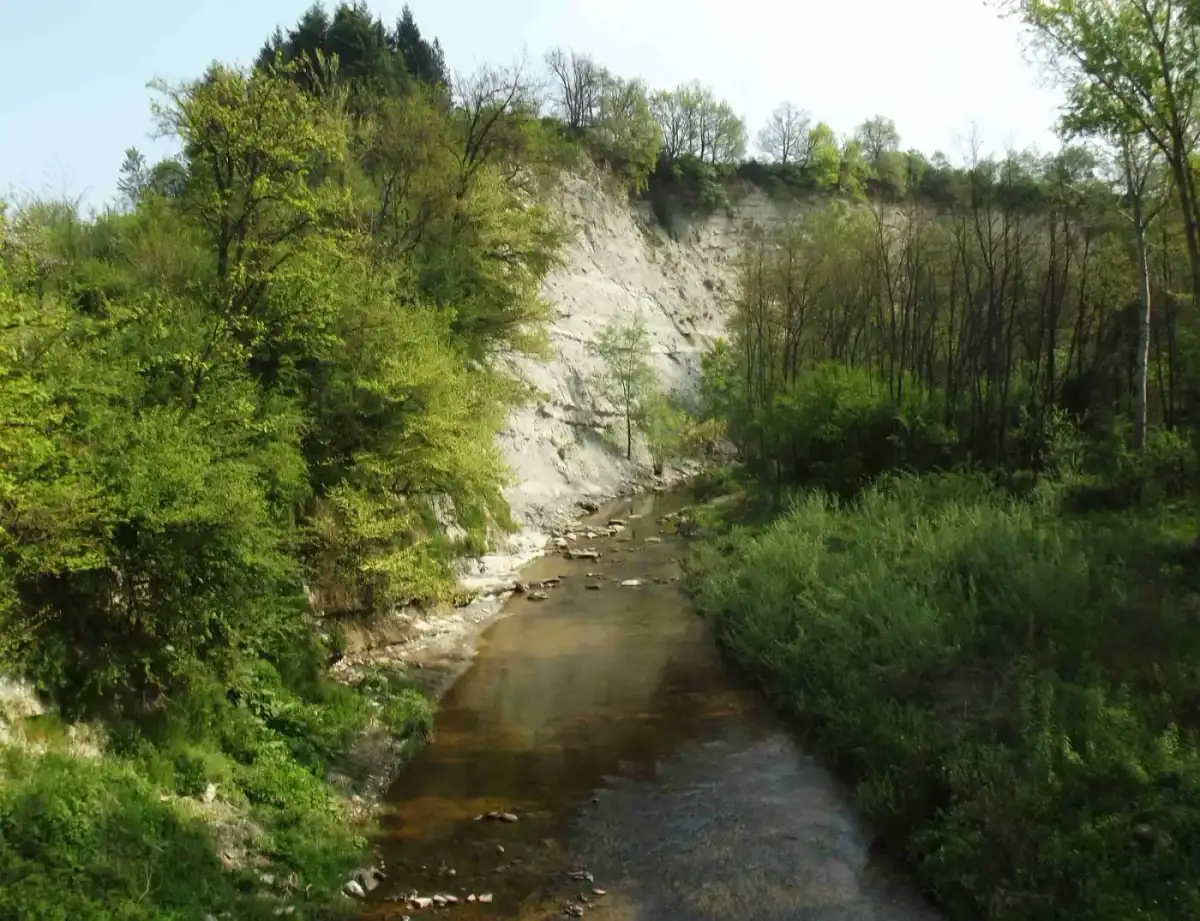 F Ceragioli · CC BY-SA 3.0
Visone (round)
The Visone is a stream that flows in the province of Alessandria . Right-hand side of the Bormida, it is thrown into it near Visone after harvesting the waters of a short valley of the Ligurian Apennines .
Read the story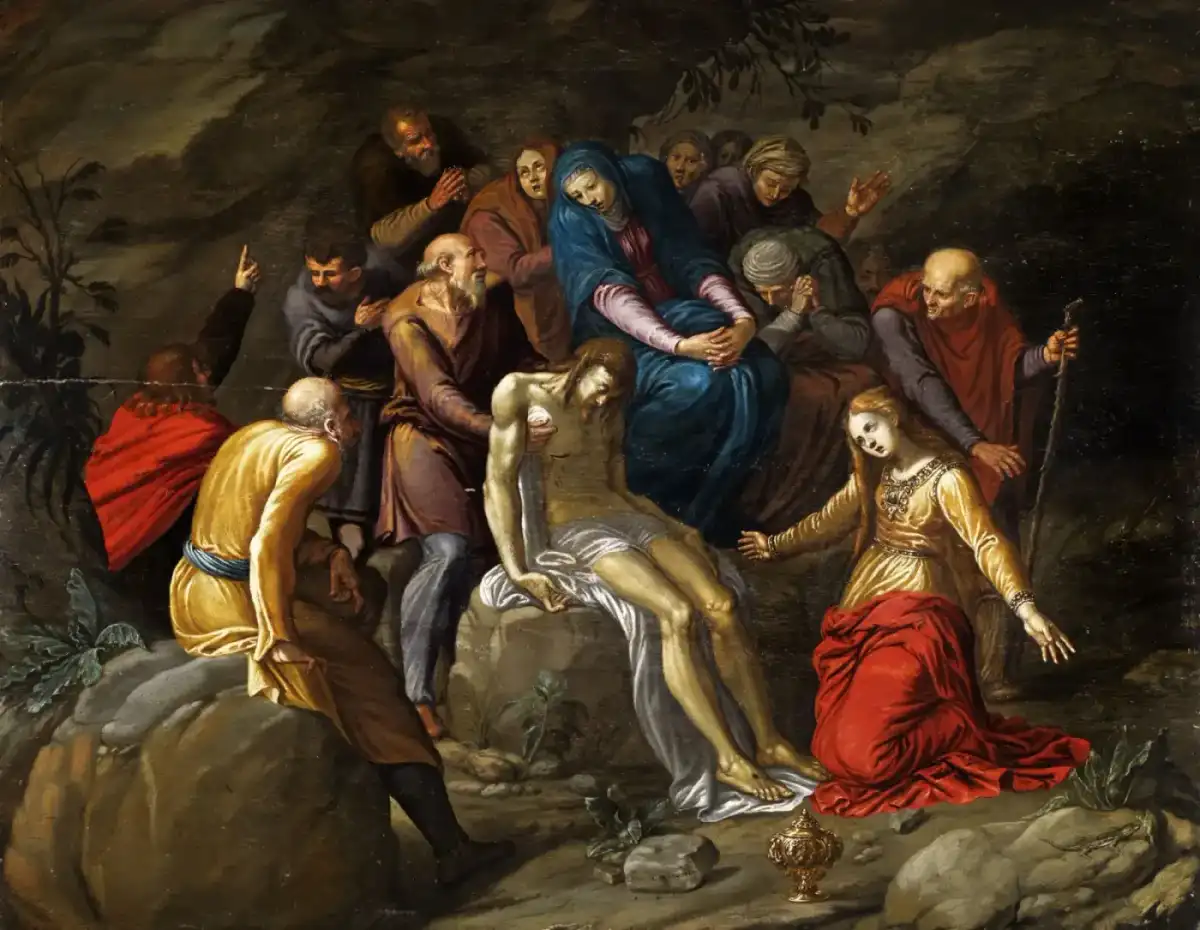 Giovanni Monevi · Public domain
Giovanni Monevi
Giovanni Monevi or Monevo ( Visone , 18 May 1637 – Visone , 15 December 1714 ) was an Italian painter of the Baroque period.
Read the storyThe wine landscape
This village in wine country
Follow the link between the country, the vineyards and the neighboring territories.
The area, step by step