Atlas of Monferrato
Rocca Grimalda: sights, history and trails
Alessandria
- Elevation
- 284 m above sea level
- Area
- 15.46 km²
- Demonym
- rocchese
- Patron saint
- Saint James
A closer look
Discovering Rocca Grimalda
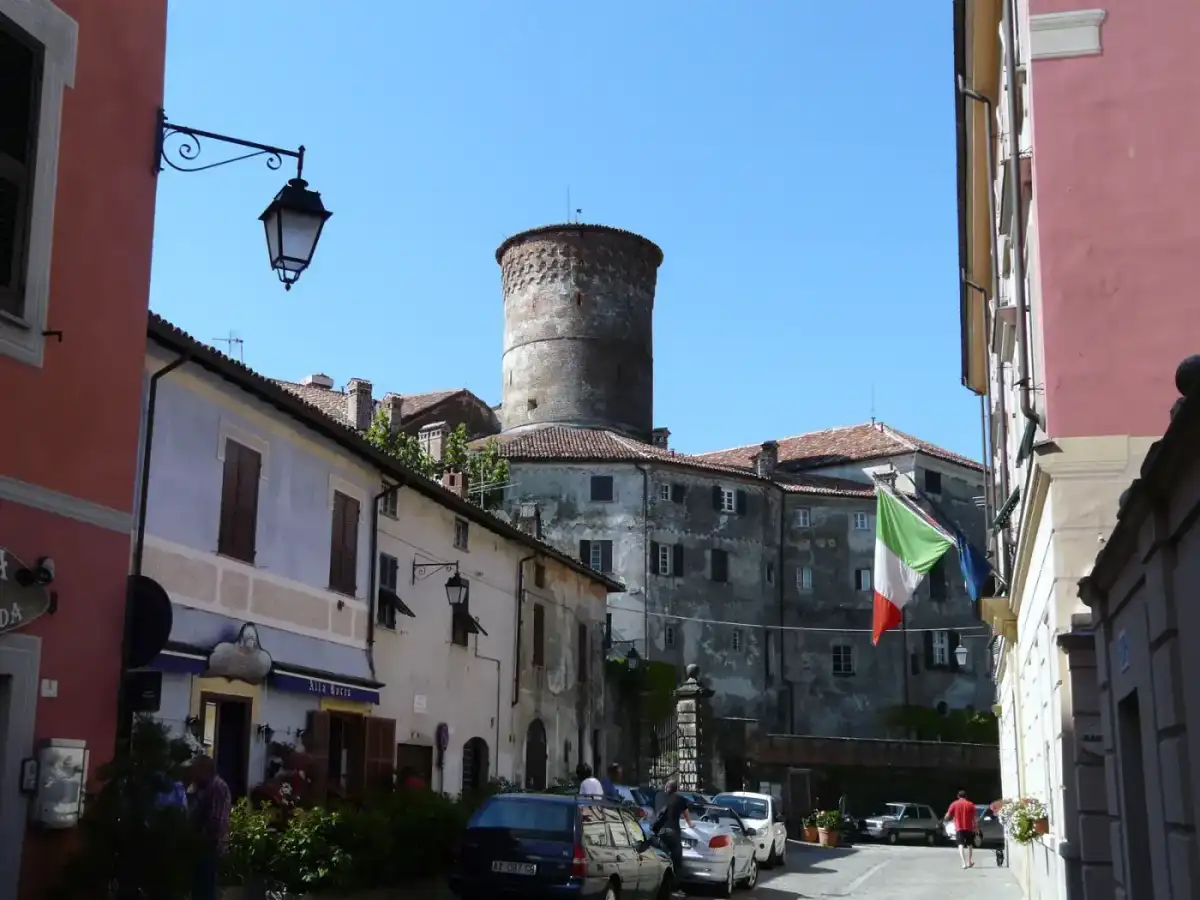
Rocca Grimalda (The Ròca Grimàuda in Piedmontese, Rare Ròca locally; To Ròcca in Liguria) is an Italian municipality of 1 382 inhabitants[1] from the province of Alessandria, in Piemonte, located in the Top Monferrato, on a rocky spur to the left of the river Orba. It is one of the main municipalities of Ovadese, historical-cultural area of Oltregiogo/Oltregiovo Ligure and/or Genovesato, Basso Piemonte and Monferrato, which takes its name from the city of Ovada.
History of Rocca Grimalda
SymbolsExplore this chapter
The traces of settlements of Ligurian populations in the valley of Orba and in particular in the municipality of Rocca Grimalda are lost in the past: the existence of the Roman city of Rondinaria, attested by numerous documents and by the discovery of a Celtic necropolis near the Silvano plain, at the foot of the rocky spur on which the town stands, suggests the existence of fortifications and settlements already in pre-Roman times even above the hill.
In the municipal territory, near the border with the municipality of Carpeneto, in the Trionzo area, the discovery of the remains of a castle from the Lombard era, built with embankments and palisades, confirmed the importance of the place which over the centuries had been shrouded in legends of witches and wild sabbats.
The village was mentioned in documents of the 10th century, as territory of the Aleramic brand, it was among the assets donated for the foundation of the monastery of San Quintino a Spigno Monferrato.
In 1164 it was ceded to the Marquis of Monferrato, in the thirteenth century it passed to the Marquises of Gavi, in the form of a pledge.
Counted by Alessandria and from the marquisate of Monferrato, it was conquered then by the Genoese who infeuded it to Malaspina.
Due to its conformation of natural fortress overlooking the valley of Orba was long disputed by the Republic of Genoa, the Marquis of Monferrato and the Duchy of Milan. In 1355, he was again granted to the Marquis of Monferrato. In 1444 he was ceded to Galeazzo Trotti.
In his history, Rocca Grimalda assumed different names, from "Rocca Val d'Orba" to "Rocca De Trotti". The hills of the manor of Rocca Grimalda remained until the 18th century mostly covered by dense forests where the brigantage flourished.
The border territories allowed the families of bandits to escape the authorities and to spread over the territory of the aftermath while the local lords were sometimes guilty in the face of the popular support they enjoyed.
After alternating events, the Trotti sold the fief to the Genoese family of Grimaldi, who retained it until the 19th century and gave the village its definitive name. The Grimaldi brought from the Republic of Genoa the cult of St. Limbania and the cultivation of the vine that overwhelmed the landscape of the surrounding hills where the wood was gradually replaced by the vine.
Of the extensive forest of the Orba valley, quoted by Alessandro Manzoni, there were only small cutouts such as the Savoy Villa Park in San Giacomo (a time called St. James of the woods).
From 1736 Rocca Grimalda entered the orbit of the Kingdom of Sardinia and followed since then the fates of Piemonte under the rule of Savoy.
During World War II, Rocca Grimalda paid a heavy tribute to the victims, and many of them were joined by the partisan wars that broke into the Ligurian Apennines until Liberation, which took place in these areas by the partisans, well before the arrival of allied troops.
From the end of the war, the country lived a period marked by emigration to large cities and abandonment of the countryside.
Since the 1990s Rocca Grimalda, like many neighboring centres, has lived a period of economic and social rebirth based on the promotion of excellent local wines, including Dolcetto di Ovada and Barbera del Monferrato, gastronomic products and tourism.
Symbols
The coat of arms and gonfalone were granted with DPR on 16 November 1988.[4]
The fuses are picked up by the family Grimaldi. The gonfalone is a drape party of white and red.
What to see in Rocca Grimalda
Rocca Grimalda presents itself as a well-preserved medieval village: the town is divided according to the shape of the rocky spur whose function...Explore this chapter
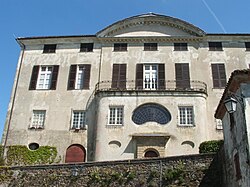
Rocca Grimalda presents itself as a well-preserved medieval village: the town is divided according to the shape of the rocky spur whose defensive function is witnessed by some names like Via dei Bastioni, the Torricella and the Porta, near the castle, the only access to the town.
The Malaspina-Grimaldi Castle, originally a military construction dating back to the 13th century, was transformed into a manor house in the 18th century after additions even during previous periods, with Renaissance and Baroque wings, along with a remarkable panoramic garden on the valley below. It is characterized by a five-storey circular tower with a helical scale obtained in the thickness of the walls that once housed the prisons: the inner walls still contain the writings and drawings carried out by some prisoners of the 17th and 18th century. Currently it is owned by a branch of the family de Rege di Donato that has curated its restoration and enhancement. The manor is part of the "Open Castles" system in Basso Piemonte.
The parish church of San Giacomo Maggiore, of Romanesque origin, but enlarged and refurbished later, preserves the ancient facade embedded in the perimeter wall right, with a series of arches made of grey stone and part of the original base of the bell tower. Inside, the three aisles are adorned by paintings on the life of St. John the Baptist, a native patron of the community.
The cult of St. James Major, very popular in the neighboring countries, is linked to the passage in the municipality of one of the ancient routes used by pilgrims to reach the sanctuary of Santiago de Compostela, where the remains of the saint are still preserved today.
The oratory of the Madonna delle Grazie, seat of the homonymous brotherhood, preserves inside it numerous works of popular devotion as well as a fine processional statue of the eighteenth century of the school of Anton Maria Maragliano while inside the oratory of the Holy Trinity and San Giovanni you can admire the valuable frescoes of the vault and another processional statue of more modest invoice. The Brotherhood of the Holy Trinity also preserves archives of expenditure dating back to the early seventeenth century that collect an important piece of the history of the country.
There are numerous votive newsstands in addition to the church dedicated to San Rocco of the 16th century, and that of San Giacomo in the homonymous hamlet.
The Church named Santa Limbania in Castelvero, dedicated to Our Lady of Assumption preserves valuable 16th century frescoes in the apse while the current structure is the result of further renovations that made it a sort of sanctuary for mule trackers; they transported goods through the Ligurian Apennines and entrusted their fortunes to the saint beginning their journey at the chiesine of Santa Limbania to Genoa Voltri in Borgo Cerusa, Rocca Grimalda: This route is rediscovered for tourist purposes every summer through a food and wine pilgrimage, as well as religious. The wooden statue of Santa Limbania, was once carved by the mothers of the country in order to get rid of them to send their children to war, a practice that demonstrates popular devotion for the holy Cypriot.
Society
Demographic evolution · Institutions, bodies and associations · Traditions and folkloreExplore this chapter
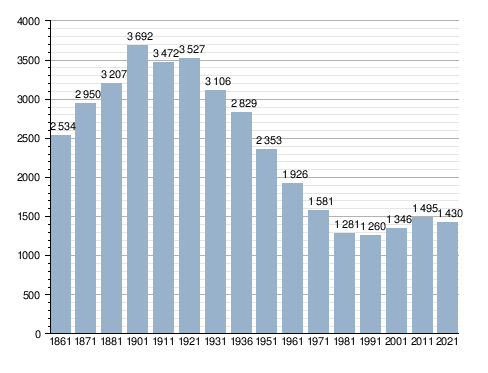
Demographic evolution
Inhabitants registered[5]
Institutions, bodies and associations
The Society of Mutuo Soccorso, formerly Circolo Garibaldino very active, is still a testimony to the social activity that characterizes Rocca Grimalda in past times and which made it one of the most important centers of the ovadese for a long time.
Traditions and folklore
Rocca Grimalda is also known for "Lachera di Rocca Grimalda" is a carnival ritual.
Culture
SagExplore this chapter
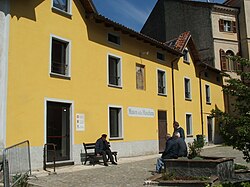
In particular, we remember the ancestral dance of Lachera that is re-proposed every year during the carnival with its meanings of community-founding ritual and propitiatory for the spring season and which stands out as a right among the most important carnivals in Europe. This tradition has been enhanced by the establishment of a Mask Museum that promotes exchanges and conferences in collaboration with similar structures throughout the world.
Lachera is represented every year in the carnival period in its most complete form, with a quest in the countryside that lasts five days of dance and music uninterrupted, until it arrives in the village where it assumes its most spectacular characteristics. The event has often been exported to other European regions and countries such as Belgium, Austria, France, Germany.
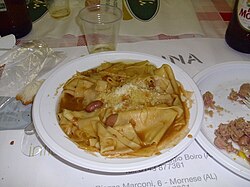
Also jealously is defended and handed down an ancient recipe, the typical dish of Rocca Grimalda from the name almost improncible to the profane, the Peirbuieira, which is held every year in the last week of August in a festival that attracts enthusiasts from all over Italy, as well as numerous long-time aficionados.
In 2005 Rocca Grimalda was chosen by the debut filmmaker Fausto Paravidino, who grew up in the small village as a set of his first film, Texas. What followed was theatrical seasons, exhibitions and events which enlivened the cultural life of the village.
Sag
- Wild boar. Last week of July
- Stracotto festival. Second Sunday of August.
- Perbuieira festival. Last week of August.
Administration
Below is a table relating to the administrations that have succeeded one another in this municipality.Explore this chapter
Below is a table relating to the administrations that have succeeded one another in this municipality.
| Period | First citizen | Match | Load | Notes | |
|---|---|---|---|---|---|
| June 4, 1985 | May 25, 1990 | Lorenzo Ottria | Italian Communist Party | Mayor | [6] |
| May 25, 1990 | April 24, 1995 | Lorenzo Ottria | Italian Communist Party, Democratic Party of the Left | Mayor | [6] |
| April 24, 1995 | June 14, 1999 | Vincenzo Cacciola | centre-left | Mayor | [6] |
| June 25, 1999 | June 14, 2004 | Vincenzo Cacciola | civic list | Mayor | [6] |
| June 14, 2004 | June 8, 2009 | Fabio Bari | civic list | Mayor | [6] |
| June 8, 2009 | May 26, 2014 | Fabio Bari | Civic List Together for Rocca | Mayor | [6] |
| May 26, 2014 | May 27, 2019 | Giancarlo Subbrero | Lista civica Insieme per Rocca Grimalda | Mayor | [6] |
| May 27, 2019 | July 16, 2019 | Antonio Facchino | Lista civica Insieme per Rocca Grimalda | Mayor | [6] |
| July 16, 2019 | September 21, 2020 | Giancarlo Subbrero | Lista civica Insieme per Rocca Grimalda | Deputy Regent | [6] |
| September 21, 2020 | in office | Vincenzo Cacciola | Civic list Tradition for the future | Mayor | [6] |
Image gallery
SportExplore this chapter
-
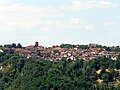 Rocca Grimalda
-
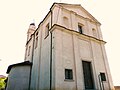 Church of Santa Limbania
-
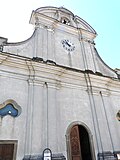 Church of San Giacomo Maggiore
-
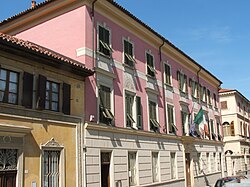
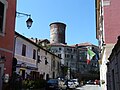 City Hall and Castle Panorama
Sport
The main sports team of the city is Polisportiva Rocca Grimalda in his football division, he joined the championship of Terza Category Piemonte and Valle D'Aosta the social colors are the Granata red and the Blue. Dispute his internal races in the hamlet of San Piero allo Stadio Comunale
Notes
Explore this chapter
- ^ to b Monthly demographic balance for the year 2026 (provisional data), up demo.istat.it, ISTAT.
- ^ Seismic classification (XLS), up risks.protezionecivile.gov.it.
- ^ Table of degrees/day of Italian Municipalities grouped by Region and Province (PDF), in Law 26 August 1993, n. 412, annex A, National Agency for New Technologies, Energy and Sustainable Economic Development, 1 March 2011, p. 151. URL consulted on 25 April 2012 (archived fromoriginal url on 1 January 2017).
- ^ Grimalda, up Central State Archive. Retrieved 7 June 2024.
- ^ Data taken from:
- Resident population of the municipalities. Censuses from 1861 to 1991 (PDF), up ebiblio.istat.it, ISTAT.
- Resident population - Time series, up exploredati.istat.it.
Please note: 2021 data refers to permanent census data as of December 31 of that year.
- ^ to b c d And f g h the j https://amministratori.interno.it/
Bibliography
Explore this chapter
- Accademia Urbense, Rocca Grimalda: a millenary history (PDF), Ovada, Municipality of Rocca Grimalda, 1990. Hosted on Accademia Urbense.
- Francesca Cacciola, On the fief of the Rocca (PDF), Accademia Urbense, Ovada, Municipality of Rocca Grimalda, 1994. Hosted on Accademia Urbense.
- Francesca Paolo Oliveri, Guide of Rocca Grimalda, Ovada, Municipality of Rocca Grimalda - Accademia Urbense, 2017.
Where to stay · Rocca Grimalda
Find stays on Booking.comStories, places and people
More about Rocca Grimalda and the surrounding area
Follow a thread of history and see where it leads.
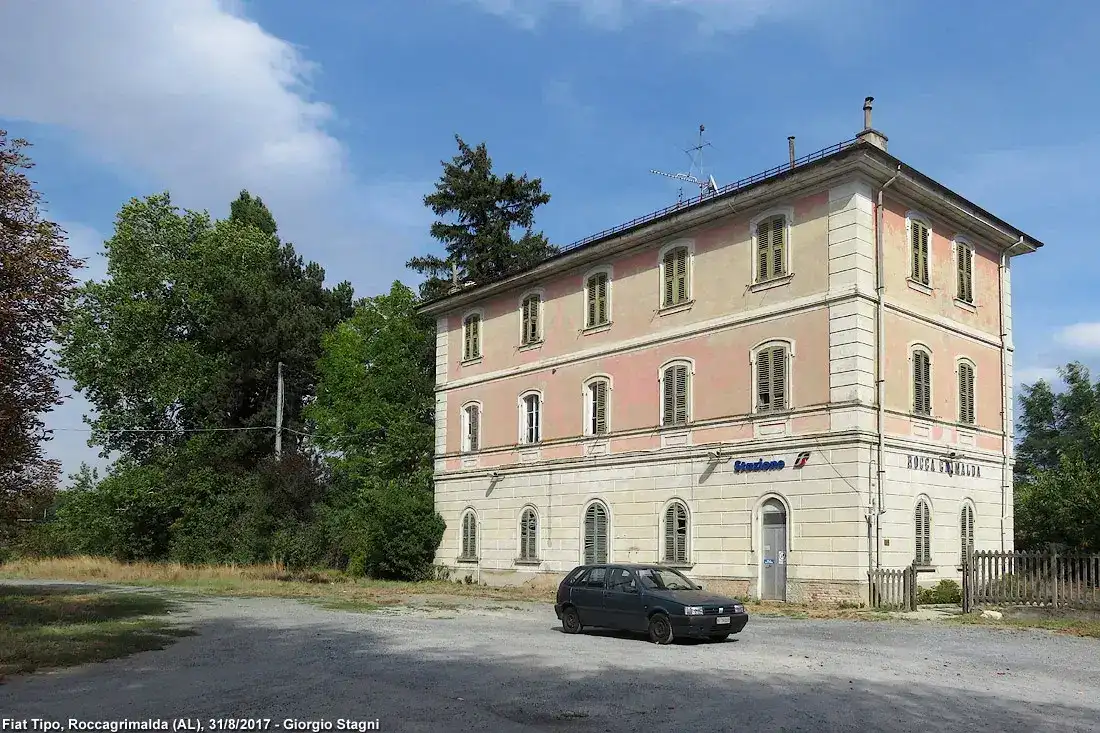 ·
Roccagrimalda Station
The station Rocca Grimalda is a train stop on the line Alessandria-Ovada . Serves the inhabited center of Rocca Grimalda .
Read the storySan Giacomo Station (Rocca Grimalda)
San Giacomo station is a train stop on the line Alessandria-Ovada . Serves the town of San Giacomo, fraction of the municipality of Rocca Grimalda .
Read the storyThe wine landscape
This village in wine country
Follow the link between the country, the vineyards and the neighboring territories.
The area, step by step
Trails and routes in Rocca Grimalda
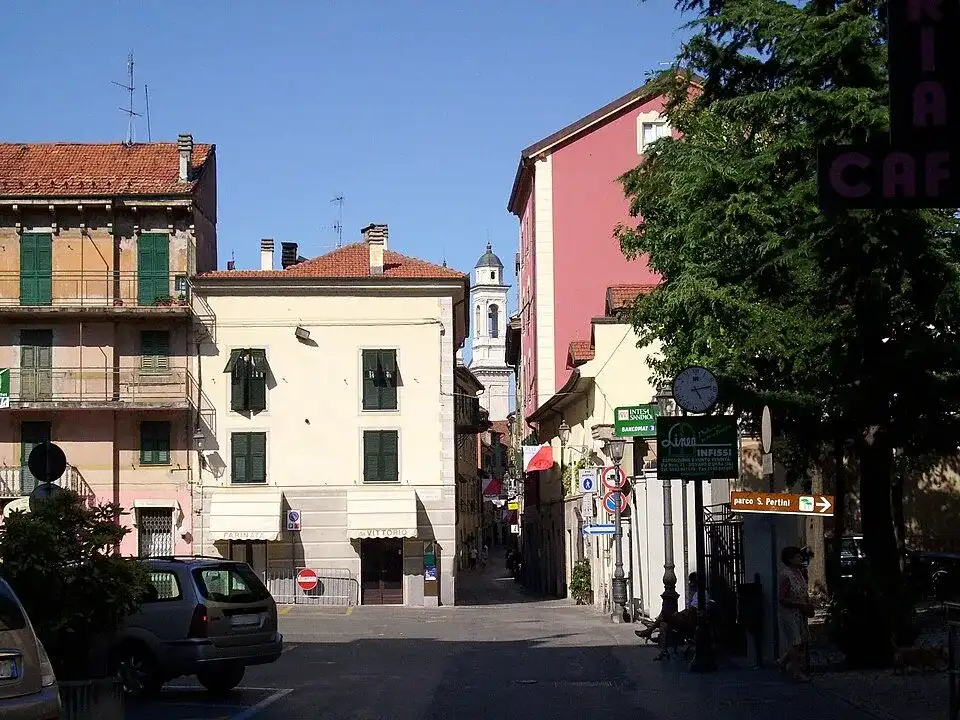 CyclingPlaces and landscapes along the route
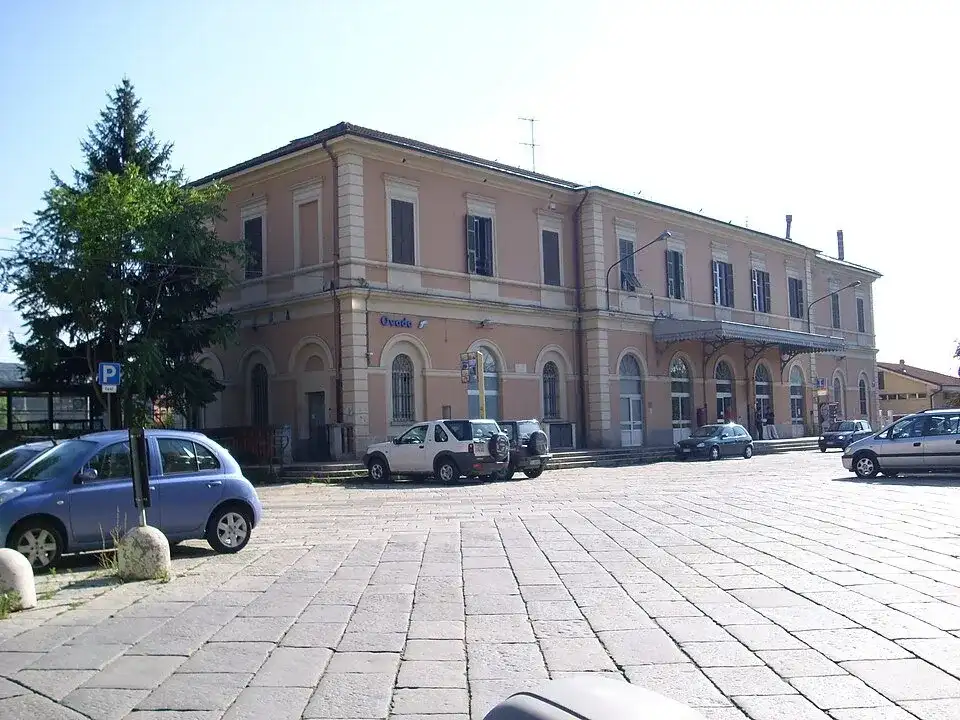 CyclingPlaces and landscapes along the route
Acquese area
The Streets of Coppi · Ovada–Ovada
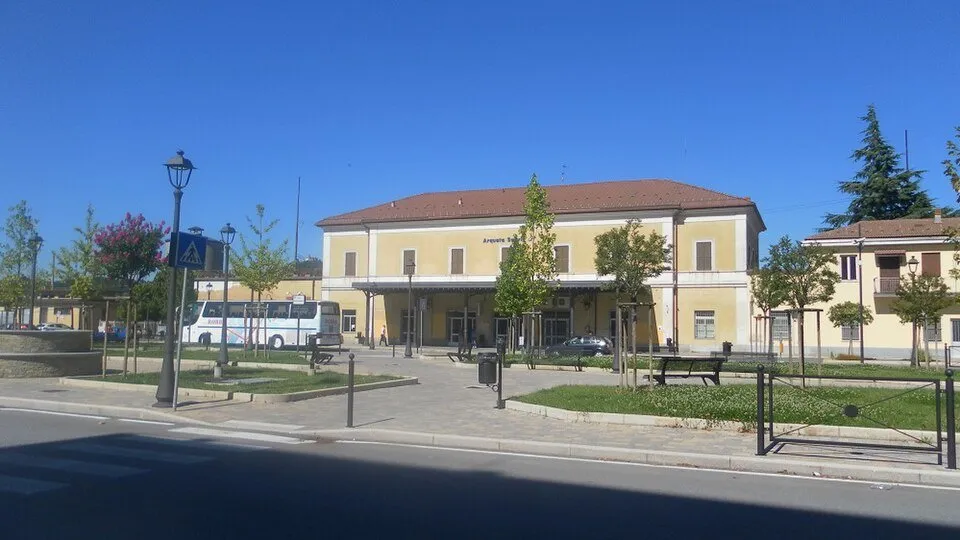 CyclingAround the starting point
Asti, Alessandria and surroundings
Il forte ed i castelli
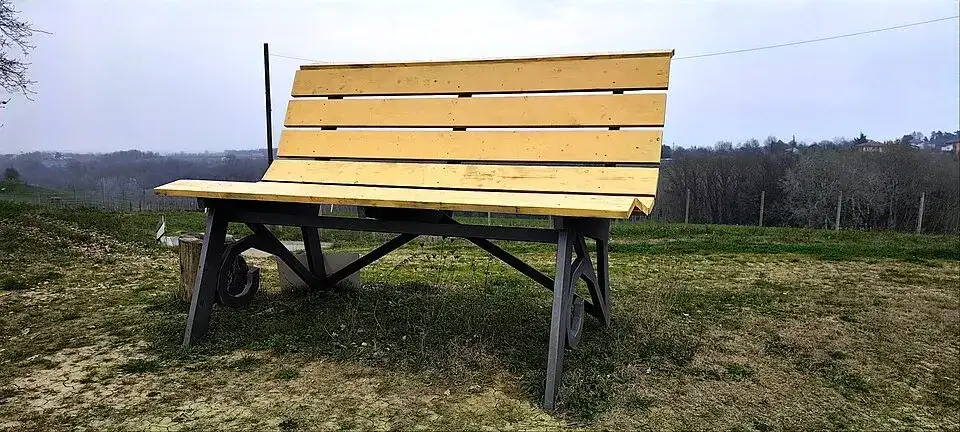 CyclingAround the starting point
Asti, Alessandria and surroundings