- Elevation
- 233 m above sea level
- Area
- 45,04 km2
- Demonym
- Gavians
- Patron saint
- Saint James
A closer look
Discovering Gavi
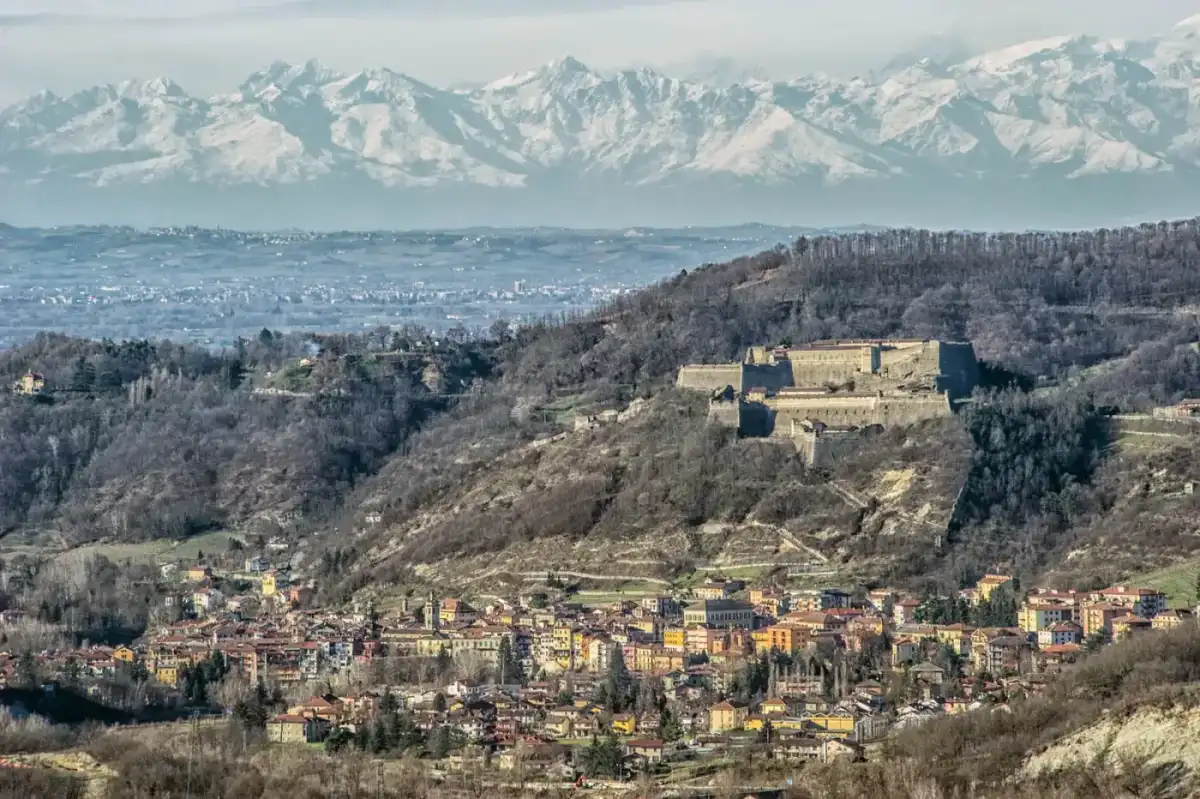
Gavi (/ˈɡavi/, pronounced [Chuckles] or [Chuckles] in Liguria, Gavi [Chuckles] in Piedmont), in the past also known as Gavi Ligure, is an Italian commune 4 371 inhabitants[1] from the province of Alessandria in the Piemonte, located on the right of the Lemme stream to confluence with the Neirone rio. A few minutes from Novi Ligure, is about 40 km from Alessandria, 60 km from Genoa and 140 km from Turin.
The municipality gives its name to the homonymous Cortese di Gavi DOCG.
History of Gavi
SymbolsExplore this chapter
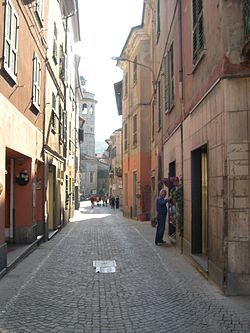
Retrievals of polished stone finds trace the presence of man in Gavi's lands over 2000 years ago. The name probably derives from the existence of the Neolithic station of Cavatium from which the Latin Gavium.[4] Gavi is believed to host a Roman garrison in defense of the Via Postumia.
After the fall of the Western Roman Empire he was occupied by a gota tribe that perhaps gave him his name (from the ancient Germanic gau, tribe and seat of the tribe, which to the genitive does exactly gawi), then also from the ungari and from the Saracens and according to the legend, one of their princesses, Gavia (or Gavina), would have established his home in the castle of the place.[5] It seems to be of French origin and in fact the oldest street of the village under the castle is called Monserito (from Mon Cheri).
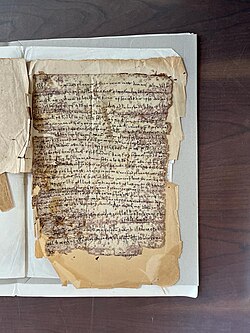
The first official document that mentions Gavi dates back to the year 972 and is preserved in the State Archive of Genoa.
Certain historical news on the Castle of Gavi is about the year 1000. At that time Gavi belonged to the family of Obertenghi. From these descended the marquis branch which from the 12th century assumed the title of Marchesi di Gavi, allies of Barbarossa, who owned part of the castle and who apparently took refuge here after the battle of Legnano. The Emperor deemed it more prudent to take refuge there for his family when he returned to Italy in 1177 to go to Venice.[6] The city soon entered the mires of the Republic of Genoa for its strategic position in Ligurian hinterland, on the most important routes of communication to the Po Valley.[7]
In 1202, the municipality was formally ceded to the Republic of Genoa. Passed under the domain of Visconti, except for a short French bracket, and following the Guasco di Alessandria, returned to Genoese hands in 1528, with the coming to power of Andrea Doria. For a long period Gavi remained under the domination of the Republic of Genoa.[8][9]
Given its strategic border position, Gavi and especially its fortress were involved in most conflicts affecting the Republic and the neighbouring Duchy of Savoy, then Kingdom of Sardinia. During the Napoleonic period, the Fort was occupied by the French army, in which it militated among other Ugo Foscolo. On the morning of 17 August 1799 in Gavi there was a short fight between the remnants of the retreating French army after the disastrous battle of Novi on 15 August and the Russian vanguard, during the Italian campaign of Suvorov and 130 French were captured.[10][11]
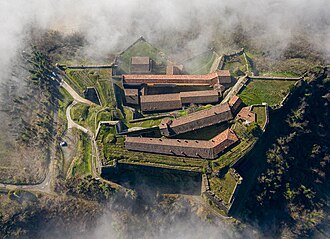
Napoleon's defeat and the subsequent sale of the Republic of Genoa to the Kingdom of Sardinia as a result of the agreements of the Congress of Vienna, and the reorganization of the Kingdom of Italy following the Resurrection, provoked the successive administrative transfer of Gavi, which was aggregated to the Province of Alessandria (1859).
On 7 June 2007 its territory was reduced by size with the sale to the municipality of Arquata Scrivia of the fraction of Sottovalle, not directly reachable from the capital but only through Carrosio or Arquata Scrivia.
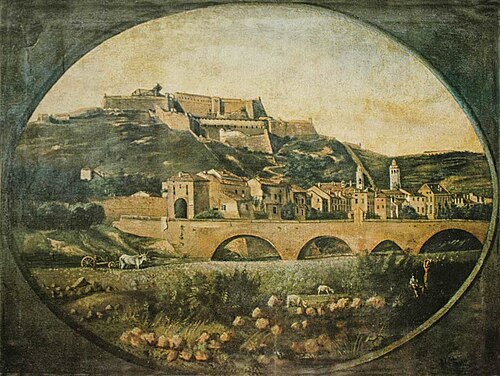
The historical monument that most identifies the history of the country is the Fort of Gavi, a remarkable example of military architecture, built by the Genoese between 1540 and 1673 on the remains of a preexisting castle, availing itself of the work of the military architect Vincenzo Maculani (called Fra' Fiorenzuola). This fortress is the most important medieval defensive outpost of all Basso Piemonte.
Symbols
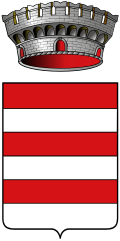
The coat of arms of the municipality of Gavi was recognized by decree of the head of the government of 7 April 1933.[12]
The gonfalone is a white drape.
What to see in Gavi
Civil architecture · Fort of Gavi · Municipal PalaceExplore this chapter
Civil architecture
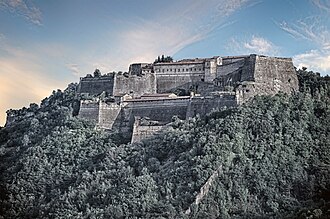
Fort of Gavi
Historical defensive fortress built by the Genoese on a pre-existing medieval castle. It is a state property and is used as a museum structure.
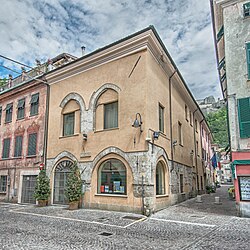
Municipal Palace
On the left of the Church stands the municipal palace, in which they resided ab antiquity the Consuls and the Podestà, who administered the thing of the Municipality. Nothing is known about its date of manufacture, and certainly through the centuries it underwent numerous changes. There is still the communal coat of arms (three-band shield) in the portico, which was also engraved on the three doors of the village: Pedaggio, Borgonuovo and Chiappa. In the year 1589, the Consular Room was remade, reduced and restored. In fact, in 1853 while practicing a niche to place you the bust of the worthy citizen envelope. Gaetano Romano (founder of the free school to which he devoted his entire heritage of 50 000 lire, still existing school where the Elementaries are located); a stone of quarry of the country that mentioned the works of 1589.
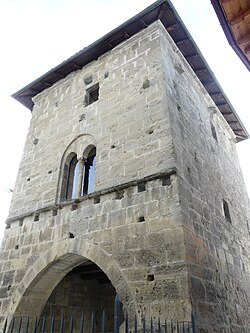
The Portino
Gavi was once completely surrounded by walls, today dismantled except for some still visible sections that descend from the Fort and that from the chapel of Madonna della Guardia in Borgonuovo line the city towards the west. The old defensive system remains today that the Portino, the only surviving port of those that allowed entry into the city. The age of edification is uncertain, but still frameable around the 13th century. The material with which it is built is limestone, unlike the most widespread sandstone in Gavi buildings.
Casa di Angelo Francesco Lavagnino
Outside the old town, on the road that leads to Carrosio The house of the composer Angelo Francesco Lavagnino stands out for its presence on the façade of medieval coats of arms and bas-reliefs.
Religious architecture
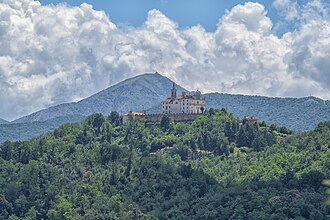
Sanctuary of Our Lady of the Guard
The Sanctuary of Our Lady of the Guard, on a Greek cross, was built by the local population in 1861, on a hill overlooking the area. It preserves inside the beautiful wooden statue of Our Lady of the Guard, built in 1746, a former vote of a Gaviese, Giacomo Bertelli, who had miraculously saved his house from bombing during the Austro-Piedmont siege.[13]
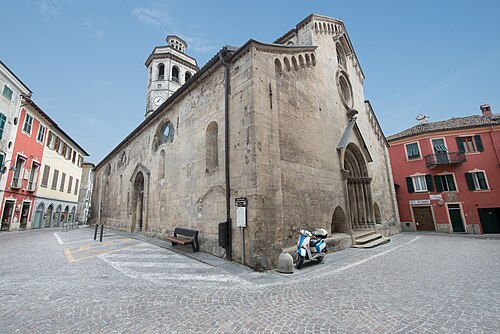
Church of San Giacomo Maggiore
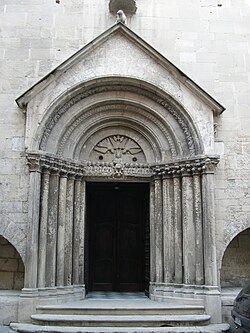
Parish church, belonging to the Archdiocese of Genoa, built in Romanesque style with sandstones taken from a quarry near the fort. It is first mentioned in the chronicles on August 15, 1172, when the consuls of Alessandria They swore you loyalty to the Marquis of Gavi.[7] It has been restored in the '600 and in700; further restorations were carried out in the 20th century[14]. The church is dominated by a lantern which acts as a bell tower. The layout is of the basilica type with three naves, with the central one elevated above the others, divided internally by columns. The façade is adorned with a series of small blind arches, and is enlivened in the center by an imposing splayed portal, surmounted by a rose window and a mullioned window. The Last Supper is represented in the lunette of the architrave.
Convent of Our Lady of the Graces of the Valley
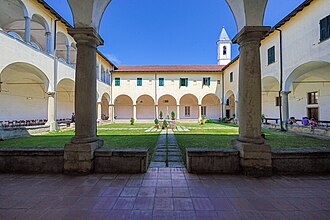
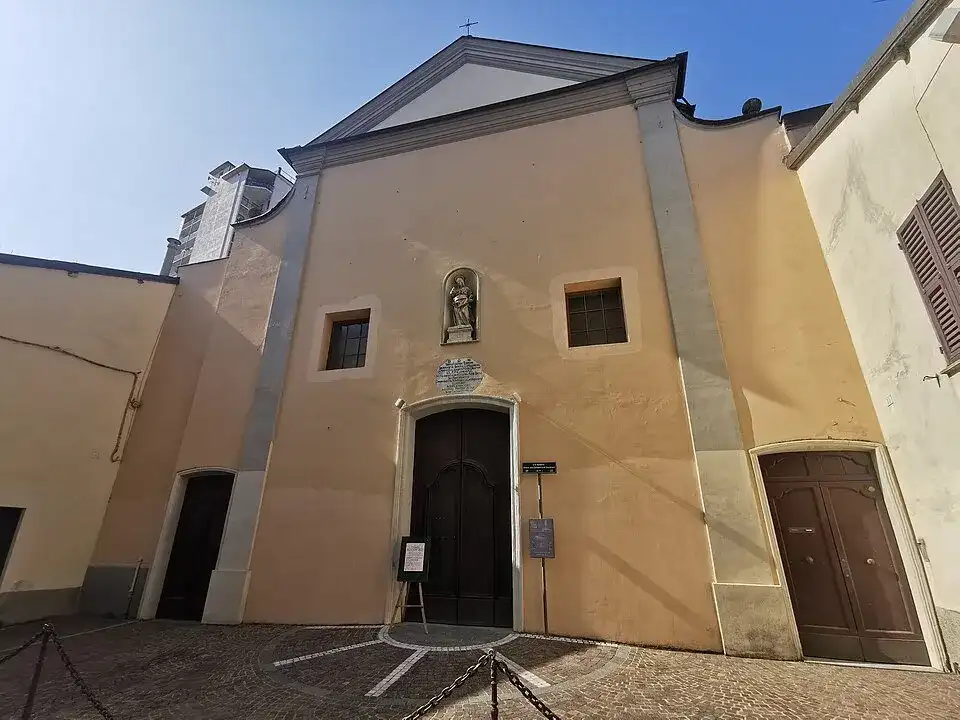
The Franciscan convent of Valle, located outside the gate, built in the 18th century[13] on a pre-existing hospice for pilgrims dedicated to St. Bernardino, preserves the statue of the saint and a painting of the Virgin dating back to the 15th century,[13] a wooden group representative The ecstasy of Saint Francis and a marble statue of San Bovo 1702. Inside are the sacristy with 18th century furniture and the cloister with lodges on the first floor.[13]
Oratory of Saints James and Philip (Bianchi)
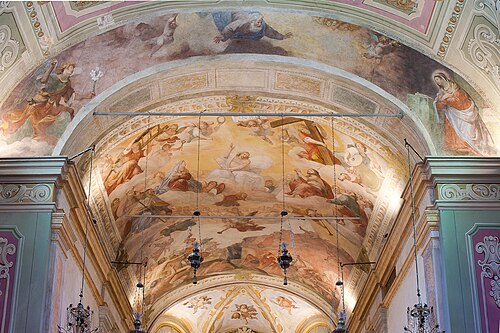
It is the oldest of the speakers. The chapters of his brotherhood, composed in 1723 and approved in 1736, claim to be the ancient brotherhood by tradition. Established about 400 years before the chapters, it dates back to 1200, at the time in which the processions of Flagellanti and Disciplinati were active throughout Italy. Of these one passed in that year to Gavi through Voltaggio and Genoa. The Oratory church has a single and wide nave. In 1595 the famous painter G. Augustine Ridolfi, as it still attested an inscription at the bottom of the church, frescoed you all around Passion of Jesus Christ. In 1825 the Confraternity was aggregated to the Archconfraternity of Death and Prayer of Rome with the task of burying the poor dead for free, wearing the black cloak; maintaining the use of the white hood for ordinary functions. This Confraternity also had in common with the Confraternity of the Reds, which arose later, the Monte del grano to advance the seed to the farmers. It also had a hospital next to it, "not rich but sufficient for the poor of the municipality".[5]
Oratory of Our Lady of the Assumption (Turchini)
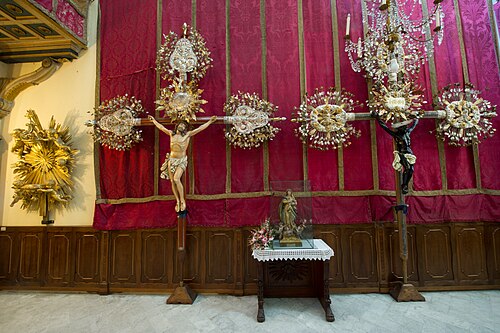
Church with a single nave dating back to 1575 whose walls and vaults bring frescoes in good style. The oratory is rich in tapestries and precious vestments: it also has some tabarini for very valuable goats. In addition, in the church there is a wooden statue of the Assumption, by Gaviese Bartolomeo Carrega, disciple of Montecucco. The Brotherhood had as the Institute of Charity the Monte di Pietà for the loan without interest on simple pledge, which dates back to ancient times. The coats used for ordinary functions are of turquoise colour.[9]
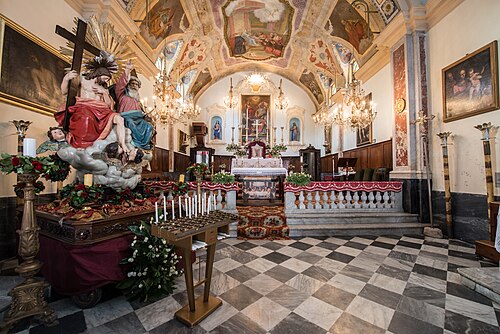
Oratory of the Holy Trinity (Rossi)
The first news on this Brotherhood was 1601: in that year fourteen tertiary members of the Order of the Minimists of St. Francis from Paola asked the Archbishop of Genoa to be able to establish a brotherhood dedicated to the Trinity.[15] In 1609 he was joined to the Archconfraternity of Rome, although he did not enjoy the benefits between 1691 and 1723. Towards 1600 Marco Elia Fossati founded the Chapel and the current church was built to replace that one. In the church of the Reds there is a beautiful canvas of St. Augustine and a wooden statue representing the Holy Trinity, work of Gaviese sculptor Norberto Montecucco. The Brotherhood took care of the Mount of wheat, which had to anticipate semente to the peasants, in common with the Brotherhood of the Whites: moreover, it hosted the statue of Our Lady of the Guard during the construction of the Sanctuary.[9]
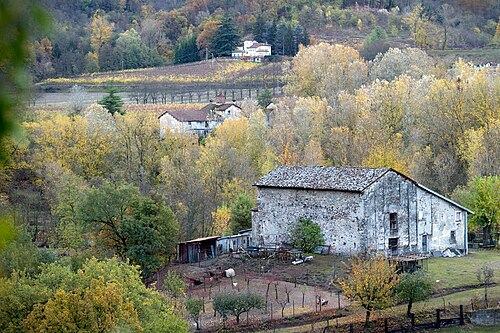
La Pieve di Santa Maria di Lemoris o di Lemme
Located on the road to San Cristoforo, it was the ancient main church, built before 1000 perhaps on the remains of a pre-existing Lombard-Byzantine temple, on a rock overlooking the Lemme, overlooking the wide bend created by the river. For a long time, the remains of the facade and the central bell with the apse remain on the site (originally it was three aisles). Substituted later by the parish of San Giacomo.
There are traces of frescoes with a lacunosa Madonna with Child and a Saint Peter, presumably dating back to the 12th-13th century.[16]
Society
Demographic evolutionExplore this chapter
Demographic evolution
Inhabitants registered[17]
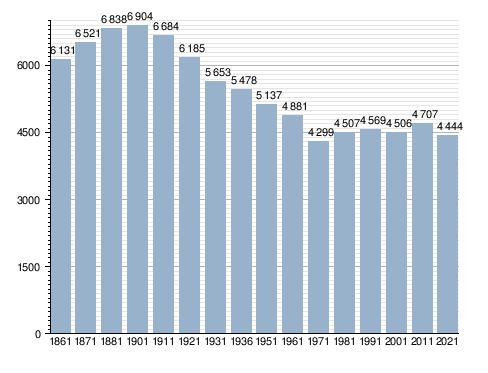
Note: Data include the fraction of Sottovalle that since 2007 belongs to the municipality of Sottovalle Arquata Scrivia.
Culture
Gavi in literatureExplore this chapter
Gavi in literature
- The importance of Gavi in the Middle Ages is underlined in the book Baudolino di Umberto Eco, where the city is mentioned both for its border position with Liguria and for its wine.
Economy
Summer holiday resort, founded its economy on tourism and local trade.Explore this chapter
Summer holiday resort, founded its economy on tourism and local trade.
For the quality of his tourist welcome, he was awarded the Orange Flag[18] of the Italian Touring Club.
Important is the agricultural activity of vine cultivation and wine production; Gavi is one of the places of production of the homonymous wine, DOCG.
Administration
Below is a table relating to the administrations that have succeeded one another in this municipality.Explore this chapter
Below is a table relating to the administrations that have succeeded one another in this municipality.
| Period | First citizen | Match | Load | Notes | |
|---|---|---|---|---|---|
| June 12, 1985 | May 27, 1990 | Alessandro Candia | Christian Democracy | Mayor | [19] |
| May 27, 1990 | 5 May 1992 | Alessandro Candia | Christian Democracy | Mayor | [19] |
| June 21, 1992 | April 24, 1995 | Enrico Ruzza | independent | Mayor | [19] |
| April 24, 1995 | June 14, 1999 | Nicoletta Rachele Albano | centre-left | Mayor | [19] |
| June 14, 1999 | October 15, 2000 | Nicoletta Rachele Albano | civic list | Mayor | [19] |
| May 27, 2001 | May 30, 2006 | Francesco Repetto | civic list | Mayor | [19] |
| May 30, 2006 | May 16, 2011 | Nicoletta Rachele Albano | civic list | Mayor | [19] |
| May 16, 2011 | 5 June 2016 | Nicoletta Rachele Albano | Civic list Gavi in the heart | Mayor | [19] |
| 5 June 2016 | January 28, 2020 | Rita Semino | Civic list Gavi in the heart | Mayor | [19] |
| January 28, 2020 | September 24, 2020 | Maria Clara Callegari | - | Prefectious Commissioner | [19] |
| September 24, 2020 | in office | Carlo Massa | Civic list YesAmo Gavi | Mayor | [19] |
Sport
The main football team of the town is Gaviese, with white-granata social colors.Explore this chapter
The main football team of the town is Gaviese, with white-granata social colors.
Image gallery
Explore this chapter
-
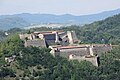 The Fortress of Gavi
-
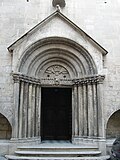 Saint James the Greater
-
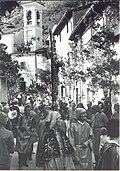 Procession of the Turkish Brotherhood
-
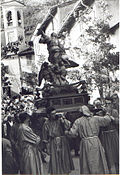 A.M. Maragliano (1664-1741) Cassa dell'Assunta. Brotherhood of the Turks
-
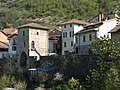 The Portino
Notes
Explore this chapter
- ^ to b Monthly demographic balance for the year 2026 (provisional data), up demo.istat.it, ISTAT.
- ^ Seismic classification (XLS), up risks.protezionecivile.gov.it.
- ^ Table of degrees/day of Italian Municipalities grouped by Region and Province (PDF), in Law 26 August 1993, n. 412, annex A, National Agency for New Technologies, Energy and Sustainable Economic Development, 1 March 2011, p. 151. URL consulted on 25 April 2012 (archived fromoriginal url on 1 January 2017).
- ^ The Press, Special Gavi, 1998.
- ^ to b General Sartore Comm. Federico, People's History of Gavi Ligure, 1933 (1987 edition edited by Cassa di Risparmio di Alessandria).
- ^ Barbarossa and its Ligurian-Pymontesi allies: acts of the international historical conference, edited by Giuseppe C. Bergaglio (Gavi: s.n., 1987).
- ^ to b Cornelius Desimoni, Historical Annals of the city of Gavi and its families (from the year 972 to 1815), 1896.
- ^ The disputed boundaries of the mandate of Gavi and the Circumdarium of Novi Ligure, up Metropolitan City of Genoa. Retrieved 23 June 2024 (filed on 24 September 2023).
- ^ to b c ibid.
- ^ Milyutin, 1852.
- ^ Orlov, 1892.
- ^ Gavi, decree 1933-04-07 DCG, recognition of coat of arms, up Central State Archive.
- ^ to b c d Monuments - The Orators, up Municipality of Gavi. Retrieved 29 January 2016 (archived fromoriginal url on 1 February 2016).
- ^ Church of San Giacomo Apostolo <Gavi>, up The churches of the Italian dioceses, Italian Episcopal Conference.
- ^ Alberto Casella, La Charitas paolana in Terzo order, in the fraternities and in the pious unions: the cases of Genoa and Gavi (XVII century), in Mario Sensi (ed.), Trades, observance and reform between Italy, France and Spain. Acts of the Convengo of Studies, Rome, 22-24 November 2007, General Curia of the Order of Minims, Rome 2004, pp. 359-409. Alberto Casella, The ‘Charitas’ Paolana in Terzo Order in the confraternities and in the pious unions: the cases of Genoa and Gavi (XVII century) (PDF), up oratoriodeirossi.altervista.org. Retrieved 23 June 2024 (filed on 27 November 2023).
- ^ The Church, up common.gavi.al.it, Municipality of Gavi. Retrieved 10 December 2019 (archived fromoriginal url on 23 January 2018).
- ^ Data taken from:
- Resident population of the municipalities. Censuses from 1861 to 1991 (PDF), up ebiblio.istat.it, ISTAT.
- Resident population - Time series, up exploredati.istat.it.
Please note: 2021 data refers to permanent census data as of December 31 of that year.
- ^ Gavi: what to see, where to sleep, where to eat | Touring Club, up Touring Club Italiano. Retrieved 23 April 2024.
- ^ to b c d And f g h the j k http://amministratori.interno.it/
Where to stay · Gavi
Find stays on Booking.comStories, places and people
More about Gavi and the surrounding area
Follow a thread of history and see where it leads.
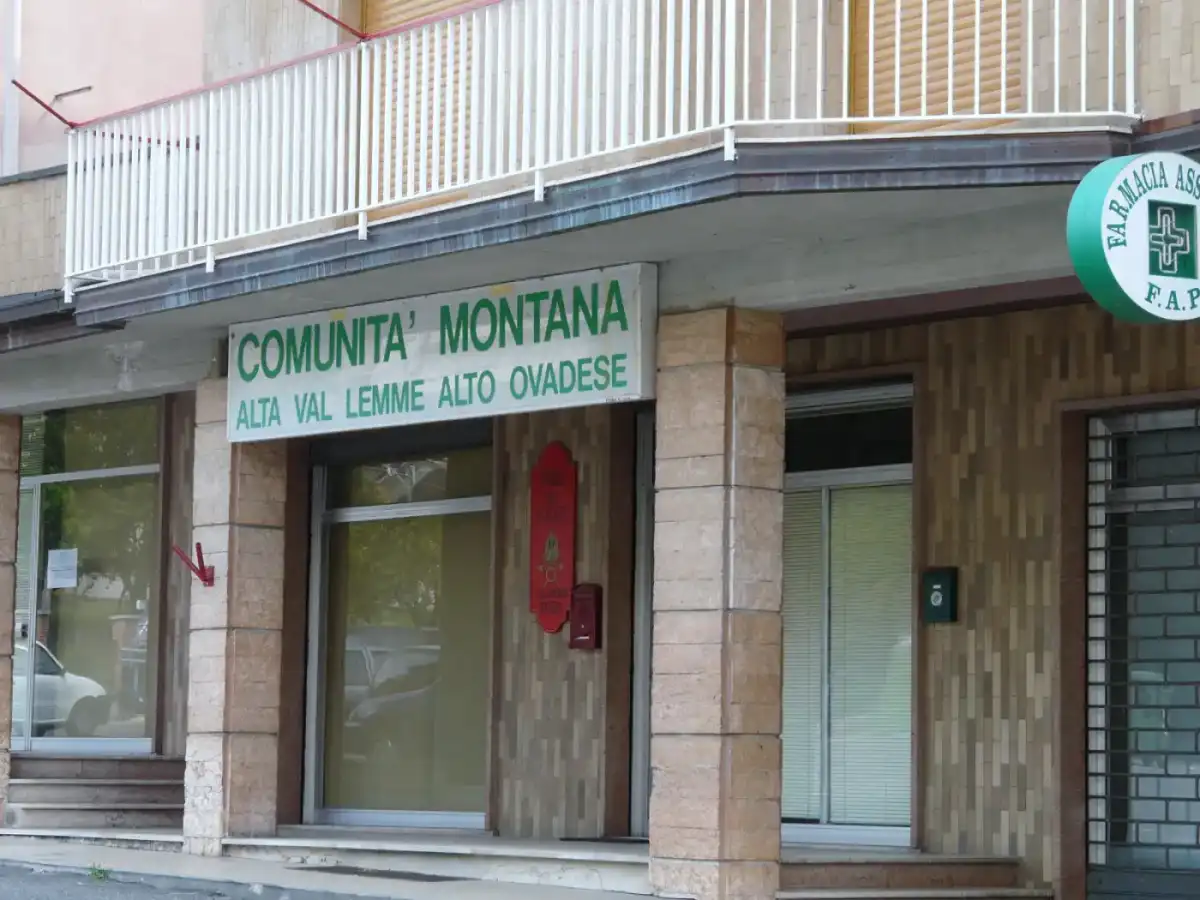 Davide Papalini · CC BY-SA 3.0
Mountain community Alta Val Lemme and Alto Ovadese
The Mountain Community Alta Val Lemme and Alto Ovadese was a mountain area of Piemonte .
Read the storyMarquisate of Gavi
The Marquisate of Gavi was an ancient Obertengo state in medieval Italy, resulting from the dismemberment of the territories that were of the Brand Obertenga .
Read the storyThe wine landscape
This village in wine country
Follow the link between the country, the vineyards and the neighboring territories.
The area, step by step
Trails and routes in Gavi

Acquese area
Grande Cammino · Tappa 12: Gavi–Carpeneto

Asti, Alessandria and surroundings
The Wine and Flavor Route · Dolcetto · Cadegualchi–Gavi
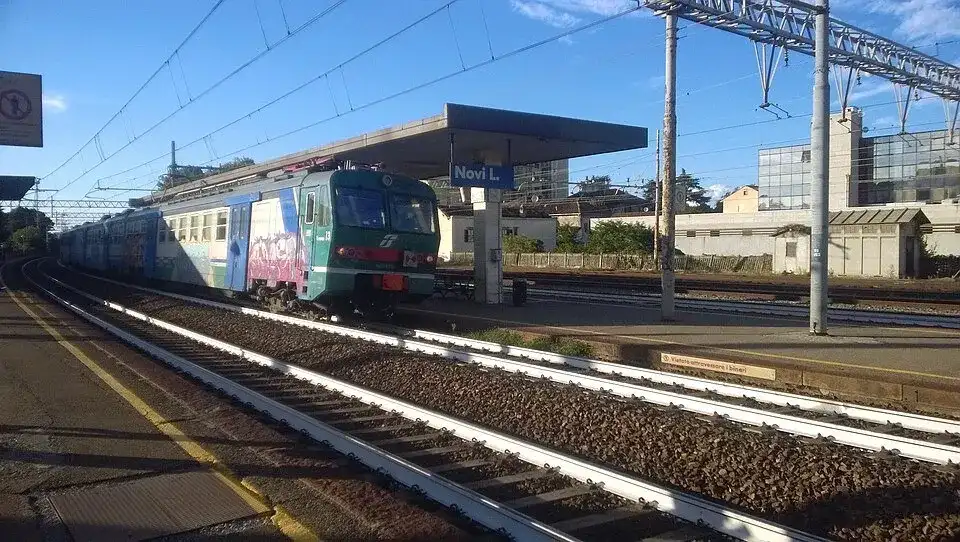 CyclingPlaces and landscapes along the route
Asti, Alessandria and surroundings
The Streets of Coppi · Gavi–Gavi
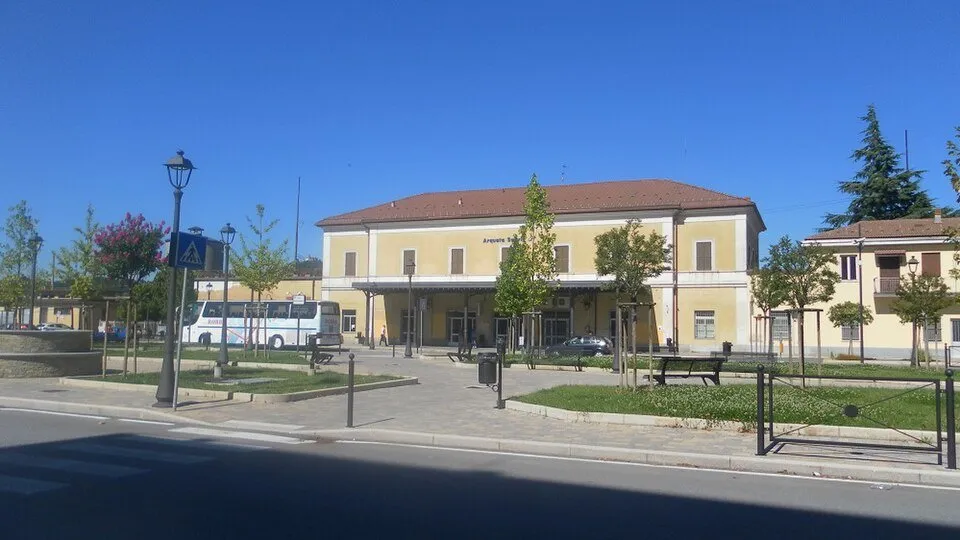 CyclingAround the starting point
Asti, Alessandria and surroundings
Il forte ed i castelli
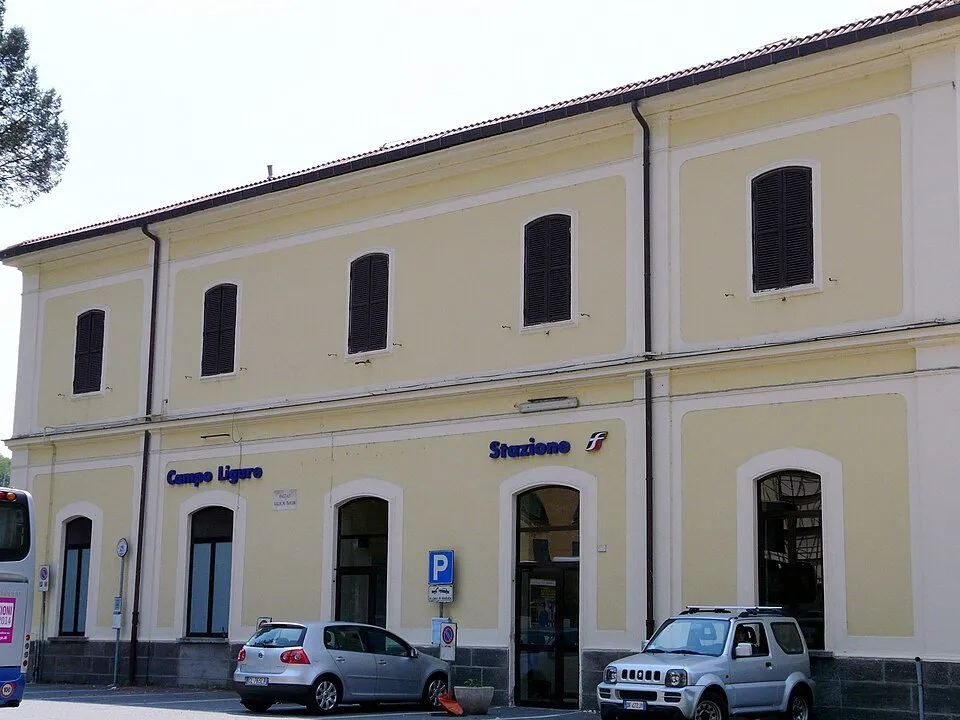 CyclingAround the starting point
Asti, Alessandria and surroundings
Le Strade della Libertà dell’Alto Monferrato
Asti, Alessandria and surroundings
Forti e castelli tra il Dolcetto e il Gavi

Asti, Alessandria and surroundings
Anello dei mulini di Gavi

Asti, Alessandria and surroundings
Dai Forti alla Fortezza
Mountain bikeAround the starting pointAsti, Alessandria and surroundings
Le colline del Gavi DOCG
 CyclingAround the starting point
Asti, Alessandria and surroundings
Le dolci terre di Novi
 CyclingAround the starting point
Asti, Alessandria and surroundings
Granfondo Dolci Terre di Novi

Asti, Alessandria and surroundings
Sentiero pratolungo - innesto sentiero e1

Asti, Alessandria and surroundings