Atlas of Monferrato
Carrosio: sights, history and trails
Alessandria
- Elevation
- 254 m above sea level
- Area
- 6.92 km2
- Demonym
- chariots
- Patron saint
- Holy Cross
A closer look
Discovering Carrosio
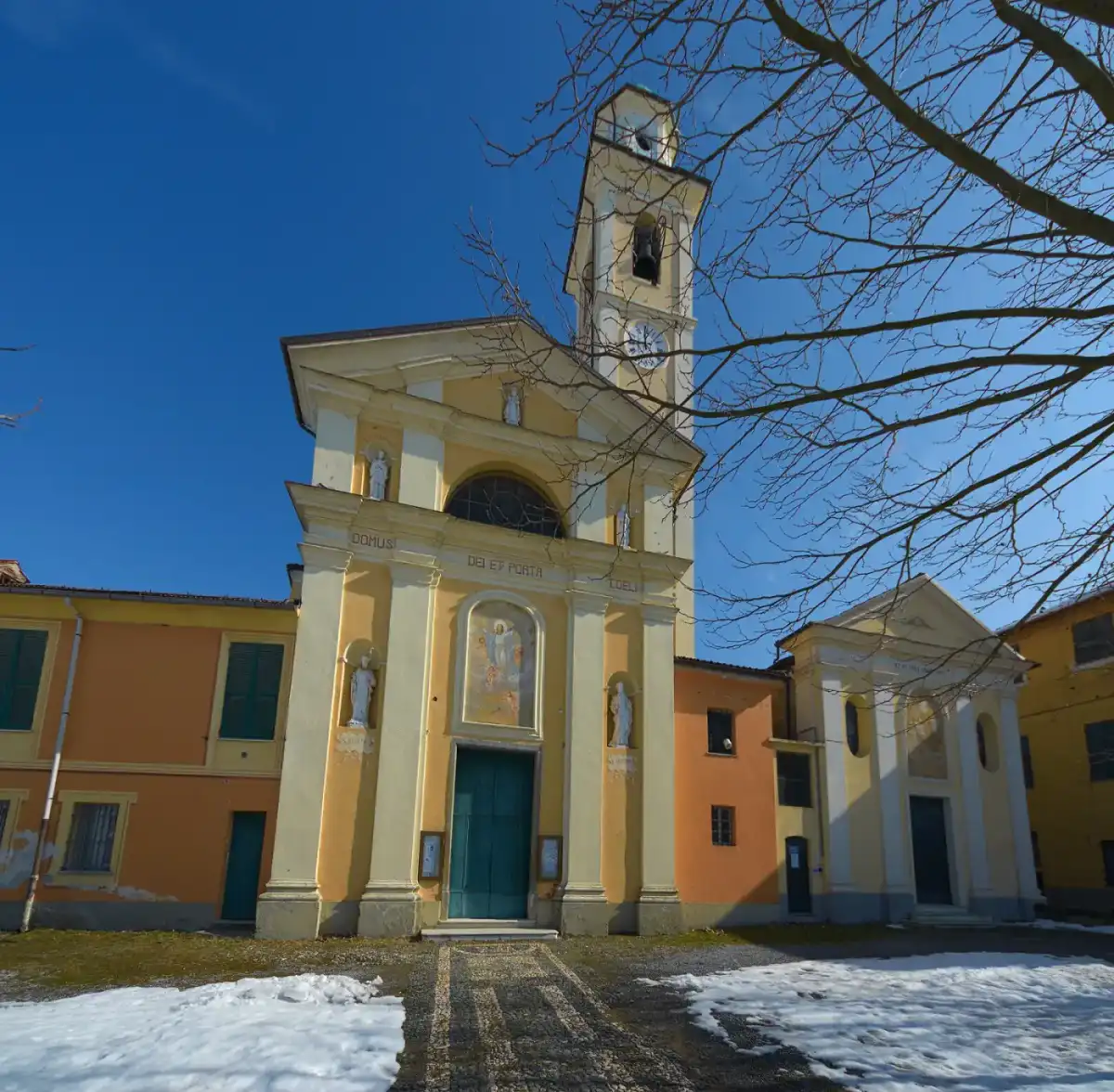
Carrosio (Carreuxo in Liguria, Careuvre in Piedmont) is an Italian municipality of 508 inhabitants[2] from the province of Alessandria in the Piemonte, located on the left bank of the Lemme stream.
History of Carrosio
The settlement of Meo · The return to the ancient settlement · The decline of Aimero (Meo) and the "rebirth" of CarrosioExplore this chapter
It is already present several centuries before Christ among the Ligurian settlements “mountain” and at the center of a dense network of exchanges with those “sea” (documented by the “Pastorage Table of the Polcevera” of 117 BC. today exposed to Isosecco), it was destroyed by the console Lucio Emilio Paolo just before 200 BC. and its inhabitants largely deported or dispersed.
The settlement of Meo
The latter took refuge on the surrounding hills, rebuilding the village in the town still known as “Meo” (because its inhabitants used to repeat the phrase Carystum pagus meus, i.e. “Carrosio my village”). After the 10th century AD the inhabitants began to descend again to reform the old settlement, thanks to the ever-increasing risk of landslides: even today Meo is in fact a small hill in the shape of a broken cone that stands alone in the center of a depression in which the streams that descend from the nearby hills converge, and no trace now remains of what once was the village that arose on it: the only building present there is the small church of Santa Maria dell'Ascensione, rebuilt in 1914 on a peak that tenaciously resists centuries-old erosion and to which the people of Carros traditionally go on Ascension Day to have a picnic in the meadow after Holy Mass[5].
The return to the ancient settlement
The name Carroxium appears, for the first time, in a document of 1144. In 1185, however, with sentence promulgated by Emperor Frederick II, the road between Voltaggio And Gavi (therefore passing through Carrosio) was declared free to the merchants of Italy.
The high leaps applied by the Marquises of Gavi forced merchants to seek an alternative route: for this purpose the old settlement of Meo was perfect, easily defendable due to its elevated and excellent "snode" for roadfarers towards Rigoroso.
In 1144 the lords of Montaldeo they gave loyalty to the Superba half of their fief and guaranteed the possession of Voltaggio, Fiaccone (today Fraconalto) and Amelio (another name for Meo); two years later, the lords of Gamondio (now known as Castellazzo Bormida) undertook to assist Genoa in the management of the three possessions.
However, the situation was not always peaceful: in 1192 the Consuls of Alessandria committed to helping Genoa in the possession of Montaldeo castles, Aimero, Tassarolo And Pasturana in addition to those already established in the area: with Gavi nowresponsible to ask in turn the alliance with Genoa, Amelio passed to be a snout – however crucial – at the service of Superba, attended not only by Genoese, but also by Milanese and Pakistani merchants, that from Tortona they went up to the Ligurian coast[6].
For all the 12th, 13th and 14th centuries this route was thus the cross-connection that connected the valleys of the Lemme and the Scrivia, with the blessing of the Consuls of the Republic of Genoa.
The decline of Aimero (Meo) and the "rebirth" of Carrosio
The increase in landslides and the gradual decrease in the importance of Aimerio (in documents from the time cited as well Amelio) due to the ever-increasing passage of merchants towards the road along the Lemme, facilitated by the agreements with Gavi, caused a rapid decline of the settlement, with its inhabitants spreading to nearby settlements: the most "chosen" one was precisely that of Carrosio.
Some family groups maintained their origins in Amelio in the surname: among them Ameri, Amelio and Imelio. In the following centuries, these surnames often appeared in the documents of noble families and in the registers of the Church, among the high local offices[7]; meanwhile, the village grew at slow but constant rhythms.
In March 1625, the French-Savoiards commanded by Carlo Emanuele I of Savoy invaded the territory of Carrosio, facing the Genoese allies with the Spanish. At first they won it, breaking down the lines of defense of Ligurians, but were later stopped at Malpertuso, near Montanesi, where today stands the Sanctuary of Our Lady of Victory, and on 21 June 1625 they finally abandoned Carrosio.
Passed to the Savoy in 1735, it became a sabauda enclave within the Republic of Genoa. Abolished the fief in 1798, it was the protagonist of a Jacobin revolt against the Piedmontese government, which settled in an attack on the castle of Serravalle Scrivia – failed – by 2000 revolutionaries; the survivors were hunted by the inhabitants of neighboring countries and killed “as unbelieving men and enemies of every authority”.
After the Napoleonic victories and reconstruction of the Ligurian Republic, Carrosio joined, by decree of 4 September 1802, one of the 18 cantons of the “jurisdiction of the Lemo”, with municipality and three peace judges.
Three years later, the Ligurian Republic was incorporated into the French Empire, and French became laws and practices in Carrosio: the mayor was called Never and official acts had to be drafted in French.
In 1812, Pope Pius VII was housed in the “Roccone” of Carrosio, which began at the exile of Fontainebleau: a stone walled in the front of the palace bears witness.
After the fall of Napoleon, at the Congress of Vienna, the annexation of the Republic of Genoa to the Kingdom of Sardinia was deluded: the country finally returned between the Saudi domains, and on September 2, 1815 King Vittorio Emanuele I and Queen Maria Teresa of Austria-Este crossed Carrosio, celebrated by the local population[8].
From the 20th century to today
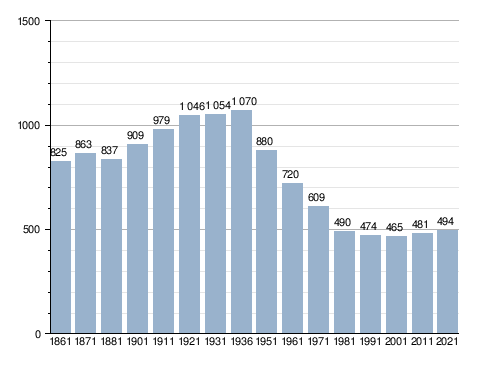
At the beginning of the 20th century, Carrosio had about 900 inhabitants; many emigrated to North and South America, especially Argentina and Uruguay.
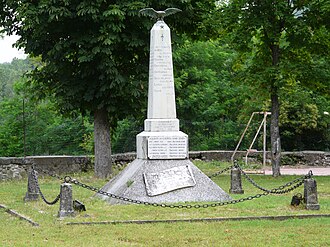
On the initiative of Dr. Felice Costa, for long years mayor of the country, an obelisk was erected in 1922 dedicated to the memory of the fallen during World War I[9].
The Second World War also bitterly involved Carrosio:
- in bombings of Villalvernia of 1 December 1944 lost his life on 17-year-old Domenico Traverso[9];
- on February 7, 1945, just two months later, his brother Peter, a younger year, was shot to death in front of the Cappelletta della Misericordia by a fighter plane that passed on raving flight on the country[9];
- from Carrosio came 6 fallen in the Strage della Benedicta of April 1944[10];
- Angelo “Giuanola” Traverso, a young athlete, never returned from El Alamein[9];
- many were deported in the various Nazi concentration camps, especially Mauthausen[11].
On 27 June 2023, Carrosio welcomed Albert II of Monaco: the prince visited the town hall, the ancient walls of the "Roccone" and the church of Santa Maria Assunta, after which, with an official ceremony, he was invested in honorary citizenship of the country.
This initiative sealed the strong links between Carrosio and Grimaldi, who controlled the fortress of Carrosio between 1248 and 1251.[12], thus making it one of the "Grimaldi Historic Sites"[13]. The event is today commemorated by a special plaque placed next to the entrance door of the town hall.
Symbols
The coat of arms and gonfalone of the municipality of Carrosio were granted by decree of the President of the Republic of 12 February 1962.[14]
It is a composition which is drawn up by the census on the country contained in G's work. Casalis, Geographical, historical, statistical and commercial dictionary of the S.M. the King of Sardinia, vol. VII, Turin, 1845.[16] The gonfalone is a drape party of white and blue.
What to see in Carrosio
Explore this chapter
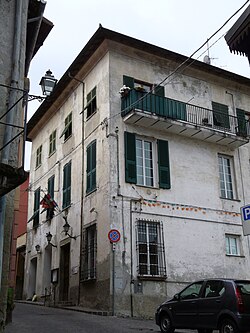
- Of interest, among the many buildings that have preserved the medieval aspect, the Palazzo Migliorati Gavotti in which he stayed Pope Pius VII during the journey to Fontainebleau (currently home of the municipality).
- Inside the parish church of Assumption, dating back to the 17th century, there is a Madonna of the Maragliano school.
Society
Demographic evolutionExplore this chapter
Demographic evolution
Inhabitants registered[19]
Administration
Other administrative informationExplore this chapter
Below is a table relating to the administrations that have succeeded one another in this municipality.
| Period | First citizen | Match | Load | Notes | |
|---|---|---|---|---|---|
| June 18, 1985 | May 26, 1990 | Gian Carlo Davico | Christian Democracy | Mayor | [20] |
| May 26, 1990 | April 24, 1995 | Carlo Massa | Christian Democracy | Mayor | [20] |
| April 24, 1995 | June 14, 1999 | Carlo Massa | center | Mayor | [20] |
| June 14, 1999 | 6 April 2001 | Carlo Massa | civic list | Mayor | [20] |
| April 27, 2001 | May 28, 2002 | Paola Fioravanti | - | Prefectious Commissioner | [20] |
| 8 June 2002 | May 29, 2007 | Renzo Davide Musso | civic list | Mayor | [20] |
| May 28, 2007 | 7 May 2012 | Valerio Cassano | civic list | Mayor | [20] |
| 7 May 2012 | June 12, 2017 | Valerio Cassano | Civic list Per Carrosio | Mayor | [20] |
| June 12, 2017 | June 13, 2022 | Valerio Cassano | Civic list Per Carrosio | Mayor | [20] |
| June 13, 2022 | in office | Corrado Guglielmino | Civic list Per Carrosio | Mayor | [20] |
Other administrative information
Carrosio is part of the Union of Municipalities composed by Carrosio, Parodi Ligure, Fraconalto and Voltaggio.
Notes
Explore this chapter
- ^ Carrosio - Encyclopedia - Treccani, up www.treccani.it. Retrieved 8 August 2026.
- ^ to b Monthly demographic balance for the year 2026 (provisional data), up demo.istat.it, ISTAT.
- ^ Seismic classification (XLS), up risks.protezionecivile.gov.it.
- ^ Table of degrees/day of Italian Municipalities grouped by Region and Province (PDF), in Law 26 August 1993, n. 412, annex A, National Agency for New Technologies, Energy and Sustainable Economic Development, 1 March 2011, p. 151. URL consulted on 25 April 2012 (archived fromoriginal url on 1 January 2017).
- ^ Roberto Benso, 1-3, in Carrosio - Myth and Reality, 1976.
- ^ Roberto Benso, 3, in Carrosio - Myth and Reality, 1976.
- ^ Roberto Benso, 4, in Carrosio - Myth and Reality, 1976.
- ^ Roberto Benso, 12, in Carrosio - Myth and Reality, 1976.
- ^ to b c d Roberto Benso, 14, in Carrosio - Myth and Reality, 1976.
- ^ Massacre of Benedicta, up polcevera.net. Retrieved 28 December 2023.
- ^ Deported to KL caught in the rake of Benedicta (PDF), up benedicta.org.
- ^ Carrosio, today the historic visit of Prince Albert of Monaco, up novionline.ilpiccolo.net, 27 June 2023. Retrieved 28 December 2023.
- ^ Historic sites, up Historic sites Grimaldi of Monaco. Retrieved 28 December 2023.
- ^ Carrosio, decree 1962-02-12 DPR, concession of coat of arms and gonfalone, up Heraldic office - Municipal files, Central State Archives. Retrieved 24 October 2021.
- ^ Piedmontese civic coat of arms, vol. I, A-L, Regional Council of Piemonte, 2016, p. 112, ISBN 978-88-96074-98-5.
- ^ History and description of the municipal coat of arms, up Municipality of Carrosio. Retrieved 8 August 2026."From the blue with pair of cross silver swords and source to two paws to the left canton of the head, surmounted by crown of Municipality and surrounded by branches of oak and bay decussed at tip."
- ^ Lorenzo Vay, SIC IT1180030 Calanchi di Rigoroso, Sottovalle e Carrosio, up protected areasappenninopiemontese.it, Piedmont Apennines protected areas management body, 30 October 2020. Retrieved 19 March 2026.
- ^ Deliberation of the Regional Council 6 May 2025, n. 28-1080 Article 3, paragraph 1 of the DPR 357/97 Regulation implementing Directive 92/43/EEC on the conservation of natural and semi-natural habitats, as well as wild fauna and flora. Agreement of the Region Piemonte on the draft ministerial decree for the Designation of Special Conservation Areas (PDF), in Official Journal, 19S3, Region Piemonte, 8 May 2025. Retrieved 19 March 2026.
- ^ Data taken from:
- Resident population of the municipalities. Censuses from 1861 to 1991 (PDF), up ebiblio.istat.it, ISTAT.
- Resident population - Time series, up exploredati.istat.it.
Please note: 2021 data refers to permanent census data as of December 31 of that year.
- ^ to b c d And f g h the j http://amministratori.interno.it/
Where to stay · Carrosio
Find stays on Booking.comThe wine landscape
This village in wine country
Follow the link between the country, the vineyards and the neighboring territories.
The area, step by step
Trails and routes in Carrosio

 CyclingAround the starting point
Asti, Alessandria and surroundings
Le Strade della Libertà dell’Alto Monferrato

Asti, Alessandria and surroundings
Anello dei mulini di Gavi
