A closer look
Obertenghi: at a glance
The Obertenghi are a sovereign dynasty of Lombard origin, founded by Oberto I, Marquis of Milan and Genoa, Count of Luni, of Tortona, and regent of the so-called Marca Obertenga in the Holy Roman Empire from the 10th century. They reigned over various territories of Italy and Europe in the Holy Roman Empire and also in the United Kingdom and India until the 20th century through the German branch of the lineage (House of Hanover).
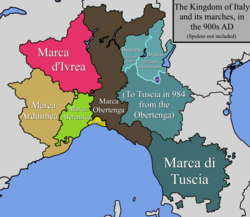
The territory of Marca Obertenga included Lombardy (with Italian Switzerland), Emilia excluding Bologna (later Ferrara), part of the Piemonte (Novara, Tortona and the Overseas with Novi Ligure, Ovada and the Bormida valley) and part of Liguria and Tuscany, from Genovesato to Lunigiana and Garfagnana, and then indirectly also Corsica and part of Sardinia.
Among the most illustrious branches are found Malaspina, Pallavicino, Cavalcabò and the Casa d'Este, therefore the so-called "young Welfen" from which the House of Hanover.
Origins
The origin of the Obertenghi remains controversial. The sources certainly date back to the headmaster Oberto I , Count and magnate in the court of King Berengario II of Ivrea, and one...Explore this chapter
The origin of the Obertenghi remains controversial. The sources certainly date back to the chieftain Oberto I, Count and Marnate in the court of King Berengario II of Ivrea, and one of the three main nobles to be elevated to the markal dignity (at that time princely) by Emperor Otto I together Arduino the Glabro, Marquis of Turin, and Aleramo, Marquises of Savona and Monferrato.[2]
They date back, according to some late genealogists, to Bonifacio, Bavarian nobleman, first Marquis of Tuscany. Against this thesis, the German historian Eduard Hlawitschka, underlined that Oberto I himself claimed to live according to Longobard laws, just like his ancestors[3].
History
Under Byzantine rule, the Maritima Italorum Province was formed with capital in Genoa, but it all passed from 641 before to the Lombards and then to the Franks who...Explore this chapter
Under the Byzantine rule, the Province Maritima Italorum with capital to Genoa, but everything passed from 641 before the Lombards and subsequently to the Franks who unified the pre-existing region, without however modifying the arrangement given by the Romans with the formation of dukedoms Lombard or counties franche. The only effective transformation was the transfer of the capital to Pavia, however remaining the religious one in Milan, seat of the archbishop.
From 614 the Abbey of San Colombano was formed.
For his defense, Bobbio relies on armed guards commanded by the descendants of the Obertenghi.
After the decadence of the 10th century, to the next one after the excommunication of the Bishop Healing and the infiudations since 1164 by Emperor Frederick Barbarossa after the enslavement of imperial and papal protection, the fiefs passed a good part directly to the Obertenghi who extended fortifications and castles with imperial support and subsequently to their descendants of various branches.
The County of Bobbio was reduced only to part of the Trebbia valley, of the Oltrepò, and with the villages of Trebecco, Ruino, Romagnese and Zavattarello in the upper Val Tidone in what will then be the fief of the Malaspina and the Dal Verme.
Division
In 950 - 951 King Berengario II ended the reorganization of Ligurian territory and northern Italy, begun by Ugo di Provenza . He named three new margraves for three...Explore this chapter
In 950-951 King Berengario II ended the reorganization of Ligurian territory and northern Italy, begun by Ugo di Provenza. He appointed three new margraves for three new territories:
- Count Aleramo del Monferrato (Marca Aleramica - Central-West Liguria with Vercelli, the Monferrato, Ceva, Acqui Terme up to the Ligurian coasts of the west from Oneglia to Albenga);
- count of Turin Arduino il Glabro (Marca Arduinica - Torino and Ivrea up to the Maritime Alps and the Ligurian coasts from Nicerdo and Ventimiglia to Sanremo);
- Marquise Oberto I (the great) marquis of Milan and Genoa and count of Luni (the Brand Obertenga, then called Marca Januensis - eastern Liguria).
The latter had been appointed Marquis of Milan and Genoa before 951, with authority on the Committees of Milan, Genoa, Tortona and Luni first belonging to the Brand of Tuscia (ruled directly) and on those of Bobbio, Pavia, Piacenza, Cremona, Parma, and territories in the committees of Modena, Reggio Emilia, Ferrara, Padua, including Monselice and Montagnana, Lucca, including Piazza al Serchio (or Serraplana) Pisa, Volterra, Arezzo, Sorano (or Supra of Grosseto) and others in the Brand of Tuscia, Alba, Acqui Terme, Gavello and Adria (Rovigo); Ascoli Piceno (it was added at a later time), then minor fiefdoms (governed by bishops or abbots or other feudal lords).
The heirs of Oberto I: Adalbert I And Oberto II [(Oberto Obizzo) died in 972] maintained the Marchional office with imperial support from Otto I to Arduino and Corrado II. From the two sons of Oberto I descended the two main lines of the home, the line "Adalbertine" and the line "Obertina".
feudal fractions and family branches
Following the numerous sons of Oberto II of Adalberto I and Tedisio I, the line divided, among others, to the Marquises of Massa-Parodi, called then to...Explore this chapter
Following the many children of Oberto II of the Adalbert I and of Tedisio I, the lineage was divided giving rise, among others, to the Marquises of Massa-Parodi, later called Massa-Corsica at the time of the acquisition of Corsica, to the Marquises Lupi of Soragna, (through female inheritance), to the Marquises of Pallavicino, to the Marquises of Cortona, to the Lords Cortinchi counts of Castagniccia, to the Marchesi di Gavi, to the Marquises Cavalcabò of Cremona, ai Malaspina, to the House of Este and therefore to the house of Braunschweig Luneburg Hannover, which gave the United Kingdom as the last sovereign of this family Queen Victoria (and therefore to the current Windsors), to the Counts of Lavagna and, perhaps, to the Marquises Greco.
Essential genealogy
Explore this chapter
| Adalbert the Margravio *? † 951? N.N. | |||||||||||||||||||||||||||
| Oberto I *? † before 15.X.975 N.N.[4] | Ambrose[5] *? †988 | ||||||||||||||||||||||||||
| Oberto II *? † after 1014/1021 1 N.N. 2 ∞ Railend[6] | Adalbert I *~925 † before III.1002 ∞ Adelaide[7][8] | Adalbert III[9] *? † 1002/1011 N.N. | Anselm *? †? | William[10] *? †? | Berta *? †? ∞ Oberto di Parma | Oberto Obizzo *? †972 | |||||||||||||||||||||
| 2 Ugo *? † after 26.I.1037 ∞ Gisella[11] | 2 Alberto Azzo I * 970 † before 1018 Adele | 2 Oberto Obizzo I *? †? | 2 Berta *? † 29.XII.1037 1 Arduino *? †1015 2 ∞ Older[12] *? †1034/1035 | 2 Adalbert IV[13] *? †1034 ∞ Adelaida[14] | 2 Anselm *? †1047 | Oberto III *? †996 | Adalbert VI *? †1047 | Berta *? †1047 ∞ Lanfranco[15] | Gisella?[16] *? †? ∞ Anselm I[17] | ||||||||||||||||||
| Alberto Azzo II *1009 †?1097 1 Cunegonda *1020 †1057 2 ∞ Gersenda *~1030 † post 1071 3 ∞ Matilde[18] | Adele *? †? ∞ Aledramus II[19] *? † before 1055 | Alberto I ? †? | Adalberto V ? †? | Adalbert II[20] *~980 †~1034 | Ugo ? †? | ||||||||||||||||||||||
 Foreign Affairs | Oberto Obizzo II *? †? | Basketball | Cavalca | ||||||||||||||||||||||||
Malaspina | |||||||||||||||||||||||||||
Marchesi di Massa, Corsica and Livorno
Oberto Brattaportata, third-born of Alberto IV the Rufo, lord of Corsica, generates line of the Marquises of Massa, Corsica and Livorno .Explore this chapter
Oberto Brattaportata, third-born of Alberto IV the Rufo, lord of Corsica, generates line of the Marquises of Massa, Corsica and Livorno.
- Oberto Brattaportata 1138-1145
- 1. Alberto 1146, for 1/3
- 2. Alberto il Corso 1146, for 1/3
- 3. Gerardo 1146, for 1/3
- 1. Upezzino
- 1. Albertaccio 1329, leaves Bindo Benigni as heir.
- 2. William 1184
- 2. Andrew 1199
- 2. Albert 1250.
- 3. William ?
- 3. Course 1369
- 3. Lemmuccio ?
- 3. Corsuccio 1361, donates the marquisate to the municipality of Livorno.
Notes
Explore this chapter
- ^ Ercole III d'Este (1727–1803), Duke of Modena and Reggio from 1780 to 1796, and his son-in-law Ferdinand of Habsburg-Lorena (1754–1806) were the only two dukes of Brisgovia and Ortenau, respectively from 1801 to 1803 and from 1803 to 1805.
- ^ Obertenghi - Encyclopedia, up Treccani. Retrieved 16 November 2024.
- ^ Eduard Hlawitschka: Franken, Alemannen, Bayern und Burgunder in Oberitalien. 1960, S. 244–245.
- ^ Daughter of Suppone the Black.
- ^ Bishop of Aléria
- ^ Daughter of Count Riprando.
- ^ Daughter of Boson I of the Counts of Sabbioneta (*? †1033),
- ^ A. Accounts, The ascenders of the Casaloldo. The Counts of Sabbioneta and the last counts of Parma between Garda and Po (Secc. XI-XIII), in M. Vignoli, Casaloldo and the battle of 10 May 1509, Mantua, 2009.
- ^ Count.
- ^ Marquis from Cortona
- ^ Daughter of Count Gisalberto II of Bergamo.
- ^ Member of the Arduinici.
- ^ Marquis.
- ^ Daughter of Count Boso.
- ^ Count of Piacenza.
- ^ Maybe Adalberto III's daughter.
- ^ Margravio, member of the Aleramics.
- ^ Sister of William, Bishop of Pavia (Aleramics).
- ^ margrave of Saluzzo
- ^ Litta, 1838.
Bibliography
Explore this chapter
- Mario Nobili, The heritage of the Obertenghi. The Obertenghi and other essays, Spoleto, Fond.Centro it. st. High Middle Ages, 2006, ISBN 88-7988-248-1.
- Mario Nobili, The territorial lords of the Obertenghi in Lunigiana, in Amleto Spicciani and Cinzio Violante (eds.), The rural lordship in the Italian Middle Ages, Pisa, ETS Editions, 1997, pp. 19-37.
- Mario Nobili, Some considerations about the extension, territorial distribution and the significance of the heritage of the Obertenghi (half century X-earth century XII), in Formation and structures of the dominant classes in the Middle Ages: Marquises, accounts and visconti in the Italic Kingdom (Secc. IX-XII), Rome, Italian Historical Institute of the Middle Ages, 1988.
- A. Basketball Politics, marriage alliances and genealogy of the first Marquises Obertenghi in the X and XI centuries, Quaderni obertenghi, n.1, Rome 2005, page 12
- Roberto Ricci The brand of Eastern Liguria and the Obertenghi (945-1056), CISAM, Spoleto, 2007
- C. Dynasty On the brands of Italy and on their division in marquisati, 2nd edition, in Acts of the Soc. Ligurian history of homeland, XXVIII, Genoa 1896, p. 108 ff.
- Eleonora Destefanis, Paola Guglielmotti The diocese of Bobbio. Training and development of a millenary institution, Editrice Reti Medievali, Florence 2015
- L. A. Walls Extended and Italian antiquities, vols. 1 and 2 with genealogical tables, Modena, 1717-1749
- L. A. Walls Of the Extended Antiquities, Naples 1776
- H. Bressla Jahrbücher d. deutschen Reichs unter Konrad II, I, Leipzig 1879 (Excurs, IV, part 3a: Das Haus der Obertiner oder Estenser, pp. 414-30)
- E. Hlawitsch Franken, Alemannen, Bayern und Burgunder in Oberitalien (774-962). Zum Verständnis der fränkischen Königsherrschaft in Italien, Freiburg im Breisgau, 1960, pp. 244-245
- F. Bouncer Entre Gandolfinigi et Obertenghi: les comtes de Plaisance aux Xe et XIe siècles, in «Mélanges de l'École française de Rome. Moyen-Ége, Temps modernis», 101 (1989), pp. 11-66
- S. Pivano State and Church from Berengario I to Arduino, Turin 1908, pages 139-145
- F. Cabinet From Berengario I to Arduino, in Arch. Stor. Ital.,s. 5, XLII (1908), p. 320
- F. Cabinet The Marquises Obertenghi, in Giorn. Stor. by Lunigiana, IX (1918), pp. 9, 10-14
- F. Cabinet The Marquises Obtaining (Conti di Tortona) until the peace of Luni (945-1124), in For the history of Tortona in the age of the Municipality, Library of the Subalpine Historical Society XCVI (1922-1925), pp. 149-190
- U. Supplies Brand Januensis, Pontremoli 1926
- U. Supplies Genoa in the lower empire and in the high Middle Ages, Milan 1941, pp. 218 ff.
- C. Violation The Caractéristiques des structures familiales en Lombardie, Emilie et Toscane au XIe et XIIe siècles, in Famille et parenté dans l'Occident médiéval, Rome, 1977
- C. Violation Family structures, relatives and consortia of aristocracies in Tuscany during the X-XII centuries, in The executive classes in Tuscany at the pre-communal age, Pisa, 1981, p.55
- Pompeo Litta, D'Este, in Popular Italian families, 1832.
- Pompeo Litta, Basketball, in Popular Italian families, 1838.
Continue your journey