Atlas of Monferrato
Belforte Monferrato: sights, history and trails
Alessandria
- Elevation
- 297 m above sea level
- Area
- 8,33 km2
- Demonym
- Belforts
- Patron saint
- Nativity of the Blessed Virgin Mary
A closer look
Discovering Belforte Monferrato
Belforte Monferrato (Berforte in Liguria, Balfórte [bal'fortɛ] according to the pronunciation autoctona) is an Italian municipality of 487 inhabitants[2] from the province of Alessandria in the Piemonte. It is one of the municipalities of Ovadese, historical-cultural area of Basso Piemonte and the Monferrato, which takes its name from the city of Ovada.
Landscape and area
Region · ClimateExplore this chapter
Region
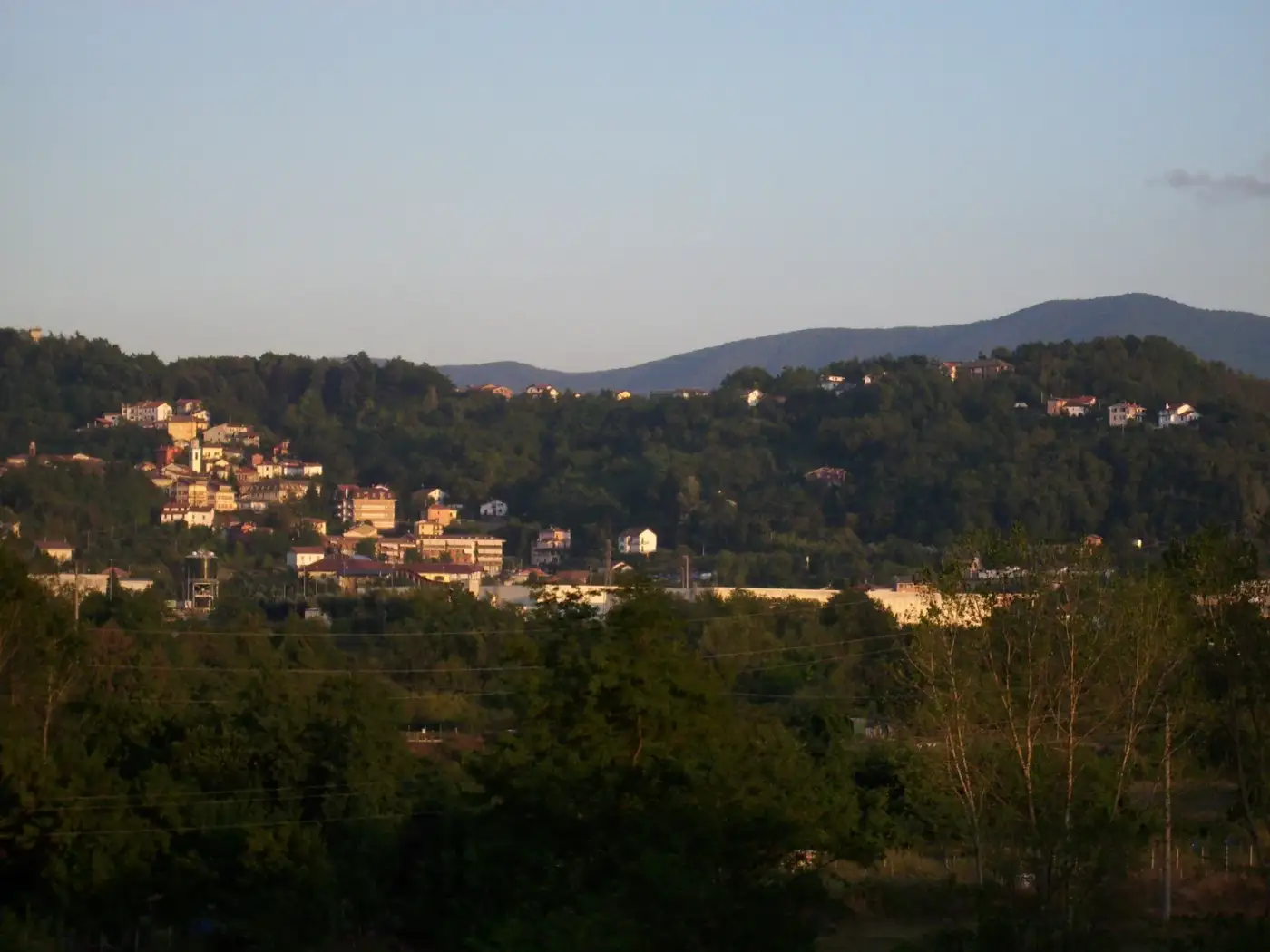
The village is situated on the extreme hilly slopes of the Ligurian Apennines, on the right end of the valley of the Stura stream at the border with Liguria. The municipality has the characteristics that most qualify the high Monferrato: a wooded area still intact that flanks the right bank of Stura with small urban centers; a hilly area of fine vineyards, in which the village is located, lying on a counterfeit at the foot of the castle, residence patrizia; in the last and wide bend of the creek there is a fertile plain rich of sources.
Climate
History of Belforte Monferrato
SymbolsExplore this chapter
It still preserves the medieval topography, drawing origin from a primitive Christian nucleus aggregated in the adjoining of a distant monastery, founded by monks of Bobbio. The monastery was located in a locality called of the Faldellino, between the Turchino state road and the left bank of the Stura stream. The lay community had to settle instead on the right bank of the stream, in the plain below, in the current area of San Colombano, where a chapel was built which, despite numerous renovations, can still be recognized as dating back to the early Middle Ages. A first inhabited center arose with the name of Bellum Fortium in the 10th century with the movement of the population from the valley floor, to occupy the area of the Castle. Subsequently, for security reasons the population abandoned the valley floor and the Church of San Colombano served only as a cemetery. Some of the inhabitants settled on the hill, near defensive buildings, where the oratory is present.
After the assault and destruction of Giusvalla Abbey by the Saracens and the continuous raids on the territory, after a few years such episodes convinced Anselmo, son of Marquis Aleramo, to erect the new abbey of San Quintino[5] of the Spigno Monferrato, as a form of contrast to raids and defense of pilgrims and trade routes.
In 934, the Burgundian kings of Italy Ugo di Provenza and Lotario II granted these funds to Aleramo del Monferrato. The concession was confirmed in 967 by Otto I. At that time in official documents the name often appears Bellum Fortium (Belforte), a name that recalls the defensive fortification of this Apennine valley.
After several events, in which the Republic of Genoa was also involved in transits towards the Po Valley, Belforte Monferrato passed under the dominion of Malaspina of the Cremolino. In 1328, the area and the castle passed under the Spinola family of Genoa. In 1539, Giambattista Spinola died, and the territory passed to the Grimaldi family until 1652, when Patrizio Cattaneo della Volta took over as marquis. The Cattaneo della Volta will be the last lords of Belforte. the territory passed under the Savoys until the unification of Italy.
In 1863 the municipality of Belforte assumed the new name "Belforte Monferrato".[6]
From 1927 to 1947 Belforte was shortened to the commune of Tagliolo Monferrato.
Symbols
The coat of arms of the municipality of Belforte Monferrato, was granted by the decree of the President of the Republic of 4 October 1955.[7]
The blue bands derive from the blason of the Marquises Cattaneo of the Face of Belforte.[8] The banner is a blue and white banner.
What to see in Belforte Monferrato
Belforte Castle · The parish church of the Nativity of Mary and Saint Colombano · Other places of historical interestExplore this chapter
Belforte Castle
Belforte Castle was built between the '400 and the '600 around the massive and high square-shaped tower, built by the Genovese Republic, around 1100, for the control of the border with Monferrato and defense of one of the high-medieval roads, that from Genoa via Capanne di Marcarolo, descended to Ovada and continued towards Acqui Terme.
Near the site where there was originally both the monastery of San Colombano del Faldellino, founded by an abbot of the Abbey of San Colombano di Bobbio[9], that the church of San Benedetto (7th century), still existing, became the first village, the locality Pastori, residence of the feudal lords who succeeded one another in possession of the fiefdom: Obertenghi, Malaspina, Spinola, Grimaldi, Cattaneo della Volta.
The parish church of the Nativity of Mary and Saint Colombano
The church of the Nativity of Virgin Mary and Saint Colombano, built at the end of the fifteenth century, preserves on the bell tower a golden statue of Our Lady and inside a canvas depicting the Crucifixion, attributed to the school of the painter Domenico Fiasella.
Other places of historical interest
Among the places of less historical interest are the ancient parish church of San Colombano, located at the cemetery and the oratory of San Rocco, seat of the brotherhood of Santissima Annunziata, which is characterized by an interesting meridiana.
Society
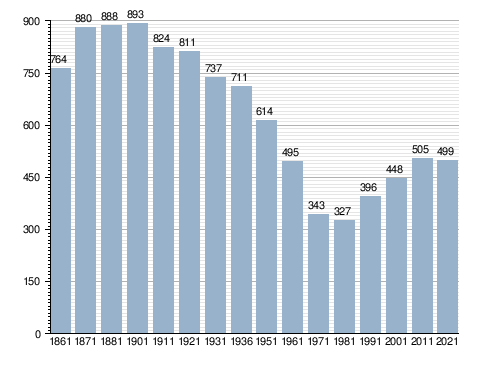
Demographic evolutionExplore this chapter
Demographic evolution
Inhabitants registered[10]
Economy
The economy is mainly based on agriculture, especially viticulture, with fine grapes, a grape bunch stands out in the coat of arms of the country and on small industries and...Explore this chapter
The economy is mainly based on agriculture, particularly viticulture, with fine grapes, a grape bunch stands out in the coat of arms of the country and on small industries and artisan laboratories. The monks, as well as wise guardians of culture, have been able to collect the dispersed people, teaching a rational use of the territory, directing the people on local resources by addressing them in crops suitable for the environment. It is due to the initiative of the monks of San Colombano if in Belforte the vineyards have developed, conquering priorities and merits in the wine tradition.
Administration
Below is a table relating to the administrations that have succeeded one another in this municipality.Explore this chapter
Below is a table relating to the administrations that have succeeded one another in this municipality.
| Period | First citizen | Match | Load | Notes | |
|---|---|---|---|---|---|
| June 10, 1985 | May 23, 1990 | Giovanni Battista Alloisio | Italian Communist Party | Mayor | [11] |
| May 23, 1990 | April 24, 1995 | Giovanni Battista Alloisio | Italian Communist Party | Mayor | [11] |
| April 24, 1995 | June 14, 1999 | Giovanni Battista Alloisio | centre-left | Mayor | [11] |
| June 14, 1999 | June 14, 2004 | Giovanni Battista Alloisio | civic list | Mayor | [11] |
| June 14, 2004 | June 8, 2009 | Franco Ravera | civic list | Mayor | [11] |
| June 8, 2009 | May 26, 2014 | Franco Ravera | civic list | Mayor | [11] |
| May 26, 2014 | May 27, 2019 | Franco Ravera | list civic Grappolo d'uva con spighe | Mayor | [11] |
| May 27, 2019 | June 9, 2024 | Nadia Incerpi | civic list Grappolo d'uva and wheat ears | Mayor | [11] |
| June 9, 2024 | in office | Nadia Incerpi | List of people in Monferrato | Mayor | [11] |
Image gallery
Explore this chapter
-
 Church of the Nativity of Mary
-
 Statue of the Church of the Nativity of Mary
-
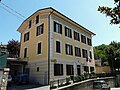 City hall
Notes
Explore this chapter
- ^ Municipality of Belforte Monferrato : Municipal Administration and Mayor - City of Belforte Monferrato and city, Alessandria, Piemonte, up www.comune-italia.it. URL consulted on 5 August 2026.
- ^ to b Monthly demographic balance for the year 2026 (provisional data), up demo.istat.it, ISTAT.
- ^ Seismic classification (XLS), up risks.protezionecivile.gov.it.
- ^ Table of degrees/day of Italian Municipalities grouped by Region and Province (PDF), in Law 26 August 1993, n. 412, annex A, National Agency for New Technologies, Energy and Sustainable Economic Development, 1 March 2011, p. 151. URL consulted on 25 April 2012 (archived fromoriginal url on 1 January 2017).
- ^ Source from the book Enzo Bernardini, Edges in the green. Journey to the hinterland of the Ligurian Riviera delle Palme, San Mauro (TO), Tipografia Stige, 2003.
- ^ Royal decree 11 January 1863, n. 1126, regarding "Decree authorizing various municipalities in the provinces of Milan, Alessandria, Brescia, Cremona, Turin, Ascoli, Macerata, Cuneo, Piacenza, Porto-Maurizio, Ravenna and Sassari to take on a new name."
- ^ Belforte Monferrato, up Heraldic office - Municipal files, Central State Archives. Retrieved 12 July 2026.
- ^ to b Municipality of Belforte Monferrato – (AL), up araldicacivica.it. Retrieved 23 October 2021.
- ^ The history of Belforte Castle, up castledibelforte.com. Retrieved 30 May 2012 (archived fromoriginal url on 5 March 2016).
- ^ Data taken from:
- Resident population of the municipalities. Censuses from 1861 to 1991 (PDF), up ebiblio.istat.it, ISTAT.
- Resident population - Time series, up exploredati.istat.it.
Please note: 2021 data refers to permanent census data as of December 31 of that year.
- ^ to b c d And f g h the http://amministratori.interno.it/
Bibliography
Explore this chapter
- AA.VV., The Piemonte country by country, Florence, Ed. Bonechi, 1993.
Where to stay · Belforte Monferrato
Find stays on Booking.comThe area, step by step
Trails and routes in Belforte Monferrato
 CyclingPlaces and landscapes along the route
 Mountain bikeAround the starting point
Asti, Alessandria and surroundings