A closer look
Tassarolo County: at a glance
The Tassarolo County It was a imperial fief mediated from 1560 to 1736, governed by the Spinolas of Luccoli. The small village, today in province of Alessandria, was located on the terminal hilly extensions of the Ligurian Apennines, in a strategic area between the Duchy of Savoy, the Monferrato and the Republic of Genoa. The Staterello was also famous for the activity of its mint. From 1736 to 1797 it always enjoyed autonomy, but depended on the Savoys, into whose kingdom it was definitively incorporated in 1815.
History
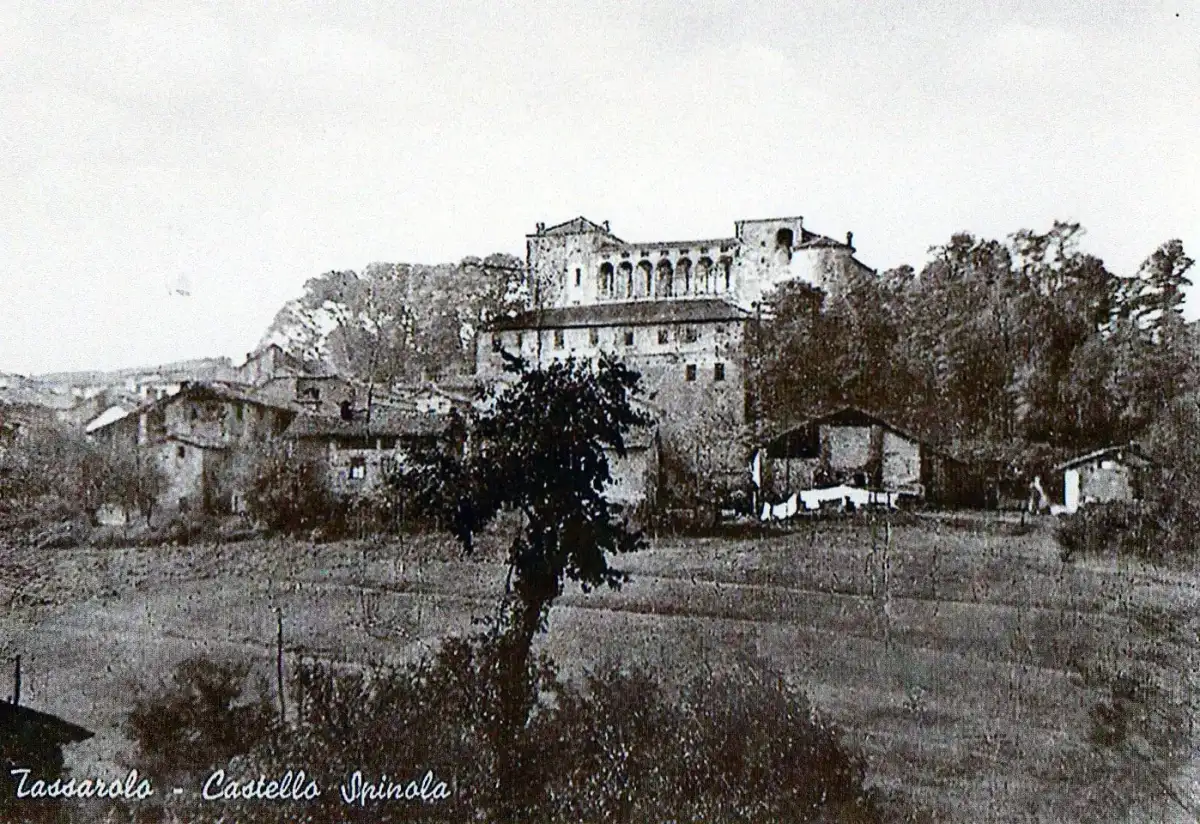
The small fief was built on the slopes of the solid bastions of the castle (all belonging to the Spinola family), on the right of the Lemme stream and included the...Explore this chapter
The small fief was built on the slopes of the solid bastions of the castle (all belonging to the Spinola family), on the right of the Lemme stream and included the villages of Alborina, Cavallari and Ortolana.
From the Republic of Genoa passed to the families Di Negro, De Camilla and Castagna: a branch of the powerful family of Genoa Spinola postponed it definitively from 16 October 1367 through the brothers Galeotto, Adamo and Carrozio (the latter, descended from Oberto Guglielmo - 1208 - with his son Ettore will be the headsets of the comitale line of Tassarolo), sons of Napoleon.[1]
The first imperial investiture (all will be twelve) was granted on 20 November 1532 by Charles V to Augustine, Charles and Bartholomew. On 30 May 1560 Emperor Ferdinand I raised the fief to the rank of imperial county and gave Marcantonio, son of Augustine and Geronima Doria, the title of Count Palatine. Seven accounts will be administered until 27 June 1797.[2]
In the years of the succession war in Mantua and Monferrato (1628-1631) the county was occupied by the French armies who devastated the territory. In 1630, however, in the castle, promptly restored, he housed Cardinal Diechtristen who, with the Counts Philip and Livia, welcomed with due honors the infant Maria Anna of Habsburg, sister of King Philip IV of Spain and future Empress, as wife of Ferdinand III.[3]
In 1689 Leopold I granted Count Maximilian I the right of first-bornness together with the prerogative of beat the coin[4].
In 1736, the county of Tassarolo ceased to be imperial fief and under the king of Sardinia Charles Emmanuel III entered into the domains of Savoy, while retaining autonomy and investment in Augustine II Spinola. The Savoy king Vittorio Amedeo II made public in vulgar language the statutes of Tassarolo emanated in 1530.[5]
On 27 June 1797 Napoleon Bonaparte promulgated the ever-sive laws of feudalism: the former county, after the Congress of Vienna, was resolutely incorporated into the kingdom of Sardinia on 10 October 1818, under Vittorio Emanuele I of Savoy, and united to the province of Sardinia. Novi Ligure. The last count Agostino Mario died in 1816: he had three nun sisters, Paola Maria, Paola Teresa, Rosa Serafina and a younger brother, Bendinelli, who died in 1786.[6]
In addition to the castle of Tassarolo, where they used to reside, the counts dwelt in the palace Nicolò Spinola di Luccoli, in Genoa; in the summer or country residences of Pietrabissara, of the "Massimiliana" to Gavi, "dell'Aureliana" a Capriata d'Orba. The family's burial place was in Genoa in the church of Santissima Annunziata di Portoria, known as Santa Caterina. In addition to captains and cardinals, the Luccoli branch included the blessed Carlo Spinola (1564-1622), son of Ottavio, Jesuit, missionary and martyr in Japan.[7]
Of the primitive Tassarolo comitale castle, a quadrangular plan with high central tower within a secure fortified fence of minor corner towers, later mozzate, still remains a cylindrical mastium on the right corner of the side prospectus. This is adorned by an elegant Renaissance loggia facing the ancient mint's seat. Sleepy interior living rooms and a flourishing garden make the residence very pleasant,[8]
Zech
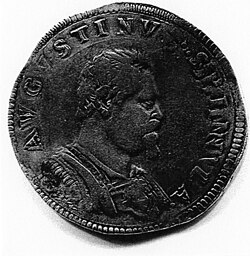
The first coins were minted in 1604 by Augustine I .Explore this chapter
The first coins were minted in 1604 by Augustine I[9].
The building, in which the monetary workshop was activated, was an integral part of the castle at the foot of the 16th century loggia.[4]. The mint maker was master Domenico D'Alessandro, the engraver Giacomo Brandi[9].
Of the right of mint, granted to the Spinola in general, they only used the palatine accounts Tassarolo, the counts, then marquises, of Ronco, the marquises of Arquata Scrivia and those of Vergagni[9].
For the fief of Tassarolo gold coins were also minted: 2 Doubles or quadruples, duchies and ongari. For all the fiefs that exercised the right of mint were coined silver: shields and fractions of shield; and luigini[10]. A part of the luigini was secretly adulterated and sent to Genoa in bags hidden between the wine and cheese, on the back of a mule[4].
The last coins were minted in 1688 with the effigy of Philip and Livia Centurioni[9].
Tassarolo accounts (1560-1797) [ 11 ]
Explore this chapter
| No. | Title | Name | Period | Consort |
| 1 | Count | Marcantonio Spinola | 1560-1604 | Cornelia De Marini Castagna |
| 2 | Count | Augustine I | 1604-1616 | Wild Spinola of Cabella; without offspring |
| 3 | Count | Philippine | 1616-1688 | Livia Centurioni-Oltremarini, regent; nephew of Augustine I |
| 4 | Count | Massimiliano I | 1688-1714 | Maria Pichenotti |
| 5 | Count | August II | 1714-1739 | Giulia De Mari |
| 6 | Count | Maximilian II | 1739-1778 | Maria Negroni |
| 7 | Count | Augustine Mario | 1778-1797 | Enrichetta De Carlon Nizos |
Notes
Explore this chapter
- ^ Castles of the Genovesato, p. 9
- ^ Ravegnani Morosini, p. 289
- ^ Sisto, p. 86
- ^ to b c Sisto, p. 139
- ^ Tacchella, p. 30
- ^ Tacchella, p. 32
- ^ Castles of the Genovesato, p. 11
- ^ Castles of the Genovesato, p. 10
- ^ to b c d Ravegnani Morosini, p. 290
- ^ exhibition catalogue The numismatic collection of Banca Carige, Cinisello Balsamo, Silvana, 2004-06. pages 205-216
- ^ Ravegnani Morosini, p. 288
Bibliography
Explore this chapter
- AA. VV., Castles of the Genovesato, Oltregiogo and Riviera di Levante, Istituto Italiano dei Castelli, Rome 1966.
- Mario Ravegnani Morosini, Ladies and gentlemen, III, ed. Maggioli, Dogana (San Marino) 1984.
- Alessandra Sisto, The imperial fiefs of Tortonese (Sec. XI-XIX), Faculty of Letters and Philosophy of the University of Turin, Turin 1956.
- Lorenzo Tacchella, Tassarolo in the history of monasticism, Spinolas, Ligurian imperial fiefs and Knights of Malta, Library of the Olubrense Academy, Milan 2001.
Continue your journey