Atlas of Monferrato
Grondona: sights, history and trails
Alessandria
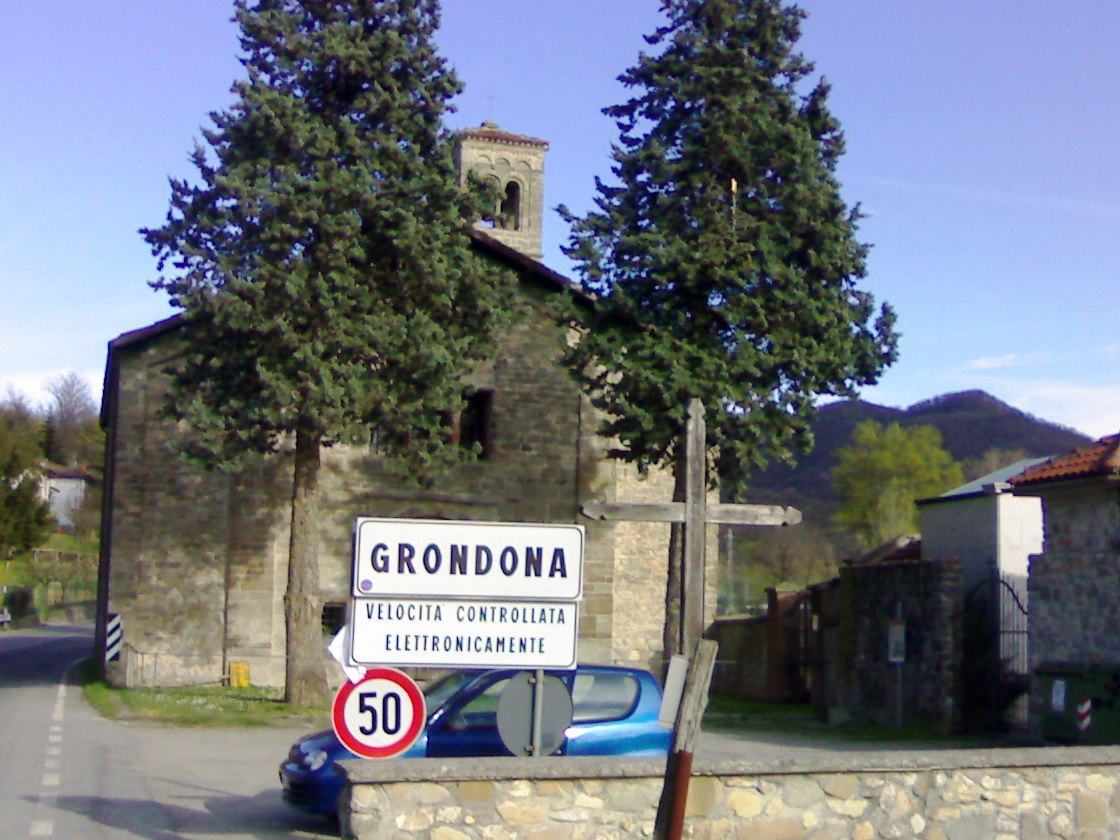
- Elevation
- 303 m above sea level
- Area
- 25.94 km²
- Demonym
- grondonese
- Patron saint
- San Sebastiano
A closer look
Discovering Grondona
Grondona (Grondyuna in Piedmontese, Grundùn-a in Liguria) is an Italian municipality of 473 inhabitants[1] from the province of Alessandria in the Piemonte
The municipality is located on the Spinti torrent, the parotic of Scrivia, the only town completely in the homonymous valley.
History of Grondona
SymbolsExplore this chapter
The area was infeuded by the Carolingians to the Marchesi di Gavi under Pavia. Grondona was first mentioned in an imperial document in 1164 when the Emperor of the Holy Roman Empire Frederick I "Barbarossa" confirming the privileges of the Municipality of Pavia, to which Grondona was subjected. In 1176 Grondona was integrated into the domains of the commune. Tortona. In 1181 the lords of Grondona who were Alberto Becco, Corrado, Alberto and Guglielmo Pavese swore loyalty to the municipality of Tortona, in exchange the municipality to the same Grondona. In 1181 the Marquis Guido II, Marquis of Gavi the half of Grondona's castle and other castles at the price of 600 silver denaries including towers, walls, moats and any good were inside and outside of them including relevant rights and income. In 1185 the consuls of Tortona they promised protection to the Milanese who had gone through the Scrivia Valley and the jurisdiction of the city, where are the de Grondona, lords of Grondona, who then passed under the protection of the bishops of Tortona. In the period 185-1192 there were frequent Genoese raids which made the bishop fear Tortona the faithfulness of Grondona's lords. In 1192 Grondona swore loyalty again to Tortona with the intermediation of the marquises of Gavi and of Parodi Ligure, allies of Tortona. Between 1198 and 1202 the marquises of Gavi Alien complete their feudal rights on Grondona. The de Grondona are therefore the only gentlemen of the place and in 1210 they swear allegiance to Tortona. In 1259 it was established as an autonomous municipality, governed by a mayor, the first being the lord of the place Federico da Grondona, also lord of Dernice, Roccaforte Ligure and Mangioncalda of Carrega Ligure. Between 1294 and 1310 Percivalle Fieschi, future bishop of Tortona bought by the lords of Grondona part of the fief that was then administered in condominium between Fieschi, Marquisi di Gavi and Grondona's gentlemen. In 1350 after a dispute resolved by the lieutenant of the Generardo Empire of Arnstein, the boundaries of the fief with the communities of Montessoro di Isola del Cantone and Roccaforte Ligure. In 1369 the boundaries of the fiefdom with the communities of Prato di were delimited Cantalupo Ligure And Roccaforte Ligure. In 1433 Nicolò Fieschi swore loyalty to the Viscontis. In 1457 it definitively passed under the Duchy of Milan, but in 1471 it was returned to Nicolò Fieschi. In 1457 the Marquis of Fosdinovo Giacomo I Malaspina was castellan of Grondona for the Duchy of Milan, in 1477 he was returned to Nicoló Fieschi, given that he had sworn loyalty to the new Duke of Milan Gian Galeazzo Sforza. In 1547 it passed together with Vargo di Stazzano to Andrea Doria who will make it imperial fief, but in 1560 he returned to Malaspina, who held it until 1797. In 1736 with the County of Tortona it passed to the Savoy. in 1797 it became part of the Ligurian Republic, in 1805 of the French Empire and in 1815 it became part of the Kingdom of Sardinia in Province of Novi in the Division of Genoa, from which it is detached in 1859 with the decree Rattazzi to become part of province of Alessandria and therefore of Piemonte. From 1943 to 1945, fighting between Nazis and partisans took place. Grondona was released on April 27, 1945. In 1968 he received the villages of Cà di Lemmi and Lemmi from the municipality of Lemmi Roccaforte Ligure.
Symbols
The coat of arms and gonfalone of the municipality of Grondona were granted by decree of the President of the Republic of 19 October 1997.[4]
The gonfalone is a yellow drape.
What to see in Grondona
The façade features a portal with a full-six arch, sculpted a cross, three lilies and God's blessing hand. The architrave, on the other hand, is smoothly connected to columns...Explore this chapter
- A castle was built in 1181 on the initiative of bishops of Tortona. The building was oblong in shape, with three cylindrical towers and a chapel, followed the history of Grondona and was abandoned in 1797. On 12 April 1934 it was destroyed by a landslide which caused ten victims. The only surviving part was the tower of the Fieschi-Doria castle.
- The parish church of Our Lady Assunta in the capital, built in the nineteenth century instead of a previous oratory dedicated to Saints Fabiano and Sebastian.
- The church of the Assumption, in Romanesque style of the 12th century, was built in the jurisdiction of San Vittore di Borghetto di Borbera. Since its origins, the town cemetery has incorporated part of it. It was remodeled and enlarged between 1645 and 1647 and in 1756.
The façade features a portal with a full-six arch, sculpted a cross, three lilies and God's blessing hand. The architrave instead is smooth connected to columns finished in crochet. The bell tower is square, four-storey high marked externally by frames of sawdust and with mirrors with blind hanging arches. The bell-cell is opened by two-periods with a pillar that ends with a die cap.
Inside it houses frescoes with St. Anthony Abbot, San Giacomo di Compostela, St. Peter and St George, the Virgin in the act of basing the devil, between St. Andrew and Saint Anthony Abbot, a work by Antonio Barbe from 1649 and the Madonna with Child among Saints Peter and Paul, 15th century.
- The parish church of Variana is dedicated to San Colombano. Between Variana and Chiapparolo there is the ancient Torre di San Colombano, in the time of the ancient Church of San Colombano no longer existing[5][6].
- The parish church of Chiapparolo is dedicated to Our Lady of Carmine. Inside there is a altarpiece (painted oil on canvas) depicting the Madonna with Child, work by Guglielmo Caccia known as "Moncalvo". There is also a wooden sculpture from the Maragliano school depicting the Madonna and Child.
Society
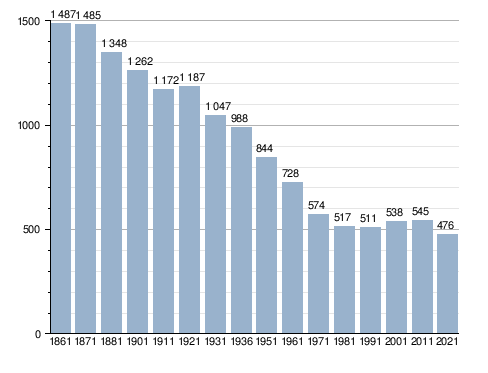
Demographic evolutionExplore this chapter
Demographic evolution
Inhabitants registered[7]
The following are the largest groups of foreigners (at 31 December 2014):
| Citizenship | Population |
|---|---|
 Romania |
23 |
| Rest of the World | 11 |
| TOTAL | 34 |
Events
Explore this chapter
- Sagra of goat and fersulla. Last weekend of August.
Administration
Below is a table relating to the administrations that have succeeded one another in this municipality.Explore this chapter
Below is a table relating to the administrations that have succeeded one another in this municipality.
| Period | First citizen | Match | Load | Notes | |
|---|---|---|---|---|---|
| November 16, 1985 | June 3, 1990 | Antonio Luigi Pratolongo | independent | Mayor | [8] |
| June 3, 1990 | April 24, 1995 | Antonio Perassolo | Christian Democracy | Mayor | [8] |
| April 24, 1995 | June 14, 1999 | Antonio Luigi Pratolongo | centre-left | Mayor | [8] |
| June 14, 1999 | June 14, 2004 | Antonio Luigi Pratolongo | civic list | Mayor | [8] |
| June 14, 2004 | June 8, 2009 | Mario Sassi | civic list | Mayor | [8] |
| June 8, 2009 | May 26, 2014 | Mario Sassi | civic list | Mayor | [8] |
| 6 June 2014 | May 27, 2019 | Silvio Barbieri | civic list Noi per la Valle Spinti | Mayor | [8] |
| 7 June 2019 | in office | Silvio Barbieri | civic list Noi per la Valle Spinti | Mayor | [8] |
Notes
Explore this chapter
- ^ to b Monthly demographic balance for the year 2026 (provisional data), up demo.istat.it, ISTAT.
- ^ Seismic classification (XLS), up risks.protezionecivile.gov.it.
- ^ Table of degrees/day of Italian Municipalities grouped by Region and Province (PDF), in Law 26 August 1993, n. 412, annex A, National Agency for New Technologies, Energy and Sustainable Economic Development, 1 March 2011, p. 151. URL consulted on 25 April 2012 (archived fromoriginal url on 1 January 2017).
- ^ Grondona, decree 1997-10-23 DPR, concession of coat of arms and gonfalone, up Central State Archive.
- ^ Cultural heritage: Torre di San Colombano, up common.grondona.al.it. Retrieved 20 September 2021 (archived fromoriginal url 25 September 2021).
- ^ Grondona (AL): Torre di San Colombano, on the portal Archeocarta, up archeocarta.org.
- ^ Data taken from:
- Resident population of the municipalities. Censuses from 1861 to 1991 (PDF), up ebiblio.istat.it, ISTAT.
- Resident population - Time series, up exploredati.istat.it.
Please note: 2021 data refers to permanent census data as of December 31 of that year.
- ^ to b c d And f g h http://amministratori.interno.it/
Bibliography
Explore this chapter
- AA.VV., The Century XIX 1886-1986, Il Secolo XIX, 1986.
- Davide Canazza, Ennio Cirnigliaro, Sergio Pedemonte, New findings of Roman tarpaulins in the Mountain Libanese, Libreria dell'Oltregiogo, n. 1, 2015.
Where to stay · Grondona
Find stays on Booking.comThe area, step by step
Trails and routes in Grondona
 WalkingAround the starting point
Asti, Alessandria and surroundings
Sentiero grondona - lemmi - costa dei gatti

Asti, Alessandria and surroundings
Sentiero grondona - persi

Asti, Alessandria and surroundings
Sentiero grondona - pian dei poggi
 WalkingAround the starting point
Asti, Alessandria and surroundings
Sentiero bivio campomagro - pian dei poggi

Asti, Alessandria and surroundings
Sentiero bivio campomagro - bivio rio gavassana
Asti, Alessandria and surroundings
Sentiero bivio mulino di sopra - cascina baro
 WalkingAround the starting point
Asti, Alessandria and surroundings