Atlas of Monferrato
Borghetto di Borbera: sights, history and trails
Alessandria
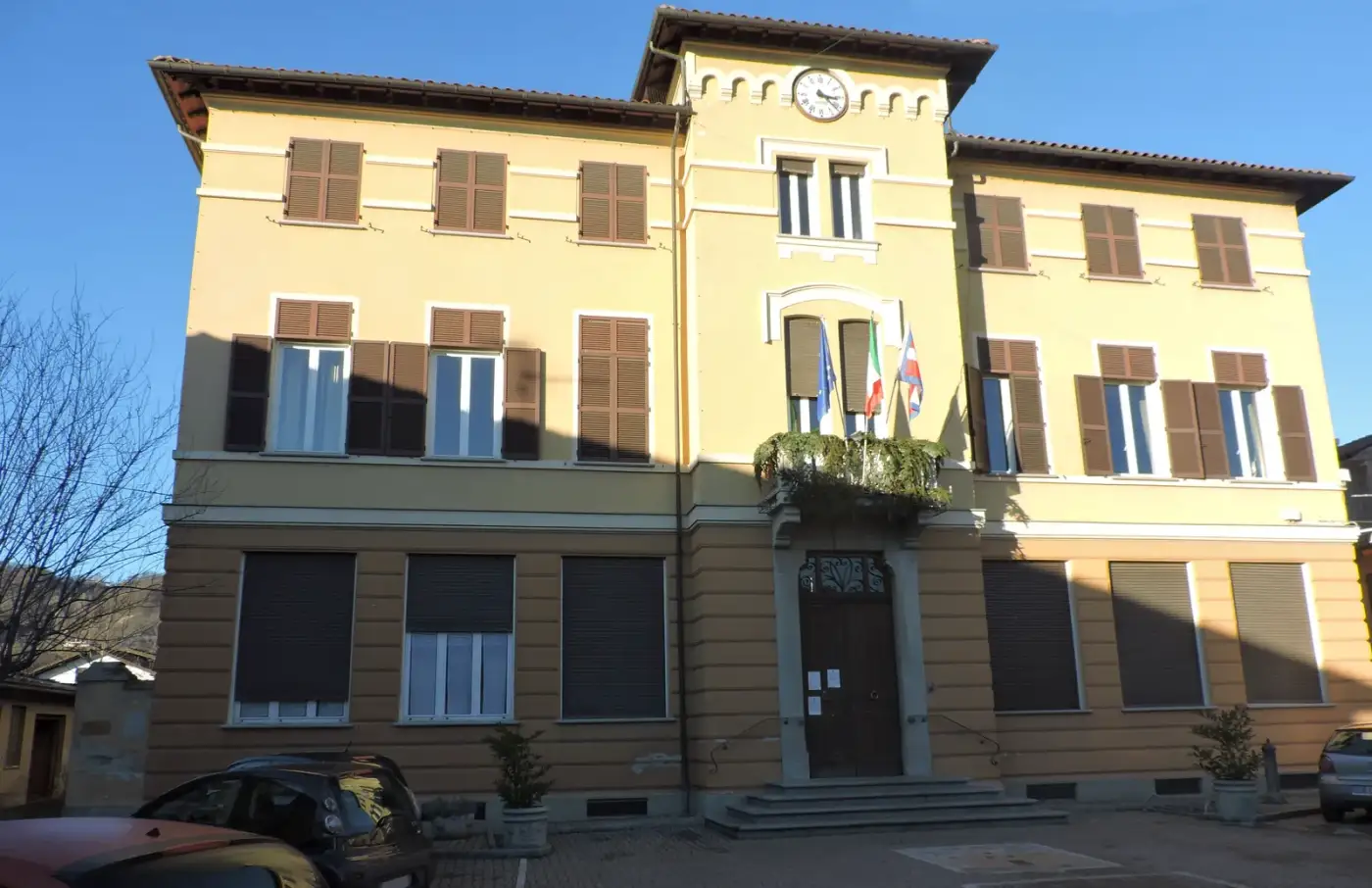
- Elevation
- 295 m above sea level
- Area
- 39.4 km²
- Demonym
- bourgeois
- Patron saint
- San Vittore and Madonna della Neve
A closer look
Discovering Borghetto di Borbera
Borghetto di Borbera (Borghet Borbaja in Piedmontese, O Borgheto in Liguria) is an Italian municipality of 1 899 inhabitants[2] from the province of Alessandria in the Piemonte, located on the right of the Borbera stream, in the lower valley.
History of Borghetto di Borbera
SymbolsExplore this chapter
Of uncertain origin, in 1204 is attested in the forms of Burchetus or Burghetus (small village)[without source]; is initially identified as the Borgo degli Aimerici (Burgum de Aymerixiis or Burgus Aymericorum), according to tradition from the name of the founder Aimerico, viscount of the bishop of Tortona, who had it built in the 11th century with military functions. In reality the foundation must be placed within the 13th century by the Aimerici family, related to the bishops-counts of Tortona. It is mentioned for the first time in a notarial document from 1319.[5] It was controlled by the Duchy of Milan, then passed in 1748 under the control of Savoy, of which it followed the events. In 1797 he joined the Italian Republic and from 1805 of the French Empire. From 1815 to 1859 he was a commune of Province of Novi, part of the Genoa Division.
The determining Borbera indicates the torrent, whose name derives from the ancient Boring, "running water", "river".[6]
Symbols
The coat of arms and gonfalone of the municipality of Borghetto di Borbera were granted by decree of the President of the Republic of 17 May 1986.[7]
The gonfalone is a drape party of yellow and green.
What to see in Borghetto di Borbera
Religious architecture · Church of St. Anthony · Church of San VittoreExplore this chapter
Religious architecture
Church of St. Anthony
Born as the church of Sant'Antonino, it became the church of St. Anthony. It is located just outside the village, in the direction Vignole Borbera. Of medieval origin, it was rebuilt and expanded in the '600; has a simple shape, with a hut facade surmounted by a fresco depicting the Madonna and Saint Anthony of Padua who intercedes for saint Rita. Above one of the two openings an epigraph dated 1681 is visible. The apse remains the medieval one from the 12th century.
Church of San Vittore
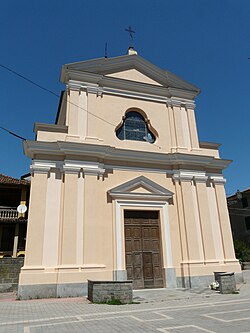
Founded as an oratory of St. John the Baptist, it was then transformed into a church of San Vittore, after that the homonymous (which was located at the present cemetery) was demolished around the 1779. The ancient oratory remains traces of the outer masonry near the apse. The present church has simple forms; the façade is divided into hysenes, surmounted by a simple timpano and with a polybate oculo; it is completed by a bell tower with high modated cornices ending with an "onion" spire reminiscent of Ligurian churches. The interior is only one nave, very wide, decorated in 1931 by Clement Salsa; the altar dedicated to St. John the Baptist, of eighteenth century forms, was restored in the years '30. In the left head, placed in a niche there is the wooden statue dedicated to San Vittore, patron saint, while in the one on the right there is the sculptural group of Madonna of the Rosary, perhaps the work of Luigi Montecucco (1805-1877), pupil of Bartolomeo Carrea (1764-1839). The balustrade and the main altar are in inlaid marble from the Milanese school of the mid-18th century; the lectern and the kneeler are from the same period.
Church of San Martino in Sorli
Only the bell tower and a small portion of the apse area are preserved from medieval origin. The rest was decorated by the '500 forward; the façade is very simple, with the hinges that frame a prospectus on which a wooden door is inserted 1896 and signed Giacomo Bagnasco. Note the Madonna with Child, a wooden work by the Turinese sculptor Vittorio Ferraro, of 1915.
Church of San Lorenzo in Sorli
Built in 1646, it preserves the processional crucifix of 1867, the fragment of the fresco Baptism of Jesus of 1661, the baptismal font of the eighteenth century and a crucified Christ, on the left of the main altar, of the fifteenth century.
Other places of interest
Castle of Torre Ratti
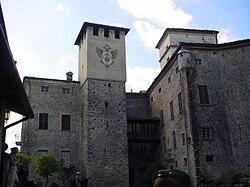
The castle of Torre Ratti, subject in the past to numerous remodellings, today has assumed the appearance of a fortified residential residence with late-renaissance architectural features and Baroque. The two bodies that form the complex are structured with semi-trailers, once used as kitchens, noble floors for residential use and underground floors intended for military use.
Castle of Molo di Borbera
Remains of the medieval castle adjacent to the monastery of the Benedictines located in Molo di Borbera.
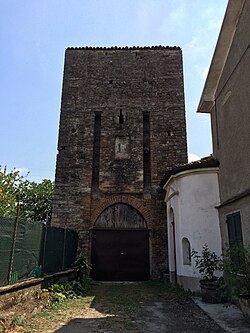
Medieval door
At the end of Via Caminata there is the medieval gate, door to the castle which was located on the right bank of the Borbera river, long completely destroyed by the watershed of Borbera[6].
Administration
TwinningExplore this chapter
Below is a table relating to the administrations that have succeeded one another in this municipality.
| Period | First citizen | Match | Load | Notes | |
|---|---|---|---|---|---|
| June 23, 1985 | May 23, 1990 | Giuseppe Bottaro | Italian Socialist Party | Mayor | [9] |
| May 23, 1990 | April 24, 1995 | Giovanni Rossi | Christian Democracy | Mayor | [9] |
| April 24, 1995 | June 14, 1999 | Giovanni Rossi | center | Mayor | [9] |
| June 14, 1999 | June 14, 2004 | Carlo Alberto Balduzzi | civic list | Mayor | [9] |
| June 14, 2004 | June 8, 2009 | Carlo Alberto Balduzzi | civic list | Mayor | [9] |
| June 8, 2009 | May 27, 2014 | Enrico Bussalino | civic list | Mayor | [9] |
| May 27, 2014 | May 27, 2019 | Enrico Bussalino | civic list Together for the town of Borghetto | Mayor | [9] |
| May 27, 2019 | June 9, 2024 | Enrico Bussalino | civic list Together for the town of Borghetto | Mayor | [9] |
| June 9, 2024 | in office | Domenico Franco Angelo Saporito | civic list Together for the town of Borghetto | Mayor | [9] |
Twinning
 Loreggia, since 2001
Society
Demographic evolution · Foreign ethnic groups and minoritiesExplore this chapter
Demographic evolution
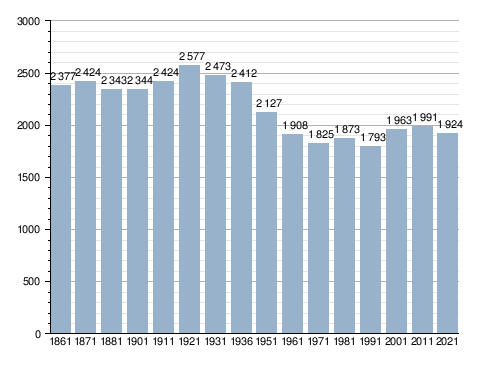
Inhabitants registered[10]
Foreign ethnic groups and minorities
Below are the two largest groups of foreigners (at 31/12/2007):
| Pos. | Citizenship | Population |
|---|---|---|
| 1 | Morocco | 39 |
| 2 | Romania | 32 |
| Rest of the World | 29 | |
| TOTAL | 100 |
Culture
Easter holidays · EventsExplore this chapter
Easter holidays
Every year in the hamlet of Persi is held the exhibition of animals, vintage tractors, crafts and tastings of Fersê (pancakes) as part of the feast of Saint Joseph on the last Sunday of March.
Events
In the hamlet of Castel Ratti, near the Borbera stream, every summer, the famous was held from 2000 to 2013 Borberock Summer Festival. It is a musical event dedicated to Italian underground rock music groups. Over the course of the editions, artists such as: Andrea Braido, The Fire, Stiliti, Ministri, 2Novembre, Passover, Viola Riot, Sintomi di Gioia, Hi Fevers, The Banshee, Cut of Mica, Gerson, Boogamen, Nadàr Solo, Piotta, Bud Spencer Blues Explosion, Ex-Otago and many others participated.[11]
Economy
Borghetto di Borbera has been the seat of the production plant of the Sutter Group since 1972.Explore this chapter
Borghetto di Borbera has been the seat of the production plant of the Sutter Group since 1972.
The town of Mulino is home to the water park Bolleblu.
Notes
Explore this chapter
- ^ Municipality of Borghetto di Borbera : Municipal Administration and Mayor - Municipality of Borghetto di Borbera e città, Alessandria, Piemonte, up www.comune-italia.it. URL consulted on 5 August 2026.
- ^ to b Monthly demographic balance for the year 2026 (provisional data), up demo.istat.it, ISTAT.
- ^ Seismic classification (XLS), up risks.protezionecivile.gov.it.
- ^ Table of degrees/day of Italian Municipalities grouped by Region and Province (PDF), in Law 26 August 1993, n. 412, annex A, National Agency for New Technologies, Energy and Sustainable Economic Development, 1 March 2011, p. 151. URL consulted on 25 April 2012 (archived fromoriginal url on 1 January 2017).
- ^ Tacchella, Lorenzo: “Borghetto Borbera in the history of the bishops-counts of Tortona”. Biblioteca dell'Accademia Olubrense, Genova, 1996
- ^ to b Mons. Clelio Goggi, History of the municipalities and parishes of the diocese of Tortona, Tortona, Litocoop, 1973.
- ^ Borghetto di Borbera, decree 1986-05-17 DPR, concession of coat of arms and gonfalone, up Heraldic Office, Municipal Issues, Central State Archives. Retrieved 23 October 2025.
- ^ Piedmontese civic coat of arms, vol. I, Regional Council of Piemonte, 2016, p. 57, ISBN 978-88-96074-98-5.
- ^ to b c d And f g h the http://amministratori.interno.it/
- ^ Data taken from:
- Resident population of the municipalities. Censuses from 1861 to 1991 (PDF), up ebiblio.istat.it, ISTAT.
- Resident population - Time series, up exploredati.istat.it.
Please note: 2021 data refers to permanent census data as of December 31 of that year.
- ^ https://myspace.com/borberock
Where to stay · Borghetto di Borbera
Find stays on Booking.comThe area, step by step
