A closer look
Diocese of Tortona: at a glance
The diocese of Tortona (in Latin Dioecesis Derthonensis) is a seat of the Catholic Church in Italy suffragan of the archdiocese of Genoa belonging to the ecclesiastical region of Liguria. In 2023 it had 274,000 baptized people out of 280,000 inhabitants. It is governed by Bishop Guido Marini.
Region
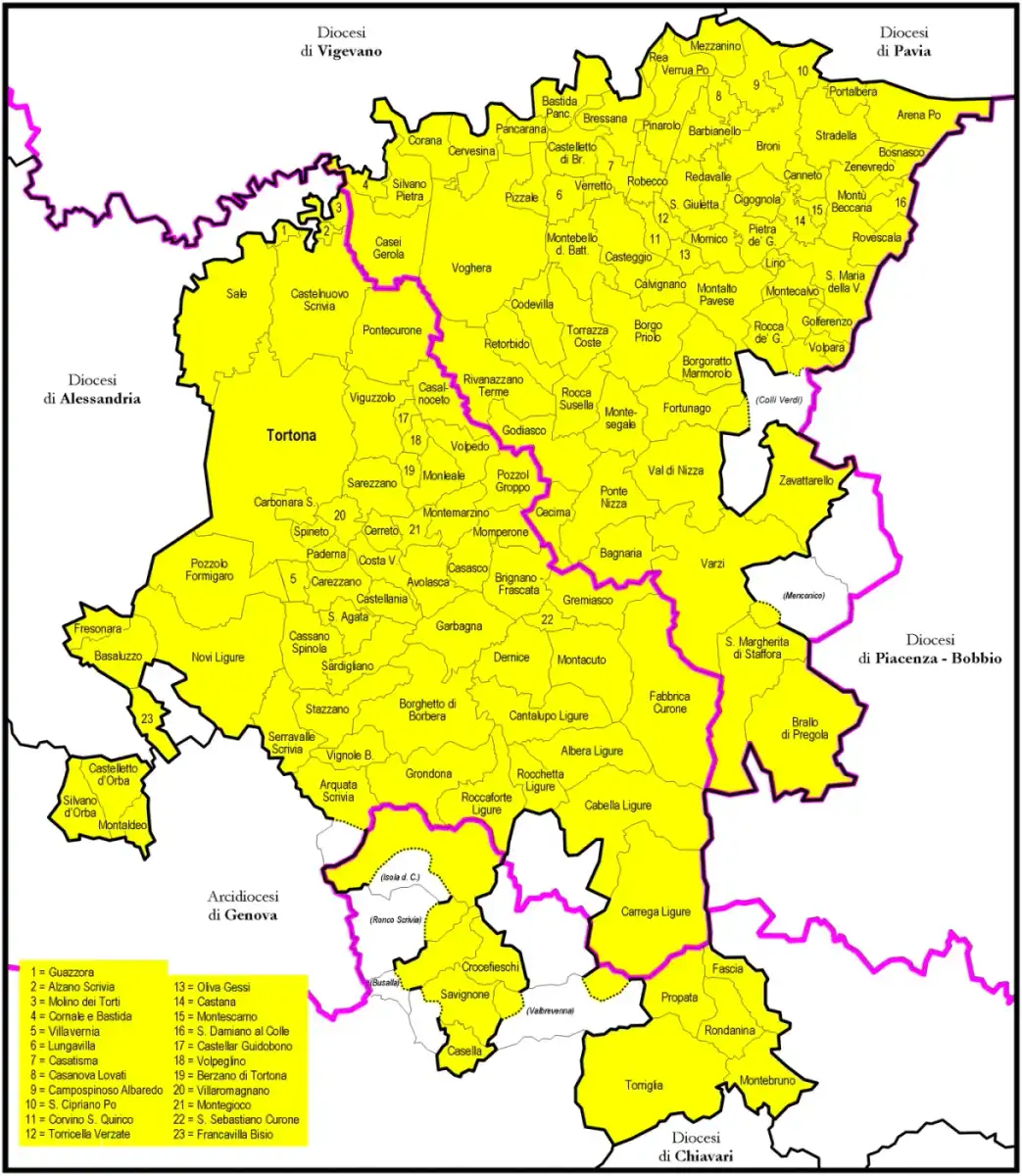
The territory of the diocese extends over four administrative regions: Piemonte , Liguria, Lombardy and Emilia-Romagna . His 309 parishes are in fact so...Explore this chapter
The territory of the diocese extends over four administrative regions: Piemonte Liguria, Lombardy and Emilia-Romagna. His 309 parishes are in fact divided into the territory:
- 144 in province of Alessandria;
- 138 in province of Pavia;
- 27 in the metropolitan city of Genoa.
These are organized in 10 vicariats: Broni-Stradella, Casteggio, Vicariato Padano, Voghera, Tortona, Varzi, Curone and Grue valleys, Novi Ligure, Arquata Scrivia-Serravalle Scrivia, Genovesato.
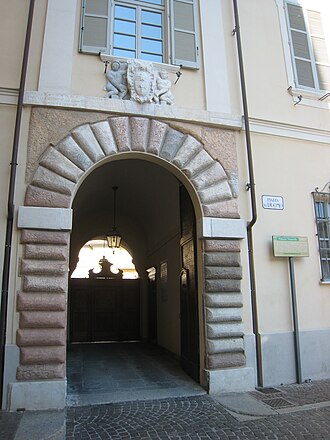
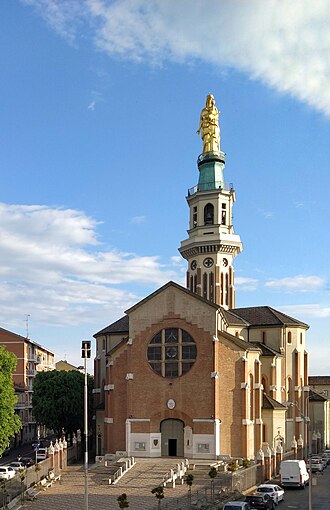
Bishop's seat is the city of Tortona, where the Cathedral of Maria Santissima Assunta and San Lorenzo. In the diocesan territory there are also two minor basilicas: San Pietro apostolo in Broni, and the Basilica of Our Lady of the Guard Tortona.
Includes all or part of the following municipalities[2]:
- in the province of Alessandria: Albera Ligure, Alzano Scrivia, Arquata Scrivia, Avolasca, Basaluzzo, Berzano di Tortona, Borghetto di Borbera, Brignano-Frascata, Cabella Ligure, Cantalupo Ligure, Carbonara Scrivia, Carezzano, Carrega Ligure, Casalnoceto, Casasco, Cassano Spinola, Castellania Coppi, Castellar Guidobono, Castelnuovo Scrivia, Castelletto d'Orba, Cerreto Grue, Costa Vescovato, Dernice, Fabbrica Curone, Francavilla Bisio, Fresonara, Garbagna, Gremiasco, Grondona, Guazzora, Molino dei Torti, Momperone, Monleale, Montacuto, Montaldeo, Montegioco, Montemarzino, Novi Ligure, Paderna, Pontecurone, Pozzol Groppo, Pozzolo Formigaro, Roccaforte Ligure, Rocchetta Ligure, Sale, San Sebastiano Curone, Sant'Agata Fossili, Sardigliano, Sarezzano, Serravalle Scrivia, Silvano d'Orba, Spineto Scrivia, Vignole Borbera, Viguzzolo, Villalvernia, Villaromagnano, Volpedo, Volpeglino;
- in the province of PaviaMonte Po, Bagnaria, Barbianello, Bastida Pancarana, Borgo Priolo, Borgoratto Mormorolo, Bosnasco, Brallo di Pregola (in part), Bressana Bottarone, Broni, Calvignano, Campospinoso Albaredo, Canneto Pavese, Casatisma, Casei Gerola, Castana, Castana, Castelletto di Branduzzo, Cecima Montescano, Montesegale, Mornico Losana, Montù Beccaria, Oliva Gessi, Pancarana, Pietra de' Giorgi, Pinarolo Po, Pizzale, Ponte Nizza, Portalbera, Rea, Redavalle, Retorbido, Rivanazzano Terme, Robecco Pavese, Rocca de' Giorgi, Rocca Susella, Rovescala, San Cipriano Po, San Damiano
- in the metropolitan city of Genoa: Busalla (the fractions of Sarissola and Semino), Casella, Crocefieschi, Fascia, Isola del Cantone (excluding the capital), Montebruno, Propata, Ronco Scrivia (the hamlet of Pietrafraccia), Rondanina, Savignone (excluding the fractions Isorelle and San Bartolomeo), Torriglia, Valbrevenna (the fractions of Nenno and Tonno);
- in the province of Piacenza: Zerba (the fraction of Samboneto[3]).
History
According to tradition, the diocese of Tortona dates back to the first decades of the second century. San Marziano, who died a martyr in 120, is considered the evangelizer of the region and...Explore this chapter
According to tradition, the diocese of Tortona dates back to the first decades of the second century. San Marziano, who died a martyr in 120, is considered the evangelizer of the region and the protovescovo of the diocese. However, the oldest text concerning the saint, composed between the 8th and 9th centuries, "does not give him the title of bishop at all and much less than first Bishop of Tortona...", which means that "when the legend was composed it had not yet formed or spread the opinion that S. Martian had been the first bishop of Tortona".[4]
Many of the first bishops attributed by tradition to the seat of Tortona were martyred and are venerated as saints. According to Lanzoni, it is a "very suspected episcopal list, apparently, reconciled in the 16th century to bring the primordi of Tortona to the 1st century".[5] The diocese is historically attested in the 4th century with the first known bishop of Tortona, Innocent, lived in the middle of the 4th century; it follows Esuperanzio, who participated in the council of Aquileia of 381. In 451 the provincial council of Milan took part in Bishop Quinzio (or Quinziano). An anonymous bishop of Tortona is mentioned in a letter from Gregory the Great to Bishop Costanzo of Milan of 599. These are the only bishops historically documented in the first six Christian centuries. Originally the diocese was suffragan of the archdiocese of Milan.
Tortona went unscathed by the barbaric invasions; indeed, its territorial jurisdiction increased, which reached the Po and the Ligurian Sea, and from the end of the 9th century also began to assert itself the civil supremacy of the bishops of Tortona. King Berengario I would have assigned jurisdiction over Voghera to the bishop of Tortona, detaching it from that of Bobbio[6][7], even though both were part of the brand Obertenga (eastern Liguria); later confirmed by Otto I, who would have assigned the prelate of Tortona the comital rights over the surrounding urban territory for a radius of one mile. The rights of the bishop-count were, however, limited both by the lay count of Tortona Farm, than from those of the large land-owning monasteries, especially that of the Senator, who enjoyed extensive immunities on his lands. Bishop Giseprando was chancellor of Lotario and simultaneously abbot of Bobbio and the founder of the abbey of San Marziano; Emperor Otto II confirmed to Bishop Gerebert in 979 all the assets owned by his Church and also the civil jurisdiction over Tortona for a radius of three miles. This civil power lasted de l'ure until 1784.
Since the 11th century, the vast territory of the diocese began to be dismantled for the erection of the surrounding dioceses. In 1014 Tortona sold a portion of its territory to the advantage of the erection of the diocese of Bobbio; in 1175 it was erected diocese of Alessandria in 1248 with the bull of Pope Innocent IV, the parish churches of the Lemme valley and the Scrivia valley were subtracted to Tortona, which were assigned to the archdiocese of Genoa.
In 1591, the Senate of Milan opened an investigation to learn about the "regions" of the alleged independence of the territories called the "Vescovato"[8] before Bishop Maffeo Gambara, nephew of his predecessor, Cesare Gambara (in 1548) succeeded Cardinal Uberto Gambara, bishop of Tortona from 1528 to 1548) also because no document was known that legitimized the alleged independence of this territory. The bishop not only opposed the investigation, but even established "a climate of terror and threats" to prevent his subjects from helping in any way the search for magistrates.[9] The Holy See advocated by principle the bishop, but following serious facts (homicides, fires and sold) made by the good of the prelate (who had made them clerics to prevent them from being punishable by civil authority) in 1594 tried to settle the matter by sending to Tortona as a pontifical examiner Carlo Bascapè bishop of Novara. The painting that came out of the letters sent to Rome was unwitting: not only were the news of violence true, but Gambara had filed trials before the Inquisition against its political opponents and to prove his reasons he ordered to create an entire code of apocrific documents with false salaries.[10] It was true that the bishops had exercised for centuries a form of government, but as a factual acquisition, however never quite peaceful, that the rulers tolerated so long that the bishops did not advance exorbitant demands. Rome then decided, to "spegnere" the question, to administer the territory disputed to the wise bishop of Lodi Ludovico Taverna from 1597 to 1614. The successor of the Gambara, Cosimo Dossena, met him in 1614 with an agreement with Madrid, even to avoid a process that could have annulled any right on the lands of the bishopric. This situation remained until 1784 when Bishop Peyretti gave them to Vittorio Amedeo III of Savoy.[11]
From the acts of the first diocesan synod of 1595, celebrated by Bishop Maffeo Gambara, it turns out that the diocese was made up of 33 parish churches, 180 parishes, 5 collegiate, 99 canons, 137 non- Parish churches, 125 confraternities, 45 monasteries and convents of both sexes, 20 hospitals. From the acts of the second diocesan synod, convened by Bishop Carlo Settala in 1673, the diocese is organized in 8 regions, where parishes and diocesan parish churches were distributed.
"On the end of the century. XVIII the diocese of Tortona had about 160,000 inhabitants; the territory was divided into 44 parish churches with 9 collegiate churches and 221 parish churches; the simple churches, the country churches and the orators amounted to 530, the male convents were 43, the female 16, in the diocesan seminary there were about 70 clerics. The secular clergy exceeded the thousand, while the regular clergy amounted to about 400 units, the conventual religious were approximately 350".[12]
In 1784 the king of Sardinia Vittorio Amedeo III wanted to re-establish the feudal jurisdiction over the bishop of Tortona, quite confused and conflicting, in analogy with what his father Carlo Emanuele III had done with the dioceses of Novara and San Giovanni di Moriana and with the archdiocese of Tarantasia. With the act of an agreement on 19 January 1784, Bishop Carlo Maurizio Peyretti of Condove renounced the title of Counts of Tortona and the lordly and feudal rights he held on the localities of Albera Ligure, Carezzano, Castellania, Costa Vescovato And Sant'Agata Fossili, in addition to those rights that he could have claimed on fiefs previously belonging to the diocese, but granted to private individuals (Fabbrica Curone, Sorli, Borghetto di Borbera And Vignole Borbera). In exchange the bishop of Tortona obtained the fiefdom of Cambio with the title of prince for himself and his successors with letters patent dated 20 January 1784.[13]
On the pressure of the French government, on 1 June 1803 the diocese was suppressed with the short Gravissimis causis of Pope Pius VII, and the bishop was forced to give up;[14] the territory was first aggregated to that of Alessandria and then from 1805 to that of the diocese of Casale Monferrato.
The seat of Tortona was restored on 17 July 1817 with the bubble Beati Petri of Pope Pius VII, with modified territory than the past: he lost 22 parishes in favor of the dioceses of Alessandria, Acqui and Bobbio, but acquired 67 from the dioceses of Pavia[15], of Bobbio and Piacenza. With the same bull the diocese became part of the ecclesiastical province of the archdiocese of Genoa.[16]
At the end of the nineteenth century, the young Luigi Orione entered the seminary in Tortona; in 1903 the institute he founded, the Little Work of Divine Providence, will receive the approval of the diocesan bishop, Igino Bandi. Luigi Orione, to which the construction of sanctuary of Our Lady of the Guard, was canonized by Pope John Paul II in 2004.
On 8 December 2023, with the decree Quo aptius of the Dicastery for Bishops, he gave 4 parishes to the diocese of Vigevano.[17][18]
Cronotassi of bishops
The vacancy periods not exceeding 2 years or not historically established are omitted. The present chronicle shows the traditional list of the bishops of...Explore this chapter
The vacancy periods not exceeding 2 years or not historically established are omitted. The present chronicles shows the traditional list of the bishops of Albania, published for the first time by Ferdinando Ughelli in his Italy sacred, and then repeated, with some additions or corrections, by Giuseppe Antonio Bottazzi, Giuseppe Cappelletti and Pius Bonifacius Gams. Chronological data is reported only for certain and historically documented bishops, with any explanatory notes taken from the works of Savio and Lanzoni.
- San Francisco Martian I †
- St.Ariberto[19]
- St.Ammonium
- San Francisco Terentian †[20]
- San Francisco Costanzo †
- San Francisco Lorenzo I †
- St.Anastasius †
- San Francisco Marcellin †
- San Francisco Giuliano †
- San Francisco Meliodor I †
- St.Innocent † (approximately 4th century)[21]
- John I[22]
- St.Esuperior † (mented in 381)[23]
- Eustasio or Teodulo? †[24]
- San Francisco Martian II †
- San Francisco Quinziano or Quintino or Quinto † (signed in 451)
- San Francisco Marcello †
- Albonio (or Albino) or Saturnino †[25]
- John II
- Sisto †
- Anonymous † (mended in 599)[26]
- Procle or Peno or Probo † (mended in 626)
- Meliodor II † (mended in 649)
- Blessed I †
- Lorenzo II †
- Audace † (meased in 680)
- Ottavio †
- Benedict I †
- Tondero (Tendero) †
- James †
- Giuseppe † (signed in 769)[27]
- Flaviano †
- Gerolamo
- Desire †
- Roberto †
- Valerio †
- John III (first half of the 9th century)[28]
- Rofredo or Ermanfredo † (meased in 842)[29]
- Teodolfo † (before 862 - after 877)
- John IV?
- Glarardo or Gerardo or Geroardo † (measured in 901)[30]
- Ildegino
- Gerebaldo †
- Benedict II or Blessed II † (before 915 - about 929/930 deceased)[31]
- Andrea † (signed in 933)
- Giseprando † (943)[32] - after 963)
- John V † (before 967 - after 969)
- Brass or Zenone? †[33]
- Vacancy office (about 969-979)[34]
- Gereberto (Guiberto) † (about 979 - after 983)
- Heriberto? †[35]
- Lintifredo (or Liutfredo) † (before 997 - after 1001)
- Tenone or Zenone † (mented in 1003)[36]
- Agirio †[37]
- Peter I † (before 1022 - after 1068)[38]
- Oddo I † (before 25 June 1080[39] - after 1083)
- Guido or Wido † (before 1098 - after 1099)
- Lambardo or Lombardo or Lamberto † (about 1105 - 26 May approximately 1111 deceased)[40]
- Peter II † (about 1111 - 30 May 1134 deposed)[41]
- William † (1134 - about 1152 deceased)[42]
- Oberto, C.R.S.A. † (about 1153 - after 25 February 1181)[43]
- Ugo † (before 21 February 1183 - after 21 March 1193)
- Gandolfo[44]
- Oddo II † (before 16 July 1196 - April 1202 deceased)
- Obizzo or Opizzone † (1202 - after 14 August 1220 deceased)
- Peter Busetto † (1220 - ?)
- Peter Tasso † (? - after 1255)[45]
- Melchiorre Busetto † (before 1283 - 1284 deceased)
- Vacancy (1284-1295)
- Giacomo Calcinari, O.S.B. † (2 October 1295[46] - before 16 December 1316[47] deceased
- Tiberio della Torre † (11 July 1317 - 24 May 1325 appointed bishop of Brescia)
- Princivalle Fieschi † (24 May 1325 - 1348 deceased)
- Giacomo Visconti † (2 July 1348 - 1363 deceased)
- John of Ceva † (13 September 1364 - about 1380 deceased)
- Giovanni? †
- Giorgio Torti † (1380 - about 1385 appointed bishop of Ceneda)
- Antonio † (28 February 1393 - ? deceased
- Pietro de Giorgi † (30 March 1394 - 15 February 1413 appointed bishop of Novara)
- Enrico Rampini † (10 May 1413 - 7 June 1435 appointed bishop of Pavia)
- Gerardo Landriani Capitani (7 June 1435 - 7 May 1436 dismissed) (vescovo elected)[48]
- Giovanni Barbavara (6 March 1437 - ?)
- Michele Marliani † (9 January 1461 - 24 April 1475 appointed bishop of Piacenza)
- Fabrizio Marliani † (24 April 1475 - 10 January 1476 appointed bishop of Piacenza)
- Giacomo Botta † (10 January 1476 - 1496 deceased)
- Gian Domenico de Zazi † (20 April 1496 - 1528 deceased)
- Uberto Gambara † (8 May 1528 - 22 March 1548 resigned)
- Cesare Gambara † (22 March 1548 - 1591 deceased)
- Maffeo Gambara (11 May 1592 - 1612 deceased)
- Cosimo Dossena, B. † (23 February 1612 - 12 March 1620 deceased)
- Paolo Arese, C.R. † (20 July 1620 - 1644 resigned)
- Francesco Fossati, O.S.B.Oliv † (23 May 1644 - 11 March 1653 deceased)
- Carlo Settala † (18 August 1653 - 23 April 1682 deceased)
- Carlo Francesco Ceva † (12 July 1683 - August 1700 deceased)
- Giulio Resta † (21 February 1701 - 11 January 1743 deceased)
- Giuseppe Luigi de Andújar, O.P. † (11 March 1743 - 2 December 1782 deceased)
- Carlo Maurizio Peyretti † (18 July 1783 - 18 February 1793 deceased)[49]
- Vacancy (1793-1796)
- Pio Bonifacio Fassati, O.P. † (27 June 1796 - 1803 dismissed)
- Depressed seat (1803-1817)
- Carlo Francesco Carnival † (21 December 1818 - 29 October 1831 deceased)
- Giovanni Negri † (15 April 1833 - 19 January 1874 deceased)
- Vincenzo Capelli † (4 May 1874 - 25 April 1890 deceased)
- Igino Bandi † (23 June 1890 - 8 September 1914 deceased)
- Simon Pietro Grassi † (22 December 1914 - 1 November 1934 deceased)
- Egisto Domenico Melchiori † (5 December 1934 - 2 March 1963 deceased)
- Francesco Rossi † (21 April 1963 - 29 November 1969 dimissed[50])
- Giovanni Canestri † (January 7, 1971 - February 8, 1975) appointed Vice-Chairman of Rome[51])
- Luigi Bongianino † (6 June 1975 - 2 February 1996 withdrawn)
- Martino Canessa (2 February 1996 - 15 October 2014 withdrawn)
- Vittorio Francesco Viola, O.F.M. (15 October 2014 - 27 May 2021 appointed secretary of the Congregation for Divine Worship and the Discipline of the Sacraments)
- Guido Marini, from 29 August 2021
Statistics
The diocese in 2023 of a population of 280.000 people had 274,000 baptized, corresponding to 97.9% of the total.Explore this chapter
The diocese in 2023 of a population of 280.000 people had 274,000 baptized, corresponding to 97.9% of the total.
| Year | Population | Priests | Diacons | Religious | Parishes | ||||||
|---|---|---|---|---|---|---|---|---|---|---|---|
| baptised | total | % | No. | secular centuries century secular secular secular centuries secular secular century secular centuries | regular | baptize. for the Presbyter |
Men | Women | |||
| 1950 | 299.000 | 300.000 | 99,7 | 630 | 500 | 130 | 474 | 200 | 500 | 316 | |
| 1969 | 303.800 | 306.936 | 99,0 | 456 | 370 | 86 | 666 | 177 | 704 | 265 | |
| 1980 | 295.000 | 297.000 | 99,3 | 375 | 313 | 62 | 786 | 94 | 720 | 317 | |
| 1990 | 272.500 | 275.000 | 99,1 | 324 | 254 | 70 | 841 | 12 | 104 | 715 | 315 |
| 1999 | 276.000 | 280.000 | 98,6 | 268 | 203 | 65 | 1.029 | 13 | 68 | 442 | 314 |
| 2000 | 276.000 | 280.000 | 98,6 | 261 | 198 | 63 | 1.057 | 12 | 66 | 435 | 314 |
| 2001 | 276.000 | 280.000 | 98,6 | 256 | 196 | 60 | 1.078 | 12 | 63 | 426 | 314 |
| 2002 | 276.000 | 280.000 | 98,6 | 247 | 188 | 59 | 1.117 | 12 | 62 | 417 | 314 |
| 2003 | 270.980 | 278.500 | 97,3 | 241 | 182 | 59 | 1.124 | 12 | 62 | 412 | 314 |
| 2004 | 272.960 | 279.070 | 97,8 | 232 | 173 | 59 | 1.176 | 15 | 63 | 365 | 314 |
| 2010 | 273.490 | 280.060 | 97,7 | 202 | 146 | 56 | 1.353 | 20 | 60 | 345 | 314 |
| 2014 | 274.695 | 281.420 | 97,6 | 164 | 106 | 58 | 1.674 | 20 | 62 | 349 | 314 |
| 2017 | 275.160 | 281.980 | 97,6 | 159 | 104 | 55 | 1.730 | 18 | 60 | 281 | 313 |
| 2020 | 275.912 | 282.420 | 97,7 | 150 | 93 | 57 | 1.839 | 17 | 62 | 279 | 313 |
| 2022 | 275.100 | 281.200 | 97,8 | 148 | 91 | 57 | 1.858 | 20 | 62 | 273 | 309 |
| 2023 | 274.000 | 280.000 | 97,9 | 146 | 89 | 57 | 1.876 | 20 | 62 | 273 | 309 |
Notes
Explore this chapter
- ^ Secretary of the Dicastery for divine worship and discipline of the sacraments.
- ^ Yearbook: Enti, up diocesetortona.it. Retrieved 29 July 2020.
- ^ It belongs to the parish of San Lorenzo in Casale Staffora (PV).
- ^ Savio, op. Cit., pp. 377-378.
- ^ Lanzoni, op. Cit., p. 820.
- ^ Giuseppe Antonio Bottazzi, The antiquities of Tortona and its agro, Alessandria, Ed. Salvatore Rossi, 1808
- ^ Voghera from the Lombards to the Middle Ages, up viqueria.com.
- ^ On the whole question see Sergio Pagano, The temporal reasons of a bishop, Maffeo Gambara, Bishop of Tortona and the judicial conflict with the Senate of Milan, Rome, 2000. Do not confuse the territory of the Bishopric mentioned here with the other fiefdoms of the bishop including Albera Ligure, of which he was marquis as heir to the extinct abbey of Vendersi in the upper Val Borbera.
- ^ S. They pay, city, p. 10.
- ^ Bascapè warned Rome that "for the part of the Church he had not walked on the sodium", that there was no document that gave the minimum legal appeal because there were imperial and pontifical privileges (from the 12th century) which concerned donations of land, but not jurisdiction.
- ^ See later on the convention of 1784 which gave the title of Prince to the bishop of Turin, in memory of the civil jurisdiction enjoyed by these prelates, note that until the 20th century the entrance into the city for the taking of possession of the diocese saw the bishop guiding the procession not on foot, but on horseback and holding not the pastoral, but the sword to symbolize his power and his rank. On the civil jurisdiction of bishops see also G. M. Merloni, Splendor and sunset of the temporal power of the bishops of Tortona, Cassano Spinola, 1993.
- ^ Statistical data from website of the diocese.
- ^ Alberto Casella, Cadets of the Real House, feudal lords of the Pope and the Emperor, princes - bishops. The title of Prince in Piemonte (second part), in Review of the Araldic College, year CXIX, 2 (December 2022), p. 117.
- ^ Text of the Apostolic Letter, published in Latin edition and French translation in: Bulletin des lois de l'Empire français, fourth series, third volume, pp. 58-69. Following is the executive letter from Cardinal Caprara (pp. 69-92), which defines and lists the villages and towns belonging to each of the surviving Piedmontese dioceses.
- ^ Thus it was able to unify the ecclesiastical jurisdiction on the town of Sale that until then had the particularity to depend on two different dioceses, Tortona and Pavia, with non-territorial but personal parishes, in fact the population of Sale followed the parish, therefore the diocese, of its ancestors without regard to the domicile. This situation stemmed from the fact that Sale had arisen from the union of villages belonging to different dioceses. See the voice of "Sale" in C. Goggi, History of the municipalities and parishes of the diocese of Tortona, Tortona, 1973.
- ^ (THE) Bull. Beati Petri, Bullarii Romani continuatio, vol. XIV, Romae, 1849, pp. 344-358.
- ^ (THE) Dicastery for bishops, Decree Quo aptius, AAS 116 (2024), pp. 113-114.
- ^ Don Paolo Butta, Diocese, four parishes from Tortona pass to Vigevano, up The Araldo Lomellino, 14 December 2023. Retrieved 28 August 2024.
- ^ The name, of clear German origin, is "invegraciously in the second century" (Lanzoni, op. Cit., p. 826), the era in which Ariberto is chronologically placed by tradition.
- ^ According to Lanzoni (p. 826), this bishop could be the same Terentian of Todi, with probable confusion between Derthona (i.e. Tortona) e Tudertum (i.e. Todi).
- ^ For Savio, Innocent is probably the true protovescovo of Tortona.
- ^ According to Lanzoni (p. 826), John I, together with the previous Marcellin, could in fact be the two homonistic priests celebrated in the life of Saint Innocent and honored to Tortona of public worship.
- ^ Gams begins the series of his bishops only with Esuperanzio.
- ^ After Esuperanzio, Cappelletti and Gams (but not Ughelli) place a bishop named Eustasio or Teodulo, obtaining its name from the list of signatories to the acts of the Milan Council of 385, where, however, the individual bishops are not attributed their seat. According to Lanzoni, neither of these two bishops could be from Tortona, as Teodulo (or Theodore) was bishop of Octodurus, that is Sion; while Eustasio was bishop of Aosta or Bologna.
- ^ According to Ughelli, a bishop named Albonio or Saturnino would take part in a council of Pope Simmaco in 499; now, being unknown Albonio (or Albino), certainly Saturnino was Bishop of Erdonia in Puglia, and not Tortona.
- ^ Mented in a letter of Pope Gregory I to Bishop Costanzo of Milan, this anonymous bishop of Tortona is quoted only by Lanzoni, but is unknown from all other sources.
- ^ Of the bishops that Ughelli attributes to the 8th century (from Ottavio to Roberto), only Joseph is historically documented, having participated in a Lateran Council of 769. This fact, of course, makes vain the traditional chronology, which ends Joseph's episcopate in 765.
- ^ About this bishop, actually existed, did not give certain; according to Savio (op. Cit., p. 382), John was bishop after 820 and before 862.
- ^ After John, Ughelli puts Bishop Rofredo, who Bottazzi identifies with Ermanfredo, who enrolled in 842 at a diploma of the Milanese archbishop Angilberto; however, his diploma does not indicate the seat of Ermanfredo.
- ^ Ughelli speaks of Glarardo, that Bottazzi corrects in Gerardo; historically a bishop named Geroardo intervened at a placitus held in Pavia in March 901 (Savio, op. Cit., p. 383); this bishop could be Gerebaldo himself, documented by Ughelli and other authors from 901.
- ^ Ughelli and Gams speak of Benedict, Savio and Cappelletti of Blessed, while Bottazzi distinguishes in two separate bishops. Beato died on an imprecisated date between 12 May 929 and 16 September 930.
- ^ Giseprando is the first bishop of Tortona whose exact date of the beginning of his episcopate.
- ^ Cappelletti and Gams enter a bishop named Ottone, who would take part in a Milanese council in 969; for Savio to that council he took part John V and not Otto. Bottazzi instead inserts the bishop Zenone, whose name appears in a diploma of 979, in which Emperor Otto II confirms to Gereberto the goods of the Church of Tortona, already granted to his predecessors Blessed, Andrea and Zenone. According to Savio it is "a magazine of the Coptics, who wrote Zenone in place of Gezone, which is the abbreviated name of Giseprando" (p. 388). Both of these names are unknown to Ughelli.
- ^ From the diploma of 979, it is clear that the seat of Tortona was diu viduata fence, that is, he was without a shepherd for a long time.
- ^ Ughelli ignores Bishop Gereberto (or Guiberto), inserting in his place Bishop Eriberto (in 984), but noting that an forte idem sit cum Giberto. Cappelletti and Gams speak of two distinct bishops, while for Savio and Bottazzi Gereberto and Eriberto are the same person.
- ^ This bishop is unknown to Ughelli, Cappelletti and Gams, and admitted by Bottazzi and Savio, based on a parchment preserved in the archive of Tortona Cathedral.
- ^ According to Ughelli, Agirio took part in Roncaglia's diet in 1004 with Archbishop Ariberto of Milan. However, in 1004 he was Archbishop of Milan Arnolfo and not Ariberto, elected in 1018. At a Roman synod in 1015 he also took part the bishop of Tortona, but the acts do not bear its name; it could be Agirio or its successor Peter I.
- ^ According to Ughelli, Peter I was elected in 1014 and died in 1077; historically it is documented only from 1022 to 1068.
- ^ In the synod of Brixen where his name appears, Oddo subscribes as Otto terdon electus.
- ^ The succession and history of the bishops from Lambardo to Oberto is documented by a notary act of 1183, reported by Savio (op. Cit., p. 393). According to this act, Lambardo governed the church of Tortona for 6 years, Peter II for 24 years, William for 18 years.
- ^ Peter II is historically documented from 10 March 1114 to August 1127.
- ^ Guglielmo is historically documented from 12 May 1140 to 12 December 1151.
- ^ A bubble of Pope Lucius III of 17 May 1182 or 1183, speaks of the bishop of Tortona, without making its name. If it is Oberto, the bubble is of 1182, because on 17 May 1183 the successor Ugo was already bishop.
- ^ Bishop present in the chronicles of Ughelli, but with incorrect dating. If Gandolfo was bishop of Tortona, it was between March 1193 and April 1196 (Savio, op. Cit., pp. 397-398).
- ^ Ughelli, and with him Gams and Cappelletti, admit one bishop named Peter. Bottazzi instead refers to two omonymous bishops; Savio agrees with Bottazzi, although it is difficult to establish the end of the episcopate of Pietro Busetto and the beginning of that of Pietro Tasso. From a documentary point of view, the bishop or bishops named Peter are attested from 8 August 1221 to 5 June 1255. Later, there are no more documents of the bishops of Tortona until 12 July 1283.
- ^ As Gams reported, Giacomo Calcinari was elected in 1288, but was confirmed by Pope Boniface VIII only in 1295, after a long trial about the election of James, elected on one side of the chapter, in dispute with another candidate, Corrado di Beccaria.
- ^ According to Bottazzi, he would die in 1313.
- ^ Bishop of Lodi, did not agree to the transfer to Tortona.
- ^ Eubel reported as an alternative death date on February 1795.
- ^ Appointed bishop owner of Aliezira.
- ^ At the same time appointed archbishop owner, personal title, of Monterano.
Bibliography
Explore this chapter
- Pontifical yearbook of 2024 and earlier, in (EN) David Cheney, Diocese of Tortona, up Catholic-Hierarchy.org.

- (EN) Umberto Benigni, v. Tortona, Catholic Encyclopedia, vol. XIV, New York, 1912
- Francesco Lanzoni, The dioceses of Italy from the beginning to the beginning of the century VII (an. 604), vol. II, Faenza, 1927, pp. 820–828
- Faithful Savio, The ancient bishops of Italy. The Piemonte, Turin, 1898, pp. 377–402
- Faithful Savio, The origins of the diocese of Tortona, in Acts of the Royal Academy of Sciences in Turin, vol. 38, 1902-1903, pp. 85–101
- Giuseppe Cappelletti, The Churches of Italy of their origin to our day, vol. XIII, Venice 1857, pp. 665–695
- (EN) Ferdinando Ughelli - Nicola Coleti, Italy sacred, vol. IV, second edition, Venice, 1719, coll. 623-654
- Giuseppe Antonio Bottazzi, The antiquities of Tortona and its agro, Alessandria, 1808
- The bishops of northern Italy in the lower Middle Ages, Cronotassi for the dioceses of Cremona, Pavia and Tortona during the XIV and XV centuries, edited by Piero Majocchi and Mirella Montanari, Pavia, 2002, pp. 103–139
- Caterina Antonioni, Diocese of Tortona, Cultural Heritage of Lombardy
- (THE) Pius Bonifacius Gams, Episcoporum Series Ecclesiae Catholicae, Graz, 1957, pp. 823–824
- (THE) Konrad Eubel, Hierarchia Catholica Medii Aevi, vol. 1, p. 476; vol. 2, p. 247; vol. 3, p. 310; vol. 4, pp. 173–174; vol. 5, p. 183; vol. 6, p. 194
- (THE) Bull. Beati Petri, in Roman Bullarii continued, Volume VII, part 2, Prato, 1852, pp. 1490–1503
Continue your journey