Atlas of Monferrato
Albera Ligure: sights, history and trails
Alessandria
- Elevation
- 423 m above sea level
- Area
- 21.23 km²
- Demonym
- alberesi
- Patron saint
- Saint John the Baptist
A closer look
Discovering Albera Ligure
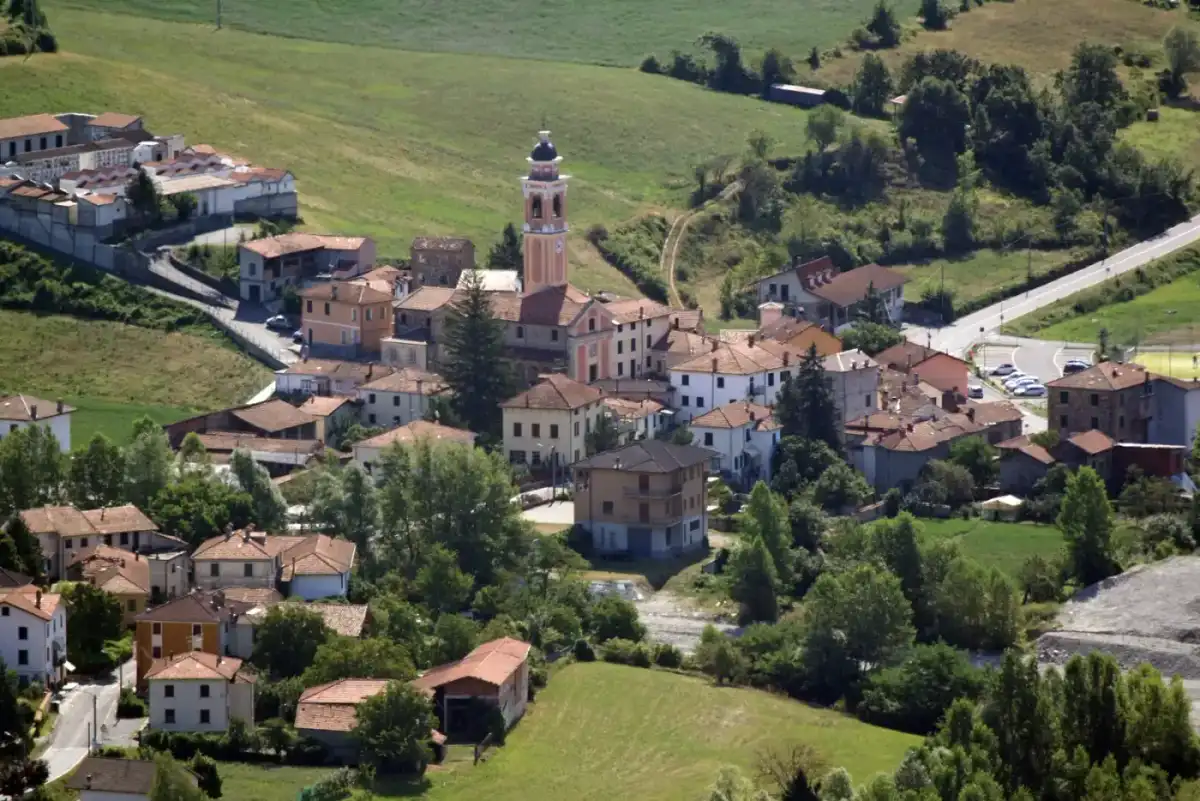
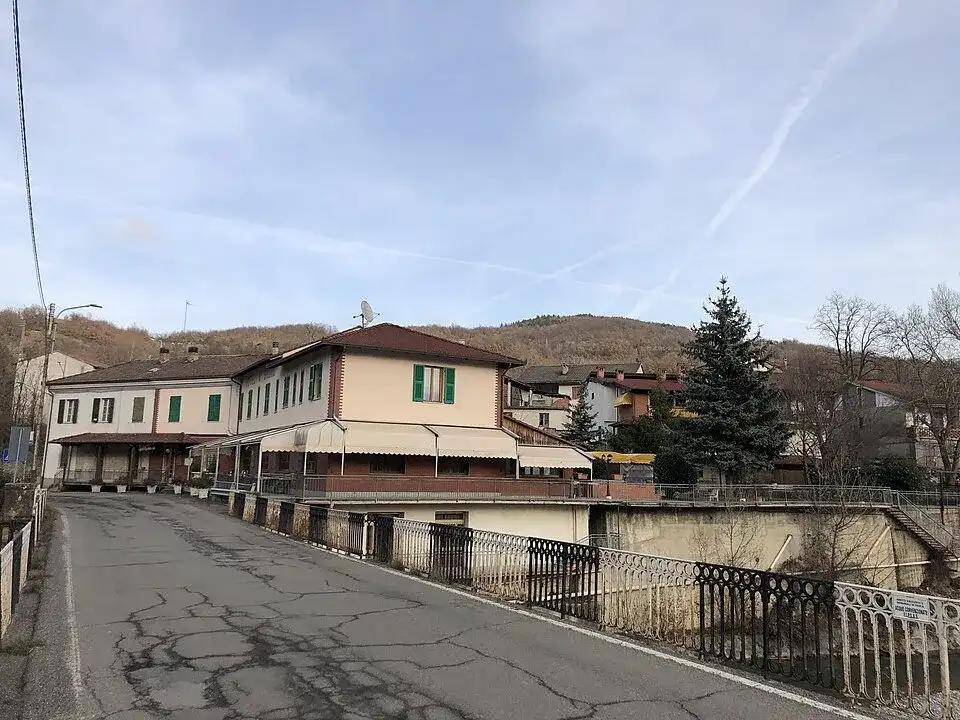
Albera Ligure (Tree in Piedmontese, Arbea in Ligurian) is an Italian municipality of 278 inhabitants[2] from the province of Alessandria in the Piemonte, located in the valley Borbera.
Landscape and area
Located on the right bank of the Borbera stream that gives its name to the valley, at the north-west slopes of Mount Ebro ( 1 701 m ) which is the highest peak of the Province...Explore this chapter
Located on the right bank of the Borbera stream which gives its name to the valley, on the north-west slopes of Monte Ebro (1701 m) which is the highest peak of Province of Alessandria. The main nucleus of the municipality is divided from the Borgo di San Martino by the Albirola stream, a tributary of the Borbera, which probably takes its name from the municipality. The hamlets: San Nazzaro, Astrata and Spinola are part of the locality, and are located along the provincial road that from Arquata Scrivia reaches Cabella Ligure. The hamlets Santa Maria, Vendèrsi, Vigo, Figino and Volpara are located to the east, scattered on the municipal territory that reaches the 1 559 Meters of Mount Pana.
History of Albera Ligure
SymbolsExplore this chapter
The history of the country, as well as its gastronomy alternates between Piemonte and Liguria. The first news of the village, although probably from origins Dectunine Ligurians, they date back to the Middle Ages. About a thousand years ago, around the 9th century, a Benedictine abbey was founded in the hamlet of Vendèrsi on the remains of a Roman settlement, where farmers fleeing from the barbarian invasions found refuge. With the assets of the Abbey, which decayed in the 13th century, a noble papal fief was created and an ecclesiastical immunity due to the diocese of Tortona headed by a provost under direct papal protection. At the time of the foundation of Alessandria in 1168, the municipality of Albera was mentioned among those who joined the fight against Frederick Barbarossa. Towards the middle of the 15th century, it came under the domination of the Imperial fiefdoms Ligurian and administered by various noble families from Genoa and Tortona, including the Fieschi, Sauli and Gambara, until the abolition of the imperial fiefdoms in July 1797.
In the second half of the 17th century, following the mandate of Bishop Carlo Settala, then bishop of Tortona, some coins were minted in the name of Albera. On the obverse was depicted the coat of arms of the Settala family and on the reverse a standing bishop figure, with miter and crosier.[5].
Only in 1861 did it come to be included in the province of Alessandria.
In 1863 the municipality of Albera took on the new name of "Albera Ligure".[6]
In 1929 the town was aggregated to the municipality of Rocchetta Ligure but it regained administrative independence after the Second World War, in 1947.
Symbols
The coat of arms and banner of the municipality of Albera Ligure were granted by decree of the President of the Republic of 8 January 1997.[7]
The banner is a banner made of yellow and blue.
What to see in Albera Ligure
In the hamlet of Vendèrsi there is the church of Saints Matteo and Fortunato dating back to the 9th century. The previous abbey was located upstream from the town, in the locality…Explore this chapter
In the hamlet of Vendèrsi there is the church of Saints Matteo and Fortunato dating back to the 9th century. The previous abbey was instead located upstream from the town, in a locality called "Pian dei Preti", still today visibly affected by landslides which destroyed the abbey at the time. Of the important Vendèrsi abbey only the lid of a granite sarcophagus remains, in section, with angular projections, 2 meters long and wide 80 cm, leaning against the external wall of the church and perhaps used in the Middle Ages as a cover for the tomb of a high prelate or a benefactor. A two-storey portico with ribbed vaults is preserved from the ancient parish church of the capital, leaning against the south side of the parish church of San Giovanni Battista. In the sacristy, the oldest part of the complex, there are frescoed vaults with pontifical coats of arms and floral motifs. In the hamlet of Figino you can observe the remains of an ancient tower, perhaps an observatory to signal the inhabitants of the time of the approach of the Saracens coming from Liguria and the sea.
Society
Demographic evolution · Foreign ethnic groups and minoritiesExplore this chapter
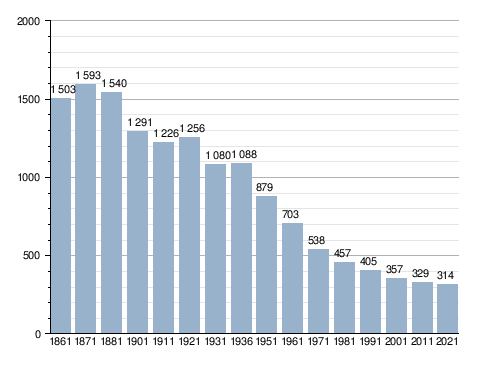
Demographic evolution
Inhabitants registered[8]
Foreign ethnic groups and minorities
According to the ISTAT census as of 31 December 2007, 5 foreigners lived in the country.
Culture
EventsExplore this chapter
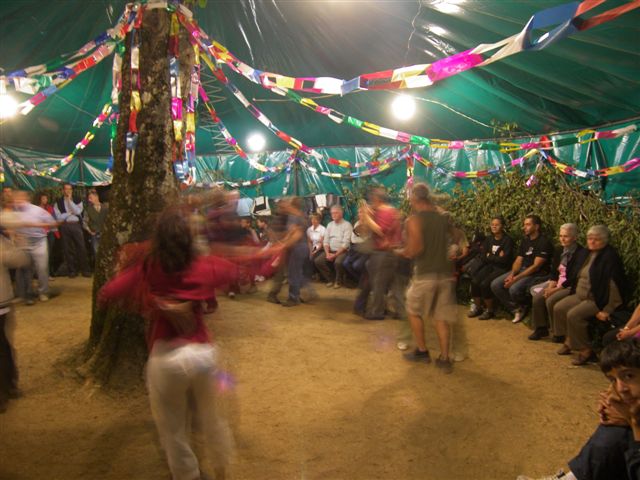
This country is part of the culturally homogeneous territory of Four provinces (Alessandria, Genoa, Pavia, Piacenza), characterized by common habits and customs and by an important repertoire of music and dance very ancient. The main instrument of this area is the Apennine fife which, accompanied by the accordion, and once by the müsa (Apennine bagpipe), leads the dances and animates the parties. The dialect spoken in the town is a type of Ligurian transition between Genoese and the dialect of the lower valley, also of Ligurian origin.
Events
The most important event is the Bread Festival in the locality of Molino di Santamaria, whose oven, since 1700, has produced delicious loaves of bread thanks to the power of a water mill. The festival is organized by the Municipality and the Val Borbera Mountain Community and takes place on the Sunday following August. The town's patron saint is Saint John the Baptist whose anniversary falls on 24 June.
Economy
In Albera Ligure, silent and discreet tourism for families and lovers of nature and peace has been emerging in recent years, but the main activity remains…Explore this chapter
In recent years, silent and discreet tourism has been emerging in Albera Ligure for families and lovers of nature and peace, but the main activity remains agriculture. Even today, cereals, legumes, potatoes and fodder are grown. Breeding is important, especially sheep farming. Migration towards the Genoese area and the plain has always been intense in past years, and in the last fifty years it has literally depopulated several municipalities and hamlets in the valley.
Administration
Below is a table relating to the administrations that have succeeded one another in this municipality.Explore this chapter
Below is a table relating to the administrations that have succeeded one another in this municipality.
| Period | First citizen | Match | Load | Notes | |
|---|---|---|---|---|---|
| July 3, 1985 | May 25, 1990 | Franco Franzante | Italian Democratic Socialist Party | Mayor | [9] |
| May 25, 1990 | April 24, 1995 | Franco Franzante | Italian Democratic Socialist Party | Mayor | [9] |
| April 24, 1995 | June 14, 1999 | Franco Franzante | centre-left | Mayor | [9] |
| June 14, 1999 | June 14, 2004 | Franco Franzante | civic list | Mayor | [9] |
| June 14, 2004 | June 8, 2009 | Roberto Massacane | civic list | Mayor | [9] |
| June 8, 2009 | May 26, 2014 | Roberto Massacane | civic list | Mayor | [9] |
| May 26, 2014 | May 27, 2019 | Renato Lovotti | civic list Together for Albera | Mayor | [9] |
| May 27, 2019 | June 9, 2024 | Renato Lovotti | civic list Together for Albera | Mayor | [9] |
| June 9, 2024 | in office | Renato Lovotti | civic list Together for Albera | Mayor | [9] |
Notes
Explore this chapter
- ^ Municipality of Albera Ligure : Municipal Administration and Mayor - Municipality of Albera Ligure and city, Alessandria, Piemonte, up www.comune-italia.it. URL consulted on 4 August 2026.
- ^ to b Monthly demographic balance for the year 2026 (provisional data), up demo.istat.it, ISTAT.
- ^ Seismic classification (XLS), up risks.protezionecivile.gov.it.
- ^ Table of degrees/day of Italian Municipalities grouped by Region and Province (PDF), in Law 26 August 1993, n. 412, annex A, National Agency for New Technologies, Energy and Sustainable Economic Development, 1 March 2011, p. 151. URL consulted on 25 April 2012 (archived fromoriginal url on 1 January 2017).
- ^ Promis.
- ^ Royal decree 11 January 1863, n. 1126, regarding "Decree authorizing various municipalities in the provinces of Milan, Alessandria, Brescia, Cremona, Turin, Ascoli, Macerata, Cuneo, Piacenza, Porto-Maurizio, Ravenna and Sassari to take on a new name."
- ^ Albera Ligure, decree 1997-01-08 DPR, granting of coat of arms and banner, up Central State Archive. URL consulted on 22 October 2021.
- ^ Data taken from:
- Resident population of the municipalities. Censuses from 1861 to 1991 (PDF), up ebiblio.istat.it, ISTAT.
- Resident population - Time series, up exploredati.istat.it.
Please note: 2021 data refers to permanent census data as of December 31 of that year.
- ^ to b c d And f g h the http://amministratori.interno.it/
Bibliography
Explore this chapter
- Domenico Promis, Tree, in Coins Piemonte unpublished or rare - supplement, Turin, Royal Printing House, 1861.
Where to stay · Albera Ligure
Find stays on Booking.comStories, places and people
More about Albera Ligure and the surrounding area
Follow a thread of history and see where it leads.
 Dani4P di Wikipedia in italiano · CC BY-SA 3.0
Four Provinces
The Four Provinces are an Italian historical-geographical region. The territory is located astride the Ligurian Apennines, and is divided between four provinces belonging to four different regions. Despite the administrative fragmentation, the region has some common historical and cultural characteristics.
Read the story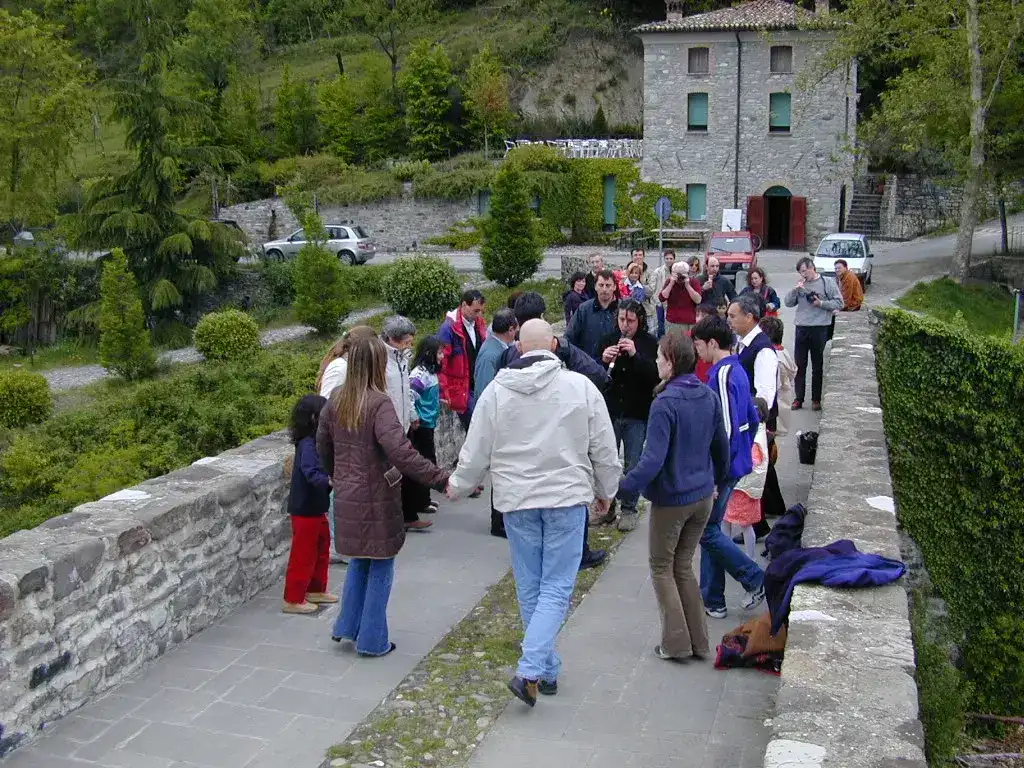 L'utente che ha caricato in origine il file è stato Dani4P di Wikipedia in italiano · CC BY-SA 3.0
Dances of the Four Provinces
The dances of the Four Provinces are a repertoire of dances spread over a homogeneous cultural area that includes the mountain areas of the provinces of Genoa , in Liguria (high Trebbia valley, high Scrivia valley , val d'Aveto and val Fontanabuona ), Alessandria , in Piemonte (Val Borbera e val Curone ), Pavia bbia, in Lombardia (Val Staffora ) and Piacenza , in Emilia-Romagna (
Read the storyThe area, step by step
Trails and routes in Albera Ligure

Asti, Alessandria and surroundings
Anello borbera - spinti tappa 05 (capanne di cosola - monte giarolo)

Asti, Alessandria and surroundings
Sentiero cantalupo ligure - monte giarolo

Asti, Alessandria and surroundings
Sentiero albera ligure – bivio figino

Asti, Alessandria and surroundings
Sentiero albera ligure - costa vendersi
 WalkingAround the starting point
Asti, Alessandria and surroundings