Atlas of Monferrato
Costa Vescovato: sights, history and trails
Alessandria
- Elevation
- 305 m above sea level
- Area
- 7.9 km2
- Demonym
- Coastal regions
- Patron saint
- San Martino
A closer look
Discovering Costa Vescovato
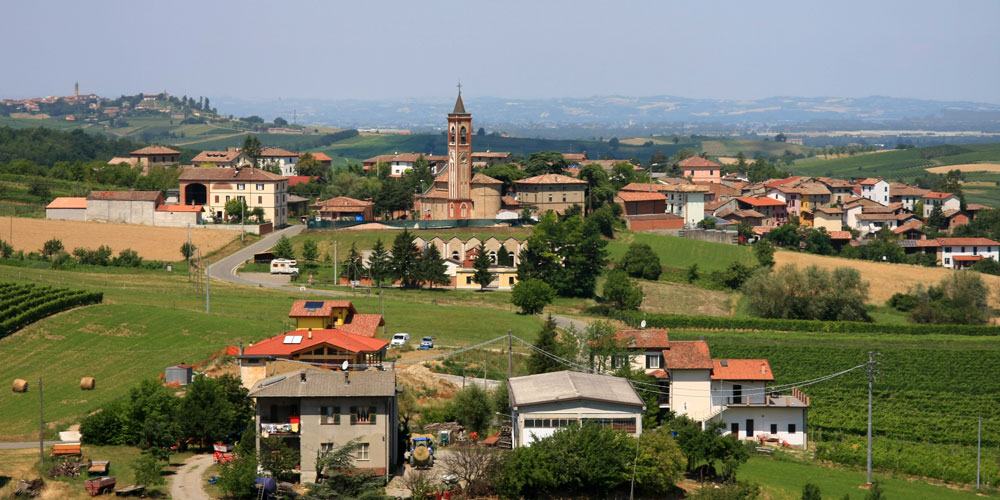
Costa Vescovato (Còsta in Piedmont) is an Italian municipality of 310 inhabitants[1] from the province of Alessandria in the Piemonte.
Landscape and area
The municipality is situated on the ridge between the Ossona streams and the Cornigliasca rio.Explore this chapter
The municipality is situated on the ridge between the Ossona streams and the Cornigliasca rio.
History of Costa Vescovato
SymbolsExplore this chapter
It was one of the territories subject to the temporal domain of bishops of Tortona, from which the name derives. Subject, like the entire territory, to the expansionist aims of the Duchy of Milan, it was the scene of jurisdictional conflicts between the bishops and the Spanish government first and then the Savoy government. After the Napoleonic period it definitively became the territory of the Kingdom of Sardinia. The absolute lordship in the Langhe was subjected to the secular jurisdiction of the bishops of Tortona with "high and full dominion" and with the exercise of mero et mix impervious, recognized with full sovereignty and independence, although this autonomy was often contested and opposed militarily over the centuries. The Pope alone was recognized as the vassalage of the bishops, taking the oath to keep the possessions of the Church of Tortona intact. The origin of the lordship probably dates back to the donation of its territories by the Lombard king Aribert II to the Church in 706, whose autonomy was confirmed by Liutprand in 716. Full independence was achieved, presumably, with the emperor Charles the Bald who at the Diet of 875 recognized the temporal lordships of the Italian bishops, probably referring to Louis the Pious who in 817 had confirmed the donations of the kings Lombards at the Heritage of San Pietro. However, the difficulties of maintaining the independence of the fiefdom increased with the birth of powerful neighbors and the growing strategic position that these lands located between the port of Genoa, Milan and the Sale road of Lombardy assumed economically. When the Duchy of Milan became a Spanish possession there was no shortage of clashes of arms between the bishop's militias and the Spanish garrison of Serravalle (Scrivia). With the transfer of the imperial fiefs of the Langhe to the Savoy in 1738, the lordship became an island of episcopal dominion within the Savoy province of Tortona. The Turin court attempted several times to impose its high power over the fiefdom on the bishops, but it was only with Bishop Carlo Pejretti (1783-1795) and the consent of the Roman Curia that the bishops of Tortona renounced their independence over the lands of the Bishopric. Thus on 9 January 1784 the sovereign lordship was ceded to the Savoys in exchange for the perpetual enfeoffment of Cambio in Lomellina with the title of principality in favor of the Tortona prelates and annexed the rights of sturgeon fishing, tolls on the Po and lordship of the surrounding river islands. The lands of the bishop's lordship extended over the hills of the Langhe east of the Scrivia and south of Tortona, between the valleys of the Borbera and Grue torrents up to the confluence with the Scrivia, bordering the fiefdoms of the Savoy and the marquisates of Avolasca, of Garbagna, of Borghetto in Val Borbera (1692-1752), the lordship of Vargo. It included the villages and castles of Stazzano, Sardigliano, Cuquello, Malvino, Gavazzana, Sant'Agata, Carezzano (until the 16th century the administrative seat of the feudal vicar on behalf of the bishops), Vezzano, Sant'Alosio, Costa del Vescovo (ceased by 1775), Sarizzola, Spineto, Sipario, Lugagnano, Basilica, Mossabella, Bavantore, Bavantorino, Castellania and Garbagna (annexed by Milan in the 14th century). The villages of Castellania and Sant'Agata were enfeoffed to the Rampini di Sant'Alosio.
Symbols
The coat of arms and gonfalone of the municipality of Costa Vescovato were granted by decree of the President of the Republic of 8 January 1991.[4]
The banner is a blue and white banner.
What to see in Costa Vescovato
Explore this chapter
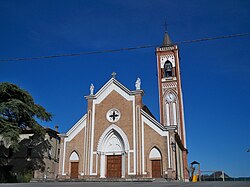
- Church of San Martino Bishop
- Church of the Assumption of Virgin Mary in Montale Celli
- Church of Saints Fabiano and Sebastian in Sarizzola
Society
Demographic evolutionExplore this chapter
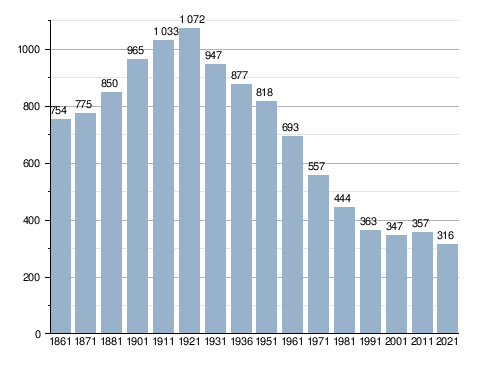
Demographic evolution
In the last hundred years, since 1921, the resident population has decreased by 67%.
Inhabitants registered[6]
Administration
Other administrative informationExplore this chapter
Below is a table relating to the administrations that have succeeded one another in this municipality.
| Period | First citizen | Match | Load | Notes | |
|---|---|---|---|---|---|
| June 30, 1985 | May 22, 1990 | Sandro Boveri | Italian Socialist Party | Mayor | [7] |
| May 22, 1990 | April 24, 1995 | Sandro Boveri | Italian Socialist Party | Mayor | [7] |
| April 24, 1995 | June 14, 1999 | Sandro Boveri | centre-left | Mayor | [7] |
| June 14, 1999 | June 14, 2004 | Sandro Boveri | civic list | Mayor | [7] |
| June 14, 2004 | June 8, 2009 | Fabio Boveri | civic list | Mayor | [7] |
| June 8, 2009 | May 26, 2014 | Fabio Boveri | civic list | Mayor | [7] |
| May 26, 2014 | May 26, 2019 | Fabio Boveri | list civic Grappolo d'uva con spighe | Mayor | [7] |
| May 26, 2019 | 09 June 2024 | Ottavio Rube | civic list Grappolo d'uva and wheat ears | Mayor | [7] |
| June 9, 2024 | in office | Ottavio Rube | list of cities Vite per Costa | Mayor | [7] |
Other administrative information
The commune was part of the Community Montana Valli Curone Grue and Ossona.
Notes
Explore this chapter
- ^ to b Monthly demographic balance for the year 2026 (provisional data), up demo.istat.it, ISTAT.
- ^ Seismic classification (XLS), up risks.protezionecivile.gov.it.
- ^ Table of degrees/day of Italian Municipalities grouped by Region and Province (PDF), in Law 26 August 1993, n. 412, annex A, National Agency for New Technologies, Energy and Sustainable Economic Development, 1 March 2011, p. 151. URL consulted on 25 April 2012 (archived fromoriginal url on 1 January 2017).
- ^ Costa Vescovato, decree 1991-01-08 DPR, concession of coat of arms and gonfalone, up Heraldic office - Municipal files, Central State Archives. Retrieved 27 October 2021.
- ^ Municipality of Costa Vescovato, Municipal statute (PDF), Art. 4 - Coat of arms and banner.
- ^ Data taken from:
- Resident population of the municipalities. Censuses from 1861 to 1991 (PDF), up ebiblio.istat.it, ISTAT.
- Resident population - Time series, up exploredati.istat.it.
Please note: 2021 data refers to permanent census data as of December 31 of that year.
- ^ to b c d And f g h the http://amministratori.interno.it/
Bibliography
Explore this chapter
- Gian Carlo Vaccari: Costa Vescovato, Montale Celli, Sarizzola, Fossaghello, ancient lands of the bishops of Tortona (ms. to the Author)
Where to stay · Costa Vescovato
Find stays on Booking.comThe area, step by step
Trails and routes in Costa Vescovato
 WalkingAround the starting point
Asti, Alessandria and surroundings