Atlas of Monferrato
Villafranca d'Asti: sights, history and trails
Asti
- Elevation
- 206 m above sea level
- Area
- 12.88 km²
- Demonym
- Villafranchesi
- Patron saint
- Saint Helena
A closer look
Discovering Villafranca d'Asti
Villafranca d'Asti (Vilafranca d'Ast in Piedmont) is an Italian municipality of 2 940 inhabitants[1] from the province of Asti, in the historical territory ofAstesana; is site at about 40 km from Turin and 15 from Asti, in the center of a valley surrounded by the Riomaggiore, Stanavasso, Traversole and Triversa streams. Its surface area is 12 km squares.
In 2004 he won the prize of Legambiente as a Italian municipality with the highest percentage of recycled waste (85%).
History of Villafranca d'Asti
SymbolsExplore this chapter
Villafranca rises from several separate housing units that in 1275, by the will of the municipality of Asti, gather their inhabitants in a single centre: Villafranca precisely. Until that date the territory of the current municipality was part of what was called the Serralonga Committee or Contad of Serralunga which had its center in a current fraction of the municipality of Cantarana and included besides the town of Villafranca that of Cantarana, Castellero, Maretto, Roatto, Tigliole and part of other nearby municipalities. In the 16th century due to the "small glaciation" the country has a radical transformation and the center begins to form where it is currently on a hill.
The valley in the Middle Ages has been inhabited since ancient times and has many villages dependent on Pieve di Musanza. At the Parish church there was a hospitalization which constituted an important commercial call. The first attestation of the existence of Villafranca dates back to 1258; from the second half of the thirteenth century it was in fact the narrow dependences of the city of Asti, which decided to found a locus novus to protect the western area of its territory. The direct dependence on Asti will continue continuously until today. From the second half of the fourteenth century Villafranca is part of Districtus Civitatis Astensis, a territorial body made up of twenty-four municipalities surrounding the city, subjected to the direct dominion of the General Council of Asti which appoints the mayors by drawing lots from among its members.[4]
In September 1554 in its territory, at the foot of the hill of Vulpilio, there is a confrontation between Spanish and French. The falls of this battle are buried on the hill, at the Romanesque church dedicated to the Madonna della Neve or Vulpilio.
In 1619 the Duke of Savoy and Count of Asti Carlo Emanuele I, in need of money for his warlike enterprises, dismantled the municipalities of the District from direct Astigian jurisdiction, giving it the feudal titles specially established to the best bidders. Villafranca was infeuded to the noble Astigiano Giovanni Andrea Cacherano d'Osasco, whose descendants seized the preached "of Villafranca". In 1740 Pius Alexander Cacherano of Villafranca married the noblewoman Monica Maillard de Tournon who remained a widow in 1774 after giving him three daughters and one son. Monica remarried the following year with Count Antonio Amedeo Alfieri Bianco and from the couple in 1749 the great tragedy Vittorio Alfieri was born. The feud of Villafranca was inherited from Angela Maria Eleonora Cacherano Scarampi Crivelli daughter of the Marquis Pio Alessandro, who married Count Giuseppe Bernardo Cavoretto of Belvedere.
There is nothing more about the medieval settlement: in fact, the current urban system of the village dates back to the seventeenth century with substantial contributions and definitive accommodation during the nineteenth century.
The country, a strategic place along the road to Turin, stood on the dominant height, once defended by fortifications, in which today lies the 17th century Parish and a beautiful 18th-century palace.
The territory of Villafranca d’Asti has long been known to paleontologists who in this area have found substantial fossil evidence, to the point of denoting Villafranchiano the phase of geological formation between the end of the tertiary era (Higher Pliocene) and the quaternary age (Middle Pleistocene).
Fossil remains are mainly of vegetable origin, but in the most sandy layers there is no unscrupulous presence of skeletons of terrestrial animals (renocents, bovids, cervids etc.). In fact, moths of mastodon were also found, today preserved at the Institute of Geology and Paleontology of the University of Turin.
Symbols
(Presidential Decree of 5 April 1995)
The coat of arms with the tree is documented for the first time on the facadespizio of the municipal catasto compiled in 1603, but it is probable that it dates back to the end of the fifteenth century, when the community obtained its own legal independence, confirmed in 1539 by a privilege of the king of France. In the nineteenth century a different one was adopted, recorded in 1954, representing a castle on the top of a hill and surmounted by a star[5], but used discontinuously, until the definitive choice to resume the original coat of arms[6] granted by the decree of the President of the Republic of 5 April 1995.
The banner is a blue cloth.[7]
What to see in Villafranca d'Asti
The church of Sant'ElenaExplore this chapter
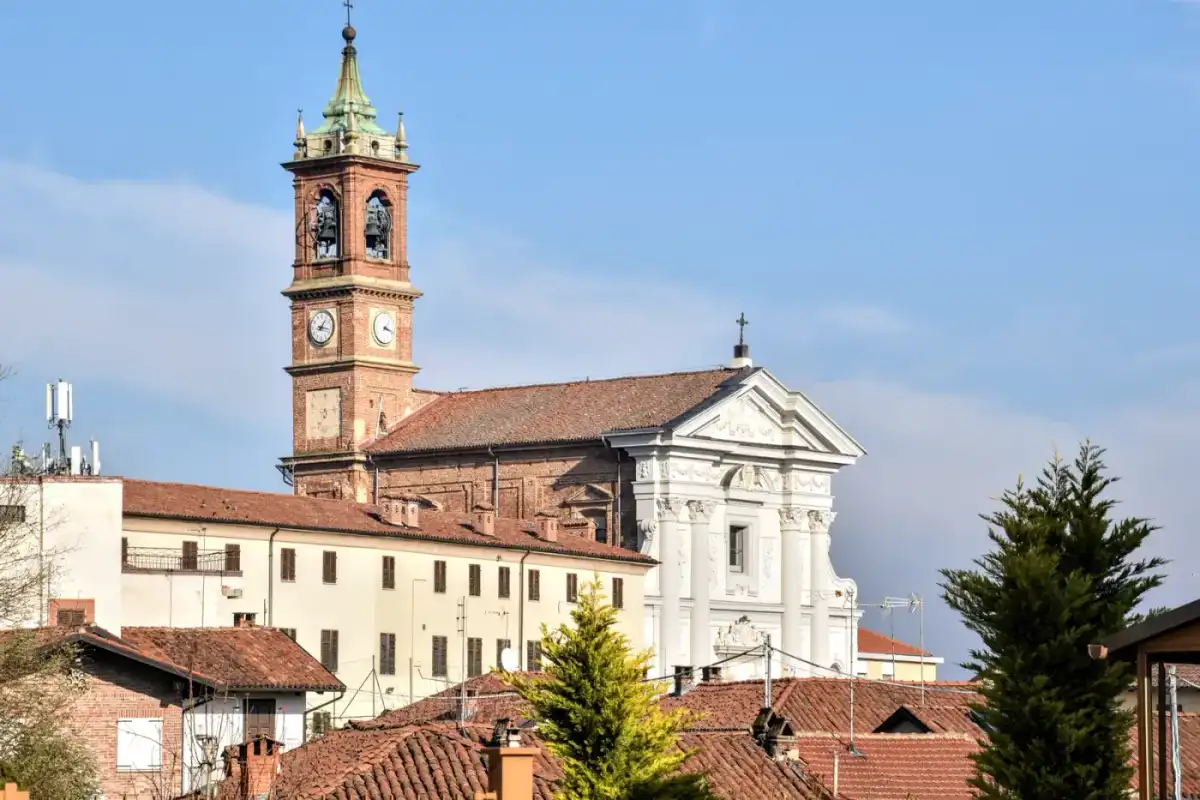
The church of Sant'Elena
The church of Sant'Elena, built between 1646 and 1652 by Francesco Garove and enriched by the Hungarian stuccoman Luca Corbellini between 1662 and 1664, is one of the most interesting works attributed to the ducal architect Amedeo di Castellamonte. It has been, and is still, the object of remarkable restoration works since 2003 that have brought back the building to the ancient splendours. During these years, after the four chapels (2003-2005) were restored. Virtue (2004-2005), the wooden choir (2007-2011), the main altar, the Barge quartzite flooring, the stuccos and paintings of the choir, the presbytery, the side walls (2016-2018), the choirs of the pulpit and the Oblates (2017-2018), the counter-façade (2018), the choir and the door (2014-2015). Restorations of the vault are currently underway and should be completed during the year.
All the works done here are described in the publication Restoration panel edited in 2018 and for sale with recess destined to the works running at the same parish church.
The church of Sant'Elena di Villafranca d'Asti is not only an example of Baroque architecture, but it is almost unique. First of all, it has not undergone any transformations and interventions that make the original aspect unreadable and irrecoverable, and this thanks to the events of the Opera Pia that owned it: in fact, it underwent changes essentially only to furnishings and decoration when it became parish in 1867. The sixteenth-century Archive of the Opera has been preserved, containing documents relating to the church yard. But above all it is an example of court architecture: thanks to the close links established between mons. Giacomo Goria, bishop of Vercelli, native to Villafranca and the Savoy family, Giacomo Goria had been, in fact, preceptor of the sons of Carlo Emanuele I, the church was designed by Amedeo di Castellamonte and worked for the construction a real "real staff", composed by the same artisans mostly from Lugano who worked in the coevi ducal yards. It was Giacomo Goria, with a donation of 1645, who founded in his native country the Opera di Sant'Elena and the Oblates of Sant'Eusebio, for which he decided to build a church.
From a typological point of view, it is an example of bourgeois architecture: the comparison with San Fedele in Milan is immediate through the mediations of the churches of Saint Martyrs and Corpus Domini, according to a direct thread that binds the Instructions to the church of Villafranca. Emblematic is the fact that Carlo Borromeo was the model of Bishop to whom mons. Goria was inspired; and in San Carlo Borromeo is dedicated the most richly decorated and finished chapel, object, in 2004, of a restoration that returned it, like to the other three chapels, the original aspect. The nineteenth-century repaintings (1911) had in fact overwhelmed the close link between rigorous catellamontian architecture and stucco decoration.
Society
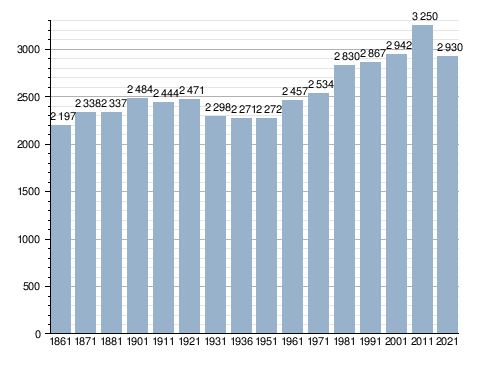
Demographic evolutionExplore this chapter
Demographic evolution
Inhabitants registered[8]
Culture
Events · "Vininvilla" and September Villafranchese · Other holiday villafranchesiExplore this chapter
Events
"Vininvilla" and September Villafranchese
The "Vininvilla" takes place in the first weekend of September Festival of Wine and Fresh Bagna, a wine competition and market exhibition of DOC and DOCG wines from the Asti area selected by ONAV. During the festival there are rides and the Charity Counter curated by the former students of the Opera Pia Sant'Elena. In reality, throughout the month of September and also in the last weekends of August there are parties, events or initiatives that enliven the town by the various associations or hamlets.
At the exhibition market you can taste and buy at cellar prices approx. 200 wines selected at the National wine competition Vininvilla for DOC and DOCG of the province of Asti, the most representative of the territory of Astigiano for number of wines and producers participating.
All combined with the best dishes of the territory among which stands out Fresh Bag, a typical dish of the town. Robust, straightforward, traditional and well-rooted, it is an authentic summer dish and not an evolution of the well-known bagna caoda. It's the same ingredients, but it's more similar to also cold of Provence.
Other holiday villafranchesi
- "Maiale d'Autore", which takes place on the third Sunday of May, concerns the pig and the processes to which its meat is subjected. This festival also has its main events on a weekend in which on Saturday evening some Pro-Loco of municipalities belonging to the Val Triversa cook dishes, the basic theme of which is precisely pork. The “Maiale d'Autore” Fair is part of the initiative ""Return to the Fair", Circuito delle Antiche Fiere del Monferrato Astigiano dell'I.C. Leader Plus, promoted by G.A.L. Lower Monferrato Astigiano.
- "Gusto all'Oratorio" which takes place on a Saturday evening in the month of July in which animators and catechists of the parish oratory cook various dishes that can be tasted in the charming Piazza Goria adjacent to the parish oratory. It is also known as the "Appetizer Festival" and dates back to 2005
- "Birrinvilla" Beer Festival with gastronomic specialties, craft beer, shows and attractions. It takes place the first weekend of June.
- Bagna caoda beneficial for LILT, curated by the Pro loco of Villafranca d'Asti. It takes place in November.
Administration
Other administrative informationExplore this chapter
Below is a table relating to the administrations that have succeeded one another in this municipality.
| Period | First citizen | Match | Load | Notes | |
|---|---|---|---|---|---|
| June 21, 1985 | May 24, 1990 | Pierino Pigella | Christian Democracy | Mayor | [9] |
| May 24, 1990 | April 24, 1995 | Giovanni Saracco | civic list Set to change | Mayor | [9] |
| April 24, 1995 | June 14, 1999 | Giovanni Saracco | civic list Set to change | Mayor | [9] |
| June 14, 1999 | June 14, 2004 | Massimo Padovani | civic list | Mayor | [9] |
| June 14, 2004 | June 8, 2009 | Massimo Padovani | civic list | Mayor | [9] |
| June 8, 2009 | May 26, 2014 | Guido Cavalla | civic list | Mayor | [9] |
| May 26, 2014 | May 27, 2019 | Guido Cavalla | Civic list From the part of the villafranchesi | Mayor | [9] |
| May 27, 2019 | in office | Anna Macchia | Civic list From the part of the villafranchesi | Mayor | [9] |
Other administrative information
From 26 May 2014, the opposition group in municipal council is represented by the civic list "Villafranca Domani", with parent Paolo Volpe. They are advisers of the list Alfredo Castaldo, Lorenzo Salvadore and Giovanni Damasio (who has taken over to the dimissionary Umberto Russo). "Villafranca Domani" opposed the exit of the Municipality from the Valtriversa Union, wanted by the majority at the end of 2013.[10]
Notes
Explore this chapter
- ^ to b Monthly demographic balance for the year 2026 (provisional data), up demo.istat.it, ISTAT.
- ^ Seismic classification (XLS), up risks.protezionecivile.gov.it.
- ^ Table of degrees/day of Italian Municipalities grouped by Region and Province (PDF), in Law 26 August 1993, n. 412, annex A, National Agency for New Technologies, Energy and Sustainable Economic Development, 1 March 2011, p. 151. URL consulted on 25 April 2012 (archived fromoriginal url on 1 January 2017).
- ^ Serafino Grassi: "History of the city of Asti" vol.II, Asti 1817 p.193
- ^ Villafranca d'Asti, decree 1954-09-26 DPR, concession of coat of arms and gonfalone, up Central State Archive. Retrieved 17 November 2021.
- ^ Coat of arms and banner, up Municipality of Villafranca d'Asti. Retrieved 17 November 2021.
- ^ Coats of arms and gonfalone of the Municipality of Villafranca d'Asti, up ACS, Collection of drawings from the coat of arms of municipalities and cities. Retrieved 24 September 2024.
- ^ Data taken from:
- Resident population of the municipalities. Censuses from 1861 to 1991 (PDF), up ebiblio.istat.it, ISTAT.
- Resident population - Time series, up exploredati.istat.it.
Please note: 2021 data refers to permanent census data as of December 31 of that year.
- ^ to b c d And f g h http://amministratori.interno.it/
- ^ OBJECT: AGREEMENT APPROVATION FOR THE RECESS FROM THE UNION of the COMMON "COMUNITY COLLINARE VALTRIVERSA" OF THE COMMUNITY OF BALDICHIERS AND VILLAFRANCA D'ASTI.; Resolution no. 28 of 30 December 2013 (PDF), up valtriversa.it. Retrieved July 2014 (archived fromoriginal url on 8 March 2016).