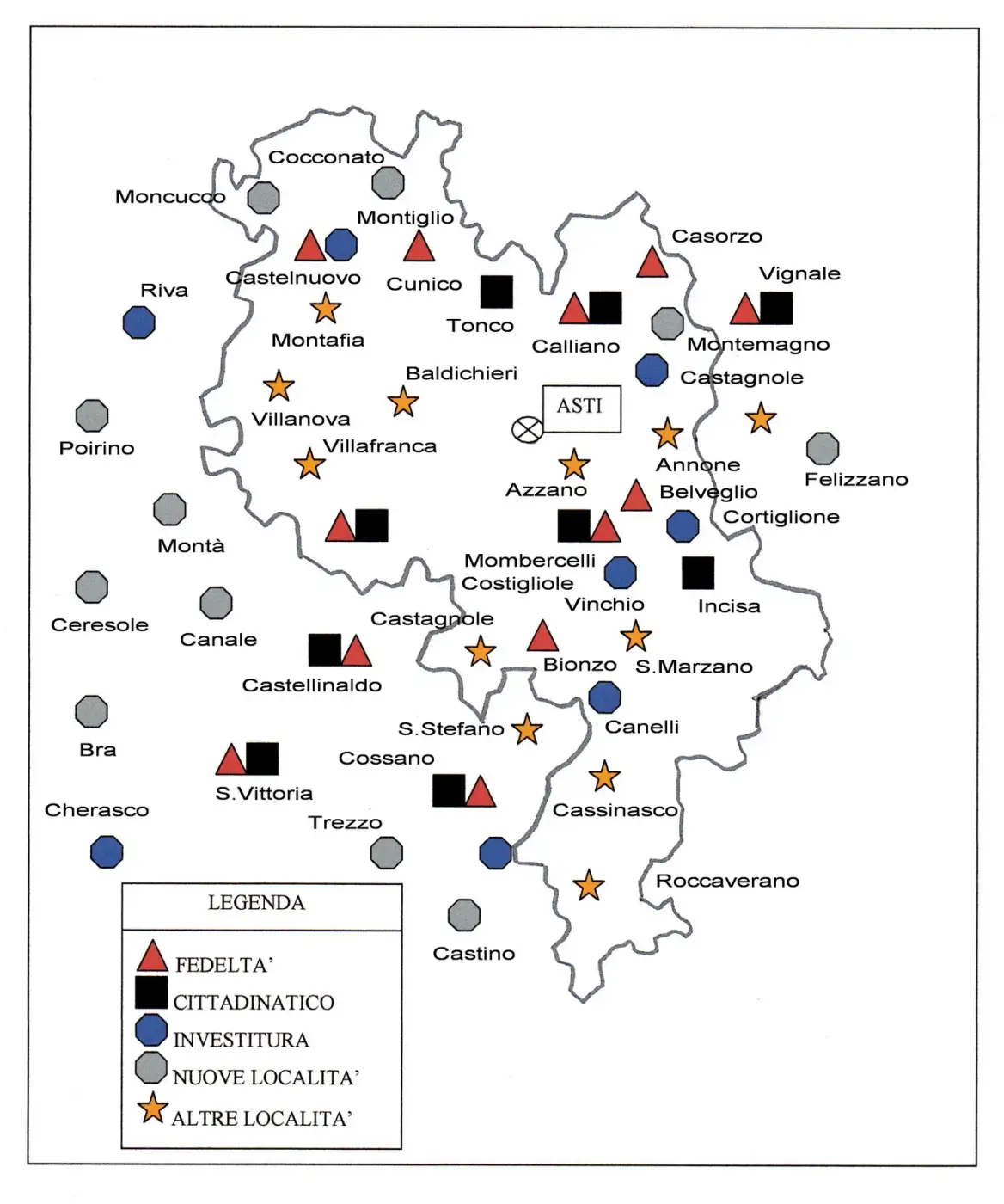
A closer look
Astesana: at a glance
There.Astesana is one of the "small patrie"[1] that make up the Piemonte. It is an ancient territory created and coagulated not on the initiative of princes or stately households, but for the political activity and economic intractability of the city that has given it its name: Asti. "Astesana" is a historical-cultural term that for seven centuries has recalled and defined the incessant and still current relationships between a city and the lands that consider it as their natural point of reference, as their inevitable capital. Since no state, no small homeland has ever remained the same over the centuries, crystallized in an immutable form, Astesana also went through a slow evolution and transformation of its borders over time, which settled at the beginning of the 18th century. Below we report some stages of this long journey.

Origin and evolution of the name
Explore this chapter
«... city of Asti and its district, not of the lands of Astesana, and of Cherasco and Bra...»
(State Archives of Asti, Orleanesi Fonds, KK314, 1 February 1393)
For the duration of the municipal period, the territory of Asti is simply defined as posse astensis[2]: an extremely dynamic and fluid concept, linked to the judicial expansion initiatives of the domain of the city of Asti. Between the end of the 12th and the beginning of the 13th century is the definition of "Astisio"[3], limited only to the territory controlled by a noble consortium made up of families belonging to the vassal clientele of the bishop of Asti; territory today known by the name of "Roero". Although not appearing in written sources, the territorial designation of "Astesana" was probably in common use already during the 13th century, as the local diffusion of the personal name "Astesano" seems to demonstrate at the time.[4]. In the same period the term "Acquesana" was used to define areas belonging to the diocese of Acqui. During the 14th century, once the territorial structure of Asti had crystallized in an attempt to guarantee its unity and compactness under the various foreign dominations that succeeded the dominion of the Municipality, its designation with a univocal and shared term appeared increasingly evident. "Astesana" therefore appears in the second half of the fourteenth century, during the Visconti domination, to highlight and enucleate the Patria Astensis within the largest and most articulated County of Asti. Already at the time of the domination of Gian Galeazzo Visconti is attested Captaineatus Astesanae, and the subsequent Orleanian lordship, at the end of the 14th century, definitively distinguishes the Astesanae land (lands of Astesana) from captainneatus Claraschi et Braydae (captainship of Cherasco and Bra) and from brandnatus Cevae (marquisate of Ceva) both forming part of the seigneurial jurisdiction of the Asti dominion. During the 15th century the term "Astesana" (also in the French variant of "Astezanne") overlaps with that of "homeland Astese" and "county of Asti" until it took definitive predominance. During the 16th century, especially following the obligation to use the Italian language in the drafting of public documents imposed by Emanuele Filiberto, the variant of "Asteggiana" became established, used until the end of the 18th century. The definitions of the toponyms Villanova in Asteggiana, Buttigliera in Asteggiana, Castelnuovo in Asteggiana, Langhe dell'Asteggiana, etc. date back to this period. Even in the 18th century, the reports of the Intendenti di Finanza exclusively used the variant of "Asteggiana", identifying a "Bassa Asteggiana" on this side of the Tanaro, made up of the districts of San Damiano, Villanova, Buttigliera, Montechiaro and Cocconato" and an "Alta Asteggiana" beyond the Tanaro, made up of the districts of Costigliole, Canelli and Mombercelli. At the beginning of the nineteenth century, the scholar Gian Secondo De Canis began to use the variant of "Astigiana" in his studies, which took over definitively over the course of the century. Following the suppression of the Province of Asti in 1860, the territory assumed the status of Circumdarium within the province of Alessandria. It is in this era that the version of "Astigiano" begins to be used, which over the decades will replace the previous one and emptiness of the known identity that were its own.
The territory of Asti in the fourteenth century
The list, drawn up in alphabetical order, shows the localities belonging to the territory subjected to the Astigian domination at the time of the maximum expansion of the Municipality. It's...Explore this chapter
The list, drawn up in alphabetical order, shows the localities belonging to the territory subjected to the Astigian domination at the time of the maximum expansion of the Municipality.[5] It is a vast territory, mainly coagulated peacefully thanks to the use of huge capitals and an incessant diplomatic work that lasted over two centuries.[6]
For a better understanding have been given the names of current municipalities, whose administrative boundaries today often include ancient missing locations and modern spelling has been used. The municipalities are listed by the current Province of membership:
Province of Asti:
Agliano Terme, Altavilla Monferrato, Antignano, Asti, Azzano d'Asti, Baldichieri d'Asti, Belveglio, Bubbio, Buttigliera d'Asti, Calamandrana, Calosso, Calliano, Camerano Casasco, Canelli, Cassinasco, Castagnole delle Lanze, Castagnole Monferrato, Castell'Alfero, Castello di Annone, Castelnuovo Belbo, Castelnuovo Calcea, Castelnuovo Don Bosco, Cellarengo, Cerro Tanaro, Cinaglio, Cisterna d'Asti, Costigliole d'Asti, Coazzolo, Corsione, Cortandone, Cortanze, Cortazzone, Cortiglione, Cossombrato, Cunico, Dusino San Michele, Ferrere, Frinco, Grana Monferrato), Isola d'Asti, Incisa Scapaccino, Loazzolo, Maretto, Masio, Moasca, Mombaldone, Mombercelli, Monale, Mongardino, Montaldo Scarampi), Montafia, Montechiaro d'Asti, Montegrosso d'Asti, Montemagno, Olmo Gentile, Piea, Portacomaro, Refrancore, Revigliasco d'Asti, Roatto, Rocca d'Arazzo, Roccaverano, Rocchetta Palafea, Rocchetta Tanaro, San Damiano d'Asti, San Giorgio Scarampi, San Martino Alfieri, San Marzano Oliveto, San Paolo Solbrito, Scurzolengo, Serole, Sessame, Settime, Sommariva Bosco, Sommariva Perno, Tigliole, Tonco, Vaglio Serra, Valfenera, Vesime, Viale d'Asti, Vigliano d'Asti, Villafranca d'Asti, Villanova d'Asti, Vinchio.
Province of Cuneo:
Bagnasco, Battifollo), Bergolo, Borgomale, Bosia, Bra, Canale, Castagnito), Castelletto Uzzone, Castellinaldo, Castellino Tanaro, Castiglione Falletto, Castiglione Tinella, Castino, Cavallermaggiore, Ceresole d'Alba, Ceva, Cherasco), Cortemilia, Cossano Belbo, Garessio, Felizzano, Gorrino, Govone, Igliano, Lequio Berria, Magliano Alfieri, Mango, Monasterolo, Monchiero, Montà d'Alba, Montaldo Roero, Monteu Roero, Montezemolo, Neive, Neviglie, Niella Tanaro, Novello, Nucetto, Pamparato, Perletto, Pezzolo Valle Uzzone, Piozzo, Pocapaglia, Priero, Priocca, Roascio, Rocchetta Belbo, Saliceto, Sanfrè, San Michele Mondovì, Santa Vittoria d'Alba, Santo Stefano Belbo, Santo Stefano Roero, Torre Bormida, Torresina, Trezzo Tinella.
Province of Alessandria:
Denice, Bergamasco, Ponti, Quattordio, Vignale Monferrato, Carentino.
Province of Turin:
Poirino, Pralormo, Riva near Chieri.
Province of Savona:
Cagna, Lodisio, Murialdo.
Administrative divisions of the territory in municipal times
The "old villages" of the municipality of Asti · The "new places" · The fiefs of the CommuneExplore this chapter
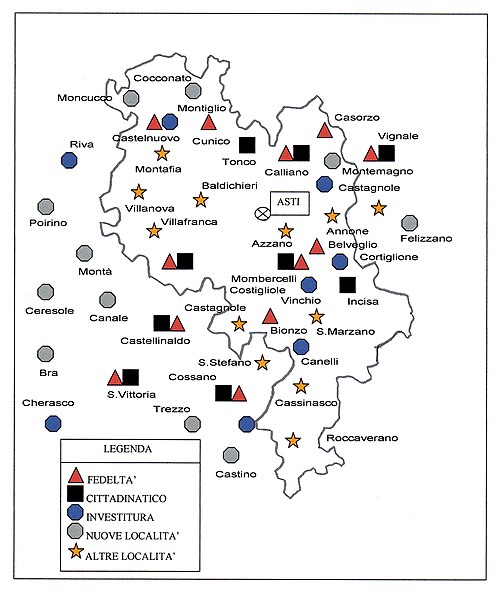
A territory so vast was not homogeneous from the political and administrative point of view: within it there were several areas related to the different types of relations that linked the dominant Asti to the peripheral centers and local powers.
The "old villages" of the municipality of Asti
They represent the original nucleus coagulated by the city's political initiative to the dawn of the Commune. They draw a territory of very close relevance and urban belonging. Azzano, Montemarzo (fraction Asti), Neante (loogue missing near Asti), San Marzano di Rocca Schiavina (now San Marzanotto, fraction of Asti), Mongardino, Bellangero (fraction between San Marzanotto and Mongardino), Camerano Vecchio (dead place), Variglie (fraction of AstiRevigliasco, Antignano, Tasseria, Molegnano, Villa Palazzo, Cumignano (located rooms Antignano, San Martino Alfieri, Celle), Baldichieri, Andona and Monfrione (located to the west of Asti).
The "new places"
Within about twenty kilometers from the city, the Municipality of Asti identified a territory of narrow urban relevance, privileged by the fact that its inhabitants enjoyed the right of Astigian citizenship, sharing the burdens and honors of those who resided within the walls. The chronicler Ogerio Alfieri at the end of the 13th century delimited this territory as follows ("All these lands are called New Places of the municipality of Asti, to distinguish them from ancient villages, vassals and castles of citizens."
- In the valley of Tanaro da Felizzano up to Neive
- In the Tiglione valley up to Belveglio and Vinchio
- In the valley Belbo da San Marzano Oliveto up to Castino
- In the Tinella valley up to Trezzo Tinella
- Fra Tanaro and Borbore to Magliano and Castellinaldo, and up to Bra and Cavallermaggiore
- In the Piana up to Poirino, Riva and Castelnuovo (Don Bosco)
- In the Triversa valley up to Buttigliera d'Asti And Maretto
- In the Rilate valley up to Montechiaro d'Asti
- In the Versa valley up to Rinco, Tonco and Calliano
- Beyond the Versa up to Montemagno, Grana Monferrato And Vignale Monferrato.
The "new places", seen as real urban relevance, could not be subjected to the feudal authority of a lord, but were directly controlled by the municipality of Asti who appointed you the podestà and the castellani. Only later, due to the gradual weakening of the municipal authority, much of the "new places" were infeuded to noble families of Astigian behind the payments, or by these latter proditoriously occupied. The terminus "Luogo Nuovo" simply indicates a place recently aggregated to the city of Asti, and does not refer to the construction or foundation of the same. However, in the context of vast land reorganization campaigns, demographic, political of the conquered territories, often the municipality of Asti built its "New Places", which then took the name "Villenove".
From the documents of the time are indicated as "New places" the following villages: Belveglio, Calosso, Canelli, Castagnole delle Lanze, Castelnuovo Calcea, Castelnuovo di Rivalba (Don Bosco), Cossano Belbo (CN), Masio (AL), Isola d'Asti, Mango (CN), Mombercelli, Neviglie (CN), Rocchetta Belbo (CN), San Marzano Oliveto, Vinchio.
They are instead "Villenove" of new foundation: Buttigliera d'Asti, Canale (CN), Costigliole d'Asti, Montechiaro d'Asti, Montegrosso d'Asti, San Damiano d'Asti, Settime, Villa San Secondo, Villafranca d'Asti, Villanova d'Asti.
The fiefs of the Commune
In addition to the "new places" where the dialectic "Republican" was preferred among equal citizens, coexisted the "Feeds of the Commune": they were those places where the Municipality could have at its liking, and that it assigned in fiefdom to feudal lords of his confidence, or local citizens bound by strong bonds of fidelity and alliance. Below we bring some of the major feudal realities present on the territory.
The fiefs of the bishop of Asti or "Terre della Chiesa"
The bishops of Asti, already owners of the jurisdiction on a vast territory, were gradually expropriated from the initiative of the Municipality of Asti. A discontinuous community, however, continued to belong directly to the high domain of the Astigian bishops, who entrusted it with feudal management to the Municipality of Asti. The towns were: Castagnito, Castellinaldo, Castello di Menabò, Castellino dei Volti, Cellarengo, Cistern, Cortanze, Cossombrato, Govone, Magliano Alfieri, Montaldo Roero, Monteu Roero, Monticello, Piobesi, Piea, Pocapaglia, Salmour (by right of tithe), Santo Stefano Roero, Santa Vittoria d'Alba, Vezza d'Alba.
The fiefs "carretteschi" of the Langhe
In the early 13th century, the powerful Marquis of Carretto, lords of much of the Langhe, sold to Asti the following locations[7], which continued to be part of the Astesi domains until well into the 17th century, some of them are part of today's province: Bergolo, Bosia, Cagna, Castelletto Uzzone, Cortemilia, Castino, Gorrino, Denice, Lequio Berria, Lodisio, Monchiero, Mombaldone, Novello Olmo Gentile, Saliceto, Serole, Perletto, Pezzolo, Roccaverano, San Giorgio Scarampi, Torre Bormida, Torre Uzzone, Vesime,
The Marquisate of Ceva
In 1295 the municipality of Asti acquired by Marquis Nano di Ceva the homonymous marquisate, grabbing the stratospheric figure of one hundred thousand Auction liras. In the same year the marquis obtained the feudal investiture of the sold lands, for himself and his heirs. The Marquisate of Ceva continued to be an autonomous and indivisible body of the Astese jurisdiction and state, even after Emanuele Filiberto I of Savoy united in his person the titles of "Count of Asti" and "Marquis of Ceva". Only in the late 17th century were the two territorial entities definitively separated. The territories of the marquisate were the following: Bagnasco, Battifollo, Castellino Tanaro, Ceva, Garessio, Igliano, Lisio, Monasterolo, Montezemolo, Niella Tanaro, San Michele Mondovì, Nucetto, Priero, Riofreddo di Calizzano, Roascio, Viola, plus the castles of Ventapanicie, Montisguardie, Proenche, Murischi.
The Orleanese State
The Astesana · The feudal lands of the Astesana · The Captain of the AstesanaExplore this chapter
On 27 January 1387 Giangaleazzo Visconti, lord of Asti and of Milan, he gave the Astigian lands to his daughter Valentina and son-in-law Luigi di Touraine (later Duke of Orléans), brother of the King Charles VI. A domination began to last, with alternating events, until 1529. The Orleanese administration, which also involved the Astilian lands in European struggles for dominance in Italy, was able to gain trust and loyalty of the subjects thanks to a substantially moderate policy, respectful of the centuries-old local autonomy and committed to relaunching the economy and trade. Under the rule of the Orléans CountyAsti it strengthened its territorial consciousness and its own spirit of belonging, reaching to feel a region with completely original characters compared to the neighboring Piemonte and Monferrato: a proudly defined region "Patria astese".
Compared to the vast municipal state, the Orleanese one, although still very extensive, was the result of significant reductions and subtractions carried out on the initiative of previous dominations, or feudal families of the citizen's patrician. Thus, for example in 1387 the countries of Tonco, Calliano, Vignale Monferrato, Montemagno, Castagnole Monferrato, Cerro Tanaro and Vignale had already belonged to the Marquis of Monferrato, while quite recent it was the subtraction of countries like Castello di Annone, Rocchetta Tanaro, Rocca d'Arazzo, Mombercelli, Vinchio, Castelnuovo Calcea, initially maintained by Giangaleazzo Visconti, then became imperial fiefdoms.
Finally, not a few nominally belonging to the county of Asti were held by lords who did not recognize its authority, providing the pretext for endless, disproportionate and inconclusive claims. Exemplify the case of the very abstinence San Damiano d'Asti, occupied for over two centuries by the marquises of Monferrato, or of Poirino, firmly in the hands of the counts of Savoy.
The Astesana
Inside the County, or Patria astese, there was an area of which the city of Asti represented the center, corresponding roughly to what at the end of the 13th century constituted the posse civitatis astensis, and whose towns were qualified as "new places" of the Municipality. This area was called Astesana. The remaining parts of the County were the lands of the Vassals, whose lords recognized (or should have recognized) the high dominion of the Asti government.
Within the Astesana, then there were other political-administrative differentiations. All around the capital Asti, for the radius of more than ten kilometers, extended the "Civic District", a real metropolitan area ante litteram corresponds to about twenty countries and villages that were incorporated into the substance as circumscriptions of urban relevance. In them the municipality of Asti named the Podestà by choosing them among the members of its City Council.
The towns of the City District were the following countries: Antignano, Cantarana, Camerano, Castell'Alfero, Cinaglio, Dusino San Michele, Montegrosso d'Asti, Mongardino, Portacomaro, San Damiano d'Asti (only for the hamlets of Gorzano and Lavezzole), Scurzolengo, Tigliole, Villafranca d'Asti; more a series of ancient Podesterie still existing as fractions or constituencies called "Ventine": Bellangero, Castiglione, Migliandolo, Montemarzo, Quarto d'Asti, San Marzanotto, Asti, Serravalle, Vaglierano, Variglie.
The feudal lands of the Astesana
They were the fiefs for Asti and as a result of his legitimate lord, maintained or enjoyed by noble citizens of Astigiani. Agliano Terme, Buneo, Calosso, Camerano Casasco, Canale, Castagnito, Castellero, Castellinaldo, Cellarengo, Ceresole, Cortandone, Cortanze, Cossombrato, Costigliole d'Asti, Ferrere, Frinco, Govone, Isola d'Asti, Magliano Alfieri, Maretto, Monale, Monta, Montafia, Montaldo Roero, Montaldo Scarampi, Monteu Roero, Monticello, Neviglie, Piea, Pocapaglia, Pralormo, Priocca, Revigliasco, Roatto, San Damiano d'Asti, Sanfrè, San Marzano Oliveto, San Martino Alfieri, San Paolo Solbrito, Santo Stefano Roero, Settime, Sommariva Bosco, Sommariva Perno, Trezzo Tinella, Vezza, Viale d'Asti.
The Captain of the Astesana
In the Astesana, the Orleanese government established a real "healthy arm" and strategically against the expansionist myres of Savoy. It was made up of twelve well-equipped and fortified towns, with precise functions of garrison in the territory: it was called "Capitanato dell'Astesana" because it was commanded by a Captain elected by the Duke himself or by the Governor of the County. The localities that composed it could not be assigned in fief, although they generally housed a "castellano" with military coordination functions, chosen among the best exponents of the citizen patriziato. The locations were: Azzano d'Asti, Baldichieri, Buttigliera d'Asti, Canelli, Castagnole Lanze, Celle Enomondo, Chiusano d'Asti, Castelnuovo Don Bosco, Montechiaro d'Asti, Neive, Vigliano d'Asti, Villanova d'Asti.
The Captainship of Bra and Cherasco and the fiefs of the Langhe
The important towns of Bra and Cherasco belonged to the Municipality of Asti since the 13th century. They were an autonomous captain. The other lands listed below, mostly held by the ancient local aristocracy, belonged to the County of Asti but were not considered as part of the Astesana. Bergolo, Bonvicino, Bosia, Bra, Cherasco, Castelletto Uzzone, Castiglione Falletto, Castino, Cigliè, Clavesana, Cortemilia, Cossano Belbo Denice, Dogliani, Farigliano, Gorrino, La Morra, Lequio Berria, Marsaglia, Mombaldone, Monesiglio, Murialdo, Novello, Perletto, Rocchetta Belbo, Saliceto, San Giorgio Scarampi, Santo Stefano Belbo, Serralunga d'Alba, Torre Bormida, Vesime,
The lands of the bishopric
The Bishop of Asti already in the 13th century had granted lands (extended between Tanaro and Borbore) on which he exercised secular jurisdiction to the Municipality of Asti, who in turn infeuded them to noble families of the City. In addition to these locations, included in the list of Astesana's Feudi, he directly controlled some centers in the upper Tanaro valley: Benevagienna, Trinità, Sant'Albano, Piozzo.
The lands held by the Count of Savoy
These places, acquired by the Municipality of Asti during the 13th century, and from it granted in fief to the counts of Savoy, still belonged nominally to the Orleanese county. Carignano, Cumiana, Riva di Chieri, Poirino, Vigone.
The Marquisate of Ceva
While maintaining its institutional and administrative autonomy, the Marquisate of Ceva continued to recognize the high domain of Asti and his legitimate lord. Although it was not part of the "Astronomy country" or Astesana, it was an important component of the Orleanese-Astigiano state, whose financial and fiscal management had the task to contribute for the fourth part. Bagnasco, Battifollo, Castellino Tanaro, Ceva, Garessio, Igliano, Lisio, Monasterolo, Montezemolo, Niella Tanaro, Nucetto, Pamparato, Priero, Riofreddo di Calizzano, Roascio, San Michele Mondovì, Torresina, Viola.
Changes in the house Savoia
From 1538, the ancient Orleanese-Astigiano state entered the final possession of Savoy's house in the hands of Duke Emanuele Filiberto of Savoy, who assumed the titles of...Explore this chapter
From 1538, the ancient Orleanese-Astigiano state entered the final possession of Savoy's house in the hands of Duke Emanuele Filiberto di Savoia, who assumed the titles of "Conte di Asti e Marquise di Ceva". However, the "piemontization" of the Astigian lands was a very slow phenomenon, also because for a long time the Saudi dukes respected the integrity and administrative structures of the ancient "Actese country" and the Astians, for their part, claimed to every occasion their "alterity" regarding the Piedmontese lands.
It was under the dominion of Carlo Emanuele I of Savoy who began modifications such as to dismantle, in the course of a century, the Astigian state, turning it definitively into the modern Astesana. The first amputations, still at the end of the 16th century, were about Bra and Cherasco as well as the brand of Ceva. Immediately after, almost for compensation, the County of Asti was assigned the ancient, small county of Cocconato, or of the Radicati (from the name of the dominant family) which remained independent until 1586. The lands of Cocconato, Aramengo, Robella, Passerano, Marmorito, Primeglio, Schierano, Capriglio, Bagnasco di Montafia.
In the middle of the 17th century, with the establishment of the Province of Alba, were subtracted to the "Ataste country" most of the municipalities constituting the territory today called "Roero", as well as a series of villages of the high Langa around Cortemilia; after 1709 the creation of the province of Alba Acqui Terme It led to the loss of other countries in the Bormida Valley. A partial integration of what is subtracted, the Astesana would in that time portray the "imperial faiths" removed in ancient times by Giangaleazzo Visconti, but remained astigiani for culture, uses, traditions and trade. It is Mombercelli, Vinchio, Castelnuovo Calcea, Rocca d'Arazzo, Rocchetta Tanaro, Belveglio, Castello d'Annone.
At the beginning of the 18th century, Vittorio Amedeo II's absolutist and centralist policy led to the definitive suppression of the County of Asti, which in the meantime had overlapped the Province that recalculated its borders. It can be said however that the classical Astesana, the one still identifiable and enucleable within the current province of Asti, had its modern layout after 1631, and its definitive borders in 1737, when there were again annexed the "imperial faiths".
The Municipalities of the Classic Astesana
These are the municipalities that make up the contemporary Astesana, defined by the territorial integrations mentioned above. From the middle of the 18th century, the territory is...Explore this chapter
These are the municipalities that make up the contemporary Astesana, defined by the territorial integrations mentioned above. From the middle of the 18th century, the territory was conventionally crafted in Alta Astesana, including lands located beyond the right bank of the Tanaro, and in Lower Astesana, consisting of the capital and the lands to the left of the river.
- Municipalities of Lower Astesana
Asti, Albugnano, Aramengo, Antignano, Baldichieri d'Asti, Berzano di San Pietro, Buttigliera d'Asti, Camerano Casasco, Cantarana, Capriglio, Castell'Alfero, Castellero, Castelnuovo Don Bosco, Cellarengo, Celle Enomondo, Chiusano d'Asti, Cinaglio, Cistern, Cocconato, Cortandone, Cortanze, Cortazzone, Cossombrato, Dusino San Michele, Ferrere, Frinco, Maretto, Monale, Moncucco Torinese, Montafia, Montechiaro d'Asti, Passerano Marmorito, Piea, Pino d'Asti, Portacomaro, Revigliasco d'Asti, Roatto, Robella, San Damiano d'Asti, San Martino Alfieri, San Paolo Solbrito, Scurzolengo, Settime, Soglio, Tigliole, Tonengo, Vagliarano, Valfenera, Viale d'Asti, Villafranca d'Asti, Villanova d'Asti.
- Municipalities of the Upper Astesana
Agliano Terme, Azzano d'Asti, Belveglio, Calosso, Canelli, Castagnole delle Lanze, Castelnuovo Calcea, Coazzolo, Costigliole d'Asti, Isola d'Asti, Moasca, Mombercelli, Mongardino, Montaldo Scarampi, Montegrosso d'Asti, Rocca d'Arazzo, Rocchetta Tanaro, San Marzano Oliveto, Vigliano d'Asti, Vinchio.
The province of Asti was suppressed in 1859 and aggregated to that of Alessandria. The identity of Astesana, however, continued to exist, and indeed to strengthen within the new province, once again as a character of "otherness" and a reason for distinction compared to other lands such as Monferrato or Alessandria. From an administrative point of view it became a "District" maintaining the previous structure. The districts were abolished by law in 1927. In 1935 the province of Asti was restored, but with different borders compared to the old one: the 70 municipalities of the classic Astesana, considered too few to constitute a provincial body on their own, were joined by another 50 municipalities taken from the Upper and Lower Monferrato. Of these, over half had been part of ancient Astesana or the County of Asti, others had never shared its history or institutions before then. Starting after the Second World War, the new province of Asti began to be mistakenly identified with the Monferrato, and the identity of the ancient homeland of Astesana was set aside to the point of almost being lost. The recovery of the ancient and never totally dormant territoriality is a recent phenomenon.
Quotes
Explore this chapter
(New Universal Geography of the Father Claudio Buffier, Turin 1793)
(Giuseppe Baretti, letter of 1770. In Writes chosen, unpublished and rare. With new memories about his life, by Giuseppe Baretti and Pietro Custodi, 1822. p. 403)
(A.Strucchi, M.Zecchini, Muscat of Canelli, Turin, U.T.E.T., 1985)
(Ferdinando Gabotto, Life in Asti at the time of Giovan Giorgio Alione, Asti, 1899, p. 22)
Notes
Explore this chapter
- ^ Country cited in Piedmont.
- ^ Ogerio Alfieri, Aliquid de ystoria Civitatis Astensium, c.51, in Codex Astensis qui de Malabaila communiter nucupatur, Printed edition edited by Quintino Sella, Rome 1880
- ^ Codex Astensis qui de Malabaila communiter nucupatur, op. cit., documents 574, 568 to 570, 575, 581, 585, 586, 734, 920, 925 and others
- ^ Codex Astensis qui de Malabaila communiter nucupatur, op. cit., under the headings "Astexana" (doc.712) "Astexanus" doc. 820, 274, 457, 578, 579 and others
- ^ The acquisition processes of the localities constituting the Astigian domain, are reported through its notary or diplomatic acts in Codex Astensis qui de Malabaila communiter nucupatur, printed edited by Quintino Sella in 1880.
- ^ The Statutes of the Municipality of Asti, already drafted at the dawn of the thirteenth century and reformed in 1379, contain two lists of villages, castles and places quod intellingantur de posse astensis: the first is in Collation 1, Chapter 44; the second in Collation 17, chapter 51. Some differences between the two lists are attributable to changes in districtization occurring during the century. (Books Statuterum Civitatis Ast per orderm Alphabeti - Printed edition of 1534)
- ^ Codex astensis qui de Malabaila communiter nucupatur, vol. II, doc. from 248 to 262
Bibliography
Explore this chapter
- Asti State Archives (ASAT) KK313, Conti rendered to the Chamber of Accounts of Blois by Giovanni Tinelli, 1387-1389
- ASAT, KK312. Book of ordinary and extraordinary revenue and expenditure from the Asti Treasures, 1387-1389
- ASAT, KK313B, Book of debts and fines, 1387-1389
- ASAT KK314, Count of Giovanni Tinelli ducal treasurer, 1393-1394
- ASAT KK315, Book of fines 1406-1407
- ASAT KK 315B, Fragment of account 1410
- ASAT KK316: Counts of Andrione Ricci treasurer 1429-1432
- ASAT kk317 Counts of Enrico Buneo treasurer 1440-1443
- ASAT KK318 Counts of Enrico Buneo, 1443-1445
- ASAT KK318B Book of Expenditure of Asti Treasure, 1447-1448
- ASAT KK318C Book of income and exits of the ducal treasury (fragment) 1448
- ASAT KK319 Book of accounts by Benedetto Damiani ducal treasurer, 1459-1460
- ASAT KK320 Book of accounts by Andrea Damiani 1461-1462
- ASAT KK421 Book of accounts by Andrea Damiani 1463-1464
- ASAT KK526 Book of accounts by Andrea Damiani, 1473-1475
- ASAT KK527 Book of accounts by Andrea Damiani, 1477-1478
- ASAT KK528 Book of accounts by Carlo Damiani 1481-1482
- ASAT KK529 Book of accounts by Carlo Damiani 1498-1499
- ASAT KK321C Book of accounts by Gerolamo Malabaila, 1517-1529
- Claude Buffier, Universal Geography of the father Claudio Buffier/of the Society of Jesus/ translated from French to Italian / nona edition etc. etc., Venice 1767
- Gian Secondo De Canis, The Modern Astigiana , 1815, manuscript available at the Astense Library - Asti, ms II, 22
- Gian Secondo De Canis, The ancient Astigiana, 1815, manuscript at the Astense Library ms II, 21
- Gian Secondo De Canis, Astigian Corography, 1816, manuscript at the Astense Library, ms.II, 20
- Serafino Grassi, History of the city of Asti, 1817, reprint 1993
- Pietro Vayra, A year of public life of the municipality of Asti- 1441, Turin, 1889
- Ferdinando Gabotto, Life in Asti at the time of Giovan Giorgio Alione, Asti, 1899
- Pietro Savio, City statutes of Villanova d'Asti, Rome, 1934
- V. Forghieri, "Asti and French politics in Lombardy from 1422 to 1461" Magazine of history, art and archaeology Alessandria and Asti, XLV 1936
- Blythe A. Raviola: The most accurate intention - Giuseppe Amedeo Corte di Bonvicino and the report of the political economic state of the Asteggiana in 1786, Turin, 2004.
- Renato Bordone, The historian Gian Secondo de Canis and his "statistical description of the Province of Asti", Asti, 1976.
- Renato Bordone, "Asti provincial capital and heritage of a medieval state", in Society and History, 1989.
- Renato Bordone, Proposal for a reading of the Astigian Choir by Gian Secondo de Canis, Asti, 1977.
- Giovanni Francesco Balduini di Santa Margherita, General Report of the Instituto d'Asti on the state of the Province- 1750-1753, edited by Società di Studi Astesi, Asti, 2010
Continue your journey