Atlas of Monferrato
Masio: sights, history and trails
Alessandria
- Elevation
- 142 m above sea level
- Area
- 22.23 km²
- Demonym
- Masisis
- Patron saint
- Saint Mary Magdalene and St Dalmazzo
A closer look
Discovering Masio
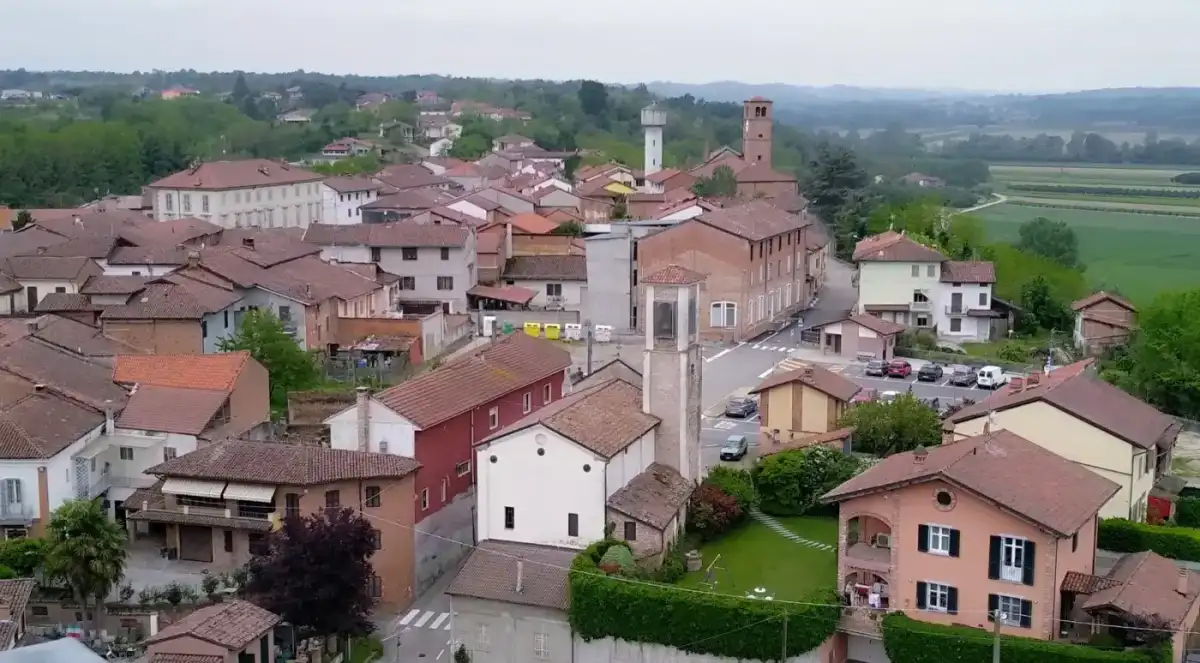
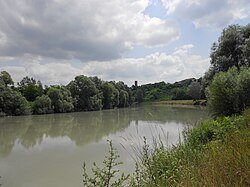
Masio (Mas in Piedmont) is an Italian municipality of 1 273 inhabitants[1] from the province of Alessandria, located on the right bank of the river Tanaro, in Piemonte.
History of Masio
SymbolsExplore this chapter
Masio has ancient origins and a remarkable past species in medieval age.
The importance of the municipality derives from its geographical position at the borders of Alto and Basso Monferrato on the right bank of the Tanaro.
It is at the center of an imaginary triangle, whose summits are the cities of Turin, Milan and Genoa.
Equid instant from Alessandria And Asti, constituted an ideal point of influx from all the valleys and all the centers located on both the right and left banks for transit on the river. This constituted the primary source of every agricultural and commercial resource.
Some historical documents in which it is cited as Massius (899), Villa Masias (959), Maxius (1081). This nomenclature seems to indicate the origin of the toponym from the Latin language ma(n)sum, that is abode, cascinal.
In medieval documents the locality is also cited as villa Maxias (959), Masius (960), Maxus (960), Castro de Maxias (961), Mascius (1024), Max. (1169), Mazo (1191), Maxia (1195), Maço (1235), Maxa (1203), Masius.
The first localization of which is known dates back to a 1292 paper preserved in a collection of the National Library of Turin.
The importance of the municipality in the various eras is evidenced by a rich series of events of considerable historical relevance already in the years close to the year thousand, of which can be indicated the following chronology:
- in 907, according to an ancient local tradition, crossed the Tanaro to Masio the procession of monks who carried the relics of San Dalmazzo from Borgo San Dalmazzo to Quargnento. A relic of the Saint is still preserved today in the parish of Santa Maria and San Dalmazzo.
- in 980 he was infeuded by the Bishop of Asti to the Viscounts of Asti;
- in 1190, the consoles of Masio, which was already organized in the Commune, concluded an agreement with Alessandria and Asti by granting exemptions from toll and war aid to both of them; in return they obtained exemptions from any toll for men of Masio who became citizens of the two major municipalities;
- in 1204 a truce was agreed between Milan and Piacenza on one side and Asti and the Marquis of Monferrato on the other;
- in 1218 the Lanerios and the Hounds of Quattordio ceded to Asti part of their jurisdiction over Masio;
- in 1223 the peace between the church of Santa Maria was signed in Alessandria, Asti and Alba, soon broken peace with regard to the application of the Treaty about Masio and the lands of Acquisana;
- in 1227 it was divided between Alessandria and Asti and the prohibition of building fortifications on its territory was imposed;
- in 1357 the Guttuari bought the lordship from the Lanerios;
- in 1372, on the occasion of the approval of the Statutes, the lordship belonged to the Visconti;
- in 1428 Masio was infeuded to the Valperga, who subsequently obtained the investment of Sforza;
- in 1451 Francesco Sforza granted Redabue to the Scaramps;
- in 1605 Philip III King of Spain invested Francesco Valperga;
- in 1650, the governor of Milan, in the name of Charles II King of Spain, was razed by the French and at the end of the Thirty Years' War the governor of Milan reintegrated into the fief the Valperga;
- in 1674 the two last Valperga sold half of the feud to Annibale Civalieri and half to Carlo Olivasso.
In the following centuries, with the end of the feudal period, the small and medium-sized landowners of noble families (Marquis de Masio, Conti Baiveri). The Rattazzi family had its greatest exponent in Urbano.
Thanks to the political activity of the latter, in the summer residence of the Rattazzi, Villa Marina took place a historic and decisive meeting with Camillo Benso, Count of Cavour who gave rise to the famous "connube" that brought the politician of Masio and Cavour to lead the decisive governments for the Unity of Italy.
During World War II, the activity of the Resistance was remarkable and took advantage of the presence of Masio in the forty-four free communes of the Republic of Upper Monferrato, with capital Nizza Monferrato (October 1944).
Symbols
The coat of arms and gonfalone of the municipality of Masio were granted by decree of the President of the Republic of 30 May 1967.[4]
What to see in Masio
Museum La Torre and the River · Church of Santa Maria and San Dalmazzo · Castle of RedabueExplore this chapter
Museum La Torre and the River
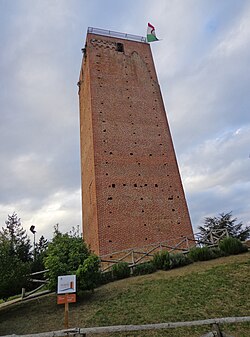
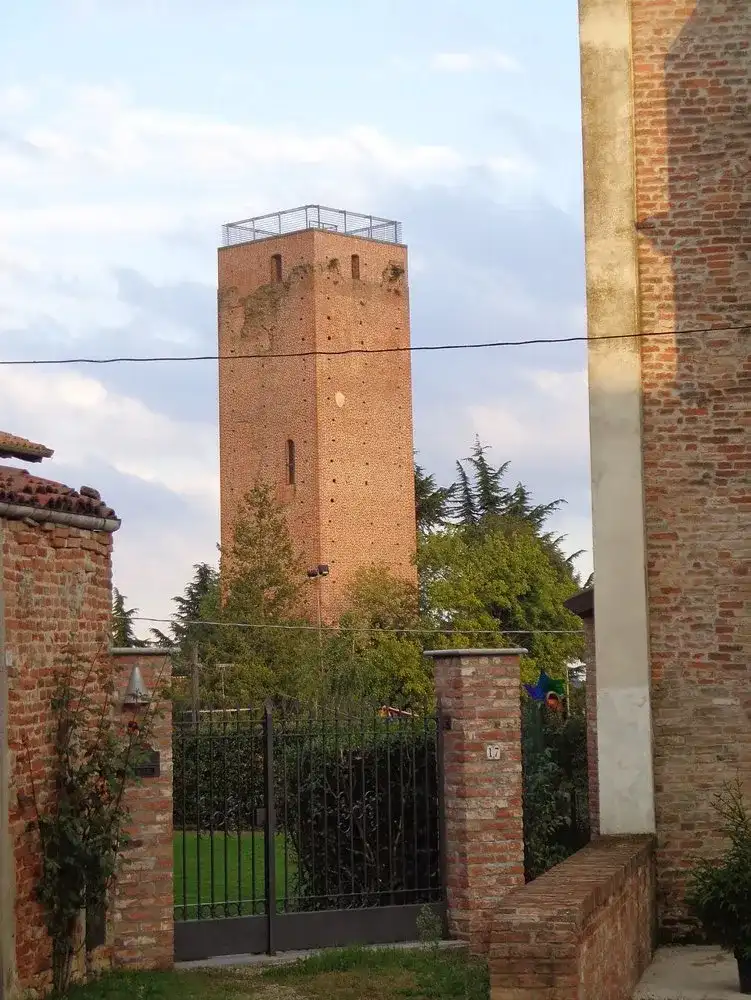
The medieval tower and part of the walls surrounding the village were preserved in Masio. In 2013 the Museum La Torre and the River dedicated to the history of towers was inaugurated, from a defence tool to a characteristic element of the landscape.
Along the seven floors of the Tower are illustrated the ancient construction techniques used in medieval times, the evolution of architectural typologies, defense systems and siege. As you climb up to the contemporary era, when the towers lose their use to protect the territory and become a characteristic element of the landscape, which in Masio is identified with the hills and the Tanaro River (the last floor is dedicated to activities on the river). The route leads to the outside summit of the tower from which you enjoy a wide view on the plain of the Tanaro and the Monferrato.
Church of Santa Maria and San Dalmazzo
Another monument of particular interest is the Romanesque-Gothic parish church of Santa Maria and San Dalmazzo. The building dates back to its primitive setting at the Romanesque time. The iter of its construction has been very long since the arches and vaults denote obvious Gothic characteristics. The transformations occurred over the centuries, due to magnificions and demolitions have partly altered the structure for which today it is different from the primitive. In the part of the church towards the facade, from the observation of the structures above the floor of the side aisles, it appears evident that they were originally covered with wooden ceiling. The central aisle and the lateral were higher and the holes where the wooden roof structures were resting. From the ancient part of the church, originally with the title of the Madonna Assunta and only in later times called also to San Dalmazzo, are still evident the rose window of the original facade (the current façade dates back to the second half of the nineteenth century) with white and red cones, a door and a window on the left flank. Dubbi is on the age of construction of the part towards the altar. Recent excavations have brought to light a foundation submeasure attributable to a pre-existing pieve. Inside the church is very similar to the collegiate of San Secondo di Asti.
Castle of Redabue
On the road Oviglio, hidden by a dense park, there is the castle of Redabue, included in the "Open Castles" circuit of Piemonte. It was probably built in the 13th century but suffered several damages until the passage of Monferrato at Casa Savoia. bought in 1830 by the Doria Lamba family, it was transformed into a summer residence; it annexed a church designed by architect Filippo Juvarra.
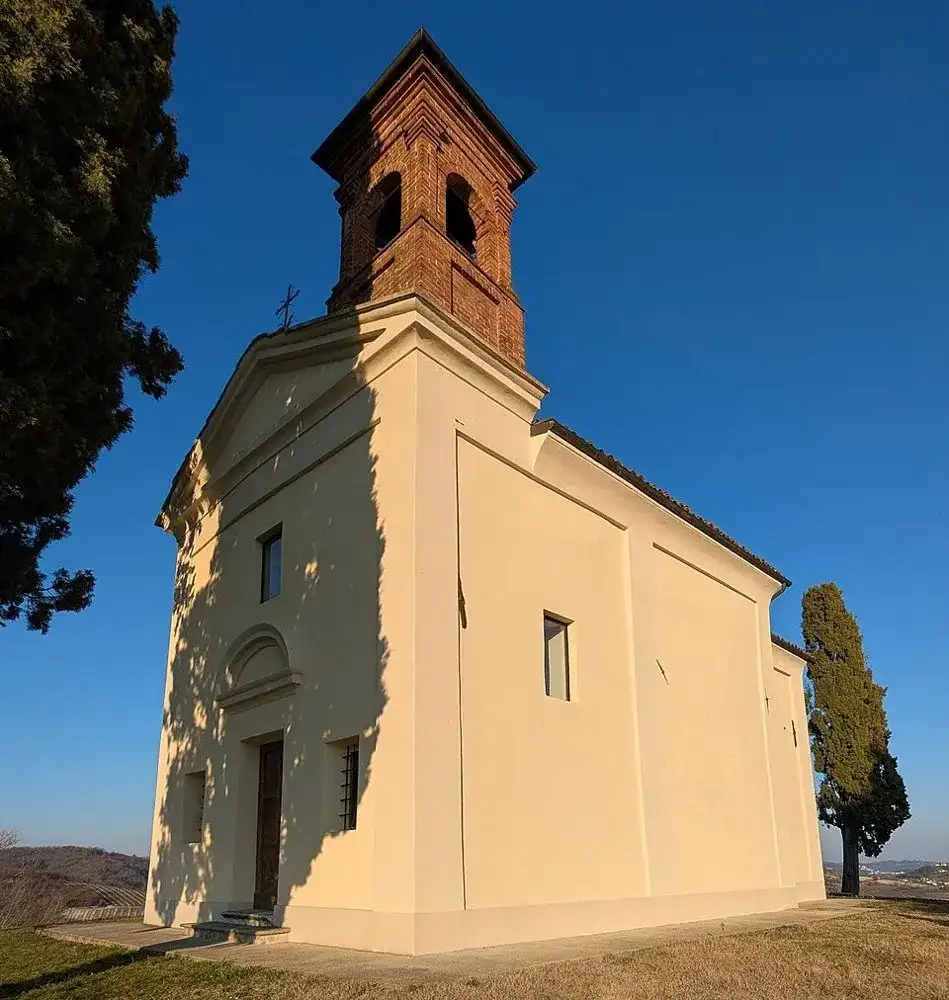
On the border of Abazia, towards Incisa Scapaccino, stands the Precepttoria di San Giovanni di Roncaglia, founded by the Sovereign Military Order of Malta. The settlement dates back to the first centuries after the Thousand, when the Order began to build hospices, churches, preceptions to assist pilgrims. The church of San Giovanni di Roncaglia is one of the last traces of this culture that has remained on the Alexandrian territory, although the appearance is not the original one. The current building was built in the second half of the 18th century, as evidenced by the stone of the facade, following a style that is influenced by late baroque and neoclassical influences of Juvarra. The elegant and refined look, unusual for a country church, makes the construction even more valuable.
Society
Demographic evolutionExplore this chapter
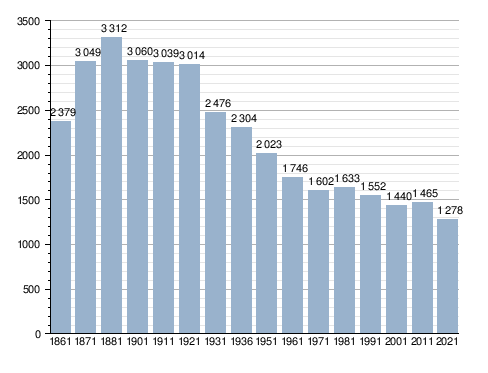
Demographic evolution
Inhabitants registered[5]
Anthropic geography
HamletsExplore this chapter
Hamlets
In addition to the capital in the municipal territory there is the fraction of Abazia (Abassìa) and Redabue. The regions Rotte, San Rocco (San Ròch), Greenhouse (Sèra) and Rampiné
Administration
Below is a table relating to the administrations that have succeeded one another in this municipality.Explore this chapter
Below is a table relating to the administrations that have succeeded one another in this municipality.
| Period | First citizen | Match | Load | Notes | |
|---|---|---|---|---|---|
| May 29, 1985 | May 21, 1990 | Giambattista Soave | Italian Socialist Party | Mayor | [6] |
| May 21, 1990 | April 24, 1995 | Giambattista Soave | Italian Socialist Party | Mayor | [6] |
| April 24, 1995 | June 14, 1999 | Giambattista Soave | centre-left | Mayor | [6] |
| June 14, 1999 | June 14, 2004 | Gianbattista Soave | civic list | Mayor | [6] |
| June 14, 2004 | June 8, 2009 | Rain Perfume | civic list | Mayor | [6] |
| June 8, 2009 | May 26, 2014 | Rain Perfume | list: comune Democratic | Mayor | [6] |
| May 26, 2014 | May 26, 2019 | Giovanni Stefano Airaudo | list: comune Democratic | Mayor | [6] |
| May 26, 2019 | June 9, 2024 | Giovanni Stefano Airaudo | list: comune Democratic | Mayor | [6] |
| June 9, 2024 | in office | Giovanni Stefano Airaudo | list: comune Democratic | Mayor | [6] |
Notes
Explore this chapter
- ^ to b Monthly demographic balance for the year 2026 (provisional data), up demo.istat.it, ISTAT.
- ^ Seismic classification (XLS), up risks.protezionecivile.gov.it.
- ^ Table of degrees/day of Italian Municipalities grouped by Region and Province (PDF), in Law 26 August 1993, n. 412, annex A, National Agency for New Technologies, Energy and Sustainable Economic Development, 1 March 2011, p. 151. URL consulted on 25 April 2012 (archived fromoriginal url on 1 January 2017).
- ^ Masio, decree 1967-05-30 DPR, concession of coat of arms and gonfalone, up data.acs.beniculturali.it.
- ^ Data taken from:
- Resident population of the municipalities. Censuses from 1861 to 1991 (PDF), up ebiblio.istat.it, ISTAT.
- Resident population - Time series, up exploredati.istat.it.
Please note: 2021 data refers to permanent census data as of December 31 of that year.
- ^ to b c d And f g h the https://amministratori.interno.it/
Bibliography
Explore this chapter
- Edmondo De Amicis, Soldier Poggio, Turin, 1925.
- Francesco Cacciabue, Maria Pia Fish and Gianpaolo Cassano, The other Patron - Masio rediscovers San Dalmazzo (907-2007), Masio, 2007.
- Francesco Cacciabue, Bartolo Gariglio, Gustavo Mola di Nomaglio, Roberto Sandri Giachino and Sandro Gastaldi, High of Masio athlete - Studies on Urbano Rattazzi (1808-1873), his family, his country, Masio, 2008.
- Roberto Ricciardi, Statues of Masio, translation and commentary of the 14th century municipal statutes, Society of History, Art and Archaeology: Accademia degli Immobili, Alessandria, 2008.
- Francesco Cacciabue, Where others do not go: the story and myth of Giovanni Poggio, Masiese, a soldier of artillery, hero of the resurgent wars, Masio, 2011.
- Enrico Lusso, The tower of Masio, a contribution to the study of the fortified foundation villages in north-western Italy (XV century), Masio, 2013.
- AA.VV., The altar of the Brotherhood of St. Mary Magdalene, Masio, 2014.
- Francesco Cacciabue, History of Masio and its territory, Masio, 2014.
- Giuseppe "Pimpi" Cacciabue, ...in the night we are staring...!, Stories of partisan life, Masio, 2014.
- Don Gianpaolo Cassano, Francesco Cacciabue, don Mariano Pinasco, Fr Jan Kupka, Corner Soave and Don Francesco Todisco, Giuseppe Faà di Bruno, Priest, missionary, successor of San Vincenzo Pallotti, founder of the College of Foreign Missions in Abazia, Masio, 2015.
- Francesco Cacciabue, Masio and Abazia in the Great War, Masio, 2015.
- Claudio Gregori, Eliso Rivera. The novel of the life of the founder and director of the Gazzetta dello Sport, Masio, 2019.
- AA.VV., The parish church of Santa Maria and San Dalmazzo di Masio. A search path, Masio, 2019.
Where to stay · Masio
Find stays on Booking.comThe area, step by step
Trails and routes in Masio

Asti, Alessandria and surroundings
The Wine and Flavor Route · Wine Rivers · Cavalcavia–Oviglio
 CyclingAround the starting point
Asti, Alessandria and surroundings
Alessandria Asti risalendo il Tanaro
 Mountain bikeAround the starting point
Asti, Alessandria and surroundings
Parco Naturale Rocchetta Tanaro e le Colline
Asti, Alessandria and surroundings
Sentiero dal tanaro alle colline
 WalkingAround the starting point
Asti, Alessandria and surroundings
Sentiero anello abazia di masio
 CyclingAround the starting point