Atlas of Monferrato
Quattordio: sights, history and trails
Alessandria
- Elevation
- 135 m above sea level
- Area
- 17.73 km²
- Demonym
- Quattordi
- Patron saint
- Saints Peter and Paul
A closer look
Discovering Quattordio
Quattordio (Quatordi [katɔdi] in Piedmont) is an Italian municipality of 1 423 inhabitants[1] from the province of Alessandria in the Piemonte.
The village is located next to the state road 10, between Asti And Alessandria. The town is divided by the Chiesetta stream which separates the ancient nucleus from the modern one.
History of Quattordio
SymbolsExplore this chapter
The origin of the town of Quattordio dates back to Roman times, when in Monferrato and its surroundings a "microcolonization" was developed that was intended to support the existing cities of Alba, Asti, Tortona and Acqui a myriad of small centers identifiable in the current Chieri, Valenza, Libarna and many others. In some of these places there were milestones, consisting of large tombstones, poplars and columns, indicating distances between the main cities. Quattordio owes its name for the presence of the milestone indicating the distance of 14 miles from Asti. It is important to note that in this period the village of Quattordio still does not exist, but this place is known only for the presence of the miliar cyprus which was supposed to be located near the paved front of the current parish church.
On 21 March 967 it can be considered the day that divides prehistory of Quattordio from its true history, knowledge handed down orally by historically accurately documented events. That day, in fact, the birth of Monferrato as a politically bounded territory. The domain of this part of Piemonte passes by Emperor Otto I to Aleramo. It is in the 12th century that this region assumes a somewhat more stable aspect, always using this term with great caution, given the continuous passages of ownership of countries is contrade. In this period two new states are formed, which in a short time acquire territories and military strength: the municipality of Asti, born in 1095, and the municipality of Alessandria, whose foundation dates back to 1168. The fights between these two municipalities, now allies and now enemies, with the Marchesi del Monferrato, fully involve this area and Quattordio in particular.
The municipality of Asti was born on the initiative of his bishop, in whose diocese it was almost certainly understood Quattordio, although there are no official documents that prove its real existence. In the period during which the birth of Alessandria (1168), Quattordio It is located to be a crucifix between astigiani to the west, Alexandrians to the east, mountains to the north, Marchesi Incisa della Rocchetta to the south.
In his second descent, the Barbarossa submits Asti and in the minutes that ratifies the peace reached, signed at Marengo on 15 February 1159, he undertakes to keep under his special podestà the municipality of Asti and forty-six villages surrounding it. Among these, for the first time in an official document, the name of Quattordio. It can certainly be considered that between 1095, the year in which the constitution of the municipality of Asti is established, and the 1379 year of the passage of Asti under the Duchy of Milan, Quattordio is always belonged to the Commune, then become Republic of Asti. The territory of this Republic came west to Carmagnola and Dusino, northwards included Cocconato, Grazzano, Moncalvo, Vignale, coming eastwards included Fubine, Quargnento, Solero and Oviglio, southward even reached the Alps in the upper valley of Tanaro, beyond Ceva and Garessio, finally south-west encuneed in the Langhe and with the ponders. Asti had an extension of approximately double compared to the current province.
In 1526, the lands of Quattordio were invaded by the Spaniards, who burned, plundered and devastated the country. Later, in February 1527, Baron Lodran and Count Alberico Belgioioso sent their lanzichenecchi to Alto Monferrato, asking Regent Marchesa for a contribution of 16 000 golden shields and, since this sum was delayed to reach, they raged on the populations, "devading several villages around Asti". Other looting and devastation fell on the lands of Quattordio and in nearby areas after about a century, around the middle of the 17th century. According to precise data, in fact, the country was plundered and burned by the French in 1642 and nine years later by gallo-piemontesis. The Spanish, now sadly known for their cyclical invasions of destruction and destabilization, conquered Quattordio in 1655, with robberies and extortion cut it and dominated it until 1706, "in which time came into power of the Savoy who held it for peace of Utrecht". The Alexandrian province passed in 1707-1708 under the control of Savoy, by virtue of the sale provided for by the secret treaty concluded with the Imperials.
After the fall of the ancient regime in Piemonte (1798) within the French administrative mesh, Quattordio followed the fortunes of the entire territory of the province of belonging, aggregated, without substantial alterations, to a circumscription of variable extension having by capital Alessandria. It was first of the Tanaro department, created during the first ephemeral period of occupation (1799), and after the return of the French and following the administrative reorganization of 1801, of the Marengo department, surrounded (arrondissement) of Alessandria. Untouched by the subsequent reorganization of 1805, the administrative framework of the district and therefore of Quattordio did not change until the Restoration. After the Napoleonic period, Quattordio returned to be part of the reconstituted province of Alessandria. The country followed the fate of Piemonte first and then of the Kingdom of Italy.
The village is, since the 1930s, home to many factories. These industries have contributed to the demographic development of the last century (1 600 inhabitants). On the municipal territory pass the Turin-Piacenza highway and, albeit marginally, a stretch of railway.
-
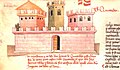 Quattordio in a miniature of the Codex Astensis
-
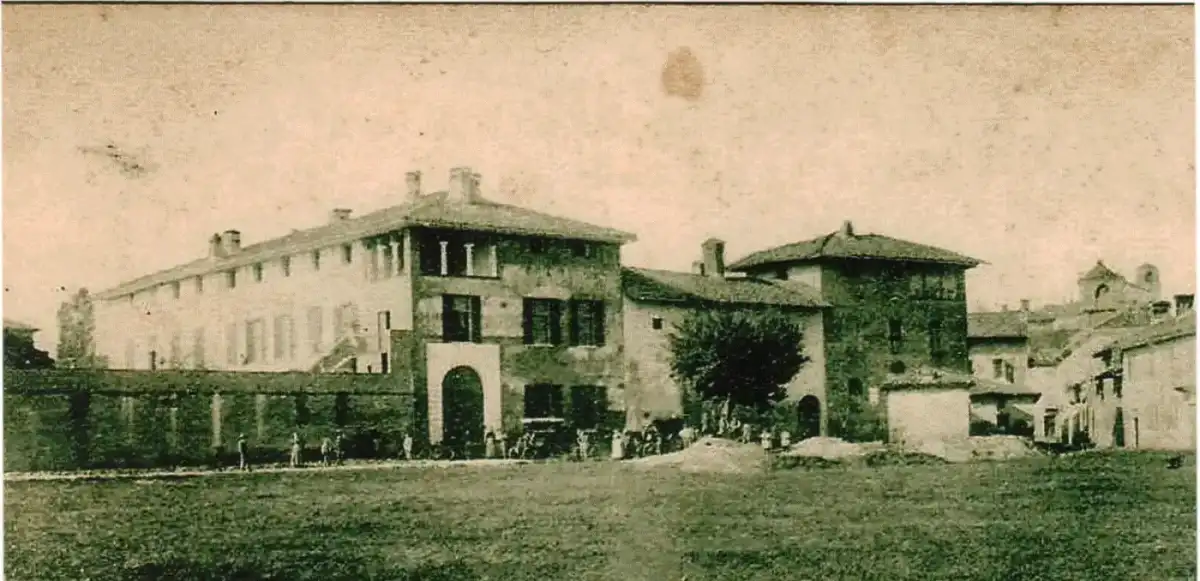
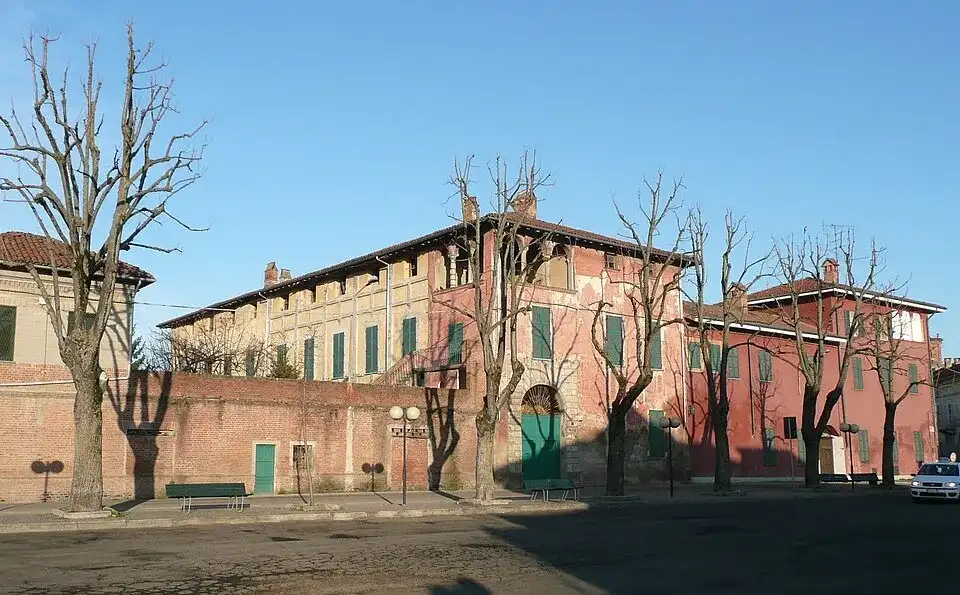
 Palazzo Olivazzi in 1900
Symbols
The coat of arms and gonfalone of the municipality of Quattordio were granted by decree of the President of the Republic of 2 May 1963.[4]
The milestone with the 14th digit refers to the name of Quattordio which comes from Latin Quattuordecimum ("fourteenth"), from the distance of fourteen Roman miles from the city of Hasta (Asti).
The gonfalone is a drape party of white and blue.
What to see in Quattordio
Church of St. Peter · Palazzo Olivazzi · Lajone CastleExplore this chapter
Among the places of interest are the Church of San Pietro, Palazzo Negri di Sanfront, current headquarters of the municipality, Palazzo Tapparone-Canefri and Palazzo Olivazzi.
Church of St. Peter
The parish church was built around 1781. It has only one nave, with six side chapels decorated with friezes and golden stucco; inside, the statue of Madonna of the Rosary by the sculptor Carlo Giuseppe Plura. The style is the classic Piedmontese baroque. Of a certain interest the organ, placed on the opposite side, and the bell tower, which reaches a height of 42 meters. The church has been restored three times over the last hundred years.
Palazzo Olivazzi
The Olivazzi family, a manor house, together with the Civalieri, of the village, had its own residence in the homonymous Palazzo: this has an extensive rural court, called Cascina Palazzo, defined at the extremes by two palaces.
The large rural court, entirely built in exposed bricks, has buildings dating back to the 17th century and other more recent ones, such as the wide 'modern' stable, with seven small facades overlooking the barn that delimits the Padana State in the center of the village. This building was built by the Olivazzi in 1844 and has brick walls thick over one meter, for thermal insulation purposes.
It is said that to cook such bricks a furnace was made directly inside the large court and that, in order to produce them, the land of the place was used, rich of clay. The farm is still active inside the farmhouse.
Lajone Castle
Not far from Quattordio, in the frame of the Piedmont hills Monferrato, it is possible to discover a delightful castle built in 1600 and subsequently expanded and embellished. Inserted among the "Open Castles" of Basso Piemonte Today it is an environment that jealously guards its splendor, preserving intact the original beauty. It has a rose garden and park with oaks, sequoias and cedars of Lebanon.
Society
Demographic evolutionExplore this chapter
Demographic evolution
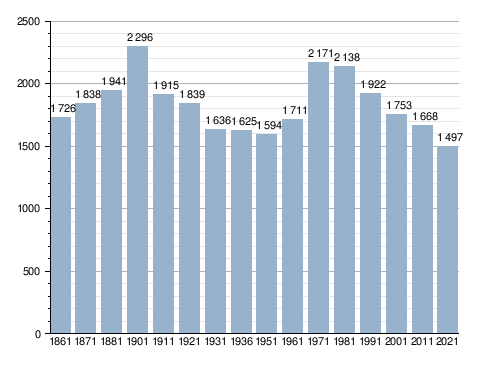
Because of the growing migration, the country continues to lose inhabitants: in the last fifty years, starting from 1971, the resident population decreased by 27.7%.
Inhabitants registered[5]
Anthropic geography
Hamlets · Greenhouse · PiepassExplore this chapter
Hamlets
Greenhouse
Greenhouse (The Sèra in Piedmont) is a small fraction of about 100 inhabitants located a short distance from the border with province of Asti, in correspondence with the municipalities of Castello di Annone and of Refrancore.
The morphology of the territory is characterized by a flat soil, in which stands the hill on which the village rises. Cross the plain several unpaved roads, which, passing through the fields, allow to reach the region Breeding, in the municipality of Refrancore and the cry of Piepass, the other fraction of Quattordio.
The center of the village is the small square in front of the church dedicated to the patron saint San Francesco, where the premises of the Recreation centre and the old elementary school now no longer used. The housing settlements, mostly composed of farmhouses, are arranged along the Montemagno road and other minor routes. Nearby there are also villas and farms.
Piepass
Piepass (Piepass in Piedmont) is located on the road that leads to Viarigi. The town church is dedicated to the Assumption and was an independent parish until it was incorporated into that of the capital.
Economy
Until the thirties of the twentieth century, the economy was mainly agricultural, based on crops of wheat, corn, barley, oats and sunflowers (but close to...Explore this chapter
Until the 1930s, the economy was mainly agricultural, based on crops of wheat, corn, barley, oats and sunflowers (but near the stream Gaminella You can find poplar forests, destined for the production of timber; there are also some vineyards.
From the 1930s onwards, a flourishing industrial area (chemistry, enamelled cables, induced FIAT) developed over the decades, which will lead Quattordio to be a major industrial pole of the province of Alessandria. With the economic crisis of the early 21st century, Quattordio suffered from a sharp decline in employment.
Administration
Below is a table relating to the administrations that have succeeded one another in this municipality.Explore this chapter
Below is a table relating to the administrations that have succeeded one another in this municipality.
| Period | First citizen | Match | Load | Notes | |
|---|---|---|---|---|---|
| June 19, 1985 | May 25, 1990 | Pier Paolo Dionigi Monti | Christian Democracy | Mayor | [6] |
| May 25, 1990 | April 24, 1995 | Pier Paolo Dionigi Monti | civic list | Mayor | [6] |
| April 24, 1995 | June 14, 1999 | Pier Paolo Dionigi Monti | center | Mayor | [6] |
| June 14, 1999 | June 14, 2004 | Mario Sillano | civic list | Mayor | [6] |
| June 14, 2004 | June 8, 2009 | Mario Felice Sillano | civic list | Mayor | [6] |
| June 8, 2009 | May 26, 2014 | Tiziana Garberi | civic list You and us together | Mayor | [6] |
| May 26, 2014 | May 26, 2019 | Alessandro Venezia | Civic list Scelgo Quattordio | Mayor | [6] |
| May 26, 2019 | June 9, 2024 | Alessandro Venezia | Civic list Scelgo Quattordio | Mayor | [6] |
| June 9, 2024 | in office | Anna Margherita Venice | list of Quattordio in the heart | Mayor | [6] |
Notes
Explore this chapter
- ^ to b Monthly demographic balance for the year 2026 (provisional data), up demo.istat.it, ISTAT.
- ^ Seismic classification (XLS), up risks.protezionecivile.gov.it.
- ^ Table of degrees/day of Italian Municipalities grouped by Region and Province (PDF), in Law 26 August 1993, n. 412, annex A, National Agency for New Technologies, Energy and Sustainable Economic Development, 1 March 2011, p. 151. URL consulted on 25 April 2012 (archived fromoriginal url on 1 January 2017).
- ^ Quattordio, decree 1963-05-02 DPR, concession of coat of arms and gonfalone, up Central State Archive. Retrieved 31 October 2021.
- ^ Data taken from:
- Resident population of the municipalities. Censuses from 1861 to 1991 (PDF), up ebiblio.istat.it, ISTAT.
- Resident population - Time series, up exploredati.istat.it.
Please note: 2021 data refers to permanent census data as of December 31 of that year.
- ^ to b c d And f g h the http://amministratori.interno.it/
Where to stay · Quattordio
Find stays on Booking.comThe area, step by step
Trails and routes in Quattordio

Asti, Alessandria and surroundings
Sentiero dal tanaro alle colline
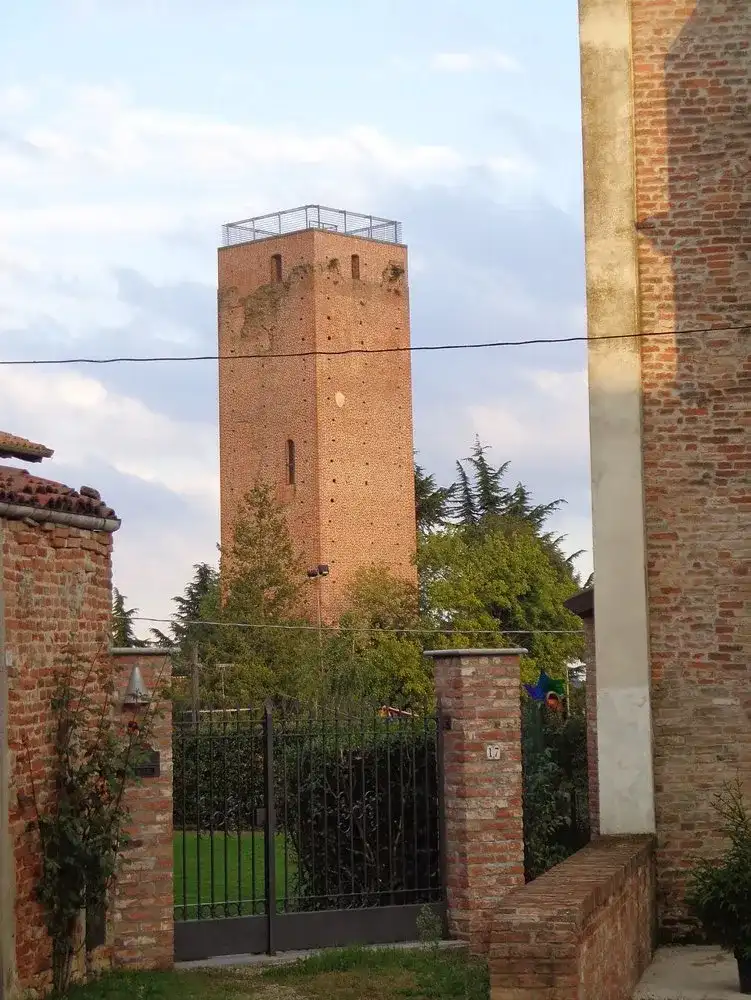 WalkingAround the starting point
Asti, Alessandria and surroundings
Sentiero anello abazia di masio
 WalkingAround the starting point
Asti, Alessandria and surroundings