- Elevation
- 150 m above sea level
- Area
- 13.21 km²
- Demonym
- Refranchose
- Patron saint
- San Dionigi [ unclear]
A closer look
Discovering Refrancore
Refrancore (Î1⁄4 ̄l or Arfranco in Piedmont) is an Italian municipality 1 541 inhabitants[1] from the province of Asti, located 13 km from Asti, eastwards, in the Lower Monferrato.
It is a country with agricultural economy, mainly viticultural.
History of Refrancore
SymbolsExplore this chapter
The name Refrancore according to some historians takes its name from the ancient rivus francorum (Frankish River), now Rio Gaminella, which runs through the hills of the Lower Monferrato and descends towards the river Tanaro.
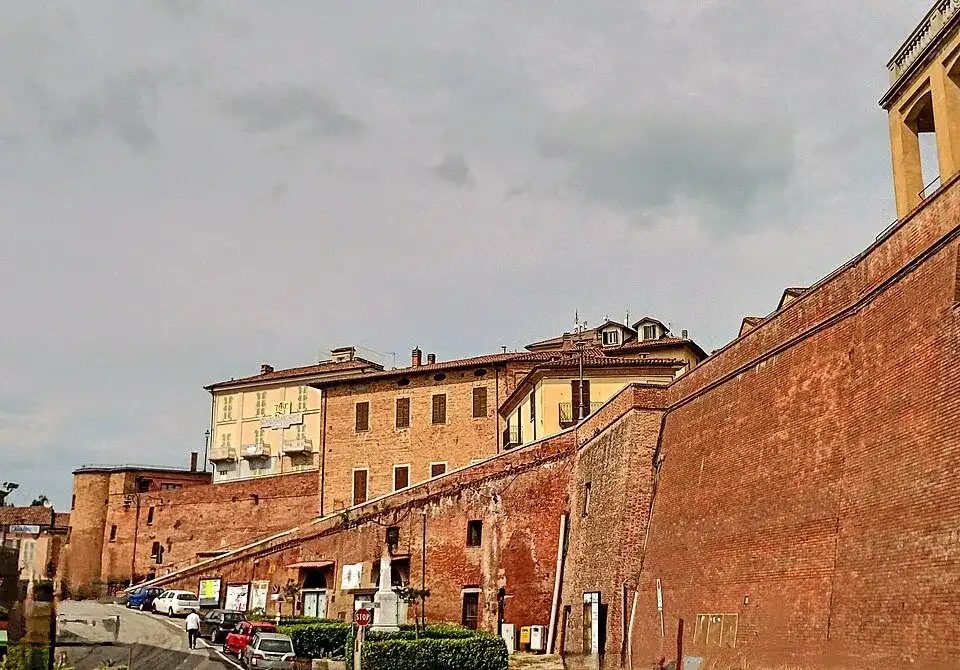
13 kilometers from Asti, almost on the border with province of Alessandria, Refrancore lies on a sandstone hill.
The oldest part of the village, around the ancient parish church of San Martino, descends along the slopes of the hill and is connected to the modern town that stretches along the three roads leading to Asti, Alessandria and Casale Monferrato.
Since the Roman period in the area there was to be some settlement, perhaps a farm or little more, which has left wide traces also of considerable value, as it is evidenced by some findings made by peasants during agricultural works. In 1874, moreover, a grave was brought to light with incineration and its kite, besides an oguentario, it was also part of a precious and refined cup of blown green glass decorated with elder branches and enrolment in Greek: "Ennione did. The buyer remembers!"
A piece of great interest, dated to the second half of the 1st century AD, which can testify to a non-mechanical settlement and which is now preserved at the Louvre Museum in Paris.
According to the story of Paolo Diacono, around 663 he enraged a violent battle between Franks and Longobards where the first had the worst to fill with their blood the stream, which since then was called rivus ex sanguine francorum and who took the name of Rivus Francorum to the small village built nearby.
The first certain document of the existence of a small fortified village called Rivo franchoris, pertaining to the powerful imperial fiefdom of Annone, dates back to December 1197 when the mayor of Asti Alberto de Fontana decreed the inalienable possession by the Municipality of Asti of the "castle of Annone with the village and the village, with Refrancore, with Cerro and with Foresto..."; a few days later Asti invested Henry of Quattordio with these possessions.
It is only from the 14th century that Refrancore appears in official documents as an autonomous and unsold entity by Annone, and in May 1355 Emperor Charles IV of Bohemia, appointing his imperial vicar the Marquis John of Monferrato, gives these numerous investitures including the fiefdom of Rivus franchorium.
The engraving that illustrates the text of the Codex Astensis, dating back to that time, shows a small square castle defended by high crenellated walls and two towers, one square and the other circular: a small strong nucleus which, with much probability, occupied the area of the future reception, still well preserved today.
The fief events followed those of the Marquisate of Monferrato and Refrancore was granted by the Marquis to several feudal lords, among which are Bernardo Valperga di Mazzè, Mercurino Arborio di Gattinara e Costantino and Aranito Comneno princes of Macedonia.
In 1547 Aranito Comneno sold Refrancore to his nephew Leonardo di Tocco, Prince of Acaja and Montemiletto, descendant of an illustrious Longobard lineage of the Benedictine, imparted, as it was mentioned, with the principles of Macedonia and, from the eighteenth century, with the royal house of Scotland, Stuart; an important and very powerful family, that reigned the feud until 1829 but
It is also for this state of things that the new castle, erected on the top of the hill around the fifteenth century, will have a very troubled existence until in 1635, besieged and expelled by the French, will be ruined and never restored again in the coming centuries; today nothing is more visible than this castle and its site is occupied by a lawn surrounded by a forest of robines.
Since the middle of the 15th century documents associate with the name Refrancore the presence of "castro, loco, et villa", that is, of castle, village and town, and it is still possible today to distinguish these three entities in the oldest and most evocative part of the built-up centre.
To reach the top of the village, from Piazza IV Novembre, naïlitated by the beautiful baroque bell tower of S. Sebastiano (first years of the eighteenth century), crosses the ancient country bordered by the current Via Roma, via Cavour and via Regina Margherita, immersed in a peaceful tranquility shaken only on Friday morning by the presence of the lively weekly market.
Going up the slope, the houses are stretched out and the space is widened in courtyards and groves until you can flank, if you follow the Via Regina Margherita, the high wall that holds the ruins covered with edera of the ancient oratory of the Annunciata, already existing in the sixteenth century and rebuilt around 1660 by the Confraternita dei Disciplinati.
At the top of the street is the church of S. Martino, ancient parish now waiting for a necessary restoration. Its interior, not to be visited for the precarious static conditions, preserves simple but refined Baroque decorations and two precious stucco altars, by Francesco Solaro and dating back to 1760.
The whole area gathered around the church square is the ancient village, now identified as an accommodation; that is a small fortified nucleus with which the Refrancoresi could protect themselves, livestock and supplies in case of attacks or raids of predons.
In 1456 William of Monferrato compiled a chapter with which he granted to the "homini de Rifrancor" the houses inside the reception and other land outside the villa; at those times it had already been erected, a few steps from the reception, the new castle, now disappeared.
Three of the four sides of the fortified village are still well preserved and visible in buildings that cing the square of the ancient parish church and continue westward (the steep sidewalls can be seen in all their charm from the road to Castagnole Monferrato, near the old mill which today houses a restaurant).
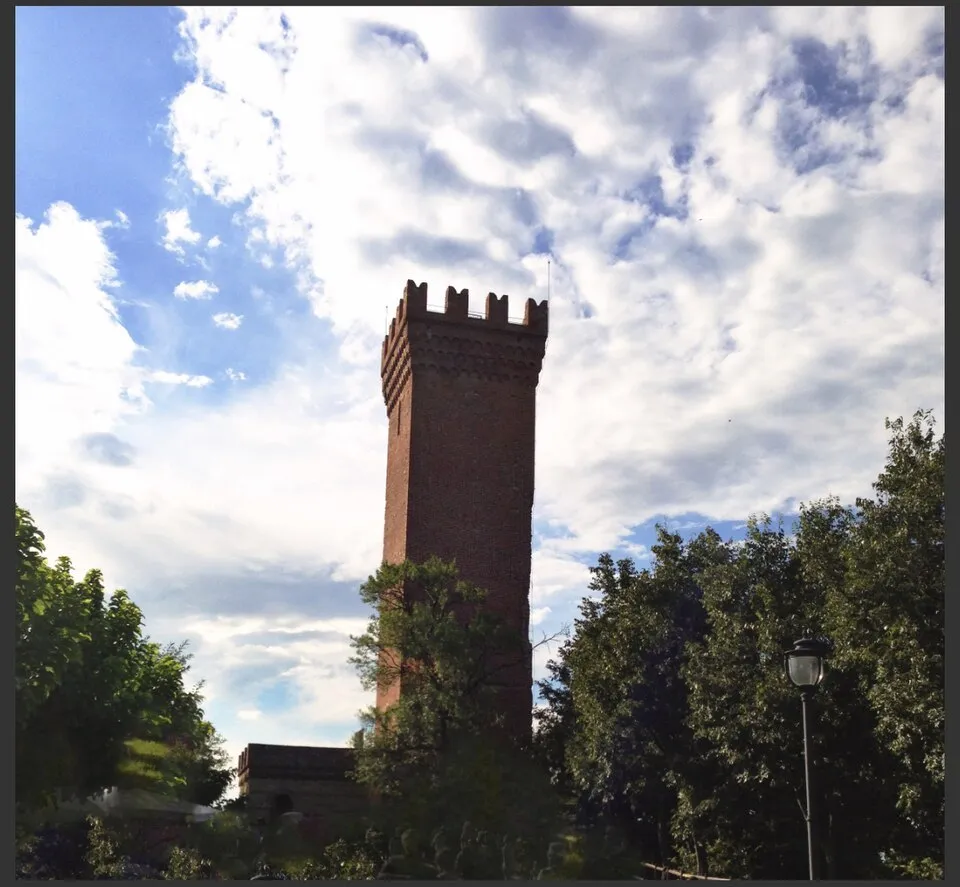
The church itself was built, starting from 1569, on the structures of a pre-existing building of the reception of which the side walls were preserved and the defensive embellishment overlooking today's Via Cavour; the bell tower, entirely made of bricks, is perhaps to be identified with the tower-door of the reception and inside it, communicating with the church, presents a beautiful vault that comes from four clear Romanesque heads.
Three kilometers from the village, along the road to Asti is situated a small Romanesque church in the house of Magdalene. From the 11th century, one of the pertinences of the powerful center of Annone, a small rural centre called Forest and organized around the parish of Santa Maria Maddalena.
This building, over the centuries long restored, is placed at the top of a low hill cultivated with vineyards; from here, the view is lost in the ascents of the fertile mountain landscape. In 1874 the remains of a tomb were born; inside it an ointment and a glass cup pregevolously decorated with elders and enrolment in Greek: "Ennione did. The buyer remembers!", dating back to the second half of the 1st century, preserved in the Louvre museum in Paris.
Symbols
The coat of arms of the Municipality of Refrancore was granted by decree of the President of the Republic of 11 August 1968.[4]
Society
Demographic evolution · Foreign ethnic groups and minoritiesExplore this chapter
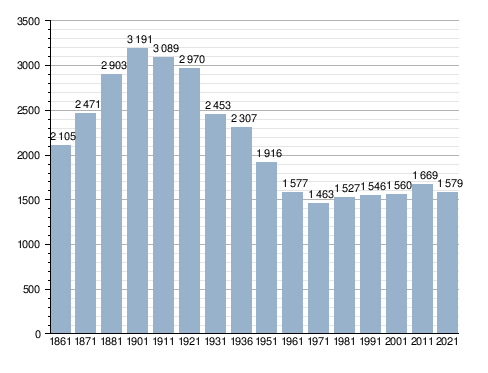
Demographic evolution
Inhabitants registered[5]
Foreign ethnic groups and minorities
According to ISTAT data on 1 January 2013 the resident foreign population was 113 people and represents 6.9% of the entire resident population. The nationalities most represented by their percentage of the total living foreign population were:
- Romania 40 35.4%
- Albania 39 34.5%
- Republic of Macedonia 4 5.56%
- Ukraine 4 5.56%
- Peru 3 2.65%
- Nigeria 3 2.65%
- Germany 2 1.77%
- United States 2 1.77%
- El Salvador 2 1.77%
- Greece 1 0.88%
- Belgium 1 0.88%
- Rep. Czech Republic 1 0.88%
- Moldova 1 0.88%
- France 1 0.88%
- Slovenia 1 0.88%
- Russia 1 0.88%
- United Kingdom 1 0.88%
- Switzerland 1 0.88%
- Bosnia and Herzegovina 1 0.88%
- Senegal 1 0.88%
- Tunisia 1 0.88%
- Ivory Coast 1 0.88%
- Brazil 1 0.88%
Culture
Kitchen · EventsExplore this chapter
Kitchen
A typical product for which the country is known is the "finocchino", biscuit flavored with fennel seeds.
Events
- Feast of Pentecost
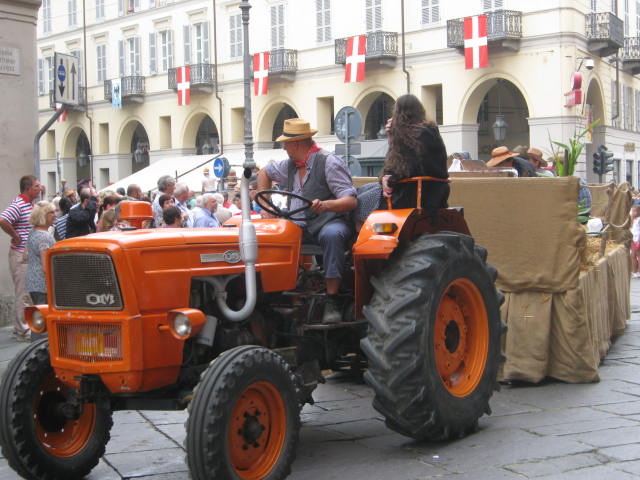
- Autumn Day (first Sunday in October)
- Feast of the Fennel
Economy
AgricultureExplore this chapter
Agriculture
Refrancore is a place of wine production, in particular of grignolino and barbera. In addition, like all Monferrato is an important centre for fruit production (fish).
Infrastructure and transport
Between 1900 and 1935 Refrancore was served by the Asti-Montemagno-Altavilla tramway.Explore this chapter
Between 1900 and 1935 Refrancore was served by the Asti-Montemagno-Altavilla tramway.
Administration
Below is a table relating to the administrations that have succeeded one another in this municipality.Explore this chapter
Below is a table relating to the administrations that have succeeded one another in this municipality.
| Period | First citizen | Match | Load | Notes | |
|---|---|---|---|---|---|
| July 10, 1985 | May 26, 1990 | Italo Mussio | Italian Communist Party | Mayor | [6] |
| May 26, 1990 | 5 July 1991 | Italo Mussio | Democratic Party of the Left, Italian Communist Party | Mayor | [6] |
| 5 July 1991 | April 24, 1995 | Franco Deambrogio | Democratic Left Party | Mayor | [6] |
| April 24, 1995 | June 14, 1999 | Bruno Ghidella | left | Mayor | [6] |
| June 14, 1999 | June 14, 2004 | Bruno Ghidella | civic list | Mayor | [6] |
| June 14, 2004 | June 8, 2009 | Italo Mussio | civic list | Mayor | [6] |
| June 8, 2009 | May 26, 2014 | Mario Morta | Civic list Together | Mayor | [6] |
| May 26, 2014 | May 27, 2019 | Mario Morta | Civic list Together | Mayor | [6] |
| May 27, 2019 | June 9, 2024 | Roberta Volpato | Civic list Together | Mayor | [6] |
| June 9, 2024 | in office | Diego Mogliotti | civic list Cambiamo Refrancore | Mayor | [6] |
Notes
Explore this chapter
- ^ to b Monthly demographic balance for the year 2026 (provisional data), up demo.istat.it, ISTAT.
- ^ Seismic classification (XLS), up risks.protezionecivile.gov.it.
- ^ Table of degrees/day of Italian Municipalities grouped by Region and Province (PDF), in Law 26 August 1993, n. 412, annex A, National Agency for New Technologies, Energy and Sustainable Economic Development, 1 March 2011, p. 151. URL consulted on 25 April 2012 (archived fromoriginal url on 1 January 2017).
- ^ Refrancore, DPR 1968-08-11, concession of coat of arms and gonfalone, up data.acs.beniculturali.it, Central State Archives, Heraldic Office, Municipal Files, envelope 296, file 4959.a. Retrieved 9 May 2021.
- ^ Data taken from:
- Resident population of the municipalities. Censuses from 1861 to 1991 (PDF), up ebiblio.istat.it, ISTAT.
- Resident population - Time series, up exploredati.istat.it.
Please note: 2021 data refers to permanent census data as of December 31 of that year.
- ^ to b c d And f g h the j https://amministratori.interno.it/
Where to stay · Refrancore
Find stays on Booking.comStories, places and people
More about Refrancore and the surrounding area
Follow a thread of history and see where it leads.
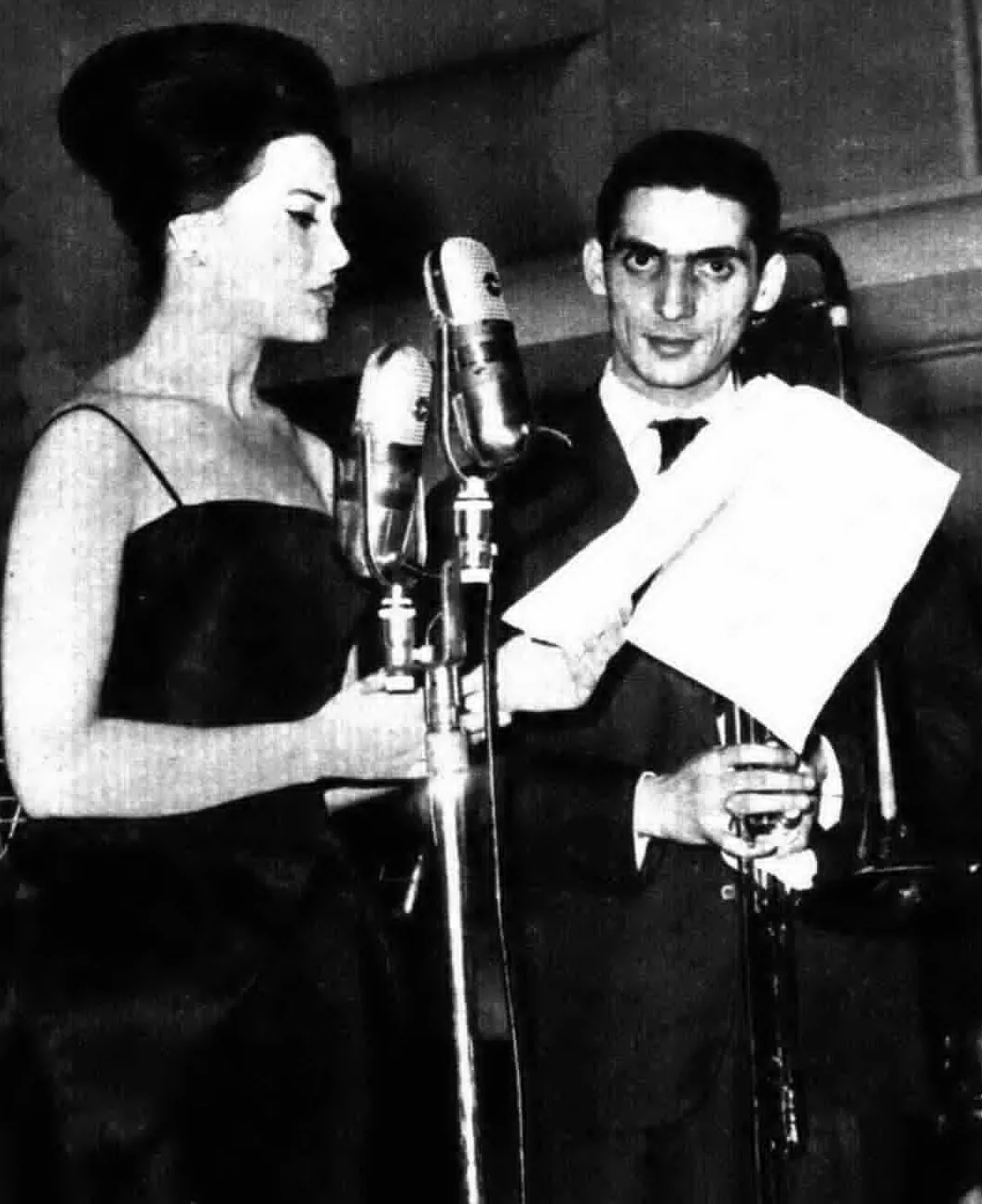 Sconosciuto Unknown author · Public domain
Dino Piana
Dino Piana ( Refrancore , 3 August 1930 – 6 November 2023 Rome) was an Italian musician and trombonist. He was one of the greatest members of Italian jazz.
Read the storyMassimo Quaglino
Massimo Quaglino ( Refrancore , 15 June 1899 – 7 July 1982 Turin was an Italian painter and sculptor.
Read the storyThe wine landscape
This village in wine country
Follow the link between the country, the vineyards and the neighboring territories.
The area, step by step